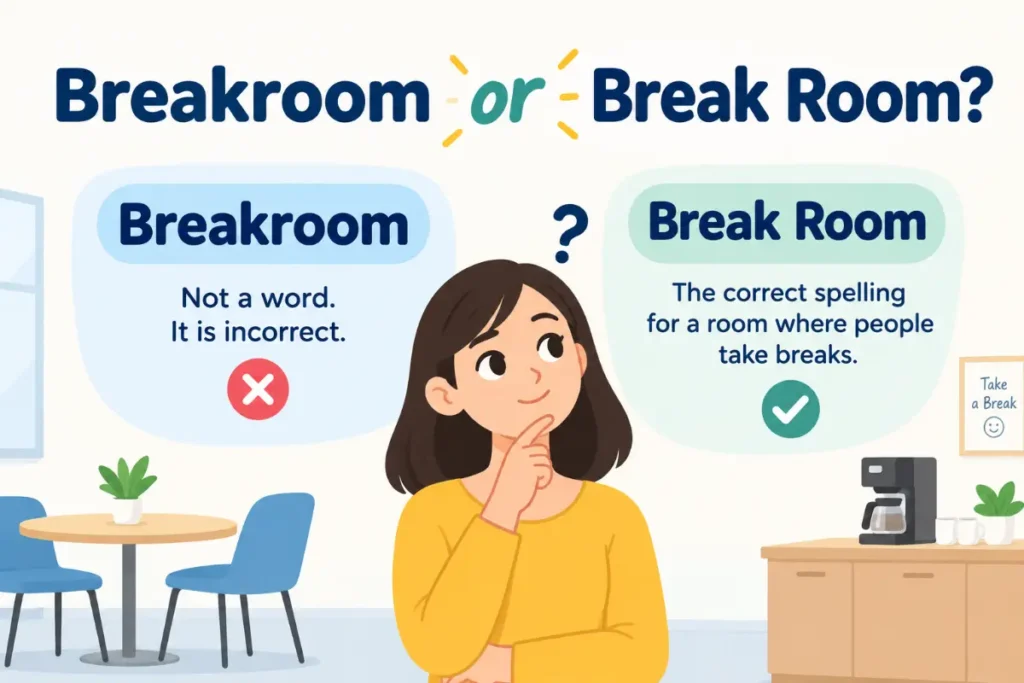
If you are unsure about breakroom or break room, the standard choice for American English is break room, written as two words. It refers to a shared space where employees can relax, eat lunch, drink coffee, or take a short break during the workday. You will commonly see the term in office buildings, hospitals, schools, factories, and other workplaces.
The confusion comes from a familiar pattern in English. Many expressions that begin as two separate words gradually develop into closed compounds, meaning they become a single word. For example, bedroom and bathroom are generally written as one word, so it is natural to wonder if break room follows the same pattern. However, the spelling conventions for these expressions do not always match.
Both breakroom and break room appear in everyday writing, workplace documents, and online searches. Still, if you are writing an employee handbook, designing an office sign, preparing a company policy, or editing professional content for an American audience, break room is the safer standard choice. This article explains the correct spelling, the meaning of the term, how to use it in sentences, and how it compares with related words such as lunchroom, staff room, and common room.
Quick Answer
Break room is the preferred standard spelling in American English. It is a two word compound noun that describes a shared workplace area where employees can eat, relax, or take a short break. Although breakroom appears in informal writing and some business names, use break room in professional documents, workplace signs, and formal communication.
Is It Breakroom or Break Room
The standard spelling is break room, with a space between the two words. The expression combines the noun break, meaning a pause from work or another activity, with the noun room, meaning an enclosed space. Together, the words describe a room intended for people to take a break.
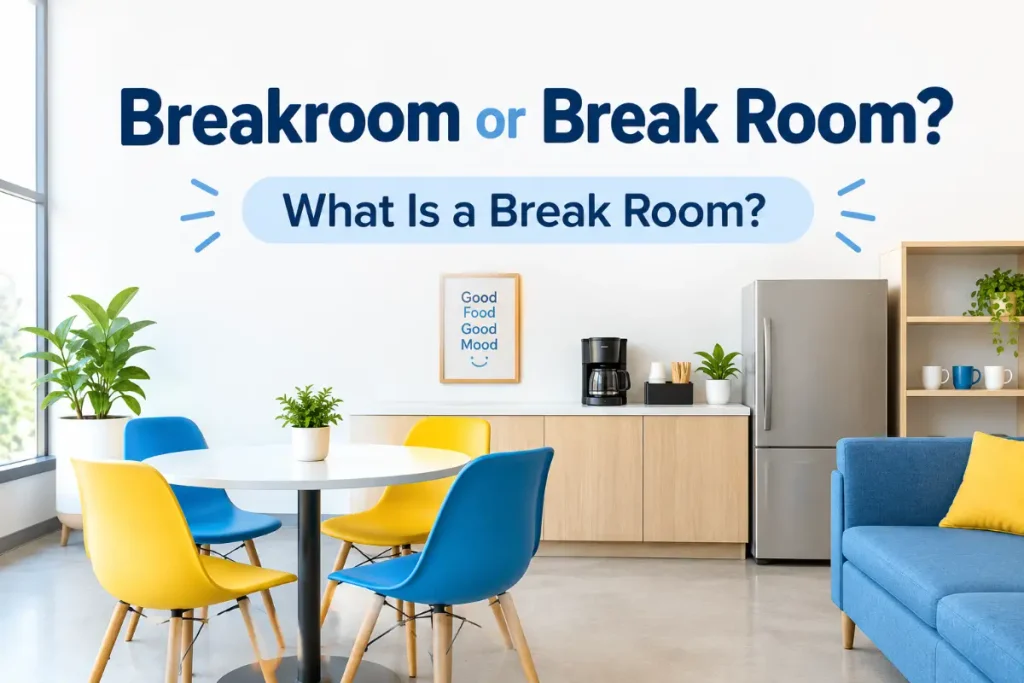
For example, an office might have a break room with a refrigerator, microwave, coffee maker, tables, and chairs. Employees can use the space to eat lunch, refill their water bottles, chat with coworkers, or step away from their desks for a few minutes. The term describes the room’s purpose rather than a specific set of furniture or equipment.
You may encounter the one word form breakroom on websites, business signs, product listings, and informal messages. Some organizations also use it as part of a branded name or internal label. That does not make it the preferred spelling for general American English writing.
The important distinction is between a spelling that readers can understand and the spelling you should choose for edited content. People will generally understand both versions, but break room is the more established choice for standard workplace communication.
Just as break room and breakroom can cause confusion, learning to avoid common spelling mistakes in English can help you write more clearly and confidently in everyday situations.
What Is a Break Room
A break room is a shared area where employees can step away from their regular duties for a short period. It may provide a place to eat, relax, socialize, or prepare a drink during a scheduled break. Depending on the workplace, it may also include lockers, vending machines, comfortable seating, or basic kitchen appliances.
In a typical American office, the break room is separate from individual workstations and meeting rooms. Employees might visit it during a morning coffee break, at lunchtime, or between demanding tasks. In a hospital or factory, the room may serve staff members who work long shifts and need a convenient place to rest during authorized breaks.
The term does not require a large or elaborate space. A small room with a table and a few chairs can serve as a break room, just as a larger staff lounge can serve the same purpose. What matters is that the space is intended for employees to pause and take time away from their usual work activities.
What Happens in a Break Room
People use break rooms for several practical reasons. Some employees eat meals there, while others take a short rest, make coffee, or have informal conversations with coworkers. The room can also provide a place to store lunches in a refrigerator or heat food in a microwave.
For example, an employee might say, “I left my lunch in the break room refrigerator.” Another might ask, “Do you want to grab coffee in the break room before the meeting?” Both sentences use the standard two word spelling naturally.
A break room is usually intended for short periods of personal time rather than formal work activities. However, employees may occasionally discuss a project, exchange updates, or have an informal conversation with a supervisor while using the space.
Break Room Spelling and Grammar
The expression break room is a compound noun. A compound noun combines two or more words to name a person, place, object, or concept. English compound nouns can appear as separate words, as hyphenated expressions, or as single words.
For example, dining room is written as two words, while bedroom is normally written as one. Similarly, break room follows the open compound pattern in standard American usage. The fact that another room related word is closed does not determine how this expression should be spelled.
When you use break room in a sentence, treat the complete expression as a single noun phrase. You can use it as the subject, object, or object of a preposition, depending on the sentence.
Examples include the following.
1. The break room is closed for maintenance.
2. Employees gathered in the break room after lunch.
3. The manager ordered new chairs for the break room.
4. Please keep the break room clean.
5. Our office has a small break room near the elevators.
The spelling remains the same in each sentence. You do not need a hyphen between the words, and you should not combine them into one word in standard edited American English.
Break Room vs Breakroom
The difference between the two forms is spelling rather than meaning. Both generally refer to the same kind of workplace space, but they do not have equal standing as the preferred form in standard American writing.
| Feature | Break room | Breakroom |
|---|---|---|
| Spelling | Two words | One word |
| Meaning | A shared area for taking breaks | Generally the same meaning |
| Standard American usage | Preferred | Less standard in general prose |
| Professional documents | Recommended | Usually avoid |
| Workplace signs | Recommended | May appear in branding or informal labels |
| Everyday searches | Common | Also used as a search variation |
| Example | The break room is upstairs. | The company calls its area the Breakroom. |
If you are writing a company policy or an employee handbook, choose break room. The same recommendation applies to office directories, building notices, safety documents, and general website content.
There is one practical exception worth remembering. If a company officially names an internal platform or branded space Breakroom, preserve that spelling when referring to the specific name. Proper names and branding can follow an organization’s chosen style, even when the general expression is normally written as two words.
How to Use Break Room in a Sentence
The expression works naturally in everyday speech, workplace messages, formal policies, and descriptions of office facilities. Its spelling does not change based on the type of sentence you write. The main consideration is choosing a context that makes the room’s purpose clear.
Here are ten examples that show how Americans use the term in different situations.
1. Everyday conversation: “I’ll meet you in the break room after lunch.”
2. Workplace email: “The break room will be unavailable on Friday while the flooring is replaced.”
3. Office notice: “Please wash your dishes before leaving the break room.”
4. Employee handbook: “Employees may use the break room during authorized rest periods.”
5. School workplace: “The teachers gathered in the break room before classes began.”
6. Hospital: “Nurses can store their meals in the break room refrigerator.”
7. Factory: “The break room is located beside the employee entrance.”
8. New employee orientation: “Your supervisor will show you the break room on your first day.”
9. Office renovation: “The company added more seating to the break room.”
10. Casual conversation: “There’s fresh coffee in the break room if you want some.”
These examples cover common uses without changing the spelling. Whether the room is in a small office, a large hospital, or an industrial facility, break room remains the natural choice for standard American English.
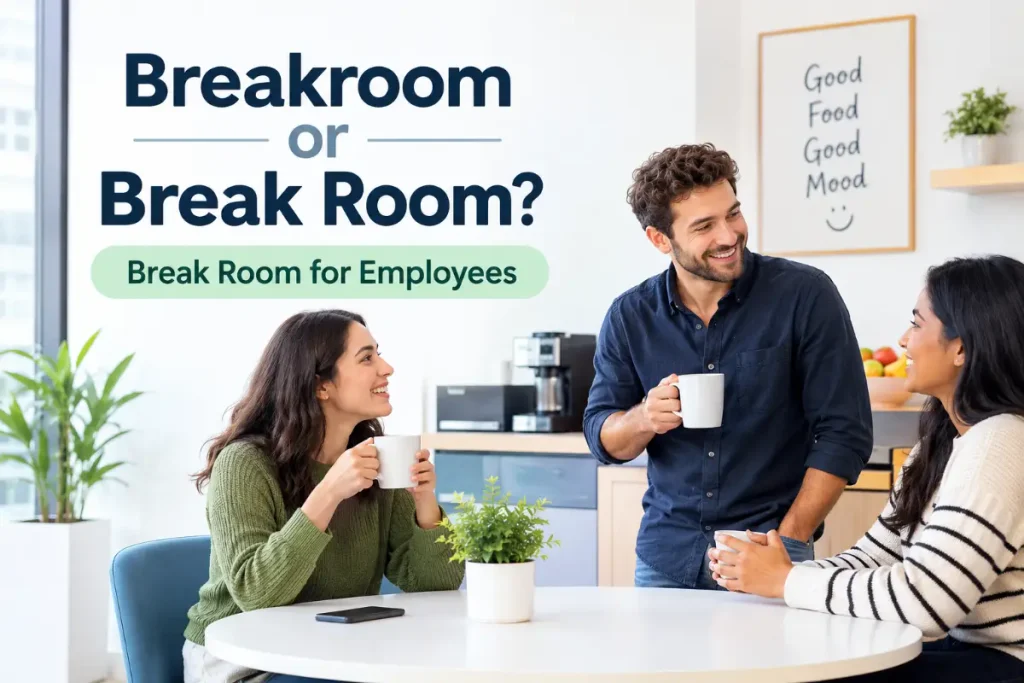
When deciding whether to write break room or breakroom, choosing the more natural expression depends on context, common usage, and the style guide you follow.
Break Room for Employees
A break room for employees is a designated space where staff members can take permitted breaks away from their main work areas. The room may be shared by an entire company, one department, or a specific group of workers. Its design depends on the number of employees, the type of work, and the facilities available.
Some employee break rooms are simple spaces with chairs, tables, and a water dispenser. Others include refrigerators, microwaves, sinks, coffee machines, lockers, and vending machines. Larger workplaces may provide separate quiet areas or lounge seating to accommodate workers with different needs.
The phrase employee break room is also grammatically correct. Here, employee acts as a noun modifier that tells readers who the room is intended for. You could write, “The employee break room is on the second floor,” or “Management plans to renovate the employee break room next month.”
For workplace documents, keep the wording practical and consistent. If your company uses break room throughout its policies and signs, avoid switching randomly to breakroom in other materials. Consistent spelling makes internal communication easier to scan and gives documents a more professional appearance.
Break Room in an Office
An office break room provides employees with a convenient place to step away from their desks. It may also encourage informal conversations between coworkers who do not regularly work together. However, the room’s primary purpose is to provide a shared space for breaks rather than replace formal meeting rooms or private work areas.
In office design documents, you might see phrases such as break room facilities, office break room, break room furniture, and break room maintenance. All these expressions use the standard two word spelling. For example, “The office break room needs a larger refrigerator” is clear and grammatically correct.
The term can also appear in building directories and workplace instructions. A sign might read, “Break Room, Second Floor,” while an employee orientation guide might explain where the room is located and which appliances are available. The spelling stays consistent even when the words appear in a heading or sign.
If the room serves multiple purposes, a company might call it an employee lounge or staff lounge instead. Those labels can suggest a more relaxed seating area, but the precise meaning depends on how the organization uses the space.
Is Lunchroom One Word or Two
Lunchroom is generally written as one word in American English. It refers to a room or designated area where people eat lunch, especially in a school, workplace, or institution. Unlike break room, the conventional spelling of lunchroom is closed.
A lunchroom may serve a similar purpose to a break room, but the terms do not always mean exactly the same thing. A lunchroom focuses on eating meals, while a break room can support several activities, including eating, drinking coffee, relaxing, and taking short rest periods.
For example, a school may have a lunchroom where students eat during scheduled meal periods. An office may have a break room where employees eat lunch but also take short breaks throughout the day. Some workplaces use both terms for the same space, depending on their internal terminology.
The distinction is useful when writing facility descriptions. Use lunchroom when the main purpose is eating meals. Use break room when the space serves as a general area for employees to take breaks.
Break Room vs Staff Room vs Lounge
Several terms describe shared spaces in workplaces, schools, and institutions. Although their meanings overlap, each term can suggest a slightly different purpose or setting.
| Term | Typical meaning | Common setting |
|---|---|---|
| Break room | A shared place for employees to take breaks | Offices, hospitals, factories |
| Lunchroom | A place primarily used for eating meals | Schools, workplaces, institutions |
| Staff room | A shared room for staff to rest or prepare for work | Schools, hospitals, workplaces |
| Lounge | A comfortable shared seating area | Offices, hotels, airports |
| Common room | A shared space for members of a community or institution | Colleges, dormitories, residential buildings |
| Cafeteria | A dining area where meals are served, often through a self service line | Schools, offices, hospitals |
These terms are not interchangeable in every situation. A cafeteria generally provides a place to obtain and eat meals, while a break room may not sell or serve food at all. A staff room may include work related resources as well as seating, especially in schools and healthcare facilities.
Regional habits also influence which expression sounds most natural. In the United States, break room is common in general workplace communication, while staff room is especially familiar in educational settings and in other varieties of English. Choose the term that accurately describes the space and matches your organization’s preferred wording.
Break Room Signs and Workplace Labels
A break room sign identifies the shared area and may communicate rules about its use. Common examples include signs that display the room’s name, identify its location, or remind employees to clean up after themselves. The standard spelling on a general American workplace sign is Break Room.
Possible sign wording includes:
1. Break Room.
2. Employee Break Room.
3. Please Keep the Break Room Clean.
4. Break Room Facilities.
5. Break Room Temporarily Closed.
6. Please Label Food Stored in the Refrigerator.
7. Clean Up After Using the Microwave.
8. Break Room Located on the Second Floor.
Capitalize the words according to the sign’s design and your organization’s style guide. Title case is common for short labels, while sentence case works well for instructions and reminders. The main point is to keep break room as two words.
For a professional setting, clear wording is more useful than a clever label that employees may misunderstand. If you are designing a sign for a shared space, use a readable font and concise instructions. A sign such as “Please Clean Up After Yourself” communicates the expected behavior directly.
Break Room Smash Things and Stress Relief Rooms
The phrase break room smash things can refer to a different kind of business or activity. Some entertainment venues operate rooms where customers pay to break or smash objects in a controlled environment. These venues are often called rage rooms, smash rooms, or anger rooms.
A traditional workplace break room is not the same thing. Its purpose is to provide employees with a place to rest, eat, and take authorized breaks. A smash room is designed for a supervised activity in which participants break designated objects while following safety rules.
The word break creates an understandable connection between the expressions, but their meanings are different. In break room, the word refers to a pause from work. In smash room, it refers to the act of breaking objects.
If you are searching for a venue that lets you smash objects, terms such as rage room near me or smash room near me are likely to be more useful than break room near me. If you want a place to eat lunch or relax at work, the standard phrase is simply break room.
Break Room Near Me and Local Searches
People searching for a break room near me may have different goals. Some want to locate the break room inside their workplace, while others may be looking for a public lounge, a coworking facility, or a place to rest during a busy day. The intended meaning matters because a standard employee break room is usually not a public service.
If you are trying to find the break room in an office building, check the building directory or ask the front desk or your supervisor. If you need a place to work and take breaks while traveling, search for coworking spaces, business lounges, or facilities that explicitly allow visitors. These terms describe places that may be accessible to the public.
For someone searching for a local smash room, use a more specific phrase that identifies the activity. A rage room or smash room is designed for a different purpose than a workplace break room. Using precise search terms helps you find the right kind of location without confusing unrelated services.
In general writing, however, the search phrase does not change the standard spelling. When you describe the employee area in an office, write break room as two words.
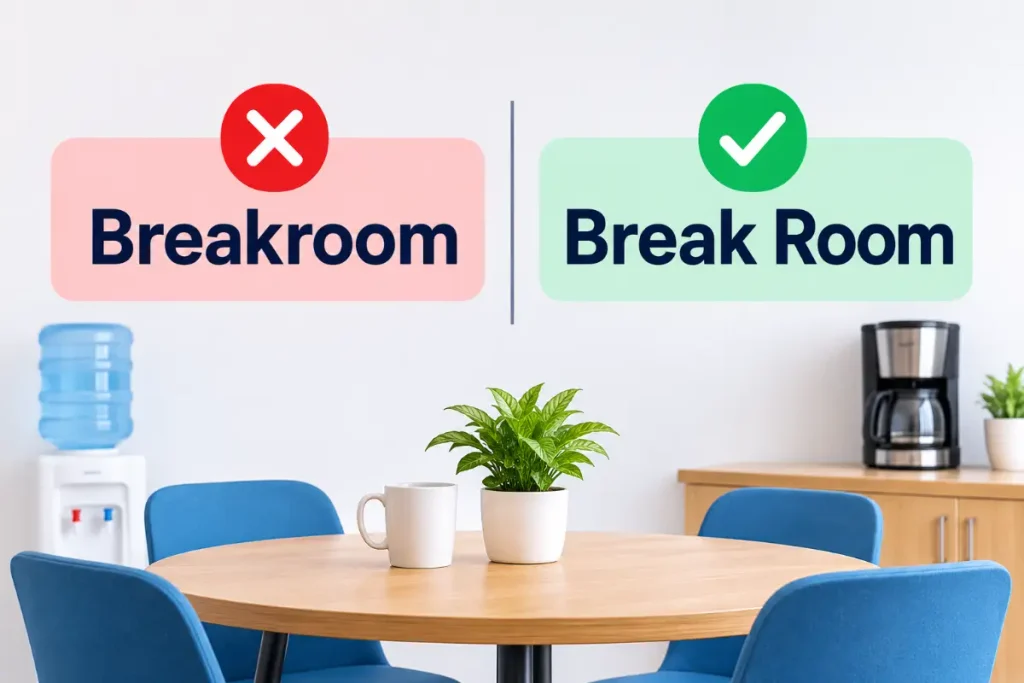
Understanding commonly confused words, such as steam and steem, can sharpen your spelling skills and help you distinguish between similar-looking words, just as knowing when to use break room or breakroom improves accuracy.
Common Break Room Spelling Mistakes
The most frequent spelling issue is joining the two words into breakroom. Readers can usually understand the closed form, but standard edited American English generally favors break room. For professional documents, choose the open compound unless you are reproducing a proper name or a specific house style.
Another mistake is adding a hyphen without a grammatical reason. In ordinary usage, break-room is not the standard form. Write “The break room is closed,” not “The break-room is closed.”
Writers may also confuse the term with lunchroom or staff room. These expressions can refer to similar spaces, but they have different conventional spellings and may emphasize different functions. Remember that break room is two words, lunchroom is one word, and staff room is two words.
Here are a few quick corrections.
| Less preferred or incorrect in standard prose | Recommended form |
|---|---|
| The breakroom is upstairs. | The break room is upstairs. |
| Please clean the break-room. | Please clean the break room. |
| Employees can eat in the lunch room. | Employees can eat in the lunchroom. |
| The staffroom is available. | The staff room is available. |
The first example is understandable but less standard for general American writing. The second uses an unnecessary hyphen, while the final two examples show the conventional spellings recommended for standard edited prose.
Frequently Asked Questions
Is breakroom one word or two
Break room is normally written as two words in standard American English. It refers to a shared space where employees can eat, relax, drink coffee, or take a short break. Although breakroom appears in informal writing and some business names, the two word form is the safer choice for professional documents and workplace signs.
Is it breakroom or break room
Break room is the preferred spelling for general American English writing. Both versions may be understood, but the open compound is the better choice for employee handbooks, office directories, emails, and formal documents. If a company uses Breakroom as an official brand or product name, preserve that specific spelling when referring to the name.
What is a break room
A break room is a shared area where employees can take short breaks away from their usual workstations. It may contain tables, chairs, a refrigerator, a microwave, or a coffee maker. The facilities vary by workplace, but the main purpose is to give employees a convenient place to rest or eat during authorized breaks.
Is break room hyphenated
No. The standard spelling is break room, without a hyphen. Write “The break room is closed for cleaning” rather than “The break-room is closed for cleaning.” A specific organization may use a different form in a branded name, but ordinary workplace writing does not require a hyphen.
Is lunchroom one word or two
Lunchroom is generally one word in American English. It describes a room or designated area where people eat lunch, particularly in schools and workplaces. A break room may also be used for lunch, but it serves a broader purpose by providing space for other types of breaks.
What is the difference between a break room and a staff room
A break room is a shared area intended for employees to rest, eat, or take short breaks. A staff room can serve similar purposes but may also provide resources for staff members to prepare for work or handle administrative tasks. The exact distinction depends on the organization and the way it uses the space.
What should a break room sign say
A break room sign should use clear wording that identifies the space or communicates basic rules. Examples include “Break Room,” “Please Keep the Break Room Clean,” and “Break Room Temporarily Closed.” Keep the spelling consistent, use readable lettering, and make any instructions direct enough for employees to understand quickly.
Is breakroom acceptable in American English
The closed form breakroom appears in American English, especially in informal material, search queries, and some branded names. However, break room remains the preferred spelling for general edited prose. For professional writing, follow the standard two word form unless an official name or a required style guide specifies otherwise.
Conclusion
For standard American English, break room is the preferred spelling. Use two words when referring to the shared workplace area where employees can eat, relax, drink coffee, or take a short break. Although breakroom appears in informal writing and some business names, it is generally best to use break room in professional documents, office signs, employee handbooks, and website content.
Remember that similar expressions follow their own spelling conventions. Lunchroom is usually one word, while staff room is two words. Choosing the conventional form keeps your writing clear and consistent, and it helps readers recognize the meaning without stopping to question the spelling.