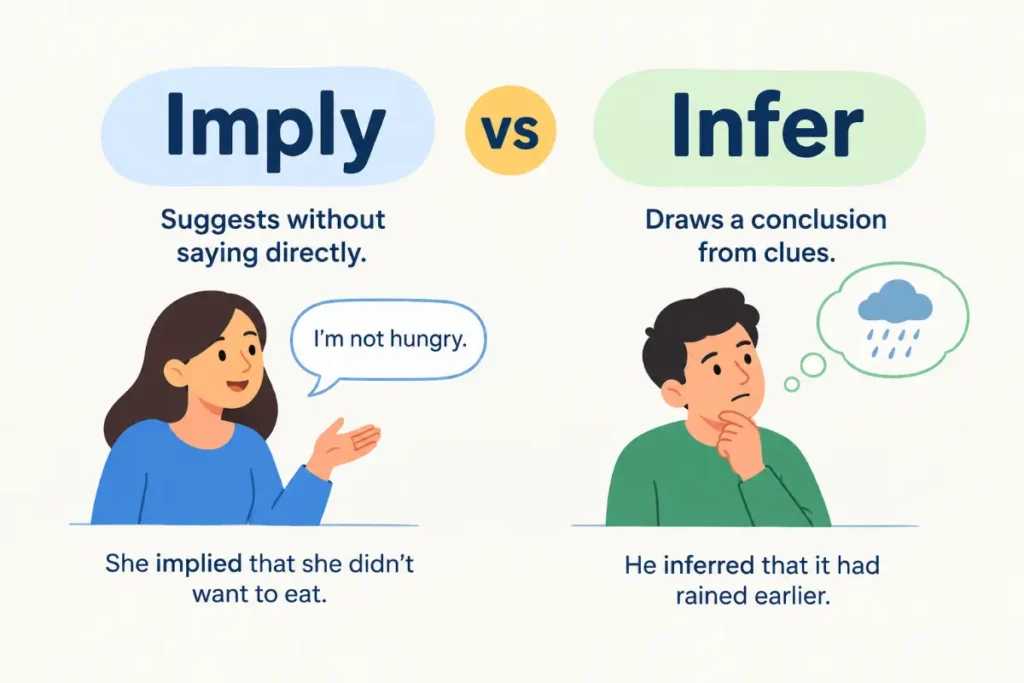
If you have ever wondered about imply vs infer, the key difference is surprisingly simple: the speaker or writer implies something, while the listener or reader infers it. Both words deal with meaning that is not stated directly, which is why they are easy to mix up. The direction of the communication is what separates them.
When someone says something that suggests an idea without stating it plainly, that person is implying. When another person uses those words, along with context or other evidence, to reach an understanding, that person is inferring. Cambridge describes the distinction in essentially the same way: we imply something by what we say, while we infer something from what someone else says.
This distinction matters in everyday conversation, workplace emails, academic writing, journalism, and formal communication. It can also prevent an awkward mistake such as saying, “Are you inferring that I made a mistake?” when you mean, “Are you implying that I made a mistake?”
Quick Answer
Imply means to suggest an idea without saying it directly. Infer means to reach a conclusion from what someone says, does, or provides as evidence. The easiest way to remember the difference is this: a speaker implies, and a listener infers. The speaker puts the unstated meaning into the message, while the listener takes meaning from it.
The Basic Difference Between Imply and Infer
The two verbs describe opposite sides of the same communication process.
Imply describes what the communicator does. A speaker or writer gives you enough information to suggest an idea without expressing that idea directly.
Infer describes what the recipient does. A listener or reader considers the available information and reaches a conclusion about what the communicator meant.
Consider this short exchange:
- Maria says, “Some people remembered to submit their reports on time.”
- James hears the comment and realizes Maria may be criticizing him because his report is late.
Maria implied a criticism. James inferred that the criticism was directed at him.
The words are connected, but they describe different actions. Maria is sending a message with an indirect meaning. James is interpreting that message.
This distinction also explains why the following sentence is normally the wrong word choice:
Are you inferring that I was irresponsible?
If the person is asking about what another speaker suggested, the natural wording is:
Are you implying that I was irresponsible?
The person who hears the statement can infer something from it. The person who makes the statement can imply something through it.
When choosing the right word, understanding the difference between ongoing terms can help you distinguish whether you are referring to repeated actions or something that continues without interruption.
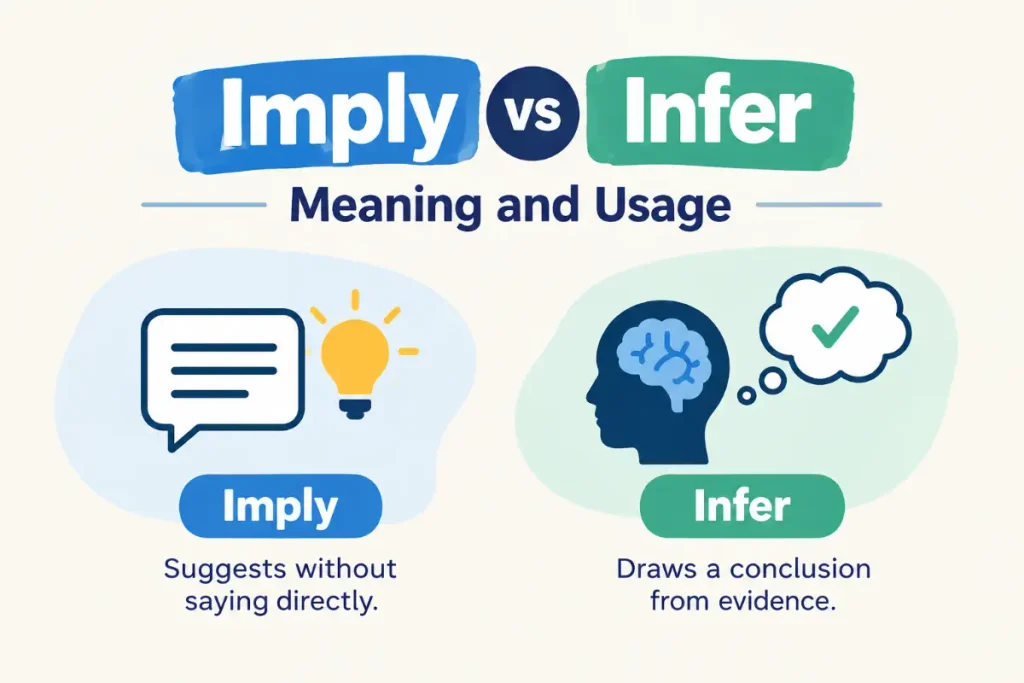
Imply Meaning and Usage
Imply is a verb meaning to suggest an idea, feeling, criticism, conclusion, or meaning without stating it directly. It can also describe something that necessarily involves or requires another thing.
For example:
Her email implied that the meeting had not gone well.
The email did not necessarily say, “The meeting went badly.” Instead, its wording gave the reader that impression.
Another example is:
His silence implied that he disagreed.
Silence itself does not literally state an opinion. The surrounding situation allows the silence to communicate something indirectly.
The word can also describe a logical relationship:
A successful launch implies careful preparation.
Here, imply does not mean that someone deliberately hinted at preparation. Instead, the successful launch suggests or indicates that careful preparation was involved.
This second meaning is common in academic, technical, business, and analytical writing. Cambridge notes both major uses: suggesting something without stating it directly and involving something as a necessary part or condition.
Common Grammar Patterns With Imply
Several sentence structures are especially common.
Imply + that clause
The manager implied that the deadline might change.
Imply + noun
Her response implied disagreement.
Imply + object
The statement implied a lack of preparation.
Be implied
The criticism was implied rather than stated directly.
You will also see implied used as an adjective.
There was an implied agreement between the two parties.
In legal and professional contexts, implied can describe something understood to exist even though it was not explicitly stated.
Infer Meaning and Usage
Infer means to reach a conclusion based on information, evidence, words, behavior, or circumstances. It focuses on the reasoning process of the person receiving or examining information.
For example:
I inferred from his expression that he was disappointed.
The expression did not directly say, “I am disappointed.” The speaker examined the available clue and reached that conclusion.
Another example is:
From the empty parking lot, we inferred that the store had closed.
The empty parking lot was evidence. The conclusion came from interpreting that evidence.
Infer is especially common in academic, analytical, scientific, legal, and professional contexts because it often describes a conclusion drawn from available information.
Common Grammar Patterns With Infer
The most useful pattern to remember is:
Infer something from something
For example:
- We inferred the meaning from the context.
- She inferred from his response that he was not interested.
- The researchers inferred a connection from the available data.
You can also use infer that:
I inferred that she had already left.
The important point is that the person doing the inferring is drawing meaning from evidence or communication.
Cambridge specifically gives the pattern infer something from something and explains infer as forming an opinion or guess because of the information available.
Imply vs Infer Comparison
| Feature | Imply | Infer |
|---|---|---|
| Basic meaning | Suggest something indirectly | Reach a conclusion from information |
| Direction | From speaker or writer to message | From listener or reader to meaning |
| Main action | Puts an indirect meaning into communication | Takes meaning from communication |
| Common subject | Speaker, writer, statement, evidence | Listener, reader, observer, researcher |
| Typical pattern | Imply that something is true | Infer that something is true |
| Common preposition | Often by or from context, depending on structure | Often from |
| Example | She implied that she was unhappy. | I inferred that she was unhappy. |
| Formality | Neutral to formal | Often somewhat formal |
| Everyday use | Common | Common, but somewhat more formal |
| Past form | Implied | Inferred |
| Present participle | Implying | Inferring |
The clearest distinction is not simply that the words have different meanings. It is that they describe different directions of interpretation.
Think of communication as a two step process:
Person A implies → Person B infers.
That simple formula will help you choose the right verb in most situations.
Examples of Imply in Sentences
The following examples show how the word works across everyday, professional, academic, and social situations.
- The teacher implied that several students had not studied enough.The teacher did not directly identify the students but suggested the idea.
- Are you implying that I forgot to do my part?The speaker is asking about an indirect suggestion.
- Her expression implied that she was surprised.Her facial expression communicated something without words.
- The email seemed to imply that the project would be delayed.The email suggested a delay without directly stating it.
- His comments implied a lack of confidence in the plan.His words suggested that he did not have confidence in the plan.
- The advertisement implies that the product will save customers money.The advertisement suggests that result without necessarily stating it as a direct fact.
- The evidence does not imply that the two events were connected.Here, imply describes what the evidence suggests.
- Her apology implied that she recognized the mistake.The apology communicated an idea indirectly.
- The contract implies certain responsibilities for both parties.In this context, the agreement involves or establishes responsibilities.
- The name itself implies what the organization does.
The name gives information about the organization indirectly.
Notice that the subject of imply can be a person, a statement, an action, a document, evidence, or even a name. The common feature is that something communicates or suggests another idea.
Examples of Infer in Sentences
Infer focuses on the person who reaches a conclusion.
- I inferred from her tone that she was frustrated.The tone provided a clue, and the listener reached a conclusion.
- We inferred that the restaurant was closed because the lights were off.The people observed a situation and drew a conclusion.
- The reader can infer the character’s feelings from the dialogue.The reader interprets clues in the text.
- From his short response, I inferred that he was busy.The short response was evidence for the conclusion.
- The detective inferred that the suspect had left through the back door.The detective reached a conclusion from available evidence.
- Students should infer the meaning of unfamiliar words from context.Students use surrounding information to understand a word.
- We can infer from the sales figures that demand has increased.The figures provide evidence for the conclusion.
- She inferred from my silence that I disagreed.She interpreted the silence and reached a conclusion.
- The researcher inferred a relationship between the two variables.The conclusion came from examining information.
- You cannot always infer someone’s intentions from a single comment.
This sentence highlights an important point: an inference can be reasonable without necessarily being certain.
That last distinction matters. To infer something is to reach a conclusion from available information. It does not automatically mean the conclusion is guaranteed to be correct.
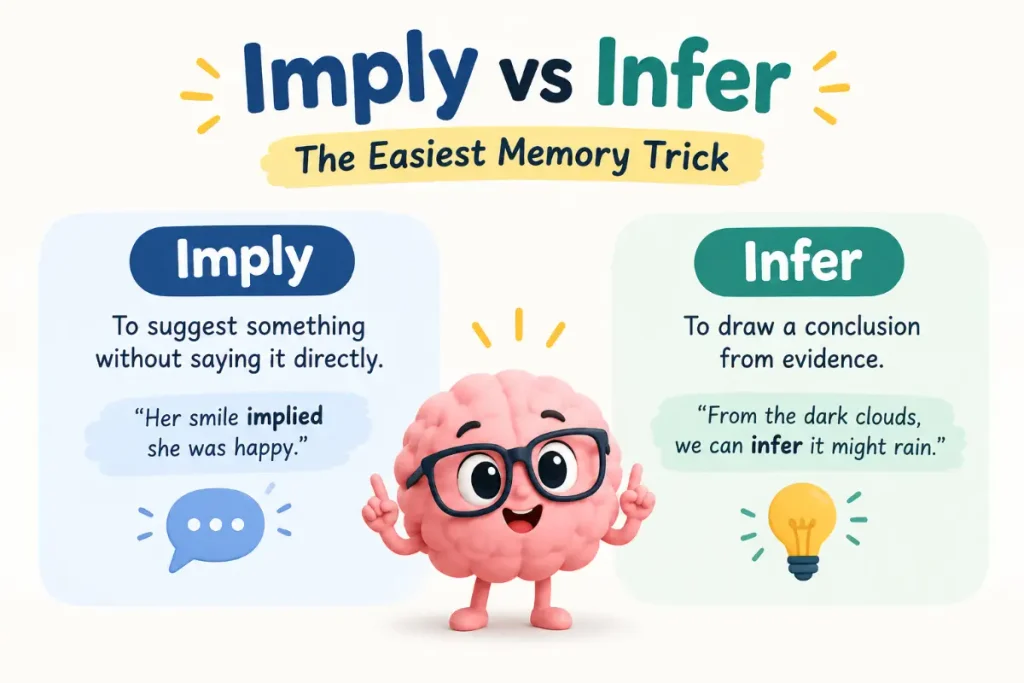
The Easiest Memory Trick
If you regularly confuse these verbs, remember:
- Imply = put the idea in.
- Infer = take the idea out.
Imagine a message as a container.
The speaker puts an unstated suggestion into the message. That is imply. The listener examines the message and takes a conclusion from it. That is infer. Another useful memory device is:
I imply. You infer.
For example:
- I implied that the meeting was unnecessary.
- You inferred that I wanted to cancel it.
The two verbs fit together naturally because they describe two sides of the same exchange.
Common Mistakes With These Words
The most frequent mistake is using infer when you mean imply.
Mistake 1
Incorrect: Are you inferring that I lied?
Correct: Are you implying that I lied?
The question asks what the other person is suggesting, so imply is appropriate.
Mistake 2
Incorrect: I implied from her silence that she was angry.
Correct: I inferred from her silence that she was angry.
The speaker is interpreting her silence and reaching a conclusion. That makes infer the correct choice.
Mistake 3
Incorrect: The reader can imply that the character is afraid.
Correct: The reader can infer that the character is afraid.
The reader is drawing a conclusion from the text.
Mistake 4
Incorrect: His comment inferred that the plan was risky.
Correct: His comment implied that the plan was risky.
A comment can suggest an idea, so imply fits.
Mistake 5
Incorrect: What are you inferring?
This sentence is not always wrong. It can be grammatical when you genuinely mean, “What conclusion are you drawing?” The problem occurs when someone uses infer to mean “What are you suggesting?”
In that situation, say:
What are you implying?
This distinction is especially useful because everyday conversation often involves indirect communication. The intended meaning depends heavily on context, tone, facial expression, and shared knowledge.
The distinction becomes especially important when describing someone’s attitude, since disinterested and uninterested have traditionally carried different meanings even though they are often confused in everyday English.
Imply vs Infer vs Insinuate
Insinuate is closely related to imply, but it carries an additional connotation.
To insinuate something usually means to suggest it indirectly, often in a way that is unpleasant, questionable, critical, or damaging. It can suggest that the speaker is deliberately avoiding a direct statement.
For example:
She implied that the report contained errors.
This simply means she suggested that the report contained errors.
She insinuated that the report had been deliberately falsified.
This suggests a more pointed or potentially accusatory implication.
The difference is not absolute. In ordinary use, insinuate can overlap with imply. However, insinuate often adds a sense of indirect accusation or suggestion.
Infer remains different because it describes the person receiving or interpreting the message.
A useful three word distinction is:
| Word | Role | Basic idea |
|---|---|---|
| Imply | Speaker or writer | Suggest indirectly |
| Insinuate | Speaker or writer | Suggest indirectly, often with a negative or pointed tone |
| Infer | Listener or reader | Reach a conclusion from clues |
For example:
- The manager implied that the employee needed to improve.
- The manager insinuated that the employee had been careless.
- The employee inferred that the manager was unhappy.
The first two describe what the manager communicated. The third describes what the employee concluded.
Imply vs Implicate
Implicate can also cause confusion because it resembles imply in spelling and sound, but its meaning is different.
To implicate someone usually means to show that the person is involved in something, especially something improper or illegal.
For example:
The evidence implicated the suspect in the robbery.
That does not simply mean the evidence indirectly suggested something. It means the evidence connected the suspect to the crime.
By contrast:
The evidence implied that the suspect had been nearby.
Here, the evidence suggested a conclusion without necessarily establishing involvement in the crime.
The words can occasionally appear in related contexts, but they should not be treated as interchangeable.
Formal and Casual Usage
Both words are standard English and work in professional writing. Infer can feel slightly more formal than everyday alternatives such as figure out, conclude, or take it to mean.
For example, in casual conversation, someone might say:
I figured from his text that he was busy.
In formal writing, the same idea could be expressed as:
I inferred from his message that he was unavailable.
Similarly, imply is natural in both conversation and formal writing:
- Are you implying that I made a mistake?
- The findings imply that additional research may be necessary.
In academic and professional writing, both verbs are useful because they precisely distinguish between what information communicates and what a reader concludes from it.
How These Words Work in Professional Writing
The distinction becomes particularly important when precision matters.
Consider a workplace report:
The findings imply that the current process needs revision.
The findings suggest the conclusion.
Now consider:
From these findings, the team inferred that the current process needed revision.
The team examined the findings and reached the conclusion.
Both sentences can describe the same situation, but they focus on different parts of the reasoning process.
This distinction is useful in:
- Business reports, where writers need to distinguish evidence from conclusions.
- Academic writing, where researchers distinguish what data suggest from what researchers conclude.
- Legal writing, where precise descriptions of evidence and interpretation matter.
- Journalism, where a writer may need to separate what a source suggested from what readers might conclude.
- Workplace emails, where indirect wording can easily be misunderstood.
- Customer communication, where an implied message may produce an unintended inference.
When clarity matters, it can sometimes be better to state the intended meaning directly rather than relying on implication.
Grammar Patterns to Remember
A few patterns make the distinction easier to apply.
Use Imply for the Communicator
- The speaker implied that the deadline was flexible.
- The email implied that the meeting had been canceled.
- Her answer implied dissatisfaction.
Use Infer for the Interpreter
- I inferred from the email that the meeting had been canceled.
- The employees inferred that the deadline was flexible.
- From her answer, he inferred that she was dissatisfied.
Use Infer From
The preposition from is especially helpful as a memory cue.
- We inferred from the evidence that the claim was false.
- She inferred from his tone that something was wrong.
- Readers can infer the meaning from the surrounding context.
This pattern appears frequently because inference involves moving from information to a conclusion. Cambridge specifically identifies infer something from something as a common grammatical structure.
Pronunciation
The two words are also pronounced differently.
Imply is pronounced approximately im PLY.
IPA: /ɪmˈplaɪ/
The stress falls on the second syllable.
Infer is pronounced approximately in FER.
US IPA: /ɪnˈfɝː/
Again, the stress falls on the second syllable. Cambridge gives the US pronunciation as /ɪnˈfɝː/ and imply as /ɪmˈplaɪ/.
The pronunciation does not normally cause the same confusion as the meanings, but hearing these words in conversation can make the distinction easier to recognize.
Word Origins
The two words are related historically, which helps explain why they look and sound somewhat alike.
Imply comes through Latin roots associated with involving or enfolding something. Its modern sense developed toward the idea of suggesting something indirectly or involving something as a necessary part.
Infer comes from Latin roots meaning to bring in or bring toward, later developing the sense of drawing a conclusion from evidence.
Their shared historical connection does not mean they are interchangeable. Modern English uses them for different directions of reasoning and communication.
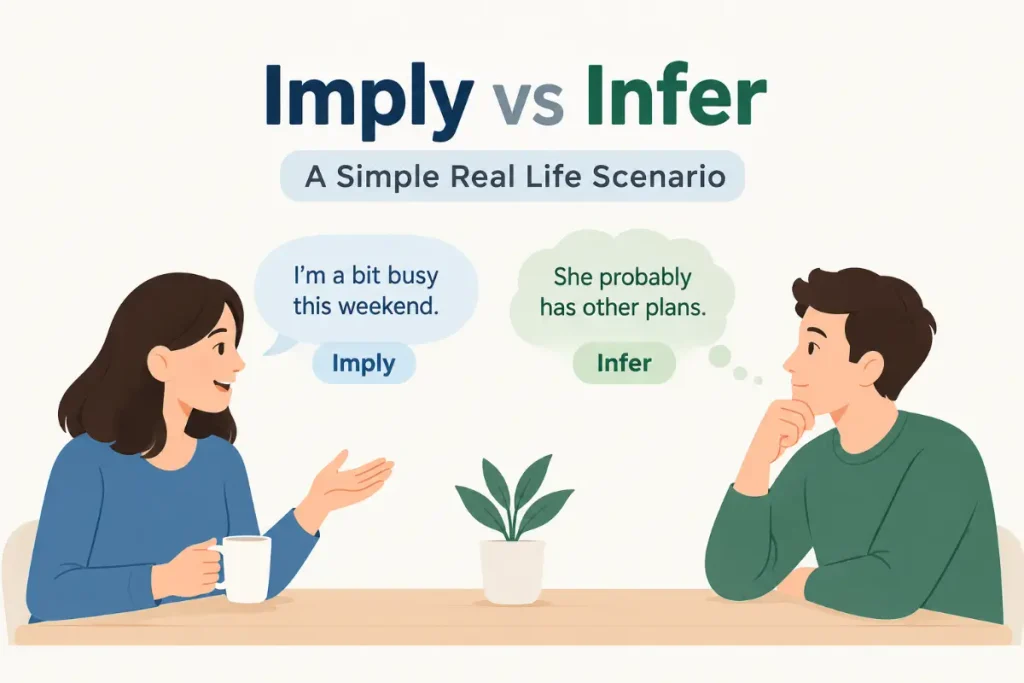
A Simple Real Life Scenario
Imagine a friend looks at the clock and says:
We should probably get going.
The friend may be implying that it is time to leave. You look at the clock, notice that the event ends in ten minutes, and conclude that your friend wants to leave.
You have inferred the meaning. Now imagine the friend says:
I am not saying we have to leave, but the last train is in twenty minutes.
The friend is implying that leaving soon would be sensible. You might infer that the friend does not want to miss the train. The same message can therefore involve both verbs at the same time. One person implies, while another person infers.
Similar confusion can occur with words that look almost identical, such as the verb and noun forms envelop and envelope, which have different meanings and grammatical functions.
Frequently Asked Questions
Which is correct, imply or infer?
Both are correct words, but they perform different jobs. Use imply for what a speaker, writer, statement, action, or piece of evidence suggests indirectly. Use infer for the conclusion a listener, reader, or observer reaches from information. Remember: the communicator implies, while the recipient infers.
Can a person infer something from what someone says?
Yes. A person can infer a meaning, conclusion, intention, or fact from another person’s words. For example, “I inferred from her response that she was disappointed” means the speaker interpreted her response and reached that conclusion. The verb commonly appears with from, as in “infer something from something.”
Can you say someone inferred something?
Yes. This is standard usage when the person reached a conclusion from available information. For example, “The reader inferred that the character was afraid.” The reader is interpreting clues in the text. Saying “The writer inferred that the character was afraid” can also be correct if the writer reached that conclusion from evidence, but it does not mean the writer suggested it to the reader.
Is imply more negative than infer?
No. Neither word is inherently negative. Imply can describe a neutral, positive, or negative suggestion, while infer can describe a neutral, positive, or negative conclusion. Insinuate, by contrast, often carries a more pointed or negative connotation because it can suggest an accusation or unpleasant idea indirectly.
Is imply the same as suggest?
They are often close in meaning, but imply has a more specific role in indirect communication. If someone says something that communicates an idea without stating it directly, that person can imply the idea. Suggest is broader and can describe many kinds of proposals, possibilities, or indirect indications.
What is the easiest way to remember imply and infer?
Remember I imply, you infer. The person communicating an indirect meaning implies it. The person receiving the communication infers it. Another useful memory trick is imply puts the suggestion into the message, while infer pulls a conclusion from the message.
Is infer more formal than imply?
Infer can sound somewhat more formal in everyday conversation, but both words are standard in American English and appropriate for professional and academic writing. In casual speech, people often use phrases such as “figure out,” “take it to mean,” or “conclude” instead. The choice depends on the context and the level of precision needed.
What is the difference between infer and insinuate?
Infer describes reaching a conclusion from information. Insinuate describes suggesting something indirectly, often with a negative, critical, or accusatory tone. For example, a person can insinuate that someone was dishonest, while another person can infer from that comment that the speaker suspects dishonesty.
The Best Way to Choose the Right Word
When you are unsure, stop and identify who is doing the action.
Ask yourself:
- Is someone suggesting an idea without saying it directly?Use imply.
- Is someone reaching a conclusion from words, behavior, evidence, or context?Use infer.
- Is the indirect suggestion pointed, critical, or potentially accusatory?Insinuate may be more precise.
- Is someone being connected to an action or wrongdoing by evidence?Consider implicate, not imply.
This approach works better than trying to memorize isolated definitions because it focuses on the direction of the communication.
Conclusion
The difference in imply vs infer comes down to who is doing what. Imply means to suggest something without stating it directly. Infer means to reach a conclusion from information, evidence, words, or context. In the simplest form, the speaker implies and the listener infers.
When you write or speak, ask yourself if you are describing the message being sent or the conclusion being drawn from that message. If you are describing the suggestion, use imply. If you are describing the interpretation, use infer. Once you connect each word with its role in communication, the distinction becomes much easier to remember and use naturally.