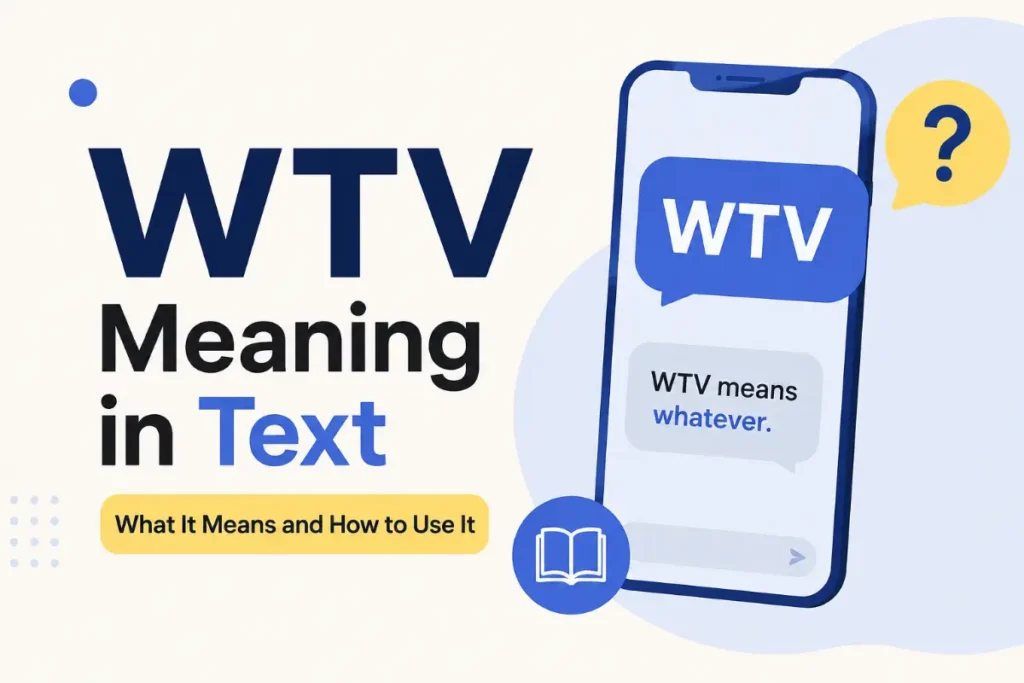
If someone sends you WTV in a text and you are not sure how to read it, the good news is that it usually has a very simple meaning. WTV is a casual abbreviation of whatever. Depending on the conversation, it can show that someone does not mind, does not care, feels annoyed, or simply wants to move past the topic.
The tricky part is the tone. A message such as WTV can sound perfectly relaxed in one conversation and surprisingly cold in another. That difference comes from the words around it, the relationship between the people texting, and what happened immediately before the message.
This guide explains what WTV means in text conversations, how people use it on Snapchat and Instagram, what it can mean from a girl or a guy, and how to tell if it sounds friendly, dismissive, sarcastic, or indifferent. You will also see natural examples and simple ways to respond.
Quick Answer
WTV usually means whatever in texting and online conversations. It is an informal abbreviation used to show indifference, flexibility, resignation, or dismissal. For example, if someone asks where you want to eat and you reply WTV, you may simply mean that you are fine with any choice. The exact tone depends on context.
What Does WTV Mean In Text
The most common meaning is whatever. People shorten the word to WTV because texting encourages quick and compact communication. Instead of typing the full word, someone can use three letters and keep the conversation moving.
The abbreviation works in several ways. Sometimes it means I do not care. Sometimes it means anything is fine. In an argument, it can sound closer to I am done talking about this. The same three letters can therefore carry different emotional weight.
Consider these two conversations.
Person A: What do you want for dinner?
Person B: WTV. You pick.
Here WTV is relaxed. The person is giving the other person freedom to choose.
Now consider another exchange.
Person A: You never listen to anything I say.
Person B: WTV.
This version feels much colder. The reply can suggest annoyance or a desire to end the discussion.
That is why translating the abbreviation word for word is not always enough. You need to read the surrounding conversation.
Why People Use WTV
Texting has its own rhythm. People often shorten familiar words because typing the full version feels unnecessary in a quick conversation. WTV fits naturally into that style.
There is also an emotional reason for using it. The abbreviation can make a response feel less formal and more casual. It can communicate a shrug without actually writing a sentence such as I do not really care.
Common reasons include:
- To show indifference. The person does not have a strong opinion.
- To give someone else the choice. They are saying that any option works.
- To dismiss a topic. They do not want to keep discussing it.
- To show resignation. They may not like the situation but have decided to accept it.
- To keep texting short. The person simply wants a quick response.
- To sound casual. The abbreviation belongs mainly in relaxed digital conversations.
The important point is that WTV does not automatically mean something negative. Context decides the attitude behind it.
WTV Meaning In Text From A Girl
If a girl sends WTV, the abbreviation itself does not reveal her feelings toward you. You need to look at the conversation before and after it.
For example, imagine you ask:
You: What movie should we watch tonight?
Her: WTV lol.
That probably means she does not have a preference. She is leaving the choice to you.
Now imagine you have been arguing and she replies:
You: Can we talk about what happened?
Her: WTV.
That response may suggest frustration, emotional distance, or a desire to stop the conversation.
A short answer can sometimes feel more serious because there is less information available. However, it would be a mistake to assume that WTV always means she is angry or no longer interested.
Look for additional clues such as emojis, punctuation, previous messages, and how she normally texts. If she usually writes long playful messages and suddenly answers with WTV, the change in communication style may matter more than the abbreviation itself.
WTV Meaning In Text From A Guy
The same principle applies when a guy sends WTV. The abbreviation does not have a special male meaning.
A guy might use it to say that he does not care which restaurant you choose.
You: Pizza or burgers?
Him: WTV works.
In that situation, he is probably saying that either option is fine.
The tone changes in an argument.
You: Are you still upset about yesterday?
Him: WTV.
That could mean he does not want to discuss the issue. It might also signal annoyance or resignation.
Do not try to decode the sender’s gender from the abbreviation. Focus on the actual conversation. Text slang is flexible, and people develop their own habits.
If you are unsure whether when to use “fewer” correctly applies in a particular sentence, understanding its relationship with countable nouns can make the distinction much easier.
WTV Meaning On Snapchat
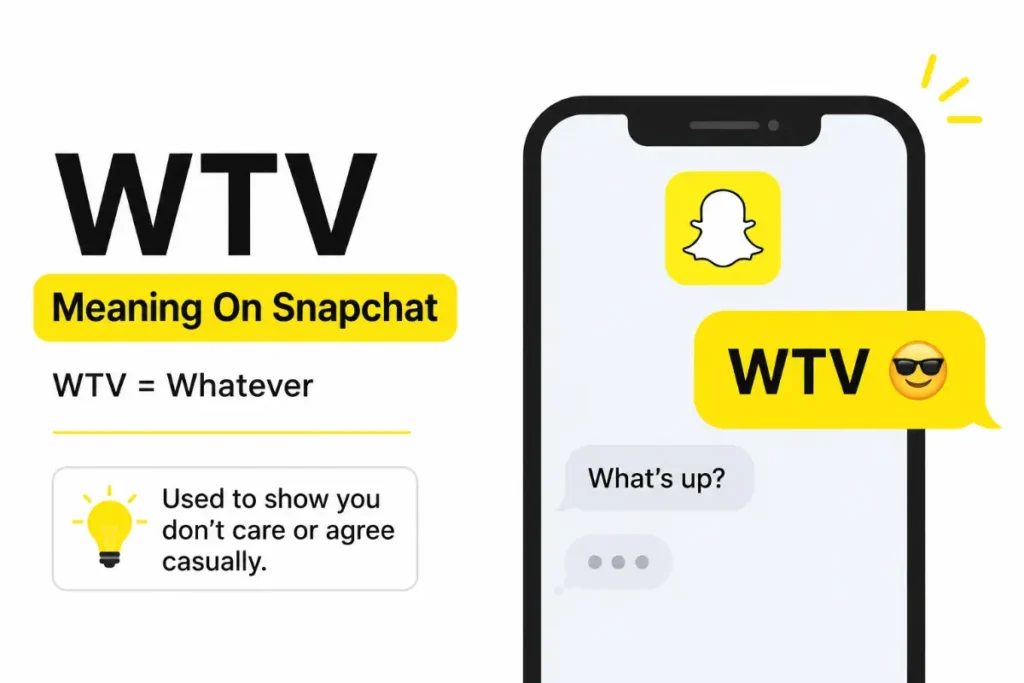
On Snapchat, WTV commonly means whatever. It can appear in direct messages, replies, captions, and casual conversations. The abbreviation is not exclusive to Snapchat, though. It also appears across other social platforms and messaging services.
The platform does not change the basic definition. What changes is the conversational setting.
For example:
Friend: Where are we going after school?
You: WTV. I am good with anything.
Here the meaning is flexible and friendly.
Another example:
Friend: I cannot believe you picked that one.
You: WTV.
This can sound dismissive because the sender is refusing to engage with the complaint.
Snapchat conversations often move quickly, so abbreviations such as WTV can fit naturally into short exchanges. Still, the safest interpretation comes from the complete message rather than the platform alone.
WTV Meaning On Instagram
On Instagram, WTV generally carries the same meaning as it does in ordinary texting. Someone may use it in a DM, comment, reply, or casual conversation to stand for whatever.
For example:
You: Which picture should I post?
Friend: WTV one you like.
That means the friend does not have a strong preference.
In a comment or argument, however, the abbreviation can sound dismissive.
Person A: That outfit does not look good.
Person B: WTV.
Here it may communicate that the second person does not care about the criticism.
The lack of facial expression and voice makes digital tone harder to read. That is why a short abbreviation can sometimes create more confusion than a full sentence.
Is WTV Rude
WTV is not automatically rude, but it can sound rude in certain situations.
The biggest factor is how it responds to the message before it. If someone asks you to choose between two harmless options, WTV can sound easygoing. If someone shares something personal and you answer only WTV, the response can come across as dismissive.
Think of it as a verbal shrug. A shrug can mean I am fine with that. It can also mean I do not want to talk about it.
These examples show the difference.
Friendly
You: Pasta or tacos?
Friend: WTV. You choose.
Dismissive
You: I am honestly upset about what happened.
Friend: WTV.
The second reply gives almost no emotional acknowledgment. That is why it can feel harsh.
If you want to avoid sounding rude, use a little more context. Instead of WTV, you could say I am fine with either or You can choose.
Is WTV A Bad Word
No. WTV is not a swear word or inherently offensive expression. It is simply an informal abbreviation of whatever.
The potential problem is tone rather than vocabulary. A person can use a harmless word in a way that feels cold or disrespectful. The same thing happens with ordinary words such as fine, okay, sure, and whatever.
For example, saying WTV when choosing a restaurant is harmless in most casual conversations. Saying it after someone tells you about a serious problem can sound insensitive.
The setting matters.
Use it mainly with people who understand your texting style. Avoid it in formal writing, school assignments, professional emails, customer service messages, and other situations where clear standard English is expected.
WTV As A Way To Say Whatever
The most straightforward use is simply replacing whatever.
For example:
I will eat WTV you order.
This means:
I will eat whatever you order.
Another example is:
Choose WTV you want.
This means:
Choose whatever you want.
In these sentences, the abbreviation is functioning as a shortened version of a normal word rather than creating a completely new meaning.
That distinction helps explain why WTV feels natural in casual digital communication. The reader already knows the full word. The abbreviation simply saves typing.
WTV As A Sign Of Indifference
Another common use expresses a lack of concern.
Suppose two friends are deciding where to go.
Friend: Coffee or ice cream?
You: WTV.
The likely message is I do not care which one.
This does not necessarily mean I dislike both choices. It can simply mean that the decision is not important enough for you to have a preference.
You can think of it as conversational flexibility.
The same idea appears in:
WTV you want is fine with me.
WTV works for me.
We can watch WTV you pick.
In these examples, the abbreviation is not hostile. It communicates openness.
WTV As A Dismissive Reply
The abbreviation can also close a conversation.
Imagine this exchange:
Person A: You should have told me earlier.
Person B: WTV.
Here the response can mean I do not want to argue about this.
That does not necessarily solve the disagreement. It simply signals that the sender does not want to continue.
This is one reason WTV can be difficult to interpret. A person may use it because they are genuinely indifferent, or they may use it because they are emotionally tired.
If the conversation involves conflict, do not assume the mildest interpretation. Pay attention to the surrounding messages.
WTV As A Resigned Response
Sometimes the abbreviation communicates acceptance without enthusiasm.
For example:
You: The event starts at 8 instead of 7.
Friend: WTV. I will be there.
Here the person may not love the change, but they are accepting it. This use is close to saying fine or I guess that works. Another example:
You: We have to take the longer route.
Friend: WTV. Let us go.
The speaker is not necessarily angry. They have simply decided not to spend more energy worrying about the situation. That subtle difference is easy to miss when reading text without hearing someone’s voice.
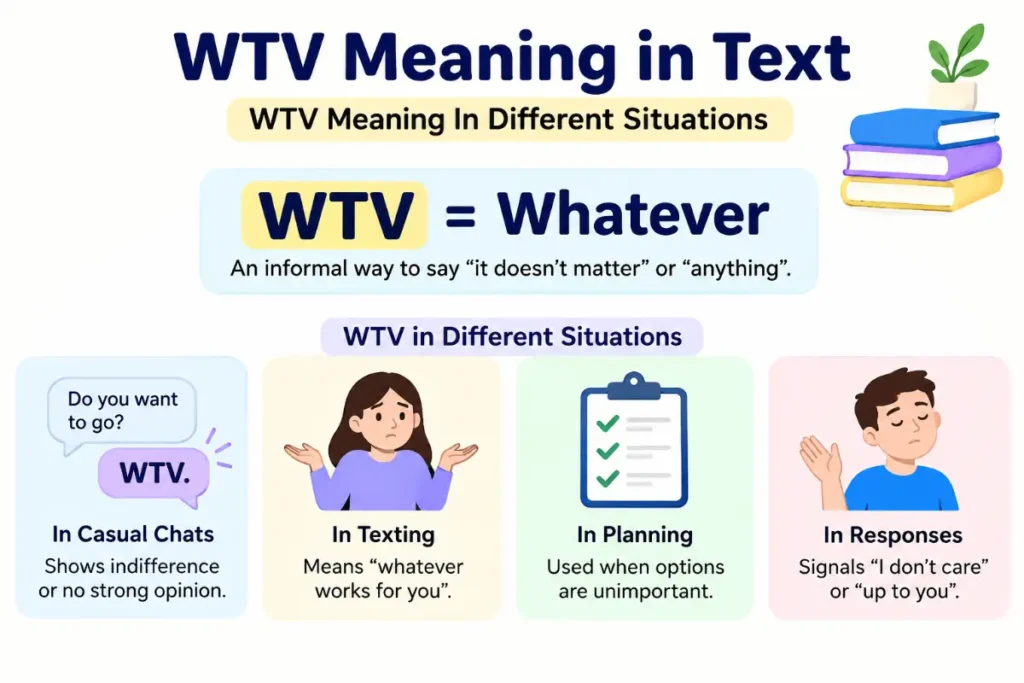
WTV Meaning In Different Situations
The easiest way to understand the abbreviation is to connect it to the situation.
| Situation | Likely meaning | Possible tone |
|---|---|---|
| Choosing dinner | Any option is fine | Relaxed |
| Choosing a movie | No preference | Casual |
| Ending an argument | I do not want to discuss this | Dismissive |
| Accepting a bad option | Fine then | Resigned |
| Replying to criticism | I do not care | Indifferent |
| Talking with close friends | Whatever | Casual |
| Answering a serious message | I am not engaging | Potentially cold |
This is why slang dictionaries can give you the basic definition but cannot always tell you exactly how a particular person feels. Digital language depends heavily on context.
WTV Compared With Whatever
The full word whatever and the abbreviation WTV usually communicate the same basic idea. The difference is style.
Whatever works in normal spoken and written English. WTV belongs primarily to informal digital communication.
Compare these:
Whatever you want is fine.
WTV you want is fine.
The first sentence is standard English. The second is casual texting language.
The abbreviation also changes the visual feel of the message. It looks quicker and less formal.
For professional communication, use whatever. For a casual message to a friend, WTV may feel completely natural.
WTV Compared With IDC
WTV and IDC can overlap, but they are not identical.
IDC means I do not care. It directly states a lack of concern.
WTV means whatever. It can express indifference, but it can also mean any option is acceptable or I am done discussing this.
Consider:
You: Pizza or tacos?
Friend: WTV.
This probably means either choice works.
Now:
You: Do you care that I changed the plan?
Friend: IDC.
That is a much more direct statement of indifference.
WTV is therefore more flexible. IDC is more explicit.
WTV Compared With IDK
IDK means I do not know. It is different from WTV even though the two can sometimes appear in similar conversations.
You: What should we watch?
Friend: IDK.
The friend does not know what to choose.
You: What should we watch?
Friend: WTV.
The friend is saying that any choice is acceptable or that they do not care.
The difference is simple:
- IDK means lack of knowledge.
- WTV usually means lack of preference or concern.
That distinction is useful when reading fast conversations.
WTV Compared With NVM
NVM usually means never mind.
It often signals that the sender has dropped a question, corrected themselves, or decided that something is no longer worth discussing.
WTV is different because it normally means whatever.
For example:
You: Can you send me the address?
Friend: NVM. I found it.
Here NVM means forget it.
But:
You: Do you want to meet at six or seven?
Friend: WTV.
Here the person is saying either time works.
These abbreviations can appear together, but they perform different jobs.
How To Respond To WTV
Your response should depend on the tone and situation.
If the person seems relaxed, simply continue the conversation.
Them: WTV. You pick.
You: Cool. Let us get pizza.
If the person sounds annoyed, you may want to avoid escalating things.
Them: WTV.
You: Okay. We can leave it there.
If you are not sure what they mean, ask directly.
You: Do you mean you are fine with anything or you do not want to talk about it?
That may feel slightly more formal than normal texting, but it prevents you from guessing incorrectly.
Natural Text Examples
Here are realistic examples showing how the abbreviation changes with context.
- You: What should we eat tonight?
Friend: WTV. You choose. - You: Red shirt or blue shirt?
Friend: WTV looks good on you. - You: Are you still mad?
Friend: WTV. - You: Should we go now or later?
Friend: WTV works for me. - You: I cannot believe they changed the plan.
Friend: WTV. Let us make our own plan. - You: Do you want to watch a comedy?
Friend: WTV you want. - You: She said we were late.
Friend: WTV. We are already here. - You: Should I post this picture?
Friend: WTV you like best. - You: Do you care where we sit?
Friend: WTV. - You: Can we talk about this later?
Friend: WTV.
Notice that the same abbreviation can move from friendly to dismissive depending on the surrounding conversation.
Does WTV Mean The Same Thing From Everyone
The basic meaning is usually the same, but the emotional tone can vary from person to person.
A close friend might send WTV because they are comfortable enough to be brief. Someone you barely know might use the same abbreviation to show that they are not interested in continuing the conversation.
Texting habits also differ between age groups, friend groups, and online communities. Some people use abbreviations constantly. Others rarely use them.
That means you should not treat slang like a mathematical formula. Context matters more than the letters alone.
A person’s normal texting style is especially useful. If they always write short replies, WTV may mean very little emotionally. If they normally write detailed messages and suddenly send only WTV, the change may be more meaningful.
Can WTV Mean Something Else
In most casual texting situations, WTV means whatever. However, abbreviations can have different meanings in specialized settings.
Some sources note alternative expansions such as What’s the verdict or Watch the video, but these uses are much less common in ordinary conversations.
The best way to identify an unusual meaning is context.
For example, if someone sends:
WTV before you decide.
The surrounding conversation may indicate that they are talking about a video rather than using the common slang meaning.
If whatever makes no sense in the sentence, consider another interpretation or ask the sender.
Do not assume a rare definition simply because an abbreviation can technically stand for several phrases.
Is WTV Used On Roblox
You may encounter WTV in Roblox chats, messages, or conversations between players. When it appears in an ordinary social exchange, the most likely meaning is still whatever.
For example:
Player A: Which game should we play?
Player B: WTV.
That likely means the second player does not mind.
Gaming communities often develop specialized abbreviations, so context still matters. If the surrounding conversation is about a specific game feature, event, item, or command, the abbreviation could potentially have a local meaning within that community.
In ordinary casual chat, however, whatever remains the safest interpretation.
WTV And Internet Slang
WTV belongs to a much larger family of internet abbreviations designed to make digital communication faster.
Common examples include:
- LOL for laughing out loud.
- IDK for I do not know.
- IDC for I do not care.
- NVM for never mind.
- TBH for to be honest.
- IMO for in my opinion.
- BTW for by the way.
- FR for for real.
These shortcuts work because the people involved already understand the longer expression. The reader mentally expands the abbreviation while reading.
WTV follows the same basic principle. It compresses a familiar word into a short form that fits the speed of online conversation.
Is WTV Formal English
No. WTV is informal internet slang.
You can use it in casual texts, DMs, comments, group chats, and conversations with friends. It is not a good choice for formal documents or professional communication.
Avoid it in:
- Job applications.
- Business emails.
- Academic assignments.
- Formal reports.
- Customer service messages.
- Official documents.
- Professional presentations.
In those situations, write the complete word whatever or use a clearer sentence.
A useful rule is simple: if you would not normally use texting slang in the setting, do not use WTV.
Common Mistakes With WTV
One common mistake is assuming that WTV always means I do not care. Sometimes it simply means any option is fine.
Another mistake is assuming that the sender is angry. A short message can feel cold, but the sender may simply have a brief texting style.
A third mistake is treating WTV as suitable for formal writing. It is not. Another problem occurs when people confuse WTV with similar abbreviations such as IDK and IDC. These terms overlap in casual conversations but do not have identical meanings.
Finally, avoid reading too much emotion into three letters. Look at the complete conversation first.
How Native Speakers Read WTV
People who regularly use texting slang usually process WTV almost instantly. They mentally expand it to whatever and then interpret the tone from the surrounding message.
For example:
WTV you want.
Most readers understand this as:
Whatever you want.
But:
WTV 🙄
feels different because the emoji adds attitude.
Likewise:
wtv lol
can feel much lighter than:
WTV.
Capitalization, punctuation, emojis, and surrounding words can all affect how a short message feels. The abbreviation itself is only one piece of the communication.
Like WTV, other short forms can have different meanings depending on the conversation, so learning the meaning of “ALR” in texting can help you understand casual online messages more easily.
The Difference Between Wtv And WTV
There is no major difference in meaning between wtv, Wtv, and WTV in ordinary texting. People choose capitalization based on personal habits, keyboard settings, sentence position, or platform style.
You may see:
- wtv
- Wtv
- WTV
All three can mean whatever. Capital letters do not create a new slang definition. Tone comes mainly from the context.
Should You Reply With WTV
You can, but think about the situation first.
- If a friend asks you to choose between two restaurants, replying WTV is probably harmless.
- If someone is trying to have a serious conversation with you, the same reply may sound dismissive.
When clarity matters, a fuller response is better.
Instead of:
WTV.
You could write:
I am fine with either one.
Instead of:
WTV you want.
You could write:
Pick whichever one you prefer.
The longer response takes a few more seconds but leaves much less room for misunderstanding.
Frequently Asked Questions
What does WTV mean in texting
WTV usually means whatever. It is an informal abbreviation used in text messages and online chats to express indifference, flexibility, resignation, or dismissal. For example, if someone asks which restaurant you want to visit and you answer WTV, you may mean that you are fine with any restaurant. The exact tone depends on the conversation.
What does WTV mean from a girl
When a girl sends WTV, it usually means whatever, just as it does for anyone else. The emotional meaning depends on context. She may be saying that she does not mind, that you can choose, or that she does not want to continue a particular discussion. Look at her previous messages and normal texting style before assuming she is annoyed.
What does WTV mean from a guy
A guy using WTV usually means whatever. He may be showing that he has no preference, accepting a choice, or dismissing a topic. The abbreviation itself does not indicate romantic interest, anger, or disinterest. Those interpretations require context from the conversation. Pay attention to the full exchange rather than trying to decode the three letters alone.
What does WTV mean on Snapchat
On Snapchat, WTV is commonly used as a shortened form of whatever. It can appear in direct messages, replies, and other casual interactions. Someone might use it to say that any choice is fine or to brush off a topic. The platform does not give the abbreviation a separate standard meaning.
Is WTV rude in a text
WTV can sound rude in some situations, but it is not inherently rude. If someone uses it while choosing food or making casual plans, it may simply mean that they do not care which option you choose. During an emotional conversation, however, the same reply can sound dismissive or cold because it gives the other person little emotional acknowledgment.
What does WTV stand for
WTV most commonly stands for whatever. It is a shortened form used in casual digital communication. People use it because it is faster to type than the full word. Other interpretations exist in specialized contexts, but they are much less common than whatever in ordinary texting and social media conversations.
Is WTV the same as IDC
Not exactly. IDC means I do not care, while WTV means whatever. WTV can express indifference, but it can also mean that any option is acceptable or that the sender wants to move past a topic. IDC is more direct. The two abbreviations can overlap, but they are not interchangeable in every sentence.
Can WTV mean something other than whatever
Yes, but alternative meanings are uncommon in ordinary texting. Some sources list possibilities such as What’s the verdict or Watch the video. If whatever does not make sense in the conversation, check the surrounding context before deciding what the abbreviation means. In normal casual texting, whatever is by far the most useful interpretation.
Final Takeaway
WTV is a short and flexible piece of texting slang that usually means whatever. It can show that someone has no preference, does not care about a particular issue, accepts a situation, or wants to stop discussing something.
The most important lesson is not the abbreviation itself. It is the tone behind it. A message such as WTV can be friendly when someone is choosing between two options, but it can sound dismissive during an argument. Read the surrounding conversation before assigning an emotional meaning.
If you are writing casually to friends, WTV is easy to understand and fits naturally into modern digital communication. If you are writing for work, school, or a formal setting, use the complete word instead.
In short, when you see WTV in an ordinary text, start with whatever as the meaning. Then let the context tell you what the sender actually intends.