Have you ever reached the end of a long message and seen TLDR followed by one short sentence? If you have searched for the tldr meaning or wondered what those four letters mean and why people use them online you are not alone. The abbreviation appears in text messages social media posts forums emails research discussions and workplace communication.
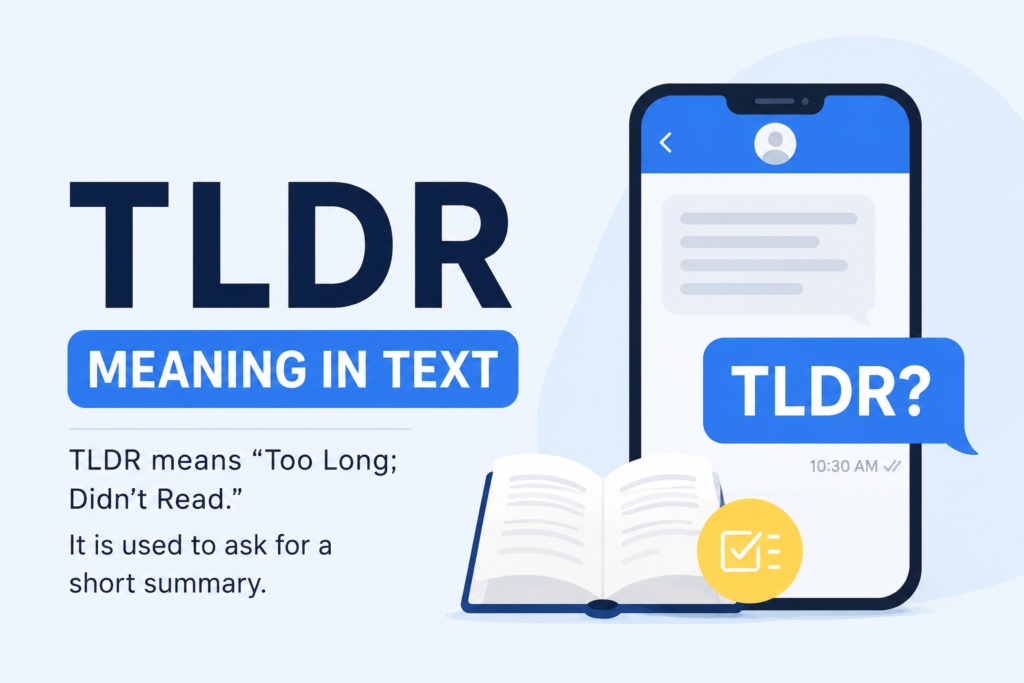
TLDR means too long; did not read. It is used to introduce a short summary of a longer piece of writing. Someone may place it at the beginning when they want to give readers the main point quickly, or at the end after a long explanation as a quick recap.
The expression started in internet culture, but it has become common enough to appear in ordinary digital communication. Its tone can be casual, humorous, practical, or slightly blunt depending on the situation. This guide explains what it means, where it came from, how people use it in chat and email, and what it communicates in different online communities.
Quick Answer
TLDR means too long; did not read. It usually introduces a short summary of a longer message, article, discussion, or explanation. In text messages and online conversations, someone may write TLDR: before the main point. It is especially useful when readers want the essential information without reading the entire text.
For example:
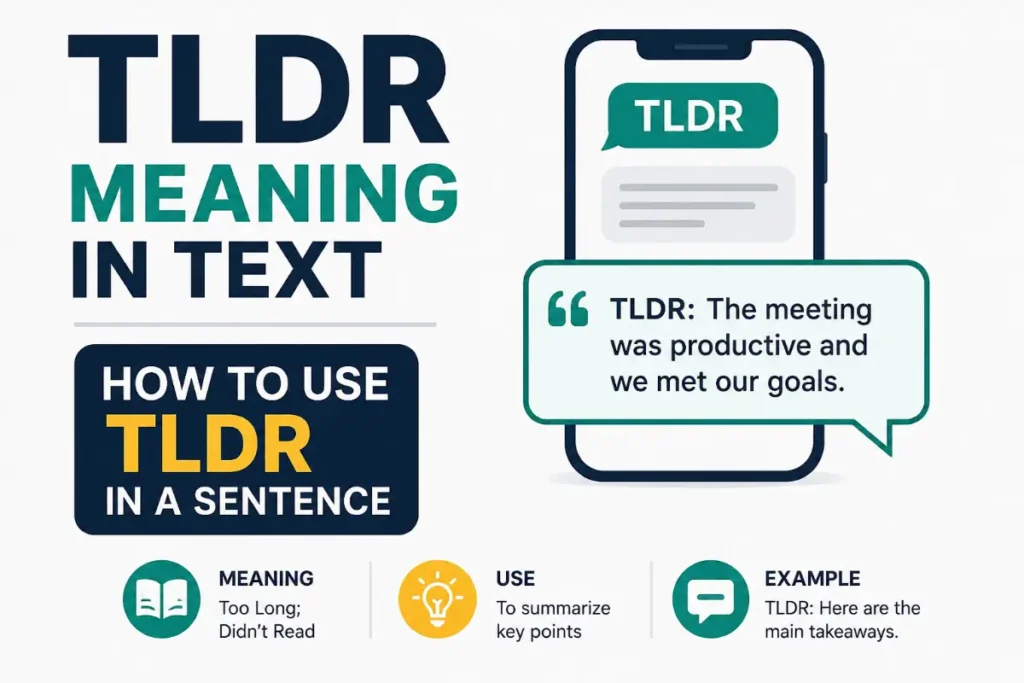
TLDR: The meeting moved to Friday at 10 AM.
The writer is saying that the longer message contains more details, but the sentence after TLDR gives you the main takeaway.
If you’re unsure about the phrase, understanding what kickback means can help you interpret the conversation more accurately.
What Does TLDR Mean
The abbreviation comes from the phrase too long; did not read. It originally described a reaction to a long piece of writing that someone chose not to read in full.
Over time, its use changed. Today, TLDR often acts as a label for a summary rather than a literal confession that the writer did not read something.
For example, someone might post several paragraphs explaining a complicated problem and then write:
TLDR: The update fixed the main issue but created a new login problem.
In this case, the writer probably did read the material. They are simply giving readers a quick version of the main point.
That distinction matters because the abbreviation has developed a more useful meaning in modern digital communication. It can now mean something close to short version, brief summary, or main takeaway.
The punctuation also varies. You may see TLDR, TL;DR, TL;DR:, or TLDR:. All of these forms are recognizable.
TLDR Meaning In Text
In text messages, TLDR usually means that the person is about to summarize something.
Imagine that a friend sends you a long explanation about why dinner plans changed. After several paragraphs, they write:
TLDR: We are meeting at 8 instead of 7.
You do not need to read every detail to understand the practical information.
People also use it when they want to summarize something they have just discussed.
For example:
TLDR: I like the idea but I think we should wait until next month.
This gives the recipient the central point immediately. In casual texting, the abbreviation can also be playful. Someone might send a huge story and then joke:
TLDR: I should have stayed home.
The humor comes from reducing a complicated story to one simple sentence.
TLDR Meaning In Chat
In online chat, the abbreviation works much like a verbal shortcut.
People often use it when conversations become long or complicated. A group chat can quickly accumulate dozens of messages, especially when several people are discussing plans, solving a problem, or debating an issue.
A participant might write:
TLDR: Alex will bring the food. Sam is bringing drinks. We still need someone to bring plates.
That summary saves everyone time. You may also see someone ask:
TLDR?
This means they are asking for the main point or a quick summary.
The request is usually informal. It does not necessarily mean the person is being rude or refusing to read. They may simply want the essential information before deciding if the full conversation is worth reading.
TLDR Meaning In Email
Email is one of the places where the abbreviation can be particularly useful.
People often receive long messages containing background information, explanations, meeting notes, project details, or several requests. A short summary can help readers understand the purpose of the email before they read everything else.
For example:
TLDR: Please approve the revised budget by Thursday.
The rest of the email might explain the changes, costs, and reasons behind the proposal. This structure works well because busy readers can identify the main action quickly.
However, there is an important difference between casual and professional email.
In a relaxed workplace, TLDR may be perfectly acceptable. In a formal business environment, client communication, legal correspondence, or executive communication, a phrase such as Summary, Key takeaway, or In short may sound more polished.
The best choice depends on your relationship with the reader and the tone of the organization.
How To Use TLDR In A Sentence
The abbreviation is flexible because people use it as a label rather than as a normal grammatical word.
Common formats include:
- TLDR: The project is delayed until next week.
- TL;DR: We need more time to test the update.
- TLDR, the results were better than expected.
- TLDR? The meeting starts at nine.
- My TLDR is that the plan needs more work.
The first format is probably the easiest and clearest for most online writing.
When used as a summary label, putting a colon after it makes the structure immediately obvious.
TLDR At The Beginning Or End
You can place the abbreviation in different parts of a message depending on your purpose.
At The Beginning
Putting the summary first helps readers who want the answer immediately.
For example:
TLDR: The event has been canceled because of the weather.
Then you can explain the background below it.
This approach works especially well for announcements, project updates, and long workplace messages.
At The End
Putting the summary at the end can work when the reader is expected to understand the explanation before seeing the conclusion.
For example:
You might describe a technical problem, explain what caused it, discuss the attempted solutions, and then finish with:
TLDR: We need to replace the server.
This format is common in online discussions because readers can choose to read the full explanation or jump directly to the takeaway.
TLDR Vs Summary
The two ideas are closely related, but they have different tones.
Summary is neutral and works in almost any setting.
TLDR is informal and strongly associated with internet culture and digital communication.
Compare these examples:
Summary: The report found that customer satisfaction increased after the redesign.
TLDR: Customers liked the redesign more.
Both communicate the same basic idea. The first sounds professional and neutral. The second sounds more conversational.
For a school paper or formal business report, summary is generally the safer label. For Reddit, Discord, group chats, casual blogs, or informal messages, TLDR can feel completely natural.
TLDR Vs In Short
In short is another common alternative.
For example:
In short, the proposal is too expensive.
This sounds natural in both conversation and writing.
TLDR: The proposal is too expensive.
This feels more internet-oriented.
The difference is mostly about register and audience. In short belongs to general English, while TLDR carries a stronger digital and informal identity.
TLDR Vs In A Nutshell
In a nutshell means that you are giving the essential idea in a compact form.
For example:
In a nutshell, the company needs to reduce costs.
This expression is conversational but not specifically tied to internet culture.
TLDR is more direct and more closely associated with online communication.
If you are writing for a broad audience, in a nutshell may feel more natural. If you are writing for an online community that frequently uses internet abbreviations, TLDR may fit better.
Why People Use TLDR
The popularity of the abbreviation comes down to a simple problem: people have limited attention.
Long articles, emails, forum posts, reports, and messages can contain useful information, but readers often want to know the main point first.
A good summary solves that problem.
People use this abbreviation to:
- Give readers the main point quickly.
- Make long posts easier to scan.
- Highlight an important conclusion.
- Summarize a complicated discussion.
- Help readers decide if the full text is worth reading.
- Add a humorous ending to a long story.
- Make lengthy online conversations easier to follow.
Used well, it is not simply an excuse for avoiding long text. It is a navigation tool.
Is TLDR Rude
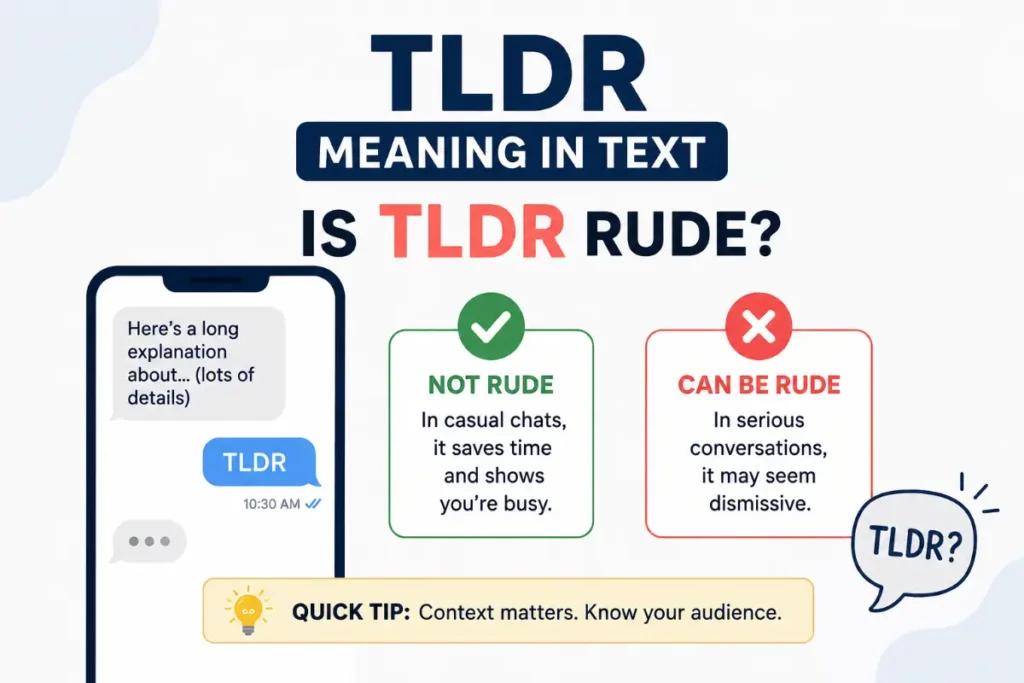
Sometimes it can sound rude, but the abbreviation itself is not automatically rude. Tone depends heavily on context. If someone responds to your carefully written message with:
TLDR
it can sound dismissive. They may be saying that your message was too long and they did not bother reading it.
On the other hand, if someone writes:
TLDR: Here is the main point for anyone in a hurry.
the intention is helpful. The same four letters can therefore communicate very different attitudes.
Context, punctuation, surrounding words, and the relationship between the speakers all matter. A good rule is to avoid using it as a criticism of someone else’s writing unless you know they will understand the joke.
When TLDR appears alongside other abbreviations, knowing CW in texting can also help clarify the intended message.
Is TLDR Sarcastic
It can be.
Internet users sometimes place TLDR before an intentionally oversimplified or humorous summary.
For example:
Someone might write five paragraphs describing an exhausting road trip and then end with:
TLDR: Bad GPS. Wrong turn. Cold food. Never again.
The summary is technically accurate, but the dramatic reduction creates the joke.
This use is especially common in casual online communities where humor and understatement are part of the communication style.
TLDR On Reddit
On Reddit, the abbreviation is especially recognizable.
Long posts are common on discussion forums, particularly when users share personal stories, explanations, reviews, arguments, technical problems, or detailed opinions.
A writer may include a summary near the bottom:
TLDR: The product worked well for six months, then the battery started failing.
Readers who want the full story can continue reading. Readers who only want the conclusion can stop there.
You may also see users ask for a summary of a very long post. In that context, the abbreviation can function almost like a request for a quick explanation.
The exact tone depends on the subreddit and the people involved. Some communities use internet abbreviations constantly, while others prefer ordinary language.
TLDR On TikTok
TikTok is primarily a visual and video platform, but the abbreviation can still appear in captions, comments, direct messages, and discussions surrounding longer explanations.
Someone may use it to summarize a story in a caption or reduce a complicated situation to one sentence.
For example:
TLDR: I bought the cheaper option and regretted it.
The phrase works because users often want quick context before deciding to watch or read more.
On social media, concise language has become especially useful. People scroll quickly, and a short summary can communicate the point without requiring a large block of text.
TLDR On ChatGPT
People also use the abbreviation when interacting with AI tools and chat assistants.
A user might ask:
Give me the TLDR.
They are asking for the shortest useful summary of the information.
They might also write:
TLDR only.
That usually means they want the conclusion without a detailed explanation.
Another common request is:
Can you give me a TLDR of this article?
The user wants the main ideas condensed into a much shorter form.
The abbreviation has therefore moved beyond traditional internet forums and into everyday interactions with digital tools.
TLDR In Corporate Communication
Workplace usage is more complicated because corporate communication ranges from extremely casual to highly formal.
In a relaxed team environment, you might see:
TLDR: We are pushing the launch to Monday.
That can be perfectly understandable.
However, the same phrase may look too casual in communication with a client, executive, legal department, or external partner.
In those situations, consider alternatives such as:
Key takeaway
Executive summary
In brief
Summary
Main point
These options communicate the same function without the internet slang.
When TLDR Works At Work
It is generally more comfortable in:
- Internal team chats.
- Informal project discussions.
- Slack conversations.
- Friendly workplace emails.
- Casual team updates.
When To Avoid It
A more formal alternative is usually better in:
- Legal documents.
- Formal proposals.
- Academic papers.
- Client contracts.
- Official reports.
- High level executive correspondence.
The goal is not to eliminate informal language. The goal is to match your language to your audience.
TLDR In Research
Research papers and academic articles often contain long explanations, methods, findings, and discussions. The concept behind a short summary is therefore extremely useful in research, even though the abbreviation itself may not belong in formal academic prose.
Academic writing already has established structures for this purpose.
An abstract gives readers a condensed overview of a research paper.
A summary can explain the main findings.
A conclusion presents the final interpretation.
A key findings section can highlight the most important results.
Using TLDR in a formal research paper would usually make the writing feel too casual. However, you might encounter it in a research discussion forum, social media post, blog, newsletter, or informal explanation of academic work.
For example:
TLDR: The study found a strong connection between sleep and memory performance.
That sentence can be useful when explaining research to a general audience.
TLDR In Online Culture
The abbreviation is part of a larger family of internet shorthand.
People use short forms because online communication rewards speed and convenience. Some expressions are practical, while others became popular because they captured a particular tone.
Related examples include:
BTW meaning by the way.
FYI meaning for your information.
IMO meaning in my opinion.
IDK meaning I do not know.
TBH meaning to be honest.
BRB meaning be right back.
TLDR belongs to this same broad culture of abbreviated digital language, although its function is different. Instead of describing the speaker’s reaction or action, it usually introduces a condensed version of information.
Is TLDR Always Written In Capital Letters
No.
You may see:
TLDR
TL;DR
tldr
tl;dr
Capital letters are common because the expression began as an initialism. However, internet language tends to be flexible.
The semicolon comes from the original phrase too long; did not read, where the punctuation separates the two parts.
Modern users often omit the punctuation and simply write TLDR because it is quicker and visually cleaner.
All of these forms are widely recognizable in informal digital communication.
Is TLDR An Acronym Or Initialism
This question has a slightly technical answer.
TLDR is often called an acronym in everyday usage, but it is more precisely described as an initialism when each letter is pronounced separately.
People normally say the individual letters rather than pronouncing the abbreviation as a single word.
The distinction is useful for language enthusiasts, but it does not affect how you use the expression.
In ordinary conversation, calling it an acronym will rarely cause confusion.
How To Write A Good TLDR
A useful summary is not simply a shorter version of every sentence. It identifies the information that matters most.
A strong summary usually does three things.
- State the main point.
Tell readers what the longer message is ultimately saying.
- Keep only useful details.
Remove background information that does not change the conclusion.
- Make it understandable on its own.
A reader should be able to understand the summary without needing to decode vague references.
For example, this is weak:
TLDR: It did not work.
The reader does not know what it refers to.
A stronger version is:
TLDR: The new payment system failed during testing and needs another week of development.
The second version gives enough context to stand on its own.
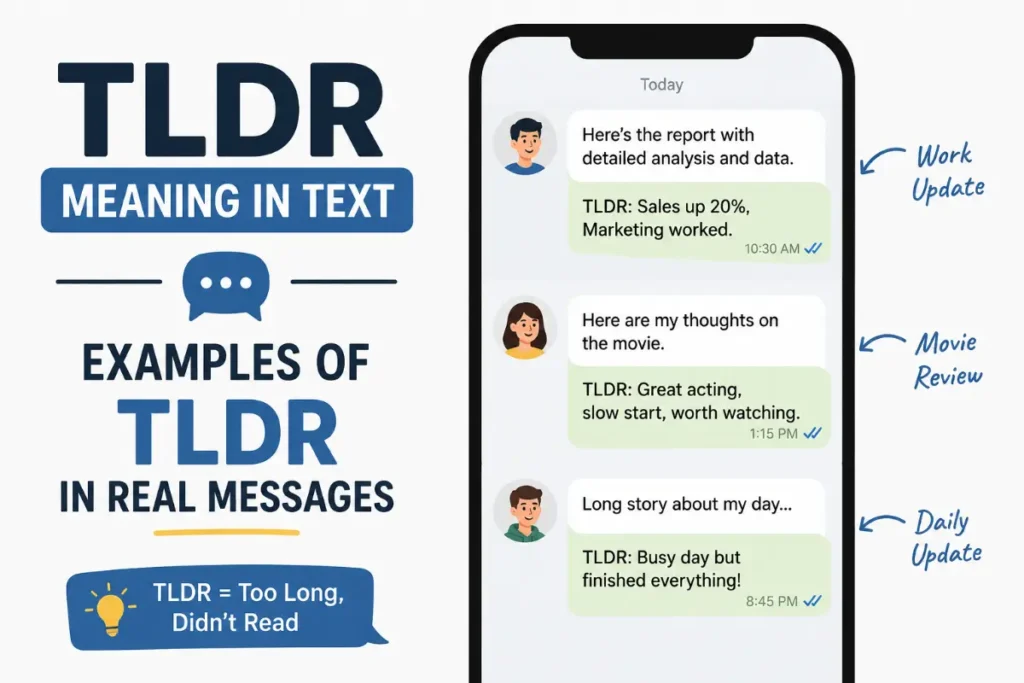
Examples Of TLDR In Real Messages
Here are natural examples showing how people might use the abbreviation.
- TLDR: The flight was delayed but we still arrived before midnight.
- TLDR: I like the apartment, but the rent is too high.
- TLDR: The update improved performance but caused a login problem.
- TLDR: We need three more volunteers for Saturday.
- TLDR: The restaurant was good, but the service was slow.
- TLDR: I finished the report and sent it to the manager.
- TLDR: The cheaper laptop is actually the better option for this project.
- TLDR: The meeting is canceled and will be rescheduled next week.
These examples show why the expression is useful. Each summary gives the reader a practical conclusion without repeating the entire explanation.
For messages involving symbolism or expressions of affection, the meaning of a red rose can add useful context to what someone is trying to convey.
Common Mistakes With TLDR
People sometimes misunderstand the expression because its original meaning and modern use are slightly different.
Mistake One
Assuming it always means the writer did not read something.
Today, it often introduces a summary written by the person who created the original content.
Mistake Two
Using it in every professional situation.
The abbreviation is casual. A formal audience may prefer summary or key takeaway.
Mistake Three
Writing an unclear summary.
A short sentence is not useful if the reader cannot understand what it refers to.
Mistake Four
Using it as an insult.
Writing TLDR in response to someone’s long message can sound dismissive. Use it carefully when you are talking about someone else’s writing.
Mistake Five
Thinking only one spelling is correct.
TLDR and TL;DR are both recognizable forms. Internet language does not follow one rigid formatting standard.
TLDR And Other Summary Expressions
Choosing the right expression depends on tone.
| Expression | Tone | Best Use |
|---|---|---|
| TLDR | Casual | Chats and online posts |
| TL;DR | Casual | Forums and social media |
| Summary | Neutral | General writing |
| In short | Conversational | Articles and explanations |
| In brief | Neutral | Professional writing |
| Key takeaway | Professional | Work and presentations |
| Executive summary | Formal | Business and reports |
| Abstract | Academic | Research papers |
| Bottom line | Conversational | Advice and business |
This table also shows why knowing the abbreviation is not enough. Good communication involves choosing language that fits the audience.
The Difference Between TLDR And Summary
The biggest difference is tone.
Summary is a standard English word with no strong connection to internet culture.
TLDR carries an informal digital tone.
If you write:
Summary: The proposal recommends expanding the program.
the sentence sounds neutral.
If you write:
TLDR: Expand the program.
the sentence feels shorter, more direct, and more casual.
Both can communicate the same basic idea, but they create different impressions.
Should You Use TLDR In A Work Email
You can use it if the workplace culture is informal and your audience is comfortable with internet shorthand.
For example:
TLDR: We approved the new schedule and will start next Monday.
That may work well in an internal email.
For a client, formal proposal, or executive document, Key takeaway or Summary would usually be a better choice.
The safest approach is to match the style already used by your organization. If your workplace communication is full of abbreviations, the expression will probably feel natural. If messages are formal and carefully written, spell out the idea instead.
Why TLDR Became So Useful
The expression reflects a broader change in how people read online.
Digital readers often scan before they commit to reading. They look at headings, bold text, short paragraphs, lists, and summaries to decide what deserves their attention.
A clear summary helps them make that decision.
This is why you often see short explanations at the beginning or end of long online content. The reader gets the main point quickly and can then decide if the details are worth exploring.
Used thoughtfully, a summary label respects the reader’s time without removing the deeper information for people who want it.
Final Takeaway
The phrase TLDR stands for too long; did not read, but its modern use is broader than the literal words suggest. Today, it commonly introduces a short summary of a longer message, article, conversation, post, or explanation.
In text and chat, it helps people get the main point quickly. In emails, it can highlight an important conclusion. On Reddit and other online communities, it often appears after a long post as a quick recap. On social platforms such as TikTok, it can reduce a complicated story to one memorable sentence.
The expression is informal, so use it freely in casual digital conversations but think about your audience in professional or formal settings. Summary, key takeaway, in brief, and executive summary are better choices when the situation calls for a more polished tone. The simplest way to remember it is this: TLDR is a shortcut to the main point.