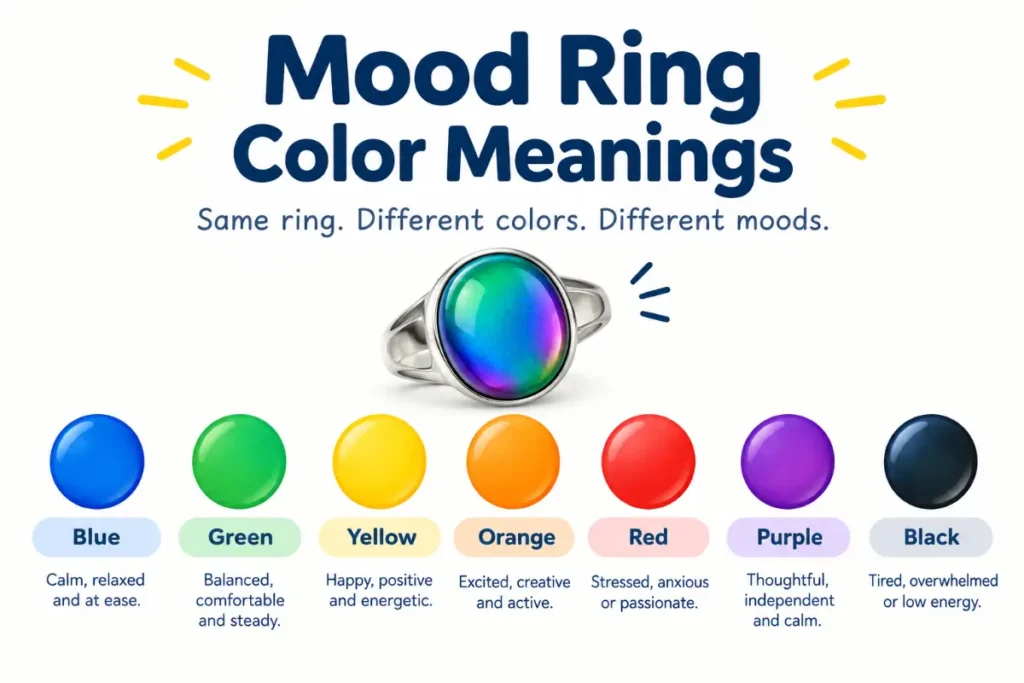
Mood rings have fascinated people for decades because their colors seem to reflect emotions. One moment, a ring may look blue, and a little later, it may turn green, purple, or black. These changes make mood rings fun to wear and interesting to interpret, especially when you want to connect a color with how you feel.
Understanding mood ring color meanings starts with one important fact: mood rings do not directly read your emotions. They contain temperature sensitive materials that change color as the temperature of your skin changes. Since your skin temperature can shift with your surroundings, circulation, activity, and stress responses, the color may sometimes appear to match your mood. However, it cannot reliably tell you exactly what you are feeling.
Most mood rings use a color changing liquid crystal material sealed beneath a clear surface. Each color represents a temperature range, and manufacturers often assign emotional meanings to those colors. Blue is commonly associated with calmness, green with balance, purple with excitement or affection, and black with tension or a cold ring. The exact meanings can vary by brand.
This guide explains the common colors, provides a practical mood ring chart, and explores how temperature affects the results. You will also learn how to interpret purple, brown, rainbow, and other colors, along with answers to common questions about wearing and using mood rings.
Quick Answer
Mood ring colors are commonly interpreted as emotional clues. Blue often represents calmness, green suggests balance, purple is associated with excitement or affection, yellow may indicate nervous energy, and black is traditionally linked with tension. However, these meanings are symbolic, not scientific measurements of emotion. Mood rings change color in response to skin temperature, so the same person may see different colors without experiencing a change in mood.
Mood Ring Color Chart
A mood ring color chart helps you understand the emotions traditionally associated with each shade. Although manufacturers may use slightly different color scales, most mood rings follow similar patterns. Blue and green are generally associated with relaxed or balanced states, while warmer shades such as yellow and orange are often linked with excitement or nervousness.
The chart below covers the most common colors and their traditional interpretations. Treat these meanings as a fun guide rather than a reliable way to measure emotions.
| Mood ring color | Common emotional meaning | Possible temperature association |
|---|---|---|
| Black | Tension, discomfort, or a cold ring | Often relatively cool |
| Gray | Nervousness, uncertainty, or uneasiness | Often cool to moderate |
| Brown | Restlessness, stress, or mixed feelings | Often moderate or changing |
| Amber or yellow | Nervous energy, alertness, or excitement | Often moderate to warm |
| Orange | Excitement, enthusiasm, or unsettled energy | Often warmer |
| Green | Balance, calmness, or a comfortable state | Often near the material’s middle range |
| Blue green | Relaxation, ease, or contentment | Often moderately warm |
| Blue | Calmness, comfort, or relaxation | Often warm for that ring |
| Dark blue | Deep relaxation, affection, or a peaceful mood | Often near the warmer end |
| Purple | Passion, excitement, affection, or imagination | Often warm, depending on the product |
| Pink | Affection, happiness, or playfulness | Varies by product |
| Rainbow or multicolor | Multiple colors appearing at once due to temperature differences or transition | Different areas may have different temperatures |
These interpretations are not standardized scientific categories. One brand may label a shade as happy, while another may describe the same shade as relaxed. Always check the color guide that came with your ring if you want to follow its manufacturer’s definitions.
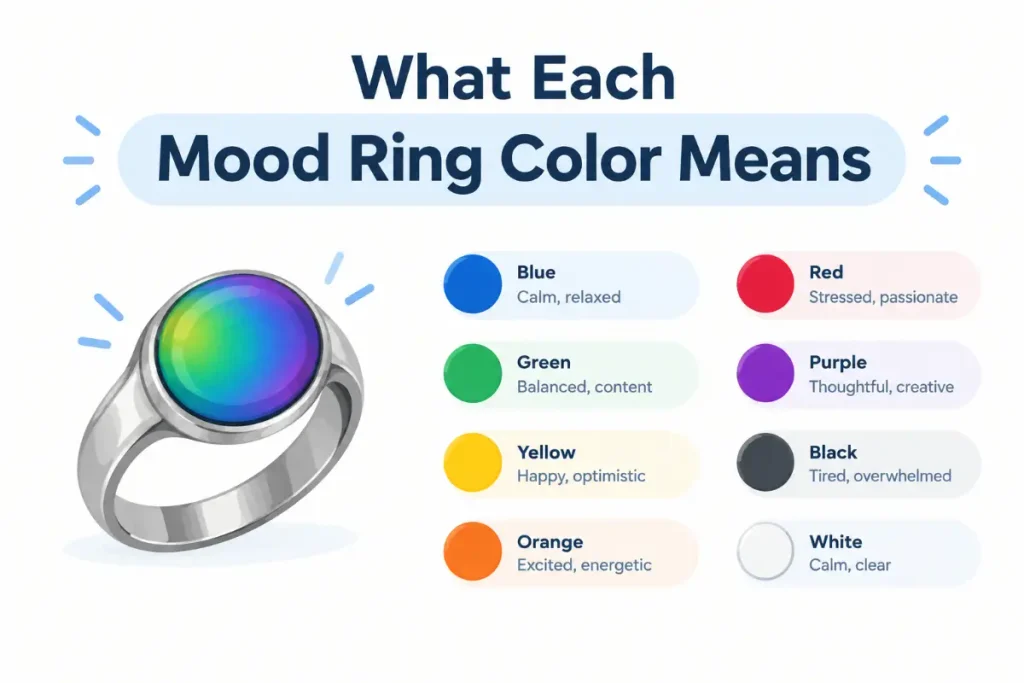
What Each Mood Ring Color Means
The color of a mood ring can be a conversation starter, a playful accessory, or a reminder to check in with yourself. Understanding the traditional associations makes the experience more enjoyable, as long as you remember that color alone cannot confirm an emotional state.
Blue Mood Ring Meaning
Common association: calmness and relaxation.
Blue is one of the colors most commonly associated with a positive mood on traditional mood rings. It is often interpreted as a sign of calmness, comfort, contentment, or emotional ease. Darker blue shades may be described as deep relaxation or affection.
If your ring turns blue while you are reading, listening to music, or spending time with friends, you might connect the color with feeling comfortable. However, the ring is responding to temperature rather than measuring your emotional state.
Blue can also appear when your hands are warm because of the room temperature, physical activity, or other environmental factors. You may feel stressed and still see blue, just as you may feel relaxed and see another color.
Green Mood Ring Meaning
Common association: balance and a comfortable state.
Green is traditionally linked with balance, steadiness, and a neutral or comfortable mood. Some mood ring charts describe it as a sign of feeling centered, grounded, or emotionally stable.
This interpretation makes green a useful symbolic reminder to pause and consider how you are doing. For example, you might use the color as a prompt to notice your energy level, take a short break, or appreciate a peaceful moment.
Green does not prove that your emotions are balanced. The color simply reflects the temperature range of the ring’s liquid crystals, which can be affected by many factors beyond your mood.
Purple Mood Ring Meaning
Common association: affection, excitement, and passion.
Purple is often associated with strong positive feelings, imagination, affection, and excitement. Some charts connect lighter purple shades with playfulness or romantic interest, while darker purple may represent passion or a more intense emotional state.
The mood ring color meanings purple interpretation can vary from one product to another. A manufacturer may describe purple as happy or loving, while another may associate it with heightened emotion or creativity. There is no universal system that assigns one precise feeling to purple.
If you enjoy symbolic interpretations, purple can serve as a reminder to make time for creativity, connection, or activities that bring you joy. Just remember that the color is not evidence that you are in love, excited, or experiencing any particular emotion.
Yellow Mood Ring Meaning
Common association: nervousness, alertness, or mental activity.
Yellow is often interpreted as a sign of nervous energy, curiosity, alertness, or excitement. Some mood ring charts connect it with a busy mind or a state of heightened awareness.
For example, a yellow ring might appear during a lively conversation or while you are concentrating on a task. You might interpret it as a reminder to slow down and notice how you feel.
However, yellow does not necessarily mean anxiety. It can simply indicate that the ring is within a particular temperature range. Different manufacturers may assign yellow a slightly different emotional label.
Orange Mood Ring Meaning
Common association: excitement and restless energy.
Orange often represents enthusiasm, excitement, creativity, or a restless state. Some traditional charts associate it with feeling energetic or emotionally stirred.
If your ring turns orange, you can use it as a playful opportunity to check in with yourself. Are you excited about something? Are you feeling impatient? Or are you simply in a warm environment?
The color cannot answer those questions for you. Your own feelings and circumstances provide much better information than the ring alone.
Red Mood Ring Meaning
Common association: energy, passion, or heightened emotion.
Red is commonly associated with passion, energy, excitement, and intense feelings. Some charts describe it as a sign of strong emotions, while others connect it with physical activity or nervous energy.
Red can also carry cultural associations with love, courage, urgency, and anger. These meanings come from broader color symbolism, not from a mood ring’s ability to identify those emotions.
If your ring displays red, it does not automatically mean you are angry or in love. The shade may simply reflect a particular temperature range in the material.
Black Mood Ring Meaning
Common association: tension or a relatively cool ring.
Black is often described as a sign of stress, discomfort, or a negative mood in traditional mood ring charts. However, a black ring may also indicate that the liquid crystal material has become too cool to display its usual range of colors.
Cold weather, air conditioning, washing your hands with cool water, or taking the ring off for a while can all affect its appearance. A ring that remains black may have a temperature related issue or may be damaged.
Do not assume that a black mood ring means you are upset. Check the temperature and condition of the ring before interpreting its color.
Brown Mood Ring Meaning
Common association: restlessness, uncertainty, or stress.
Brown is sometimes associated with uneasiness, frustration, nervous energy, or mixed emotions. Its exact meaning depends on the chart provided with the ring.
Brown may appear during a transition between colors, particularly if the ring is warming up or cooling down. The material, lighting, and condition of the ring can also influence how the shade looks.
The mood ring color meanings brown interpretation should therefore be treated as symbolic rather than definitive. A brown shade does not prove that you are worried or emotionally unsettled. If you feel fine, there is no reason to let the ring convince you otherwise.
Gray Mood Ring Meaning
Common association: uncertainty or nervousness.
Gray is often linked with nervousness, uncertainty, or feeling unsettled. On some rings, it appears when the material is relatively cool or when the color is transitioning.
Because gray can look similar to silver, black, or a muted blue, lighting may affect how you identify it. The shade might also differ from the color shown in the manufacturer’s chart.
If your ring turns gray, treat the label as a traditional interpretation rather than a diagnosis of your emotional state.
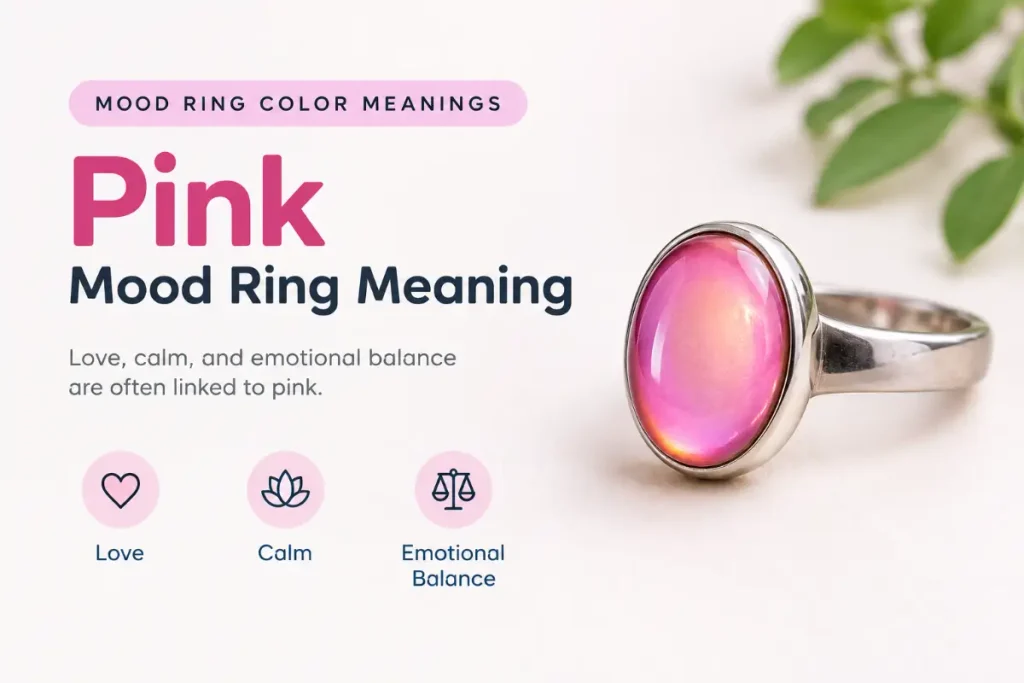
Pink Mood Ring Meaning
Common association: affection, happiness, or playfulness.
Pink is sometimes associated with affection, warmth, romance, or a playful mood. It can be a particularly appealing color for people who enjoy using mood rings as accessories with personal meaning.
Some rings display pink as a distinct color, while others show it as a light shade between red and purple. The interpretation depends on the product’s color scale.
Pink does not confirm romantic feelings or happiness. It is simply another shade that can be used as a lighthearted reminder to reflect on your emotions.
Mood Ring Color Meanings for Adults
For adults, mood rings can be more than nostalgic jewelry. They can serve as conversation starters, fashion accessories, or playful reminders to pay attention to personal feelings. Some adults enjoy the traditional emotional associations, while others simply like watching the colors change.
The mood ring color meanings for adults are generally the same as those used for children. Blue is associated with relaxation, green with balance, purple with affection or excitement, and yellow with nervous energy. These interpretations are not age specific, and the ring cannot determine an adult’s emotional state.
Adults can use mood rings as a starting point for self reflection. If you notice a color change, take a moment to ask yourself how you feel and what might be affecting your energy. Your own observations are more reliable than the color itself.
Mood rings can also make thoughtful novelty gifts for birthdays, holidays, or people who enjoy retro fashion. Their appeal comes from the combination of changing colors, personal interpretation, and simple curiosity.
Mood Ring Color Meanings for Kids
Mood rings can be a fun way for children to learn about colors and talk about emotions. A child might see blue and associate it with feeling calm, or see yellow and wonder if it means excitement. These conversations can encourage children to describe their feelings and recognize that emotions can change throughout the day.
For mood ring color meanings kids can understand, keep the explanations simple and flexible. Explain that blue is often called a calm color, green can represent feeling balanced, and purple may be associated with excitement or affection. Make it clear that these are traditional interpretations, not rules that tell children how they feel.
For example, if a child says their ring is yellow but they feel happy, there is nothing wrong with that. The ring does not know their emotions. Children should feel comfortable describing their own experiences instead of changing their answers to match the color chart.
Mood rings can support conversations about feelings, but they should never replace listening to children or helping them express difficult emotions. The best lesson is that every emotion is valid, and a color does not define it.
Mood Ring Color Meanings and Temperature
Temperature is the main factor behind mood ring color changes. Most traditional mood rings contain thermochromic liquid crystals, which change how they reflect light as their temperature changes. These materials are sealed inside or beneath the ring’s transparent surface.
Each liquid crystal formulation responds to a particular temperature range. As the ring warms or cools, its appearance shifts through colors associated with those ranges. The effect can look like an emotional response, but the mechanism is physical rather than psychological.
How Skin Temperature Changes the Color
Your fingers do not maintain exactly the same temperature throughout the day. Blood circulation, room temperature, physical activity, contact with objects, and exposure to cold or warm water can all affect the temperature at your skin.
Stress and other emotional experiences can sometimes influence peripheral blood flow, which may change the temperature of your fingers. That creates a possible indirect connection between your emotional state and the ring’s color. However, this relationship is inconsistent, and the ring cannot identify a specific emotion.
The same ring may show blue in a warm room and turn darker after you step outside into cold weather. Your emotional state may remain unchanged throughout both situations.
Why Different Mood Rings Show Different Colors
Not all mood rings use identical liquid crystals or temperature ranges. Some products display a broad sequence of colors, while others show only a few shades. The ring’s construction, calibration, age, and lighting can also affect the colors you see.
This explains why one mood ring might display purple at a particular temperature while another shows blue or green. Their color charts may also assign different emotional meanings to similar shades.
For accurate interpretation of the product, use the manufacturer’s chart rather than assuming every mood ring follows the same color scale.
Mood Ring Color Meanings Rainbow
A rainbow mood ring displays several colors at once or shifts through a sequence of different shades. This effect can look especially interesting because the colors may blend together or change as you move your hand.
The mood ring color meanings rainbow interpretation often centers on change, variety, and mixed emotions. Some people associate rainbow colors with happiness, creativity, or emotional complexity. However, a rainbow effect does not mean that you are experiencing several emotions at once.
Multiple colors can appear because different areas of the ring are at different temperatures. The liquid crystals may also be transitioning between colors, creating a multicolored appearance. Lighting and the way you view the ring can make the effect more noticeable.
If your ring shows a rainbow pattern, enjoy the visual effect rather than treating it as a precise emotional reading. The pattern reflects the material’s response to temperature, not a reliable assessment of your feelings.
Does a Mood Ring Actually Work?
Yes, a mood ring works as a temperature sensitive accessory. It can detect changes in the temperature of the material inside the ring and display different colors in response. However, it does not directly measure emotions or reliably identify your mood.
The distinction matters because emotional states are complex. Happiness, sadness, anger, and anxiety cannot be identified accurately from a single skin temperature reading. Many physical and environmental factors influence your fingers’ temperature, so the same color can appear during different emotional experiences.
Mood rings are best enjoyed as novelty jewelry rather than scientific instruments. They can encourage curiosity about feelings, but they cannot replace self awareness, direct communication, or professional mental health support.
Why Is My Mood Ring Always Blue?
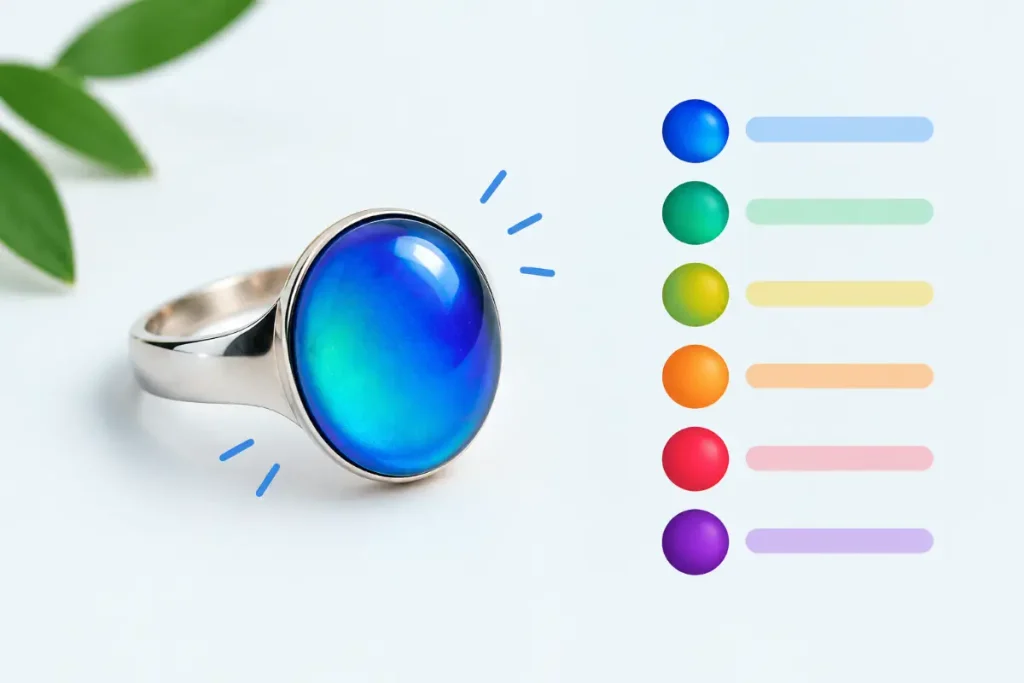
If your mood ring is always blue, the most likely explanation is that the material is staying within a temperature range associated with that shade. Your fingers may be warm enough to keep the ring in its blue range, or the ring may have a limited color response.
Before assuming anything about your mood, consider a few practical explanations.
1. Your hands are consistently warm. Room temperature, circulation, and daily activities can keep your fingers within a similar temperature range.
2. The ring has a limited color scale. Some products display only a small selection of colors, even if other mood rings show a wider range.
3. The ring needs time to respond. Temperature sensitive materials may take a little time to adjust after you move between different environments.
4. The ring may be damaged. If it never changes color, even after gradual temperature changes, the liquid crystal material may no longer be working correctly.
Blue traditionally represents calmness and relaxation, but a permanently blue ring does not mean you are always calm. It simply indicates that the ring is not displaying other colors under the conditions you have tested.
What Color on a Mood Ring Means Angry?
Red, orange, brown, and black are sometimes associated with anger, frustration, tension, or heightened emotions in traditional mood ring charts. However, there is no scientifically established mood ring color that specifically means anger.
A person might feel angry while wearing a blue ring, or feel completely relaxed while the ring displays red. Skin temperature alone cannot distinguish anger from excitement, physical activity, or other experiences.
If you want to understand your anger, pay attention to your thoughts, physical sensations, and the situation that triggered the feeling. A mood ring can be a conversation starter, but it cannot tell you what you are experiencing.
What Finger Do You Wear Your Mood Ring On?
You can wear a mood ring on any finger that feels comfortable. There is no scientific rule requiring a particular finger, and the finger you choose does not determine the ring’s emotional meaning.
Your choice may affect how the ring fits and how much it comes into contact with your surroundings. A snug ring may respond differently from a loose one because contact with your skin influences heat transfer. However, comfort and a suitable fit matter more than choosing a specific finger.
Some people prefer the index finger because the ring is easy to notice, while others wear it on the middle finger or ring finger as part of their usual jewelry style. Choose the finger that feels best and allows the ring to sit comfortably against your skin.
How to Read a Mood Ring Correctly
To get the most consistent color changes from your ring, give it time to adjust to your skin temperature. Avoid interpreting its color immediately after washing your hands, going outside in cold weather, or holding a hot object.
Keep these practical tips in mind.
- Allow the ring to settle against your skin before checking its color.
- Compare the shade with the chart provided by the manufacturer.
- Check the ring under consistent lighting because surrounding light can change how a color appears.
- Avoid exposing the ring to extreme heat or cold, which may damage its materials.
- Treat emotional descriptions as traditional associations rather than scientific results.
With these steps, you can enjoy the changing colors without expecting the ring to provide an accurate reading of your emotions.
Conclusion
Mood ring color meanings offer a fun way to explore the traditional associations between colors and emotions. Blue is commonly linked with calmness, green with balance, purple with affection or excitement, and yellow with nervous energy. Brown, black, red, and rainbow patterns have their own interpretations, although the exact meanings vary by manufacturer.
The most important fact is that mood rings respond to temperature rather than directly detecting feelings. Your surroundings, circulation, and physical activity can all affect the color you see. Use your ring as an entertaining accessory or a reminder to check in with yourself, but trust your own feelings instead of letting a color define your mood.