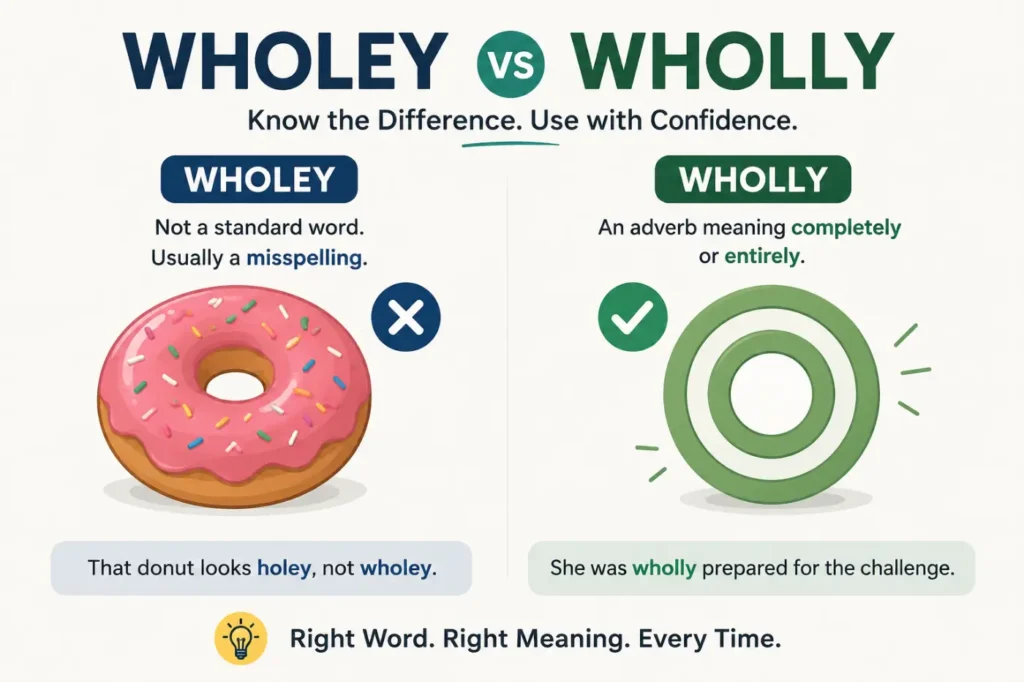
The difference between wholey vs wholly comes down to one important spelling rule. Wholly is the correct standard English word. Wholey is generally a misspelling.
The confusion is understandable because the word is pronounced in a way that can make the spelling feel uncertain. The pronunciation sounds close to holy, while the meaning is connected to ideas such as completely, entirely, and fully. Many writers also see the word whole and naturally assume that adding ly should create wholey. English does not always follow that kind of simple pattern.
This guide gives you a clear answer and explains the reasoning behind it. You will learn the meaning of wholly, its pronunciation, its word origin, its grammar, its common synonyms, and the difference between wholly and related words such as solely, entirely, and completely. You will also see natural sentence examples and practical advice from an editorial perspective so you can recognize the correct spelling immediately when writing.
Quick Definition
Wholly is the correct spelling. It is an adverb meaning completely, entirely, or fully. For example, The decision was wholly unexpected means the decision was completely unexpected. Wholey is not the standard spelling of this word and is usually a misspelling.
Quick Answer
Use wholly when you mean completely, entirely, or fully. The spelling wholey is incorrect in standard English. The confusion usually comes from the word whole, but the adverb is formed as wholly, with the final e removed before ly is added.
For example:
- The plan was wholly successful.
- She was wholly responsible for the decision.
- The argument was wholly unconvincing.
Just as writers often confuse spelling differences in conex and connex, it’s worth checking which form is accepted in your specific industry or region before publishing.
Comparison Table
| Feature | Wholly | Wholey |
|---|---|---|
| Standard spelling | Yes | No |
| Part of speech | Adverb | Not a standard English word |
| Meaning | Completely entirely or fully | Usually intended to mean wholly |
| Origin | Developed from whole and the adverbial suffix ly | Common spelling mistake |
| Formality level | Standard and suitable for formal writing | Nonstandard |
| Common contexts | Academic writing professional communication literature journalism everyday English | Informal errors online searches and typing mistakes |
| Usage frequency | Common | Very limited as a nonstandard spelling |
| Example | The project was wholly successful. | Wholey is generally incorrect. |
The table gives you the essential distinction, but the reason behind the spelling becomes clearer once you look at the word itself.
Meaning Of Both Terms
The two spellings are not equal alternatives. One is the established English adverb, while the other is usually an error created by applying an understandable but incorrect spelling pattern.
What Does Wholly Mean
Wholly means completely, entirely, or fully. It describes something that is total rather than partial.
For example:
The building was wholly destroyed by the fire.
This means the building was completely destroyed.
Another example is:
I am wholly responsible for the mistake.
This means the speaker accepts complete responsibility. The word can describe a wide range of ideas, including:
- Complete agreement.
- Total responsibility.
- Full ownership.
- Entire destruction.
- Complete dependence.
- Total commitment.
In many sentences, wholly can be replaced by completely or entirely without changing the basic meaning.
For example:
The proposal was wholly rejected.
This has essentially the same meaning as:
The proposal was completely rejected.
The choice between these words often depends on tone and rhythm. Wholly can sound slightly more formal or literary, while completely is more common in everyday conversation.
What Does Wholey Mean
Wholey is generally not the standard spelling of the adverb meaning completely. When people write wholey, they usually intend to write wholly.
The mistake is easy to understand. A writer may start with whole and try to add ly:
whole + ly = wholely
Then the spelling may be simplified incorrectly to wholey. However, standard English uses a different form:
whole → wholly
The word does not keep the final e. That spelling pattern is the key point to remember.
Key Differences
The main difference is not meaning. In most cases, a person who writes wholey is trying to express the same meaning as wholly. The real difference is standard usage.
Spelling Difference
The correct form is:
wholly
The nonstandard form is:
wholey
The correct spelling contains two l letters before the y:
w h o l l y
That double l is one of the most important visual clues.
Meaning Difference
In standard English, wholly means completely or entirely.
Wholey does not normally carry an independent standard meaning. It is usually an accidental spelling variation.
This makes the comparison different from pairs such as advice and advise, where both words are correct but have different grammatical functions. Here, the standard form is wholly.
Tone Difference
Wholly can appear in both ordinary and formal writing. It is especially common in careful prose, academic discussion, legal writing, journalism, and literary language.
For example:
The conclusion was wholly unsupported by the evidence.
The sentence sounds measured and professional.
In casual conversation, many speakers may choose completely instead:
The conclusion was completely unsupported by the evidence.
Both are natural. The difference is mainly one of style and word choice.
Grammar Difference
Wholly is an adverb. It modifies a verb, adjective, or another adverb.
Examples include:
- The plan was wholly rejected.
- She wholly accepted the explanation.
- The result was wholly unexpected.
Wholey does not function as a standard adverb in ordinary English.
Context Difference
The correct form appears in almost every context where the meaning is complete or total.
You can use wholly in:
- Everyday writing.
- Academic essays.
- Professional emails.
- News articles.
- Legal documents.
- Literary prose.
- Formal speeches.
The incorrect spelling may appear in online comments, search queries, social media posts, or user generated content. Its appearance online does not make it standard.
Which Spelling Is Correct
Wholly is the correct spelling.
Use it when you mean:
- Completely.
- Entirely.
- Fully.
- Totally.
For example:
The company was wholly owned by the parent organization.
The word wholly is also different from holy. The two words sound alike in many varieties of English, but their meanings and spellings are unrelated in ordinary use.
Holy relates to religion or sacredness.
Wholly means completely.
Compare these sentences:
- The church is considered a holy place.
- The project was wholly successful.
The similar sound does not make the words interchangeable.
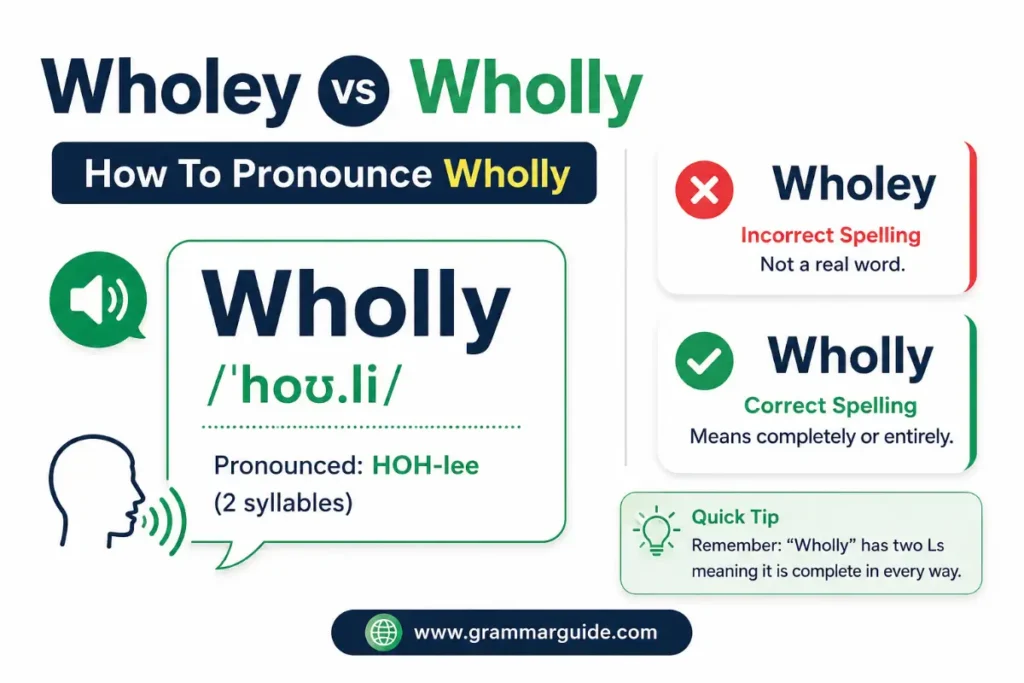
How To Pronounce Wholly
The pronunciation of wholly is one of the reasons learners sometimes connect it with other words.
IPA Pronunciation
Wholly is commonly pronounced:
/ˈhoʊ.li/ in American English.
In many varieties of British English, the pronunciation is also close to:
/ˈhəʊ.li/
Syllable Breakdown
The word has two syllables:
whole ly
The stress falls on the first syllable.
You can think of the pronunciation as sounding like:
HOLE lee
The spelling looks more complicated than the pronunciation. The wh at the beginning is pronounced with the same sound as the beginning of whole in modern standard English.
Common Pronunciation Mistakes
Some learners try to pronounce every letter separately. That can lead to awkward versions such as:
- whole lee with an exaggerated final sound.
- A pronunciation that adds an extra syllable.
- Confusion with holy.
In normal speech, the word is short and smooth. The most important thing is to keep the stress on the first syllable.
How To Remember The Correct Spelling
The easiest memory trick is to connect the word with its meaning.
Think:
whole → wholly
The final e disappears, and the l is doubled before y.
A useful visual pattern is:
whole + ly → wholly
You can also remember the phrase:
Wholly means fully.
Both words begin with the same strong f sound in meaning, which can help you connect the two concepts.
Another practical method is to remember three related forms:
- Whole.
- Wholly.
- Wholeness.
These words are related, but they do not all follow the same spelling pattern. The adverb is the unusual one, so it deserves special attention.
If you are editing your own writing and see wholey, pause and ask what you mean. If the intended meaning is completely or entirely, change it to wholly.
Wholly In A Sentence
The best way to understand wholly is to see how it works in natural sentences. The word usually strengthens the idea of completeness. It tells the reader that something is total rather than partial.
Here are ten examples.
- The decision was wholly unexpected.
- She was wholly committed to improving the quality of the project.
- The argument was wholly based on outdated information.
- The company is wholly owned by a private investment group.
- His explanation was wholly inadequate for the situation.
- The outcome was wholly dependent on accurate data.
- The witness was wholly convinced that the identification was correct.
- The proposal was wholly rejected by the review committee.
- The new system was wholly different from the original design.
- The organization is wholly independent of the government.
In each sentence, the word means completely or entirely. It does not describe a physical object. Instead, it adds the idea of totality to another part of the sentence.
Wholey In A Sentence
Because wholey is not the standard spelling, you should not normally use it in a sentence. If you write it when you mean completely or entirely, the correct form is wholly.
Here are ten examples showing the correction.
- Incorrect: The decision was wholey unexpected.
Correct: The decision was wholly unexpected. - Incorrect: She was wholey responsible for the error.
Correct: She was wholly responsible for the error. - Incorrect: The plan was wholey successful.
Correct: The plan was wholly successful. - Incorrect: The company is wholey owned by its founder.
Correct: The company is wholly owned by its founder. - Incorrect: The conclusion was wholey unsupported.
Correct: The conclusion was wholly unsupported. - Incorrect: His attention was wholey focused on the task.
Correct: His attention was wholly focused on the task. - Incorrect: The result was wholey predictable.
Correct: The result was wholly predictable. - Incorrect: The project depends wholey on external funding.
Correct: The project depends wholly on external funding. - Incorrect: The explanation was wholey unconvincing.
Correct: The explanation was wholly unconvincing. - Incorrect: The decision was wholey based on personal opinion.
Correct: The decision was wholly based on personal opinion.
These examples show why the spelling matters. The intended meaning is usually obvious, but standard spelling still matters in professional, academic, and published writing.
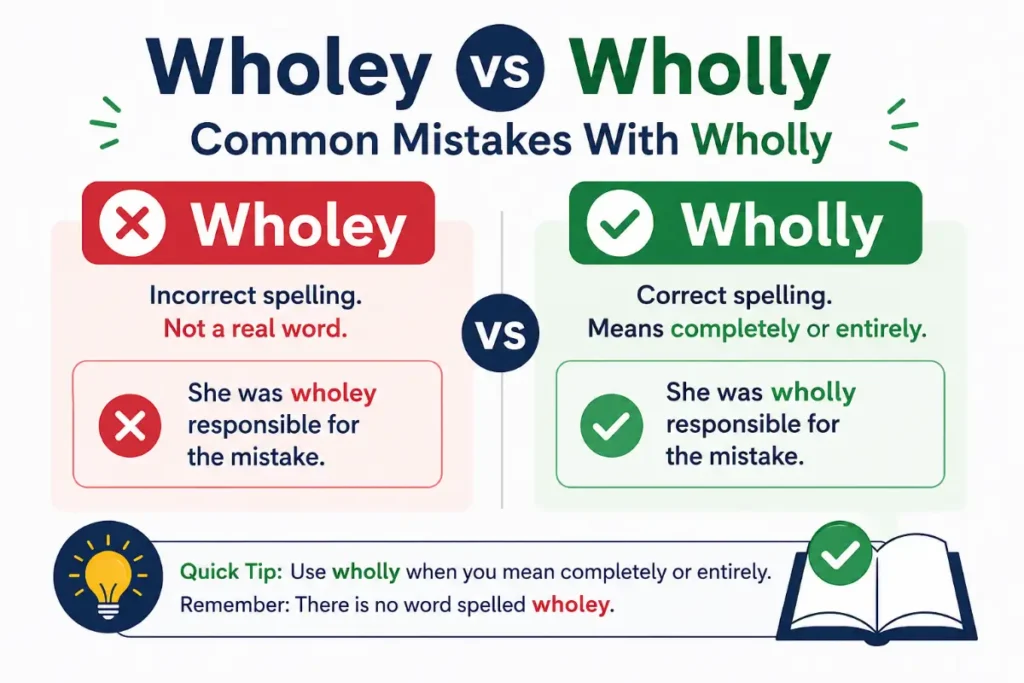
Common Mistakes With Wholly
The most common mistake is writing wholey because the word seems to come directly from whole. That instinct is understandable, but English spelling does not always follow a simple add a suffix pattern.
Adding The Wrong Ending
Many writers mentally form the word like this:
whole + y = wholey
That produces the wrong spelling.
The standard form is:
wholly
The final e is removed, and the l is doubled.
Confusing Wholly With Holy
The words wholly and holy are pronounced alike in many varieties of English. However, they have completely different meanings.
Holy relates to religion or something regarded as sacred.
Wholly means completely or entirely.
Compare these examples:
- The temple is considered holy.
- The temple was wholly destroyed by the earthquake.
The pronunciation may be similar, but the spelling and meaning are different.
Confusing Wholly With Whole
Whole is usually an adjective or noun.
Examples:
- I ate the whole apple.
- The whole team attended the meeting.
Wholly is an adverb.
Examples:
- The team was wholly prepared.
- The decision was wholly unexpected.
The words are related, but they do different jobs in a sentence.
Using Wholly When Solely Is Intended
This is a meaning mistake rather than a spelling mistake.
Wholly means completely or entirely.
Solely means only or exclusively.
Compare:
The project was wholly successful.
This means the project was completely successful.
The project was funded solely by donations.
This means donations were the only source of funding.
The two words can sometimes appear in similar contexts, but they are not interchangeable.
Assuming Search Results Prove A Spelling Is Correct
A misspelling can appear thousands of times online. User comments, search queries, social media posts, and automatically generated pages often contain spelling errors.
That is why frequency alone is not a reliable guide to standard English. A dictionary, respected style guide, or established editorial source provides much stronger evidence.
Etymology And Word Origin
The history of wholly is connected to the older English word whole, which has deep Germanic roots.
The word whole is related to Old English hāl, meaning sound, healthy, uninjured, or complete. The same historical family is connected to ideas of being intact or lacking nothing.
Over time, English developed related forms that expressed the idea of completeness in different grammatical roles.
- Whole became the common adjective and noun.
- Wholly developed as the adverb meaning completely.
- Wholeness became the noun describing a state of completeness.
The spelling of the adverb reflects historical changes in English word formation rather than a simple modern spelling rule.
This is one reason learners should not assume that every word ending in ly is created by simply attaching those letters to the base word. English has many spelling patterns shaped by pronunciation, historical development, and older forms of the language.
The meaning has remained remarkably stable. From its early roots to modern English, the central idea is completeness.
Regional Usage
The spelling wholly is standard across the major varieties of English. Unlike words such as colour and color, there is no major British and American spelling difference here.
British English
British English uses wholly in formal writing, journalism, education, and everyday communication.
Examples include:
- The proposal was wholly inadequate.
- The organisation was wholly independent.
The spelling remains the same even though other words in British English may use different conventions.
American English
American English also uses wholly as the standard form.
It appears in academic writing, business documents, legal language, journalism, and general prose.
For example:
The conclusion was wholly unsupported by the evidence.
Australian English
Australian English follows the same standard spelling.
The word appears in both formal and general writing without a regional spelling variation.
Canadian English
Canadian English also uses wholly.
Although Canadian spelling sometimes combines British and American conventions, this word does not change between the major varieties.
The important point is simple. Writers in these four English varieties should use the same spelling.
If you’re interested in avoiding common double-letter spelling mistakes, our guide on mentioned vs mentionned explains another frequently confused word pair.
Grammar Rules
Understanding the grammatical role of wholly helps you use it accurately.
Wholly Is An Adverb
An adverb can modify a verb, adjective, or another adverb. In this case, wholly usually expresses the extent or degree of something.
Examples include:
- The plan was wholly unsuccessful.
- She wholly accepted the explanation.
- The result was wholly unexpected.
The word adds the meaning of totality.
Wholly Before An Adjective
This is a common structure.
Examples:
- wholly unnecessary.
- wholly inadequate.
- wholly unexpected.
- wholly independent.
- wholly unacceptable.
The adverb strengthens the adjective by showing that the quality applies completely.
Wholly With A Past Participle
The word also commonly appears before past participles.
Examples:
- wholly owned.
- wholly funded.
- wholly dependent.
- wholly supported.
- wholly committed.
For example:
The subsidiary is wholly owned by the parent company.
Here, wholly tells us that the ownership is complete.
Wholly With Verbs
The adverb can also modify an action.
For example:
She wholly accepted the explanation.
This means she accepted it completely.
In everyday speech, completely or fully may sound more natural in many situations, but wholly remains grammatically correct.
No Plural Form
Because wholly is an adverb, it does not have a plural form.
You do not write:
whollys
The word remains unchanged regardless of the number of people, objects, or ideas being described.
Tense Does Not Change The Word
The verb in a sentence may change tense, but the adverb does not.
For example:
- The plan was wholly rejected.
- The plan is wholly rejected.
- The plan will be wholly rejected.
The word remains wholly in every sentence.
Real Life Usage Examples
The word appears in many types of writing, although everyday speakers often choose simpler alternatives such as completely or entirely.
Daily Conversation
You may hear it in phrases such as:
I wholly agree with you.
However, many speakers would naturally say:
I completely agree with you.
Both versions are correct. The second often sounds more relaxed and conversational.
Academic Writing
Academic writers use wholly when discussing evidence, theories, conclusions, or explanations.
For example:
The results cannot be wholly explained by changes in temperature.
This sentence carefully states that temperature changes do not provide a complete explanation.
Professional Communication
The word is common in business, legal, and organisational language. Examples include:
- Wholly owned subsidiary.
- Wholly independent organisation.
- Wholly funded programme.
- Wholly owned property.
These phrases often describe complete ownership, control, independence, or financial support.
Literature
Writers may choose wholly because it can sound more deliberate and formal than completely. For example:
He was wholly unaware of the consequences.
The word fits naturally into serious or reflective prose.
Media
News articles and opinion pieces use the word when a writer wants to express totality without sounding overly casual. For example:
The claim was wholly rejected by the review panel.
The wording is concise and authoritative.
Related Search Terms And Language Questions
People who search for this spelling often have several connected questions. Understanding those questions helps clarify the wider language picture.
Wholly Meaning
The meaning is completely, entirely, or fully.
Example:
The decision was wholly unexpected.
This means the decision was completely unexpected.
Wholly Synonym
Common synonyms include:
- Completely.
- Entirely.
- Fully.
- Totally.
- Utterly.
- Absolutely.
The best choice depends on the sentence. Utterly can sound stronger and more emotional, while fully often sounds neutral and direct.
Wholly And Solely Meaning
These words are related but different.
- Wholly means completely.
- Solely means only or exclusively.
Compare:
- The idea was wholly rejected. The idea was completely rejected.
- The idea was supported solely by one researcher.
Only one researcher supported it.
Wholly Spelling
The correct spelling is wholly. The form wholey is usually a spelling error when the intended meaning is completely or entirely.
Wholly In A Sentence
A natural example is:
The project was wholly dependent on external funding.
This means the project depended entirely on external funding.
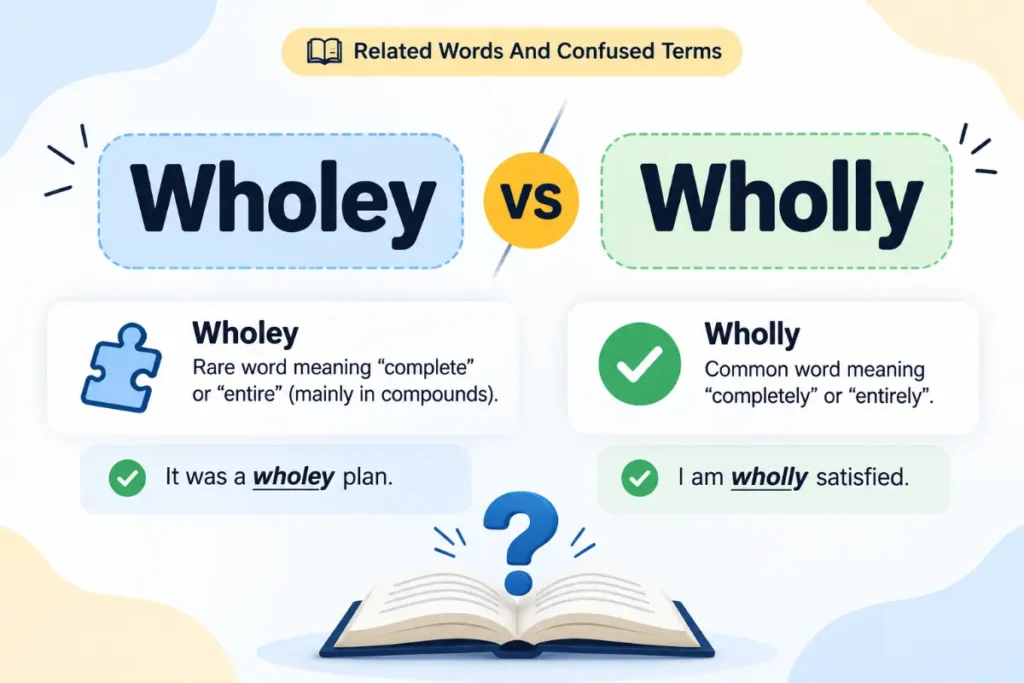
Related Words And Confused Terms
The word wholly belongs to a larger group of words that express completeness, totality, exclusivity, or degree. Understanding those relationships helps you choose the most precise word instead of treating every similar term as interchangeable.
Wholly And Completely
Completely is the closest everyday synonym for wholly.
Both can mean entirely or in every part.
Examples:
- The plan was wholly successful.
- The plan was completely successful.
The meaning is nearly identical. Completely is often more common in casual conversation, while wholly can sound slightly more formal or deliberate.
Wholly And Entirely
Entirely is another close synonym.
For example:
The decision was wholly unexpected.
and:
The decision was entirely unexpected.
Both sentences mean that the decision was completely unexpected.
The difference is mainly style and rhythm. Writers often choose the word that sounds most natural in the sentence.
Wholly And Fully
Fully can also mean completely, although it often emphasizes a complete level, condition, or degree.
For example:
The system is fully operational.
This means the system is operating completely or at its full intended level.
Wholly can express a similar idea, but it often sounds more absolute.
Wholly And Totally
Totally is common in informal conversation.
For example:
I totally agree.
This sounds natural in casual speech.
I wholly agree.
This is grammatically correct but sounds more formal and less conversational.
The meaning is similar, but the tone is different.
Wholly And Solely
This distinction deserves special attention because the two words are often confused.
Wholly means completely or entirely.
Solely means only or exclusively.
Compare these sentences:
The company is wholly owned by its founder.
The founder owns the entire company.
The company is funded solely by donations.
Donations are the only source of funding.
One word describes totality. The other describes exclusivity.
Wholly And Holy
These words are homophones in many varieties of English. That means they sound the same but have different meanings and spellings.
Holy means sacred or associated with religion.
Wholly means completely.
Examples:
- The site is considered holy.
- The site was wholly destroyed.
This is one of the most important word relationships to understand when learning the correct spelling.
Wholly And Whole
The word whole describes something complete or entire.
Wholly is the adverbial form used to describe complete action or degree.
Compare:
She ate the whole cake.
Here, whole describes the cake.
She was wholly satisfied with the meal.
Here, wholly modifies the adjective satisfied.
NLP And Semantic Relationships
From a language analysis perspective, wholly belongs to the semantic field of totality and completeness.
Related concepts include:
- Complete.
- Entire.
- Total.
- Full.
- Absolute.
- Exclusive.
- Partial.
- Incomplete.
- Limited.
- Fractional.
The opposite of wholly is often expressed through terms such as partly, partially, in part, or to some extent.
For example:
The claim was wholly accurate.
The opposite idea would be:
The claim was only partly accurate.
Understanding these semantic relationships helps you choose words based on meaning rather than spelling alone.
Similar to understanding the difference between immerse and emerse, mastering subtle spelling distinctions like wholey vs wholly helps improve both accuracy and confidence in writing.
Expert Language Insight
From an editorial perspective, the most important lesson is simple. Wholly is a standard adverb. Wholey is normally a spelling mistake.
The error happens because the spelling looks as though it should be built directly from whole. That makes the mistake understandable, especially for learners who expect English words to follow consistent suffix rules. Unfortunately, English spelling has many historical patterns that do not work that neatly.
When editing a sentence, I would not simply look at the word in isolation. I would check its role in the sentence.
- If the writer means completely, entirely, or fully, the correct form is wholly.
- If the writer means sacred, the correct word is holy.
- If the writer means the complete object or group, the correct word may be whole.
- If the writer means only, the correct word may be solely.
That distinction is more useful than memorizing a spelling rule without understanding the meaning. A practical editing test is to replace the word with completely. If the sentence still makes sense, wholly may be the correct choice.
For example:
The claim was wholly unsupported.
Replace the word:
The claim was completely unsupported.
The meaning remains clear. That is a strong clue that wholly is the right form.
Native speakers also tend to choose simpler alternatives in casual conversation. Completely, totally, and entirely are often more common in relaxed speech. Wholly appears naturally in formal prose, professional writing, academic discussion, journalism, and fixed expressions such as wholly owned subsidiary.
The best writing does not use the most complicated word available. It uses the word that fits the meaning, audience, and tone. In many situations, wholly is exactly right. In others, completely will sound more natural.
Frequently Asked Questions About Wholey vs Wholly
Is wholly the correct spelling?
Yes. Wholly is the standard spelling of the adverb meaning completely, entirely, or fully. Wholey is usually a misspelling. The correct form contains two l letters before the final y.
What does wholly mean?
Wholly means completely, entirely, or fully. For example, The project was wholly successful means the project was completely successful. The word can describe total responsibility, complete agreement, full ownership, or any other situation where something applies in its entirety.
What is a synonym for wholly?
Common synonyms include completely, entirely, fully, totally, and utterly. The best choice depends on context. Completely is common in everyday English, while wholly can sound more formal. Utterly often adds stronger emotional emphasis.
How do you pronounce wholly?
Wholly is generally pronounced /ˈhoʊ.li/ in American English and close to /ˈhəʊ.li/ in many varieties of British English. It has two syllables and sounds similar to holy. The first syllable receives the main stress.
Is wholly and solely the same?
No. Wholly means completely or entirely. Solely means only or exclusively. For example, wholly owned means owned completely, while solely funded by donations means donations are the only source of funding.
Is wholey a Scrabble word?
Wholey is not the standard spelling of the adverb meaning completely, and it should not be used as a substitute for wholly in standard writing. Scrabble word lists can vary by edition and language version, so players should check the specific official word list being used for the game.
Is wholly a homonym of wait?
No. Wholly is not a homonym of wait. The words have different pronunciations and different meanings. Wholly sounds similar to holy in many varieties of English, while wait is pronounced like weight. Holy and wholly are the more relevant homophone pair.
Why is wholly spelled with two l letters?
The spelling developed through the historical relationship between whole and its adverbial form. The standard form is wholly, not wholey. The doubled l is part of the established spelling and must be memorized as part of the word.
Conclusion
The correct spelling is wholly. Use it when you mean completely, entirely, or fully. The spelling wholey is generally incorrect when used as a substitute for this word.
The confusion makes sense because wholly is related to whole, sounds similar to holy, and does not follow the spelling pattern many learners might expect. Still, the practical rule is easy to remember: when you mean completely, write wholly.
Keep these distinctions in mind:
- Wholly means completely.
- Solely means only.
- Holy means sacred.
- Whole means complete or entire.
- Wholey is usually a misspelling.
For everyday writing, completely or entirely may sometimes sound more natural. In formal writing, professional communication, academic prose, and established expressions such as wholly owned, the standard word fits perfectly.
The strongest takeaway is simple. If you can replace the word with completely and the meaning stays the same, wholly is probably the spelling you need.