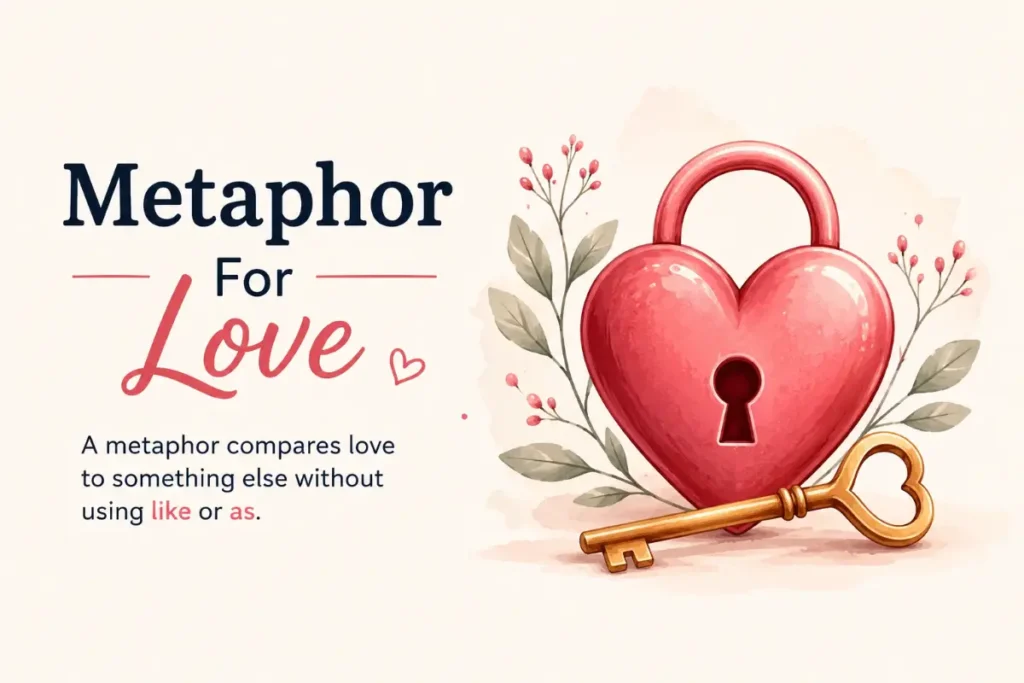
Love is one of the most powerful emotions people experience, yet it is also one of the hardest to explain. That is why the search for a Metaphor for Love is so common. Sometimes the words I love you are not enough. A thoughtful comparison can capture feelings that ordinary language cannot, making emotions feel vivid, personal, and unforgettable.
A love metaphor compares love to something else without using words like as or like. Instead of saying love is strong, you might say love is an anchor or love is a quiet fire. These expressions paint a picture in the reader’s mind and create an emotional connection that plain statements often miss.
People use love metaphors in poems, wedding vows, greeting cards, novels, song lyrics, speeches, and everyday conversations. Some are short and simple. Others are deeply symbolic and invite readers to discover new layers of meaning.
This guide explores different kinds of love metaphors, explains how they work, and shows you when to use them. You will also find practical examples, creative inspiration, and expert writing advice to help you express affection, devotion, longing, and commitment with confidence.
If you’re exploring the topic with younger readers, metaphors kids can easily understand can make abstract ideas like love much easier to grasp.
Quick Definition
A Metaphor for Love is a figure of speech that describes love by saying it is something else instead of comparing it with words such as like or as. Writers use metaphors to communicate emotions, relationships, and experiences in a vivid, memorable, and emotionally engaging way.
Quick Answer
If you need a simple answer, remember these key points.
- A love metaphor describes love through symbolic language.
- It creates stronger emotional impact than literal wording.
- Writers use it in poetry, literature, songs, speeches, and personal messages.
- The best metaphor depends on the emotion you want to express.
- Effective metaphors feel natural and meaningful instead of forced.
What Is A Love Metaphor
A metaphor is a figure of speech that states one thing is another to highlight a shared quality. When applied to love, it helps people express emotions that are often too complex for direct language.
For example, saying love is a lighthouse tells readers that love offers guidance, hope, and safety during difficult times. The sentence does not describe an actual lighthouse. Instead, it transfers the qualities of a lighthouse to the feeling of love.
Unlike ordinary descriptions, metaphors invite readers to imagine and interpret. That is why they appear so often in literature and everyday communication. They transform abstract emotions into images people can easily understand and remember.
Strong metaphors usually share three characteristics.
- They create a clear mental picture.
- They reveal an emotional truth.
- They help readers connect with the message on a personal level.
When those elements come together, even a short sentence can leave a lasting impression.
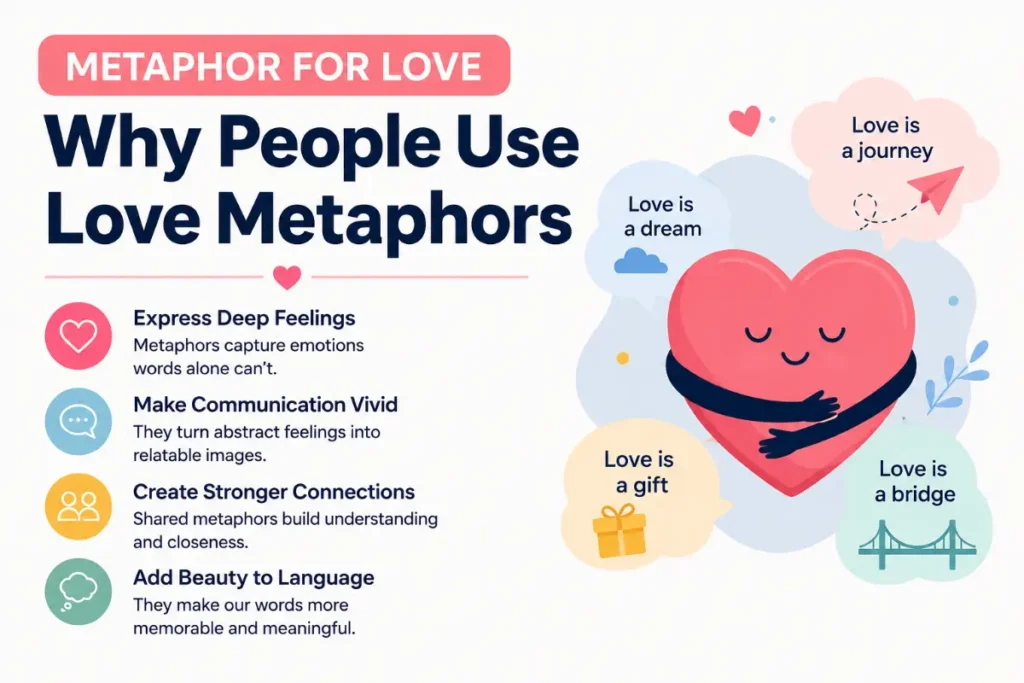
Why People Use Love Metaphors
Love is deeply personal, and every relationship has its own story. Metaphors allow people to describe those experiences with creativity and emotional depth.
Writers often choose symbolic language because it communicates feelings that simple statements cannot fully express. A carefully chosen image can reveal tenderness, trust, excitement, sacrifice, heartbreak, or lifelong commitment in just a few words.
People commonly use love metaphors in these situations.
- Writing romantic letters.
- Creating wedding vows.
- Composing poems.
- Writing novels.
- Crafting song lyrics.
- Celebrating anniversaries.
- Expressing gratitude to a partner.
- Sharing meaningful social media captions.
These comparisons also help readers form emotional connections. Instead of reading facts, they experience images that stay in their minds long after they finish reading.
Comparison Table Of Popular Love Metaphors
Different metaphors emphasize different aspects of love. The table below highlights some of the most common themes and the emotions they represent.
| Metaphor | Represents | Best Used For | Emotional Tone | Example |
|---|---|---|---|---|
| Love is a flame | Passion and energy | Romantic writing | Intense | Our love is a flame that refuses to fade. |
| Love is a garden | Growth and care | Relationships | Warm | Every kind word helps our garden bloom. |
| Love is an anchor | Stability and trust | Long term commitment | Reassuring | You are the anchor that keeps me steady. |
| Love is a journey | Shared experiences | Marriage and partnerships | Hopeful | Every step has brought us closer together. |
| Love is a bridge | Connection | Rebuilding relationships | Encouraging | Love became the bridge across our differences. |
| Love is a home | Comfort and belonging | Family and romance | Gentle | My heart finally found its home with you. |
| Love is a melody | Harmony | Poetry and music | Soft | Our hearts still follow the same melody. |
| Love is a lighthouse | Guidance | Difficult times | Comforting | Your love guided me through every storm. |
Each metaphor highlights a different quality. Choosing the right one depends on the message you want your words to convey.
How To Choose The Right Love Metaphor
Not every metaphor fits every situation. A phrase that works beautifully in a wedding speech may sound out of place in a breakup poem or a heartfelt letter.
Start by asking yourself what emotion you want readers to feel.
- Do you want to express comfort and security.
- Do you want to celebrate excitement and passion.
- Do you want to describe lasting commitment.
- Do you want to acknowledge loss or longing.
- Do you want to inspire hope for the future.
After identifying the emotion, choose an image that naturally reflects it.
For example, a relationship built on trust may be described as an anchor or a sturdy tree. A new romance might become a sunrise or a spark. A relationship that has survived challenges could be compared to a bridge that remained standing through every storm.
Avoid using complicated images simply to sound poetic. The strongest metaphors are often the simplest because readers immediately understand their meaning without needing an explanation.
Short Metaphors For Love
Sometimes just a few words carry enormous emotional weight. These short metaphors work well in greeting cards, captions, wedding speeches, text messages, and personal letters.
- Love is home.
- Love is sunshine after rain.
- Love is an anchor.
- Love is a quiet fire.
- Love is a compass.
- Love is a heartbeat.
- Love is a safe harbor.
- Love is a sunrise.
- Love is a masterpiece.
- Love is forever blooming.
- Love is a gentle breeze.
- Love is a guiding star.
- Love is an open door.
- Love is living hope.
- Love is endless light.
Although these metaphors are brief, each one suggests a larger story. Readers naturally connect the image with their own experiences, making the message feel personal and memorable.
Expert Writing Tip
A memorable metaphor does more than sound beautiful. It helps readers see, feel, and experience an emotion. Instead of searching for the most unusual comparison, look for one that genuinely reflects the relationship or feeling you want to describe.
Simple images often create the strongest emotional response because they feel authentic. A well chosen metaphor does not call attention to itself. Instead, it quietly strengthens every sentence around it and leaves readers with a feeling they remember long after they have finished reading.
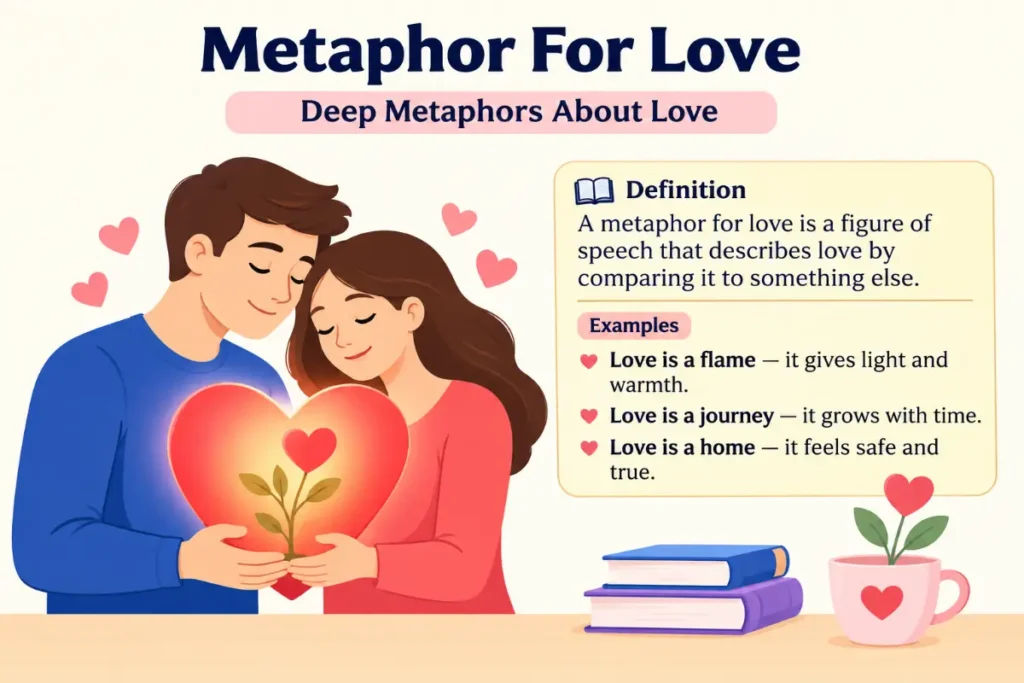
Deep Metaphors About Love
Some emotions run so deep that ordinary words cannot fully express them. That is where powerful metaphors shine. They move beyond romance and explore trust, sacrifice, vulnerability, healing, and lifelong commitment.
These deeper comparisons often appear in novels, poetry, wedding speeches, and reflective writing because they invite readers to discover meaning for themselves.
Here are some meaningful examples.
- Love is an ocean that grows deeper with every tide.
- Love is a tree whose roots grow stronger through every storm.
- Love is a mirror that reflects our truest selves.
- Love is a quiet mountain that never moves when life becomes uncertain.
- Love is a river that keeps flowing even when the path changes.
- Love is a heartbeat that continues through every season.
- Love is a shelter built long before the rain begins.
- Love is a woven thread that holds two lives together.
- Love is a bridge connecting two different worlds.
- Love is a seed that rewards patience with lasting beauty.
Each metaphor emphasizes a different quality. Some highlight strength, while others focus on growth, resilience, or emotional security.
Poetic Metaphors For Love
Poets often avoid direct statements because symbolism creates richer emotional experiences. A poetic metaphor encourages readers to imagine rather than simply understand.
These examples work well in poems, romantic letters, anniversary messages, and wedding vows.
- Love is the moon teaching the night how to shine.
- Love is the first light that greets every dawn.
- Love is the melody hidden inside silence.
- Love is the wind carrying forgotten dreams home.
- Love is a candle that brightens every shadow.
- Love is a garden where hope blooms every season.
- Love is a constellation guiding lost hearts.
- Love is a page that never reaches its final chapter.
- Love is rain that teaches flowers how to bloom.
- Love is the quiet language spoken by two hearts.
Notice that these comparisons rely on imagery instead of explanation. That is what gives poetic writing its emotional power.
Using simple metaphor examples can also show children how writers describe love through familiar objects, feelings, and everyday experiences.
Love Metaphors For Him
When writing for a husband, boyfriend, fiancé, or partner, the strongest metaphors usually highlight trust, loyalty, encouragement, and emotional strength rather than exaggerated romance.
Here are meaningful examples.
- You are the anchor that keeps my world steady.
- You are the lighthouse that guides me through every storm.
- You are the compass that always points me home.
- Your love is the foundation beneath every dream I build.
- You are the sunrise that makes every morning brighter.
- Your heart is the safest place I have ever known.
- You are the steady flame that never fades.
- Your love is the bridge that carried me through difficult days.
- You are the calm sea after every storm.
- You are the strongest chapter in my life’s story.
These metaphors sound sincere because they celebrate character as much as affection.
Love Metaphors For Her
The best metaphors for her express admiration, appreciation, comfort, and emotional connection. They should feel genuine instead of overly dramatic.
Here are several thoughtful examples.
- You are the melody that brings peace to my heart.
- Your smile is the sunrise after the longest night.
- Your love is the garden where my soul feels alive.
- You are the star that guides every dream I chase.
- Your kindness is the light that brightens every room.
- You are the home my heart searched for.
- Your laughter is the music that makes ordinary days unforgettable.
- Your love is a quiet river that never stops flowing.
- You are the heartbeat behind my happiest memories.
- Your heart is the safe harbor where I always belong.
Personal details always make these metaphors stronger. Connecting the image to shared experiences creates a message that feels unique.
Metaphors For Love In A Relationship
Healthy relationships grow through shared experiences, mutual respect, and everyday acts of care. The most effective metaphors reflect those realities instead of focusing only on romance.
Consider these examples.
- A relationship is a garden that flourishes with patience and attention.
- Love is a bridge strengthened every time two people choose understanding.
- A lasting partnership is a house built one brick at a time.
- Love is a road where both people walk together instead of pulling apart.
- A relationship is a dance that depends on trust and balance.
- Love is a book whose best chapters are still waiting to be written.
- A strong partnership is a fire that grows warmer through shared effort.
- Love is an orchestra where harmony comes from listening as much as speaking.
- A relationship is a tree that grows stronger with every passing season.
- Love is a compass helping two people move toward the same future.
These metaphors remind readers that meaningful relationships are built through consistent care rather than grand gestures alone.
Dark Metaphors For Love
Not every love story is joyful. Literature often explores heartbreak, obsession, sacrifice, jealousy, and emotional conflict through darker symbolism. These metaphors help writers describe difficult experiences without stating every emotion directly.
Examples include:
- Love is a storm that leaves nothing unchanged.
- Love is a wildfire that consumes everything in its path.
- Love is a maze where every turn reveals another mystery.
- Love is a shadow that follows every memory.
- Love is an eclipse hiding the brightest parts of the sky.
- Love is a cracked mirror reflecting both beauty and pain.
- Love is winter waiting patiently beneath spring.
- Love is an abandoned lighthouse searching for distant ships.
- Love is smoke that lingers after the fire disappears.
- Love is an unfinished song echoing through empty rooms.
Dark metaphors should be used thoughtfully. They work best when exploring emotional complexity rather than encouraging unhealthy relationships.
Cannibalism As A Metaphor For Love In Literature And Psychology
At first glance, this idea may seem shocking. In literature, psychology, and literary criticism, however, cannibalism as a metaphor for love does not usually describe physical behavior. Instead, it symbolizes overwhelming desire, emotional dependence, obsession, or the wish to become completely united with another person.
Writers have used this symbolism for centuries to examine the intense side of human relationships. The metaphor suggests a longing so powerful that one person wants to erase every boundary between themselves and someone they love. It often represents possessiveness, sacrifice, identity, or emotional consumption rather than affection in its healthiest form.
Modern novels, films, and academic discussions sometimes explore this symbolism when analyzing complex characters or emotionally charged relationships. Literary scholars generally view it as a symbolic device that reflects psychological conflict, vulnerability, or unhealthy attachment rather than genuine romance.
Because of its intensity, this metaphor belongs in literary analysis and critical discussion instead of everyday romantic writing. For personal messages, healthier images such as gardens, bridges, homes, or guiding stars communicate love with greater warmth and emotional balance.
Metaphors For Someone You Love
The most meaningful metaphors feel personal. Instead of choosing the most dramatic image, think about the person’s personality, your shared experiences, and the emotions you want to express. A thoughtful comparison often says more than a long paragraph.
Here are some heartfelt examples you can adapt for different situations.
- You are the compass that always leads me home.
- You are the quiet harbor where my restless heart finds peace.
- You are the sunrise that gives every new day a reason to begin.
- You are the strongest root beneath every dream I grow.
- You are the melody my heart never forgets.
- You are the lighthouse that guides me through uncertainty.
- You are the book I never grow tired of reading.
- You are the warm fire that makes every cold season easier.
- You are the steady heartbeat behind my happiest memories.
- You are the bridge that connects my past with my future.
These metaphors work well in anniversary cards, wedding vows, love letters, birthday messages, speeches, and social media captions because they focus on genuine emotion instead of exaggerated language.
Common Mistakes When Writing Love Metaphors
A good metaphor should feel effortless. Readers should connect with the image immediately instead of stopping to figure out what it means.
Writers often make these mistakes.
- Mixing unrelated images.
For example, describing love as both a storm and a peaceful garden in the same paragraph can confuse readers unless the contrast is intentional.
- Choosing overly complicated comparisons.
Simple images often carry more emotional weight than obscure or highly technical references.
- Copying familiar expressions without adding personality.
Phrases that appear everywhere can lose their emotional impact. Adding personal details makes even a familiar metaphor feel fresh.
- Using too many metaphors together.
One strong comparison creates a clear picture. Filling every sentence with symbolic language can overwhelm readers and weaken the message.
- Ignoring the audience.
A wedding speech, poem, greeting card, and novel all require different levels of emotion and creativity. Choose imagery that fits the occasion.
Related Words And Literary Devices
Love metaphors belong to a larger family of figurative language. Learning these related terms helps you recognize the differences and use each device effectively.
| Literary Device | Purpose | Example |
|---|---|---|
| Metaphor | States one thing is another | Love is a lighthouse. |
| Simile | Compares using like or as | Love is like sunshine after rain. |
| Personification | Gives human qualities to nonhuman things | Love whispered hope into every heart. |
| Symbolism | Uses an object to represent an idea | A rose represents love. |
| Imagery | Creates vivid mental pictures | Their love bloomed beneath the spring sky. |
| Allegory | Uses an entire story to express a deeper meaning | A journey representing lifelong commitment. |
You may also encounter these related terms.
- Figurative language.
- Romantic symbolism.
- Emotional imagery.
- Extended metaphor.
- Poetic expression.
- Symbolic comparison.
- Literary device.
- Creative writing.
Understanding these concepts makes it easier to write naturally while adding depth to your words.
Just as love metaphors can carry deeper meanings, the forbidden fruit metaphor has also been interpreted in different ways throughout religious and literary discussions.
Expert Language Insight
Experienced writers rarely search for unusual metaphors. They search for honest ones.
The strongest comparisons grow naturally from the emotion behind the message. Instead of trying to impress readers with elaborate language, they choose images that feel authentic and easy to visualize.
Notice how many timeless love metaphors come from ordinary life. Gardens, stars, rivers, homes, trees, light, and journeys appear again and again because people immediately understand their emotional meaning. These images have lasted for generations because they connect with universal human experiences.
When writing your own metaphor, ask yourself three questions.
- What emotion am I trying to express.
- What image naturally represents that feeling.
- Will the reader understand the comparison without an explanation.
If the answer to all three questions is yes, your metaphor will usually feel natural, memorable, and sincere.
Frequently Asked Questions
What is a metaphor for love?
A love metaphor is a figure of speech that describes love as something else to express emotion in a vivid and memorable way. Instead of explaining feelings directly, it uses symbolic language to help readers imagine and experience those emotions.
What are some short metaphors for love?
Popular short examples include Love is home, Love is a lighthouse, Love is an anchor, Love is a quiet fire, Love is a guiding star, and Love is a garden. These brief comparisons work well in cards, captions, and personal messages.
Why do writers use metaphors to describe love?
Love is an abstract emotion, so figurative language makes it easier to express. Metaphors create strong mental images, add emotional depth, and help readers connect with experiences that may be difficult to explain through literal language alone.
What is the difference between a metaphor and a simile?
A metaphor says one thing is another, while a simile compares two things using words such as like or as. For example, Love is a lighthouse is a metaphor, while Love is like a lighthouse is a simile.
What are deep metaphors about love?
Deep metaphors explore trust, sacrifice, growth, healing, and lifelong commitment. Examples include Love is a tree with unshakable roots, Love is a river that never stops flowing, and Love is a bridge built through shared experiences.
Can love metaphors be used in everyday writing?
Yes. They appear in greeting cards, speeches, social media posts, wedding vows, novels, songs, and personal letters. Choosing a simple and meaningful comparison often makes everyday writing more engaging and memorable.
Are dark metaphors about love appropriate?
They can be effective in poetry, fiction, and literary analysis when exploring heartbreak, obsession, grief, or emotional conflict. In personal messages, warmer imagery usually creates a stronger and more positive emotional connection.
How can I create my own love metaphor?
Start by identifying the feeling you want to express. Then think of an object, place, or experience that shares the same qualities. Keep the comparison simple, genuine, and easy for readers to picture in their minds.
Conclusion
Finding the right Metaphor for Love is not about choosing the most poetic words. It is about choosing the comparison that best reflects your emotions and the relationship you want to describe.
Some metaphors celebrate joy and new beginnings. Others express loyalty, comfort, resilience, or lifelong commitment. There are also darker comparisons that explore heartbreak and emotional complexity in literature. Each serves a different purpose, and the most effective choice depends on your message and audience.
When writing about love, clarity and sincerity matter more than complexity. A simple image that feels honest will leave a stronger impression than an elaborate comparison that feels forced. The best metaphors invite readers to see familiar emotions from a fresh perspective while remaining easy to understand.
Use these examples as inspiration, then create comparisons drawn from your own experiences. Personal metaphors often become the most memorable because they reflect real moments, genuine feelings, and authentic relationships.