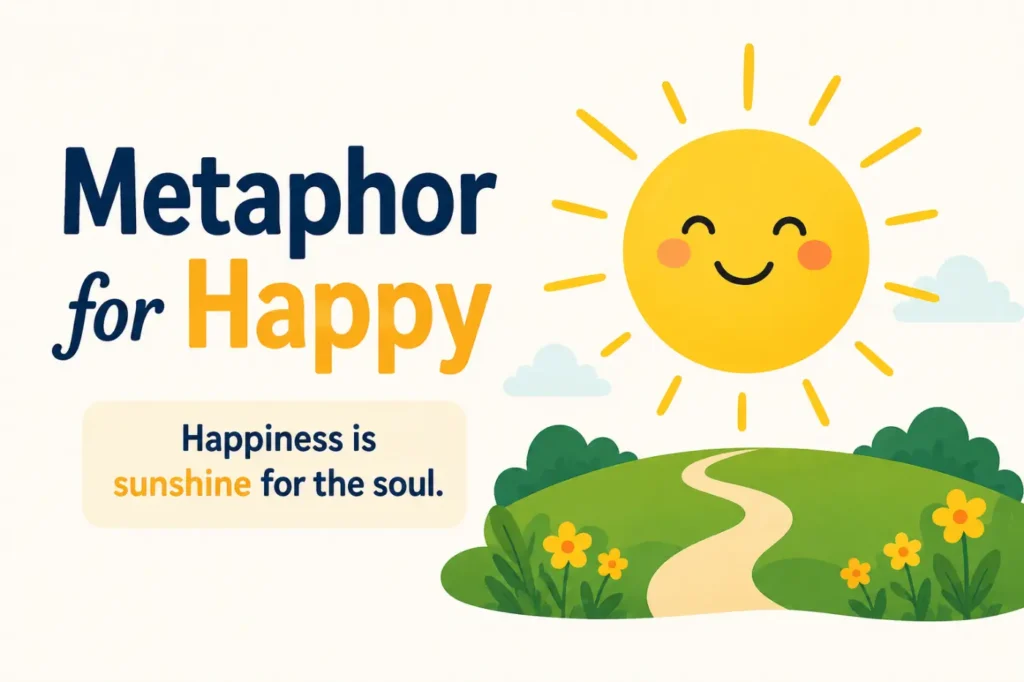
Finding the right metaphor for happy can transform an ordinary sentence into one that feels vivid, memorable, and emotionally rich. Instead of simply saying someone is happy, you can compare that feeling to sunshine after a storm, a kite catching the wind, or a garden bursting into bloom. A strong metaphor paints a picture that readers instantly understand and remember.
Many people search for creative ways to express happiness because the word happy can feel repetitive. Writers, students, teachers, poets, and anyone crafting a heartfelt message often want fresh language that sounds more engaging without becoming confusing or overly dramatic.
The good news is that English offers countless ways to describe joy through figurative language. Some metaphors are short and powerful, while others create deeper emotional imagery. The best choice depends on your audience, your purpose, and the feeling you want to convey.
This guide brings together practical examples, expert writing advice, and real world usage to help you choose the perfect expression. By the end, you will know how to use happiness metaphors naturally in conversations, creative writing, speeches, stories, social media posts, and everyday communication.
Quick Definition
A metaphor for happy compares happiness to another person, object, place, or experience without using the words like or as. Instead of stating that someone is happy, a metaphor creates a vivid image that helps readers feel the emotion more deeply.
Quick Answer
If you need a quick answer, remember these points.
- A metaphor describes happiness by comparing it directly to something else.
- It makes emotions more vivid and memorable.
- Writers use metaphors to add creativity, emotion, and imagery.
- The strongest metaphors match the tone and context of the message.
- Simple comparisons often have the greatest impact because readers understand them immediately.
Just as happiness can be represented through familiar images and ideas, the symbolism of the forbidden fruit shows how metaphors can give deeper meaning to something that appears simple on the surface.
What Is A Metaphor For Happy
A metaphor is a figure of speech that says one thing is another to highlight a shared quality. It does not mean the comparison is literally true. Instead, it helps readers picture an emotion through familiar images.
When describing happiness, a metaphor replaces the plain emotion with something that represents warmth, light, growth, freedom, or celebration.
For example:
- Her smile was sunshine after the rain.
- His heart was a sky full of fireworks.
- Their home became a garden in full bloom.
- She was a bird soaring above the clouds.
- The good news was a spark that lit the entire room.
Each comparison creates an image that feels stronger than simply saying someone was happy.
Good metaphors appeal to the imagination. They encourage readers to experience the feeling instead of merely reading about it.
Why Writers Use Metaphors For Happiness
Happiness is one of the most common emotions in writing. Because readers encounter the word so often, repeating it can make descriptions feel flat.
Metaphors solve that problem by adding personality and emotion.
Writers use them because they:
- Create memorable images.
- Make emotions easier to visualize.
- Add variety to repetitive writing.
- Strengthen storytelling.
- Help readers connect emotionally with a scene.
- Make speeches and conversations more engaging.
- Bring poems and creative writing to life.
For example, compare these two sentences.
- She looked happy.
- She was a sunrise chasing every shadow away.
The second sentence gives readers something they can picture. It transforms a simple statement into an emotional image.
That is why experienced writers rely on metaphors when they want readers to feel an emotion instead of simply recognizing it.
40 Short Metaphors For Happy
Sometimes a few carefully chosen words communicate more than an entire paragraph. Short metaphors work well in speeches, greeting cards, social media captions, stories, and everyday conversation because they are easy to remember and instantly create imagery.
Here are some simple and expressive examples.
- A ray of sunshine.
- A blooming flower.
- A glowing star.
- A dancing flame.
- A bright rainbow.
- A golden sunrise.
- A warm breeze.
- A singing bird.
- A sparkling diamond.
- A floating cloud.
- A gentle wave.
- A shining lantern.
- A soaring kite.
- A glowing ember.
- A colorful butterfly.
- A cheerful melody.
- A laughing river.
- A fresh spring morning.
- A basket of light.
- A sky without storms.
- A smiling horizon.
- A field in bloom.
- A glowing candle.
- A pocket full of sunshine.
- A tree full of blossoms.
- A calm ocean at sunrise.
- A fountain of laughter.
- A bright lighthouse.
- A joyful heartbeat.
- A rainbow after rain.
- A sparkling stream.
- A glowing campfire.
- A peaceful meadow.
- A balloon drifting upward.
- A patch of blue sky.
- A morning filled with birdsong.
- A window full of light.
- A basket of fresh flowers.
- A room filled with music.
- A garden kissed by spring.
Each metaphor captures happiness from a different angle. Some focus on warmth and light, while others emphasize freedom, growth, hope, or celebration.
How To Choose The Right Metaphor
Not every metaphor fits every situation. A thoughtful comparison feels natural because it matches the mood, audience, and purpose of the writing.
Keep these guidelines in mind.
- Match the emotion to the image. A peaceful moment works better with gentle images like a calm lake or a blooming flower. A moment of celebration may suit fireworks or a rising sun.
- Think about your audience. Simple metaphors are easier for children and general readers to understand, while literary audiences may appreciate more imaginative comparisons.
- Avoid overused expressions. Familiar phrases can still work, but fresh imagery often leaves a stronger impression.
- Stay consistent with your tone. A humorous article benefits from playful comparisons, while a heartfelt letter deserves warmer and more sincere imagery.
- Use metaphors sparingly. One strong comparison often has more impact than several packed into the same paragraph.
The goal is not to impress readers with complicated language. The goal is to help them see and feel the emotion through a clear and memorable image.
Metaphors For A Happy Person
Some metaphors describe happiness by focusing on the person instead of the emotion itself. These comparisons help readers picture someone’s personality, energy, or outlook without repeatedly using the word happy.
Here are creative examples that work well in stories, speeches, and everyday writing.
- She was a ray of sunshine wherever she went.
- He was a lighthouse guiding everyone through difficult days.
- She was a blooming flower after the first rain of spring.
- He was a campfire that warmed every room he entered.
- She was a bird singing at daybreak.
- He was a bright star lighting the darkest night.
- She was a rainbow stretching across gray skies.
- He was a gentle breeze on a warm afternoon.
- She was a glowing lantern in the evening.
- He was a fountain that never stopped flowing with joy.
Each metaphor highlights a different quality. Some emphasize warmth, others focus on hope, kindness, optimism, or contagious enthusiasm. Choosing the right image depends on the personality you want readers to imagine.
Metaphors For Happy Love
Love often inspires some of the most beautiful metaphors in the English language. Instead of simply saying two people are happy together, writers compare their relationship to images that suggest growth, harmony, warmth, and lasting connection.
Consider these examples.
- Their love was a garden that bloomed in every season.
- They were two stars shining in the same sky.
- Their hearts became a shared sunrise.
- Love turned their house into a home filled with light.
- Their relationship was a river flowing without fear.
- They danced through life like leaves carried by a gentle breeze.
- Their laughter became music filling every corner of the room.
- Their love was an anchor that kept hope alive.
- Together they built a bridge stronger than every storm.
- Their happiness became a fire that never faded.
These metaphors work well in wedding speeches, anniversary messages, romantic stories, and heartfelt letters because they express emotion without sounding repetitive.
Metaphors For A Happy Life
Describing a joyful life often requires broader imagery than describing a single happy moment. These comparisons focus on long term contentment, gratitude, and personal growth.
Examples include:
- Life became a road lined with blooming trees.
- Every day was another page in a beautiful adventure.
- Their future was a sunrise that never stopped glowing.
- Happiness became the foundation of their home.
- Life unfolded like a peaceful river.
- Each year added another bright color to the painting.
- Their journey became a mountain path with breathtaking views.
- Every season brought another harvest of joy.
- Their world became a garden that rewarded every act of care.
- Life was a melody played without missing a note.
These comparisons help readers imagine lasting happiness rather than temporary excitement.
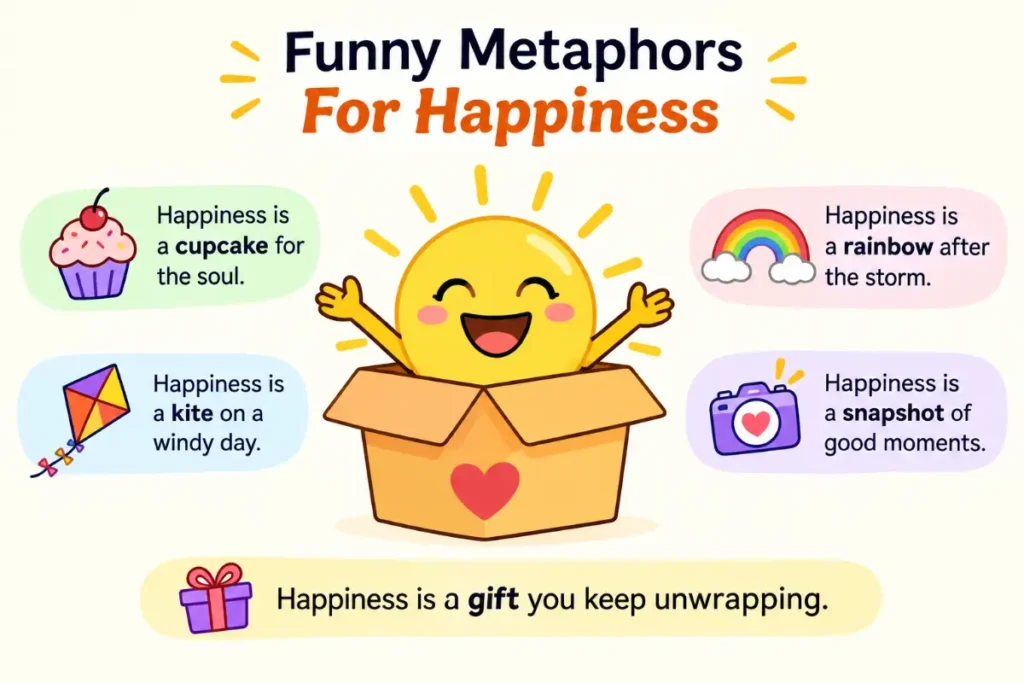
Funny Metaphors For Happiness
Humor can make figurative language even more memorable. Funny metaphors work well in casual conversations, greeting cards, speeches, and social media posts.
Here are playful examples.
- He was a puppy that had just discovered an endless park.
- She was popcorn bouncing inside a hot pan.
- He looked like a kid locked inside a candy store.
- She was a soda bottle that had just been shaken.
- He bounced around like a rubber ball with unlimited energy.
- She smiled brighter than a phone screen in a dark room.
- He was a toaster celebrating every slice of bread.
- She floated through the office like someone who had won the lottery.
- He was a squirrel that had found a lifetime supply of acorns.
- She glowed like a light bulb that had finally found electricity.
Humorous metaphors should match the audience. A playful comparison can add personality, but using too many in serious writing may weaken the emotional impact.
Happiness Metaphors And Similes
Metaphors and similes both create vivid imagery, but they do it in different ways.
A metaphor says one thing is another.
A simile compares two things using like or as.
The table below highlights the difference.
| Metaphor | Simile |
|---|---|
| Her smile was sunshine. | Her smile was like sunshine. |
| His heart became a celebration. | His heart was as joyful as a celebration. |
| She was a blooming flower. | She bloomed like a spring flower. |
| Their home was paradise. | Their home felt like paradise. |
| Hope became a lighthouse. | Hope stood like a lighthouse. |
Neither form is better than the other. The right choice depends on your writing style and the level of emphasis you want to create.
Simile For Happy
If you prefer similes instead of metaphors, there are plenty of expressive options that sound natural in everyday English.
Here are some examples.
- As happy as a child on a birthday.
- As cheerful as a bird at sunrise.
- As bright as the morning sun.
- As joyful as a room filled with laughter.
- As free as a kite in the wind.
- As excited as a puppy seeing its owner.
- As peaceful as a quiet lake at dawn.
- As delighted as a gardener seeing flowers bloom.
- As light as a feather floating through the air.
- As radiant as a rainbow after rain.
Similes are especially useful in descriptive writing because they help readers understand an emotion through familiar experiences.
Grammar Tips For Using Metaphors Naturally
A strong metaphor should improve your writing instead of distracting from it. Following a few simple grammar and style principles will help your comparisons sound smooth and believable.
Keep these tips in mind.
- Match the metaphor to the subject. A comparison should fit the person, place, or situation you are describing.
- Stay consistent. Do not mix unrelated images in the same sentence. For example, avoid combining ocean imagery with space imagery unless there is a clear reason.
- Keep the comparison clear. Readers should understand the image without needing to stop and interpret it.
- Avoid forcing creativity. Natural comparisons are usually more effective than complicated ones.
- Limit the number of metaphors in a single paragraph. One memorable image often creates a stronger impression than several competing comparisons.
- Read the sentence aloud. If it sounds awkward in conversation, revise it until it flows naturally.
Strong writing balances creativity with clarity. Readers should notice the emotion first and the metaphor second.
Common Mistakes
Even experienced writers occasionally misuse metaphors. Most mistakes are easy to fix once you know what to watch for.
Here are the most common problems.
- Mixing unrelated metaphors.
For example:
The sunshine of her happiness sailed across the mountain.
The images do not belong together, so the sentence feels confusing.
- Using tired expressions too often.
Phrases like walking on cloud nine are familiar, but repeating them throughout an article can make the writing feel predictable.
- Choosing images that do not match the mood.
A peaceful moment deserves calm imagery, while a celebration may call for brighter and more energetic comparisons.
- Explaining the metaphor after using it.
A good metaphor should communicate the idea on its own. If readers need a lengthy explanation, the comparison may not be the best choice.
- Overloading every paragraph with figurative language.
Metaphors are most effective when they appear naturally. Too many comparisons can distract readers from the main message.
Thoughtful writing finds the right balance between creativity and clarity. The goal is to enrich the reader’s experience, not overwhelm it.
Happiness is not the only emotion that benefits from figurative language; powerful metaphors for love can also turn complex feelings into vivid, memorable images.
Happy Metaphor Quotes
A well written metaphor can express happiness in just a few words. These original quotes use vivid imagery to communicate joy, hope, and contentment. They are suitable for speeches, greeting cards, social media captions, journals, and creative writing.
- Happiness is a sunrise that never rushes yet always arrives.
- A joyful heart is a garden where every season blooms.
- True happiness is a lantern that keeps shining through every storm.
- A grateful soul is a river that never runs dry.
- Joy is the music that keeps playing long after the celebration ends.
- A happy life is a bridge built from hope and kindness.
- Happiness is a window that lets fresh light into every ordinary day.
- A cheerful spirit is a candle that lights countless others without growing dim.
- Real joy is a tree whose roots grow deeper with every challenge.
- Happiness is a compass that quietly guides you home.
These quotes work because they create clear mental images instead of simply stating an emotion.
Real Life Usage Examples
Metaphors are not limited to poems and novels. They appear in everyday communication, education, public speaking, and professional writing because they help people understand emotions more clearly.
Daily Conversation
People naturally use figurative language without realizing it.
Examples include:
- Her smile was sunshine after a difficult week.
- He walked into the room carrying a spark of joy.
- Their laughter became the heartbeat of the party.
- She was the rainbow everyone needed after the storm.
- The good news lit up the entire office.
These expressions sound natural because they connect happiness with familiar images.
Creative Writing
Stories and novels often rely on metaphors to make characters feel more realistic.
Examples include:
- His happiness became wings that carried him beyond every doubt.
- Her heart blossomed like a spring garden brought to life.
- Joy wrapped around the family like a warm blanket on a winter evening.
These comparisons help readers experience the emotion instead of simply reading about it.
Speeches And Presentations
Public speakers frequently use metaphors because they are memorable and emotionally engaging.
For example:
- Our success became the sunrise after years of hard work.
- Every small victory planted another seed for the future.
- Hope became the bridge that carried us forward.
These comparisons make ideas easier for audiences to remember.
Professional Writing
Even business writing occasionally benefits from carefully chosen metaphors, especially in speeches, presentations, and leadership communication.
Examples include:
- Innovation became the engine driving our growth.
- Teamwork became the foundation of our success.
- Optimism became the fuel behind every achievement.
Professional writing should use metaphors thoughtfully. A few strong comparisons often create a greater impact than filling every paragraph with figurative language.
Related Literary Devices And Confused Terms
Metaphors belong to a larger family of literary devices. Understanding the differences helps writers choose the right technique for each situation.
| Literary Device | Meaning | Example |
|---|---|---|
| Metaphor | Direct comparison | Her smile was sunshine. |
| Simile | Comparison using like or as | Her smile was like sunshine. |
| Personification | Giving human qualities to nonhuman things | Happiness knocked on the door. |
| Hyperbole | Intentional exaggeration | I was happier than anyone on Earth. |
| Symbolism | Using an object to represent an idea | A rainbow symbolized hope and joy. |
| Imagery | Descriptive language that creates mental pictures | Golden light filled the room with warmth. |
These devices often work together. A writer might combine imagery with symbolism or pair a metaphor with personification to create a richer emotional effect.
Expert Writing Insight
Strong metaphors do more than decorate a sentence. They help readers experience emotions through familiar images. That is why skilled writers focus on clarity before creativity.
The most effective comparisons usually come from everyday life. A sunrise, a blooming garden, a calm river, or a glowing lantern creates an immediate picture because readers already understand those experiences. Complicated or abstract comparisons often slow readers down instead of drawing them into the writing.
Professional editors also pay close attention to consistency. If a paragraph begins with nature imagery, they usually continue with related images instead of suddenly switching to machines, sports, or outer space. This creates a smoother reading experience and strengthens the emotional impact.
Another useful habit is moderation. A memorable metaphor stands out because it has room to breathe. Filling every sentence with figurative language can make writing feel crowded and reduce the power of each comparison.
When choosing a metaphor, ask yourself one question.
Does this image help readers feel the emotion more clearly?
If the answer is yes, the metaphor is doing its job.
Frequently Asked Questions
What is a good metaphor for happy?
A good metaphor compares happiness to something bright, hopeful, or full of life. Examples include a ray of sunshine, a blooming garden, a glowing lantern, and a rainbow after rain. The best choice depends on the emotion and context you want to express.
What is a short metaphor for happy?
Short metaphors are easy to remember and work well in everyday writing. Examples include a bright star, a warm breeze, a singing bird, a joyful flame, and a pocket of sunshine. They communicate emotion without adding unnecessary words.
What is the difference between a metaphor and a simile?
A metaphor makes a direct comparison by saying one thing is another. A simile compares two things using like or as. For example, Her smile was sunshine is a metaphor, while Her smile was like sunshine is a simile.
Can I use metaphors in formal writing?
Yes. Metaphors appear in speeches, essays, presentations, and articles when they support the message. In highly technical or legal documents, however, literal language is usually the better choice because precision matters more than imagery.
Why do writers use metaphors instead of the word happy?
The word happy communicates an emotion, but a metaphor helps readers picture and experience that emotion. It adds depth, variety, and personality, making writing more memorable and emotionally engaging.
What are common themes in happiness metaphors?
Many comparisons draw inspiration from nature, light, music, growth, celebration, freedom, and warmth. Images such as sunshine, flowers, rivers, birds, stars, and gardens appear often because they naturally suggest positive emotions.
How do I create my own metaphor?
Start by thinking about what happiness feels like. Then connect that feeling to something readers already recognize. Ask yourself what image best represents warmth, hope, freedom, or excitement. Keep the comparison simple, specific, and easy to picture.
Are metaphors suitable for children?
Yes. Children often understand simple metaphors very quickly because they create vivid mental pictures. Comparisons such as a rainbow after rain or a bird singing at sunrise are easy to imagine and help young readers connect with the emotion.
Conclusion
A thoughtful metaphor can turn an ordinary sentence into one that readers remember long after they finish reading. Instead of simply describing happiness, it invites people to see it, feel it, and imagine it through familiar experiences.
The strongest comparisons are clear, natural, and appropriate for the situation. Some create warmth through images of sunlight and blooming flowers, while others capture excitement with fireworks, music, or soaring birds. Choosing the right image depends on your audience, your purpose, and the feeling you want to express.
As you write, focus on meaning before creativity. A simple metaphor that fits the context will usually have a greater impact than an elaborate comparison that feels forced. With practice, you will find yourself creating original expressions that make your writing more engaging, memorable, and emotionally authentic.