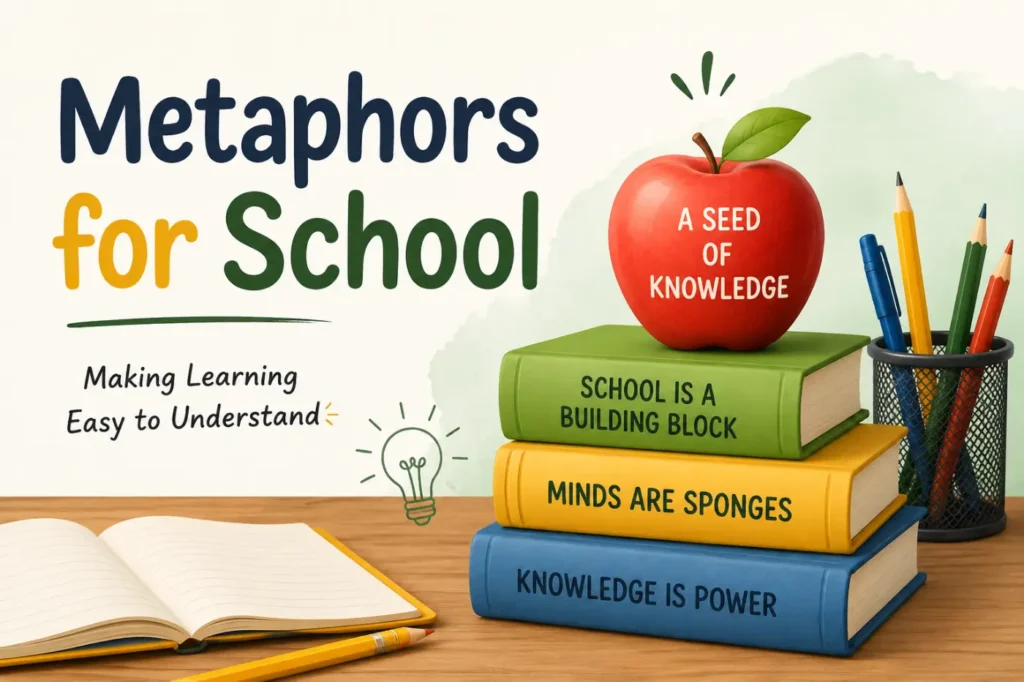
School can be a building, a community, a challenge, a place of discovery, or even a small version of the wider world. That is why finding good Metaphors for School is not simply about replacing the word school with something colorful. A useful metaphor should communicate an idea about what school feels like or what it does for students.
For one student, school may feel like a garden because teachers help ideas grow. For another, it may feel like a maze because every day brings difficult choices, deadlines, and unfamiliar challenges. Someone preparing for graduation might see school as a bridge between childhood and adulthood.
The best comparison depends on the point you want to make. A positive essay needs a different image from a humorous paragraph about homework. A middle school student may describe school differently from a senior preparing for college.
This guide explains the strongest ways to describe school through figurative language. You will find useful examples for essays, creative writing, classroom assignments, speeches, and everyday descriptions. You will also learn how to create your own instead of relying on the same tired comparisons found everywhere online.
Quick Definition
A metaphor for school compares school directly with something else to highlight a particular quality. For example, saying school is a garden suggests that students grow through teaching, practice, encouragement, and experience. The comparison is not literal. It gives readers a familiar image that helps them understand an abstract idea about education and student life.
Quick Answer
There is no single best metaphor for school because the right choice depends on the idea you want to express.
- School is a garden suggests growth and development.
- School is a workshop suggests practice and skill building.
- School is a bridge suggests movement toward a future.
- School is a laboratory suggests curiosity and experimentation.
- School is a mirror suggests self discovery.
- School is a training ground suggests preparation.
- School is a doorway suggests opportunity.
- School is a community suggests belonging and connection.
- School is a maze suggests confusion and challenge.
- School is a stage suggests performance and self expression.
A strong metaphor does not simply sound clever. It gives the reader a clear reason to see school in a particular way.
Best Metaphors for School At A Glance
| Metaphor | Main idea | Best use | Example |
|---|---|---|---|
| Garden | Growth | Positive writing | School is a garden where young minds grow. |
| Workshop | Skill building | Student essays | School is a workshop where skills are shaped through practice. |
| Bridge | Transition | Graduation writing | School is a bridge to the future. |
| Laboratory | Discovery | Science and learning | School is a laboratory for testing ideas. |
| Mirror | Self discovery | Personal writing | School is a mirror that reveals strengths and weaknesses. |
| Doorway | Opportunity | Inspirational writing | School is a doorway to possibilities. |
| Training ground | Preparation | Career writing | School is a training ground for adult life. |
| Maze | Difficulty | Honest reflection | School is a maze filled with unexpected turns. |
| Stage | Expression | Creative writing | School is a stage where students discover their voices. |
| Toolbox | Useful knowledge | Educational writing | School is a toolbox filled with skills for life. |
| Lighthouse | Guidance | Teacher focused writing | School is a lighthouse guiding students toward their goals. |
| Launchpad | New beginnings | Graduation writing | School is a launchpad for future dreams. |
The familiar images above are common because they are easy to understand. However, many online lists stop at the comparison itself. A better explanation asks what the image actually communicates and when it makes sense to use it. Research on school metaphors also shows that people describe school through many different conceptual categories rather than one universal image. A large study involving students, teachers, and teacher candidates identified 74 valid metaphors grouped into 10 broader themes.
Just as school can be described through vivid comparisons, metaphors that capture happiness can make positive emotions easier to understand and express.
Positive Metaphors for School
Positive comparisons work especially well in graduation speeches, personal essays, classroom writing, school websites, and reflective assignments. They focus on opportunity, growth, friendship, knowledge, confidence, and preparation.
School Is A Garden
A garden is a natural metaphor for growth because plants do not become strong overnight. They need time, care, sunlight, water, and suitable conditions. Students develop in much the same way.
A teacher can provide guidance, but students still need time and effort to develop their abilities. Some students grow quickly in one area and slowly in another. That does not make their progress less valuable.
Example: School is a garden where curiosity takes root and confidence slowly blooms.
This metaphor works particularly well when you are writing about personal development. It also gives you room to extend the image without making it complicated. Lessons can become seeds, teachers can become gardeners, and new skills can become branches.
School Is A Workshop
A workshop is a place where people make, repair, practice, and improve things. This makes it a strong metaphor for education because students are not simply collecting information. They are developing abilities through repeated practice.
Example: School is a workshop where students turn curiosity into useful skills.
This image is especially useful for essays about practical learning. It also avoids the idea that education is simply about memorizing facts.
A workshop allows mistakes. A student may build something incorrectly, discover the problem, and try again. That is an important part of learning.
School Is A Bridge
A bridge connects two places that would otherwise be separated. School can serve a similar purpose by helping students move from one stage of life toward another.
For younger students, the bridge can represent the move from childhood toward greater independence. For older students, it can represent the transition from high school toward college, work, or another future path.
Example: School is a bridge connecting the person I am today with the person I hope to become.
This is one of the strongest choices for graduation writing because it naturally communicates transition.
School Is A Doorway
A doorway represents access to something beyond it. That makes it useful when you want to focus on opportunity.
Example: School is a doorway that opens into a world of ideas and possibilities.
The image works because education can introduce students to subjects, careers, cultures, people, and ideas they might never encounter otherwise.
Unlike the bridge metaphor, which emphasizes movement, the doorway emphasizes access. That small difference can make your writing more precise.
School Is A Laboratory
A laboratory is a place where people investigate, test ideas, observe results, and learn from mistakes. This makes it a natural metaphor for curiosity.
Example: School is a laboratory where questions are tested and new ideas are born.
This comparison works particularly well for science writing, but it can also describe education more broadly. Writing, history, mathematics, art, and technology all involve testing ideas and discovering how things work.
The best part of this metaphor is that failure does not automatically mean defeat. An unsuccessful experiment can still teach something valuable.
Metaphors for School And Personal Growth
School is not only about academic knowledge. It can also shape confidence, independence, identity, communication, discipline, and relationships.
School Is A Mirror
A mirror reflects what is in front of it. School can act like a mirror because students often discover strengths and weaknesses through classes, friendships, competitions, projects, and challenges.
Example: School is a mirror that shows students strengths they never knew they had.
This metaphor is especially effective in personal essays because it focuses on self discovery rather than grades.
A student might discover a talent for writing in English class. Another might realize they enjoy solving problems in mathematics. Someone else may learn that they are good at leading a team.
School can reveal those qualities because students are constantly placed in situations that require different abilities.
School Is A Training Ground
A training ground is where people prepare before facing a larger challenge. School can play that role by giving students opportunities to practice communication, problem solving, responsibility, teamwork, and persistence.
Example: School is a training ground where students prepare for challenges beyond the classroom.
This metaphor is useful when discussing preparation for adult life. It also works well when writing about discipline and effort.
However, do not use it when you want to describe school as relaxing or purely creative. The phrase carries a stronger sense of preparation and challenge.
School Is A Toolbox
A toolbox contains different tools for different jobs. School can be viewed in the same way because students leave with a collection of knowledge and skills that they can use later.
Example: School is a toolbox filled with skills that students carry into adult life.
Math can become a tool for solving problems. Writing can become a tool for communication. Research can become a tool for making decisions. Collaboration can become a tool for working with others. The metaphor becomes stronger when you explain the individual tools instead of leaving the comparison vague.
School Is A Launchpad
A launchpad gives something a starting point for moving toward a destination. School can play a similar role by helping students develop the knowledge and confidence needed for their next stage.
Example: School is a launchpad that gives students the skills to pursue bigger goals.
This image works particularly well in graduation writing. It focuses on what comes next instead of treating school as the final destination.
One caution matters here. Do not imply that every student must follow the same path. A launchpad can send people in many directions. That flexibility makes the metaphor more realistic.
Metaphors That Show Discovery
Some of the best educational comparisons focus on curiosity rather than achievement. They present school as a place where students discover ideas and learn more about themselves.
School Is A Treasure Hunt
A treasure hunt involves clues, questions, surprises, and discoveries. It can represent the process of learning because students rarely understand everything immediately.
Example: School is a treasure hunt where every lesson reveals another clue about the world.
This metaphor works well for creative writing because it gives you plenty of imagery to develop. A difficult question can become a hidden clue. Research can become the search. Knowledge can become the treasure.
It also makes learning sound active rather than passive.
School Is An Open Book
A book contains stories, information, perspectives, and possibilities. School can be compared with an open book because students encounter new subjects and experiences every day.
Example: School is an open book with a new lesson waiting on every page.
This is a familiar image, so it is not particularly original. Still, it works for younger students and simple classroom assignments because the meaning is immediately clear.
School Is A Map
A map helps people understand where they are and where they might go. School can provide knowledge that helps students make decisions about their future.
Example: School is a map that helps students find their direction in a complicated world.
The map metaphor is strongest when writing about goals, careers, planning, or personal direction.
It becomes weaker when used simply to say that school helps students learn. A more specific explanation gives the image a reason to exist.
Metaphors for College That Show Challenge
Not every student experiences school as a garden or doorway. Tests, deadlines, social pressure, difficult subjects, and uncertainty can make school feel demanding.
A good article should acknowledge that side too.
School Is A Maze
A maze contains twists, dead ends, choices, and unexpected routes. That makes it a strong metaphor for the confusing parts of school life.
Example: School was a maze of deadlines, choices, friendships, and unfamiliar challenges.
This comparison works well for personal writing because it leaves room for both difficulty and growth. The student may become better at navigating the maze over time.
School Is A Mountain
A mountain represents a difficult goal that requires effort and persistence. The higher the climb, the more demanding the journey becomes.
Example: Each difficult subject was another mountain I had to climb.
This metaphor works especially well when describing academic challenges.
It also gives you a natural way to describe progress. A difficult assignment can be a steep section of the climb. Finishing an exam can feel like reaching a viewpoint. Graduation can represent reaching the summit.
School Is An Obstacle Course
An obstacle course contains different challenges that require different skills. That makes it more specific than simply calling school difficult.
Example: School is an obstacle course where every new challenge demands a different skill.
A student may need patience for one subject, creativity for another, teamwork for a group project, and discipline for a long assignment.
That variety is what makes the comparison useful.
Many school-related metaphors connect naturally with the idea of life as a learning journey, where every experience teaches us something new.
Metaphors for School That Students Can Actually Use
A common problem with figurative language lists is that the examples sound like dictionary entries rather than sentences a student would naturally put into an essay.
Good school metaphors should be easy to adapt.
Here are several natural examples.
- School is a workshop where I learned to turn mistakes into better ideas.
- My classroom became a garden where my confidence slowly grew.
- School was a bridge between the child I was and the adult I wanted to become.
- Every difficult assignment was another mountain on the road to graduation.
- My teachers became guides who helped me find paths I had never noticed.
- The school library was a doorway into worlds far beyond my neighborhood.
- Each new subject became another tool in my growing toolbox.
- The classroom became a laboratory where questions mattered as much as answers.
- School was a mirror that helped me discover what I was capable of doing.
- High school became a launchpad for dreams I had once considered impossible.
The difference is subtle but important. These examples connect the metaphor to a concrete idea. They do not simply say that school is something else and leave the reader to guess why.
Metaphors for Middle School
Middle school deserves its own set of comparisons because it is often a strange in between stage. Students are no longer little children but may not yet feel ready for the independence of high school. New teachers, changing friendships, harder classes, and greater expectations can make the experience feel exciting and confusing at the same time.
A useful metaphor should capture that transition rather than simply describe school as a place where students learn.
Middle School Is A Roller Coaster
A roller coaster rises and falls quickly. It can be exciting one moment and intimidating the next.
Example: Middle school is a roller coaster of new friendships, difficult tests, unexpected changes, and growing independence.
This metaphor works because the experience can contain several emotions at once. A student might be excited about making new friends while worrying about harder assignments.
Middle School Is A Bridge
The bridge metaphor works especially well here because middle school connects two important stages of childhood.
Example: Middle school is a bridge between childhood and the independence waiting in high school.
The comparison gives the writer a natural way to discuss change. Students are moving forward even when they are not completely sure where the path will lead.
Middle School Is A Training Camp
Middle school can feel like preparation for greater responsibilities.
Example: Middle school is a training camp where students practice the skills they will need in high school and beyond.
This image works best for writing about responsibility, organization, studying, teamwork, and independence.
Middle School Is A Puzzle
A puzzle contains many separate pieces that must eventually fit together. Middle school can feel similar as students figure out academics, friendships, interests, identity, and future goals.
Example: Middle school is a puzzle whose pieces slowly reveal who you are becoming.
This is a stronger choice for reflective writing because it focuses on personal development rather than simply academic pressure.
Metaphors for High School
High school often carries a different emotional weight. Students are thinking about graduation, careers, college, relationships, independence, and the future. The school experience becomes closely connected with questions about identity and direction.
High School Is A Launchpad
High school can provide a starting point for the next stage of life.
Example: High school is a launchpad that sends students toward futures they have spent years preparing for.
This works particularly well for graduation speeches and senior essays.
High School Is A Crossroads
A crossroads is a place where several roads meet and a decision must be made. High school can feel like that because students begin making choices that influence what comes next.
Example: High school is a crossroads where every student begins choosing a direction for the future.
This metaphor does not mean one decision determines an entire life. It simply captures the feeling of having more options and greater responsibility.
High School Is A Rehearsal
A rehearsal is preparation for a future performance. High school can work as a rehearsal for communication, responsibility, independence, work, and adult relationships.
Example: High school is a rehearsal where students practice for the larger performance of adult life.
This metaphor is especially effective when writing about preparation rather than achievement.
High School Is A Countdown Clock
A countdown creates a sense of limited time. Seniors often experience this feeling as graduation approaches.
Example: Senior year can feel like a countdown clock with every school day bringing graduation closer.
This comparison works well for personal narratives because it captures both excitement and pressure.
Metaphors for The Classroom
The classroom is smaller than the entire school experience. That means the metaphor should focus on what happens inside the learning environment.
The Classroom Is A Laboratory
A laboratory is a place where people investigate ideas and learn from results.
Example: Our classroom was a laboratory where questions were tested instead of simply memorized.
This works especially well for subjects that involve discussion, experimentation, research, or problem solving.
The Classroom Is A Stage
A stage is a place where people perform, communicate, and express themselves in front of others.
Example: The classroom became a stage where every student had a chance to find a voice.
This metaphor works well when discussing presentations, debates, drama, public speaking, or student participation.
The Classroom Is A Workshop
A workshop suggests active practice.
Example: Our classroom was a workshop where rough ideas were shaped into thoughtful answers.
This is particularly useful for writing classes because students often improve through drafting, feedback, revision, and practice.
The Classroom Is A Hive
A beehive is busy, organized, and filled with activity. This can describe a classroom where students are constantly working together.
Example: The classroom became a hive of questions, conversations, experiments, and ideas.
This metaphor creates a lively picture. It is better suited to a busy classroom than a quiet lecture.
Metaphors for Teachers
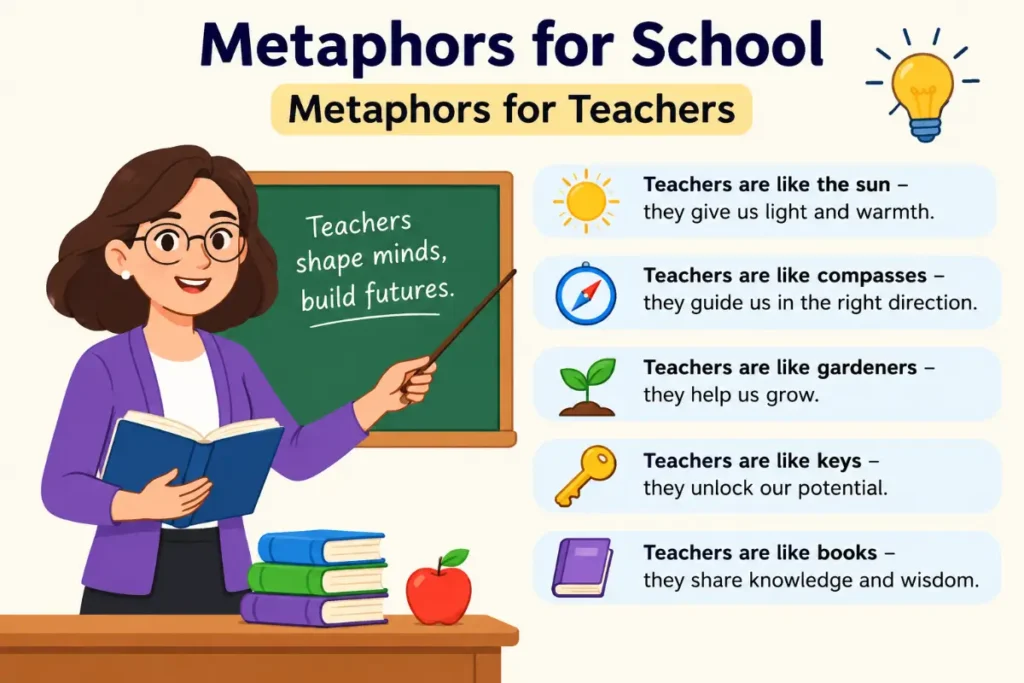
Teachers are often described through metaphors because their role extends beyond delivering information. They can guide, challenge, encourage, motivate, correct, and inspire.
A Teacher Is A Lighthouse
A lighthouse helps ships navigate dangerous waters and find a safer direction.
Example: My teacher was a lighthouse when I could not see where my future was heading.
This is a strong metaphor for guidance and support.
A Teacher Is A Gardener
A gardener creates conditions that allow plants to grow. The gardener does not force a flower to bloom but provides care and attention.
Example: A good teacher is a gardener who helps every student find the conditions needed to grow.
This comparison works well for essays about patience and individual development.
A Teacher Is A Coach
A coach teaches skills, gives feedback, sets expectations, and encourages people to improve.
Example: My teacher was a coach who pushed me past the limits I had placed on myself.
This metaphor is especially useful when describing demanding but supportive teachers.
A Teacher Is An Architect
An architect designs structures carefully and thinks about how separate parts fit together.
Example: A great teacher is an architect who helps students build strong foundations for the future.
This metaphor emphasizes structure and long term development.
A Teacher Is A Compass
A compass does not carry someone to a destination. It helps them determine direction.
Example: My teacher was a compass who helped me choose a direction without choosing it for me.
That final distinction makes this metaphor particularly strong. A teacher can guide a student without controlling the student’s future.
Metaphors for Students
Students can also be described through figurative language. These comparisons are useful when writing about potential, growth, curiosity, or learning.
A Student Is A Seed
A seed contains potential that develops under the right conditions.
Example: Every student is a seed with the potential to grow in a different direction.
This metaphor emphasizes possibility rather than fixed ability.
A Student Is An Explorer
An explorer enters unfamiliar territory and learns by observing, questioning, and adapting.
Example: A student is an explorer traveling through unfamiliar territory in search of knowledge.
This works well for curiosity and independent learning.
A Student Is A Builder
A builder creates something through planning, practice, and patience.
Example: Every student is a builder constructing a future one skill at a time.
This metaphor is useful for essays about effort and long term development.
A Student Is A Sponge
The sponge metaphor suggests absorbing information quickly.
Example: Young students can be like sponges that soak up new ideas from the people and world around them.
This is common and easy to understand, but it can oversimplify learning because students do more than absorb information. They question, analyze, interpret, and create.
Metaphors for Homework
Homework is one of the easiest school topics to make humorous because students already have strong opinions about it.
Homework Is A Mountain
Example: The weekend homework pile looked like a mountain I had no choice but to climb.
The metaphor emphasizes quantity and difficulty.
Homework Is A Shadow
Example: Homework followed me home like a shadow that refused to disappear.
This gives the reader a stronger sense of annoyance and persistence.
Homework Is A Second Shift
Example: After six hours at school, homework felt like a second shift waiting at home.
This comparison is useful for realistic student writing because it communicates exhaustion without exaggeration.
Homework Is A Never Ending Conveyor Belt
Example: Homework felt like a conveyor belt that delivered one assignment just as I finished another.
This metaphor emphasizes repetition and workload.
Metaphors for Exams And Tests
Tests create a different kind of pressure. They can be described through competition, obstacles, journeys, or high stakes.
An Exam Is A Mountain
Example: The final exam was a mountain of questions I had spent weeks preparing to climb.
This works especially well when the student has studied hard.
An Exam Is A Gate
Example: The final exam felt like a gate standing between me and graduation.
The image emphasizes the idea of an obstacle that must be passed.
An Exam Is A Mirror
Example: The test became a mirror that showed me which lessons I truly understood.
This is a more thoughtful metaphor because it removes some of the fear surrounding exams and focuses on feedback.
An Exam Is A Race
Example: The exam felt like a race against the clock.
This is a familiar comparison because time pressure is one of the defining features of many tests.
Funny Metaphors For School
Humor can make school writing memorable. The trick is to make the comparison relatable rather than random.
School Is A Daily Boss Battle
Example: Every morning felt like I was entering another boss battle against homework, quizzes, and the alarm clock.
This works well in casual writing and humorous student content.
School Is A Battery Drain
Example: School was a battery drain that somehow reached one percent before lunch.
The image captures exhaustion in a modern and recognizable way.
School Is A Marathon With Pop Quizzes
Example: School felt like a marathon where someone kept throwing surprise pop quizzes onto the track.
This combines a familiar school experience with an unexpected image.
School Is A Group Chat You Cannot Leave
Example: School is like a group chat you cannot leave because there is always another assignment waiting.
This is more of a comparison than a traditional metaphor, but it works well in casual student writing.
School Is A Never Ending Alarm
Example: School felt like a never ending alarm clock that rang every morning before I was ready.
This gives the reader an immediate sense of frustration.
Metaphors for Education And Learning
School and education are closely connected, but they are not exactly the same. School refers to an institution and the experience students have there. Education is broader and can happen at home, through books, work, travel, conversation, observation, and experience.
That distinction gives writers more room to create meaningful comparisons.
Education Is A Key
A key opens something that was previously inaccessible.
Example: Education is a key that opens doors to ideas, opportunities, and new possibilities.
This is one of the most familiar educational metaphors. It works because knowledge can give people access to opportunities they did not previously understand or have.
Learning Is A Muscle
Muscles become stronger through repeated use and training.
Example: Learning is a muscle that grows stronger every time we challenge it.
This metaphor emphasizes practice. It also supports the idea that ability can develop over time.
Knowledge Is A Light
Light allows people to see what was previously hidden.
Example: Knowledge is a light that makes unfamiliar ideas easier to understand.
This metaphor is particularly useful in philosophical or inspirational writing.
Education Is A Passport
A passport allows a person to cross borders and enter new places.
Example: Education is a passport that can take the mind far beyond the limits of one place.
This is a strong metaphor for cultural learning and exposure to different perspectives.
How To Choose The Right Metaphor
The biggest mistake students make is choosing a metaphor because it sounds impressive. A better method is to decide what you actually want the reader to understand.
Use this simple approach.
- Decide the message. Do you want to show growth, challenge, opportunity, discovery, pressure, friendship, or preparation?
- Choose an image with the same quality. A garden fits growth. A mountain fits difficulty. A bridge fits transition.
- Make the comparison specific. Explain why the image fits.
- Add a concrete example. Show the metaphor in action.
- Remove anything that sounds forced. If you would never say it naturally, rewrite it.
For example, if your essay is about struggling with mathematics, calling school a garden may not be your strongest choice. A mountain or obstacle course could communicate the difficulty more clearly.
If your essay is about becoming more confident, a mirror may work better because it focuses on self discovery.
If your essay is about graduation, a bridge or launchpad may be more effective because both images naturally suggest movement toward the future.
Metaphor Versus Simile For School
Metaphors and similes both create comparisons but they do it in different ways. A metaphor states that one thing is another thing. A simile usually uses like or as to make the comparison explicit.
For example:
School is a garden.
That is a metaphor because school is directly presented as a garden.
School is like a garden.
That is a simile because the word like signals the comparison.
Both sentences can communicate growth. The metaphor sounds more direct and confident. The simile sounds more clearly comparative.
You can use either form in creative writing. The best choice depends on the sentence and the effect you want.
| Type | How it works | Example |
|---|---|---|
| Metaphor | Direct comparison | School is a garden. |
| Simile | Comparison using like or as | School is like a garden. |
| Analogy | Explains a relationship through comparison | Learning at school is like building a house because both require a strong foundation. |
| Personification | Gives human qualities to something nonhuman | The classroom welcomed every new idea. |
| Symbolism | An image represents a larger idea | A school doorway can symbolize opportunity. |
| Idiom | Established expression with a figurative meaning | We are back to the books. |
Understanding these differences helps you choose the right type of figurative language instead of calling every comparison a metaphor.
Metaphor And Analogy Are Not The Same
An analogy usually explains an idea through a comparison. It tends to be longer and more explanatory than a metaphor.
Consider this example:
School is a toolbox.
That is a metaphor.
Now expand the idea:
School is like a toolbox because each subject gives students a different skill they can use to solve problems later in life.
That is an analogy. It does more than make a comparison. It explains the relationship between the two ideas.
This distinction matters in academic writing. A teacher asking for a metaphor may expect a short comparison. A teacher asking for an analogy may expect you to explain how two systems or experiences are similar.
Metaphors For School And Symbolism
A metaphor can become a symbol when an image takes on a broader meaning throughout a piece of writing.
For example, a door can symbolize opportunity.
A bridge can symbolize transition.
A garden can symbolize growth.
A light can symbolize knowledge.
A path can symbolize direction.
The context determines the meaning. A locked school door could symbolize a lack of opportunity. An open door could symbolize possibility. A broken bridge could represent a difficult transition.
That is why writers should not assume that an image always carries one fixed meaning.
Good writing gives the image enough context for readers to understand what it represents.
How To Make Your School Metaphors More Original
The easiest way to make a metaphor feel fresh is to connect it to a specific experience instead of using a generic comparison.
Instead of:
School is a journey.
Try:
School is a trail where every difficult climb teaches you something about the strength in your legs.
The second version gives the journey a purpose. It also gives the reader a physical image.
You can make the comparison even more personal:
My first year of high school felt like entering a forest without a map. Every new class gave me another trail to follow.
Now the metaphor is connected to a specific experience.
This technique works with almost any image.
A garden can contain seeds, roots, branches, seasons, and blooms.
A workshop can contain tools, materials, mistakes, repairs, and finished projects.
A mountain can contain steep climbs, setbacks, rest stops, and views from the top.
A bridge can contain two sides, distance, movement, and a destination.
The key is to develop one image instead of throwing several unrelated images into the same paragraph.
How To Extend A Metaphor Naturally
A strong extended metaphor stays within one conceptual world.
Suppose you choose the idea of school as a garden.
You could write:
My school was a garden. Every teacher planted something different in us. One taught us to question, another taught us to write, and another taught us to solve problems. Some lessons took root immediately. Others needed years before I understood their value. By graduation, I realized I had not simply completed classes. I had grown.
Notice how the imagery remains connected.
Garden.
Plant.
Root.
Growth.
Graduation.
That makes the writing feel intentional.
Now compare it with a paragraph that jumps between unrelated images:
School was a garden, a rocket, a maze, a battlefield, and a toolbox.
The writer may have interesting ideas, but the paragraph has no central image. The comparisons compete instead of working together.
One strong metaphor can often do more than five weak ones.
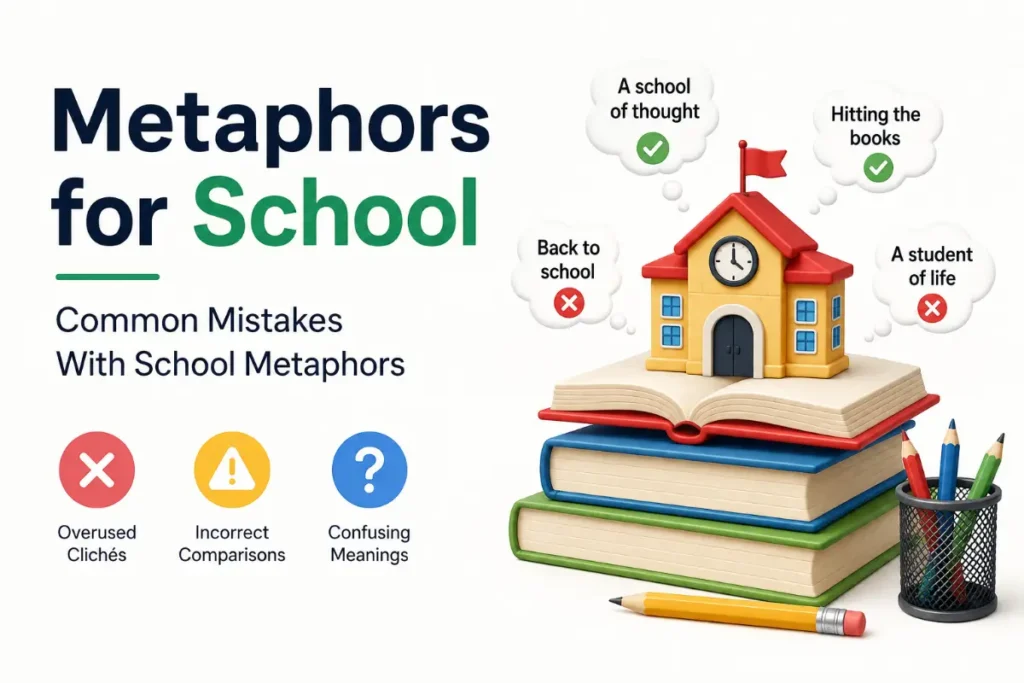
Common Mistakes With Metaphors
Using A Metaphor That Does Not Fit
A metaphor should match the quality you want to describe.
Calling school a vacation when you are writing about hard work creates confusion unless you are intentionally being humorous.
Calling school a battlefield suggests conflict and competition. It may be suitable for a difficult personal experience but inappropriate for an essay celebrating friendship and growth.
Always ask what emotional message the comparison sends.
Mixing Too Many Images
Avoid switching from gardens to oceans to mountains to machines in the same paragraph. Choose one main image and develop it.
Explaining The Metaphor Too Much
Students sometimes write the metaphor and then explain every word.
School is a garden. A garden has plants. Plants grow. Students grow. Teachers are gardeners. Lessons are seeds. Knowledge is water.
The comparison becomes mechanical. Instead, let the metaphor appear naturally inside the writing.
My teachers gave me the patience and encouragement I needed to grow.
The reader understands the image without a long explanation.
Choosing A Metaphor Only Because It Sounds Fancy
A complicated metaphor is not automatically a better metaphor. Simple language often creates stronger writing.
School is a bridge to my future.
That sentence is simple but clear.
You do not need to write:
School is an intricate architectural passageway connecting the fragmented landscape of childhood with the distant horizon of adult responsibility.
The second version sounds forced and less natural.
Using Clichés Without Adding Anything
Some school metaphors are extremely common. That does not make them useless, especially for younger students. But if you use one, add a specific detail.
Instead of:
School is a garden where students grow.
Try:
My school was a garden where every teacher helped a different part of me grow.
The personal detail gives a familiar metaphor a reason to exist.
Some literary comparisons also explore more serious themes, with poetic metaphors for death helping writers discuss loss and endings in a thoughtful way.
Metaphors For School In Academic Writing
Academic writing usually benefits from precision. Figurative language can make an explanation memorable, but it should not replace clear facts.
For example:
Education is a foundation for lifelong learning.
This is a common metaphor, but it communicates a clear idea.
You could develop it:
Early education provides a foundation on which students build more advanced knowledge and skills.
The second sentence is more appropriate for formal academic writing because it explains the idea directly.
A good rule is to use metaphor to clarify an idea rather than hide it.
If the metaphor makes your argument harder to understand, remove it.
Metaphors For School In Creative Writing
Creative writing gives you much more freedom.
You can make the school itself behave like a character.
The old school building watched generations of students hurry through its doors.
You can turn the classroom into a living place.
The classroom woke up whenever someone asked a difficult question.
You can turn a school year into a season.
September planted new friendships while June harvested the memories of the year.
You can even build an entire story around one image.
A student might enter school as an unopened book and gradually fill the pages through experiences, mistakes, friendships, discoveries, and challenges.
The possibilities are wide, but the same principle still applies. The image should serve the story.
Metaphors For School In A Graduation Speech
Graduation speeches often use metaphors because they naturally involve reflection and looking toward the future.
A bridge works well:
For years, we thought school was the destination. Now we can see that it was a bridge. It carried us from who we were toward everything we have yet to become.
A launchpad also works:
This school gave us more than lessons. It gave us a launchpad from which we can pursue goals that once seemed far away.
A garden can create a warmer emotional tone:
We entered these halls as seeds with uncertain futures. Our teachers, families, and friends helped us grow. Today we leave knowing that growth does not stop at graduation.
These examples work because the metaphor supports the larger message rather than appearing as a random decorative phrase.
Original Metaphors For School
If you want something less predictable than garden, bridge, or journey, consider these alternatives.
- School is a workshop for the mind.
- School is a rehearsal for independence.
- School is a greenhouse for curiosity.
- School is a testing ground for ideas.
- School is a compass room where students learn to choose directions.
- School is a doorway with thousands of possible rooms beyond it.
- School is a puzzle that becomes clearer one piece at a time.
- School is a forge where patience and discipline are shaped.
- School is a library that teaches you how to read the wider world.
- School is a crossroads where different futures begin to appear.
- School is a practice field for skills that matter beyond grades.
- School is a greenhouse where curiosity gets room to grow.
- School is a mirror that reveals strengths hidden beneath uncertainty.
- School is a laboratory where mistakes become evidence.
- School is a map that helps students discover possible directions.
Some of these are better suited to serious essays. Others work well in creative writing. The strongest choice depends on the message.
Frequently Asked Questions
What Is A Good Metaphor For School
A garden is one of the strongest general choices because it represents growth, patience, care, and development. A workshop works better when you want to emphasize skills and practice. A bridge fits transition and graduation. A laboratory suits discovery and curiosity. The best option depends on the specific quality of school you want the reader to notice.
What Is A Metaphor For A Student
A student can be described as a seed, explorer, builder, artist, athlete, or traveler. A seed emphasizes potential and growth. An explorer emphasizes curiosity. A builder emphasizes effort and skill development. The comparison becomes stronger when it connects to a real characteristic of the student instead of simply giving the student a flattering label.
What Is A Metaphor For A Teacher
A teacher can be a lighthouse, gardener, coach, architect, compass, guide, or sculptor. Each image highlights a different role. A lighthouse suggests guidance. A gardener suggests patience and growth. A coach suggests practice and challenge. An architect suggests building a strong foundation. Choose the image that matches the teacher’s actual influence.
What Is A Metaphor For A Classroom
A classroom can be described as a laboratory, workshop, stage, hive, garden, or studio. A laboratory emphasizes investigation. A workshop emphasizes practice. A stage emphasizes communication and performance. A garden emphasizes growth. A studio emphasizes creativity. The best choice depends on what students are doing inside the classroom.
What Is A Metaphor For School Life
School life can be compared with a journey, maze, roller coaster, marathon, adventure, or puzzle. A journey emphasizes progress. A maze emphasizes confusion and unexpected turns. A roller coaster emphasizes changing emotions. A marathon emphasizes persistence. A puzzle emphasizes discovering identity and fitting different experiences together.
What Is A Metaphor For High School
High school can be described as a bridge, crossroads, launchpad, rehearsal, training ground, or countdown. A bridge emphasizes transition. A crossroads emphasizes choices. A launchpad emphasizes future opportunities. A rehearsal emphasizes preparation for adult responsibilities. These images work particularly well in graduation essays and speeches.
What Is A Funny Metaphor For School
A funny school metaphor can compare school with a battery drain, boss battle, marathon, alarm clock, second job, or never ending conveyor belt. These comparisons work best in casual writing because they exaggerate familiar student experiences. Keep humorous metaphors away from serious academic writing unless the assignment specifically calls for a playful tone.
Is School A Metaphor For Life
School can function as a metaphor for life when a writer uses classrooms, lessons, tests, mistakes, teachers, and graduation to represent broader human experiences. For example, a difficult exam can represent a challenge, while graduation can represent a transition. The comparison works because school contains many experiences that resemble real life.
Final Takeaway
The best school metaphor is not the one that sounds the most impressive. It is the one that makes the reader understand your idea faster and feel it more clearly.
- Use a garden when you want to show growth.
- Use a workshop when you want to show practice and skill.
- Use a bridge when you want to show transition.
- Use a doorway when you want to show opportunity.
- Use a laboratory when you want to show discovery.
- Use a mirror when you want to show self discovery.
- Use a mountain when you want to show difficulty.
- Use a maze when you want to show confusion and unexpected challenges.
- Use a launchpad when you want to show preparation for the future.
- Use a crossroads when you want to show important choices.
Most importantly, do not treat figurative language like a box that needs to be checked on an assignment. A metaphor should have a job. It should help the reader see an ordinary idea from a sharper angle.
If you are writing about your own school experience, start with something real. Think about the hardest day, the best teacher, the subject that changed you, the friendship you gained, or the moment you realized you had grown. Then find an image that naturally captures that experience.
That approach will almost always produce better writing than copying a metaphor from a list. A school can be a garden for one student, a mountain for another, a laboratory for someone else, and a bridge for someone preparing to graduate. The metaphor changes because the experience changes.