
Home is more than four walls and a roof. It is the familiar sounds, comforting smells, and people who make us feel safe and loved. A metaphor like “home is a harbor with the porch light on” captures that feeling far better than simply saying “I love my home.”
In this guide, you’ll discover 40+ metaphors for home, each with a simple meaning and an example sentence. From a place to sleep to a place of deep belonging, these expressions help bring the meaning of home to life.
You’ll also find practical tips for using metaphors in essays, memoirs, and poems, along with common overused phrases to replace. For more creative inspiration, explore our metaphor examples by topic.
What Is a Metaphor for Home?
A metaphor for home describes a house, a family, a city or a feeling of belonging as something else, without using “like” or “as.” “She felt comfortable at home” states a fact. “Home was a hug in the shape of a house” lets the reader feel warmth and safety. The comparison is not literal. It borrows the qualities of the image, such as shelter, warmth, roots or music, to show what home means to a person.
We use home metaphors in daily speech without noticing: a safe haven, the heart of the house, putting down roots, a home away from home, a place to hang your hat. These phrases show how naturally we picture home as shelter, warmth and a place to return to.
Why Do We Use Metaphors for Home?
Home means something different to everyone. For one person it is a childhood kitchen, for another a small apartment in a new city, and for another a group of friends. A single word cannot hold all of that. Metaphors let writers show what home means to a specific person.
Home also holds strong emotions: comfort, safety, memory, longing and sometimes pain. Not everyone has a happy home, and metaphors can show that too, through images of cages, cold rooms or houses that never felt like shelter. Good writing about home respects both the warm and the difficult versions.
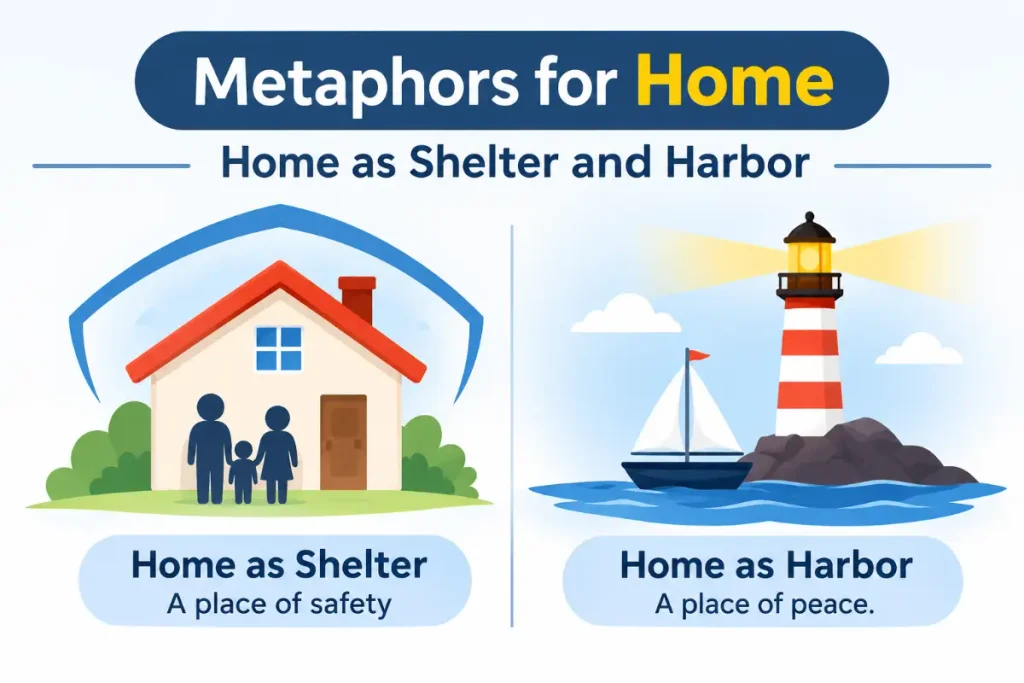
Home as Shelter and Harbor
These images show home as a safe place from the outside world.
- Home is a harbor with the porch light on. A safe place to return to after rough seas.
- Home was a nest lined with years of comfort. Soft, protected and built by care.
- The house was a shelter from the storm. A place to be safe when everything outside was hard.
- Her apartment was a cocoon. Quiet, private and soft.
- Home is an umbrella that stays open in any weather. Reliable protection.
Home as Warmth and Hearth
These images show home as a place of comfort and heat.
- Home is a warm fire at the end of a long road. A place of comfort after effort.
- The kitchen was the heart of the house. The place where everyone gathered.
- Home was a hug in the shape of a house. Comfort that surrounded him.
- The hearth was a small sun in the middle of winter. Warmth and light for everyone nearby.
- Our living room was a blanket we all pulled over our knees. Shared comfort and closeness.
Home as Roots and Belonging
These images show home as a deep connection to people and place.
- Home is the root of the tree. It holds you up and feeds you from below.
- Home is a lighthouse. It guides you back no matter how far you travel.
- Her hometown was an anchor she carried everywhere. A steady point of identity.
- Home was a compass that always pointed back. A place she could always find her way to.
- The old street was a family tree made of houses. Generations lived side by side.
Home as Sound and Smell
Senses make home feel real. These images show the sights, sounds and scents of belonging.
- Home was a song with the same chorus every night. Comforting, familiar routines.
- The smell of bread was a doorway home. A scent that brought back belonging.
- Footsteps on the stairs were a familiar rhythm. Everyday sounds that meant safety.
- The squeak of the front door was a welcome. A small noise that meant arrival.
- Their laughter was the wallpaper of the house. Happy sounds that filled every room.
Home as People, Not Place
For many people, home is not a building but the people in it.
- Home is a person, not a place. Belonging comes from someone, not somewhere.
- Her arms were a house with no address. Comfort she could find anywhere.
- Friends were the rooms of a home he carried in his pocket. Belonging that traveled with him.
- Home was the table with everyone’s chair. A place where every person had a seat.
- Family was a home built of voices. Belonging made from conversation.
Home as Memory and Nostalgia
These images show home as a place in the past that stays alive.
- The childhood home was a museum of tiny moments. Everyday memories kept in every corner.
- The worn steps were a diary of footsteps. Years of life recorded in the wood.
- The old key was a doorway to childhood. A small object that opened the past.
- The house on Maple Street was a book she could still read with her eyes closed. Every detail remained clear.
- The attic was a time capsule. Years of belongings kept safe and unchanged.
Home and Homesickness
These images show the ache of being away from home.
- Homesickness was a tide pulling her toward the shore. A constant tug back to where she belonged.
- Her suitcase was a small house she carried everywhere. A few things that kept home close.
- The new city was a coat that did not fit yet. Unfamiliar and a little uncomfortable.
- The empty house was a shell with the echo of a voice. Quiet, with the memory of people still in it.
- Missing home was a window she kept looking through. A constant glance toward what she left behind.
Home as Something You Build
These images show home as something made over time with care.
- A home is built, not bought. It grows from effort and love.
- They made the apartment a home one candle at a time. Small touches added warmth.
- Home was a garden they planted together. Shared care helped it grow.
- Love was the foundation under every wall. The base that held everything up.
- Coming home was a deep breath after a long dive. Relief and rest after effort.
Metaphors for Home in Sentences and Paragraphs
Here are short examples showing home metaphors in real sentences.
- After the long trip, the porch light was a harbor, and the smell of onions on the stove was a rope thrown to shore.
- Their kitchen was the heart of the house, and every conversation seemed to begin there.
- For years, her suitcase was a small house she carried from city to city.
- Home, he decided, was not a place but a table with everyone’s chair.
Here is a longer example that builds one image across a paragraph:
When Amir turned the key, the house was a lighthouse after a long night at sea. The hallway still smelled of cardamom and old books. The stairs creaked their familiar song. In the kitchen, his mother’s chair sat where it had always sat, and the light through the window was the same gold it had been when he was seven. He did not need to say anything. The house knew he had come back.
And here is a shorter example about a home that was hard:
For Jo, the house was a cold room with the heater off. She learned to keep a small warm place inside herself, and later, when she had a door of her own, she lit a candle in the window.
The Home Scale
Home means different things to different people, and the best metaphors match them.
| Level | Type | Metaphor | What it shows |
|---|---|---|---|
| Basic | A place to sleep | The room was a shell. | Shelter without warmth |
| Temporary | A new place | The new city was a coat that did not fit yet. | Unfamiliar and uncertain |
| Comfortable | A pleasant home | Her apartment was a cocoon. | Soft and private |
| Warm | A happy home | Home was a hug in the shape of a house. | Comfort and safety |
| Deep belonging | Roots and identity | Home is the root of the tree. | Strong, lasting connection |
| Longing | Missing home | Homesickness was a tide pulling her toward the shore. | A constant pull back |
How Writers Use Home Metaphors
Home is a favorite subject in memoirs, novels, poems and personal essays. A few techniques help.
Use the senses. Smell, sound and touch make home feel real. A metaphor like “the smell of bread was a doorway home” shows how a small detail can carry a whole world.
Anchor it in specific places. A kitchen table, a creaky stair or a certain window can hold the feeling of home better than general words. A metaphor can then name what that place means.
Show home as people. Many readers feel that home is about who is there. Images of tables, voices and arms show this warmly.
Include difficult homes. Not every home is safe or happy. A cold room, a locked door or a house that never felt like shelter are honest images, and they help readers who have felt the same.
Show leaving and returning. Homesickness, moving and coming back add story. A metaphor can mark the change, such as a coat that does not fit yet becoming a coat that does.
Avoid stereotypes. Home looks different across cultures and families. Avoid suggesting that one kind of home is the right one.
How to Use Home Metaphors in Essays and Memoirs
In a school essay, follow three steps: find the metaphor, explain it and show its effect.
- Find it. Look for a comparison that says home is something, such as “home is a harbor with the porch light on.”
- Explain it. Say what the two things share. A harbor protects ships from storms, and a light helps them find it, so the comparison shows that home gives safety and guidance.
- Show the effect. Say what the reader feels, such as comfort, belonging or longing.
Here is a short sample paragraph:
The writer describes the grandmother’s kitchen as “the heart of the house.” This metaphor suggests that the kitchen is the center of the family’s life. A heart keeps a body alive and moving, so the comparison shows that the kitchen keeps the family connected. As a result, the reader feels the warmth and closeness of the home.
In a memoir, one strong home metaphor can open a chapter. Start with a sensory detail, add the image, and then tell the story of the place.
Common Home Phrases and Clichés to Avoid
Many home phrases are so familiar that readers barely notice them. Try fresher images when you can.
| Common phrase | Fresher alternative |
|---|---|
| Home sweet home | The house had a way of exhaling when she walked in. |
| Home is where the heart is | Home was wherever the kettle was already warm. |
| Make yourself at home | The couch had a dent shaped like a guest. |
| A roof over your head | Four walls that held the weather out. |
| Empty nest | The house was suddenly all hallway. |
| Hits close to home | The words landed on the same step she always tripped on. |
Other mistakes to watch for:
- Mixing images. “Home is a harbor that blooms like a garden” blends two pictures. Choose one.
- Only showing warmth. Real homes have noise, mess and difficulty. A few honest details feel more true.
- Assuming everyone has a happy home. Be gentle with readers who have had hard experiences.
- Too many at once. One clear image per paragraph is usually enough.

Try It Yourself: Write a Home Metaphor in Five Steps
Use these steps with any home you know.
- Choose a place. For example: a grandparent’s kitchen.
- Decide the feeling. Is it comfort, memory, longing or belonging?
- Pick a source. Think of weather, sound, food, light, roots or water.
- Write three versions. For example: The kitchen was a small sun in winter. / The house was a song with the same chorus every night. / Her cooking was a doorway home.
- Choose the best one and add a detail. The kitchen was a small sun in winter, and everyone drifted toward it in socks.
Now write a second version about missing that place, using a tide, a window or a coat that does not fit.
Frequently Asked Questions
What is a good metaphor for home?
“Home is a harbor with the porch light on” and “home is the heart of the house” are both warm and clear. One shows safety, and the other shows the center of family life.
What is a metaphor for a childhood home?
Try a museum of tiny moments, a book you can read with your eyes closed, a time capsule or a diary of footsteps. They show how every corner holds memory.
What is a metaphor for homesickness?
Try a tide pulling toward the shore, a window you keep looking through, a coat that does not fit yet or a small house in a suitcase. They show the ache of being away.
What is the difference between a house and a home in metaphor?
A house is a building, so its metaphors involve walls, roofs and shells. A home is a feeling, so its metaphors involve warmth, roots, harbors and people.
Is “home is where the heart is” a metaphor?
Yes. It compares home to the place where your feelings live, suggesting that belonging is about love, not a location. It is also a very common phrase, so try a fresher image if you can.
What is a metaphor for a new home that does not feel like home yet?
Try a coat that does not fit, an empty shell, a stage before the play or a blank page. They show a place waiting to be filled.
Are home metaphors good for school writing?
Yes. They work well in memoirs, personal essays and poems. Add a sentence that explains what the image shows about the person or the place.
Conclusion
Home is more than walls and a roof, and metaphors help us show that. A harbor shows safety, a hearth shows warmth, roots show belonging and a table with everyone’s chair shows that home can be made of people. The best writing about home also admits that it can be hard to leave, hard to return to and, for some, hard to find.
When you write about home, use the senses, anchor your images in specific places and respect the many kinds of home people have. Avoid worn-out phrases when you can, show both warmth and difficulty, and explain your metaphor in school work. A single well-chosen image can bring a whole house, and the people in it, into the room.
Related Metaphors
- For the people who often make a home, read our guide to metaphors for family.
- For the past that homes keep alive, see metaphors for memory.
- When home is far away, try metaphors for loneliness.