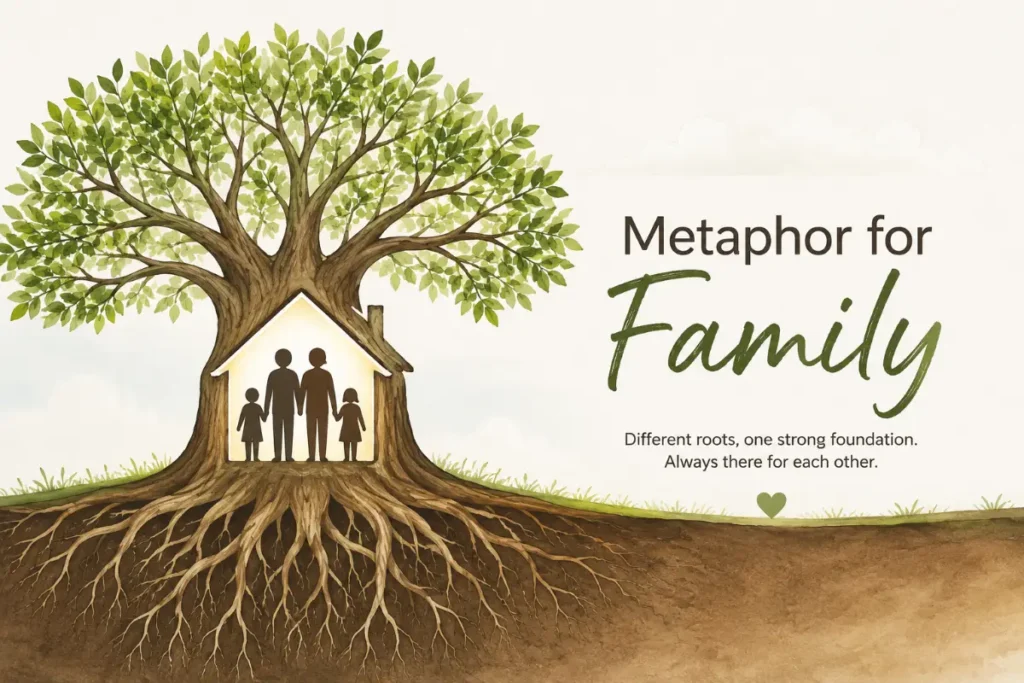
Family can be difficult to describe in a few words. It can be a source of comfort, a place where people learn their first lessons, a collection of shared memories, or the people who stand beside us when life gets rough. That is why writers often turn to figurative language when ordinary descriptions do not feel strong enough. A metaphor can turn an abstract family relationship into something readers can see and feel.
A useful metaphor for family might describe family as a tree with deep roots, a home with an open door, a team that works together, or a garden that needs patience and care. Each image highlights something different. A tree suggests heritage and growth. A home suggests belonging. A team suggests cooperation. A garden suggests relationships that become stronger through attention.
There is no single perfect comparison for every family. The best choice depends on the feeling you want to express and the people you are describing. In this guide, you will find meaningful examples for writing, school assignments, poems, speeches, cards, social posts, and everyday conversation. You will also learn how to create your own original family imagery instead of relying only on familiar phrases.
Quick Definition
A family metaphor describes a family by comparing it directly to another person, object, place, or system without using words such as like or as. For example, family is a tree compares relatives to roots, branches, and leaves to express ideas about heritage, connection, growth, and generations.
Quick Answer
A family can be described as a tree, home, garden, team, anchor, lighthouse, foundation, safety net, puzzle, tapestry, bridge, or journey. Each comparison emphasizes a different quality. For example, a tree represents roots and generations, while a home represents belonging and emotional security. The strongest choice depends on the message you want to communicate.
What A Family Metaphor Means
A metaphor makes an imaginative comparison between two different things. Instead of saying that family provides support, you might call family a safety net. Instead of simply saying that relatives are connected across generations, you might describe them as branches growing from the same tree.
The comparison does not need to be literally true. A family is not physically a tree or a lighthouse. The point is that the qualities of the chosen image help explain something about family life.
This is why metaphors are so useful in writing. They give an abstract idea a shape. Words such as love, belonging, loyalty, trust, heritage, and support can be difficult to visualize on their own. A strong comparison gives those ideas something concrete for the reader to picture.
Consider the difference between these two sentences:
- My family supports me when life gets difficult.
- My family is the safety net that catches me when life knocks me down.
The first sentence is clear and direct. The second creates an image. You can picture someone falling and a net preventing them from hitting the ground. That image makes the idea of emotional support more vivid.
Good figurative language does not replace clear writing. It strengthens it.
Just as family can represent love, belonging, and protection, metaphors that capture life’s final chapter can help us express difficult ideas about loss and mortality in a more thoughtful way.
Why Writers Use Family Metaphors
Family is an emotional subject. A direct description can explain a relationship, but a carefully chosen image can communicate its emotional weight much faster.
A writer might use family imagery to express love, protection, conflict, loyalty, growth, distance, friendship, memories, or belonging. The same family can even be represented by different images at different moments.
For example, a person might describe their family as a harbor when talking about comfort after a difficult day. The same person might call that family a ship when discussing how everyone works together during a crisis. Neither image is automatically better. They simply emphasize different qualities.
Metaphors are especially useful in:
- School essays and creative writing assignments.
- Poems about parents, siblings, or childhood.
- Eulogies and family speeches.
- Greeting cards and personal messages.
- Social media captions.
- Personal essays and memoirs.
- Fiction and character development.
- Graduation speeches.
- Wedding speeches.
- Descriptions of family relationships.
The strongest writing usually chooses an image for a reason. A metaphor should reveal something about the relationship rather than exist only to make a sentence sound fancy.
Comparison Of Common Family Metaphors
| Family image | Main idea | What it can represent | Best use |
|---|---|---|---|
| Tree | Heritage and growth | Roots, generations, branches | Poems and essays |
| Home | Belonging | Safety, comfort, identity | Personal writing |
| Team | Cooperation | Shared effort and responsibility | Speeches and essays |
| Garden | Care and growth | Patience, nurturing, development | Reflective writing |
| Safety net | Support | Protection during hardship | Personal messages |
| Anchor | Stability | Strength and grounding | Emotional writing |
| Lighthouse | Guidance | Wisdom and direction | Speeches |
| Foundation | Stability | Values and upbringing | Essays |
| Puzzle | Individual roles | Different people forming one whole | School writing |
| Tapestry | Connection | Individual stories woven together | Poetry |
| Bridge | Connection | Generations and relationships | Essays |
| Journey | Shared experience | Life changes and memories | Personal writing |
| Harbor | Security | Rest and emotional refuge | Poems |
| Campfire | Warmth | Togetherness and tradition | Creative writing |
| Nest | Nurturing | Childhood and protection | Family poems |
This table shows an important point. There is no universal winner. A writer choosing a family comparison should first decide what aspect of family life deserves attention.
Family As A Tree
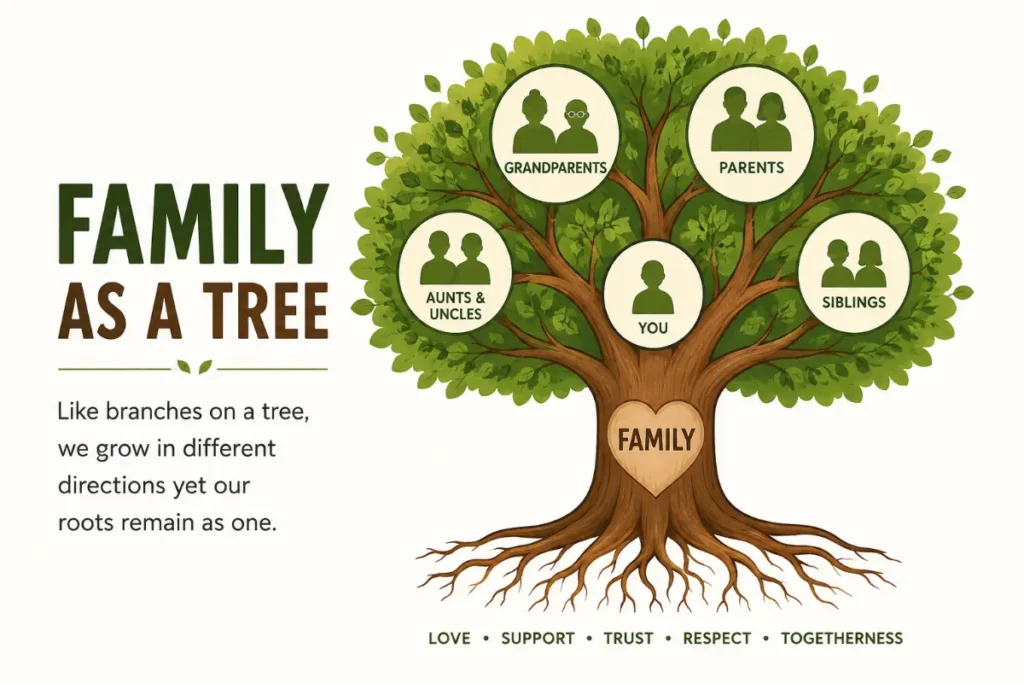
The family tree is one of the most familiar images for describing relatives and generations. It works because the structure of a tree naturally reflects the way families can grow across time.
The roots can represent ancestors and family history. The trunk can represent the central bond connecting generations. Branches can represent different family lines. Leaves can represent individual family members. New growth can represent children and future generations.
A simple example is:
Our family is a tree with roots deep in the past and branches reaching toward the future.
The image becomes more meaningful when the writer connects each part of the tree to a specific idea. Instead of stopping at a familiar comparison, you can develop it.
Our grandparents are the roots beneath us. Our parents form the sturdy trunk that holds us together, while the younger generations stretch outward like new branches reaching for sunlight.
This kind of extended metaphor is particularly useful for family history projects, ancestry essays, poems, and speeches.
The tree image also works well because it allows room for imperfections. Real trees have broken branches, scars, storms, and uneven growth. A family can have those things too. That gives writers another direction:
Our family tree has weathered storms, lost branches, and grown new ones, but its roots still hold.
That sentence communicates resilience without pretending that every family relationship is perfect.
Family As A Home
A home is more than a building. In personal writing, it can represent belonging, familiarity, security, and the feeling of having somewhere to return. That makes it one of the strongest images for family love.
My family is my home.
The sentence is short, but the meaning can be much larger than the words themselves. It suggests that home is found in people rather than in a particular address. You can develop the idea further:
My family is the home I carry with me, even when I am miles away.
This works particularly well for writing about moving away, growing up, traveling, or leaving home for college. The image can also focus on emotional safety:
Family is the place where I can put down the weight I carry all day.
This is not a literal place. It describes the emotional relief that can come from trusted relationships.
For a poem or personal essay, you can explore familiar household details such as a kitchen table, front door, bedroom, porch, or family photographs. Those details can turn a broad idea into something personal.
Family As A Team
A team works toward a shared goal. Members may have different skills and personalities, but their efforts contribute to something larger than any individual member.
That makes a team a useful image for families that value cooperation.
My family is a team, and every person has a role to play.
The image becomes stronger when you show how the roles differ.
One person might organize everything. Another might provide encouragement. Someone else might solve practical problems. A child might bring humor into stressful situations. No role has to be identical for the group to function.
This comparison is especially useful for school assignments and speeches because it naturally leads to examples. You could write:
My family is a team that does not always agree on the play, but we still show up for one another when the game gets tough.
That version feels more realistic than an overly sentimental description. Families disagree. Strong relationships can survive disagreement because people continue to care about one another.
Family As A Garden
A garden is not created in one afternoon. It requires attention, patience, sunlight, water, and time. That makes it a useful image for relationships.
Our family is a garden, and love is what keeps it growing.
The image can represent children growing up, relationships developing, traditions being passed down, or people learning to care for one another.
It also gives writers a way to discuss difficult periods without portraying family life as perfect.
Some seasons in our family garden have been dry, but we kept watering what mattered.
That sentence suggests hardship while preserving a sense of hope.
A garden metaphor is especially effective when discussing parenting. Children do not simply need instructions. They need time, encouragement, boundaries, patience, and opportunities to grow.
You can therefore extend the image:
Parents plant the first seeds, but children grow in directions of their own.
That idea can also support a thoughtful essay about independence. Good parenting is not about forcing a child to become an exact copy of the parent. It is about providing conditions in which the child can develop.
Family As A Safety Net
A safety net represents support during a fall. That makes it a strong comparison for families that provide help during difficult periods.
My family is the safety net beneath me.
The power of this image comes from the idea that you can take risks because someone will help you recover if things go wrong.
It can represent emotional support, financial help, practical assistance, encouragement, or simply knowing that someone will answer the phone when you need them.
A more developed example is:
My family is the safety net that gives me courage to take the next step because I know I will not have to face every fall alone.
This image works well in graduation speeches because young adults often describe family support as they move into a new stage of life.
It can also be used in a more personal way:
When life pulled the ground from beneath me, my family became the net that kept me from falling too far.
That creates a clear emotional picture while keeping the wording natural.
Family As An Anchor
An anchor keeps a vessel from drifting away. As a family image, it represents stability, connection, and grounding.
My family is my anchor.
This is particularly effective for describing people who help you stay connected to your values during uncertain periods. The metaphor can also express the feeling of returning to familiar people after major life changes.
No matter how far life carries me, my family keeps me anchored to where I came from.
There is an important difference between an anchor and a chain. An anchor suggests stability and security. A chain can suggest restriction. Writers should choose carefully because the image can change the emotional meaning of a sentence.
If you want to describe family as supportive, an anchor works well. If you want to describe a difficult or controlling family relationship, a chain may communicate something very different.
Family As A Lighthouse
A lighthouse helps ships navigate dangerous waters. It does not steer the ship itself. Instead, it provides a visible point of guidance.
That makes the image particularly useful for describing parents, grandparents, mentors, or relatives who offer advice without controlling every decision.
My parents are lighthouses that help me find my way through unfamiliar waters.
The image suggests guidance, wisdom, and reassurance.
It also allows the writer to express independence. A lighthouse does not carry the ship to shore. It simply helps the ship navigate. That makes this comparison especially appropriate for describing the relationship between parents and adult children.
My family does not choose my path for me. They are the light that helps me recognize the safe way forward.
That is a more nuanced idea than simply saying family is a guide.
Family As A Foundation
A foundation supports a structure from beneath. In family writing, it can represent the values, lessons, traditions, and experiences that shape a person’s life.
My family is the foundation on which I built my life.
This image works particularly well in essays and graduation speeches.
A foundation is mostly hidden. You do not always notice it when everything is going well, but its importance becomes obvious when a structure is tested. That makes the metaphor useful for discussing childhood:
The lessons I learned at home became the foundation beneath every decision I made later.
The image can also focus on values such as honesty, kindness, responsibility, perseverance, and respect. Rather than saying that parents simply raised someone, a writer can explain how those early lessons became part of the person’s character.

Family As Glue
Glue holds separate pieces together. As a family image, it represents connection and unity.
Love is the glue that holds our family together.
This expression is familiar, but it remains useful because the image is immediately understandable. You can make it more specific by explaining what creates the bond:
Shared memories are the glue that keeps our family connected across distance and time.
This is particularly useful for writing about relatives who live in different places. The metaphor also reminds us that families are made up of individuals. The pieces do not need to be identical. The important idea is that something connects them.
Family As A Puzzle
A puzzle contains individual pieces that form a larger picture. This makes it useful for describing families with different personalities, interests, ages, and roles.
Our family is a puzzle, and every person completes a different part of the picture.
The image works especially well for children because it is easy to visualize. It can also communicate individuality:
We do not all fit the same shape, but together our differences create the picture of our family.
That is a stronger message than suggesting every family member should think and behave alike.
The puzzle comparison can also describe family changes. When someone moves away or dies, the writer may describe an empty space. However, be careful with this idea because suggesting that a person is simply a missing piece can unintentionally reduce a complex relationship to a single role.
Family As A Tapestry
A tapestry is made from many threads woven together into one larger design. Each thread contributes to the final picture while remaining distinct.
This makes it an excellent image for family history and shared memories.
Our family is a tapestry woven from different lives, stories, struggles, and celebrations.
The individual threads can represent parents, children, grandparents, siblings, traditions, places, and important events. A more poetic version might be:
Every generation adds another thread to the tapestry, and the pattern becomes clearer with time.
This image is particularly strong for ancestry writing because it naturally accommodates generations. It can also describe imperfect families:
Some threads are bright, some are faded, and some are tangled, but together they tell our story.
That feels more human than presenting family as a flawless picture.
Family As A Journey
A journey represents movement, change, shared experiences, and an unknown future. It is a natural comparison for family life because people grow, relationships change, children become adults, and families experience unexpected turns.
Family is a journey we learn to navigate together.
The image allows you to talk about different stages of life without suggesting that everything remains the same. You can describe childhood as the beginning of the road, adulthood as a new stretch of the journey, and family memories as landmarks along the way.
For example:
Our family journey has taken us through smooth roads, steep hills, wrong turns, and beautiful places we never expected to find.
This kind of extended metaphor works well in graduation speeches, anniversary messages, family reunion speeches, and personal essays.
It also leaves room for uncertainty. A journey does not require the destination to be known. The important part is that people continue moving forward together.
How To Choose The Right Family Image
The easiest way to choose a strong comparison is to start with the quality you want to describe.
- If you want to express heritage, consider a tree or roots.
- If you want to express belonging, consider a home.
- If you want to express support, consider a safety net.
- If you want to express guidance, consider a lighthouse or compass.
- If you want to express stability, consider an anchor or foundation.
- If you want to express growth, consider a garden.
- If you want to express cooperation, consider a team.
- If you want to express individuality within unity, consider a puzzle or tapestry.
- If you want to express shared experiences, consider a journey.
- If you want to express comfort, consider a harbor, blanket, or campfire.
The key is to match the image to the emotion. Do not choose a metaphor simply because another website lists it. A familiar comparison becomes much more powerful when it connects to something real about the family you are describing.
Short Metaphors For Family
Sometimes you do not need an extended explanation. A short line can work perfectly in a caption, card, poem, speech, or personal message.
- Family is home.
- Family is my anchor.
- Family is our foundation.
- Family is a garden.
- Family is a safe harbor.
- Family is a guiding light.
- Family is our shelter.
- Family is a woven tapestry.
- Family is a shared journey.
- Family is the roots beneath us.
- Family is the glue that connects us.
- Family is a circle of belonging.
- Family is a campfire on a cold night.
- Family is a bridge between generations.
- Family is a book written together.
Short comparisons work best when the reader already understands the context. If the line stands alone, adding one vivid detail can make it more memorable.
For example, family is home is simple and familiar. Family is the home I carry wherever I go gives the reader a stronger emotional picture.
What Makes A Metaphor Powerful
A memorable comparison usually does at least one of three things. It makes an abstract feeling easier to picture, connects the idea to a familiar experience, or reveals something personal about the relationship.
The strongest examples also have room to grow. A tree can become roots, branches, leaves, seasons, storms, and new growth. A journey can become roads, destinations, detours, landmarks, and shared miles. A house can become doors, rooms, windows, foundations, and memories. That ability to develop an image is what separates a useful metaphor from a decorative phrase.
If you are writing an essay, poem, or speech, choose one central image and explore it instead of throwing ten unrelated comparisons into the same paragraph. Readers remember a clear image far more easily than a pile of disconnected ones.
The goal is not to make family sound complicated. The goal is to make the reader feel the relationship behind the words.
Family As A River
A river is always moving, yet it remains connected to its source. That makes it a thoughtful image for family relationships. People grow older, move to different places, form their own families, and follow different paths, but their shared history can still connect them.
Our family is a river that carries each generation forward while remaining connected to its source.
The image works particularly well when writing about grandparents, parents, children, and future generations. The source can represent ancestors. The main current can represent the present generation. Smaller streams can represent different branches of the family.
A river also gives you room to describe change. Some parts may move calmly while others pass through rapids. In the same way, family life can contain peaceful years and difficult periods.
Our family river has passed through storms and quiet waters, but it has never stopped moving forward.
This comparison is especially useful for family history essays because it presents change as a natural part of life rather than something that destroys connection.
Family As A Ship
A ship carries people through uncertain waters. It needs direction, teamwork, maintenance, and trust. That makes it a useful comparison for families facing major changes together.
Our family is a ship, and every person helps keep it moving through the changing waters of life.
The captain could represent a parent or another guiding figure. The crew could represent family members who contribute in different ways. The sails might represent hopes and ambitions. The compass could represent shared values.
You can also use storms to represent difficult periods.
Our family ship has weathered storms that would have frightened us if we had faced them alone.
This image works well for speeches because it naturally creates a story. A family does not need calm water to remain strong. Sometimes strength is shown by how people respond when the water becomes rough.

Family As A Compass
A compass does not decide where a traveler should go. It provides direction. That distinction makes it a particularly useful image for parents and relatives who offer guidance while allowing someone to make their own choices.
My family is my compass when I am unsure which direction to take.
The comparison can represent values learned during childhood. Honesty, kindness, responsibility, patience, and perseverance can become internal directions that guide decisions long after a person leaves home.
A more developed example is:
My family gave me more than a map for life. They gave me a compass that helps me find my direction when the road becomes unfamiliar.
This is a strong choice for graduation writing because it recognizes parental influence without suggesting that adults must follow every instruction they were given as children.
Family As A Campfire
A campfire represents warmth, light, gathering, and shared time. People naturally move closer to a fire on a cold evening, which makes the image useful for family togetherness.
My family is a campfire that keeps burning through every season.
The flames can represent love. The warmth can represent comfort. The people gathered around it can represent relatives sharing stories and traditions.
This comparison is particularly effective when writing about family memories.
Our family gatherings are like sitting around a campfire. Someone always brings a story, someone brings laughter, and the old memories keep the fire alive.
The image does not need to suggest that family life is always peaceful. Even a campfire has sparks, smoke, and moments when the flames become weak. That gives the metaphor room for realism.
Family As A Nest
A nest provides shelter and protection for young birds before they are ready to leave. This makes it a natural image for childhood, parenting, and the gradual movement toward independence.
My family was the nest that gave me shelter before I learned to fly.
This comparison works especially well in writing about growing up. It acknowledges the importance of protection without suggesting that children should remain dependent forever.
A thoughtful version might say:
Home was my nest when I was young, but my family also taught me that the purpose of a safe nest is to give you the courage to eventually spread your wings.
That idea makes the image more complete. Healthy family relationships can provide security while also encouraging independence.
Family As A Bridge
A bridge connects places that would otherwise remain separated. In family writing, it can represent connections between generations, cultures, traditions, or distant relatives.
Family is the bridge that connects where we came from with where we are going.
This comparison is especially useful for writing about grandparents. Older generations can pass down stories, traditions, values, recipes, languages, and memories that might otherwise disappear.
It can also describe families separated by distance.
Miles may separate us, but family remains the bridge that brings our lives back together.
The image becomes stronger when you explain what travels across the bridge. Memories, advice, traditions, and affection can all become part of the comparison.
Family As A Heartbeat
A heartbeat is steady, familiar, and essential to life. Using it as family imagery can express emotional closeness and the sense that loved ones remain part of everyday life.
My family is the heartbeat beneath everything I do.
This works particularly well for emotional writing because a heartbeat is something people do not usually notice until something changes.
You can develop the image without becoming overly sentimental:
I may spend my days far from home, but my family remains the quiet heartbeat behind many of my choices.
The comparison can also describe family traditions. Repeated meals, annual celebrations, familiar jokes, and holiday routines can become the rhythm of family life.
Family As A Song
A song is made from individual notes that become something larger when combined. This makes music a useful image for families with different personalities and voices.
Our family is a song made from many different voices.
One person may be loud. Another may be quiet. One may bring humor while another brings calm. The differences do not necessarily weaken the whole.
A more poetic version is:
We do not all sing the same note, but together we create a song that belongs to us.
This is especially effective for poems about siblings and family gatherings. It can also represent shared memories because certain songs often become connected with particular people and moments.
Family As A Book
A book can represent shared history, memories, lessons, and generations. Each person can contribute a chapter without being the entire story.
Our family is a book, and every generation adds another chapter.
This comparison is useful for family history projects because it naturally creates a beginning, middle, and future.
Grandparents can represent earlier chapters. Parents can represent the middle of the story. Children can represent new chapters that have not yet been written.
The image can also emphasize unfinished stories:
We inherited chapters written before we were born, and now we are writing the pages that come next.
That idea can be powerful in essays about heritage because it recognizes that people inherit a history but still have the ability to shape what happens next.
In the same way that family shapes who we become, thinking of school as a journey of growth highlights how our early experiences, relationships, and lessons influence us over time.
Family As A Library
A library contains many books, voices, experiences, and sources of knowledge. As a family comparison, it can represent the accumulated wisdom of different generations.
My family is a library filled with stories I did not know I needed until I grew older.
Grandparents may hold memories of events younger relatives never experienced. Parents may carry practical lessons from their own mistakes. Older siblings may provide experiences that younger children can learn from.
This image is especially useful for writing about family traditions.
Every relative adds another book to the family library, and each story helps explain where we came from.
The library metaphor also allows for forgotten stories. Some family memories disappear when no one records them. That makes the image useful for encouraging people to ask older relatives questions and preserve family history.
Family As A Constellation
A constellation is made of separate stars that appear to form a recognizable pattern. The stars remain distinct, yet people see a connection between them.
This is a strong comparison for families whose members have very different personalities or live far apart.
Our family is a constellation. We may live in different places, but together we form a pattern only we can recognize.
The stars can represent individual relatives. The invisible lines between them can represent shared history, love, memories, or traditions.
This image is especially useful for adult children and extended families who no longer live close to one another.
It also avoids the idea that every family member needs to be similar. Each star can shine in its own way while still belonging to the same constellation.
Family As A Mirror
A mirror reflects an image back to us. Family can function in a similar way because relatives often reveal parts of our personality, history, habits, and identity that we may not notice ourselves.
My family is a mirror that shows me where I came from.
Parents may pass down certain habits. Siblings may reflect traits that a person recognizes in themselves. Grandparents may reveal pieces of family history that explain traditions or values.
The mirror image can also be complicated.
Sometimes family shows us qualities we admire. At other times, it reveals behaviors we want to change.
My family is a mirror, and growing up meant learning which reflections I wanted to carry forward and which ones I wanted to leave behind.
That makes this comparison especially useful for reflective essays because it allows the writer to discuss both inheritance and personal choice.
Family As A Classroom
A classroom is a place where people learn through instruction, practice, mistakes, and experience. The family is often where people learn their earliest lessons about communication, responsibility, kindness, boundaries, and relationships.
My family was my first classroom.
The idea is simple but powerful.
Children learn how to speak to others, solve disagreements, handle disappointment, share, apologize, celebrate, and care for people partly through what they experience at home.
A more developed example is:
My family was my first classroom, where everyday moments taught lessons no textbook could explain.
This comparison works particularly well in school essays because it connects family life with personal development.
It also allows for honest reflection. Not every lesson learned at home is a good one. Sometimes people grow by recognizing what they do not want to repeat.
Family As A Workshop
A workshop is a place where things are built, repaired, tested, and improved. It can represent a family as a place where people develop character through experience.
Family is a workshop where patience, courage, and character are shaped over time.
The comparison emphasizes effort rather than perfection. Families make mistakes. People argue. Relationships require repair.
That makes the workshop image useful for describing realistic family life.
We were never a perfect family, but we learned how to repair what we damaged and build something stronger from the pieces.
This approach can be especially meaningful for personal essays because it avoids the common mistake of presenting family as flawless.
Family As A Kitchen
The kitchen is often associated with food, conversation, traditions, celebrations, and ordinary routines. For many people, family memories are connected to meals more strongly than formal occasions.
Our family is a kitchen where memories are always being made.
A kitchen metaphor gives you many concrete details to work with. A recipe can represent tradition. A shared meal can represent connection. Old family recipes can represent inheritance.
For example:
Grandmother’s recipe was more than food. It was a piece of family history passed from one generation to the next.
This kind of imagery is particularly effective because it turns an abstract idea into something sensory. Readers can imagine the smell of food, the sound of conversation, and people gathered around a table.
Family As A Blanket
A blanket provides warmth and comfort. As an emotional comparison, it can represent the feeling of being cared for during difficult moments.
My family is the blanket I reach for when life becomes cold.
The image works because it is simple and familiar. It does not require an elaborate explanation.
You can develop it through emotional situations:
When the world feels cold and uncertain, my family wraps around me like a familiar blanket and reminds me that I am not alone.
This works well in personal writing, sympathy messages, and reflective poems.
Family As A Shield
A shield protects someone from danger. This makes it a strong image for relatives who defend, encourage, and stand beside one another.
My family is the shield that stands between me and the hardest parts of life.
The image is more forceful than a safety net. A safety net catches you after a fall. A shield suggests protection before harm reaches you.
This makes the comparison useful when writing about parents who defend their children or relatives who support one another during difficult circumstances.
It can also be used carefully to describe emotional protection:
Their encouragement became a shield against the doubt I carried inside.
Family As A Safe Harbor
A harbor gives ships a place to rest after difficult waters. It represents refuge without suggesting that the outside world disappears.
My family is the harbor where I can rest after difficult days.
This comparison works particularly well for adults who live independently but still see family as a place of emotional return.
Unlike the home metaphor, a harbor emphasizes coming back after being away. That makes it useful for writing about distance, travel, college, marriage, or major life changes.
I may spend most of my life sailing toward new places, but my family remains the harbor I know I can return to.
Family As A Circle
A circle has no obvious beginning or end. It can represent belonging, continuity, and the idea that everyone has a place.
Our family is a circle where everyone has a place.
The image can be useful for describing inclusion. It suggests that family is not only about individual roles but also about connection.
A more emotional version is:
Family is the circle that reminds me I belong somewhere even when the rest of the world feels unfamiliar.
This can work well for writing about chosen family too. Some people build deep relationships with friends who become as important as relatives. The emotional meaning of family can therefore extend beyond biology.
Family And Friends As A Shared Home
Family and friendship sometimes overlap. A close friend may become the person you call first when something important happens. A relative may also become your closest friend.
This is where family imagery can move beyond blood relationships.
Some friends become rooms in the home we build around our lives.
The idea is that emotional family can be created through trust, loyalty, shared experiences, and care.
A simpler example is:
My closest friends are part of the family I chose.
This language is useful for writing about friendship, chosen family, and relationships formed outside traditional family structures.
It also reminds readers that belonging is not always determined by a family tree.
Metaphors For Family Love
Love can be difficult to explain directly because it is experienced rather than measured. Figurative language gives it a physical form.
Family love can be described as:
- A steady flame that continues through difficult seasons.
- A bridge that remains standing across distance.
- A root system that keeps people connected.
- A light that makes unfamiliar places feel safer.
- A thread that runs through generations.
- A harbor that welcomes people home.
- A blanket that offers comfort during hard times.
- A foundation beneath important decisions.
- A river that continues through changing landscapes.
- A song that stays familiar even after many years.
The strongest choice depends on the kind of love you want to describe. A flame suggests warmth and continuity. A bridge suggests connection. Roots suggest heritage. A harbor suggests safety.
That distinction helps prevent repetitive writing. Instead of using the same image for every emotional situation, choose the one that naturally matches the idea.
Metaphors For Family Memories
Memories can be described through images such as photographs, old books, keepsakes, threads, landmarks, or footprints.
Family memories are photographs stored in the mind.
This is familiar but effective. You can make it more distinctive by developing the image.
Some family memories are photographs that time cannot fade. Others are old pages that become more meaningful each time we read them.
Another option is to use landmarks:
Our family memories are landmarks along the road that remind us where we have been.
The important idea is that memories are not merely facts about the past. They influence how people understand their identity and relationships.
Metaphors For A Complicated Family
Not every family relationship is warm or easy. Honest writing should leave room for conflict, distance, misunderstanding, and emotional tension.
A difficult family can be described as:
- A storm that keeps returning.
- A house with rooms no one enters.
- A puzzle with pieces that do not fit.
- A tangled knot that takes patience to loosen.
- A cracked mirror that reflects both love and pain.
- A bridge with broken boards.
- A garden that has been neglected.
- A door that is difficult to open.
- A book with missing chapters.
- A road filled with unexpected turns.
These comparisons should be used thoughtfully. They can help a writer express complicated emotions without turning a personal experience into a simple label.
For example:
Our family is an old house with rooms full of memories, some warm and welcoming and others I still struggle to enter.
That sentence acknowledges complexity without explaining every detail.
Family Metaphors For Students
Students are often asked to write about family in poems, essays, journals, and creative assignments. The best approach is to avoid choosing the most obvious comparison and stopping after one sentence.
Start with something you actually know about your family.
- If your family loves cooking, use a kitchen.
- If relatives live in different places, use a constellation.
- If your family has overcome difficulties, use a ship or bridge.
- If traditions are important, use a tree, book, or tapestry.
- If your parents encouraged independence, use a nest and wings.
For example:
My family is a kitchen filled with recipes I learned before I understood they were lessons. Every meal taught me something about patience, generosity, and the importance of sitting together.
That is more engaging than simply writing my family is a kitchen and moving on.
A good school assignment usually becomes stronger when the metaphor is connected to a personal example. Teachers are not only looking for a clever comparison. They want to see that you understand why the comparison works.
Family Metaphors For Poems
Poetry gives you more freedom to stretch an image and use sensory details. Suppose you choose a tree. Instead of writing:
My family is a tree.
You could build the image:
- We began beneath the same roots,
- grew toward different pieces of sky,
- lost leaves to difficult seasons,
- and still returned to the same ground.
The second version creates movement and emotion. The tree becomes more than a decorative comparison. The same principle works with a house:
- We are a house of borrowed laughter,
- old photographs,
- doors that never quite close,
- and one kitchen light
- that always seems to stay on.
The strongest family poems often use ordinary objects because ordinary objects carry personal memories. A dinner table can say more than an abstract statement about love when the reader understands what happened around that table.
How To Avoid Clichés
Some family comparisons are so common that they can become predictable. That does not make them useless. It means you need to give them a personal angle.
Instead of:
My family is my rock.
Try:
My father was the steady ground beneath me when everything else in life kept shifting.
Instead of:
My family is my home.
Try:
Home was never the address on our mailbox. It was the kitchen light still glowing when I came back late.
Instead of:
My family is a tree.
Try:
Our family tree bends differently in every generation, but the roots still reach the same soil.
The difference is specificity. A familiar image becomes more memorable when you attach it to a detail that belongs to your story.
The Most Effective Family Comparisons
After looking across the major types of family imagery, several stand out because they are flexible enough for many writing situations.
- Tree is strongest for heritage and generations.
- Home is strongest for belonging and emotional security.
- Garden is strongest for growth and care.
- Team is strongest for cooperation.
- Anchor is strongest for stability.
- Lighthouse is strongest for guidance.
- Tapestry is strongest for family history and individuality.
- Journey is strongest for shared experiences and change.
- Harbor is strongest for comfort and returning home.
- Constellation is strongest for families whose members are separated by distance.
There is no need to use all of them in the same piece. One well developed comparison will usually have more impact than ten unrelated images.
Metaphors For Family In Everyday Writing
The best family imagery does not always sound poetic. Sometimes the simplest comparison feels the most natural because it matches the way people actually talk. If you are writing a card, social post, personal reflection, school assignment, or speech, choose an image that helps the reader understand the relationship instead of trying to impress them with complicated language.
A family can be a home, a foundation, a team, a safety net, a compass, or a garden. Each image communicates something slightly different. A home focuses on belonging. A foundation suggests stability. A team highlights cooperation. A safety net suggests support during failure. A compass points toward guidance. A garden emphasizes growth and care.
The strongest comparisons usually have one clear emotional purpose. If you are writing about a parent who supported you during a difficult period, a foundation or anchor may fit naturally. If you are describing siblings who grew up together but developed different personalities, a tree or constellation may give you more room to explore that contrast.
Short Metaphor For Family
Sometimes you need a brief expression rather than a long explanation. Short comparisons work well for captions, greeting cards, school activities, photo descriptions, and personal notes.
Here are some concise examples:
- Family is my foundation.
- Family is my safe harbor.
- Family is the roots beneath me.
- Family is my guiding light.
- Family is the heart of my home.
- Family is my strongest anchor.
- Family is a garden of memories.
- Family is a circle of belonging.
- Family is the thread that holds us together.
- Family is the compass that guides me home.
These work because each one communicates a recognizable idea quickly. Still, a short comparison becomes much more memorable when you add a personal detail. Family is my foundation is clear, but Family is the foundation beneath every dream I have built gives the reader something more specific to remember.
Metaphors For Parents
Parents often represent protection, guidance, patience, sacrifice, and stability. The best image depends on the quality you want to highlight.
A parent can be a lighthouse because a lighthouse provides direction without traveling the journey for the person at sea. A parent can be a compass because their advice can influence important decisions. A parent can be a foundation because much of a child’s early security rests on them.
For example:
My mother is a lighthouse whose light has guided me through more storms than she will ever know.
Another option is:
My father is a foundation beneath the life I am building, strong enough to support me even when I doubt myself.
These comparisons work because they connect an abstract quality with a concrete image. Instead of simply saying a parent is supportive, the comparison lets the reader picture what that support feels like.
Metaphors For Siblings
Siblings often share history while developing very different personalities. That makes comparisons involving branches, musical notes, roads, or stars particularly useful.
My brother and I are two branches growing from the same tree.
The branches share the same roots but do not have to grow in the same direction. This makes the image useful for describing siblings who have different interests, careers, or personalities.
Another approach is music:
My sister and I are different notes in the same family song.
The comparison acknowledges difference without turning it into conflict. It suggests that individuality can actually add depth to the whole family.
For siblings who argue but remain close, you could use a more playful image:
We are two gears in the same machine, constantly bumping against each other but somehow keeping the whole thing moving.
That kind of comparison sounds more human because it recognizes the messy reality of sibling relationships.
Metaphors For Family Love
Family love can be expressed through images of warmth, light, roots, shelter, and connection. The strongest choice depends on the emotional situation.
- If you want to express comfort, use a blanket, fire, or harbor.
- If you want to express lasting connection, use roots, a thread, or a bridge.
- If you want to express guidance, use a lighthouse or compass.
- If you want to express growth, use a garden or tree.
For example:
Family love is a quiet light that remains visible even when life becomes dark.
That sentence does not claim that family solves every problem. It simply describes the emotional reassurance that loved ones can provide.
A more intimate version could be:
Their love is the thread I carry through every chapter of my life, even when distance changes the shape of our days.
The image becomes stronger because it connects love with time and change rather than treating it as a static feeling.
Metaphors For Family Memories
Memories are often easier to express through physical objects. A photograph, old book, attic, garden, road, or keepsake can represent the way family experiences remain with us.
Family memories are photographs that time cannot completely fade.
You can develop that image by adding details:
Some family memories are bright photographs that still make us laugh. Others are faded pictures that become more precious as the years pass.
An old house can create another useful comparison:
Our childhood home is a museum of family memories, with every room holding a story.
This works particularly well in reflective writing because physical spaces often trigger memories. A kitchen can remind someone of holiday meals. A staircase can bring back childhood games. A backyard can represent years of growing up.
Specific details make these comparisons feel personal rather than generic.
Family relationships can also bring moments of distance, conflict, or loss, and powerful images for sadness can make those complicated emotions easier to describe.
Metaphors For Family And Friends
Family and friends can overlap when friendship develops into deep emotional belonging. Some people consider close friends part of their chosen family because those relationships provide trust, support, and companionship.
A useful comparison is a home with many rooms.
Family and close friends are rooms in the same home, each giving me a different kind of comfort.
Another option is a circle:
The people I love form a circle that is larger than my family tree.
This idea is useful because it recognizes that meaningful relationships do not always follow biological lines. A childhood friend, mentor, neighbor, or longtime colleague can become an important part of someone’s emotional support system.
When writing about friendship and family together, focus on the quality that connects them. Trust is often stronger than simply saying both groups are important.
Metaphors For Family Friendship
Friendship within a family can be expressed through images that combine closeness with familiarity.
My sister is both family and my oldest friend.
You can expand that idea through a shared journey:
We started on the same road as children and somehow became the people who still know each other’s shortcuts.
Another comparison is a shared diary:
My best friend and I are two pages from the same diary, filled with stories only we remember.
These images work because friendship within families often depends on shared history. You do not have to explain every memory. A carefully chosen image can suggest years of experiences without listing them.
Metaphors For A Strong Family
A strong family does not need to be described as perfect. Strength can mean resilience, trust, communication, forgiveness, or the ability to recover after difficult moments.
- A bridge represents connection.
- A tree represents roots and growth.
- A ship represents teamwork during difficult conditions.
- A foundation represents stability.
- A woven fabric represents the strength created by many individual strands.
For example:
Our family is woven fabric. One thread may be fragile, but together our strands create something strong enough to withstand years of wear.
This image captures an important idea. Family strength often comes from relationships between people rather than from one person carrying everyone else.
Metaphors For Family In An Essay
Academic and personal essays require a little more control than poems or captions. The comparison should support the main argument instead of taking over the entire paragraph.
Suppose you are writing about family traditions. A tree could give you a useful structure.
My family tree is more than a record of names. It is a living map of traditions passed from one generation to another.
You can then explain what those traditions are and how they changed over time. If your essay focuses on support, use a foundation:
My family became the foundation beneath my education, giving me the stability to pursue goals that once seemed out of reach.
The important editorial principle is simple. Do not introduce a metaphor and abandon it immediately. Give the comparison enough context to serve a purpose.
A strong essay usually follows this pattern:
- Introduce the comparison.
- Explain what the image represents.
- Give a concrete personal example.
- Connect the example back to the main point.
That structure keeps figurative language useful rather than decorative.
Metaphors For Family In A Speech
Speeches benefit from comparisons that listeners can understand immediately. Avoid complicated imagery that requires a long explanation.
A lighthouse is particularly effective:
My family has been the lighthouse behind many of my biggest decisions. They did not choose my path for me, but their guidance helped me see where I was going.
A journey can also work well:
We have traveled through many seasons together, and every difficult road has taught us something about staying close.
For a graduation speech, the nest and wings image can be especially appropriate:
My family gave me a safe place to grow, then taught me that growing also meant learning how to fly on my own.
The best speech comparisons sound natural when spoken aloud. Read them aloud before using them. If the sentence feels awkward in your mouth, it will probably sound awkward to the audience too.
Metaphor Or Simile For Family
A metaphor directly presents one thing as another. A simile makes the comparison using words such as like or as.
Consider these examples:
My family is a lighthouse.
This is a metaphor.
My family is like a lighthouse.
This is a simile.
The meaning can be nearly identical, but the tone changes slightly. The metaphor sounds more direct and confident. The simile creates a little more distance between the two ideas.
Another example is:
Our family is a tree with deep roots.
That is a metaphor.
Our family is like a tree with deep roots.
That is a simile.
Neither form is automatically better. Use the one that fits your sentence and the tone of your writing. Metaphors often feel stronger in poetry and persuasive writing. Similes can feel more conversational and explanatory.
Common Mistakes With Family Metaphors
The biggest problem is not choosing the wrong image. It is choosing an image and failing to develop it.
A sentence such as my family is a tree gives the reader very little. Why a tree? Are the roots important? Are the branches different generations? Does the tree survive storms? Does it grow over time?
A stronger version might be:
My family is an old tree, rooted in stories from generations before me and still growing new branches today.
Another common mistake is mixing images without a reason.
For example:
My family is the foundation that sails through storms and lights my path.
The sentence combines a foundation, ship, and lighthouse. Each image could work alone, but together they compete. Keep one central image within a paragraph unless you deliberately want to create a larger pattern.
A third mistake is relying too heavily on familiar clichés. Family is my rock is understandable, but it has been used so often that it rarely feels personal.
You can keep the basic idea while making it specific:
When everything around me changed, my grandfather remained the steady ground I could return to.
That sounds more individual because the image belongs to a particular experience.
How To Create Your Own Family Metaphor
Original comparisons do not require complicated vocabulary. They usually come from paying attention to ordinary details.
Think about what your family actually does together.
Maybe everyone gathers around the kitchen table. Maybe relatives live in different states. Maybe your parents constantly encourage you. Maybe siblings argue but defend each other immediately. Maybe grandparents preserve old traditions.
Turn that real detail into an image.
- If your family gathers around the table, think about a campfire.
- If everyone has different personalities, think about a constellation.
- If relatives live far apart, think about a bridge.
- If older generations pass traditions down, think about a river or tree.
- If family provides emotional stability, think about an anchor.
Then ask yourself three questions.
- What does the object do?
- How is that similar to my family?
- What specific memory proves the comparison?
The third question is the one many writers skip. It is also the question that can turn a generic metaphor into memorable writing.
Expert Language Insight
Strong figurative writing does not come from forcing unusual comparisons into ordinary sentences. It comes from choosing an image that already shares important qualities with the subject.
That creates a semantic field around the central comparison. The individual images support one another instead of competing for attention.
If a family relationship is distant, a bridge may be more accurate than a home. If a family is supportive but demanding, a compass may work better than a blanket. If relatives have different personalities but share the same heritage, a constellation may be more precise than a single tree.
The best comparison is not necessarily the prettiest one. It is the one that tells the truth most clearly.
Final Thoughts
Family can be difficult to capture in a single sentence because every family carries its own history. Some relationships are warm and uncomplicated. Others are distant, complicated, or shaped by years of change. Good figurative language gives writers a way to express those differences without flattening them into simple descriptions.
That is how figurative language becomes personal. Instead of simply telling readers that your family matters, you give them an image they can see, feel, and remember. The best metaphor is the one that makes an ordinary family story feel unmistakably yours.