Life is difficult to explain with a single definition. We experience joy, loss, growth, uncertainty, love, failure, change, and hope, often all within the same year. That is why people turn to imagery when ordinary language feels too flat. A Metaphor for Life gives an abstract experience a shape we can picture and understand.
One person may see life as a journey with unexpected turns. Someone else may see it as a garden that needs patience and care. Another person may compare it to a book where every chapter brings a new beginning. None of these comparisons is literally true. Yet each one captures something meaningful about the human experience.
The best metaphor depends on the lesson you want to express. A metaphor about a road can communicate direction and choice. A storm can represent hardship. A garden can represent growth. A mirror can represent self knowledge.
This guide explores powerful metaphors about life and explains why they work. You will find life metaphors for struggles, lessons, relationships, change, personal growth, and everyday experiences. You will also find short examples, deeper interpretations, funny comparisons, and practical ways to create your own.
Quick Definition
A metaphor for life is a figure of speech that compares life to something else without using the words like or as. It gives an abstract idea such as growth, struggle, change, or purpose a concrete image that readers can understand. Common examples compare life to a journey, book, garden, classroom, river, or mountain.
Quick Answer
The best metaphor for life depends on the message you want to convey. A journey represents direction and personal choices. A book represents chapters and change. A garden represents growth and care. A mountain represents challenges and achievement. A river represents movement and change. Strong life metaphors work because they turn complicated experiences into images people can immediately understand.
Like many powerful symbols, the forbidden fruit metaphor shows how a simple image can represent temptation, choice, desire, and the consequences that follow our decisions.
Comparison Of Life Metaphors
Different metaphors highlight different parts of the human experience. There is no single comparison that explains everything. A useful metaphor chooses one aspect of life and makes that aspect easier to see.
| Metaphor | What It Represents | Common Meaning | Best Context | Example |
|---|---|---|---|---|
| Journey | Direction and choices | Life has a path with turns and destinations | Personal growth | Life is a journey with roads we choose ourselves. |
| Book | Time and experience | Each stage becomes a new chapter | Change and reflection | Life is a book and every year adds another chapter. |
| Garden | Growth and care | What we nurture can flourish | Personal development | Life is a garden that needs patience and attention. |
| River | Change and movement | Life keeps moving forward | Change and uncertainty | Life is a river that never stops flowing. |
| Mountain | Challenge and achievement | Progress requires effort | Hardship and ambition | Life is a mountain and every climb teaches something. |
| Classroom | Learning | Experiences teach valuable lessons | Personal growth | Life is a classroom without a final exam. |
| Canvas | Creativity and choice | We help shape our own story | Identity and purpose | Life is a canvas waiting for bold decisions. |
| Game | Decisions and consequences | Choices affect the outcome | Humor and motivation | Life is a game where nobody gets the same instructions. |
| Puzzle | Complexity | Meaning becomes clearer piece by piece | Reflection | Life is a puzzle whose pieces make sense later. |
| Mirror | Self discovery | Experiences reveal who we are | Personal reflection | Life is a mirror that shows what we need to understand. |
The table also shows why metaphor is such a useful literary device. Each image carries its own emotional associations. A mountain suggests effort. A river suggests movement. A garden suggests patience. A book suggests unfinished possibility.
Meaning Of A Life Metaphor
A metaphor does more than decorate a sentence. It creates a mental connection between two different ideas.
When someone says life is a journey, life is not literally a road. The comparison asks the reader to think about life in terms of movement, direction, decisions, destinations, delays, and unexpected turns.
That is the power of metaphor. It lets us understand something abstract through something familiar.
For example:
Life is a garden.
This simple sentence can suggest several ideas at once. Gardens require attention. Some plants grow quickly while others take years. Weeds appear without invitation. Seasons change. Some things bloom while others must be removed.
The metaphor therefore becomes richer than a literal statement such as life requires effort.
Why Metaphors About Life Work
Human beings naturally understand unfamiliar ideas through familiar experiences. This is especially useful when discussing emotions and experiences that are difficult to define.
A metaphor can make an abstract idea:
- Easier to visualize.
- Easier to remember.
- More emotionally powerful.
- More relatable.
- More concise.
- More open to personal interpretation.
That is why metaphors appear everywhere from poetry and novels to speeches, songs, essays, films, conversations, and motivational writing.
Key Differences Between Life Metaphors
Not every metaphor communicates the same idea. Two comparisons can describe the same subject while creating completely different emotional effects.
Consider these two statements:
Life is a battlefield.
Life is a garden.
Both can describe hardship and growth. Yet they create very different mental pictures.
The battlefield emphasizes conflict, survival, competition, and endurance. The garden emphasizes patience, care, seasons, and gradual growth.
This difference matters when choosing a metaphor for writing.
Positive Metaphors
Positive imagery often presents life as something full of possibility.
Common examples include:
- Life is a sunrise.
- Life is a garden.
- Life is an open door.
- Life is a blank canvas.
- Life is a beautiful adventure.
These comparisons work well in inspirational writing because they emphasize hope, opportunity, creativity, and renewal.
Metaphors About Life Struggles
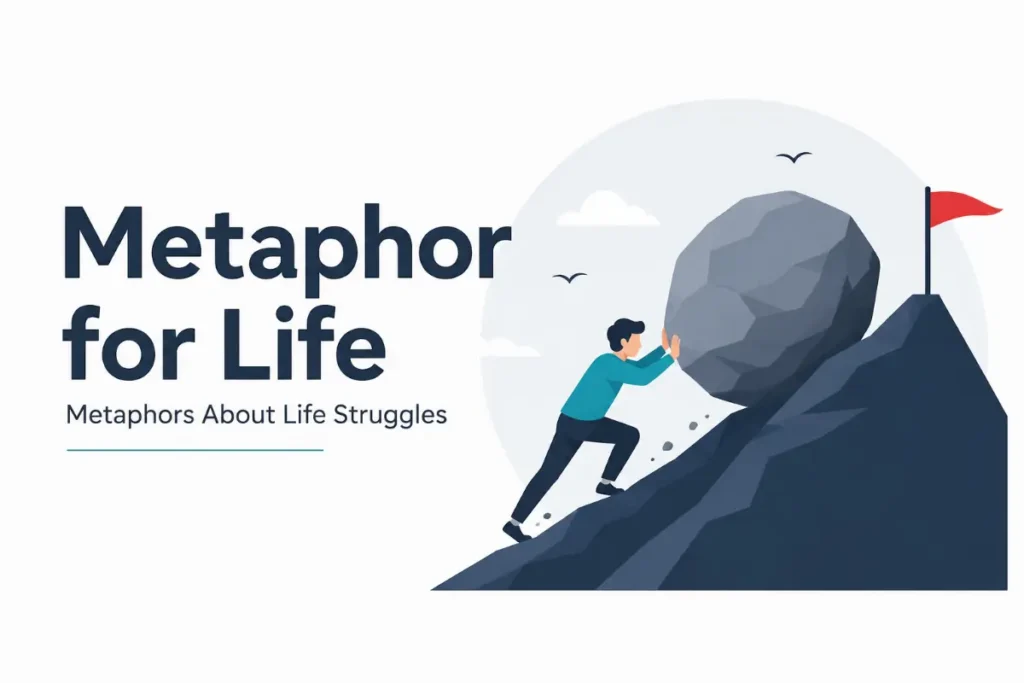
Hardship often needs stronger imagery because simple statements can feel emotionally weak.
Examples include:
- Life is a storm.
- Life is a battlefield.
- Life is a steep mountain.
- Life is a winding road through the dark.
- Life is a ship fighting rough seas.
These images communicate difficulty without explaining every detail. A storm suggests forces beyond our control. A mountain suggests effort and persistence. Rough seas suggest uncertainty and the need to stay steady.
Deep Metaphors About Life
Some metaphors invite deeper reflection because they can hold several meanings at once.
Life is a river.
At first glance the comparison seems simple. But think about what a river does. It moves constantly. It encounters rocks and bends. Sometimes it flows gently. Sometimes it becomes violent. It can change its course. It eventually reaches somewhere new.
The metaphor can therefore represent time, change, uncertainty, resilience, and the inability to return to exactly the same moment.
Another powerful example is:
Life is a book.
A book has beginnings, turning points, quiet chapters, difficult chapters, and endings. One bad chapter does not determine the entire story. A person can also begin a new chapter without erasing what came before.
That makes the book metaphor particularly useful when writing about mistakes, recovery, personal growth, and new beginnings.
Which Metaphor Best Describes Life
There is no universally best metaphor because life does not have one universal meaning.
- If you want to emphasize personal direction, life is a journey is one of the clearest choices.
- If you want to emphasize change, life is a river works well.
- If your subject is growth, life is a garden provides a richer image.
- If you are discussing hardship, life is a mountain communicates effort and persistence.
- If you are writing about new beginnings, life is a book offers an especially flexible comparison.
The strongest choice is the one that matches the specific idea behind your writing.
Metaphor For Life Examples
Here are practical examples you can use as inspiration. Each one takes a familiar object or experience and connects it with an aspect of human life.
- Life is a journey filled with unexpected turns.
- Life is a book with chapters we have not read yet.
- Life is a garden that rewards patience.
- Life is a river that keeps moving forward.
- Life is a mountain that becomes smaller with every step.
- Life is a classroom where experience is the teacher.
- Life is a canvas painted by our choices.
- Life is a puzzle whose meaning becomes clearer over time.
- Life is a road where detours can lead somewhere beautiful.
- Life is a seed waiting for the right conditions to grow.
Notice that these examples do not simply say life is good or life is difficult. Each comparison gives the reader a picture. That picture carries the emotional meaning.
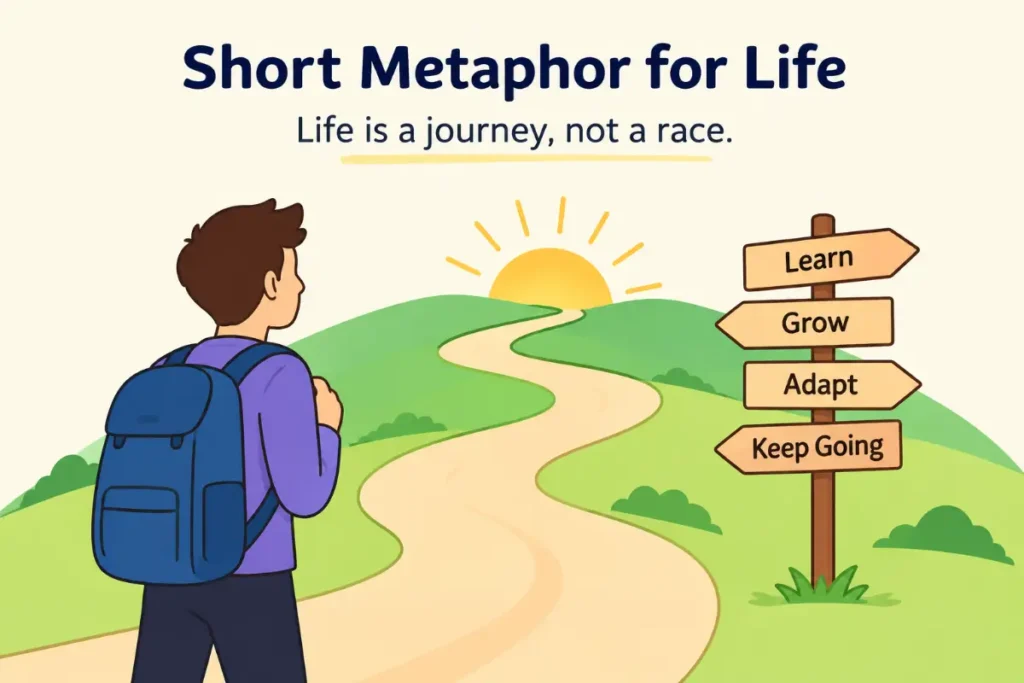
Short Metaphor For Life
A short metaphor can sometimes be more powerful than a long explanation. The key is choosing an image that carries enough meaning on its own.
Here are concise examples:
- Life is a journey.
- Life is a river.
- Life is a garden.
- Life is a classroom.
- Life is a canvas.
- Life is a mountain.
- Life is a puzzle.
- Life is a story.
- Life is a sunrise.
- Life is a winding road.
Short metaphors work especially well for captions, titles, journal entries, speeches, and inspirational writing. Their brevity leaves room for the reader to bring personal meaning to the image.
Metaphor For Life Lessons
Many of the strongest life lessons become easier to remember when expressed through imagery.
Consider the idea that failure can teach us something valuable. Instead of writing:
Failure is an important part of learning.
You could write:
Failure is a compass that shows us where to change direction.
The second sentence creates an image. A compass does not remove obstacles, but it helps you understand direction. That makes the metaphor useful for writing about mistakes and personal growth.
Here are more examples.
- Life is a classroom where mistakes become lessons.
- Failure is a stepping stone across a difficult river.
- Patience is the soil where progress grows.
- Experience is a map drawn by every journey we take.
- Wisdom is a collection of roads we have already traveled.
- Change is a door that opens into unfamiliar rooms.
- Courage is a bridge built while the other side is still hidden.
- Time is a river that carries every moment away.
The strongest lesson metaphors do not preach. They allow the reader to discover the lesson through the image.
Funny Metaphor For Life
Life does not always need to sound profound. Humor can make a metaphor more memorable and relatable.
A funny comparison can turn an ordinary frustration into something people instantly recognize.
Try these examples:
- Life is a group project where nobody received the instructions.
- Life is a phone battery that always reaches one percent at the worst moment.
- Life is a GPS that occasionally says recalculating after you have already made the wrong turn.
- Life is a suitcase that somehow gets heavier every year.
- Life is a recipe where someone forgot to include the measurements.
- Life is a browser with thirty tabs open and no idea where the music is coming from.
- Life is a roller coaster designed by someone who enjoys surprises.
- Life is a Monday that somehow lasts all week.
Humor works because it creates recognition. The reader sees a familiar experience inside an unexpected comparison.
A funny metaphor should still make sense. If the connection is too random, the joke disappears and the sentence becomes noise.
Metaphor For Life Quotes
A strong metaphor can become memorable when it is expressed as a concise statement.
Here are original examples that show different perspectives:
- Life is a road where the unexpected turns often become the best stories.
- Life is a garden where patience matters as much as effort.
- Life is a book and every difficult chapter still belongs to your story.
- Life is a river because standing still is rarely an option.
- Life is a mountain because the view changes when you keep climbing.
- Life is a canvas and every decision leaves a mark.
- Life is a puzzle because some pieces make sense only after others fall into place.
- Life is a classroom where experience gives the hardest exams.
These lines work because the imagery supports the message. The metaphor is not simply added for decoration. It carries the central idea.
What Makes A Life Metaphor Powerful
A memorable metaphor usually has three qualities: clarity, emotional relevance, and originality.
First, the reader should understand the basic comparison quickly. If the image requires several paragraphs of explanation, it may be too complicated.
Second, the image should connect with a real human experience. Roads, storms, gardens, books, mountains, rivers, and mirrors work because people already understand them.
Third, the comparison should offer something beyond an ordinary statement. Saying life is difficult is clear but predictable. Saying life is a mountain with hidden paths creates curiosity and gives the reader something to picture.
The strongest metaphors also leave enough room for interpretation. A good image is not a locked box with one answer. Different readers can see different parts of themselves inside it.
How To Choose The Right Metaphor
Start with the idea you want to communicate. Do not begin by searching for a clever object and then forcing your message into it.
If your message is about growth, think about things that grow.
A garden works because growth requires care, time, sunlight, pruning, and changing seasons.
If your message is about hardship, think about experiences that involve resistance.
A mountain works because climbing requires effort and progress can be slow.
If your message is about uncertainty, think about things that move without revealing the destination.
A river or journey can communicate that feeling naturally.
A useful process is:
- Identify the main emotion or lesson.
- Choose a familiar image connected to that idea.
- Find the strongest similarity between the image and life.
- Remove unnecessary explanation.
- Read the metaphor aloud.
- Ask if the comparison feels natural rather than forced.
This approach produces stronger writing than simply collecting impressive sounding phrases.
Why Metaphors Matter In Everyday Language
Metaphors are not limited to poetry or inspirational quotes. Native English speakers use metaphorical language constantly without thinking about it.
People talk about:
- Chasing dreams.
- Carrying emotional baggage.
- Reaching a crossroads.
- Breaking through barriers.
- Losing direction.
- Building relationships.
- Facing storms.
- Turning the page.
- Finding a path.
- Planting the seeds of success.
Many of these expressions are so familiar that we barely notice their metaphorical origins.
That is one reason metaphors are powerful. When used well, they do not feel like literary decoration. They feel like natural human language.
Metaphors About Life Struggles
Some experiences are difficult to explain directly. Grief, failure, uncertainty, loneliness, disappointment, and major change can leave people searching for language that feels honest without becoming overly dramatic. This is where a strong metaphor can help.
A storm is one of the clearest images for difficult periods. Storms are temporary but powerful. You cannot always control when they arrive or how long they last. You can prepare, seek shelter, and wait for calmer weather. That makes the image useful when writing about hardship without suggesting that every problem has an instant solution.
Consider these examples:
- Life is a storm, and courage is learning how to stand in the rain.
- Hard times are rough seas that test how well we hold the wheel.
- Failure is a cracked road that forces us to find another route.
- Grief is a tide that changes the shape of the shore.
- Loneliness is an empty room where every thought sounds louder.
- Fear is a locked door that courage learns to open.
- Difficult seasons are winter chapters in a story that has not ended.
- Adversity is a weight that can strengthen us when we learn how to carry it.
These comparisons work best when they acknowledge difficulty rather than pretending every struggle has a positive purpose. Not every painful experience needs to become a motivational lesson. Sometimes the metaphor simply gives a difficult feeling a shape.
Deep Metaphors About Life
A deep metaphor does not necessarily use complicated language. In fact, the strongest ones are often simple enough to understand immediately but rich enough to think about later.
Consider the idea that life is a river.
A river moves forward but does not travel in a straight line. It bends, narrows, widens, encounters obstacles, and changes its surroundings. Sometimes it moves peacefully. At other times it becomes dangerous.
That single image can represent time, change, uncertainty, resilience, and personal development.
Another powerful comparison is life is a mirror. A mirror reflects what stands before it, making it a useful image for self awareness. Experiences can reveal qualities we did not know we possessed. Difficult conversations can expose weaknesses. Success can reveal strengths. Relationships can show us how we treat other people.
A third example is life is a mosaic. Individual pieces may appear meaningless when viewed alone, but they contribute to a larger picture. This metaphor works particularly well for experiences that seem disconnected at first and make more sense with time.
Deep imagery becomes effective when the comparison has several layers without becoming confusing.
Metaphor For Life Lessons
Life lessons often become more memorable when they are attached to an image.
Imagine telling someone that personal growth takes time. The statement is true but ordinary. Now compare it with this:
Growth is a tree that cannot be rushed by pulling on its branches.
The image communicates patience immediately. A tree grows according to its own process. Pulling harder does not make it grow faster.
That is the advantage of metaphor. It can compress an entire explanation into one memorable picture.
Here are several original examples focused on lessons people learn through experience:
- Mistakes are footprints showing where we have already walked.
- Wisdom is a map drawn from roads we once found difficult.
- Patience is the bridge between effort and results.
- Courage is a muscle strengthened by use.
- Experience is a teacher that rarely gives easy homework.
- Change is a doorway that looks frightening until we step through it.
- Failure is a teacher with a blunt voice but valuable lessons.
- Time is an editor that removes what once seemed essential.
The best lesson based comparisons do not tell readers what they must believe. They give readers an image and allow them to make the connection themselves.
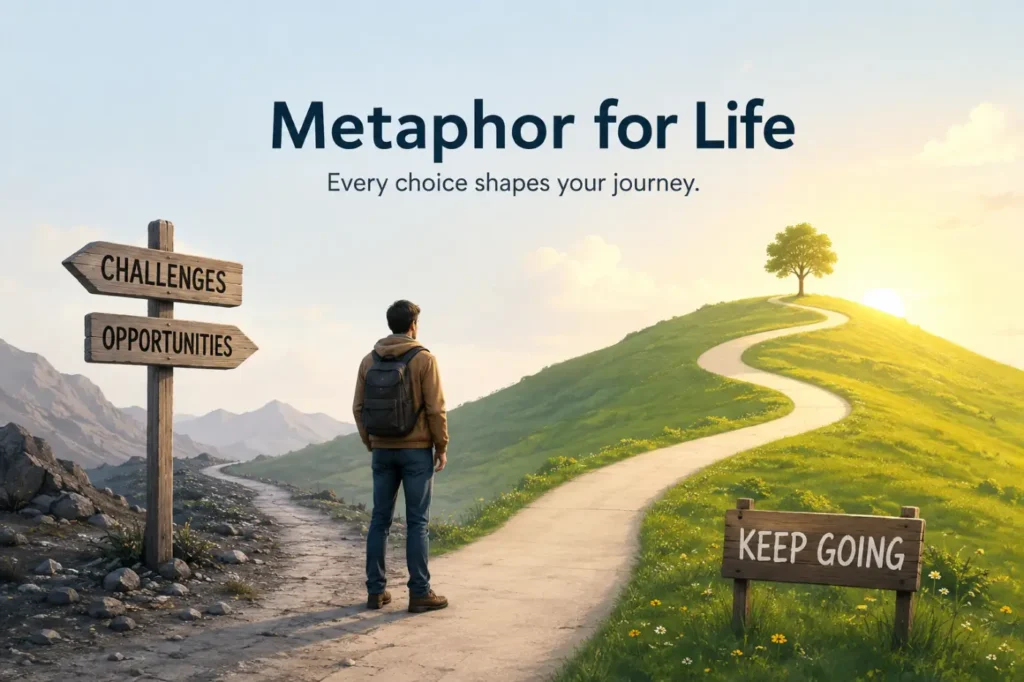
Life As A Journey
The journey metaphor is probably one of the most familiar ways to describe human existence. It works because a journey contains many elements that naturally resemble life.
A journey can have:
- A starting point.
- A destination.
- Different routes.
- Unexpected delays.
- Wrong turns.
- Companions.
- Difficult terrain.
- Rest stops.
- Changes in direction.
- An uncertain final destination.
This gives writers plenty of material.
Life is a journey, not a straight road.
The sentence suggests that people should expect changes and unexpected turns. It also leaves room for personal choice. A traveler may choose one road while another person takes a completely different route.
The metaphor becomes especially useful when discussing career changes, relationships, education, personal growth, and major decisions.
It also avoids one common problem with motivational writing. A journey does not need every step to be perfect. Getting lost is part of traveling. Taking a detour does not necessarily mean the trip has failed.
Life As A Book
The book metaphor focuses on time, memory, change, and new beginnings.
A person’s life can contain childhood chapters, difficult chapters, joyful chapters, quiet periods, unexpected plot twists, and moments that change everything.
This makes the image especially effective for someone who feels trapped by the past.
One difficult chapter does not define the entire book.
That sentence offers hope without pretending that painful experiences do not matter. The difficult chapter remains part of the story, but it does not have to be the final one.
The metaphor also works for personal reinvention. Starting a new job, moving to another city, ending a relationship, returning to school, or pursuing a long delayed goal can all become a new chapter.
It is also flexible enough for humor:
Life is a book written by someone who keeps adding unexpected plot twists.
That version captures the unpredictable side of everyday experience without becoming overly serious.
Life As A Garden
A garden is one of the richest images for personal development because it naturally includes patience, care, seasons, and change.
A garden does not produce identical results overnight. Some plants need more attention. Some grow quickly. Others take years. Weeds appear without being invited. Old plants sometimes need to be removed to make space for something new.
That gives the comparison emotional depth.
Life is a garden, and attention determines what gets the chance to grow.
This can represent habits, relationships, skills, friendships, health, creativity, and personal values.
The garden image also offers a useful lesson about neglect. Things that matter often require continued care. A relationship can weaken without attention. A skill can become rusty without practice. A goal can disappear beneath distractions.
At the same time, the metaphor should not be taken too literally. People do not control every circumstance in life. A garden can be damaged by weather, disease, or forces beyond the gardener’s control. That makes the metaphor more balanced when it focuses on care rather than total control.
Life As A Mountain
The mountain metaphor emphasizes effort and progress.
A mountain does not become easier simply because someone wants to reach the top. Climbing requires preparation, persistence, patience, and sometimes a change of route.
That makes it useful for discussing difficult goals.
Life is a mountain, and progress is measured one step at a time.
The image also provides an important perspective on comparison. Two climbers may take different paths and move at different speeds. Their journeys can still lead toward meaningful achievements.
However, writers should avoid using the mountain metaphor to imply that every person must constantly climb higher. Rest matters too. Sometimes reaching a plateau is valuable. Sometimes the wiser decision is to turn around and choose another path.
Just as life can be understood through images and comparisons, powerful metaphors for love can make complicated emotions easier to express and understand.
Life As A Classroom
Calling life a classroom shifts attention from achievement to learning.
Every experience becomes an opportunity to discover something. Some lessons arrive through success. Others arrive through mistakes, disappointment, relationships, responsibility, and failure.
Life is a classroom where experience writes the curriculum.
This comparison works particularly well in educational writing and personal reflection because it frames mistakes as information rather than proof of personal failure.
There is also room for humor:
Life is a classroom where the surprise tests never seem to end.
That line captures a familiar feeling. Just when things seem predictable, something unexpected happens.
The classroom metaphor also reminds us that learning is ongoing. There is no age at which a person suddenly knows everything worth knowing.
Life As A Game
The game metaphor focuses on decisions, rules, risk, strategy, luck, and consequences.
It can be useful when discussing competition or decision making.
Life is a game where everyone receives different starting conditions.
That version is more thoughtful than simply saying people should play to win. It recognizes that people begin with different resources, opportunities, responsibilities, and circumstances.
A humorous version might be:
Life is a game that somehow starts before you finish reading the instructions.
This works because it reflects a common experience. People often make major decisions without having complete information.
The game metaphor should be used carefully, though. Real life is not always fair, and people are not pieces on a board. The comparison works best when it highlights decisions or uncertainty rather than reducing human experiences to winning and losing.
Life As A Canvas
The canvas metaphor emphasizes creativity and personal agency.
Life is a canvas, and our choices become part of the picture.
The image suggests that people have some ability to shape their lives. It does not imply complete control. A painter cannot control every external condition, just as a person cannot control every event.
That balance makes the metaphor useful for discussing creativity, identity, career choices, relationships, and personal goals.
It can also describe mistakes.
A painting can contain an unexpected mark and still become something beautiful. Sometimes the artist changes direction because of an accident. The original plan does not always survive the creative process.
That is a useful way to think about unexpected changes in life.
Life As A Puzzle
A puzzle represents uncertainty and incomplete understanding.
Sometimes an experience makes no sense when it happens. Years later, another event provides context and suddenly an earlier decision looks different.
That makes this metaphor particularly useful for reflection.
Life is a puzzle, and some pieces make sense only after the picture becomes clearer.
The image also explains why people should not judge their entire story from one moment. One puzzle piece rarely reveals the whole picture.
The comparison works well in essays, speeches, personal writing, and reflective conversations because it naturally encourages patience.
Life As A Mirror
The mirror metaphor focuses on self knowledge.
Life is a mirror that reveals what we carry inside.
The comparison suggests that experiences can expose our values, fears, habits, strengths, and weaknesses.
A difficult situation may reveal patience we did not know we had. A conflict may reveal a habit we need to change. Success may show us what truly motivates us.
This metaphor is particularly effective when discussing emotional maturity and personal responsibility.
Still, it should not be used to suggest that every negative experience is caused by a person’s attitude. External circumstances matter. Good metaphorical writing leaves room for reality rather than forcing every experience into a neat lesson.
Metaphor, Simile, Analogy And Symbolism
These terms are related but not identical. Knowing the difference helps you write stronger comparisons.
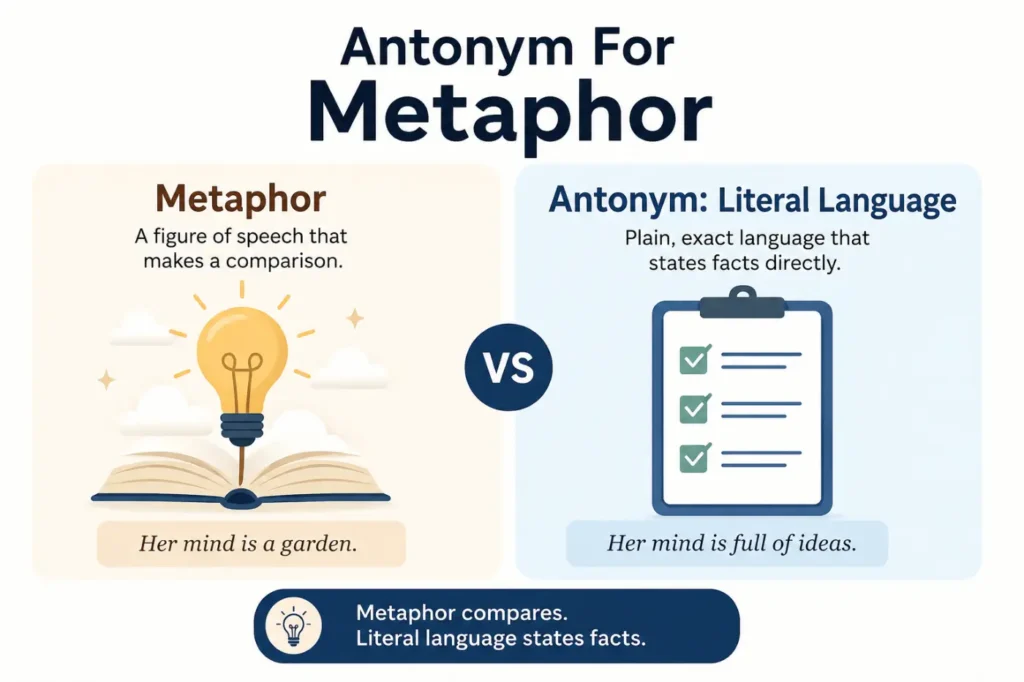
Metaphor
A metaphor directly identifies one thing with another.
Life is a journey.
The statement does not mean life is literally a trip. It creates a conceptual comparison.
Simile
A simile uses like or as to make the comparison explicit.
Life is like a journey with unexpected turns.
The idea is similar, but the grammatical structure is different.
Analogy
An analogy explains one idea by comparing it with another situation that shares relevant characteristics.
For example, you might compare learning a skill to building a house. Both require foundations, repeated work, correction, and time. The analogy usually develops across several sentences rather than appearing as one compact phrase.
Symbolism
Symbolism gives an object, image, character, or event a broader meaning.
A road can symbolize freedom or choice. A storm can symbolize hardship. A sunrise can symbolize hope or a new beginning.
The four concepts can overlap, but they serve different purposes.
Real Life Usage Of Life Metaphors
Metaphors appear naturally across different types of communication.
Daily Conversation
People often say:
- I feel like I am at a crossroads.
- We need to turn the page.
- I am carrying too much baggage.
- That experience changed the direction of my life.
- We have hit a rough patch.
These phrases are so common that most speakers do not stop to identify them as metaphors.
Academic Writing
Academic writers use metaphor carefully to explain difficult concepts. A metaphor can make an abstract argument easier to understand, but it should not replace precise evidence.
For example, a researcher might describe a process as a feedback loop or a pathway. These terms help readers visualize relationships between ideas.
Professional Communication
Business writing also relies on familiar metaphors.
People talk about:
- Building trust.
- Reaching a milestone.
- Navigating uncertainty.
- Removing obstacles.
- Opening doors.
- Changing direction.
Used sparingly, these expressions make professional communication more natural.
Literature
Literature gives metaphors more room to develop. A novelist may use a road throughout an entire story to represent freedom, escape, or identity.
Poetry often compresses complex emotional ideas into a single image. That is why metaphors about seasons, oceans, light, darkness, gardens, and journeys appear so often in literary writing.
Media
Movies, interviews, advertising, songs, and social media all rely heavily on metaphor because images are quick to understand and easy to remember.
A strong metaphor can turn an ordinary message into something people repeat long after they have forgotten the original explanation.
How To Write Your Own Life Metaphor
You do not need to be a poet to create an effective metaphor. Start with a real experience and identify its most important quality.
Suppose you want to describe uncertainty.
Ask yourself what uncertainty feels like. Maybe it feels like walking through fog. That gives you a starting point.
Life is a road covered in fog, where the next turn becomes visible only after we keep moving.
The comparison works because the road and uncertainty share a clear quality. You cannot see everything ahead, but movement gradually reveals more of the path.
Try the same process with other ideas.
- For growth, think about trees, gardens, seeds, or seasons.
- For struggle, think about storms, mountains, rough seas, or steep roads.
- For change, think about rivers, seasons, doors, or moving trains.
- For choice, think about crossroads, maps, keys, or open roads.
- For memory, think about photographs, old houses, libraries, or echoes.
- For hope, think about sunrise, windows, candles, bridges, or spring.
- For uncertainty, think about fog, mazes, oceans, or unfinished maps.
The goal is not to sound profound. The goal is to make the reader see the idea.
Related Words And Confused Concepts
People searching for life metaphors often encounter several related literary terms. These concepts overlap, but they are not interchangeable. Understanding the differences helps you choose the right expression for an essay, speech, caption, poem, article, or personal reflection.
- Metaphor makes a direct comparison between two unlike things. For example, life is a journey connects life with the experience of traveling.
- Simile makes a comparison using words such as like or as. For example, life is like a winding road.
- Analogy develops a comparison to explain an idea. A writer might compare personal growth with climbing a mountain and then explain how effort, setbacks, and persistence relate to the climb.
- Symbolism gives an object or image a deeper meaning. A sunrise may symbolize hope or a new beginning.
- Idiom is a familiar expression whose meaning cannot always be understood literally. At a crossroads can describe an important decision even when no physical road exists.
- Personification gives human qualities to something nonhuman. For example, time waits for no one treats time as if it could make a decision.
- Imagery uses descriptive language to create a mental picture. Metaphors often create imagery, but imagery can also exist without a metaphor.
These distinctions matter because a good writer chooses the device that fits the purpose. A short metaphor can make an idea memorable. An analogy can make a difficult concept easier to understand. Symbolism can add layers of meaning to a story.
Expert Language Insight
From an editorial perspective, the strongest life metaphors are not necessarily the most elaborate ones. A complicated comparison can sound impressive while saying very little. A simple image can have far more impact if the connection is clear and emotionally accurate.
Consider life is a journey. It is familiar, perhaps even predictable, but it remains useful because the image naturally supports ideas such as direction, choices, detours, destinations, companions, and unexpected obstacles.
Now consider a more unusual comparison:
Life is a suitcase packed by people we have not met yet.
It is intriguing, but it needs explanation. What does the suitcase represent? What does packing mean? Who are the people? Without a clear connection, the reader has to work too hard.
That does not mean original metaphors are bad. Quite the opposite. Fresh imagery can make writing memorable. The important point is that originality should serve meaning.
An experienced editor also watches for mixed metaphors. This happens when a writer begins with one comparison and suddenly switches to another unrelated image.
For example:
Life is a ship climbing the mountain toward a brighter chapter.
The sentence combines a ship, a mountain, and a book. Each image could work independently, but together they compete for attention.
A cleaner version would choose one central image:
Life is a ship navigating waters we cannot always predict.
The image is easier to follow because every part of the sentence belongs to the same conceptual world.
Another useful editorial principle is restraint. Once a metaphor has done its job, stop explaining it. Readers are capable of making connections themselves. Overexplaining a strong image can drain it of its power.
How Native Speakers Use Metaphorical Language
Native English speakers use metaphors constantly without consciously labeling them as literary devices. Everyday phrases such as turn the page, find your path, carry a burden, hit a wall, and reach a crossroads are examples of metaphorical thinking that has become part of ordinary language.
This matters for writers because natural metaphor usually feels familiar before it feels poetic.
If you are writing for a general American audience, choose images people can understand quickly. Roads, seasons, gardens, storms, books, bridges, mountains, rivers, and windows are useful because readers already understand the experiences associated with them.
A metaphor becomes less effective when the reader has to decode it before understanding the sentence.
There is also a difference between a metaphor that explains and a metaphor that decorates. An explanatory metaphor helps the reader understand an idea. A decorative metaphor simply makes a sentence sound more colorful.
Both have a place, but explanatory metaphors are usually more valuable in educational and informational writing.
Choosing The Best Image For The Message
The phrase best metaphor for life has no single answer because the best image depends on the message.
- Use a journey when you want to discuss direction, decisions, or personal growth.
- Use a garden when you want to discuss patience, relationships, habits, or development.
- Use a mountain when you want to emphasize effort, perseverance, or achievement.
- Use a river when you want to focus on change, movement, or the passage of time.
- Use a book when you want to discuss memories, new beginnings, mistakes, or different stages of life.
- Use a classroom when the central idea is learning from experience.
- Use a canvas when you want to emphasize creativity and personal choice.
- Use a puzzle when the message involves uncertainty or the delayed understanding of past experiences.
The image should support the central idea rather than compete with it.
Stronger Alternatives To Cliches
Some comparisons have become so familiar that they can lose their impact. Life is a journey is a good example. It remains useful, but using it without adding a fresh perspective can make the writing feel generic.
You can refresh a familiar metaphor by adding a specific insight.
Instead of:
Life is a journey.
Try:
Life is a journey where the detours sometimes teach more than the destination.
Instead of:
Life is a book.
Try:
Life is a book whose quiet chapters often prepare us for the loudest ones.
Instead of:
Life is a garden.
Try:
Life is a garden where attention decides what gets room to grow.
The underlying comparison remains familiar, but the second part gives the reader something new to consider.
This is a useful technique for writers who want their work to sound natural rather than manufactured. Start with an accessible image, then add an observation based on real human experience.
Life Metaphors For Different Situations
The same broad idea can be expressed differently depending on the situation.
For Personal Growth
Use images connected to development and patience.
- Life is a garden that grows through seasons.
- Growth is a staircase built one step at a time.
- Experience is a map created through travel.
- Wisdom is a tree whose roots grow deeper with time.
For Difficult Times
Use imagery that acknowledges struggle without making unrealistic promises.
- Hardship is a storm that tests our shelter.
- Grief is a tide that changes the shoreline.
- Adversity is a steep road that demands patience.
- Uncertainty is a fog that reveals the path slowly.
For New Beginnings
Images involving doors, sunrise, spring, and fresh pages work naturally.
- A new beginning is an unopened door.
- Hope is a sunrise after a long night.
- Change is a blank page waiting for a new chapter.
- Starting over is spring returning after winter.
For Relationships
Use images involving bridges, gardens, anchors, and homes.
- Trust is a bridge built through repeated actions.
- Friendship is a garden that needs attention.
- A healthy relationship is an anchor during difficult weather.
- Home is a place where the heart can finally put down its luggage.
For Uncertainty
Use images that suggest limited visibility or incomplete information.
- The future is a road hidden by fog.
- Uncertainty is an unfinished map.
- Life is a puzzle missing several pieces.
- The next chapter is a page we have not turned yet.
In the same way that life can be compared to a journey or a winding road, images that capture happiness can give abstract feelings a vivid, memorable form.
Short Metaphors That Work Well
Short comparisons are useful for social posts, speeches, journal entries, headings, and creative writing. Their strength comes from compression.
Here are original examples:
- Life is a winding road.
- Life is an unfinished story.
- Life is a moving river.
- Life is a changing season.
- Life is a garden of choices.
- Life is a mountain trail.
- Life is a collection of chapters.
- Life is a canvas of decisions.
- Life is a puzzle in progress.
- Life is a classroom without a final bell.
These lines can stand alone, but they can also become the starting point for a longer paragraph.
Frequently Asked Questions
What is a good metaphor for life?
A journey is one of the most useful comparisons because it can represent choices, direction, obstacles, relationships, detours, and destinations. A garden works better for growth and patience, while a river works well for change and time. The strongest choice depends on the specific idea you want the reader to understand.
What is a short metaphor for life?
A short example is life is a journey. Other concise options include life is a river, life is a garden, life is a book, life is a mountain, and life is a canvas. Each creates a different meaning, so choose the image that matches the emotion or lesson you want to communicate.
What are some metaphors about life struggles?
Common images for hardship include storms, mountains, rough seas, difficult roads, winter, and steep climbs. For example, hardship is a storm suggests temporary difficulty and uncertainty, while life is a mountain emphasizes effort and persistence. Strong comparisons should acknowledge the reality of struggle rather than pretending every painful experience has an easy positive outcome.
What is a metaphor for life lessons?
A useful example is life is a classroom where experience writes the curriculum. This comparison suggests that people learn through success, failure, relationships, mistakes, and difficult experiences. Another option is mistakes are footprints showing where we have already walked, which presents errors as information that can guide future decisions.
What are some deep metaphors about life?
A river, mirror, puzzle, and book can all support deeper reflection. A river can represent time and change. A mirror can represent self knowledge. A puzzle can represent experiences that only make sense later. A book can represent different stages of life and the possibility of beginning a new chapter.
What is a funny metaphor for life?
A humorous example is life is a group project where nobody received the instructions. Another is life is a phone battery that reaches one percent at exactly the wrong moment. Funny comparisons work when they connect an ordinary frustration with an unexpected image that readers immediately recognize.
What is the difference between a metaphor and a simile?
A metaphor makes a direct comparison, such as life is a journey. A simile uses words such as like or as, as in life is like a journey. Both devices compare different things, but their grammatical structure and rhetorical effect are different. A metaphor often sounds more direct and confident.
How can I create my own metaphor about life?
Start with the idea you want to express, such as growth, uncertainty, love, failure, or change. Then think of a familiar object or experience that shares an important quality with that idea. Connect the two clearly and remove unnecessary explanation. The strongest comparison usually feels natural enough that the reader understands it almost immediately.
Conclusion
A good life metaphor does more than make writing sound beautiful. It gives shape to experiences that are difficult to explain directly. A journey can represent choices. A garden can represent growth. A mountain can represent struggle. A river can represent change. A book can represent time, memory, and the possibility of a new beginning.
There is no single comparison that perfectly captures every person’s experience. That is part of what makes metaphor so useful. Life contains too many emotions and contradictions to fit neatly into one image.
When choosing a comparison, start with the message rather than the phrase. Decide what you want the reader to feel or understand. Then choose an image that naturally carries that idea. Keep the language clear, avoid mixing unrelated images, and trust the reader to make the connection.
The most memorable metaphors are often simple. They take something familiar and make us see it differently.
Life may be a journey, a garden, a river, or a book. The important part is not finding one perfect image. It is finding the image that tells your particular truth.