If you’ve ever stopped in the middle of a math problem because you couldn’t remember which symbol points in which direction, you’re not alone. Many students, parents, and even adults mix up less than or greater than because the symbols look similar at first glance. The good news is that the concept is much easier than it seems once you understand what each symbol actually means.
The symbols compare two numbers, values, or expressions. A greater than symbol shows that the number on the left is larger than the number on the right. A less than symbol shows the opposite. Learning to recognize the difference helps you solve math problems accurately, compare quantities, understand graphs, and build a stronger foundation for algebra and higher level math.
This guide explains everything you need to know in simple language. You’ll learn what each symbol means, how to read and use them correctly, where they appear in everyday life, and the most common mistakes people make. You’ll also find comparison tables, real examples, pronunciation tips, grammar guidance, and practical teaching advice that makes these symbols much easier to remember.
Quick Definition
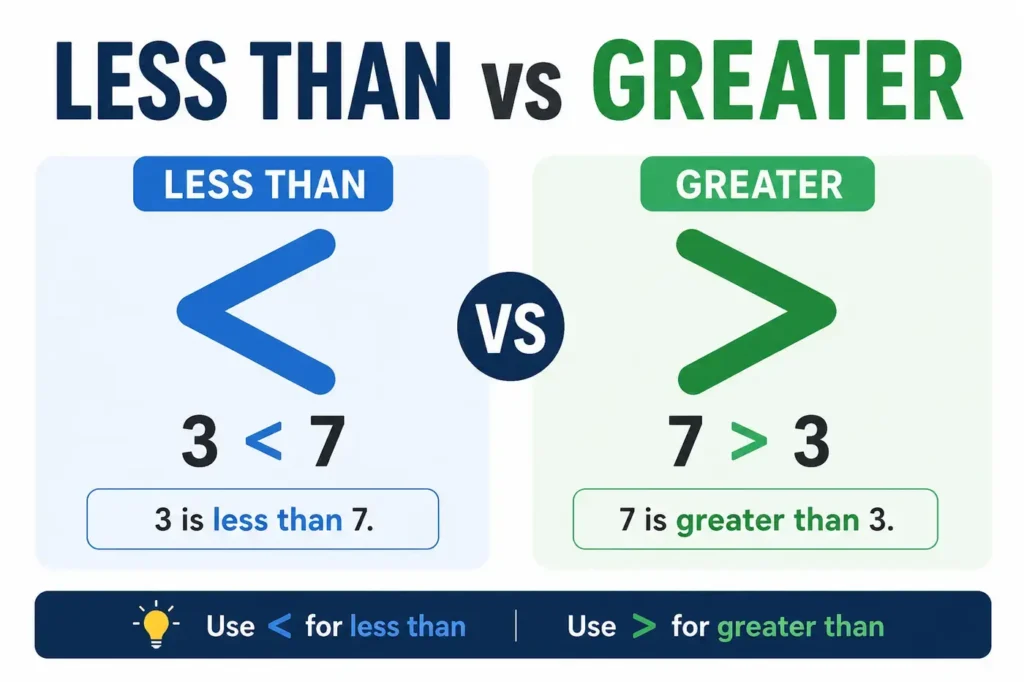
Less than and greater than are mathematical comparison symbols used to compare two numbers or values. The less than symbol < means the value on the left is smaller than the value on the right. The greater than symbol > means the value on the left is larger than the value on the right. These symbols have opposite meanings but work the same way.
Less Than And Greater Than Quick Answer
The quickest way to remember these symbols is to look at the open side.
The open side always faces the larger number, while the pointed side faces the smaller number.
For example:
- 3 < 8 means 3 is less than 8.
- 12 > 5 means 12 is greater than 5.
- Read the symbol from left to right.
- Compare the numbers before deciding which symbol to use.
A simple memory trick is to imagine the symbol as the mouth of a hungry alligator. The alligator always wants to eat the bigger number, so its open mouth points toward the larger value.
Less Than Or Greater Than Comparison Table
| Feature | Less Than | Greater Than |
|---|---|---|
| Symbol | < | > |
| Meaning | Smaller than another value | Larger than another value |
| Type | Mathematical comparison symbol | Mathematical comparison symbol |
| Origin | Derived from mathematical notation developed in the 1600s | Derived from mathematical notation developed in the 1600s |
| Correct Use | Compare a smaller value to a larger one | Compare a larger value to a smaller one |
| Common Contexts | Mathematics algebra statistics programming finance | Mathematics algebra statistics programming finance |
| Usage Frequency | Very common | Very common |
| Pronunciation | Less than | Greater than |
| Example | 6 < 10 | 15 > 9 |
Less Than vs Greater Than Meaning
Although these symbols are opposites, they work together to compare values. Understanding each one on its own makes the difference much easier to remember.
What Less Than Means
The less than symbol < shows that the value on the left is smaller than the value on the right.
For example, 4 < 9 tells us that 4 has a lower value than 9. This symbol appears throughout elementary math, algebra, science, economics, and computer programming because comparing values is a basic mathematical skill.
You’ll often see the less than symbol in situations like these:
- Comparing test scores.
- Ordering numbers from smallest to largest.
- Setting limits in programming.
- Comparing prices and measurements.
- Solving algebraic inequalities.
What Greater Than Means
The greater than symbol > shows that the value on the left is larger than the value on the right.
For example, 20 > 14 means 20 has a higher value than 14. Like the less than symbol, it appears in nearly every branch of mathematics and many real world applications.
You’ll commonly use the greater than symbol when:
- Comparing ages.
- Comparing temperatures.
- Working with equations.
- Reading charts and graphs.
- Evaluating financial data.
Although the symbols point in opposite directions, they follow exactly the same comparison rule. The larger value always sits next to the open side of the symbol.
Less Than vs Greater Than Key Differences
The easiest way to avoid confusion is to understand what each symbol represents instead of trying to memorize its shape.
The less than symbol tells you that the first number has a smaller value. The greater than symbol tells you that the first number has a larger value. They always compare the value on the left with the value on the right.
Here are the main differences.
| Less Than | Greater Than |
|---|---|
| Means smaller than | Means larger than |
| Symbol is < | Symbol is > |
| Example 2 < 7 | Example 12 > 8 |
| Open side faces the larger number | Open side faces the larger number |
| Used to show a lower value | Used to show a higher value |
Another helpful way to remember the difference is to focus on the direction of the pointed end. The pointed end always points toward the smaller number, while the wider opening faces the larger one.
Which One Is Correct
Neither symbol is more correct than the other. The correct choice depends entirely on the numbers or expressions you’re comparing.
For example, compare the numbers 9 and 15.
Since 9 is smaller than 15, the correct statement is:
9 < 15
Writing 9 > 15 would be incorrect because it claims that 9 is larger than 15.
Now compare 18 and 6.
Since 18 has the greater value, the correct comparison is:
18 > 6
Before choosing a symbol, follow these simple steps.
- Compare both values carefully.
- Decide which value is larger.
- Place the open side of the symbol next to the larger value.
- Read the complete statement aloud to confirm it makes sense.
This habit helps students avoid one of the most common mistakes in elementary mathematics.
Pronunciation Guide
Most learners recognize the symbols before they know how to say them correctly. Fortunately, the pronunciation is straightforward.
Less Than
IPA pronunciation:
/lɛs ðæn/
Syllable breakdown:
Less than
Greater Than
IPA pronunciation:
/ˈɡreɪtər ðæn/
Syllable breakdown:
Great er than
When reading mathematical expressions aloud, say the complete comparison instead of naming the symbol.
For example:
- 8 < 13 is read as Eight is less than thirteen.
- 25 > 11 is read as Twenty five is greater than eleven.
This approach improves understanding because it reinforces the meaning instead of simply identifying the symbol.
Understanding With Visual Thinking
Many teachers use visual strategies because symbols become much easier to remember when students connect them with an image instead of memorizing shapes.
One popular method is the hungry alligator trick. Imagine the symbol as an alligator with a very big appetite. The alligator always wants the larger meal, so its open mouth faces the bigger number.
Another method is to focus on the width of the symbol. The wider opening welcomes the larger value, while the narrow pointed end naturally points toward the smaller value.
Both techniques teach the same rule from different angles. Choose the one that feels most natural to you, then use it consistently until comparing numbers becomes second nature.
Expert Learning Tip
Students often try to memorize the direction of the symbols without understanding what they’re comparing. That usually leads to mistakes once the numbers become larger or equations include variables.
A better approach is to compare the values first and choose the symbol second. This small change encourages mathematical thinking instead of memorization. As students move into algebra, fractions, decimals, and inequalities, this habit becomes much more valuable than relying on memory tricks alone.
Examples
The best way to understand less than or greater than is to see them in real examples. As you read each sentence, pay attention to what the symbol is comparing. Instead of memorizing the direction of the symbol, focus on the relationship between the two values.
Less Than Examples
The less than symbol < shows that the value on the left is smaller than the value on the right.
- 5 < 12 because 5 is smaller than 12.
- 18 < 25 because 18 comes before 25 on the number line.
- 99 < 100 because 99 is one less than 100.
- A child who is 7 years old is less than a child who is 10 years old.
- A bottle containing 500 milliliters is less than one containing 1 liter.
- If today’s temperature is 45 degrees and yesterday’s was 60 degrees then 45 < 60.
- A test score of 82 is less than a score of 90.
- Spending 30 dollars is less than spending 50 dollars.
- A runner who finishes in 8 minutes is faster than one who finishes in 10 minutes because 8 < 10.
- In programming an application may display a warning if a value is less than zero.
These examples show that the less than symbol appears far beyond the classroom. You’ll see it in shopping, weather reports, science, finance, and computer programming.
Greater Than Examples
The greater than symbol > shows that the value on the left is larger than the value on the right.
- 15 > 8 because 15 is larger than 8.
- 100 > 75 because 100 has the greater value.
- 50 > 49 even though the difference is only one.
- A person who is 21 years old is greater than someone who is 18 years old.
- A paycheck of 900 dollars is greater than one worth 700 dollars.
- If a car travels 300 miles and another travels 220 miles then 300 > 220.
- A class with 32 students is greater than a class with 28 students.
- A recipe calling for 3 cups of flour uses more than one calling for 2 cups.
- In science a solution with a higher concentration has a value greater than one with a lower concentration.
- Many websites display a notification when a value is greater than the maximum limit.
Once you understand the meaning behind the symbols, reading these comparisons becomes as natural as reading ordinary sentences.
Less Than vs Greater Than Common Mistakes
Most mistakes happen because learners pay attention to the shape of the symbol instead of the numbers being compared. The good news is that these errors are easy to avoid once you understand the basic rule.
Here are the mistakes teachers see most often.
Reversing The Symbol
This is the most common error.
Incorrect:
9 > 15
Correct:
9 < 15
Before writing the symbol, compare the numbers first. The smaller number should always point toward the narrow end.
Memorizing The Shape Instead Of The Meaning
Some students try to remember the direction of the symbol without understanding what it represents. That strategy usually works for a while, but it becomes confusing with larger numbers, fractions, decimals, or algebra.
Instead, ask yourself one simple question.
Which value is larger?
Once you know the answer, the correct symbol becomes much easier to choose.
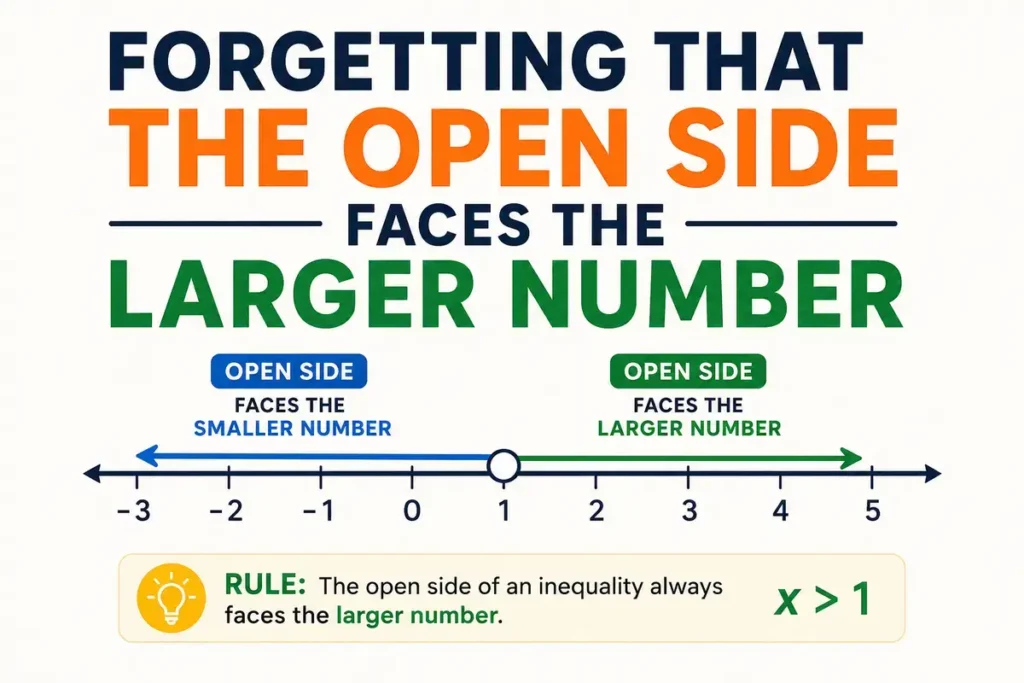
Forgetting That The Open Side Faces The Larger Number
This rule works every time.
- The open side faces the larger value.
- The pointed side faces the smaller value.
Keeping this single rule in mind is more reliable than trying to memorize two separate symbols.
Reading The Symbol Incorrectly
Some learners read 7 < 12 as “seven is greater than twelve.”
Reading every comparison aloud helps reinforce the correct meaning.
For example:
- Seven is less than twelve.
- Twenty is greater than fourteen.
Speaking the comparison out loud strengthens understanding and reduces mistakes over time.
Confusing The Symbols With Equal To
The symbols < and > compare values, while the equals sign = shows that two values are exactly the same.
For example:
- 8 = 8 means both values are equal.
- 8 < 10 means 8 is smaller than 10.
- 10 > 8 means 10 is larger than 8.
Each symbol has a different purpose, so choosing the correct one matters.
Etymology And Word Origin
The words less and greater have been part of English for hundreds of years, but the mathematical symbols came much later.
The words themselves trace back to Old English and Germanic languages. Less developed from words meaning smaller or lower in amount, while greater evolved from words describing something larger or more significant.
The comparison symbols < and > were introduced in the seventeenth century by the Welsh mathematician Thomas Harriot. Before his work, mathematicians often wrote comparisons using full words instead of symbols, which made equations longer and harder to read.
Harriot’s symbols simplified mathematical writing. Their design was intentionally simple, making comparisons quicker to read and easier to understand. More than four hundred years later, the same symbols remain a standard part of mathematics across the world.
Regional Usage
Unlike spelling differences such as color and colour, the symbols for less than vs greater than are universal. Students in different countries learn the same mathematical notation, although teaching methods and terminology may vary slightly.
American English
Schools in the United States introduce these symbols during the early elementary grades. Teachers often use visual learning techniques, including the hungry alligator story, number lines, and picture comparisons.
British English
British schools teach the same symbols with the same meanings. Teachers may place more emphasis on comparing quantities and reading mathematical statements aloud before students begin solving inequalities.
Australian English
Australian classrooms also use the standard mathematical symbols. Lessons commonly include hands on activities, visual models, and number comparisons to strengthen understanding.
Canadian English
Canadian schools follow the same mathematical conventions. Depending on the province, instructional materials may resemble either American or British textbooks, but the symbols and their meanings never change.
No matter where you study, < always means less than, and > always means greater than.
Grammar Rules
Although these are mathematical terms, they also follow normal English grammar when used in sentences.
Part Of Speech
Both less than and greater than function as comparison phrases. They help describe the relationship between two quantities, values, or measurements.
Examples include:
- Five is less than eight.
- Twenty is greater than fifteen.
Sentence Structure
A complete comparison usually follows this pattern.
Value + comparison phrase + value
Examples:
- Twelve is greater than seven.
- Three is less than nine.
This structure makes mathematical statements easy to read and understand.
Using Numbers And Words Together
In formal writing, writers often combine numbers with words naturally.
For example:
- The attendance was greater than 500 people.
- The package weighs less than 2 pounds.
- Children younger than 5 years old receive free admission.
Notice that the comparison phrase connects two values in a clear and logical way.
Comparing Variables
As students move into algebra, symbols compare variables as well as numbers.
Examples include:
- x < 10
- y > 25
The rule stays exactly the same. Compare the values represented by the variables, then choose the correct symbol.
Usage In Real Life
Many people think these symbols belong only in math class, but they appear almost everywhere.
Daily Life
You compare values more often than you realize.
Examples include:
- Finding the cheaper product at the grocery store.
- Comparing travel times before leaving home.
- Checking which phone plan costs less.
- Comparing sports scores.
- Looking at today’s temperature compared with yesterday’s.
School And Education
Students use comparison symbols in many subjects.
- Mathematics.
- Science.
- Economics.
- Statistics.
- Computer science.
As lessons become more advanced, these symbols appear in formulas, graphs, inequalities, and data analysis.
Professional Communication
Many careers depend on accurate comparisons.
Examples include:
- Financial reports compare profits and expenses.
- Engineers compare measurements and tolerances.
- Data analysts compare performance metrics.
- Scientists compare experimental results.
- Software developers use comparison operators when writing code.
Literature And Media
While the symbols themselves appear less often in books and newspapers than in mathematics, comparison phrases such as less than or greater than appear regularly in everyday writing.
Writers use them to compare prices, populations, distances, percentages, ages, and many other measurable values.
Understanding these comparisons makes reading reports, articles, and research papers much easier.
Related Words And Confused Terms
Once you’ve mastered less than and greater than, you’ll come across several other comparison symbols. Learning them together makes it easier to understand equations, inequalities, and mathematical statements.
Here are the comparison symbols students often confuse.
| Symbol | Meaning | Example |
|---|---|---|
| < | Less than | 4 < 9 |
| > | Greater than | 15 > 10 |
| = | Equal to | 8 = 8 |
| ≠ | Not equal to | 6 ≠ 9 |
| ≤ | Less than or equal to | x ≤ 12 |
| ≥ | Greater than or equal to | y ≥ 5 |
These symbols all compare values, but each one answers a different question. Before choosing a symbol, think about the relationship between the two numbers instead of relying on memory alone.
You may also hear these related mathematical terms.
- Inequality.
- Comparison.
- Numerical value.
- Expression.
- Equation.
- Variable.
- Integer.
- Decimal.
- Fraction.
- Number line.
Understanding these terms will make algebra and higher level math much easier.
Expert Language Insight
Students often ask which symbol is harder to learn. In reality, neither symbol is difficult once you stop treating them as shapes and start thinking about what they communicate.
Experienced math teachers rarely begin with the symbols themselves. Instead, they ask simple questions like, “Which number is bigger?” or “Which value is smaller?” Once students answer those questions, choosing the correct symbol becomes almost automatic.
Another common habit among successful learners is reading every comparison as a complete sentence. Saying “Eight is less than twelve” or “Twenty is greater than sixteen” reinforces the meaning every time you solve a problem. Over time, you won’t need memory tricks because the symbols will feel as familiar as ordinary words.
As students move into algebra, geometry, statistics, and computer programming, these comparison symbols appear more frequently. Building a solid understanding now makes advanced topics much easier later.
Frequently Asked Questions
What is the difference between less than and greater than?
The difference is simple. The less than symbol shows that one value is smaller than another, while the greater than symbol shows that one value is larger. Both symbols compare two values, but they point in opposite directions.
How do I remember less than vs greater than?
A simple way to remember the symbols is to look at the open side. It always faces the larger number, while the pointed side faces the smaller one. Many teachers also use the hungry alligator example because it helps younger learners remember the rule.
Which symbol means less than?
The symbol < means less than. For example, 6 < 11 means six is smaller than eleven. You can also remember that the pointed end faces the smaller value.
Which symbol means greater than?
The symbol > means greater than. For example, 18 > 9 means eighteen is larger than nine. The wider opening always faces the greater value.
Are less than and greater than used outside math?
Yes. These comparison symbols appear in computer programming, statistics, finance, engineering, economics, and science. Even when the symbols aren’t written, people regularly use the phrases less than and greater than to compare prices, ages, distances, temperatures, and measurements.
What is less than or equal to?
The symbol ≤ means a value can be smaller than another value or exactly equal to it. For example, x ≤ 10 means x can be any number up to and including ten.
Why do students confuse these symbols?
Most students focus on memorizing the direction of the symbols instead of comparing the numbers first. Looking at the values before choosing a symbol makes the process much easier and greatly reduces mistakes.
Why are these symbols important?
Comparison symbols form the foundation of mathematics. They help students understand arithmetic, algebra, inequalities, graphs, statistics, and programming. Learning them early builds confidence and prepares learners for more advanced mathematical concepts.
Conclusion
Understanding less than or greater than doesn’t have to be confusing. Both symbols have one clear purpose: they compare two values. The less than symbol shows that the value on the left is smaller, while the greater than symbol shows that the value on the left is larger.
Instead of memorizing the direction of each symbol, compare the numbers first. Once you know which value is greater, the correct symbol becomes much easier to choose. The rule stays the same whether you’re working with whole numbers, decimals, fractions, variables, or algebraic expressions.
These comparison symbols appear in far more places than most people realize. You’ll see them in classrooms, financial reports, scientific research, computer programs, charts, graphs, and everyday decision making. The more you practice reading and writing comparisons, the more natural they become.
Keep one simple idea in mind. The open side of the symbol always faces the larger value. Remember that rule, practice with real examples, and you’ll use less than vs greater than with confidence in every math problem you solve.