Seeing an outgoing call in your phone history is usually straightforward. The outgoing call meaning is that a call was initiated from your phone to another person or number. In other words you were the person or device that started the call.
The confusion often comes from what the label tells you and what it does not tell you. An outgoing call does not automatically mean the other person answered. The call may have connected successfully. It may have gone unanswered. You may have ended it before the other person picked up. The exact status depends on what happened after the call was placed.
This guide explains the meaning in plain English and covers how the label works on iPhone and Android phones. You will also learn the difference between outgoing and incoming calls plus what missed calls blocked numbers and call duration can tell you.
Quick Answer
An outgoing call is a call that you start from your phone to another number. It appears in your call history when your device attempts to place the call. An outgoing call can be answered or unanswered. The label only tells you who initiated the call. It does not by itself confirm that someone picked up.
What Does Outgoing Call Mean
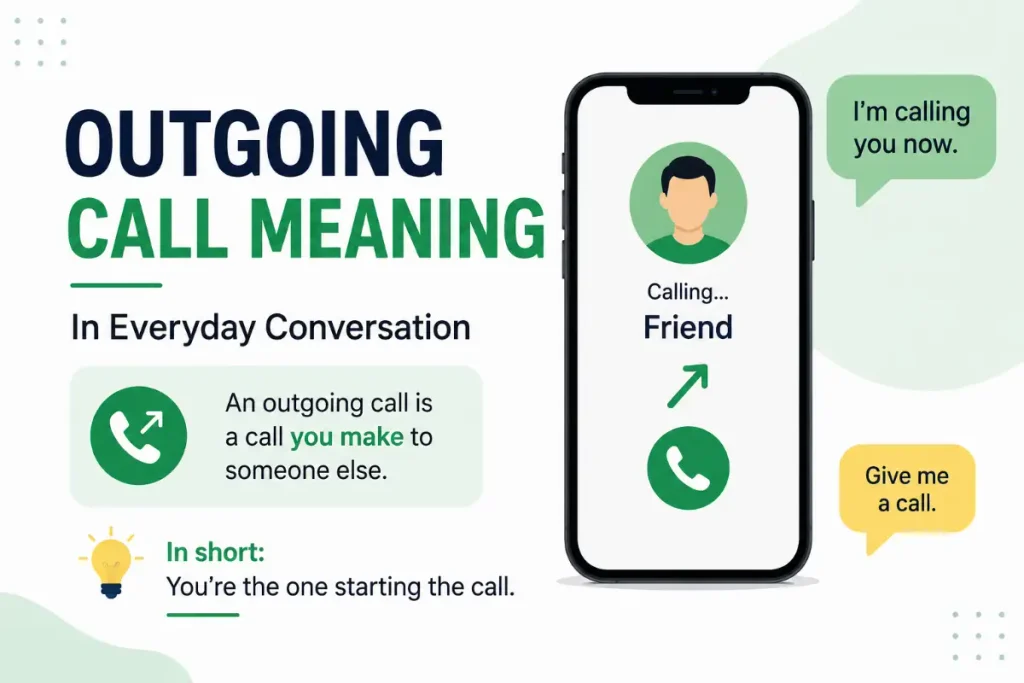
An outgoing call is a phone call that starts from your device.
For example if you open your contacts tap your friend’s name and press the call button your phone makes an outgoing call. The same applies when you manually enter a phone number and press the call button.
The word outgoing describes the direction of the call. The call is going out from your device toward another phone or number.
This gives you a simple way to remember it.
- Outgoing means you called them.
- Incoming means they called you.
The term does not describe the quality of the conversation or tell you what the other person did. It only identifies the side that started the call.
For example you might see an outgoing call in your recent calls after accidentally tapping a contact. The other person might never have seen or answered it. The record can still show that your phone attempted to place the call.
That distinction matters because people sometimes assume that an outgoing call means a conversation happened. It does not necessarily mean that.
What an outgoing call can mean
Depending on the situation an outgoing call may indicate that:
- You called someone and they answered.
- You called someone but they did not answer.
- You called someone and they rejected the call.
- You started the call and ended it before it connected.
- Your phone attempted to place the call but a network problem prevented the connection.
- You accidentally tapped the call button.
- An app or calling service placed the call from your device.
The call history gives you a record of the attempted communication. Other details such as duration can provide more information about what happened next.
If you come across the phrase “stitch incoming” in a message or comment, understanding the “stitch incoming” explained meaning can help clarify what the sender is referring to.
Outgoing Call Meaning For Gen Z
For Gen Z the basic meaning is exactly the same. An outgoing call simply means you called someone.
The difference is mostly in how people communicate. Younger users often rely heavily on texting social media direct messages voice notes and video calls. Because of that a traditional phone call can sometimes feel more noticeable or intentional.
If someone says I got an outgoing call from your number they usually mean their phone shows that a call was placed from your number or device.
If you tell a friend I made an outgoing call you are simply saying that you called someone.
Here are some natural examples:
- I made an outgoing call to my friend because texting was taking too long.
- My phone shows an outgoing call from earlier this morning.
- I accidentally made an outgoing call when my phone was in my pocket.
- The outgoing call lasted only a few seconds.
- I made an outgoing call but they never picked up.
The phrase itself is not special Gen Z slang. It is standard phone and telecommunications language. Younger users may use simpler expressions such as I called them because that sounds more natural in everyday conversation.
Outgoing Call Meaning On iPhone
On an iPhone an outgoing call generally refers to a call that you initiated from the device.
You might see an outgoing call in your recent call history after calling a contact or entering a number manually. The phone records the activity so you can identify calls you placed.
The exact icons and labels can vary depending on your iOS version and the type of call involved. However the basic concept stays the same.
If you opened the Phone app and called someone then that call originated from your iPhone.
One important point deserves attention. An outgoing call record does not automatically prove that the other person answered.
For example imagine you call your brother. His phone rings but he does not respond. You end the call after twenty seconds. Your recent calls can still show that you made the call.
The call was outgoing because you initiated it.
It was simply unanswered.
Does an outgoing call on iPhone mean they answered
No. An outgoing call on an iPhone does not automatically mean that the other person answered. The label identifies the direction of the call rather than the final result.
Consider these three situations.
| Situation | Call direction | Did they answer |
|---|---|---|
| You call and they answer | Outgoing | Yes |
| You call and they do not answer | Outgoing | No |
| You call and hang up quickly | Outgoing | Not necessarily |
This is one of the most common points of confusion when people check their call history.
If you need to know if a call actually connected you should look at the available call duration and other information shown by your phone or carrier. A very short record does not always provide enough information by itself.
Outgoing Call Meaning On Android
Android phones use the same basic concept.
When you start a phone call from an Android device the call is outgoing. Your call history can show the number or contact along with other available information such as the time and duration.
Android is used by many different manufacturers. Samsung Google Pixel Motorola OnePlus and other brands can use different versions of the Phone app. Because of that the appearance of call history screens can vary.
The underlying meaning does not change.
If your phone started the call then the call is outgoing.
For example if you search for a contact and tap the phone icon your Android device attempts to connect your call to that person. The resulting entry belongs to your outgoing call history.
The same rule applies if you type the number yourself.
Outgoing Vs Incoming Call
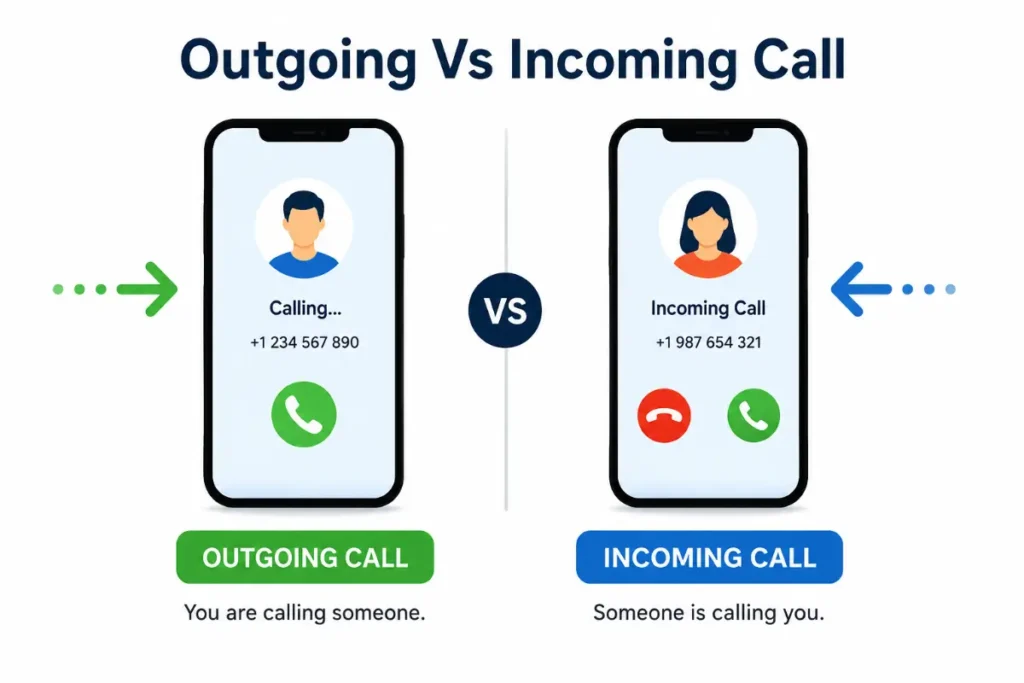
The easiest way to understand these two terms is to focus on who starts the call.
| Term | Meaning | Simple example |
|---|---|---|
| Outgoing call | You start the call | You call your friend |
| Incoming call | Someone calls your phone | Your friend calls you |
| Missed call | An incoming call was not answered | Your friend called while you were away |
| Returned call | You call someone back | You return a missed call |
Think of your phone as the center of the conversation.
When the call travels from your phone to another number it is outgoing from your perspective.
When another person calls your phone it is incoming from your perspective.
This direction can change depending on whose call history you are looking at. A call that appears as outgoing on your phone appears as incoming on the other person’s phone.
That is an important detail.
Suppose you call Sarah.
Your phone records the call as outgoing.
Sarah’s phone receives the call as incoming.
It is the same call. The labels simply describe it from two different sides.
Does Outgoing Call Mean They Answered
No. An outgoing call only means that your phone initiated the call.
It does not guarantee that the recipient answered.
This is easier to understand if you separate the call process into stages.
- You start the call. Your device sends the call request.
- The network attempts to connect it. The call travels through the relevant telephone or cellular network.
- The other phone may ring. The recipient might see your call.
- The recipient may answer. If they accept the call the conversation begins.
- The recipient may ignore or reject it. The call can remain unanswered.
- The call may fail. Network conditions or other technical issues can prevent a connection.
Your call history can record the outgoing activity even when the conversation never takes place.
So if you are looking at a call log and wondering Does outgoing call mean they answered the safest answer is no.
You need additional information to determine the final outcome.
Does An Outgoing Call Mean The Other Person Saw It
Not necessarily.
A call attempt does not prove that the other person noticed it.
Their phone could have been turned off. They could have had no service. Their device could have been in another room. They could have been busy. They could have rejected the call immediately.
A call may also fail before the recipient’s phone rings.
This is why you should not treat an outgoing call entry as proof that someone saw or deliberately ignored your call.
The record primarily tells you that your device initiated the call.
What Does A Short Outgoing Call Mean
A short outgoing call can have several explanations.
You might have called someone and hung up quickly. They might have answered and you exchanged only a few words. The call might have connected briefly before ending. A technical problem might also have interrupted it.
Context matters.
For example a call lasting two seconds could be an accidental pocket tap. It could also be a quick call where someone answered and immediately said they were busy.
The duration alone cannot tell you the exact story.
This is a useful lesson when reading phone records. A call log is a technical record rather than a transcript of what happened between two people.
Outgoing Call Meaning When Blocked
A blocked number can create confusion because different phones and carriers handle blocked calls differently.
If you have blocked someone you may be prevented from calling them depending on the settings and service involved. If someone has blocked your number their phone may handle your call differently from a normal call.
An outgoing call entry therefore does not provide a reliable way to determine that someone has blocked you.
You should not assume that a failed outgoing call proves blocking.
Other possibilities include:
- Poor cellular service.
- The recipient’s phone being turned off.
- Temporary network problems.
- Call restrictions.
- Incorrect dialing information.
- Carrier related issues.
- Device settings.
- The recipient declining the call.
Blocking is only one possible explanation.
Outgoing Call Meaning In A Call Log
Your call history is essentially a record of calling activity.
Most phones organize entries according to direction and other available information. You may see names or numbers along with timestamps and call duration.
Here is a simple example.
| Call history entry | What it tells you |
|---|---|
| Outgoing at 9:15 AM | You initiated a call |
| Incoming at 10:20 AM | Someone called you |
| Missed at 11:05 AM | You received a call that was not answered |
| Outgoing lasting 3 minutes | You initiated a call that lasted about 3 minutes according to the record |
The important distinction is between direction and outcome.
Direction answers this question.
Who started the call?
Outcome answers a different question.
Did the call connect and what happened afterward?
Do not treat those two ideas as the same thing.
Outgoing Call Meaning In Friends And Relationships
The phrase can have a surprisingly different emotional meaning in casual conversations. Technically it is just a phone record. Socially people may read more into a call.
For example someone might ask why you made an outgoing call late at night. They are no longer asking about telecommunications terminology. They are asking about your reason for calling.
You might say:
I called because I wanted to check on him.
Or:
I called by accident.
Or:
I needed an answer quickly.
The technical label does not explain your intention.
That is why phrases such as I called my friend sound more natural in everyday American English. People usually use outgoing call when talking about phone records customer service telecommunications or technical details.
When discussing how someone looks or why they may receive attention, the phrase conventionally attractive can describe appearance that generally aligns with widely accepted beauty standards.
Outgoing Call Meaning In Everyday Conversation
Native speakers usually do not say outgoing call during ordinary conversation unless the direction of the call matters.
For example this sounds natural:
I called Jessica this morning.
This also sounds natural:
I made a call to Jessica this morning.
But this sounds more technical:
I made an outgoing call to Jessica this morning.
The third version is perfectly understandable. It simply sounds more like language used in a phone system or call record.
You might hear the term in customer support.
Your account shows an outgoing call at 3:45 PM.
You might also see it in a phone app.
Outgoing calls: 12.
In both cases the phrase is useful because the system needs to distinguish calls you initiated from calls you received.
Outgoing Call Meaning In Professional Settings
Businesses use the term frequently because call direction matters in professional communication.
A customer service center may track outgoing calls made by employees. A sales team may monitor outbound calling activity. A company may keep records of calls placed to customers or suppliers.
In these settings you may encounter terms such as:
- Outgoing call.
- Incoming call.
- Outbound call.
- Inbound call.
- Call attempt.
- Connected call.
- Missed call.
- Call duration.
The words outgoing and outbound are closely related.
An outgoing call generally describes a call initiated from a device or phone system.
An outbound call often appears in business environments where an organization actively contacts customers or other people.
For everyday personal calls these terms can overlap in meaning.
Outgoing And Outbound Calls
People sometimes wonder if outgoing and outbound mean different things.
In many situations they describe essentially the same direction.
- Outgoing emphasizes that the call is going out from your phone.
- Outbound is especially common in business and telecommunications.
For example:
I made an outgoing call to my sister.
This sounds natural.
In a call center you might hear:
The team made 500 outbound calls today.
Both describe calls initiated by the caller.
The difference is mainly about context and style rather than the fundamental direction of the call.
Common Misunderstandings About Outgoing Calls
Several myths appear repeatedly when people examine their call history.
1. An outgoing call means someone answered
This is false.
You can initiate a call without the other person answering.
2. An outgoing call proves the other phone rang
Not always.
Network conditions and other technical factors can affect the connection before the recipient’s phone rings.
3. An outgoing call proves someone saw your number
No.
A call attempt does not necessarily mean the recipient noticed it.
4. A failed outgoing call proves you were blocked
No.
Blocking is only one possible explanation for an unsuccessful call.
5. A long outgoing call proves you had a meaningful conversation
Not necessarily.
The call record can show duration but cannot tell you what people discussed.
6. Outgoing and outbound always have different meanings
Usually they describe the same basic direction. Outbound is simply more common in certain business and telecommunications contexts.
Understanding these distinctions prevents you from reading too much into a simple phone record.
How To Tell If A Call Connected
The exact information available depends on your phone operating system carrier and calling service.
In general you can look at the call duration and the details provided in your call history.
A call with meaningful duration usually indicates that the call connected. However you should not use a single call log label as absolute proof of what happened.
For example a call lasting one minute could have been a conversation. It could also have involved voicemail or another automated system.
If the reason matters for billing business records or another important purpose your carrier’s detailed call records may provide more reliable information than simply looking at the phone’s recent calls.
Outgoing Call Vs Missed Call
These labels describe different things.
An outgoing call is started by you.
A missed call is generally an incoming call that you did not answer.
For example your friend calls you while you are in the shower. Your phone records the event as a missed call.
Later you see the notification and call your friend back.
Your original missed call remains an incoming event. Your return call becomes an outgoing event.
This simple sequence explains why both labels can appear next to the same person’s name in your call history.
Outgoing Call Vs Incoming Call Example
Imagine that you and your friend Alex talk three times in one day.
At 9 AM you call Alex.
Your phone records an outgoing call.
At noon Alex calls you.
Your phone records an incoming call.
At 6 PM you call Alex again.
Your phone records another outgoing call.
From Alex’s perspective the direction is reversed.
The morning call is incoming for Alex.
The noon call is outgoing for Alex.
The evening call is incoming for Alex.
So the terms describe the call from the perspective of the device receiving the record.
Why Phones Use These Terms
Phone systems need a simple way to categorize communication.
A call can move in two basic directions.
It can come into your device.
Or it can leave your device.
That is why incoming and outgoing are useful labels.
They help users understand call history without needing technical knowledge about cellular networks.
The same concept appears in many other communication systems.
You can have incoming messages and outgoing messages. Email services can distinguish incoming and outgoing mail. Business systems can track inbound and outbound communication.
The underlying idea is always direction.
Is Outgoing Call Correct English
Yes. Outgoing call is standard English.
The adjective outgoing describes something that moves outward or leaves a particular place.
The noun call identifies the communication.
Together they create a clear compound phrase.
Examples include:
- The phone shows an outgoing call.
- I have three outgoing calls in my history.
- The company tracks outgoing calls.
- She made an outgoing call to the office.
In ordinary conversation however I called the office is usually shorter and more natural.
The longer phrase becomes useful when you need to distinguish call direction.
Pronunciation And Grammar
The phrase is straightforward to pronounce.
Outgoing is commonly pronounced /ˈaʊtˌɡoʊɪŋ/ in American English.
You can think of it as:
out + going
The word functions as an adjective when it describes the call.
For example:
an outgoing call
Here outgoing describes the type of call.
The word call is a noun in that phrase.
You can also use outgoing in other contexts.
- The outgoing message was clear.
- The outgoing train left on time.
- The outgoing president gave a speech.
Its broader meaning is something that is leaving or moving outward.
Related Phone Terms You Should Know
Understanding related terminology makes phone records much easier to read.
| Term | Simple meaning |
|---|---|
| Incoming call | Someone calls you |
| Outgoing call | You call someone |
| Missed call | An incoming call you did not answer |
| Declined call | A call that was actively rejected |
| Call duration | How long the recorded call lasted |
| Voicemail | A recorded message left after a call |
| Blocked number | A number restricted by a device or service |
| Outbound call | A call initiated by a person or organization |
| Inbound call | A call received by a person or organization |
| Call history | A record of recent calls |
Knowing these terms can save you a lot of confusion when looking at your phone settings or speaking with customer support.
How People Usually Say It
The technical phrase is useful but people often choose simpler language.
Here are natural alternatives:
- I called him.
- I called her earlier.
- I made a call.
- I tried calling him.
- I called but nobody answered.
- I called her back.
- I returned the call.
The phrase outgoing call becomes more useful when you need to describe a record or distinguish your calls from calls you received.
For example:
I checked my call history and saw an outgoing call at 8 PM.
That sentence sounds natural because the technical distinction matters.
If someone replies with “FRL” after an outgoing call or conversation, knowing what FRL means in texting can make the message much easier to interpret.
Frequently Asked Questions
What does an outgoing call mean
An outgoing call means your phone initiated a call to another number. It does not automatically mean that the recipient answered. The call may have connected or remained unanswered. The term mainly describes the direction of the call from your device to another number.
Does an outgoing call mean they answered
No. An outgoing call only confirms that you initiated the call. The other person may have answered or ignored it. They may also have rejected it or the call may have failed because of network or device issues. Look at the available call duration and other call details for more context.
What is the difference between outgoing and incoming calls
An outgoing call is started by your phone. An incoming call is started by someone else and received by your phone. If you call your friend the event is outgoing in your call history. The same call appears as incoming in your friend’s call history.
Does an outgoing call mean they saw my call
No. An outgoing call does not prove that the other person saw or noticed it. Their phone could have been unavailable or the call might not have reached their device. The record mainly shows that your phone attempted to initiate communication.
What does an outgoing call mean on iPhone
On an iPhone it generally means that you initiated the call from your device. The call can appear in your recent calls after you attempt to contact another number. The entry does not by itself prove that the person answered or that a conversation took place.
What does an outgoing call mean on Android
On Android it generally means that your device initiated a call. Different Android manufacturers can display call history differently but the basic meaning stays the same. If you tap the call button and your phone attempts to contact another number the resulting activity is considered outgoing.
Can an outgoing call mean I was blocked
Not by itself. An outgoing call record does not prove that someone blocked your number. A failed call can happen for many reasons including poor service a switched off phone network problems call restrictions or other technical issues. Blocking is only one possible explanation.
What is another word for outgoing call
Outbound call is the closest common alternative especially in business and telecommunications. In everyday conversation people usually say I called someone or I made a call. The best wording depends on the situation. Technical records often use outgoing or outbound while casual conversations usually use simpler language.
Final Takeaway
The simplest way to remember the term is this: outgoing means you started the call.
It does not automatically mean the other person answered. It does not prove that they saw the call. Also, it does not prove that you were blocked if the call failed. The label tells you the direction of the communication and little more.
For everyday conversation you will usually sound more natural saying I called him or I called her. The technical phrase becomes useful when you are reading a phone log comparing incoming and outgoing calls or discussing telecommunications.
Once you separate who started the call from what happened after it started the whole terminology becomes much easier to understand.