Have you ever stopped while writing and wondered if specialty or speciality is the right spelling? You are not alone. Both forms are used by native English speakers, both have the same basic meaning, and both appear in dictionaries. The difference is mainly regional rather than grammatical.
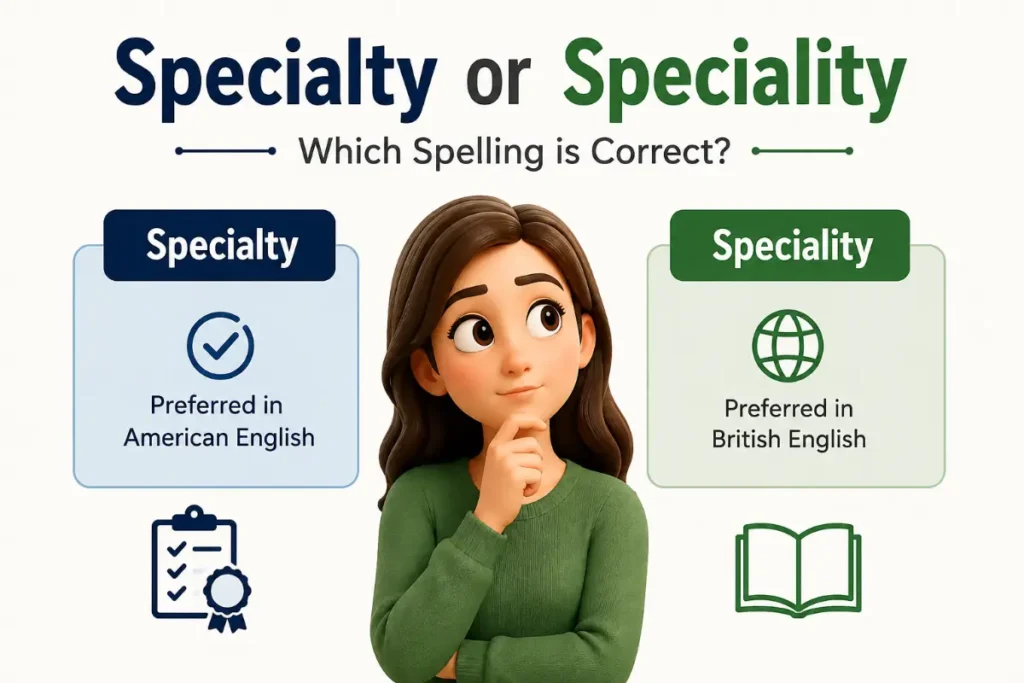
Specialty is the standard spelling in American English. Speciality is the traditional spelling used in British English and is also common in Australian and some other varieties of English. Neither form is simply a misspelling of the other.
That distinction matters if you write for an international audience. A word that looks perfectly normal to an American reader can look unusual to someone accustomed to British spelling. The reverse can happen too.
This guide explains the difference clearly so you can choose the form that fits your audience. You will learn the meaning of both spellings, their history, pronunciation, regional preferences, plural forms, common expressions, and practical examples. We will also look at phrases such as specialty medicine and specialty food, along with the way people discuss the spelling online.
The short version is simple. Use specialty for American English and speciality for British English. Both are legitimate forms.
Quick Definition
Specialty and speciality are two regional spellings of the same noun. Specialty is preferred in American English, while speciality is preferred in British English and commonly used in other varieties that follow British spelling conventions. Both refer to a particular area of expertise, a distinctive product, or something regarded as especially characteristic or important.
Quick Answer
The choice depends mainly on the variety of English you are writing.
- Specialty is the preferred American English spelling.
- Speciality is the preferred British English spelling.
- Both forms are grammatically correct.
- Both forms have the same core meaning.
- Specialty is common in American medical language, business writing, restaurants, and product descriptions.
- Speciality is common in British medical writing, British business communication, and other contexts using British spelling.
- The plural forms are specialties and specialities respectively.
For a United States audience, choose specialty. For a United Kingdom audience, choose speciality. Most importantly, stay consistent within the same piece of writing.
Comparison Table
| Feature | Specialty | Speciality |
|---|---|---|
| Part of speech | Noun | Noun |
| Standard in | American English | British English |
| Basic meaning | A particular area of expertise or distinctive product | A particular area of expertise or distinctive product |
| Core meaning difference | None | None |
| Formality | Standard | Standard |
| Origin | French through English | French through English |
| Common medical use | Specialty medicine | Speciality medicine |
| Common food use | Specialty food | Speciality food |
| Plural | Specialties | Specialities |
| Pronunciation | Usually the same | Usually the same |
| Common audience | United States | United Kingdom and many British English contexts |
| Example | Cardiology is her specialty. | Cardiology is her speciality. |
The important point is that this is primarily a spelling variation, not a difference in definition. A cardiologist in New York and a cardiologist in London can use the word to describe exactly the same professional field. The spelling changes because the surrounding variety of English changes.
Just as regional English differences can affect specialty vs speciality, understanding the differences between subdivisions and villages can help you choose the most accurate term for a particular place or community.
Meaning Of Both Terms
At its heart, the word describes something specialized, distinctive, or particularly associated with a person, field, business, place, or activity.
It can refer to an area in which someone has particular knowledge or skill. A chef might have Italian cuisine as a specialty. A doctor might work in a particular medical specialty. A company might sell a specialty product that is unusual or highly specific.
The word can also describe something distinctive that a place or person is known for. A restaurant may advertise its regional specialty. A bakery may have a specialty cake that customers associate with the business.
The Meaning Of Specialty
In American English, specialty is the usual form.
It commonly refers to a specific area of professional expertise.
For example:
Pediatrics is her medical specialty.
Here, the word identifies a field in which the person has specialized knowledge.
It can also refer to a product or service that is distinctive.
The bakery is known for its chocolate specialty.
In business and retail language, the term can describe products designed for a particular purpose or audience. This is why you may encounter phrases such as specialty coffee, specialty food, specialty store, and specialty equipment.
The word therefore has a fairly broad semantic range. It can describe expertise, products, services, industries, or distinctive offerings.
The Meaning Of Speciality
Speciality carries the same basic meanings but is the preferred spelling in British English.
A British writer might say:
Dermatology is her medical speciality.
An American writer would normally write:
Dermatology is her medical specialty.
The underlying idea has not changed. Only the spelling convention has.
This distinction is useful because learners sometimes assume that the two forms have slightly different meanings. In ordinary modern English, they generally do not. The regional spelling is the main difference.
Specialty As A Distinctive Product
The word can describe something that is made or offered because it is particularly distinctive.
A restaurant might promote a house specialty. A food producer might sell specialty ingredients. A retailer might focus on specialty products that are not normally found in general stores.
This meaning is especially common in American commercial English.
Specialty As An Area Of Expertise
The professional meaning is particularly important in medicine, education, science, technology, and skilled trades.
Someone’s specialty is the field in which they have developed advanced knowledge or experience.
Examples include:
- Neurology is his medical specialty.
- Environmental law is her legal specialty.
- Structural engineering is his professional specialty.
- Medieval history became the professor’s academic specialty.
The same concept can be expressed with phrases such as area of expertise, field of specialization, professional focus, or specialized field.
Key Differences
The biggest difference is regional spelling. There is no major difference in pronunciation or basic meaning.
American English generally removes the second i and uses specialty. British English retains speciality. This follows a broader pattern in which American and British English sometimes prefer different spellings.
The distinction becomes especially noticeable in professional fields.
In the United States, medical organizations, hospitals, universities, and professional publications commonly use specialty. In the United Kingdom, speciality is the expected form in comparable contexts.
There are also differences in related word forms.
American English:
specialty → specialties
British English:
speciality → specialities
This change is important because the spelling difference becomes more visible in the plural.
Meaning Differences
There is generally no meaningful difference in definition.
Both forms can describe:
- A specialized field.
- An area of expertise.
- A distinctive product.
- A particular skill.
- Something a person or business is especially known for.
Tone Differences
Neither form is more formal than the other.
An American professor may use specialty in a formal research paper. A British professor may use speciality in an equally formal paper.
The difference comes from regional language standards rather than tone.
Grammar Differences
Both forms function primarily as nouns.
The grammar around the word stays the same. What changes is the spelling.
For example:
Her specialty is pediatric medicine.
Her speciality is paediatric medicine.
The second sentence also demonstrates another common regional difference. American English usually writes pediatric, while British English uses paediatric.
This is a useful reminder that spelling choices often occur in groups. A writer should not mix regional conventions unnecessarily.
Context Differences
Some expressions are particularly common in American English while others are more familiar in British English.
For instance, Americans frequently use specialty store, specialty food, and medical specialty. British writers use the corresponding forms with speciality.
The meaning remains clear across borders, so an American reader will normally understand speciality and a British reader will understand specialty.
Which One Is Correct
Both spellings are correct, but they belong to different regional standards.
For American English, specialty is the preferred choice. For British English, speciality is the traditional and generally preferred choice.
This is similar to other regional spelling differences. American English uses center, while British English commonly uses centre. American English uses color, while British English commonly uses colour. In the same way, American English uses specialty, while British English commonly uses speciality.
The important editorial rule is consistency.
If you are writing an American English article, use specialty throughout. If you are writing specifically for British readers, use speciality throughout.
Do not switch between the two simply because you encounter both online. Mixed spelling can make an otherwise polished article look careless.
A Practical Rule For Writers
Use this simple guide.
- Writing for readers in the United States: specialty.
- Writing for readers in the United Kingdom: speciality.
- Writing for Australian readers: speciality is generally the natural choice.
- Writing for Canadian readers: specialty is commonly used.
- Referring to an official name: preserve the spelling used by the organization or brand.
This approach works well for websites, academic papers, business documents, product descriptions, and professional communication.
Pronunciation Guide
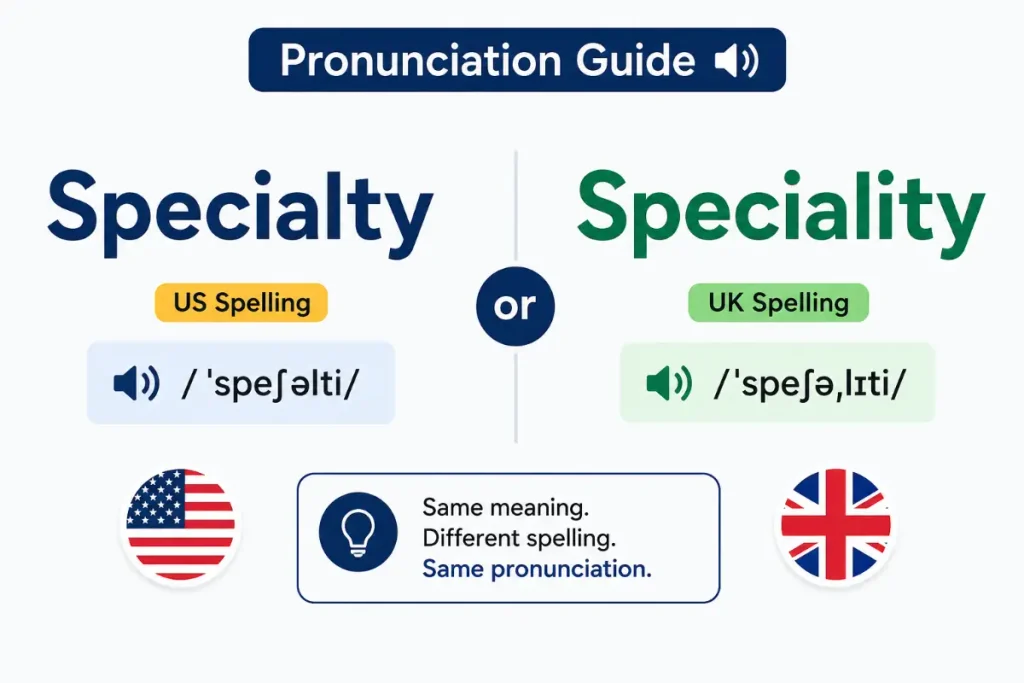
Despite the spelling difference, the two forms are normally pronounced the same way.
Specialty
A common pronunciation in American English is:
/ˈspɛʃəlti/
It can be broken down approximately as:
SPEH shul tee
The strongest stress falls on the first syllable.
Speciality
A common British pronunciation is:
/ˌspɛʃiˈæləti/
It can be broken down approximately as:
speh shee AL uh tee
Pronunciation can vary by speaker and region, particularly because speciality contains an additional syllable in many British pronunciations.
This is one place where the spelling difference can affect how learners perceive the word. American English commonly compresses the word into a shorter spoken form, while British pronunciation may preserve more of the spelling.
Common Pronunciation Mistakes
Learners sometimes try to pronounce every written letter equally. That can make the word sound unnatural.
A better approach is to listen to native speakers from the variety of English you are learning. Pay attention to syllable stress rather than trying to pronounce each letter separately.
The American form generally sounds shorter and more compact. The British form can sound more syllabic because of the additional vowel sound.
Neither pronunciation is inherently more correct. The appropriate choice depends on the variety of English being used.
How To Remember The Correct Spelling
The easiest memory trick is to connect the spelling with the audience.
Think:
American English → specialty
British English → speciality
The American form is shorter. The British form keeps the additional i found in the longer spelling.
Another useful technique is to remember the plural forms together.
- Specialty → specialties
- Speciality → specialities
This helps because the change becomes easier to visualize when you see both the singular and plural forms side by side.
If you are writing for a general American audience, specialty should become your automatic choice. If your audience is British, speciality will usually feel more natural.
The important thing is not to memorize the word as an isolated spelling. Connect it to the larger spelling system you are using.
Examples In Sentences
The easiest way to see the distinction is to put each form into natural sentences. The examples below also show why context matters. The spelling changes with the variety of English, but the underlying idea stays the same.
Specialty Examples
- Her specialty is pediatric cardiology.
- Seafood is the restaurant’s specialty.
- The store sells specialty coffee from small farms.
- Digital marketing has become his professional specialty.
- The doctor referred me to a specialist in her medical specialty.
- The bakery is famous for its chocolate cake specialty.
- Wildlife photography is one of the photographer’s specialties.
- The company develops specialty equipment for laboratories.
- Italian cuisine is the chef’s specialty.
- The university offers several programs in this specialty.
These examples cover professional expertise, medicine, food, business, education, and personal skills. The word does not have to describe a profession. It can describe almost anything that is distinctive or highly specialized.
Speciality Examples
- Cardiology is her medical speciality.
- Local seafood is the restaurant’s speciality.
- The shop is known for its speciality cheeses.
- Environmental law is his legal speciality.
- The hospital has specialists in several medical specialities.
- Traditional baking is the chef’s speciality.
- The university offers courses in this academic speciality.
- The company manufactures speciality equipment for laboratories.
- Regional cuisine is one of the restaurant’s specialities.
- The clinic provides treatment across several medical specialities.
The important point is not that these sentences have different meanings. They do not. The spelling reflects the variety of English being used.
Common Mistakes
The most common mistake is assuming that one spelling must be wrong. That is not the case here. Both forms have a legitimate place in English, but their regional preferences differ.
Treating One Form As A Misspelling
An American writer may see speciality and assume it contains an error. A British writer may have the opposite reaction when seeing specialty. Neither assumption is justified.
The surrounding language provides the clue. If a document consistently uses American spelling, specialty fits naturally. If it follows British spelling conventions, speciality is the expected form.
Mixing Regional Styles
A bigger editorial problem occurs when a writer mixes spelling systems throughout the same document.
For example, an article might use specialty alongside colour, centre, and organise. That combination is not automatically wrong, but it creates an inconsistent regional style.
A polished document should normally choose one main variety of English and follow it consistently.
Confusing The Plural Forms
The plural deserves special attention.
American English:
specialty → specialties
British English:
speciality → specialities
The change from y to ies in the American form can cause mistakes such as specialtys or specialitys. Those forms are incorrect.
Assuming The Medical Meaning Is Different
Searches for medical terminology can make the distinction seem more complicated than it is.
American medical writing generally uses specialty.
British medical writing generally uses speciality.
The medical concept remains the same. Both refer to a particular branch of medicine in which a doctor or healthcare professional has specialized training.
Copying Search Results Without Checking Context
Online searches can show both spellings on the same page. That does not mean the writer used them randomly. An international website may serve readers from several countries, or the results may come from sources using different editorial standards.
Look at the source and its audience before deciding which spelling is appropriate.
Specialty And Speciality In Medicine
Medicine is one of the clearest areas where regional spelling becomes visible.
A medical specialty is a branch of medicine that focuses on a particular area of health, disease, diagnosis, or treatment. Examples include cardiology, dermatology, neurology, oncology, pediatrics, and surgery.
American medical writing generally uses specialty.
British medical writing generally uses speciality.
For example, an American hospital might write:
She chose cardiology as her medical specialty.
A British hospital might write:
She chose cardiology as her medical speciality.
The distinction is purely regional in this context. The training, professional field, and clinical meaning are not changed by the spelling.
This is particularly useful for medical writers working with international audiences. If a document is intended for an American healthcare organization, specialty will normally be the natural choice. A document intended for a British healthcare audience should generally use speciality.
Common Medical Expressions
You may encounter both forms in phrases such as:
- Medical specialty or medical speciality.
- Specialty doctor or speciality doctor.
- Specialty care or speciality care.
- Medical specialties or medical specialities.
- Specialty training or speciality training.
- Specialty clinic or speciality clinic.
Some individual healthcare systems also have terminology that differs for institutional reasons. In those cases, the official terminology of the organization should take priority.
Specialty And Speciality In Food
Food is another area where the word appears frequently.
A specialty food is generally a distinctive or specialized food product that may be associated with a particular region, producer, method, ingredient, or culinary tradition.
American businesses commonly use specialty food.
British businesses commonly use speciality food.
For example, an American grocery store might advertise specialty foods from around the world. A British retailer might describe similar products as speciality foods.
The phrase can cover a wide range of products, including artisan cheese, imported ingredients, regional sauces, premium chocolate, unusual spices, and foods made for particular dietary or culinary purposes.
The exact meaning depends on context. The word does not automatically mean expensive or luxurious. A specialty product is simply distinctive or produced for a particular market or purpose.
Similar spelling variations appear in other word pairs too, and our guide to which version fits the context for uncollectible and uncollectable explains how meaning and usage can influence the preferred choice.
Specialty And Speciality On Reddit
Reddit discussions can be useful for seeing how ordinary people think about spelling differences. They can also create confusion because Reddit is an international platform where American, British, Canadian, Australian, and other varieties of English appear side by side.
Someone searching Reddit for specialty or speciality may find users arguing that one spelling is correct while another is wrong. In many cases, the disagreement comes from regional language habits rather than an actual grammar rule.
For practical writing, do not treat a Reddit comment as an authority on English usage. Community discussions can show how people use a word, but dictionaries, established style guides, and professional editorial conventions are better sources for determining standard spelling.
Reddit is particularly useful for observing informal language and regional preferences. It is less useful as the final authority for formal spelling decisions.
Plural Form
The singular forms are easy to understand, but the plural forms are worth learning separately.
American English Plural
The American plural is:
specialties
For example:
The clinic offers several medical specialties.
The final y changes to ies.
British English Plural
The British plural is:
specialities
For example:
The hospital offers several medical specialities.
Here, the spelling keeps the i before the plural ending.
This difference follows the spelling of the singular form.
| English variety | Singular | Plural |
|---|---|---|
| American English | specialty | specialties |
| British English | speciality | specialities |
Remembering the pair together is easier than learning each plural independently.
Etymology And Word Origin
The history of the word reaches back to special and ultimately to Latin.
The Latin word specialis meant something particular or distinctive. It developed through Old French and Middle English before becoming part of modern English vocabulary.
The related English word special has been used for centuries to describe something distinguished from what is ordinary or general. From that family came words connected with specialization and specific areas of expertise.
The noun forms developed to describe a particular area or thing that receives special attention.
The American spelling specialty became established as a regional form, while speciality remained common in British English. Neither spelling represents a modern invention. Both developed within the history of English.
This is an important distinction for learners. The difference did not arise because one country changed a correct word into an incorrect one. English has developed multiple regional standards over time, and this is one example of that broader pattern.
Regional Usage
Regional preference becomes especially useful when you are writing for a specific audience.
American English
Specialty is the standard form in the United States.
You will commonly see it in:
- Medical writing.
- Restaurant descriptions.
- Retail language.
- Academic writing.
- Business communication.
- Professional profiles.
- Product descriptions.
British English
Speciality is the traditional British form.
It appears in professional and everyday writing, including medical terminology, food descriptions, academic contexts, and discussions of professional expertise.
Australian English
Australian English generally follows the British form and commonly uses speciality.
Australian spelling has many similarities with British English, although actual usage can vary across organizations and publications.
Canadian English
Canadian English commonly uses specialty, particularly in professional and everyday contexts. Canadian English contains influences from both American and British English, so individual words can sometimes vary in usage.
For this word, specialty is a well established Canadian form.
Why Regional Consistency Matters
If your website targets Americans, use the American form. If your publication is written specifically for British readers, use the British form.
For international websites, either spelling can work, but consistency matters more than trying to use both. You can also state your chosen English variety in an editorial style guide so writers follow the same convention.
Grammar Rules
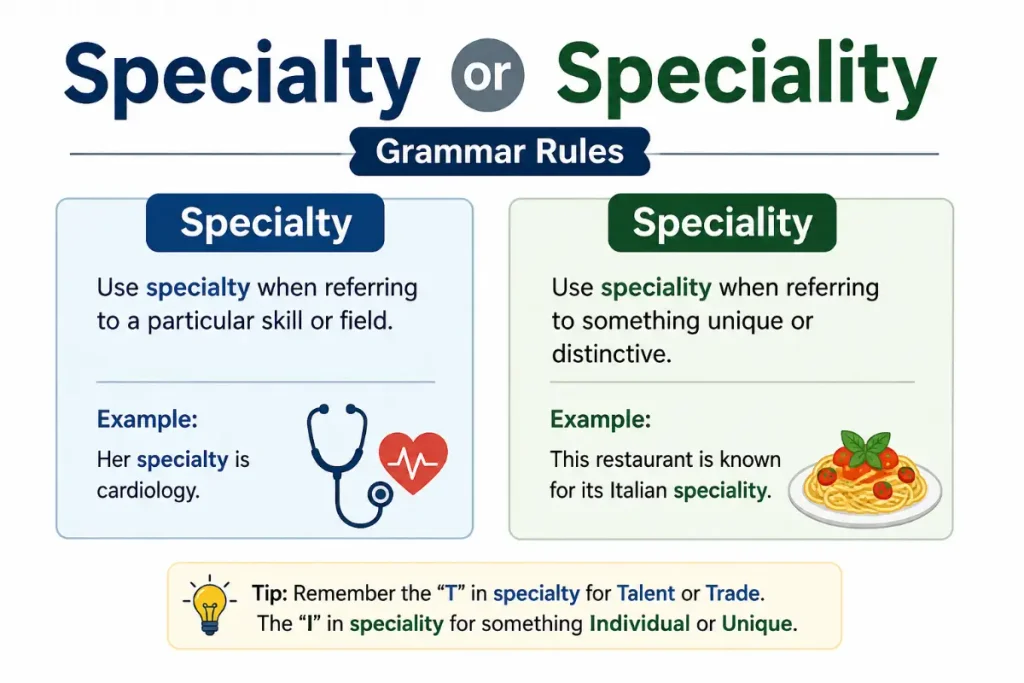
Both forms are primarily nouns. The word usually identifies a particular field, skill, product, or area of expertise.
Singular Use
Examples include:
- Cooking is her specialty.
- Cardiology is his speciality.
- This restaurant’s specialty is fresh pasta.
- Marine biology became her academic specialty.
Possessive Use
The word can also take a possessive form.
Examples include:
- The doctor’s specialty is neurology.
- The restaurant’s specialty is grilled seafood.
- The professor’s speciality is medieval history.
Plural Use
When referring to multiple fields or areas of expertise, use the appropriate plural.
American:
The university offers several specialties.
British:
The university offers several specialities.
Adjective Forms
The word itself is mainly a noun, but it frequently appears before another noun to form compound expressions.
Examples include:
- Specialty food.
- Specialty coffee.
- Specialty clinic.
- Specialty retailer.
- Specialty equipment.
In these combinations, the first word modifies the second. The phrase describes something designed for a particular purpose, market, field, or category.
Verb And Adjective Confusion
Do not confuse specialty or speciality with words such as specialize, specialized, and specialist.
They are related but serve different grammatical functions.
- Specialist usually refers to a person.
- Specialized describes something designed or developed for a particular purpose.
- Specialize is the verb describing the act of focusing on a particular field.
- Specialty and speciality are nouns describing the field or distinctive area itself.
Real Life Usage
The word appears in many parts of everyday communication, which explains why the spelling question is so common.
Daily Conversation
Someone might say:
Baking is my specialty.
Another person might say:
Italian cooking is her speciality.
Both speakers communicate the same idea.
Academic Writing
Researchers and professors use the term to identify areas of expertise.
For example:
The professor’s specialty is eighteenth century literature.
A British publication might use the corresponding spelling.
Professional Communication
The term is especially common in resumes, professional biographies, business profiles, and company descriptions.
A designer might describe user experience as a professional specialty. A consultant might identify supply chain management as an area of specialization.
Food And Hospitality
Restaurants frequently use the term to identify signature dishes.
Examples include:
- The restaurant’s specialty is wood fired pizza.
- The chef’s speciality is traditional French pastry.
- The market sells specialty cheeses.
- The café specializes in regional coffee.
Media And Advertising
Marketing writers often use the word to make a product sound distinctive or targeted. Phrases such as specialty products, specialty services, and specialty stores are common in commercial English.
The exact meaning depends on the product. It may indicate something highly specialized, unusual, regional, artisan, or designed for a particular group.
Related Words And Confused Terms
Understanding the word family makes this spelling difference much easier to remember. Several related terms appear in the same sentences, but they do not all perform the same grammatical job.
Specialist
A specialist is usually a person with advanced knowledge or training in a particular field.
For example:
She is a specialist in pediatric medicine.
The person is the specialist. The field is the specialty or speciality.
Specialize
Specialize is the verb.
For example:
The clinic specializes in sports medicine.
American English generally uses specialize while British English commonly uses specialise.
Specialized
Specialized is the adjective used to describe something intended for a particular purpose or field.
For example:
The laboratory uses specialized equipment.
British English often uses specialised instead.
Specialization
Specialization refers to the process or practice of focusing on a particular area.
For example:
Her specialization is environmental law.
The word is closely related to specialty and speciality but is not interchangeable with them.
Expertise
Expertise refers to advanced knowledge or skill.
For example:
His expertise is renewable energy policy.
You can sometimes replace specialty with expertise in a sentence, but the meaning is not always identical. A specialty usually identifies a particular field or area. Expertise emphasizes the person’s knowledge or ability in that area.
Niche
Niche describes a specialized position, market, interest, or area.
For example:
The company found a niche selling specialty baking equipment.
The two words can appear together because they describe related ideas from different angles.
Specialty Synonym
Common contextual synonyms include:
- Specialty.
- Speciality.
- Expertise.
- Specialization.
- Field.
- Area of expertise.
- Forte.
- Niche.
- Concentration.
- Particular strength.
These are not perfect replacements in every sentence. Context determines the best choice.
Another interesting example is baloney vs bologna, where the distinction between food spelling versus figurative nonsense shows how context can completely change which form is appropriate.
Expert Language Insight
From an editorial perspective, this is a simple regional spelling decision rather than a complicated grammar problem.
If you are writing for a United States audience, specialty is the safest and most natural choice. It fits American dictionaries, professional writing, medical terminology, product descriptions, and ordinary conversation.
For British audiences, speciality is the conventional form. The same principle applies to formal publications, educational material, and professional documents that follow British English.
The most important editorial rule is consistency. Do not switch between the two forms simply because you encounter both online. Pick the spelling that matches your publication’s English variety and keep that choice throughout the document.
There is also a practical SEO lesson here. Search engines can understand that the two forms are closely related, so writers do not need to repeat both spellings unnaturally throughout an article. Clear explanations, useful examples, regional context, and natural language provide much stronger coverage.
For websites serving multiple English speaking markets, a short regional note can eliminate confusion. For example, an American website can use specialty throughout its main content while explaining that speciality is the common British spelling.
This approach serves readers better than constantly alternating between the forms.
FAQs
Is Specialty Or Speciality Correct
Both spellings are correct. Specialty is the standard form in American English, while speciality is commonly used in British English and several varieties influenced by British spelling. The two words have the same basic meaning and grammatical function. The appropriate choice depends mainly on the English variety used by your audience.
Is Specialty American Or British
Specialty is primarily the American spelling. American writers commonly use it for a field of expertise, a medical field, a distinctive product, or something for which a person or business is particularly known. British English generally prefers speciality for the same meanings.
Is Speciality The British Spelling
Yes. Speciality is the traditional British spelling of the noun. It is commonly used in British English for areas of expertise, medical fields, distinctive products, and particular skills. Writers following British spelling conventions should normally choose speciality rather than the American form specialty.
What Is The Plural Of Specialty
The American plural is specialties. The final y changes to ies. For example, you can write The hospital offers several medical specialties. In British English, the corresponding plural is specialities, following the spelling of the singular noun speciality.
What Is The Difference Between Specialty And Speciality
The main difference is regional spelling rather than meaning. American English generally uses specialty, while British English generally uses speciality. Both can describe an area of expertise, a medical field, a distinctive food, a specialized product, or something for which a person or organization is particularly known.
Which Is Used In Medical Writing
American medical writing generally uses specialty, as in medical specialty or medical specialties. British medical writing generally uses speciality, as in medical speciality or medical specialities. The medical concept is the same. Only the regional spelling changes.
Which Is Used For Food
American English commonly uses specialty food, specialty coffee, and specialty products. British English commonly uses speciality food and related forms. The term usually refers to food that is distinctive, specialized, regional, artisan, or associated with a particular producer or culinary tradition.
Can I Use Both Spellings In One Article
You can mention both forms when explaining the regional difference, but consistent usage is better for normal writing. If the article follows American English, use specialty as the main form. If it follows British English, use speciality. Switching between regional spellings without a reason can make the writing look inconsistent.
Conclusion
The answer is straightforward. Specialty and speciality are both legitimate English spellings of the same noun.
Use specialty for American English. Use speciality for British English and contexts that follow British spelling conventions.
The difference becomes especially visible in medical writing, food descriptions, academic discussions, professional profiles, and business language. The plural forms follow the same regional pattern, giving us specialties in American English and specialities in British English.
You do not need to memorize two completely different words. Think of them as regional members of the same word family.
If you are writing for an American audience, choose specialty and stay consistent. If your readers use British English, choose speciality. Once you connect the spelling to the regional variety, the confusion becomes much easier to avoid.