If you are trying to describe a person who cries, the spelling can feel surprisingly uncertain. Cryer vs crier looks like a simple spelling question, but the two forms can create confusion because English uses several related words built from the verb cry. The good news is that crier is the usual and safest choice when you mean a person who cries.
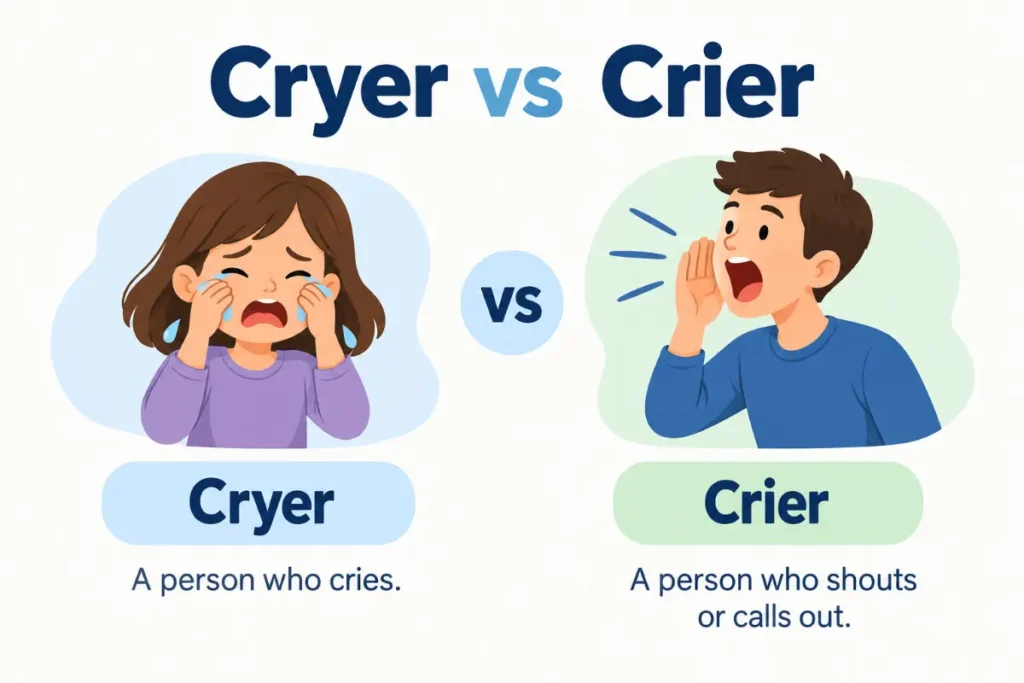
There is also a second meaning worth knowing. A crier can be someone who makes a public announcement by calling it out loudly, as in the traditional expression town crier. That older meaning comes from a different sense of cry, meaning to call out or proclaim something. The spelling remains the same.
This guide explains the difference between cryer and crier, shows how native speakers use crier, covers pronunciation and word history, and gives practical examples. You will also see when cryer can appear, why people confuse the forms, and which spelling works best in American English.
Quick Answer
Crier is the standard spelling for a person who cries. It can also mean someone who calls out announcements publicly, as in town crier. Cryer can appear as a less common spelling or surname, but it is not the usual choice when describing someone who cries. For standard American English, use crier.
Cryer Vs Crier Meaning
The main difference is connected to how English forms nouns from the verb cry.
Crier is an established English noun. It can describe someone who cries frequently or someone who cries at a particular moment. It can also describe a person whose job or role involves calling out announcements.
Cryer is much less common as an ordinary noun. Some dictionaries and historical sources may record it in particular uses, and it can also occur as a surname or proper name. However, if your intended meaning is simply “a person who cries,” crier is the natural standard form.
This distinction matters because English spelling does not always create an agent noun by simply adding er to the verb. The spelling of the resulting word may reflect older forms and pronunciation patterns.
Comparison Table
| Feature | Crier | Cryer |
|---|---|---|
| Standard form | Yes | Usually no for this meaning |
| Part of speech | Noun | Noun in limited or nonstandard use |
| Main meaning | A person who cries or calls out | A less common form associated with someone who cries |
| Common US usage | Common enough in relevant contexts | Uncommon |
| Town crier | Correct | Not standard |
| Person who cries | Correct | Usually replaced by crier |
| Formality | Neutral | Unusual |
| Pronunciation | Usually sounds like CRY er | Usually sounds like CRY er |
| Common context | Crying, public announcements, historical roles | Rare usage, names, or specialized contexts |
The table shows why the spelling can be confusing. The two forms can look and sound almost identical, but their status in standard English is not the same.
What Does Crier Mean
Crier is a noun with two closely related meanings.
The first meaning is a person who cries. It can describe someone who cries easily, cries frequently, or is crying in a particular situation.
For example:
The baby was a frequent crier during the night.
You might also hear the expression a big crier, which usually describes someone who cries easily or openly.
The second meaning is a person who publicly announces news or information by calling it out. This meaning appears most famously in town crier.
Historically, a town crier would walk through a community and announce important news aloud. The person might use a bell or another attention grabbing sound before making the announcement. This older occupation explains why crier can refer to someone who cries out words rather than sheds tears.
What Does Cryer Mean
Cryer is not normally the preferred spelling for the ordinary noun meaning a person who cries.
A reader may encounter the form in historical material, names, informal writing, or contexts where an individual writer has formed the noun directly from cry. It may also appear because someone assumes that adding er to cry should produce cryer.
That assumption is understandable. English has many nouns formed with er, including runner, writer, teacher, and worker. However, established vocabulary does not always follow a perfectly predictable spelling pattern.
If you are writing a sentence such as:
She is a frequent crier.
the standard choice is crier.
Writing cryer in the same sentence can look like a spelling mistake to many readers.
Why Crier Is Spelled With I
The spelling becomes easier to understand when you look at the related verb cry and the way English has historically formed the noun.
The word crier is connected to the older English verb forms related to cry and to the broader development of the noun as an established word. The i is not simply an arbitrary spelling choice. It belongs to the conventional form that English speakers have preserved.
A useful practical rule is to remember the word as:
cry → crier
Do not assume that every verb ending in y creates an agent noun by adding er without any spelling change. English has many exceptions and historical patterns.
For example, try becomes trier, not tryer, when the noun means someone who tries. Similarly, lie becomes liar, which follows an entirely different historical pattern.
The important point is that established words need to be learned in their standard forms rather than reconstructed from spelling rules alone.
Cryer vs Crier: Which One Is Correct
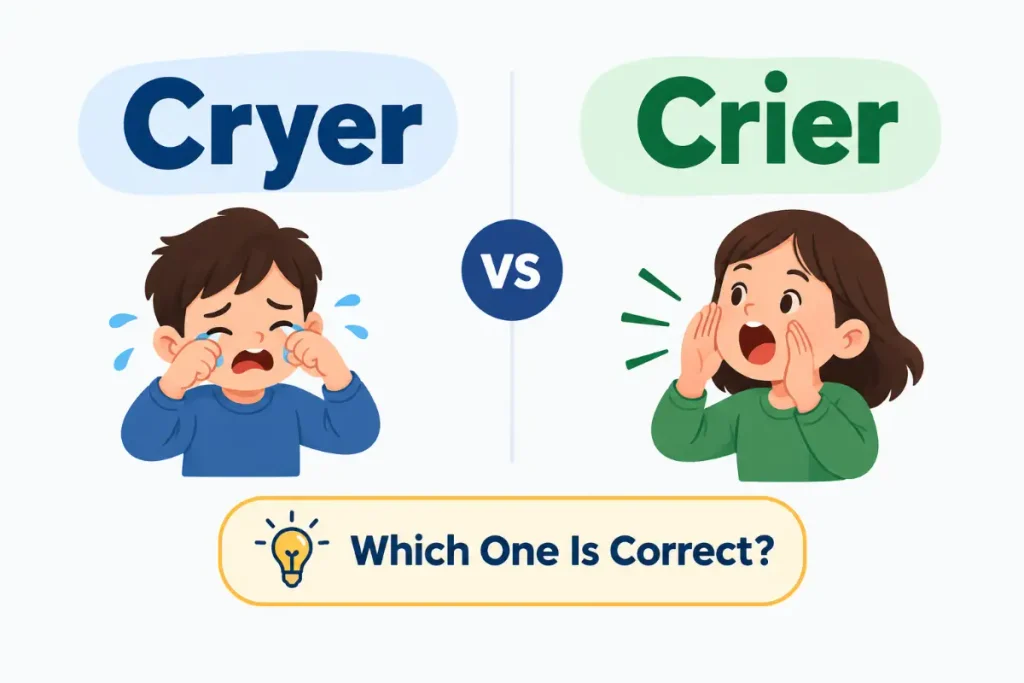
For standard American English, crier is the correct choice when you mean a person who cries. Use crier in sentences such as:
- The child was a loud crier.
- She has always been an emotional crier.
- The baby became a much happier crier after developing a regular sleep routine.
Use town crier when referring to the traditional public announcer.
- The town crier announced the news in the village square.
The form cryer should generally be avoided in ordinary edited writing when you mean a person who cries. If you see it used as part of a person’s surname, company name, title, or another proper name, that is a different matter. Proper names can have spellings that do not follow standard vocabulary conventions.
Crier Examples In Sentences
The following examples show the different ways crier works in modern English.
- The baby was a surprisingly calm crier during the afternoon.
- My nephew is a happy crier who starts laughing as soon as he gets upset.
- She became an emotional crier after watching the movie.
- He was such a loud crier that everyone in the room noticed.
- The child is not much of a crier and usually stays calm.
- Her mother described her as a sensitive crier when she was young.
- The town crier announced the arrival of the royal visitors.
- A town crier once delivered important news to people gathered in public places.
- The historical reenactment included a town crier dressed in traditional clothing.
- The crier called out the announcement so people could hear it.
Notice that the meaning depends heavily on context. A sentence about a baby usually concerns crying with emotion. A sentence about a town crier concerns speaking or calling out an announcement.
Cryer Examples In Context
Because cryer is not the standard everyday noun for a person who cries, it is better to treat examples of this form as examples of unusual or nonstandard usage rather than present them as recommended English.
You may encounter sentences such as:
- The writer used cryer as an informal noun for someone who cries.
- The old text contains the spelling cryer.
- The surname Cryer appears in historical and modern records.
- The character’s unusual nickname was spelled Cryer.
- The website used cryer where standard edited English would normally use crier.
These examples illustrate an important distinction. A form can appear in real writing without being the preferred standard form. If you are writing an article, email, essay, report, or professional document, crier is the safer choice for the ordinary meaning.
Common Spelling Mistakes
The most common mistake is assuming that the noun should be formed by adding er directly to cry.
A writer may reason:
cry + er = cryer
That looks logical, but standard English uses crier.
Incorrect
He is a frequent cryer.
Correct
He is a frequent crier.
The same issue can appear when writers search for the word by sound. Since crier and cryer can sound nearly identical, pronunciation does not always reveal the correct spelling.
Another mistake is assuming that crier only applies to someone who cries emotionally. The word also appears in the historical expression town crier, where cry means to call out loudly.
Is Crier A Real Word
Yes. Crier is a well established English word.
Its most familiar modern meaning is a person who cries, particularly someone who cries easily or frequently. Its historical meaning is a person who calls out or announces something publicly.
The word is therefore not merely an alternative spelling of cryer. It has its own established history and usage.
The expression town crier is especially important because it preserves an older sense of the verb cry. In this context, cry means to proclaim or call something aloud.
Pronunciation Of Crier
In American English, crier is generally pronounced approximately like CRY er.
The IPA pronunciation is commonly represented as:
/ˈkraɪ.ər/
It has two syllables:
cry er
The first syllable receives the main stress.
One reason the spelling question persists is that crier and cryer can sound essentially the same in ordinary speech. A listener usually cannot determine the spelling simply from pronunciation.
That makes this a classic spelling issue rather than a pronunciation issue. If you hear the word in conversation and later need to write it, remember the standard form crier.
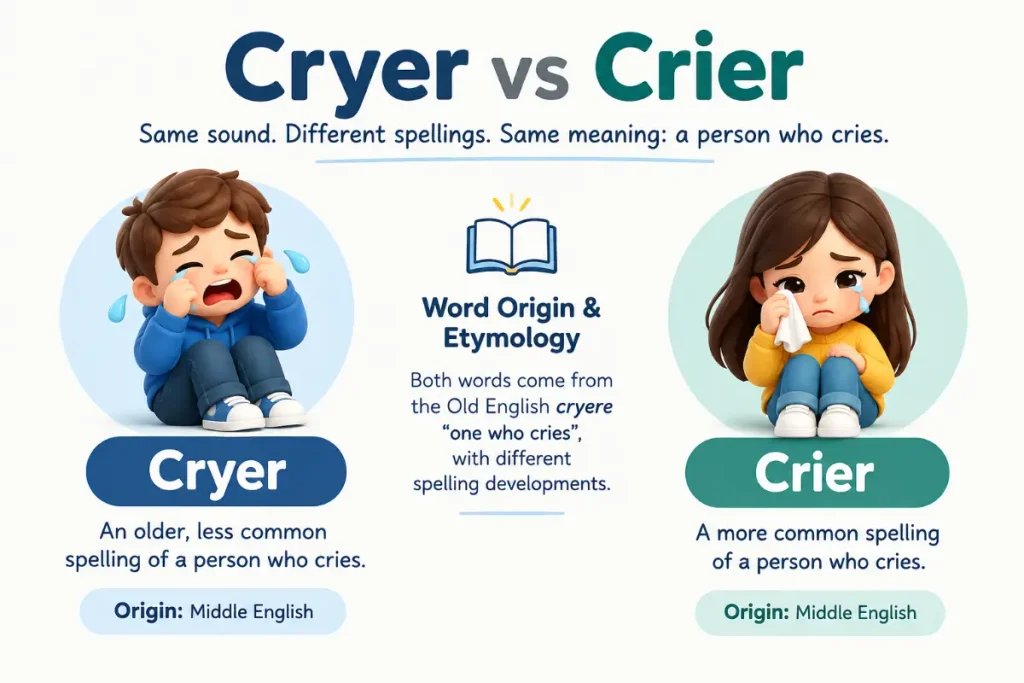
Word Origin And Etymology
The history of crier is connected to the long history of the English verb cry. The verb has roots reaching back through Old French and ultimately to Latin forms associated with calling out or shouting.
English developed several related meanings from the idea of making a loud call. A person could cry out words, announce something publicly, or express emotion through a cry.
The noun crier developed from this family of meanings. That helps explain why the same word can describe someone who cries and someone who publicly calls out an announcement.
The famous town crier belongs to the second sense. Before newspapers, radio, television, and widespread digital communication, public announcements often had to be delivered directly to a community. A town crier performed that role by calling out important information.
The emotional meaning developed within the broader semantic family of crying and vocal expression. Modern speakers therefore understand crier according to context.
American And British English
There is no major American and British spelling difference between crier and cryer.
American English uses crier as the standard form. British English also uses crier in the relevant senses. Canadian and Australian English likewise generally use the same spelling.
This means you do not need to choose between the two forms based on nationality. The distinction is mainly one of standard usage rather than regional spelling.
For example:
- US: She is a frequent crier.
- UK: She is a frequent crier.
The spelling remains unchanged.
The historical expression town crier is also recognized across varieties of English, although the occupation itself is much less common today than it was historically.
Grammar Rules For Crier
Crier is a countable noun. You can use it in singular and plural forms.
Singular Form
Crier refers to one person.
The baby was a frequent crier.
Plural Form
The plural is criers.
Some babies are naturally louder criers than others.
The historical meaning also allows the plural:
The town criers gathered for the ceremony.
Possessive Form
For one crier, use crier’s.
The crier’s announcement attracted a crowd.
For multiple criers, use criers’.
The criers’ announcements could be heard across the square.
As A Compound Noun
The most familiar compound is town crier.
Other combinations can appear depending on context, but the noun should remain crier when the intended meaning is a person who cries.
Formal And Casual Usage
Crier is a neutral noun, but its naturalness depends on context.
In everyday conversation, people often use simpler expressions such as:
- She cries easily.
- He is always crying during sad movies.
- The baby cries a lot.
Calling someone a crier is perfectly understandable, but it can sound more descriptive or categorical than simply saying that the person cries often.
For example:
She is a crier.
This can suggest that crying is a noticeable characteristic of the person.
In professional or academic writing, the word may be useful when the subject requires a noun, but a more specific expression can sometimes sound smoother.
The child cries frequently during transitions.
This may be preferable to:
The child is a frequent crier during transitions.
The best choice depends on the sentence and the level of precision you need.
Crier In Real Life Communication
The word appears in several different types of communication.
Everyday Conversation
People may use crier when talking about personality or emotional reactions.
I am a total crier during sad movies.
This is natural and informal.
Text Messages
A person might write:
I am such a crier. That ending got me.
This is casual and expressive.
Workplace Communication
The word is less common in professional communication unless crying is directly relevant to the subject. In most workplace situations, a more neutral description may be clearer.
Academic Writing
Academic writers may use crier when discussing language, historical occupations, literature, psychology, or behavior. The surrounding context determines which meaning is intended.
Historical Writing
The word is particularly useful when discussing the town crier, public announcements, and communication before modern mass media.
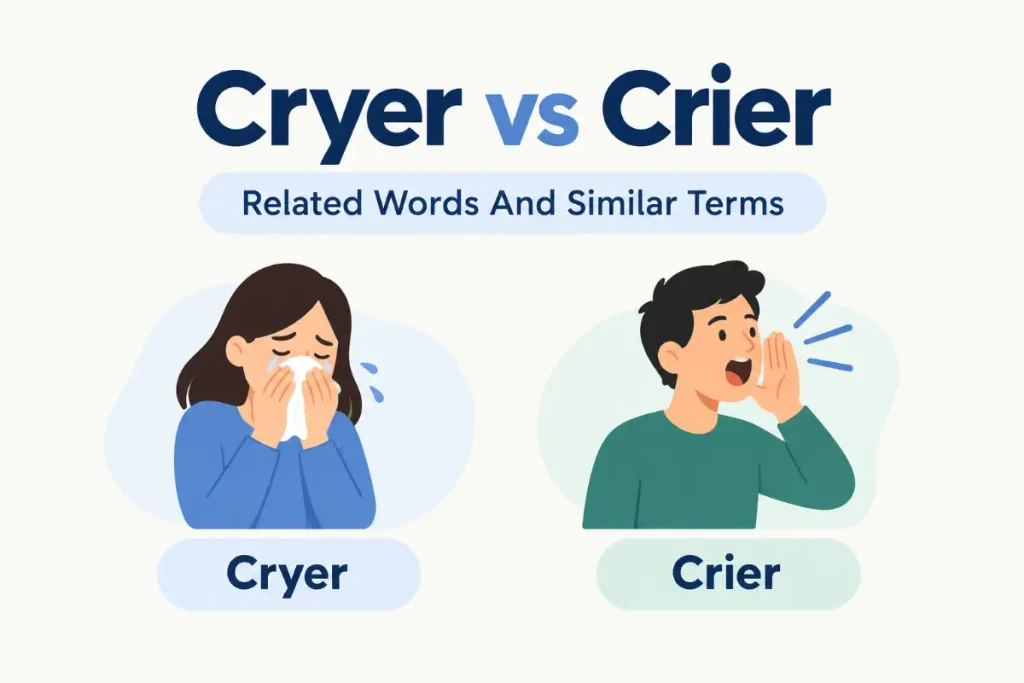
Related Words And Similar Terms
Several words sit close to crier in meaning, but they are not interchangeable in every sentence.
Cry
Cry is the basic verb.
The child began to cry.
Crying
Crying is the present participle or gerund form.
Crying can be a normal emotional response.
Tearful
Tearful is an adjective describing someone who has tears or appears close to crying.
She became tearful during the conversation.
Weeper
Weeper can describe a person who cries, especially someone who cries easily. It can also describe something that causes or invites crying, depending on context.
The movie was a real weeper.
Sobber
Sobber is a much less common noun referring to someone who sobs.
Town Crier
A town crier is a person who traditionally announces news publicly by calling it out.
The expression is still familiar in American English, especially in historical discussions and cultural references.
How To Remember The Correct Spelling
If you often hesitate between the two forms, connect crier with other familiar words ending in ier.
Think:
cry → crier
The easiest memory trick is to picture the word as cry + er, then remember that English changes the spelling of the final y to i in this form.
You can also remember the related pair:
try → trier
cry → crier
This is not a universal rule for every English word, but it gives you a useful spelling pattern for these forms.
Another helpful reminder is the familiar phrase:
town crier
Because this expression is so established, it can serve as a visual anchor for remembering the spelling.
Which Word Should You Use
For almost every ordinary writing situation, choose crier when you mean a person who cries.
Use crier in:
- Articles and blog posts.
- School assignments.
- Emails.
- Professional writing.
- Social media posts.
- Everyday messages.
- Descriptions of emotional behavior.
- Historical discussions involving a town crier.
Avoid cryer as the ordinary noun unless you have a specific reason to reproduce that spelling.
If you are editing someone else’s writing, do not automatically change Cryer when it is a person’s name or another official proper name. Names can have their own established spellings.
Frequently Asked Questions
Which Is Correct Crier Or Cryer
Crier is the standard choice when you mean a person who cries. The form cryer may appear in unusual, historical, informal, or name based contexts, but it is not the normal spelling for standard edited American English. If you are writing about someone who cries frequently, use crier.
Is Crier A Word For Someone Who Cries
Yes. Crier can mean a person who cries, especially someone who cries easily or frequently. For example, you can say, She is a crier when she watches emotional movies. The word also has a historical meaning connected to public announcements, which is preserved in the expression town crier.
Why Is Crier Spelled With An I
The spelling crier is an established English form that developed from the verb cry and older word formation patterns. English does not always create nouns by simply adding letters to the unchanged verb. The standard form is therefore crier, not cryer, when describing a person who cries.
Is Cryer Ever Correct
Cryer can be correct in specific contexts, particularly as a proper name or in unusual historical or nonstandard usage. However, it is not the normal standard noun for a person who cries. For general American English writing, crier is the safer and more widely accepted choice.
What Is A Town Crier
A town crier is a person who traditionally announced news or official information publicly by calling it out. Town criers were especially important before modern newspapers and electronic communication became widespread. The word crier in this expression comes from the sense of cry meaning to call out or proclaim something aloud.
How Do You Pronounce Crier
In American English, crier is generally pronounced CRY er and can be represented in IPA as /ˈkraɪ.ər/. It has two syllables, with the main stress on the first syllable. Because crier and cryer can sound almost identical, pronunciation does not reliably tell you which spelling to use.
Is Crier American Or British
Crier is standard in both American and British English. There is no major regional spelling difference between the two varieties for this word. Canadian and Australian English also generally use crier. The choice is therefore not about American versus British spelling. It is mainly about using the established English form.
What Is The Plural Of Crier
The plural of crier is criers. For example, The town criers announced the news to the crowd. The same plural form applies when referring to people who cry. The possessive forms are crier’s for one person and criers’ for more than one person.
Final Verdict
When you mean a person who cries, crier is the standard spelling you should use in American English. The form cryer may appear in names or unusual sources, but it is not the normal choice for standard edited writing.
The word crier also has an important historical meaning. A town crier was someone who publicly announced news by calling it out. That older meaning helps explain why the word can refer to someone who cries emotionally and someone who cries out information.
The simplest way to remember cryer vs crier is to connect the correct spelling with the verb cry. If you are writing an email, school assignment, article, social media post, or professional document, choose crier when describing someone who cries.