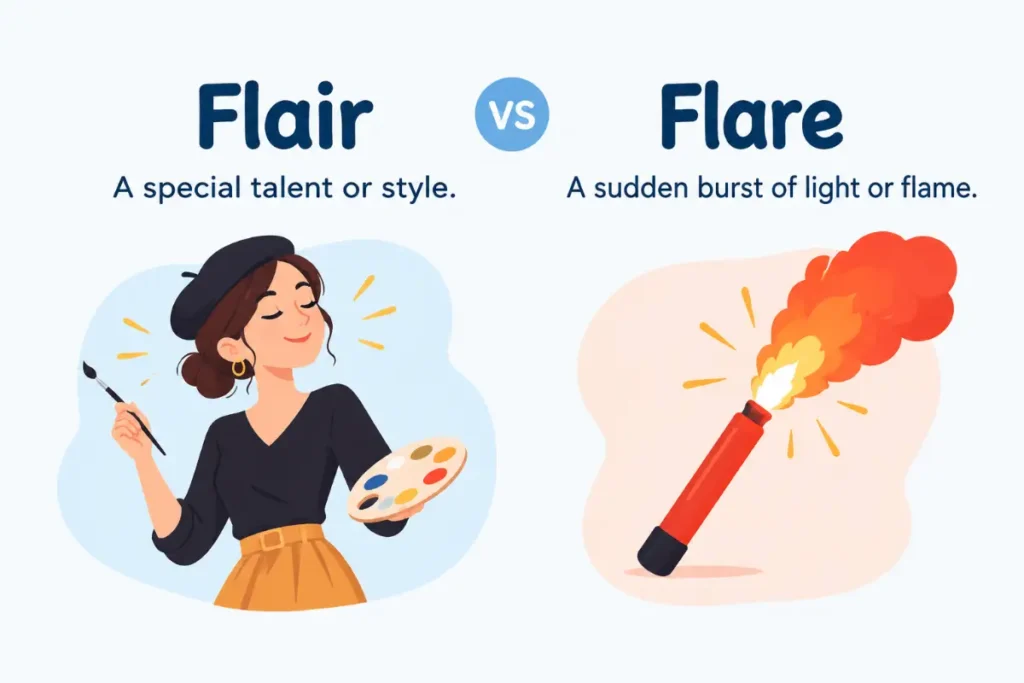
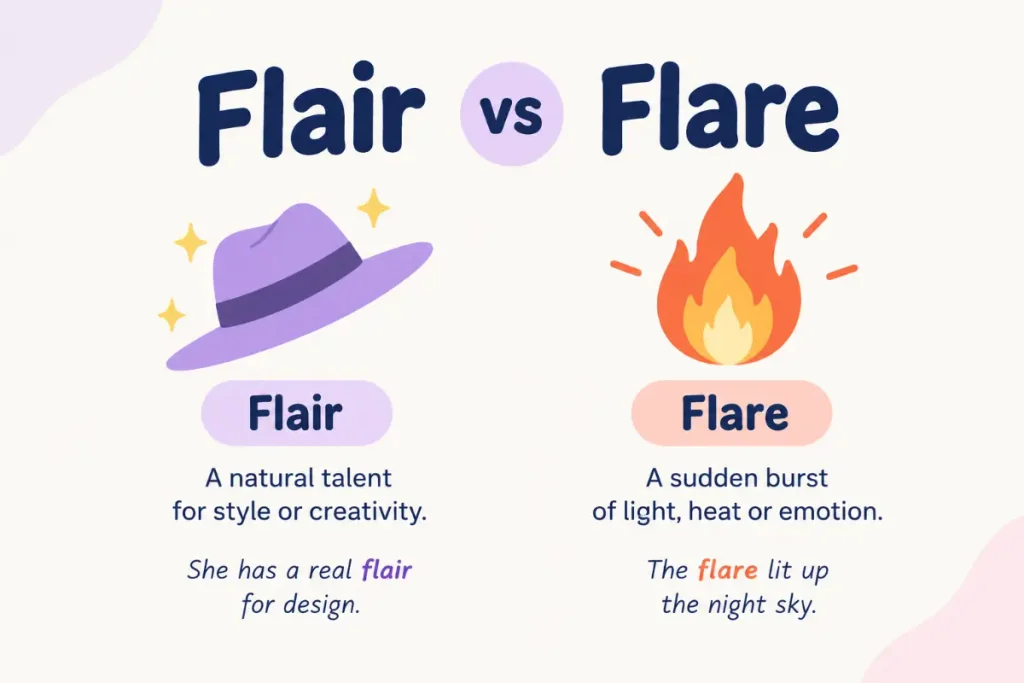
If you have ever paused over flair vs flare, you are not alone. These words sound exactly alike in American English, but they have different meanings and grammatical roles. Flair usually refers to a natural talent, distinctive style, or special quality. Flare can describe a sudden burst of light, a worsening of symptoms, something spreading outward, or a sudden increase in intensity.
The confusion becomes even easier to understand because both words appear in familiar phrases. You might have a flair for writing, see a flare in the sky, experience a flare up of symptoms, or wear flare jeans. Medical writing adds another wrinkle because FLAIR can also appear as an uppercase acronym for a specific MRI sequence.
This guide explains the difference in plain American English. You will learn what each word means, how to use it naturally, how to pronounce them, why the spelling differs, and how to avoid common mistakes in everyday, professional, medical, and fashion contexts.
Quick Answer
Flair means natural talent, skill, style, or a distinctive quality. Flare refers to something that suddenly burns or shines, becomes wider, gets worse, or increases sharply. Use flair for talent or style and flare for fire, sudden increases, widening shapes, medical symptom flare ups, and flared clothing.
What Does Flair Mean
Flair is a noun. In everyday American English, it mainly describes a natural ability to do something well or a distinctive quality that makes someone or something interesting.
You can have a flair for a particular activity or subject. You can also do something with flair. The first pattern focuses on talent or aptitude. The second often emphasizes style, imagination, or an appealing way of doing something. Cambridge gives examples such as having a flair for languages and performing with imagination and flair.
Consider these examples.
- She has a flair for interior design.
- Marcus has a flair for explaining complicated ideas.
- The chef prepared the dish with considerable flair.
- Her presentation had plenty of flair.
- He has a natural flair for comedy.
- The designer added some flair to the otherwise simple room.
- Nina has a flair for finding practical solutions.
- His writing has personality and flair.
- The restaurant combines traditional recipes with modern flair.
- She decorated the classroom with artistic flair.
Notice that none of these examples involves fire, sudden worsening, or physical expansion. Flair is about ability, style, or a distinctive quality.
A useful pattern is flair for + noun or gerund. For example, you can have a flair for languages, a flair for cooking, or a flair for solving problems.
Like “flair” and “flare,” three commonly confused words can sound similar while having completely different meanings and uses.
What Does Flare Mean
Flare has several meanings, and it can function as both a verb and a noun. This makes it much more versatile than flair.
As a verb, flare can mean to burn or shine brightly, become wider, or suddenly become more intense. It can also describe an argument, conflict, emotion, or problem that suddenly becomes stronger. Cambridge lists meanings involving bright burning, widening, and sudden increases in intensity.
As a noun, flare can refer to a bright flame or signal. It can also describe a sudden increase in intensity or a widening shape.
Here are some examples.
- The candle began to flare in the wind.
- The fire flared when she added more wood.
- His anger flared after the argument.
- Tensions flared during the meeting.
- The horse’s nostrils flared.
- The skirt flares below the knee.
- The emergency flare lit up the night sky.
- Her symptoms began to flare again.
- The dispute flared into a larger conflict.
- The photographer captured a bright lens flare.
The central idea behind many uses of flare is a sudden increase, outward spread, or bright burst. That gives you a useful mental image. Think of something expanding or becoming more intense.
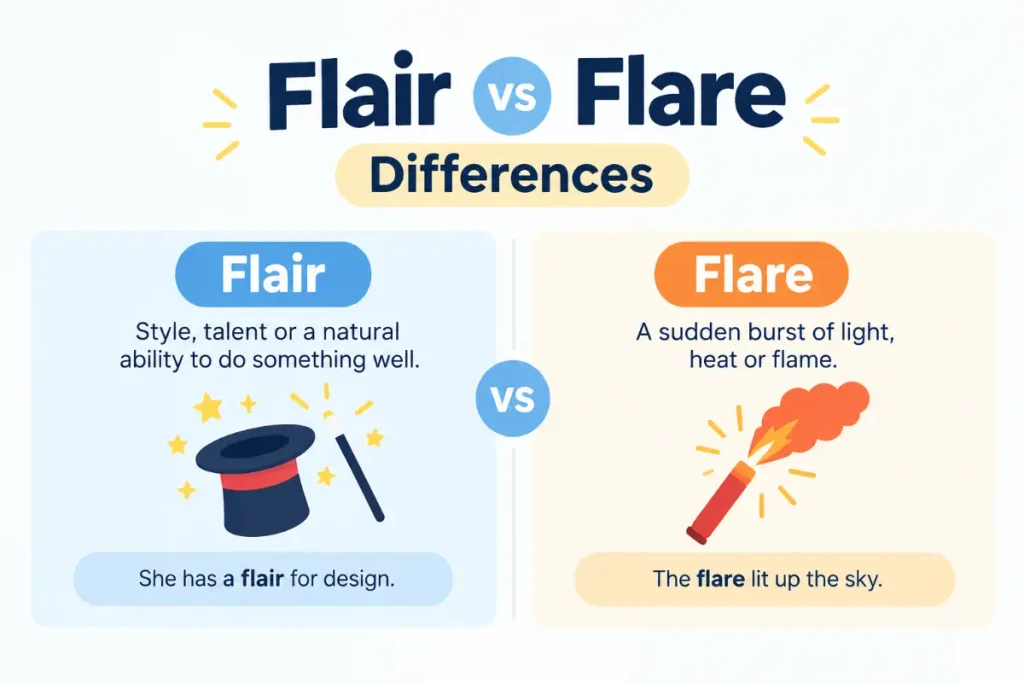
Flair vs Flare Differences
The easiest way to separate these words is to connect each spelling with its core idea.
| Feature | Flair | Flare |
|---|---|---|
| Part of speech | Noun. | Noun and verb. |
| Main meaning | Natural talent or distinctive style. | Sudden brightness, increase, widening, or worsening. |
| Common pattern | Flair for something. | Flare up. |
| Talent | Correct. | Incorrect. |
| Style | Correct. | Usually incorrect. |
| Fire or light | Incorrect. | Correct. |
| Medical symptoms | Incorrect in ordinary medical wording. | Correct. |
| Clothing shape | Usually incorrect. | Correct. |
| Pronunciation in US English | /fler/. | /fler/. |
| Example | She has a flair for design. | Her symptoms began to flare. |
The pronunciation does not help much because the two words are homophones in standard American English. The spelling and meaning do the real work.
A simple memory trick can help. Flair has an extra i, and you can associate that i with an individual talent or distinctive identity. Flare has no i, and you can picture a flame suddenly spreading or brightening.
It is not a formal spelling rule. It is simply a memory aid.
When To Use Flair
Use flair when you are talking about talent, aptitude, style, creativity, or an appealing distinctive quality.
The phrase a flair for is especially common. It works naturally in casual conversation, professional writing, school writing, and formal prose.
You could write:
- She has a flair for graphic design.
- Daniel has a flair for public speaking.
- The teacher has a flair for making history interesting.
- He showed a flair for leadership during the project.
- My sister has a flair for decorating cakes.
- The author writes with considerable flair.
- The new restaurant has a modern flair.
- The musician performed the song with remarkable flair.
In professional writing, flair can describe a useful strength without sounding overly formal. A resume might say that someone has a flair for visual storytelling, although a more precise description of specific skills is often stronger in a job application.
The word can also describe style that goes beyond technical ability. A person may know exactly how to perform a task but still lack flair. Another person may bring energy, creativity, personality, or elegance to the same task.
That distinction matters. Flair does not simply mean skill. It often suggests a special quality in the way someone does something.
When To Use Flare
Use flare when something suddenly becomes brighter, more intense, wider, or worse.
The word is especially common with physical processes and sudden changes.
For example, a fire can flare. An argument can flare. A person’s temper can flare. A medical condition can flare. A skirt can flare outward. A signal flare can produce bright light.
The verb is flexible because its different meanings share the idea of expansion or sudden intensity.
Consider these examples.
- The flames flared as the wind picked up.
- Her temper flared when she heard the accusation.
- The conflict flared again after several quiet weeks.
- The patient’s symptoms began to flare.
- The curtains flared outward when the door opened.
- The nostrils of the horse flared.
- The skirt flares gently at the bottom.
- A signal flare appeared over the water.
The noun works differently in sentences such as these.
- We saw a bright flare in the distance.
- The sailor launched a flare for help.
- The camera created a lens flare.
- The patient reported a flare of symptoms.
When you see flare up, the meaning usually involves something suddenly becoming active or more intense.
“Allude” and “elude” are another easily confused pair that often cause problems because their spellings and pronunciations are so similar.
Flair vs Flare Up
Flare up is an important phrase because it causes many spelling mistakes.
The correct spelling is flare up or flare up as a verb phrase depending on sentence structure. The related noun flare up is also commonly written as two words in American English, while flare up can appear in other editorial forms depending on the dictionary or style guide. The important point for this comparison is that the word is based on flare, not flair.
For example:
- My back pain flared up after the long drive.
- The argument flared up again.
- Her allergies flared up in the spring.
- The dispute flared up during the meeting.
- His symptoms suddenly flared up.
The medical meaning is especially common. A flare or flare up generally describes a period when symptoms become more active or severe after a period of relative improvement. Cleveland Clinic notes that a relapse can also be called a flare up.
So you should write symptom flare, disease flare, or symptoms flared up. You should not replace flare with flair simply because the two words sound identical.
Flair vs Flare In Medical Writing
Medical contexts create a particularly important distinction.
In ordinary medical language, flare describes a temporary increase in symptoms or disease activity. Someone might talk about a flare of pain, a flare of symptoms, or a condition that has flared up.
For example:
- My arthritis symptoms started to flare again.
- The patient reported a flare of joint pain.
- Stress can sometimes coincide with symptom flare ups.
- Her skin condition went through a severe flare.
- The doctor asked how often her symptoms flare.
The spelling flair does not normally express this medical meaning.
There is also a separate technical use of FLAIR in medical imaging. In this context, the uppercase form is an acronym for fluid attenuated inversion recovery. It refers to an MRI sequence designed to suppress cerebrospinal fluid signal and improve the visibility of certain brain abnormalities.
That means a medical document can contain both flare and FLAIR, but they mean completely different things.
For example, a radiology report may discuss FLAIR images. A patient’s clinical history may mention symptom flares. The capitalization helps distinguish the technical MRI term from the ordinary English noun.
If you see FLAIR in an MRI report, do not interpret it as the ordinary word flair meaning talent or style. It is a medical acronym.
Flair vs Flare Jeans
The correct fashion term is flare jeans or flared jeans.
These jeans generally fit more closely through the upper leg and become wider toward the lower leg. Fashion references commonly describe flared jeans as widening from around the knee toward the hem.
Examples include:
- She bought a pair of dark blue flare jeans.
- Flared jeans are back in many current fashion collections.
- He prefers straight leg jeans to flare jeans.
- She wore high waisted flare jeans with a fitted top.
- The flare becomes wider below the knee.
You may occasionally see flairs or flair jeans in informal writing because people confuse the homophones. In standard modern usage, flare jeans is the safer choice for clothing that widens toward the bottom.
The connection makes sense because flare can mean to spread or become wider. The shape of the jeans literally widens toward the hem. Historical usage has also connected flare with trousers that spread outward.
Flair In Office Space
If you have searched for flair vs flare office space, you may be thinking about the 1999 comedy Office Space.
The movie made flair especially memorable through the character Joanna and her workplace uniform. At Chotchkie’s, employees were expected to wear decorative buttons and other pieces of flair as a form of personality and workplace expression. The movie uses the word in exactly the sense of distinctive style or decoration.
The joke works because flair fits the context. The decorations are supposed to add personality and visual style. They are not flames, sudden increases, medical symptoms, or widening shapes.
That scene also helped make the phrase pieces of flair recognizable in American popular culture. The expression can now be used humorously for decorative items that someone wears or displays to show personality.
So if you are describing decorative pins, buttons, or expressive accessories in that context, flair is the correct spelling.
How To Pronounce Flair and Flare
In standard US English, flair and flare are pronounced the same way: /fler/. Cambridge gives the US pronunciation for both words as /fler/.
You can think of the sound as similar to fair.
That creates the main reason people confuse the spellings. When you hear someone say, I have a flair for writing, you cannot determine the spelling from pronunciation alone.
The same problem appears in speech when someone says:
- I have a flair for photography.
- The candle began to flare.
- Her symptoms started to flare.
- She bought flare jeans.
All four sentences contain words that sound alike. Context tells you which spelling belongs on the page.
Common Mistakes With These Words
The most common error is choosing the spelling based on sound rather than meaning. Since both words sound the same, that method will not work.
Here are several mistakes worth remembering.
- Incorrect: She has a flare for writing.
Correct: She has a flair for writing.
The sentence describes natural ability. - Incorrect: Her symptoms began to flair.
Correct: Her symptoms began to flare.
The sentence describes worsening symptoms. - Incorrect: She bought flair jeans.
Correct: She bought flare jeans.
The jeans widen toward the bottom. - Incorrect: The candle began to flair.
Correct: The candle began to flare.
The sentence describes a sudden increase in brightness. - Incorrect: He decorated the room with a lot of flare.
Correct: He decorated the room with a lot of flair.
The sentence describes style or distinctive character. - Incorrect: His temper flaired during the argument.
Correct: His temper flared during the argument.
The past tense of flare is flared. - Incorrect: She has a flare for fashion.
Correct: She has a flair for fashion.
The meaning is talent or natural ability. - Incorrect: The dispute began to flair up again.
Correct: The dispute began to flare up again.
The phrase describes a sudden increase in conflict.
Autocorrect can make these mistakes harder to notice because both spellings are legitimate English words. A spellchecker may not flag the wrong word if the sentence remains grammatically possible.
That is why meaning matters more than spell checking here.
Understanding similar-sounding words with different meanings can help you avoid the same kind of confusion that occurs with “flair” and “flare.”
Word Origin And History
The two words do not simply represent alternate spellings of one word. They developed through different historical paths.
Flair entered English from French and originally related to smell or scent. Its later meanings developed toward discernment, aptitude, and eventually the modern sense of natural talent or distinctive style. The connection with hunting and a dog’s ability to detect a scent helped shape the idea of having a special instinct or ability.
Flare has a different history. Its English development is associated with meanings involving spreading outward and shining suddenly. Later meanings expanded to include bright light, signal devices, widening shapes, and sudden increases in intensity. The clothing sense developed from the idea of trousers spreading outward.
The histories explain why the words look similar while carrying different meanings. Their spelling is not an arbitrary modern distinction created by grammar textbooks.
American English Usage
For US readers, both flair and flare are standard English words. Neither spelling is simply an American alternative for the other.
American English uses flair for talent, style, and distinctive character.
- She has a flair for teaching.
- The design has a modern flair.
- He writes with flair.
American English uses flare for sudden brightness, expansion, worsening, and related meanings.
- The fire flared.
- Her symptoms flared up.
- The skirt flares at the bottom.
- The argument flared into a larger dispute.
British English uses the same basic distinction. The pronunciation can differ somewhat between regional varieties, but the spelling contrast remains meaningful.
This is not one of those cases where American English prefers one spelling and British English prefers another. The two words carry different meanings in both varieties.
Formal And Casual Usage
Both words are flexible enough for formal and casual writing.
Flair works well in professional writing when you are describing talent or style. For example, a manager might write that an employee has a flair for explaining technical subjects to customers.
Flare is equally common in formal writing. It appears in medical contexts, scientific writing, journalism, fashion writing, and everyday conversation.
The phrase flare up is natural in ordinary speech and also appears in more formal writing. In highly technical medical writing, a specialist may use more precise terminology based on the specific condition, but flare remains an established general term.
You might say in casual conversation:
- She has a flair for decorating.
- My allergies are flaring up.
- Those jeans really flare at the bottom.
- His temper flared.
In professional writing, precision matters more than formality. Choose the word that matches the meaning.
A Simple Memory Trick
If you struggle to remember the difference, focus on the ideas rather than the spelling.
Flair connects with talent and style.
Think:
Flair = talent or personality.
Flare connects with fire and spreading outward.
Think:
Flare = fire, increase, or widening.
You can also remember a few fixed phrases.
- Flair for writing.
- Flair for design.
- With flair.
- Flare up.
- Signal flare.
- Flare jeans.
- Flare of symptoms.
These common combinations make the distinction much easier to recall.
Frequently Asked Questions
Which is correct flair or flare
Both are correct words, but they have different meanings. Use flair for natural talent, distinctive style, or an appealing quality. Use flare for sudden brightness, worsening symptoms, outward expansion, or a sudden increase in intensity.
What does flair mean
Flair means a natural talent or a distinctive quality or style. You might have a flair for languages, a flair for design, or a flair for public speaking. The word can also describe doing something in an interesting, imaginative, or stylish way.
What does flare mean
Flare can mean to burn or shine suddenly, become wider, or become more intense. As a noun, it can describe a bright light, a signal device, or a sudden increase in something such as symptoms or conflict.
Is flare the correct word for medical symptoms
Yes. Flare is the standard word for a period when symptoms become more active or severe. You can write about a disease flare, a flare of symptoms, or symptoms that flare up. Flair does not normally carry this medical meaning.
Is it flair jeans or flare jeans
The standard term is flare jeans or flared jeans. The name refers to the shape of the jeans because the lower leg widens toward the hem. Flair jeans is a common spelling mistake caused by the identical pronunciation.
Why do flair and flare sound the same
Both words are pronounced /fler/ in standard US English. They are homophones, meaning they sound alike while having different spellings and meanings. Context therefore determines the correct spelling when you are writing.
What does FLAIR mean in an MRI
In medical imaging, FLAIR stands for fluid attenuated inversion recovery. It is an MRI sequence that suppresses the signal from cerebrospinal fluid and can make certain abnormalities easier to see. This technical medical acronym is unrelated to the ordinary word flair meaning talent or style.
Does Office Space use flair or flare
Office Space uses flair because the movie is talking about decorative items worn by employees to express personality and style. The word fits the ordinary meaning of distinctive character or visual expression.
Conclusion
The difference between flair vs flare becomes much easier once you connect each spelling with its main meaning. Flair is about talent, style, creativity, and distinctive character. Flare is about sudden brightness, widening, worsening symptoms, or an increase in intensity.
For everyday writing, remember a few reliable phrases: a flair for writing, with flair, symptoms flare up, a signal flare, and flare jeans. The words sound identical in US English, so pronunciation cannot guide your spelling. Let the meaning do that job. When you are describing talent or style, choose flair. When something burns, spreads, widens, or suddenly becomes more intense, choose flare.