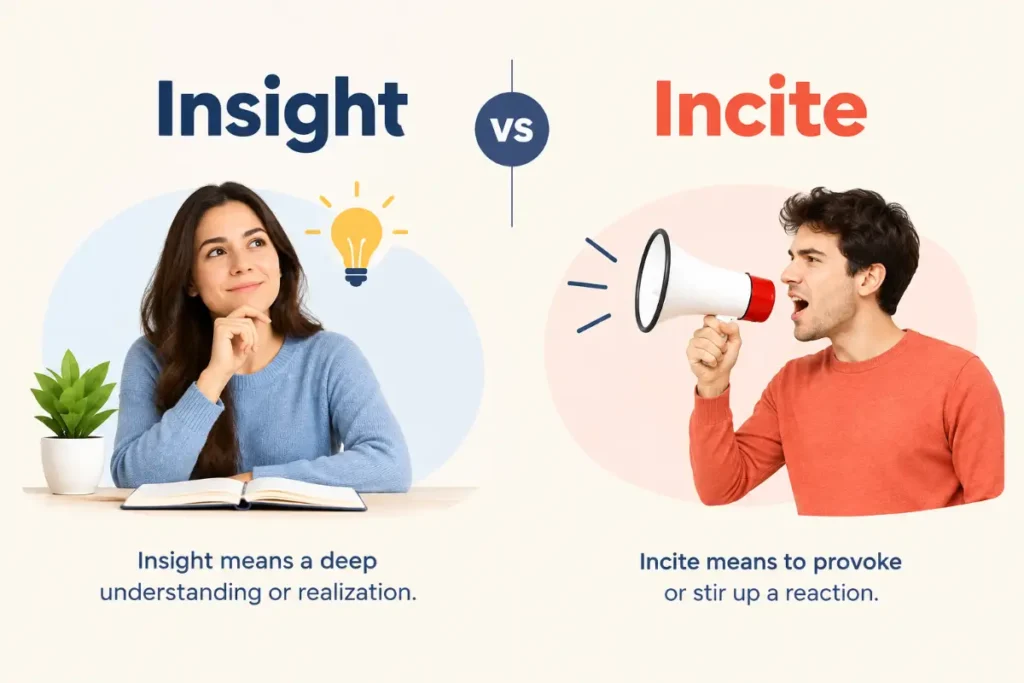
If you have ever confused insight vs incite, you are dealing with two words that look and sound remarkably similar but do completely different jobs. Insight is a noun that refers to a deep understanding, clear perception, or useful realization. Incite is a verb that means to encourage, provoke, or stir someone into action. The spelling difference is small, but the meaning changes completely.
The confusion often comes from pronunciation. In many varieties of English, the two words contain the same basic sounds, but their stress patterns differ. Insight is stressed on the first syllable, while incite is stressed on the second. That difference can be easy to miss in fast conversation.
This distinction matters in everyday writing, professional communication, academic work, journalism, and school assignments. Writing the report gave me incite into the problem is not a minor spelling variation. The correct word is insight. Likewise, the speech was intended to insight violence is incorrect because the verb is incite.
This guide explains the meanings, grammar, pronunciation, examples, common mistakes, word origins, related terms, and practical usage of both words.
Quick Answer
Insight is a noun meaning deep understanding, awareness, or perception. Incite is a verb meaning to encourage or provoke someone to act, often in a harmful or disruptive way. Use insight when you mean understanding and incite when you mean stirring someone into action.
What Does Insight Mean
Insight is a noun that means a clear, deep, or accurate understanding of a person, situation, idea, or problem.
Think of insight as seeing something clearly beneath the surface. You do not simply know a fact. You understand what that fact means and how different parts of a situation connect.
For example:
- The interview gave us valuable insight into customer behavior.
- Her experience gave her insight into the challenges facing new teachers.
- The therapist helped him gain insight into his reactions.
- The report provides useful insight into the company’s financial problems.
The word commonly appears with into when the writer is describing the subject of the understanding.
You might say:
- The research provides insight into how children learn.
You can also use insight without into.
- Her insight helped the team solve the problem.
The plural form is insights. It is especially common in business, research, education, psychology, marketing, and professional communication.
- The survey revealed several important insights about customer preferences.
Insight As A Noun
The most important grammatical fact is simple: insight is a noun.
It can refer to the ability to understand something deeply.
- His insight into human behavior impressed the committee.
It can also refer to a particular understanding or realization.
- The conversation gave me an insight into why she was upset.
It may describe a valuable observation.
- The manager offered several useful insights during the meeting.
The adjective insightful means showing or providing insight.
- That was an insightful comment.
The adverb insightfully is much less common but is also grammatically valid.
What Insight Does Not Mean
Insight does not mean causing someone to act.
If a person gives you a useful understanding of a problem, they provide insight. If a person deliberately encourages people to take action, you may need the verb incite.
Compare these sentences:
- The documentary gave viewers insight into the conflict.
- The speaker tried to incite the crowd.
The first sentence concerns understanding. The second concerns action.
Like “insight” and “incite,” another commonly confused pair can cause mistakes when two similar-looking words have completely different meanings or grammatical roles.
What Does Incite Mean
Incite is a verb meaning to encourage, provoke, or stir someone into action. It is particularly common when the action involves anger, violence, rebellion, conflict, hatred, or another serious disturbance. Oxford defines it as encouraging someone to do something violent, illegal, or unpleasant, especially by making that person angry or excited.
For example:
- The speech was accused of trying to incite violence.
- The article could incite public anger.
- The leader attempted to incite a rebellion.
The word does not always require a harmful action. In some contexts, incite can simply mean stimulate or urge someone to act. Still, modern usage frequently carries a negative or strongly cautionary sense, particularly when the object is violence, hatred, disorder, or illegal activity. Collins also notes that the verb means to urge someone to action, stir up, or rouse.
Incite As A Verb
Unlike insight, incite is a verb.
It normally describes an action performed by a person, group, statement, event, or other influence.
Common structures include:
incite someone to something
The speech incited the crowd to violence.
incite someone to do something
The rumors incited several people to protest.
incite something
The statement incited anger.
The verb forms are:
| Form | Example |
|---|---|
| Base form | incite |
| Third person | incites |
| Past tense | incited |
| Past participle | incited |
| Present participle | inciting |
The related nouns are incitement and inciter.
The court considered the accusation of incitement.
The speaker was described as an inciter of violence.
Insight And Incite Difference
The easiest way to separate the words is to focus on what happens after the word.
Insight involves understanding. Incite involves action.
| Feature | Insight | Incite |
|---|---|---|
| Part of speech | Noun | Verb |
| Core meaning | Deep understanding or perception | Encourage or provoke action |
| Main idea | Understanding something | Causing or urging action |
| Common pattern | insight into something | incite someone to action |
| Related word | insightful | incitement |
| Typical context | Research, learning, analysis, experience | Conflict, protest, anger, violence, action |
| Pronunciation | /ˈɪnsaɪt/ | /ɪnˈsaɪt/ |
| Example | The study provided useful insight. | The speech could incite violence. |
A useful mental shortcut is:
Insight is something you gain. Incite is something you do.
You gain insight into a problem.
You incite people to action.
That simple distinction solves most usage problems.
Why These Words Are Easy To Confuse
The spelling creates the first problem. Both words begin with in and contain the sound represented by sight or cite. When spoken quickly, they can sound extremely similar.
There is also a meaningful difference in stress. In standard American English, insight is generally pronounced with stress on the first syllable: IN sight. Incite is pronounced with stress on the second syllable: in CITE. The standard American pronunciation of incite is /ɪnˈsaɪt/, while insight is /ˈɪnsaɪt/.
This distinction can be especially difficult for listeners who encounter the words primarily in writing.
There is also an important regional point. Sources describing South Asian English note that the two words can be pronounced alike in some varieties, so relying entirely on pronunciation can make the distinction harder.
For American English writing, the safest approach is to remember the grammatical role and meaning rather than relying only on sound.
How To Use Insight In A Sentence
Here are natural examples showing the range of insight in American English.
- The survey gave the company valuable insight into what customers want.
- Her experience provided insight into the challenges faced by first year teachers.
- The book offers insight into the history of American immigration.
- I gained new insight into why the project failed.
- His comments showed remarkable insight into the problem.
- The manager asked employees to share their insights during the meeting.
- The documentary provides insight into life in rural communities.
- The counselor helped her develop greater insight into her behavior.
- The professor offered an insightful explanation of the theory.
- The interview gave readers a rare insight into the artist’s creative process.
Notice that insight often appears with words such as valuable, useful, new, deep, greater, fresh, and important.
It also frequently appears in professional writing.
The customer interviews provided valuable insight into purchasing decisions.
In academic writing, it can describe understanding gained through research.
The experiment provided new insight into how memory works.
In everyday conversation, it can describe a personal realization.
Talking with my sister gave me some insight into what I was doing wrong.
How To Use Incite In A Sentence
Here are natural examples showing how incite works as a verb.
- The speaker was accused of trying to incite violence.
- The article could incite anger among readers.
- The rumor incited a heated argument.
- The group attempted to incite a protest.
- The speech was designed to incite the crowd.
- The comments could incite people to take reckless action.
- The prosecutor argued that the messages were intended to incite hatred.
- The leader used inflammatory language to incite his supporters.
- The announcement incited strong reactions online.
- The organizers warned participants not to incite conflict.
These examples show why incite often has a stronger and more negative tone than ordinary verbs such as encourage or motivate.
You would normally say:
The coach motivated the players to work harder.
You would not normally replace motivated with incited unless you specifically want to suggest provocation or stirring people into action.
Insight And Incite In One Sentence
You can use both words in the same sentence when you want to contrast understanding with action.
Here are several examples:
- The report provided insight into the problem but did not incite anyone to act recklessly.
- Her insight helped the team understand the issue without inciting an argument.
- The journalist gained insight into the controversy without trying to incite public anger.
- The discussion offered valuable insight rather than inciting another dispute.
- His research gave readers insight into the issue, while his speech later helped incite a public response.
These sentences make the difference especially clear because both words appear in the same context.
A useful pattern is:
- insight = understanding
- incite = provoke action
Once you recognize that contrast, the spelling becomes much easier to remember.
English has many similar-sounding words that are easy to mix up, especially when their meanings are unrelated despite their similar spelling or pronunciation.
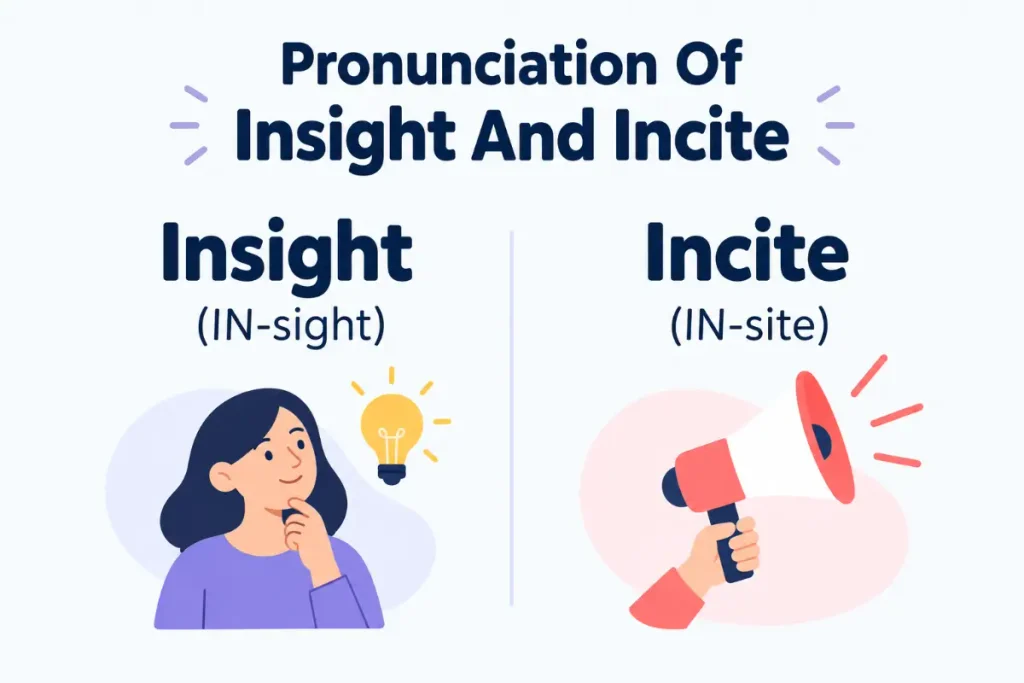
Pronunciation Of Insight And Incite
Pronunciation is important because these words are commonly confused by sound.
Insight
American English pronunciation:
/ˈɪnsaɪt/
A simple guide is:
IN sight
The stress falls on the first part.
Incite
American English pronunciation:
/ɪnˈsaɪt/
A simple guide is:
in SITE
The stress falls on the second part. Oxford gives the American pronunciation as /ɪnˈsaɪt/.
The two words therefore share the aɪ sound but differ in stress.
When speaking carefully, make the distinction clear:
IN sight for insight.
in CITE for incite.
Still, pronunciation is not always enough. In some varieties of English, including some South Asian English usage, the stress distinction may be reduced or absent.
That makes spelling and context particularly important for writers.
Common Mistakes With These Words
The most common errors happen when someone chooses the word based on sound instead of meaning.
Mistake 1: Using Incite For Understanding
Incorrect:
The report gave us valuable incite into customer behavior.
Correct:
The report gave us valuable insight into customer behavior.
The sentence describes understanding, so the noun insight is required.
Mistake 2: Using Insight As A Verb
Incorrect:
The speech was intended to insight anger.
Correct:
The speech was intended to incite anger.
The sentence describes an action that causes or provokes anger. The required word is the verb incite.
Mistake 3: Writing Incite Into
Incorrect:
The study gave us incite into the problem.
Correct:
The study gave us insight into the problem.
The phrase insight into is a common grammatical pattern.
Mistake 4: Writing Insight Violence
Incorrect:
The speaker tried to insight violence.
Correct:
The speaker tried to incite violence.
Here the writer needs a verb describing an attempt to provoke violence.
Mistake 5: Confusing Incite With Excite
Incite and excite are related in meaning, but they are not interchangeable.
The announcement excited the audience.
This means the announcement caused enthusiasm or strong interest.
The speech incited the crowd.
This suggests the speech stirred the crowd into action, often with a negative or confrontational implication.
The words can overlap in the broad idea of stirring emotions, but incite is much more associated with provoking action.
Incite And Instigate
Instigate is another word that can be confused with incite because both describe causing or encouraging action.
Incite means to encourage or provoke someone into action.
Instigate means to cause something to begin, often by deliberately initiating it.
For example:
The speech incited the crowd to protest.
The investigation revealed who had instigated the conflict.
The distinction can be subtle. Incite often emphasizes stirring people or emotions into action. Instigate often emphasizes initiating an event or situation.
Collins notes that instigate generally carries a stronger implication that the person responsible initiated the action, while incite focuses on urging or stimulating action.
For everyday writing, choose the word that matches the specific relationship you want to describe.
Insightful And Incitement
Knowing the related forms makes the vocabulary easier to organize.
Insightful
Insightful is an adjective meaning perceptive or showing deep understanding.
She made an insightful observation.
The professor gave an insightful explanation.
Someone who provides valuable understanding can be described as insightful.
Incitement
Incitement is a noun referring to the act of encouraging or provoking action.
The statement was investigated as possible incitement to violence.
It is especially common in legal, political, journalistic, and public discussion.
Incited
Incited is the past tense and past participle of incite.
The speech incited the crowd.
The crowd was incited by the inflammatory message.
Inciting
Inciting is the present participle.
The organization was accused of inciting violence.
These forms belong to the incite word family, not the insight family.
Word Origins
The two words have different histories, which helps explain why their meanings are unrelated.
Insight developed from older Germanic and Scandinavian forms associated with inner seeing or understanding. The word has long been connected with the idea of mentally seeing into something rather than simply seeing it with the eyes. Sources trace it through Middle English and related Germanic and Scandinavian forms.
Incite has a Latin origin. It entered English through French and ultimately comes from Latin incitare, meaning to set in motion, urge, or rouse.
The origins therefore reflect the modern distinction quite well.
- Insight developed around the idea of inner or mental seeing.
- Incite developed around the idea of setting something in motion.
They happen to resemble each other in modern English, but they are not different forms of the same word.
Formal And Casual Usage
Both words are standard English and can appear in formal or casual communication, but they occur in different kinds of sentences.
Insight is common in:
- Academic writing.
- Business reports.
- Research.
- Psychology.
- Education.
- Interviews.
- Everyday conversation.
- Professional presentations.
For example:
The survey provides useful insight into employee satisfaction.
Incite is more common in serious or formal contexts involving conflict, public behavior, legal issues, or strong emotions.
For example:
The statement was criticized for potentially inciting violence.
You can use incite in ordinary conversation, but it may sound more serious than alternatives such as encourage, provoke, prompt, or motivate.
That difference matters in professional writing. If you simply mean that something encouraged people to act, encourage may be clearer.
Choosing The Right Word
When you are unsure, ask yourself one question:
Am I talking about understanding or action?
If the answer is understanding, use insight.
The meeting gave me insight into the company’s goals.
If the answer is provoking or encouraging action, use incite.
The statement could incite an angry response.
You can also use the grammar test.
If the word needs to function as a noun, insight is probably the answer.
Her insight was valuable.
If the word needs to function as a verb, incite may be the answer.
His comments could incite a confrontation.
This test works particularly well during proofreading.
A Simple Memory Trick
The easiest memory trick is to connect insight with sight.
You use your eyes to see. Insight is like seeing into an idea or situation with your mind.
Insight = inner understanding.
For incite, think of something being set in motion.
Incite = urge into action.
Another useful pair is:
- Insight gives you clarity.
- Incite creates movement.
This is not a formal grammar rule, but it is an effective way to keep the two spellings separate.
When writing for different English-speaking audiences, a useful spelling comparison can help you recognize regional variations without changing the meaning of the word.
Frequently Asked Questions
Which is correct insight or incite
Both words are correct, but they have different meanings and grammatical roles. Insight is a noun meaning deep understanding or perception. Incite is a verb meaning to encourage or provoke action. Use insight into a problem when discussing understanding and incite someone to action when discussing provocation.
What does insight mean
Insight means a clear, deep, or accurate understanding of something. It can describe an understanding of a person, situation, problem, idea, or process. For example, The interview gave us insight into the company’s culture. The word is a noun, and the related adjective is insightful.
What does incite mean
Incite means to encourage, provoke, or stir someone into action. It is often used for actions involving anger, conflict, violence, rebellion, or other serious behavior. For example, The speech was accused of trying to incite violence. The word is a verb.
Are insight and incite pronounced the same
They are very similar in pronunciation, but standard American English places stress differently. Insight is /ˈɪnsaɪt/, with stress on the first syllable. Incite is /ɪnˈsaɪt/, with stress on the second syllable. Some varieties of English may reduce this distinction, so context remains important.
Is incite a negative word
Incite often has a negative or cautionary tone because it frequently describes provoking violence, hatred, conflict, or illegal behavior. However, its broader meaning is to urge or stimulate action, so the word is not inherently limited to harmful behavior. Context determines the exact implication.
What is the synonym of incite
Common synonyms include provoke, urge, spur, stir, instigate, and encourage, depending on context. These words are not perfect substitutes in every sentence. Provoke often emphasizes causing a reaction, while instigate can emphasize initiating an event. Incite strongly suggests urging someone toward action.
Is insight a verb
No. Insight is normally used as a noun. The related adjective is insightful, meaning perceptive or showing deep understanding. You can say She gained insight into the problem or She made an insightful observation. You should not use insight as a standard verb in place of understand or realize.
What is the difference between incite and instigate
Both verbs can describe causing or encouraging action, but incite often emphasizes stirring someone into action, especially through emotion or provocation. Instigate often emphasizes deliberately initiating an event or situation. The words overlap, but they are not identical in every context.
Conclusion
The distinction between insight vs incite becomes simple once you focus on meaning and grammar. Insight is a noun connected with understanding, perception, and realization. Incite is a verb connected with provoking, urging, or stirring people into action.
Use insight into when you mean gaining a deeper understanding of something. Use incite when you mean encouraging or provoking an action. Remember the pronunciation difference in standard American English too: IN sight for insight and in CITE for incite. When pronunciation is unclear, grammar and context provide the safest guide.
If you remember one distinction, make it this: insight helps you understand something, while incite pushes someone toward action.