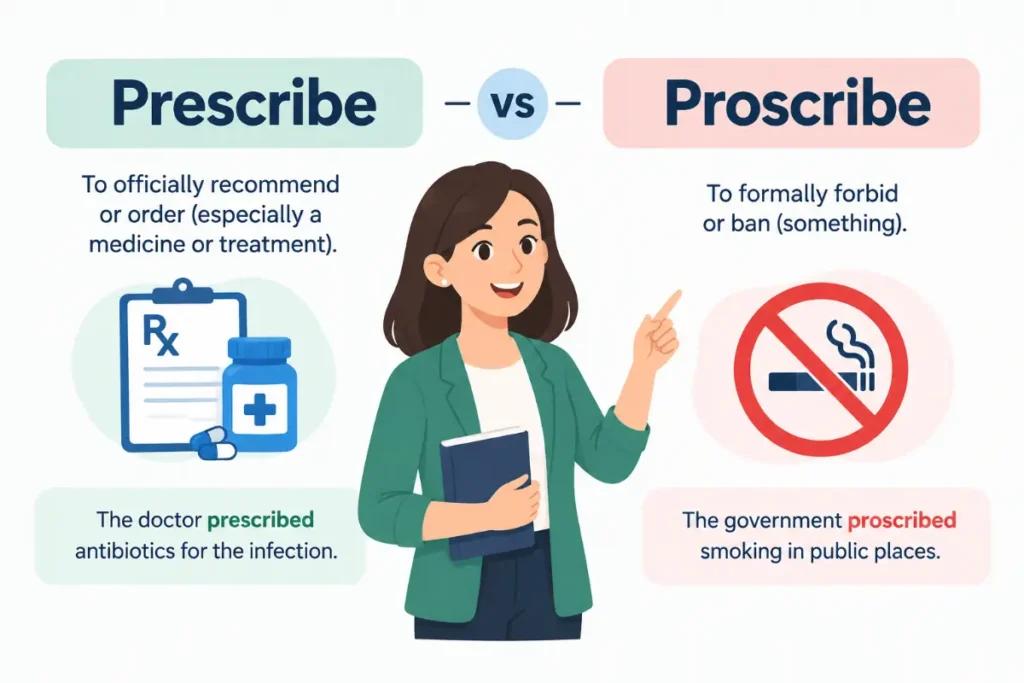
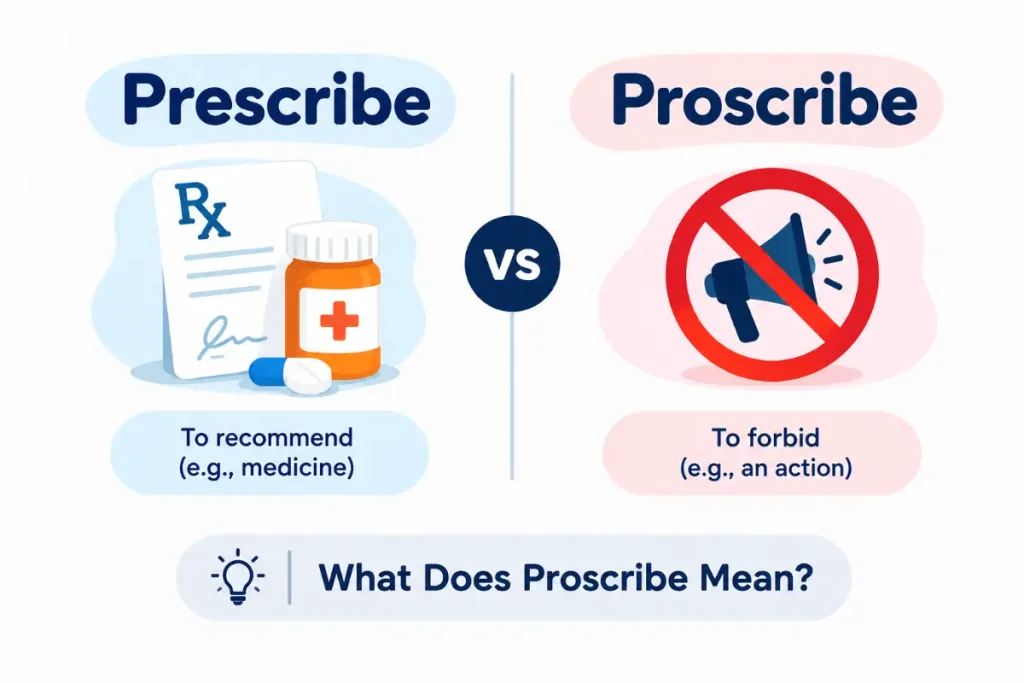
Prescribe vs proscribe can be confusing because the two words look and sound almost alike while pointing in opposite directions. Prescribe means to recommend, order, or officially state something that should be done. Proscribe means to forbid or officially reject something. A doctor can prescribe medication, while a law can proscribe certain conduct. The difference comes down to a simple idea: prescribe tells you what is required or recommended, while proscribe tells you what is forbidden.
The confusion often starts with the shared ending and similar pronunciation. Both words also appear in formal writing, especially in medicine, law, government, academia, and professional communication. That makes the distinction important because choosing the wrong word can reverse the intended meaning.
The difference becomes much easier once you focus on the direction of the action. If someone prescribes something, they are setting out what should be done or used. If someone proscribes something, they are setting out what should not be done or used. This guide explains the meanings, grammar, pronunciation, word origins, sentence patterns, common mistakes, and practical usage so you can choose the right word with confidence.
Quick Answer
Prescribe means to recommend, direct, or officially establish something as appropriate or necessary. Proscribe means to forbid, prohibit, or officially condemn something. A doctor prescribes medicine, while a law may proscribe certain behavior. Remember the difference as prescribe tells you what to do, while proscribe tells you what not to do.
What Does Prescribe Mean
Prescribe is a verb that means to recommend, order, or officially establish something as a course of action. Its most familiar use appears in medicine, where a doctor or another authorized medical professional prescribes medication or treatment for a patient.
For example, you might say, “The doctor prescribed antibiotics for the infection.” The doctor has instructed the patient to use a particular treatment. The word does not simply mean mention or suggest in a casual sense. In medical contexts, it often involves an authorized professional giving specific instructions about medication, treatment, dosage, or care.
Prescribe also has a broader meaning outside medicine. Someone can prescribe rules, procedures, standards, or methods. A policy might prescribe how employees should handle confidential information. A regulation might prescribe specific safety procedures for a workplace.
The broader idea remains the same. Prescribe establishes or recommends what should happen.
Prescribe in Simple Terms
Think of prescribe as setting out a course of action. A doctor prescribes medication. A policy prescribes a procedure. A teacher might prescribe a particular format for an assignment. A law or regulation can prescribe requirements that people must follow.
The word can therefore range from a professional recommendation to an official requirement. Context tells you how strong the instruction is.
Consider these examples:
- The doctor prescribed a new medication.
- The therapist prescribed several exercises for the patient.
- The policy prescribes a clear process for handling complaints.
- The school requires students to follow the format prescribed by the department.
- Federal regulations prescribe safety standards for certain workplaces.
In each sentence, prescribe points toward something that should be done, followed, used, or observed.
Just as prescribe and proscribe are often confused, understanding bring vs take can help you use similar-looking verbs correctly.
What Does Proscribe Mean
Proscribe is a verb that means to forbid, prohibit, or officially condemn something. It is much less common in everyday conversation than prescribe, but it appears regularly in legal, political, academic, and formal writing.
For example, a law may proscribe certain conduct. This means the law prohibits that conduct. A professional organization might proscribe a particular practice because it violates its rules or ethical standards.
The important distinction is that proscribe moves in the opposite direction from prescribe. Prescribe establishes what should be done. Proscribe establishes what should not be done.
Consider this sentence: “The organization proscribes discrimination in the workplace.” The organization is not recommending discrimination. It is explicitly forbidding it.
Proscribe in Simple Terms
Think of proscribe as a formal way of saying ban or prohibit. If a rule proscribes something, that rule says the action is not allowed.
For example:
- The law proscribes the unauthorized use of the information.
- The policy proscribes discrimination against employees.
- The organization proscribes conflicts of interest.
- The regulation proscribes certain unsafe practices.
- The code of conduct proscribes harassment.
The word often sounds more formal than prohibit or ban. That makes it particularly useful in legal and academic writing, although a simpler word may be clearer for a general audience.
Prescribe vs Proscribe Meaning
The central difference is simple. Prescribe tells someone what should be done, used, or followed. Proscribe tells someone what is forbidden or unacceptable.
| Feature | Prescribe | Proscribe |
|---|---|---|
| Part of speech | Verb | Verb |
| Core meaning | Recommend, order, or establish | Forbid or prohibit |
| Main idea | What should be done | What must not be done |
| Common setting | Medicine, rules, procedures, standards | Law, policy, ethics, formal writing |
| Medical use | Very common | Rare |
| Legal use | Establish a requirement | Forbid conduct |
| Related noun | Prescription | Proscription |
| Simple synonym | Recommend or order | Prohibit or ban |
| Example | The doctor prescribed medication. | The law proscribed the conduct. |
The easiest test is to ask what direction the sentence takes. If something is being required, recommended, or established, prescribe is likely correct. If something is being forbidden, banned, or condemned, proscribe is the better choice.
This distinction matters because the words can create almost opposite meanings. Replacing one with the other is not a minor spelling mistake. It can change the entire point of the sentence.
How to Use Prescribe Correctly
Prescribe is most familiar in medical writing and conversation. Doctors and other authorized medical professionals prescribe medications, treatments, therapies, and sometimes specific care instructions.
For example, “The doctor prescribed a lower dose of the medication.” The sentence describes an official medical instruction. You can also say, “The physician prescribed physical therapy after the injury.”
The verb also works with nonmedical subjects. Rules can prescribe behavior. Procedures can prescribe steps. Regulations can prescribe standards. In these contexts, the word usually has a formal tone.
For example, “The company policy prescribes a specific process for reporting safety concerns.” The policy establishes the required process. It does not necessarily mean that the process is a medical or personal recommendation.
The grammar is straightforward. Prescribe is normally a transitive verb when it means to order or recommend something.
Common patterns include:
- Prescribe medication.
- Prescribe treatment.
- Prescribe a procedure.
- Prescribe a course of action.
- Prescribe standards.
- Prescribe rules.
- Prescribe requirements.
- Prescribe a method.
The past tense is prescribed.
For example, “The doctor prescribed the medication yesterday.” The present participle is also prescribing, as in “The physician is prescribing a different treatment.”
How to Use Proscribe Correctly
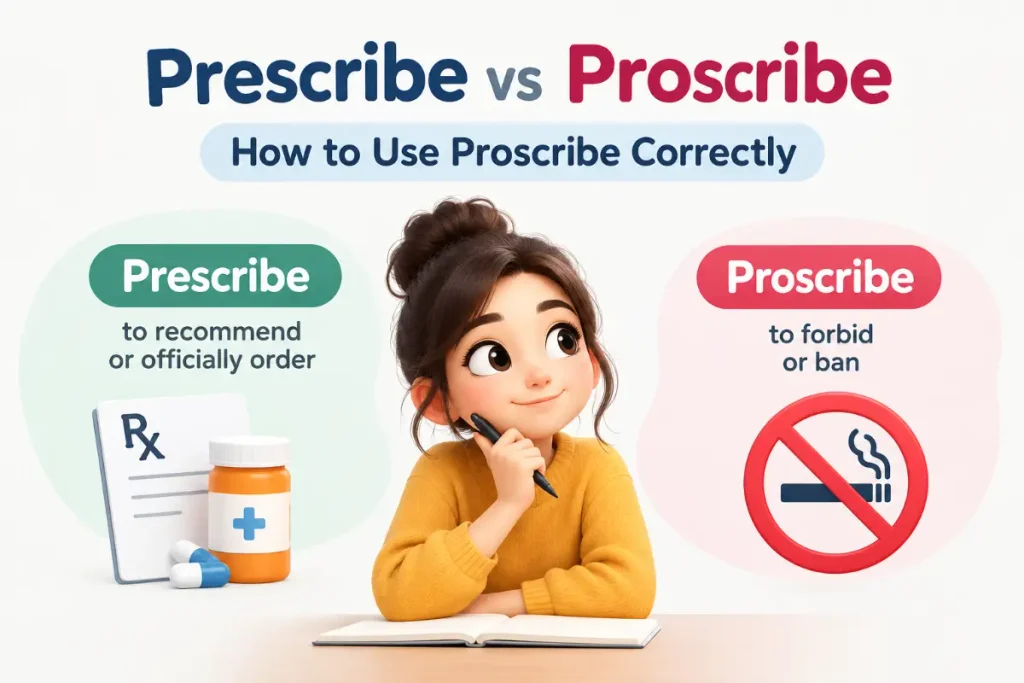
Proscribe is also a transitive verb. It takes the thing that is being forbidden as its object.
For example, “The law proscribes discrimination.” Here discrimination is the thing being prohibited.
You might also see the passive form in formal writing. “Certain practices are proscribed by the regulations” means the regulations prohibit those practices.
Common patterns include:
- Proscribe conduct.
- Proscribe behavior.
- Proscribe discrimination.
- Proscribe a practice.
- Proscribe an activity.
- Proscribe the use of something.
- Proscribe certain actions.
- Proscribe violations of a rule.
The past tense is proscribed. The present participle is proscribing.
Because proscribe is relatively formal, writers should use it carefully. In a document intended for a broad audience, prohibit may be clearer. There is nothing wrong with choosing a simpler word when it communicates the idea more directly.
Prescribe vs Proscribe in a Sentence
Using both words in the same sentence is one of the best ways to see the difference.
“The policy prescribes proper handling of customer information and proscribes unauthorized disclosure.”
The first part establishes what employees should do. The second part prohibits a specific action.
Another example is, “The medical protocol prescribes appropriate treatment and proscribes unsafe procedures.” Prescribes tells readers what the protocol requires or recommends. Proscribes tells them what the protocol forbids.
A legal example makes the contrast even clearer. “The statute prescribes reporting requirements and proscribes the misuse of confidential records.” One provision establishes an obligation. The other prohibits an action.
These examples show why the two words are sometimes used together. They can describe two sides of the same system of rules.
Prescribe vs Proscribe vs Prescription
Prescription is closely related to prescribe, but it has several meanings. In medicine, a prescription is an authorized instruction for medication or treatment. A doctor prescribes the medication, and the resulting written or electronic order is a prescription.
For example, “The doctor prescribed the medication and sent the prescription to the pharmacy.” The first use is the verb. The second use is the noun.
Prescription also has a broader meaning. It can refer to a recommended approach, rule, or established way of doing something. In linguistics, for example, prescription can refer to rules about how people are expected to use language rather than descriptions of how people actually use it.
The word family can be understood like this:
- Prescribe is the verb.
- Prescribed is the past tense or past participle.
- Prescribing is the present participle.
- Prescription is the related noun.
- Proscribe is the verb meaning prohibit.
- Proscribed is the past tense or past participle.
- Proscription is the related noun meaning prohibition or formal ban.
The similar forms can make the distinction harder, so it helps to pay attention to the root meaning.
Learning pairs such as aisle vs isle can also help you recognize how small spelling differences can completely change a word’s meaning.
Prescribe vs Proscribe vs Prescribed
Prescribed is simply a grammatical form of prescribe. It means something was recommended, ordered, or established.
For example, “The doctor prescribed rest after the procedure.” Here prescribed is the past tense of prescribe.
You can also use prescribed as an adjective. “The patient followed the prescribed treatment plan” means the treatment plan had been officially recommended or ordered.
Proscribed works in the same grammatical way for proscribe. “The regulation proscribed the practice” means the regulation prohibited it. “The proscribed conduct could result in disciplinary action” means the conduct was formally forbidden.
The spelling difference between prescribed and proscribed reflects the difference in meaning. Prescribed points toward something set out as appropriate or required. Proscribed points toward something forbidden.
Prescribe vs Describe
Prescribe and describe are sometimes confused because they share the same ending, but their meanings are unrelated.
Describe means to explain or represent what something is like. Prescribe means to recommend, order, or establish what should be done.
Compare these sentences:
“The doctor described the patient’s symptoms.”
“The doctor prescribed a treatment.”
The first sentence explains the symptoms. The second sentence establishes a course of treatment.
This distinction is especially important in academic writing. A description reports or explains what exists. A prescription tells someone what should happen.
For example, a researcher might describe a pattern in language use. A style guide might prescribe a preferred form. The first approach focuses on observation. The second focuses on recommendation or rules.
This difference also explains the linguistic terms descriptive and prescriptive. Descriptive approaches examine how people actually use language. Prescriptive approaches focus on rules about how language should be used.
Prescribe to the Idea
The phrase prescribe to the idea is usually a mistake when the intended meaning is agreement with or acceptance of an idea.
The correct expression is normally subscribe to the idea.
For example:
Incorrect: I prescribe to the idea that everyone deserves equal treatment.
Correct: I subscribe to the idea that everyone deserves equal treatment.
Subscribe to means to agree with, support, or accept an idea, belief, principle, or viewpoint. Prescribe does not carry that meaning.
This confusion probably occurs because prescribe and subscribe both have similar spelling patterns and can appear in formal writing. They are not interchangeable, however.
You can prescribe a treatment or prescribe a course of action. You can subscribe to an idea or belief.
Prescribe to a Belief
Prescribe to a belief is also generally incorrect when you mean that someone accepts or follows a belief.
The natural phrase is subscribe to a belief.
For example:
Incorrect: She prescribes to the belief that hard work matters.
Correct: She subscribes to the belief that hard work matters.
Subscribe is the verb used for accepting or agreeing with an idea or belief. Prescribe means to recommend, order, or establish something.
There is another useful distinction here. A person can prescribe a belief in the sense of formally recommending or imposing a particular belief as something others should adopt. That is a different construction and much less common.
For instance, “The institution does not prescribe a particular religious belief” can be grammatically correct. In that sentence, prescribe means require or impose. The phrase “prescribe to a belief” still does not mean subscribe to a belief.
Proscribe vs Prohibit
Proscribe and prohibit are close synonyms. Both can mean to officially forbid something.
For example:
“The law prohibits discrimination.”
“The law proscribes discrimination.”
Both sentences communicate the basic idea that discrimination is forbidden. The main difference is tone and frequency.
Prohibit is much more common in everyday American English and is usually the clearer choice for a broad audience. Proscribe is more formal and often appears in legal, academic, political, or institutional writing.
That does not mean proscribe is incorrect or unnecessarily fancy in every context. If the surrounding writing already has a formal legal or academic tone, proscribe can fit naturally. If your readers need the clearest possible wording, prohibit is often the safer choice.
A useful editing principle is to prefer the familiar word when it communicates the same idea without losing precision.
Pronunciation
The pronunciation of these words contributes to the confusion. In American English, prescribe is commonly pronounced /prɪˈskraɪb/. The stress falls on the second syllable, so it sounds roughly like “prih SKRYBE.”
Proscribe is commonly pronounced /proʊˈskraɪb/. It also has stress on the second syllable and ends with the same long i sound. The main difference is the opening vowel.
Prescribe begins with a sound similar to the beginning of “pretty.” Proscribe begins with a sound similar to the beginning of “program.” Listening carefully to the first syllable can help, but meaning remains the strongest clue.
The past forms follow the same basic pattern. Prescribed and proscribed both end with the same sound, which can make them especially difficult to distinguish when spoken quickly.
Prescribe vs Proscribe Etymology
The origins of these words help explain why they developed different meanings.
Prescribe comes from Latin roots associated with writing beforehand or setting something down in advance. The word entered English through French and developed meanings involving rules, directions, recommendations, and medical orders.
The idea of setting something down in advance connects naturally with modern uses. A doctor sets out a treatment plan. A regulation sets out requirements. A procedure sets out what should happen.
Proscribe also comes from Latin and originally involved the idea of making something publicly known through an official written notice. In historical Roman usage, proscription could involve an official declaration that condemned or excluded people. English later developed the broader meaning of formally forbidding or condemning something.
The prefixes help modern readers remember the contrast, but they should not be treated as a perfect shortcut for understanding every use. The best memory aid remains the modern distinction between establishing something and forbidding something.
Common Mistakes With These Words
The most serious mistake is using proscribe when you mean prescribe.
Incorrect: The doctor proscribed antibiotics for the infection.
Correct: The doctor prescribed antibiotics for the infection.
The first sentence says the doctor prohibited the antibiotics. The second says the doctor ordered or recommended them.
The opposite mistake is just as important.
Incorrect: The law prescribes unauthorized access to the system.
Correct: The law proscribes unauthorized access to the system.
If the intended meaning is that the law forbids unauthorized access, proscribes is the correct verb.
Another mistake is using prescribe when subscribe is needed.
Incorrect: He prescribes to the idea that education should be affordable.
Correct: He subscribes to the idea that education should be affordable.
A final mistake occurs when writers assume proscribe is simply another spelling of prescribe. It is not. Both are legitimate verbs with established meanings, and confusing them can reverse the intended message.
Examples in Everyday and Professional Writing
The distinction becomes easier to remember when you see each word in different settings. Prescribe is especially natural in medicine and in discussions of rules or procedures. Proscribe is more common in formal discussions of restrictions, prohibitions, laws, and institutional standards.
Examples With Prescribe
- The doctor prescribed medication for the patient’s condition.
- Her physician prescribed physical therapy after the surgery.
- The therapist prescribed daily exercises to improve mobility.
- The treatment plan prescribed regular follow up visits.
- The policy prescribes a specific procedure for handling complaints.
- Federal regulations prescribe minimum safety requirements.
- The instructor prescribed a particular format for the research paper.
- The contract prescribes how disputes must be handled.
- The guidelines prescribe several steps for submitting an application.
- The committee prescribed a new process for reviewing proposals.
These examples show that prescribe does not belong only to medicine. Its broader meaning involves setting out a recommended or required course of action.
Examples With Proscribe
- The law proscribes discrimination in employment.
- The policy proscribes the unauthorized sharing of customer information.
- The regulations proscribe unsafe workplace practices.
- The code of conduct proscribes harassment.
- The organization proscribes conflicts of interest.
- The statute proscribes certain forms of fraudulent activity.
- The agreement proscribes the use of confidential information for personal gain.
- The institution’s rules proscribe abusive behavior.
- The professional code proscribes conduct that creates a serious conflict of interest.
- The regulations proscribed the practice after concerns were raised.
These examples all involve restrictions or prohibitions. That is the defining idea behind proscribe.
Formal and Casual Usage
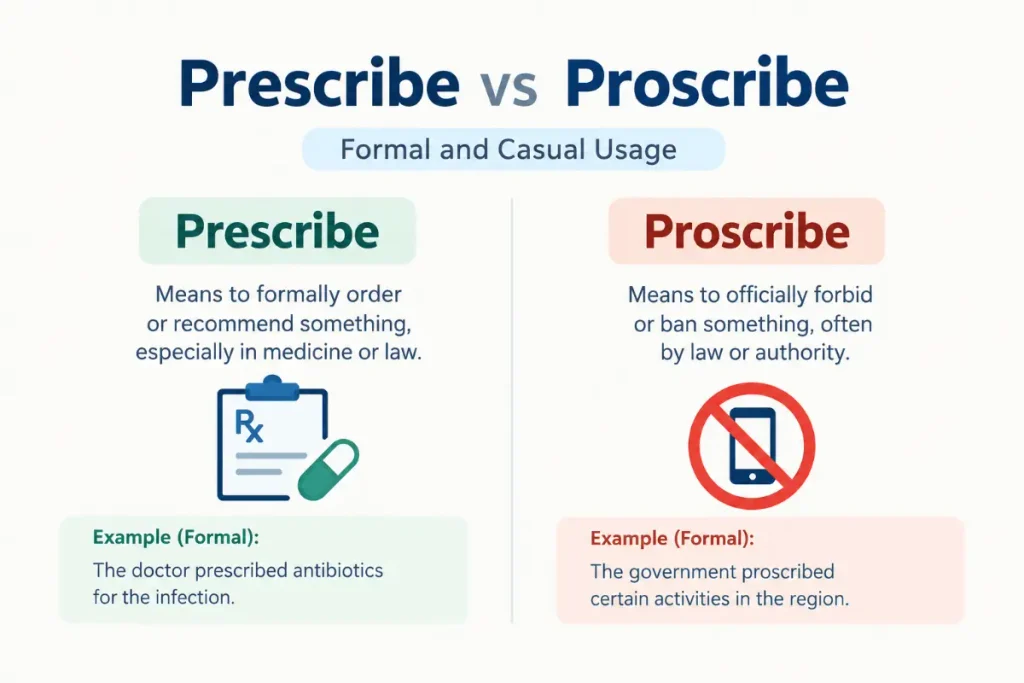
Prescribe is common in everyday American conversation because medical prescriptions are part of ordinary life. Someone might say, “My doctor prescribed a new medication.” The word feels natural in this context and does not sound unusually formal.
Outside medicine, prescribe tends to become more formal. A person might say that a company requires a certain procedure instead of saying that company policy prescribes it. Both can be correct, but the simpler version may sound more natural in casual communication.
Proscribe is considerably more formal in most contexts. In ordinary conversation, Americans are more likely to say ban, forbid, or prohibit. In legal or academic writing, proscribe can be appropriate because the word clearly expresses formal prohibition.
For professional writing, consider your audience. If a plain word such as prohibit communicates the idea just as accurately, it may be the better choice. Good writing is not about choosing the most sophisticated word. It is about choosing the word that gives readers the clearest meaning.
American Usage and Regional Differences
Prescribe and proscribe are established words in American English and do not have separate American and British spelling forms. The core distinction remains the same across major varieties of English.
The main difference lies in style and frequency rather than spelling. Prescribe is widely used in American medical language and also appears in formal discussions of rules and requirements. Proscribe is less common in casual speech and tends to appear more often in legal, academic, political, and institutional contexts.
You may encounter prohibit more often than proscribe in general American writing. That does not make proscribe a regional variant or an incorrect form. It simply reflects a difference in everyday vocabulary and register.
Grammar and Word Forms
Both prescribe and proscribe are regular verbs. Their basic forms are easy to identify once you understand their meanings.
For prescribe, the main forms are:
- Prescribe.
- Prescribes.
- Prescribed.
- Prescribing.
- Prescription as the related noun.
For proscribe, the main forms are:
- Proscribe.
- Proscribes.
- Proscribed.
- Proscribing.
- Proscription as the related noun.
Notice the spelling of proscribing. The final e is dropped before adding ing. The same pattern appears in prescribing.
The related nouns are particularly useful for understanding the word families. A prescription is something prescribed. A proscription is a prohibition or formal ban.
Similarly, knowing the difference between waive vs wave can prevent common vocabulary mistakes in both formal and casual writing.
Which Word Should You Use
Use prescribe when someone recommends, orders, establishes, or sets out something that should be done or followed. Medical treatment is the most familiar example, but the word also applies to rules, procedures, standards, and requirements.
Use proscribe when someone formally forbids, prohibits, or condemns something. Think about laws, regulations, policies, ethical standards, and prohibited conduct.
Use prohibit when you want a more familiar and direct alternative to proscribe. Use subscribe to when you mean agree with or support an idea or belief. Use describe when you mean explain what something is like.
A quick substitution test can help. If you can replace the word with recommend, order, or establish, prescribe probably fits. If you can replace it with ban or prohibit, proscribe is probably correct. If you can replace it with agree with, you likely need subscribe instead.
Expert Usage Tips
The safest way to choose between these words is to focus on the action rather than the spelling. Ask what the subject is doing to the object. If the subject is setting out a treatment, rule, standard, or course of action, prescribe expresses that relationship.
If the subject is preventing an action or declaring it unacceptable, proscribe expresses the relationship. This distinction works across medical, legal, workplace, academic, and everyday contexts.
Pay attention to tone as well. Prescribe is completely natural in medical language and can sound formal outside that setting. Proscribe is usually more formal, so prohibit may be preferable when writing for readers who are unfamiliar with specialized vocabulary.
Most importantly, do not assume that similar spelling means similar meaning. English contains many word pairs that look related but behave very differently. In this case, a single letter at the beginning separates two verbs that point in opposite directions.
Frequently Asked Questions
What is the difference between prescribe and proscribe
Prescribe means to recommend, order, or establish something as a course of action. Proscribe means to forbid or prohibit something. A doctor prescribes medicine, while a law can proscribe certain conduct. The simplest memory aid is that prescribe establishes what should happen, while proscribe establishes what must not happen.
Is proscribe the opposite of prescribe
In many contexts, the two words express opposing ideas, but they are not strict grammatical opposites in every use. Prescribe can mean establish or recommend a course of action, while proscribe means prohibit or condemn an action. This creates a strong conceptual contrast, especially when discussing rules, regulations, policies, or standards.
Does prescribe mean recommend
Yes. Prescribe can mean recommend, especially when an authorized professional gives specific advice or instructions. In medicine, a doctor may prescribe medication or treatment. Outside medicine, a policy can prescribe a procedure or a rule can prescribe certain behavior. The word can therefore express anything from a professional recommendation to an established requirement.
What does proscribe mean
Proscribe means to formally forbid, prohibit, or condemn something. It is more common in formal writing than casual conversation. For example, a law may proscribe discrimination, or an organization’s code may proscribe certain conduct. In everyday American English, prohibit or ban is often more familiar.
Is prescribe to an idea correct
Usually not if you mean agree with or support an idea. The natural expression is subscribe to an idea. For example, “She subscribes to the idea that education should be accessible.” Prescribe can be used with an idea in a different construction when it means impose or establish something as a requirement, but prescribe to an idea is not the standard expression for agreement.
Is prescribe to a belief correct
Not when you mean accept or follow a belief. The standard expression is subscribe to a belief. For example, “He subscribes to the belief that honesty matters.” Prescribe means recommend, order, or establish, so it does not normally take the place of subscribe in this expression.
What is the difference between prescribe and prescription
Prescribe is a verb, while prescription is a related noun. A doctor prescribes medication, and the written or electronic order for that medication is a prescription. Prescription can also refer more broadly to a recommended method or established rule. In language studies, prescription can describe rules about how language should be used.
Is proscribe the same as prohibit
Yes, the two words are close synonyms when they mean formally forbid or ban something. Proscribe is more formal and less common in everyday American speech. Prohibit is usually more familiar to general readers. In legal, academic, or institutional writing, proscribe can be a precise and appropriate choice.
Conclusion
The key to prescribe vs proscribe is remembering the direction of each word. Prescribe means to recommend, order, or establish something that should be done. Proscribe means to forbid, prohibit, or formally condemn something. A doctor prescribes treatment, while a law may proscribe certain behavior.
Keep a few related words separate as well. Prescription belongs to the prescribe family, while proscription relates to prohibition. Subscribe to is the phrase you need when talking about agreement with an idea or belief, and describe means to explain what something is like. Once you focus on meaning rather than spelling, these similar looking words become much easier to use accurately.