
The OP meaning in text usually depends on the conversation. OP can mean “original poster” on social media, “overpowered” in gaming, or “opponent” when someone uses it informally to talk about an enemy. You may also see OP used as a playful compliment when a friend does something impressive. The words around it help you understand the intended meaning.
People use OP in text messages, WhatsApp chats, TikTok comments, gaming conversations, and online communities. For example, someone might call a game character OP because it is too powerful, while another person might use OP to identify the creator of a post. The phrase “my biggest OP” may even refer to someone’s biggest enemy, although opp is the more common spelling for that meaning.
Quick Answer
OP has three widely recognized meanings in online communication.
- Original poster: The person who created a post or started an online discussion.
- Overpowered: Something unusually strong, effective, or difficult to beat, especially in gaming.
- Opponent: An enemy or rival, although opp is the more common spelling in informal slang.
The first two meanings are especially common online. In casual conversations, OP can also describe someone who is exceptionally skilled, impressive, or hard to beat. Always check the topic before deciding what the abbreviation means.
What Does OP Mean in Text Messages
In text messages, OP often means “overpowered” when someone talks about games, skills, or impressive actions. It can also mean “original poster” when friends discuss something they saw online. In some conversations, people use OP loosely to describe a person who seems unusually good at something.
For example, imagine your friend wins five rounds in a row in a video game. You might text, “Bro, you are OP today!” This means your friend is playing extremely well and seems difficult to beat. However, if you are discussing a post from Reddit, the same letters may refer to the person who created it.
Here are some common examples.
- “That new character is OP.” The character is too powerful or difficult to defeat.
- “The OP replied to my comment.” The original poster answered the comment.
- “Your comeback was OP.” Your response was unusually clever or impressive.
- “Ask OP for the full story.” Ask the person who created the original post.
- “My biggest opp keeps talking about me.” The speaker is talking about an enemy or rival, using the more common spelling for that meaning.
The key difference is the subject of the conversation. If people discuss a post, OP usually points to its creator or the original content. If they discuss a game, OP often means overpowered. If they talk about an enemy, check if they mean opp instead.

OP Meaning in Friends Conversations
Among friends, OP can be a playful way to praise someone’s skills, confidence, or performance. Friends might use it after a great joke, an impressive achievement, or a clever response. In these cases, the intended meaning is usually close to “overpowered,” “too good,” or “unbeatable.”
For example, your friend might help you finish a difficult assignment in ten minutes. You could reply, “You are OP for that!” You are praising your friend for doing something impressive, not saying they are an enemy or the creator of a post.
Friends may also use the term humorously in everyday situations. Someone who finishes a huge meal might joke that their appetite is OP, while a friend who wins every board game might earn the same label. The tone is usually lighthearted, especially when everyone understands the joke.
Here are a few natural examples.
- “You are OP at basketball.” Your friend is exceptionally good at basketball.
- “That joke was OP.” The joke was surprisingly funny or clever.
- “Your memory is OP.” Your friend remembers things extremely well.
- “Bro, that comeback was OP.” Your friend gave a very strong response.
- “You are my biggest opp for eating my fries.” This jokingly calls a friend an enemy because they stole the speaker’s food.
Notice that the last example uses opp, not OP. Friends may mix up the spelling, but the meaning is different. OP commonly refers to a post creator or something overpowered, while opp refers to an opponent or rival.
OP Meaning in WhatsApp Chat
In WhatsApp chats, OP can mean different things depending on the group and topic. In a group discussing a social media post, OP may refer to the person who shared the original content. In a gaming group or casual conversation, it may mean overpowered or describe something impressive.
For example, suppose a friend shares a video of someone performing an amazing trick. You might reply, “That move is OP!” You mean the move looks incredibly good or difficult to match. However, if someone asks, “Can OP explain what happened?” in a group discussing a shared post, they may be asking the original poster to provide more details.
The distinction is easier to see in these examples.
| WhatsApp message | Likely meaning |
|---|---|
| “That player is OP.” | The player is exceptionally strong or skilled. |
| “Ask OP what happened.” | Ask the person who created the original post. |
| “Your plan is OP.” | Your plan is impressive or unusually effective. |
| “My biggest opp is in this group.” | The speaker is referring to an enemy or rival. |
| “OP already explained everything.” | The original poster has provided an explanation. |
In a private WhatsApp conversation, the original poster meaning is less likely unless you are discussing a post, screenshot, or group message. Instead, OP may be used as gaming slang or a playful compliment. If the abbreviation is unclear, ask the sender what they mean rather than guessing.
OP Meaning in Social Media
On social media, OP most commonly means original poster or original post. The original poster is the person who first shared the content, while the original post is the content itself. People use the abbreviation to avoid repeating a username or referring to the first post in a long discussion.
For example, someone might write, “I agree with OP.” This means they agree with the person who started the discussion. Another person might say, “Read the OP first,” which usually means readers should check the original post before commenting.
OP on TikTok and Instagram
On TikTok and Instagram, OP may refer to the creator of a video, photo, or post being discussed. For example, someone might comment, “The OP explained this in the caption.” They mean the person who shared the original content provided more information.
The abbreviation can also appear in gaming clips, memes, and funny videos. In those situations, OP may mean overpowered instead. A comment such as “This character is OP” describes a powerful character rather than the person who uploaded the video.
OP on Reddit and Online Forums
Reddit and other discussion forums use OP frequently. It identifies the person who started a thread or the original post that other users are discussing. This helps readers follow conversations with many replies.
For example, “The OP updated the story” means the person who created the thread added new information. In contrast, “The OP contains all the details” refers to the original post itself. The exact meaning depends on how the sentence is written.
OP Meaning in a Relationship
In relationship conversations, OP does not have one special romantic meaning. It may refer to the original poster in a relationship advice discussion, or it may mean overpowered when someone uses it as playful slang. If the conversation involves an enemy or rival, the person may actually mean opp.
For example, someone discussing a relationship post might say, “The OP deserves an honest answer.” Here, OP means the person who shared the original story. In a private message, someone might say, “Your confidence is OP,” meaning the person finds that confidence impressive.
Friends and partners can also use overpowered humor to describe a strong personality, a clever response, or an impressive romantic gesture. Consider these examples.
- “Your flirting skills are OP.” The person is very good at flirting.
- “That was an OP move.” The action was clever or impressive.
- “My biggest opp is my ex.” The speaker considers their ex a rival or enemy, perhaps seriously or jokingly.
- “The OP explained her relationship problem.” The original poster described a relationship issue.
Do not assume that OP is automatically a compliment or a sign of attraction. The actual words and the relationship between the people matter more than the abbreviation itself. If someone calls you OP, the surrounding message will usually show if they are praising your skills, joking with you, or referring to a post.
OP Meaning in Gaming
In gaming, OP usually means overpowered. Players use it to describe a character, weapon, ability, item, or strategy that seems too strong compared with the alternatives. Something described as OP may make a match feel unfair because it gives one player a major advantage.
For example, imagine a new game character can defeat most opponents with very little effort. Players might say, “This character is OP and needs a nerf.” They mean the character is too powerful and the developers should reduce its strength.
Gamers use the abbreviation in several ways.
- Characters: “That hero is OP.” The hero is difficult to defeat.
- Weapons: “This gun is OP.” The weapon is unusually powerful.
- Abilities: “Her special move is OP.” The move gives her a strong advantage.
- Strategies: “That strategy is OP.” The strategy works so well that it may be difficult to counter.
- Players: “He is OP at this game.” The player is extremely skilled or difficult to beat.
The term does not always mean something is unfair. Sometimes gamers use OP simply to praise a strong character or a highly skilled player. However, when players complain about balance, they usually mean something is stronger than it should be.
Related Gaming Terms
A few other gaming words often appear alongside OP.
| Term | Meaning | Example |
|---|---|---|
| Nerf | Make something weaker | “They need to nerf that weapon.” |
| Buff | Make something stronger | “The update gave the character a buff.” |
| Meta | The most effective strategies or choices | “That weapon is part of the current meta.” |
| Broken | Extremely powerful or poorly balanced | “That ability feels broken.” |
| Noob | An inexperienced player | “I was a noob when I started.” |
For instance, if a weapon is too powerful, players may call it OP and ask developers to nerf it. If developers weaken it too much, players might complain that the weapon is no longer useful. These terms help gamers discuss balance without writing long explanations.
OP Meaning in Text Funny
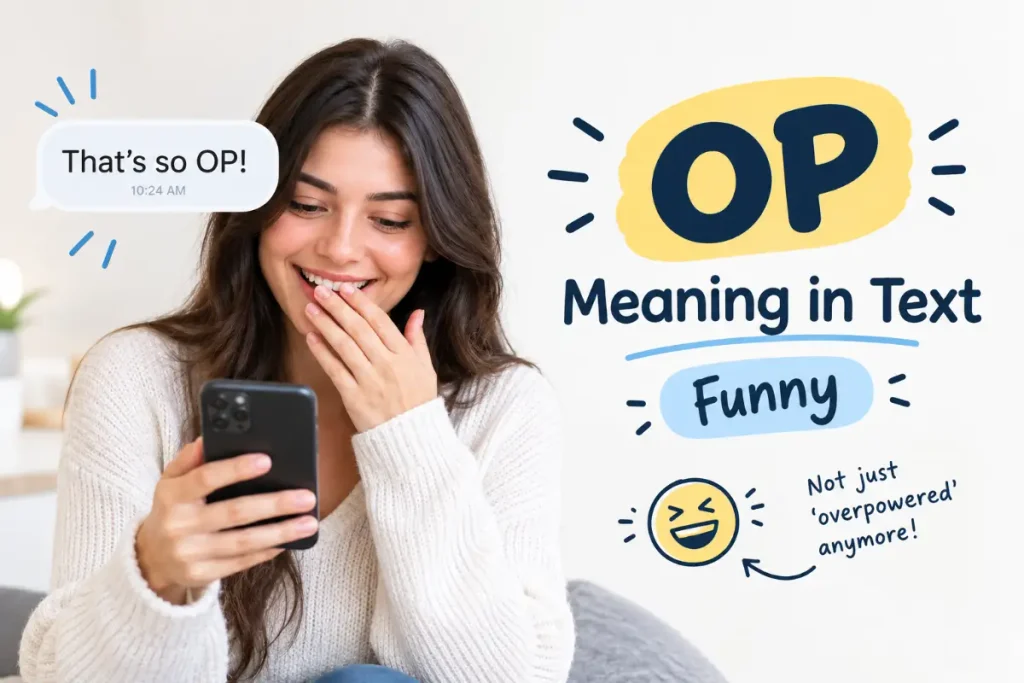
In funny texts and memes, OP can describe something that seems ridiculously powerful, surprisingly effective, or unusually impressive. People often exaggerate for humor, so the term may not refer to actual strength. It can make an ordinary situation sound like a major achievement.
For example, someone might text, “My mom found my hidden snacks in two seconds. Her detective skills are OP.” The speaker is joking that their mom has almost unbelievable detective skills. Another person might say, “Coffee at 7 AM is OP,” meaning coffee gives them a huge boost of energy.
Here are some funny examples you can use in casual conversations.
- “My alarm clock is OP at ruining my dreams.” The speaker jokes that the alarm is too effective at waking them.
- “My little sister is OP at finding my snacks.” She is surprisingly good at finding hidden food.
- “Homework is my biggest opp.” The speaker humorously treats homework like an enemy.
- “My bed is OP at convincing me to skip the gym.” The bed is described as too tempting to resist.
- “My grandma learned to use emojis. Her texting game is OP.” The speaker praises their grandma in a playful way.
Funny usage depends on exaggeration. You do not need to be discussing a video game to use OP humorously, but your audience should understand the slang. If they do not, a phrase such as “too good,” “unbeatable,” or “ridiculously effective” may communicate the joke more clearly.
My Biggest OP Meaning
The phrase “my biggest OP” usually appears when someone is talking about a person they consider an enemy, rival, or major source of trouble. However, in this context, opp is the more common slang spelling. The phrase “my biggest opp” means the person someone sees as their biggest rival or enemy.
For example, someone might text, “My biggest opp is the person who keeps spreading rumors about me.” They mean that person is their main rival or someone they do not trust. In a funny conversation, the same phrase might refer to a harmless annoyance rather than a real enemy.
Consider these examples.
- “My biggest opp is Monday morning.” This jokingly treats the start of the week as an enemy.
- “My biggest opp keeps stealing my food.” The speaker calls someone a rival because they keep taking their snacks.
- “He used to be my best friend, but now he is my opp.” The speaker says their friendship has turned into a rivalry.
- “Sleep is my biggest opp during exam week.” The speaker jokes that sleep gets in the way of studying.
The intended meaning depends on the situation. In serious conversations, opp can refer to an actual enemy or someone involved in a conflict. Among friends, people often use it playfully to describe a person, task, or situation that annoys them.
OP Meaning in Enemy Slang
When someone uses OP while talking about an enemy, they may actually mean opp, which is short for opponent. In informal slang, opp refers to an enemy, rival, or person who is against someone. The plural form is opps.
For example, “Watch out for the opps” means to be careful around enemies or rival individuals. A sentence such as “He is my biggest opp” means the speaker considers him their main rival. The word can sound serious in some settings, so it is important to understand the tone before using it.
Here are a few examples of enemy slang.
- “That guy is my opp.” He is my enemy or rival.
- “We are not friends anymore. He is an opp now.” Their relationship has become hostile.
- “My opp keeps talking about me.” The speaker believes a rival is discussing them.
- “The team defeated its biggest opp.” The team beat its strongest rival.
- “Homework is my opp today.” The speaker jokingly treats homework as an enemy.
OP vs Opp
Although the words look similar, they usually serve different purposes. OP commonly means original poster or overpowered, while opp usually means an enemy or opponent. People may confuse the spelling in fast messages, but using the correct form makes your meaning clearer.
| Term | Common meaning | Example |
|---|---|---|
| OP | Original poster | “The OP replied to my question.” |
| OP | Overpowered | “That character is OP.” |
| Opp | Enemy or rival | “He is my biggest opp.” |
| Opps | Enemies or rivals | “The opps are talking again.” |
| OG | Original or respected person | “She is an OG gamer.” |
If someone writes “my biggest OP,” they may intend to say “my biggest opp.” Look at the rest of the message to identify the intended meaning instead of assuming that OP always refers to an enemy.
How to Reply When Someone Says OP
Your response depends on what the sender means. If they use OP as a compliment, you can thank them or respond with a joke. If they are discussing a social media post, you can ask which post or person they mean. If they use opp to describe an enemy, your reply should fit the seriousness of the conversation.
Here are some natural replies for different situations.
| Situation | Possible reply |
|---|---|
| A friend says you are OP at a game. | “I have been practicing!” |
| Someone says your joke was OP. | “Glad you liked it!” |
| A gamer says a weapon is OP. | “Yeah, it needs better balance.” |
| Someone asks you to contact the OP. | “Sure, I will ask the person who posted it.” |
| A friend jokes that you are their opp. | “Over some fries? Seriously?” |
| Someone talks about a real enemy. | “What happened between you two?” |
You can also ask a direct question if the abbreviation confuses you. For example, “Do you mean overpowered or original poster?” is a simple way to clear up the meaning. A quick clarification is better than replying to the wrong idea.

Common Mistakes When Understanding OP
The biggest mistake is assuming OP has only one meaning. Its interpretation changes across gaming, social media, friendships, and online discussions. A gamer describing a powerful weapon is using the term differently from someone talking about the author of a Reddit post.
Another common mistake is confusing OP with opp. Although some people type OP when they mean an enemy, opp is the more common spelling for that slang meaning. If the sentence includes words such as enemy, rival, or opps, the writer may be using or referring to the enemy slang.
People also sometimes assume that calling someone OP is always a compliment. In gaming, it can be praise, but it can also be a complaint about unfair power. In friendships, it may be a joke, while in social media discussions, it may simply identify the person who created a post.
To avoid confusion, follow these simple rules.
- Look at the topic of the conversation.
- Check how the abbreviation fits into the sentence.
- Remember that OP commonly means original poster or overpowered.
- Recognize opp as the more common spelling for an enemy or rival.
- Ask for clarification when the intended meaning remains unclear.
These steps will help you understand the abbreviation without guessing or misreading the message.
Frequently Asked Questions
What Does OP Mean in Texting
OP usually means “original poster” or “overpowered” in online communication. The first meaning refers to the person who created a post, while the second describes something unusually powerful or impressive. In conversations about enemies, the writer may mean opp instead.
What Does OP Mean in WhatsApp Chat
In WhatsApp chats, OP can refer to the original poster when people discuss shared content. It can also mean overpowered in gaming conversations or work as a playful compliment among friends. The topic and sentence help you identify the intended meaning.
What Does OP Mean in a Relationship
In relationship conversations, OP may refer to the person who wrote a relationship advice post. In casual messages, it can describe someone as impressive or exceptionally good at something. If the conversation involves an enemy, the intended word may be opp.
What Does OP Mean in Gaming
In gaming, OP means overpowered. Players use it to describe characters, weapons, abilities, or strategies that are stronger than expected. For example, “This weapon is OP” means the weapon is extremely powerful and may be difficult to counter.
What Does My Biggest OP Mean
“My biggest OP” may be a misspelling or informal version of “my biggest opp,” which means someone’s biggest enemy or rival. People also use the phrase jokingly for things that cause frustration, such as homework, Monday mornings, or an alarm clock.
Is OP a Compliment
OP can be a compliment when someone uses it to describe a person’s skills, confidence, or impressive performance. For example, “You are OP at basketball” means the person is exceptionally good at the sport. However, OP can also describe an overpowered game feature or identify the creator of a post, so the meaning depends on context.
Conclusion
Understanding the op meaning in text becomes easier when you consider the conversation. OP most commonly means original poster on social media or overpowered in gaming. Friends may also use it as a playful compliment for someone who does something exceptionally well.
If you see “my biggest OP” in a message about an enemy, the writer may mean my biggest opp, which refers to a major rival or enemy. Pay attention to the surrounding words, the platform, and the sender’s tone to understand the intended meaning. Once you recognize these differences, you can read and use the abbreviation more confidently in everyday conversations.