
Have you ever written a sentence about moving money, changing schools, or sending files and wondered if transferred or transfered is the correct spelling? The confusion is understandable because both versions look reasonable. However, only one follows standard English spelling rules. The correct spelling is transferred, with two R’s after the letter E in the ending.
The word transferred is the past tense and past participle of transfer. It describes something that has already been moved, changed, or reassigned from one place, person, or situation to another. You might use it when discussing a bank transaction, a workplace assignment, a school admission, or a digital file.
The mistake usually happens because people apply a familiar spelling pattern to the word. Many English verbs simply add -ed to form the past tense, but transfer follows a specific consonant doubling rule. Once you understand that rule, you can spell transferred correctly without relying on autocorrect.
This guide explains the correct spelling, grammar rules, pronunciation, meaning, examples, and common mistakes. You will also learn how transferred differs from transferring, transfer, and other related forms.
Quick Answer
Transferred is the correct spelling in American English. It is the past tense and past participle of transfer. The final consonant R is doubled before adding -ed because the verb follows the consonant doubling rule. Transfered is a misspelling in standard English. For example, write “The money was transferred yesterday.”
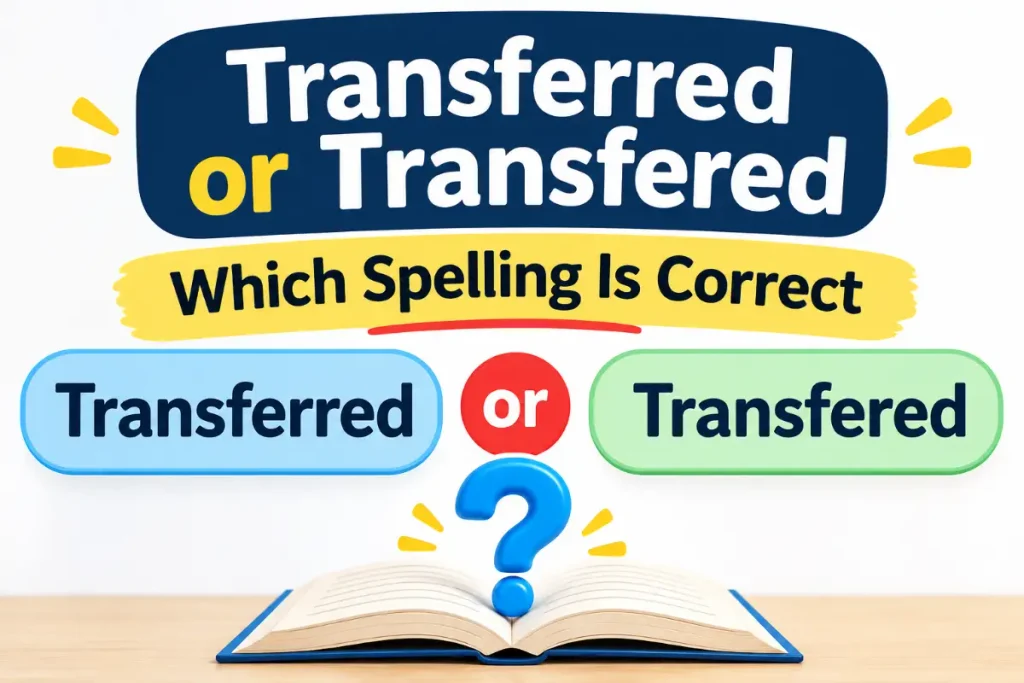
Transferred or Transfered Which Spelling Is Correct
The correct spelling is transferred, with two R’s before the ending -ed. The incorrect spelling transfered contains only one R before the ending.
This difference comes from a standard English spelling rule. When a verb ends in a consonant-vowel-consonant pattern and the final syllable is stressed, English usually doubles the final consonant before adding a suffix that begins with a vowel.
The verb transfer follows this rule in its past tense and past participle forms.
- Transfer becomes transferred.
- Transfer becomes transferring.
- Transfer becomes transferrable in the less common spelling variant, although transferable is the preferred modern spelling.
The original verb contains one R at the end. However, the final R is doubled when the verb takes certain endings.
Here are some examples:
- I transferred the money to my savings account.
- She transferred to another department last month.
- The files were transferred to the new computer.
- He transferred ownership of the vehicle.
- We transferred the patient to another hospital.
In each example, transferred describes an action that happened in the past or an action completed by the subject.
The spelling transfered does not follow the standard spelling pattern. Although readers may understand what you mean, it can look incorrect in school assignments, business emails, official documents, and professional writing.
Why Transferred Has Two R’s
The main reason transferred contains two R’s is the English consonant doubling rule. This rule explains why some verbs double their final consonant before adding endings such as -ed and -ing.
The Consonant Doubling Rule
In many English verbs, you double the final consonant when the following conditions apply:
- The verb ends in a consonant-vowel-consonant pattern.
- The final syllable receives the stress.
- The suffix begins with a vowel, such as -ed or -ing.
The word transfer ends in the letters R, which represent a consonant, E, which represents a vowel, and R, which represents a consonant.
Its final syllable is stressed in standard pronunciation: trans-FER.
Because the final syllable is stressed, the final R doubles before the suffix is added.
Transfer + ed = transferred
The same pattern applies when adding -ing.
Transfer + ing = transferring
This spelling rule helps maintain the expected pronunciation and follows a common pattern in English word formation.
Why You Do Not Write Transfered
The spelling transfered treats the verb as if it simply takes the ending -ed without any spelling change.
However, English spelling rules require the final consonant to double in this situation.
Compare the following forms:
| Base Verb | Incorrect Form | Correct Form |
|---|---|---|
| Transfer | Transfered | Transferred |
| Transfer | Transfering | Transferring |
| Prefer | Prefered | Preferred |
| Refer | Refered | Referred |
| Occur | Occured | Occurred |
These examples follow the same general consonant doubling pattern. Learning the rule makes it easier to recognize the correct spelling of several common verbs.
What Does Transferred Mean
Transferred means moved, shifted, reassigned, or passed from one person, place, organization, or situation to another.
It is the past tense and past participle of the verb transfer. The exact meaning depends on the context in which you use it.
For example, transferring money means moving funds from one account to another. Transferring a student means changing the school or institution they attend. Transferring a file means moving digital information from one device or location to another.
The word can describe physical movement, financial transactions, changes in responsibility, or changes in ownership.
Transferred as a Past Tense Verb
The simple past tense describes an action that happened and finished in the past.
Examples:
- I transferred the payment this morning.
- She transferred to a different university last year.
- The company transferred its headquarters to Chicago.
- They transferred the equipment before the renovation.
- He transferred the documents to his manager.
In these sentences, the action occurred at a particular time in the past.
The word transferred does not change according to the subject. You use the same form with I, you, he, she, it, we, and they.
For example:
- I transferred.
- She transferred.
- They transferred.
This consistency makes the simple past form relatively easy to use.
Transferred as a Past Participle
Transferred also functions as a past participle. You commonly use it with helping verbs such as have, has, had, and was.
Examples:
- I have transferred the money.
- She has transferred to another department.
- We had transferred the files before the system crashed.
- The payment was transferred successfully.
- The employee has been transferred to another location.
The past participle appears in perfect tenses and passive voice constructions.
In the sentence “The money was transferred,” the subject receives the action. The sentence focuses on the money rather than the person who moved it.
Transferred vs Transfered vs Transfer
Understanding the difference between the base verb and its past forms can help you avoid mistakes.
| Word | Correct? | Meaning or Function |
|---|---|---|
| Transfer | Yes | Base form of the verb |
| Transferred | Yes | Past tense and past participle |
| Transferring | Yes | Present participle or gerund |
| Transferable | Yes | Capable of being transferred |
| Transfered | No | Incorrect spelling of transferred |
| Transfering | No | Incorrect spelling of transferring |
Transfer
Transfer is the base form of the verb. You use it when discussing an action in the present, future, or after certain helping verbs.
Examples:
- I transfer money every month.
- We need to transfer the files.
- She will transfer to another office.
- Please transfer the call to customer service.
The spelling remains unchanged when you use the base form.
Transferred
Transferred describes an action that happened in the past or appears as a past participle.
Examples:
- She transferred the funds yesterday.
- The account has been transferred.
- They transferred the responsibility to another team.
Remember that transferred has two R’s before -ed.
Transferring
Transferring is the present participle or gerund form of the verb.
Examples:
- I am transferring the documents now.
- Transferring money online is convenient.
- They are transferring the employee to another office.
- The company is transferring its operations.
The final R doubles before adding -ing.

Transferred in American English
Transferred is the standard spelling in American English. It is used in everyday communication, academic writing, workplace documents, legal paperwork, financial records, and professional correspondence.
American English follows the consonant doubling rule for verbs such as transfer, prefer, refer, and occur when their final syllables are stressed.
The spelling does not change based on the meaning of the word. You should use transferred when discussing:
- Bank transactions.
- School or university changes.
- Workplace assignments.
- Medical patient movement.
- Ownership changes.
- Digital file movement.
- Business operations.
- Telephone calls.
For example:
“The customer transferred the payment to the wrong account.”
“The employee was transferred to the New York office.”
“The documents were transferred securely.”
All three sentences use the standard American spelling.
Is Transferred British or American English
Transferred is correct in both American and British English. There is no regional difference in this spelling.
Some English words have different spellings in the United States and the United Kingdom, such as color and colour or traveled and travelled. However, transferred is not one of those words.
Both American and British writers double the final R before adding -ed.
You should not use transfered simply because you are writing for a British audience. The correct spelling remains transferred.
Examples of Transferred in Sentences
The best way to understand a word is to see how it works in different contexts. Transferred appears in many areas of daily life, from banking and education to business and technology.
Everyday Conversation Examples
- I transferred the money to your account yesterday.
- She transferred to a new school after moving.
- We transferred the furniture to the other room.
- He transferred the call to his supervisor.
- They transferred their belongings into the new apartment.
- My brother transferred his membership to another location.
- The package was transferred to a different delivery center.
- I transferred the photos from my phone to my laptop.
- She transferred the responsibility to her assistant.
- The family transferred ownership of the house.
These examples show that transferred works naturally in both personal and practical conversations.
Text Message and Social Media Examples
Transferred is also common in messages and online communication.
- I transferred the payment. Check your account.
- The pictures were transferred to the shared folder.
- I transferred everything to my new phone.
- The video transferred successfully.
- She transferred the files before deleting the old ones.
- I transferred the money, so you should receive it soon.
- The account was transferred to your new email.
- He transferred the group chat to another platform.
In casual messages, people may use shorter sentences, but the spelling remains the same.
Workplace and Business Examples
In professional communication, transferred often describes changes involving employees, money, responsibilities, and documents.
- The manager transferred the project to another team.
- The employee was transferred to the regional office.
- The company transferred its assets to a subsidiary.
- The payment was transferred according to the agreement.
- The client transferred ownership of the account.
- We transferred the records to the new database.
- The department transferred its responsibilities to the operations team.
- The company transferred several employees to its headquarters.
- The funds were transferred after approval.
- The contract was transferred to the new owner.
These examples are suitable for business emails, reports, and workplace discussions.
Academic and Educational Examples
Transferred is frequently used when discussing students, credits, schools, and academic records.
- She transferred to a university in California.
- He transferred his credits from another college.
- The student transferred schools during the semester.
- The academic records were transferred successfully.
- I transferred to a different major last year.
- The professor transferred the class to another room.
- She transferred her scholarship to the new institution.
- The credits were transferred toward the degree.
- They transferred the student to a specialized program.
- The school transferred the files to the new administration.
In education, the word usually describes a change in institution, program, location, or academic record.
Financial and Banking Examples
In financial contexts, transferred describes the movement of money between accounts, people, or organizations.
- The bank transferred the funds overnight.
- I transferred $500 into my savings account.
- The payment was transferred electronically.
- She transferred the balance to another account.
- The money has been transferred successfully.
- The company transferred the funds to its supplier.
- The customer transferred the payment before the deadline.
- The bank transferred the remaining balance.
- The transaction was transferred to the correct account.
- The funds were transferred after verification.
Financial writing often uses transferred in passive constructions because the focus is on the money or transaction rather than the person who initiated it.
Common Mistakes With Transferred
Even experienced writers sometimes make spelling mistakes when working quickly. Understanding the most common errors can help you recognize and correct them.
Using Transfered Instead of Transferred
Incorrect: The money was transfered yesterday.
Correct: The money was transferred yesterday.
Explanation: The final R in transfer doubles before adding -ed. The correct spelling contains two R’s before the ending.
Writing Transfering Instead of Transferring
Incorrect: I am transfering the documents now.
Correct: I am transferring the documents now.
Explanation: The same doubling rule applies when adding -ing. You must double the final R before the suffix.
Using the Past Tense With a Base Form
Incorrect: She has transfer the files.
Correct: She has transferred the files.
Explanation: The present perfect tense requires the past participle. Transferred is the correct form after has, have, or had.
Confusing Transferred With Transferring
Incorrect: The employee was transferring to another office last month.
Correct: The employee transferred to another office last month.
Explanation: The simple past is generally the better choice when describing a completed action at a specific time. Transferring can work in a different sentence structure, but it does not automatically replace the past tense.
Forgetting the Correct Form in Passive Voice
Incorrect: The documents were transfer yesterday.
Correct: The documents were transferred yesterday.
Explanation: Passive voice requires the past participle after the appropriate form of the verb be. The correct past participle is transferred.
Transferred vs Transferrable vs Transferable
Another spelling question involves transferable and transferrable.
Both transferable and transferrable are accepted English spellings. However, transferable, with one R in the middle, is the more common and preferred spelling in modern American English.
Transferable means that something can be transferred from one person, place, or situation to another.
Examples:
- The skills are transferable to other jobs.
- The ticket is transferable to another person.
- The credits are transferable between universities.
- The warranty is transferable to the new owner.
Although transferable and transferrable are both valid, transferred is not optional in the same way. The standard past tense spelling is transferred.
| Word | Meaning | Preferred Usage |
|---|---|---|
| Transfer | Move or change something | Standard |
| Transferred | Moved or changed in the past | Standard |
| Transferring | Moving or changing something | Standard |
| Transferable | Able to be moved or reassigned | Preferred spelling |
| Transferrable | Able to be moved or reassigned | Accepted variant |
| Transfered | Incorrect past tense spelling | Avoid |
For most American readers, transferable is the clearest choice.
How to Remember the Spelling of Transferred
If you often forget the second R, try a simple spelling technique.
Remember the Base Verb
Start with the word transfer. It ends with an R, and the final syllable is stressed.
When adding -ed, double that R.
Transfer + ed = transferred.
This method works because it connects the spelling to the actual word formation rule.
Compare It With Similar Verbs
The word transferred follows the same spelling pattern as preferred, referred, and occurred.
Try remembering this group:
- Transfer → transferred.
- Prefer → preferred.
- Refer → referred.
- Occur → occurred.
Each verb doubles its final consonant before adding -ed.
This pattern can help you recognize the spelling instead of memorizing each word separately.
Practice With Short Sentences
Writing a few sentences can reinforce the correct spelling.
- I transferred the money.
- She transferred the file.
- We transferred the records.
- They transferred the employee.
- He transferred ownership.
You can also create your own examples using situations from your daily life.
Check the Final R
Before submitting a document, look at the spelling of transferred.
Ask yourself:
“Did I double the R before adding -ed?”
If the word contains only one R before the ending, correct it.
Spell checkers can help, but understanding the rule makes it easier to catch mistakes independently.
Frequently Asked Questions
Is Transferred or Transfered Correct?
Transferred is correct in standard American and British English. It is the past tense and past participle of transfer. The final R doubles before adding -ed. Transfered is a misspelling and should be avoided in formal, academic, and professional writing.
Why Does Transferred Have Two R’s?
Transferred has two R’s because the final syllable of transfer is stressed. English spelling rules generally double the final consonant of a stressed consonant-vowel-consonant verb before adding a vowel-initial suffix such as -ed. This is the same pattern found in preferred and referred.
Is Transfered Ever Correct?
Transfered is not the standard spelling of the past tense of transfer. It may appear in informal writing or as a typing mistake, but it should not be used in edited English. The correct form is transferred, with two R’s before the ending.
Is Transferred American or British English?
Transferred is correct in both American and British English. Unlike some verbs that have regional spelling differences, transfer follows the same consonant doubling rule in both varieties. You should use transferred regardless of your intended English audience.
What Is the Difference Between Transfer and Transferred?
Transfer is the base form of the verb, while transferred is its past tense and past participle. For example, “I transfer money every month” describes a regular action. “I transferred money yesterday” describes a completed action in the past.
Is Transferring Spelled With Two R’s?
Yes, transferring is the correct spelling. The final R in transfer doubles before adding -ing. Transfering is incorrect in standard English. For example, write “She is transferring the files” rather than “She is transfering the files.”
Is Transferable or Transferrable Correct?
Both transferable and transferrable are accepted spellings. However, transferable is the more common and preferred form in modern American English. It means something can be moved, reassigned, or passed from one person or situation to another.
Can I Use Transferred in Formal Writing?
Yes, transferred is appropriate for formal writing, including business emails, academic papers, financial documents, reports, and legal communication. It is the standard past tense and past participle of transfer. The spelling does not change based on the formality of the situation.
Conclusion
The correct spelling is transferred, not transfered. The word is the past tense and past participle of transfer, and it follows the English consonant doubling rule. Because the final syllable is stressed, the final R doubles before adding -ed. The same pattern applies to transferring, which also contains two R’s.
Remember that transfer is the base form, transferred describes a completed past action, and transferring describes an ongoing action or activity. These forms are used in American English across banking, education, business, technology, and everyday conversation. Whenever you write about moving money, changing locations, or reassigning responsibility, choose transferred. A simple reminder to double the final R will help you spell the word correctly every time.