If you have ever taken a personality quiz and been labeled indulgent or sober, the description may have felt surprisingly personal. One sounds warm, pleasure seeking, and expressive. The other sounds disciplined, serious, and controlled. That is why the comparison between indulgent vs sober creates so much confusion. Many people assume one is positive and the other negative, but that is not how psychologists, writers, and native speakers usually use these words.
The short answer is simple. Indulgent describes someone who enjoys comfort, pleasure, or emotional expression and may be lenient with themselves or others. Sober describes someone who is serious, restrained, practical, and emotionally controlled. They are not opposites in every situation, but they often represent different ends of a personality spectrum.
The confusion comes from the fact that sober has more than one meaning. It can refer to not being intoxicated, but it can also describe a calm and serious attitude. Meanwhile, indulgent can describe food, parenting, spending habits, emotions, or personality.
This guide explains the real meanings, psychological implications, usage differences, pronunciation, common mistakes, and how native speakers actually choose between these words in everyday life.
Quick Definition
Indulgent means lenient, pleasure seeking, or willing to allow enjoyment and comfort. Sober means serious, restrained, practical, or emotionally controlled. In personality discussions, an indulgent person tends to seek enjoyment and express emotions freely, while a sober person tends to value self control, caution, and moderation.
Indulgent vs Sober Quick Answer
Choose indulgent when describing someone who enjoys pleasure, comfort, treats, or emotional expression. Choose sober when describing someone who is serious, restrained, practical, or self controlled.
For example:
- An indulgent parent allows extra treats and bends the rules.
- A sober parent sets firm boundaries and focuses on discipline.
- An indulgent personality seeks enjoyment and experiences.
- A sober personality values restraint and careful judgment.
Neither word is inherently better. They describe different attitudes and behaviors.
Comparison Table
| Feature | Indulgent | Sober |
|---|---|---|
| Part of speech | Adjective | Adjective and verb |
| Core meaning | Lenient or pleasure seeking | Serious or restrained |
| Emotional tone | Warm, generous, expressive | Calm, controlled, practical |
| Common contexts | Food, parenting, spending, personality | Personality, mood, judgment, alcohol |
| Formality level | Neutral to slightly descriptive | Neutral to formal |
| Psychology connection | Enjoyment, reward seeking, openness | Self control, restraint, conscientiousness |
| Typical example | An indulgent vacation. | A sober assessment. |
| Can describe a person? | Yes | Yes |
| Can describe a thing? | Yes | Yes |
Just as choosing between indulgent and sober depends on context, understanding the difference between reins and reigns can help you avoid another commonly confused pair in everyday writing.
Understanding Indulgent Meaning
The easiest way to understand indulgent is to think of allowing pleasure.
An indulgent person gives themselves or others permission to enjoy comfort, treats, emotions, or desires more freely than a strict or restrained person would.
Common Meanings
- Allowing extra pleasure or comfort.
- Being lenient or permissive.
- Enjoying luxury or treats.
- Expressing emotions freely.
Everyday Examples
- An indulgent dessert is rich and luxurious.
- An indulgent parent gives extra privileges.
- An indulgent weekend involves relaxation and enjoyment.
- An indulgent friend lets small mistakes slide.
Psychological Meaning
In psychology and personality discussions, indulgence is often associated with:
- reward seeking.
- openness to experience.
- emotional expressiveness.
- lower emphasis on strict self discipline.
This does not mean an indulgent person is irresponsible. It simply means they are more comfortable allowing enjoyment and flexibility.
Indulgent In Parenting
This is one of the most common uses.
An indulgent parent may:
- allow extra screen time.
- buy treats more often.
- avoid harsh punishment.
- prioritize the child’s happiness.
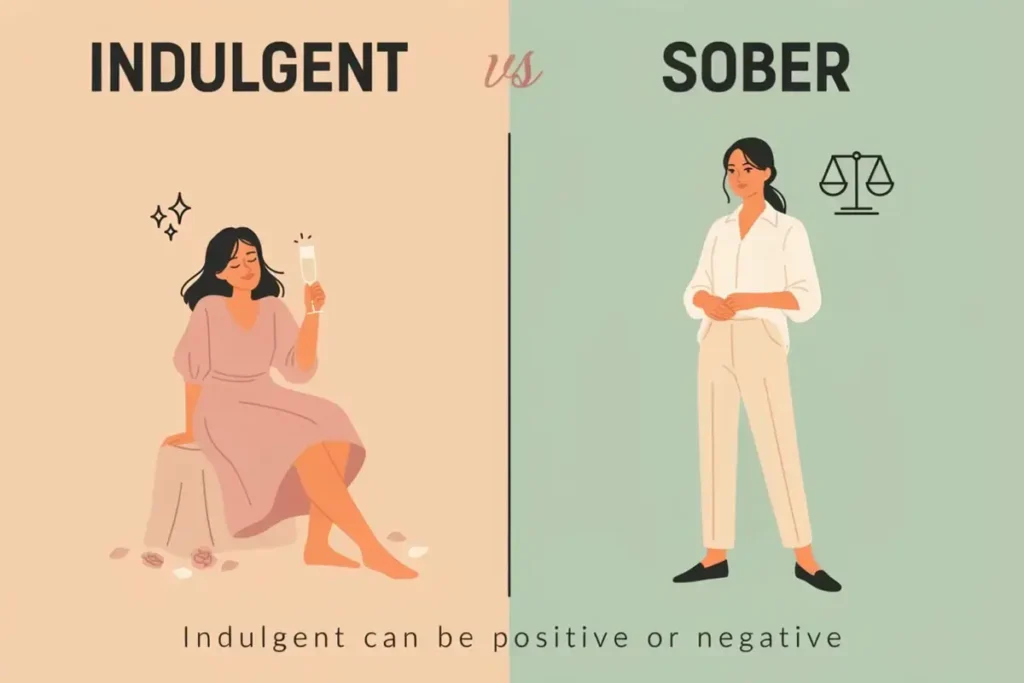
The word here is descriptive, not automatically positive or negative.
Understanding Sober Meaning
Most people first learn sober in the context of alcohol, but the personality meaning is different.
A sober person is serious, restrained, thoughtful, and emotionally controlled.
Common Meanings
- Not intoxicated.
- Serious and thoughtful.
- Calm and restrained.
- Practical and realistic.
Everyday Examples
- A sober driver has not consumed alcohol.
- A sober speech avoids exaggeration.
- A sober personality is measured and controlled.
- A sober decision is based on facts rather than impulse.
Psychological Meaning
In personality discussions, soberness is often linked to:
- self control.
- caution.
- conscientiousness.
- emotional restraint.
A sober person may still enjoy life, laugh, travel, and celebrate. The word suggests moderation and seriousness, not joylessness.
The Core Difference
The simplest comparison is this:
Indulgent personality
Seeks enjoyment and allows comfort.
Sober personality
Seeks restraint and careful judgment.
Think of them as different default settings.
| Situation | Indulgent Response | Sober Response |
|---|---|---|
| Vacation | Book the luxury hotel. | Choose a practical option. |
| Dessert | Order the chocolate cake. | Skip or share it. |
| Parenting | Bend the rules. | Keep the rules consistent. |
| Money | Spend on experiences. | Save for the future. |
| Emotions | Express them openly. | Keep them measured. |
Most people are a mix of both depending on the situation.
Why People Get Confused
Several factors make this pair tricky.
Sober Has Two Meanings
A sentence like He is sober could mean:
- He is not drunk.
- He is serious and restrained.
Context tells you which meaning is intended.
Indulgent Can Be Positive Or Negative
These all use the same word:
- an indulgent grandmother.
- an indulgent dessert.
- an indulgent spending habit.
The tone changes with the context.
Personality Tests Use Specialized Definitions
Many online personality tests use indulgent and sober as broad temperament categories, which can make them sound more technical than they are in everyday English.
Which Word Should You Use
Use indulgent when you want to emphasize enjoyment, comfort, generosity, or leniency.
Examples:
- an indulgent meal.
- an indulgent parent.
- an indulgent personality.
- an indulgent vacation.
Use sober when you want to emphasize seriousness, restraint, practicality, or careful judgment.
Examples:
- a sober discussion.
- a sober assessment.
- a sober personality.
- a sober approach to money.
A useful test is to ask:
- Pleasure and flexibility? → Indulgent.
- Restraint and seriousness? → Sober.
Pronunciation Guide
Indulgent
IPA: /ɪnˈdʌl.dʒənt/
Syllables: in DUL gent
Sober
IPA: /ˈsoʊ.bɚ/ (American)
IPA: /ˈsəʊ.bə/ (British)
Syllables: SO ber
Common Mistakes
- Saying in dul GENT with the stress on the last syllable.
- Pronouncing sober as sobber with a short vowel.
Native speakers stress the middle syllable in indulgent and the first syllable in sober.
Expert Language Insight
Native speakers rarely use indulgent as a direct insult. It usually suggests warmth, generosity, luxury, or permissiveness. If someone says She is indulgent with her children, the tone is often mildly critical but not harsh.
Sober, on the other hand, often carries a tone of respect. Phrases like a sober analysis, a sober leader, or a sober judgment suggest maturity and reliability. However, describing a person as sober in a social setting can also imply that they are serious, reserved, or less playful than others.
Writers often choose these words not because one is right and the other wrong, but because they create very different impressions of a person’s temperament and priorities.
Examples Of Indulgent And Sober In Sentences
Reading real examples is one of the fastest ways to understand how these words work. Notice how the meaning changes depending on the situation. Although indulgent and sober can describe people, they also describe decisions, writing, food, emotions, and behavior.
Ten Examples Using Indulgent
- The restaurant is famous for its indulgent chocolate cake.
- Her grandparents were indulgent and rarely said no to their grandchildren.
- He planned an indulgent weekend at a luxury spa after months of hard work.
- The novel describes an indulgent lifestyle filled with expensive vacations and fine dining.
- She smiled at her son’s small mistake instead of scolding him, showing an indulgent attitude.
- The company rewarded its employees with an indulgent holiday celebration.
- His indulgent spending habits made it difficult to save money.
- The hotel offered an indulgent breakfast with fresh pastries and gourmet coffee.
- She enjoyed an indulgent evening watching movies and ordering her favorite food.
- The teacher gave the class an indulgent extension after hearing about the unexpected weather conditions.
These examples show that indulgent often suggests generosity, comfort, pleasure, or flexibility. Depending on the context, it can sound positive, neutral, or gently critical.
Ten Examples Using Sober
- The judge delivered a sober warning before announcing the decision.
- She gave a sober assessment of the company’s financial situation.
- His sober personality helped the team stay calm during the crisis.
- The documentary presented a sober view of climate change.
- Everyone appreciated her sober advice before making an important investment.
- He remained sober throughout the celebration because he was driving home.
- The manager kept a sober expression during the difficult meeting.
- After hearing the news, the room became quiet and sober.
- The article offered a sober analysis instead of making emotional claims.
- Her sober approach to budgeting helped the family reach its financial goals.
These examples highlight the different meanings of sober. In some sentences it refers to not being under the influence of alcohol, while in others it describes a thoughtful, serious, and measured attitude.
Key Differences Between The Two Words
Although these words are sometimes presented as opposites, they are not true antonyms in every situation. Each one emphasizes a different aspect of behavior, attitude, or decision making.
Here are the biggest differences.
Meaning
An indulgent person tends to welcome pleasure, comfort, and emotional expression. A sober person usually values restraint, practicality, and careful judgment.
Tone
The emotional tone also changes.
- Indulgent often feels warm, generous, relaxed, or luxurious.
- Sober often feels calm, thoughtful, disciplined, or serious.
Neither tone is automatically positive or negative. The surrounding context determines how readers interpret the word.
Grammar
Both words are adjectives in their most common forms.
However, sober can also function as a verb.
Examples include:
- He became sober after the accident.
- The news sobered the entire group.
By contrast, indulgent functions only as an adjective. The related verb is indulge.
Context
You’ll usually encounter indulgent in discussions about:
- Parenting.
- Food.
- Luxury.
- Spending habits.
- Personal enjoyment.
- Personality traits.
You’ll often see sober in discussions about:
- Judgment.
- Leadership.
- Alcohol.
- Professional communication.
- Personality.
- Decision making.
Understanding the context is often more important than memorizing definitions.
If you’re which spelling is correct when using eying or eyeing, it’s worth learning the usage rules before relying on instinct.
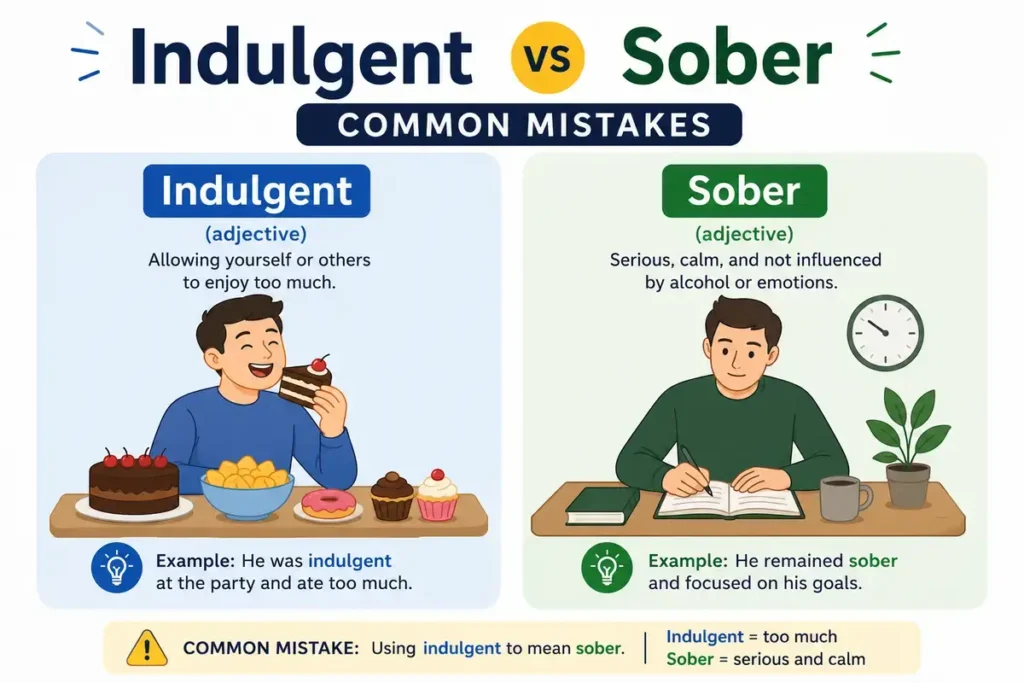
Indulgent vs Sober Common Mistakes
These words are familiar, but they’re often misunderstood because they describe attitudes instead of measurable qualities.
Here are the mistakes that language teachers and editors see most often.
Assuming They Are Complete Opposites
People sometimes believe every indulgent person is never sober or every sober person is never indulgent.
Real life is much more balanced.
Someone may be financially sober but indulgent with food. Another person may be emotionally restrained while still enjoying luxury vacations.
Human personality is rarely limited to one trait.
Confusing Sober With Serious All The Time
Because sober has multiple meanings, readers should always consider the context.
For example:
- She remained sober after the party.
- She maintained a sober attitude during the meeting.
The first sentence refers to alcohol.
The second refers to personality and behavior.
Using Indulgent As A Negative Label
Some writers treat indulgent as another word for spoiled or irresponsible.
That is not always accurate.
An indulgent vacation simply means relaxing and enjoyable. An indulgent dessert refers to something rich and satisfying. The word becomes negative only when the context suggests excess or poor judgment.
Forgetting Audience Expectations
Business writing usually favors words like measured, balanced, or practical instead of repeatedly describing someone as sober.
Creative writing has more flexibility because authors often use personality adjectives to build vivid characters.
Etymology And Word Origin
Learning where these words came from makes their meanings easier to remember.
Origin Of Indulgent
The word indulgent comes from the Latin verb indulgere, meaning to be kind, yield, or grant favors. It entered English through French and gradually developed the sense of showing kindness, allowing pleasure, or giving someone more freedom than expected.
Over time, the meaning expanded beyond people.
Today the word can describe food, vacations, spending habits, lifestyles, parenting styles, and emotional behavior.
Origin Of Sober
The word sober comes from the Latin sobrius, meaning moderate, sensible, or not intoxicated.
When it entered Middle English, it referred mainly to avoiding drunkenness. Later, writers began using it to describe serious thinking, restrained behavior, and thoughtful judgment.
That broader meaning remains common in modern English.
Regional Usage
Unlike spelling pairs such as gray and grey, these words do not change across major varieties of English.
American English
American speakers use both words frequently.
You’ll often hear indulgent in conversations about food, parenting, luxury products, and lifestyle. Sober appears regularly in discussions about alcohol, leadership, business, and personality.
British English
British English uses the same spellings and meanings.
Some formal writing may favor words like restrained, measured, or temperate in place of sober, but the meaning remains unchanged.
Australian English
Australian English follows the same usage patterns.
Both words appear naturally in newspapers, books, workplaces, and everyday conversations.
Canadian English
Canadian English also shares the same meanings and spellings.
The differences between these regional varieties are so small that readers rarely notice them.
Grammar Rules
Using these words correctly becomes much easier once you understand their grammatical roles.
Indulgent
Indulgent functions as an adjective.
Examples:
- An indulgent parent.
- An indulgent lifestyle.
- An indulgent dessert.
The related forms include:
- Indulge as a verb.
- Indulgence as a noun.
- Indulgently as an adverb.
Sober
Sober functions mainly as an adjective but can also be a verb.
Examples as an adjective:
- A sober decision.
- A sober personality.
Examples as a verb:
- The experience sobered him.
- The unexpected news quickly sobered the crowd.
Related forms include:
- Soberness as a noun.
- Soberly as an adverb.
- Sobriety as a noun.
Knowing these word families helps you choose the most natural form for every sentence.
Indulgent vs Sober Real Life Usage
These words appear in many different settings because they describe behavior, attitude, and decision making.
Daily Conversation
People often describe vacations, meals, parenting, shopping habits, and personalities using these adjectives.
Examples include:
- That was an indulgent dinner.
- She has a sober approach to money.
Academic Writing
Researchers may discuss indulgent parenting styles, self control, emotional regulation, personality traits, and behavioral psychology.
Professional Communication
Managers and executives often describe reports, strategies, and recommendations as sober, meaning balanced, realistic, and supported by evidence.
Marketing content, on the other hand, frequently uses indulgent to promote luxury experiences, premium desserts, wellness retreats, and high end products.
Literature And Media
Novelists use these words to develop believable characters.
An indulgent character may chase excitement or comfort, while a sober character often brings stability, discipline, or careful reasoning to the story.
Using these adjectives thoughtfully helps readers understand a character long before the plot fully unfolds.
Related Words And Commonly Confused Terms
Learning related words helps you understand subtle differences in meaning and choose the most accurate word for the situation. Some of these terms share similar traits with indulgent or sober, while others are commonly confused because they describe personality or behavior.
Words Related To Indulgent
These words carry meanings that overlap with indulgent, although each has its own nuance.
- Lenient.
- Permissive.
- Generous.
- Self indulgent.
- Easygoing.
- Pampering.
- Compassionate.
- Liberal.
- Tolerant.
- Reward seeking.
Words Related To Sober
These words are often used in similar contexts.
- Serious.
- Practical.
- Restrained.
- Thoughtful.
- Sensible.
- Disciplined.
- Balanced.
- Cautious.
- Rational.
- Moderate.
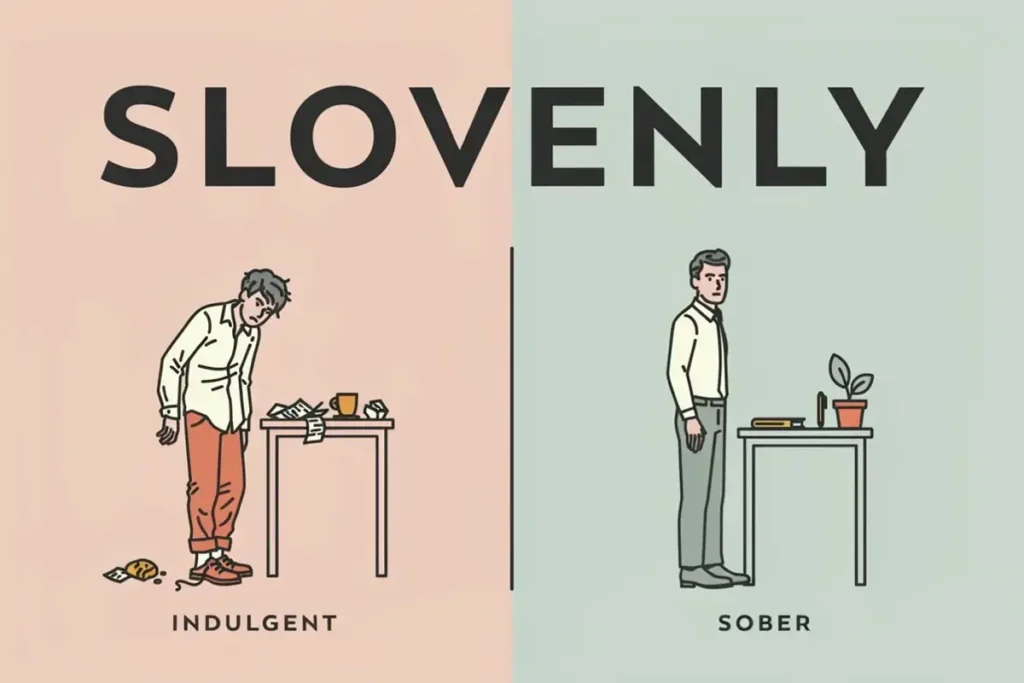
Slovenly Meaning
Slovenly describes someone who is habitually untidy, careless about personal appearance, or messy in their work and surroundings.
Examples:
- His slovenly desk made it difficult to find important documents.
- The report looked slovenly because it contained spelling mistakes and inconsistent formatting.
Being slovenly has nothing to do with being indulgent or sober. It refers to appearance, cleanliness, or organization rather than personality or decision making.
Feisty Or Gracious
These words describe very different personality traits.
Feisty refers to someone who is spirited, confident, energetic, and willing to stand up for themselves. A feisty person may challenge ideas or defend their opinions without hesitation.
Gracious describes someone who is kind, polite, considerate, and generous toward others. Gracious people make others feel welcome and respected.
Neither word is a synonym for indulgent or sober, although a person can display several of these traits at the same time.
For example:
- A gracious leader can also have a sober approach to decision making.
- A feisty entrepreneur may still enjoy an indulgent lifestyle outside work.
Understanding these differences helps you choose words that match the personality you want to describe.
Writers who enjoy polishing their vocabulary may also appreciate our guide to stellar spelling mistakes to avoid, where we explain why steller is usually considered incorrect.
Expert Language Insight
Native speakers rarely think of indulgent and sober as direct opposites. Instead, they choose each word based on the impression they want to create.
For example, calling a dessert indulgent immediately suggests richness, comfort, and enjoyment. Calling the same dessert sober would sound unnatural because food is rarely described that way. On the other hand, phrases like a sober assessment, a sober warning, or a sober discussion are common because they emphasize careful thinking and emotional restraint.
Professional editors also pay close attention to context. In lifestyle writing, indulgent often creates a positive image by highlighting luxury or relaxation. In business or academic writing, sober usually carries a positive meaning because it suggests objectivity, sound judgment, and credibility.
Context also changes the emotional tone. Saying someone has an indulgent personality may suggest warmth and generosity, while describing the same person as self indulgent can imply excess or poor self control. Likewise, describing someone as sober may praise their maturity, but in another situation it may suggest they are reserved or less expressive.
Choosing the right word is less about memorizing definitions and more about understanding the message you want readers to take away.
Frequently Asked Questions About Indulgent vs Sober
What is the difference between indulgent and sober?
The main difference is their focus. Indulgent describes someone who enjoys pleasure, comfort, or flexibility, while sober describes someone who values restraint, seriousness, and careful judgment. Both words are positive in the right context and neither is automatically better than the other.
Can a person be both indulgent and sober?
Yes. Personality is complex, and most people display different traits depending on the situation. Someone may be sober when making financial decisions but indulgent during vacations, celebrations, or family gatherings.
Is indulgent a positive or negative word?
It depends on the context. An indulgent dessert or vacation usually has a positive meaning because it suggests enjoyment and luxury. An indulgent spending habit or parenting style may carry a mildly negative tone if it implies excess or a lack of discipline.
Does sober always mean not drinking alcohol?
No. Although sober often refers to someone who is not intoxicated, it also describes a serious, thoughtful, and restrained attitude. Native speakers rely on context to determine which meaning is intended.
Is indulgent used in psychology?
Yes. Psychology and personality research sometimes use indulgent to describe people who are more comfortable seeking pleasure, expressing emotions, or allowing flexibility. The exact definition depends on the psychological model being discussed.
What is a sober personality?
A sober personality is generally calm, practical, emotionally controlled, and thoughtful. People with this temperament often prefer careful planning, measured decisions, and realistic expectations over impulsive behavior.
Is slovenly the opposite of sober?
No. Slovenly describes someone who is untidy or careless about appearance and organization. Sober describes attitude, judgment, or emotional restraint. The two words describe completely different characteristics.
Which word should I use in writing?
Choose the word that best matches your intended meaning. Use indulgent when describing pleasure, generosity, comfort, or leniency. Use sober when describing seriousness, self control, careful thinking, or a measured approach. Reading the sentence aloud can help you decide which word sounds more natural.
Conclusion
Understanding the difference between indulgent and sober becomes much easier once you look beyond simple dictionary definitions. These words describe different attitudes, behaviors, and ways of approaching life rather than competing ideas.
An indulgent person often embraces comfort, enjoyment, flexibility, and emotional expression. A sober person usually values restraint, thoughtful judgment, and self discipline. Neither trait is inherently better because each can be helpful in different situations. A balanced life often includes moments of enjoyment alongside moments that require careful thinking and moderation.
The most important step is choosing the word that matches your context. If you are describing luxury, generosity, or permissiveness, indulgent is usually the better choice. If you want to emphasize seriousness, practicality, or emotional control, sober will communicate your message more accurately.
Expanding your vocabulary is about more than learning definitions. It is about recognizing the subtle shades of meaning that allow you to communicate with confidence and precision. Once you understand how native speakers use these words, selecting the right one becomes much more natural.