If you’ve searched for realist vs realest, chances are you’ve seen both words online and wondered if they mean the same thing or if one of them is simply wrong. Social media, song lyrics, and casual conversations have made realest more visible than ever, while realist has been part of standard English for centuries. Since both words come from the root word real, it is easy to assume they can be used interchangeably. They cannot.
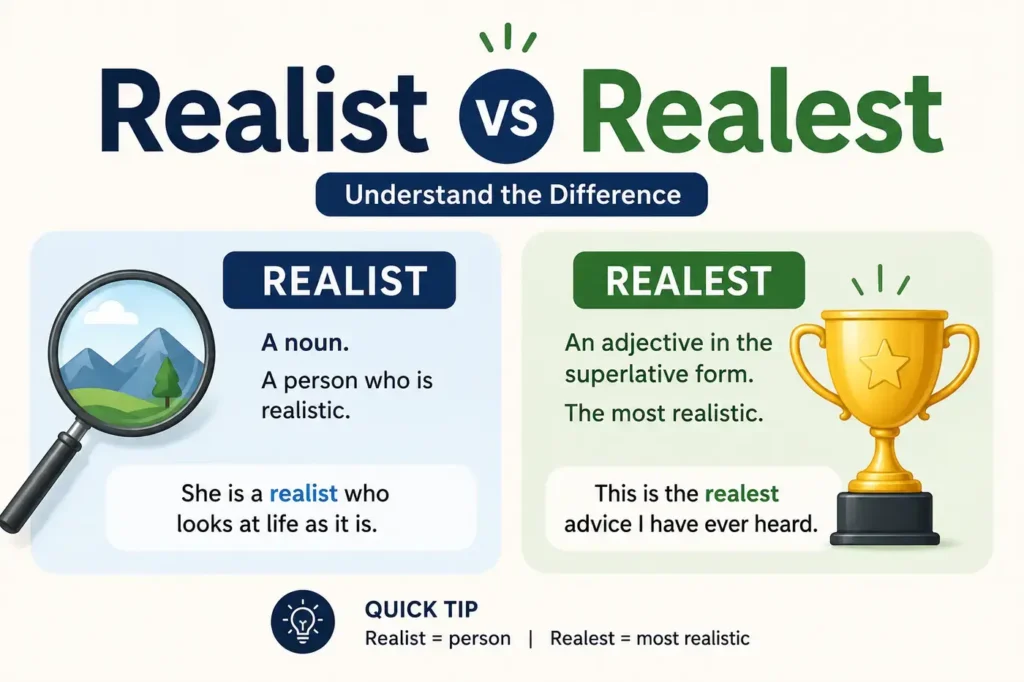
The short answer is simple. Realist is a standard English noun with a well established meaning. Realest is also a real word, but it serves a completely different purpose. It is the superlative form of the adjective real and is most common in informal speech, music, and popular culture.
Understanding this difference helps you choose the right word with confidence. In this guide, you will learn what each term means, how they are used in everyday English, where they overlap, and why people often confuse them. You will also discover grammar rules, pronunciation, sentence examples, regional preferences, expert writing tips, and practical advice that makes the distinction easy to remember.
Quick Definition
Realist is a noun that describes a person who sees situations as they truly are instead of relying on wishful thinking. Realest is the superlative form of real and means the most genuine, authentic, or true. Although both words come from the same root, they have different meanings, grammar, and uses.
Quick Answer
If you are choosing between these two words, the decision depends on what you want to say.
- Use realist when talking about a person with a practical or realistic outlook.
- Use realest when describing someone or something as the most genuine or authentic.
- Do not replace one word with the other because they perform different grammatical roles.
- If you are writing formally, realist is much more common than realest.
A simple way to remember the difference is this. A realist is a person. Realest is a description.
Comparison Table
| Feature | Realist | Realest |
|---|---|---|
| Part of speech | Noun | Adjective |
| Meaning | A person who accepts reality and thinks practically | The most real, genuine, or authentic |
| Origin | From the word real plus the suffix ist | Superlative form of real |
| Correct form | Standard English | Standard but mostly informal |
| Formality | Formal and informal | Mostly informal |
| Common contexts | Psychology, philosophy, politics, literature, everyday conversation | Music, casual speech, social media, entertainment |
| Usage frequency | Very common | Less common |
| Example | She is a realist who plans carefully. | He is the realest friend I know. |
If you often get confused by similar spelling variations, learning the correct spelling of “eyeing” can help you avoid another common English writing mistake.
Understanding Both Words
Although these words share the same root, they developed for different reasons and belong to different parts of speech. Looking at each one separately makes the difference much clearer.
What Does Realist Mean
A realist is someone who views situations objectively and focuses on facts instead of unrealistic expectations. Realists recognize challenges, weigh evidence, and make decisions based on what is likely to happen rather than what they hope will happen.
The word appears in many fields, including psychology, philosophy, politics, economics, literature, and everyday conversation. In each case, the central idea remains the same. A realist accepts reality and responds to it in a practical way.
Here are a few common situations where the word is used.
- Describing someone with a practical mindset.
- Talking about philosophical beliefs.
- Discussing political theories.
- Explaining literary movements.
- Comparing different personality types.
What Does Realest Mean
Realest is the superlative form of the adjective real. It means the most genuine, honest, authentic, or true among a group of people or things.
Although dictionaries recognize the word, it appears much more often in casual conversation than in formal writing. It has become especially popular in music, sports, entertainment, and social media, where people use it to praise someone’s honesty or loyalty.
For example, someone might say that a close friend is the realest person they know because that friend is dependable, sincere, and always truthful.
Unlike realist, this word does not describe a personality type or philosophy. Instead, it compares one person or thing with others.
Realist vs Realest Key Differences
Many people confuse these words because they share the same root. Once you understand their grammatical roles, the difference becomes straightforward.
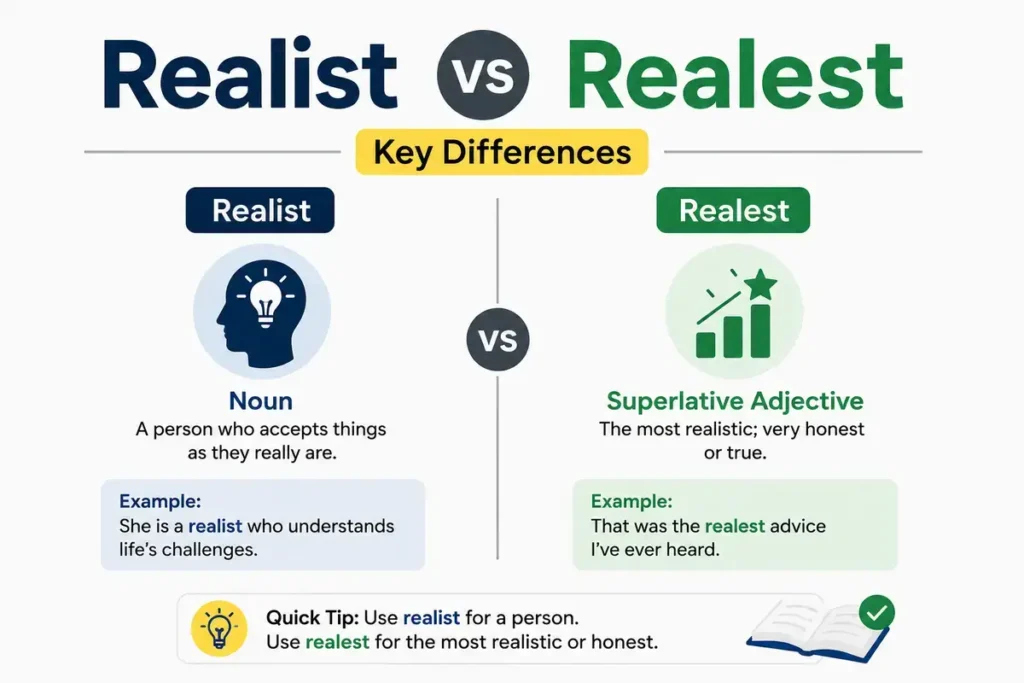
The biggest distinction is that realist names a person, while realest describes someone or something. One is a noun. The other is an adjective.
Here is a side by side comparison.
| Realist | Realest |
|---|---|
| Refers to a person | Describes a person or thing |
| Noun | Superlative adjective |
| Focuses on practical thinking | Focuses on authenticity or genuineness |
| Common in formal and academic writing | Most common in casual language |
| Used in philosophy and psychology | Used in everyday speech and popular culture |
Another helpful way to remember the difference is to ask yourself a simple question.
Are you naming a person or describing one?
If you are naming someone with a practical outlook, choose realist.
If you are describing someone as the most authentic or genuine, choose realest.
Which Word Is Correct
A common question is which word is correct. The answer is that both words are correct, but they are correct in different situations.
Choose realist when referring to someone who thinks practically or sees the world as it is.
Examples include:
- She is a realist who always considers the facts before making a decision.
- His friends describe him as a realist because he stays calm during difficult situations.
- The author takes the perspective of a political realist throughout the book.
Choose realest when comparing levels of authenticity or sincerity.
Examples include:
- She has been the realest friend I have ever had.
- Fans called him the realest artist in the industry.
- Everyone agreed that her apology felt the realest.
Although both words are grammatically correct, they cannot replace each other. Saying someone is a realest when you mean they are a practical thinker changes the meaning completely.
Pronunciation Guide
Both words begin with the same root, but they end differently because they belong to different grammatical categories.
Realist
IPA pronunciation:
/ˈriːəlɪst/
Syllable breakdown:
Ree uh list
Realest
IPA pronunciation:
/ˈriːəlɪst/ or /ˈriːələst/
Syllable breakdown:
Ree uh list or Ree uh lest
The pronunciation of realest varies slightly among native speakers because the middle vowel may become softer in fast speech. Both pronunciations are widely understood in everyday English.
Is Realest A Word
Yes. Realest is a real English word.
Many people assume it is slang because they first encounter it in songs, movies, or social media posts. In reality, it follows the normal English pattern for forming superlative adjectives. Just as small becomes smallest and kind becomes kindest, real can become realest when comparing authenticity or genuineness.
That said, frequency matters. In professional writing, journalists, editors, and academics often prefer phrases such as most authentic, most genuine, or most sincere because they sound more formal. In casual conversation, however, realest feels natural and is widely understood.
Expert Language Insight
As an editor, one pattern appears repeatedly. Writers usually confuse these words because they focus on the shared root instead of the grammar.
A reliable way to avoid mistakes is to identify the role the word plays in the sentence before choosing it. If the word names a person with a practical outlook, the noun realist is the correct choice. If the sentence compares authenticity or sincerity, the superlative adjective realest fits naturally.
Thinking about grammar first instead of spelling makes the correct choice much easier. It also helps you avoid errors that spell checkers may not catch because both words are valid English.
Examples In Sentences
Seeing each word in context is one of the easiest ways to understand the difference. Read the examples carefully and notice how one word names a person while the other describes the highest level of authenticity.
Realist Examples
A realist is someone who approaches situations with logic, evidence, and practical thinking.
- Sarah is a realist who always considers the facts before making a decision.
- Even during difficult times, Mark remained a realist and focused on practical solutions.
- The coach is a realist who prepares the team for every possible challenge.
- As a realist, she understood that success would take time and consistent effort.
- His friends admire him because he is a realist who never makes empty promises.
- The economist is a realist who bases every prediction on reliable data.
- My grandfather was a realist, so he always planned for unexpected expenses.
- The novelist created a realist character who viewed life without illusions.
- She considers herself a realist instead of an optimist or a pessimist.
- A good leader can be a realist while still inspiring others.
Realest Examples
Realest describes the highest level of authenticity, honesty, or sincerity.
- She has been the realest friend I have ever known.
- Everyone agreed that his apology sounded the realest.
- They called her the realest person on the team because she always spoke honestly.
- That interview gave fans the realest look at the actor’s life.
- His advice was the realest thing anyone said that day.
- Many listeners believe this is the realest song the artist has released.
- She shared the realest version of her story without hiding her struggles.
- Out of everyone in the group, he remained the realest from beginning to end.
- The documentary offers the realest picture of life in the region.
- Her reaction felt the realest because it came straight from the heart.
These examples highlight an important difference. Realist identifies a person with a practical mindset, while realest compares how genuine or authentic someone or something is.
Common Mistakes
People usually confuse these words because they look similar and share the same root. In reality, they belong to different parts of speech and serve different purposes.
Here are the mistakes that appear most often.
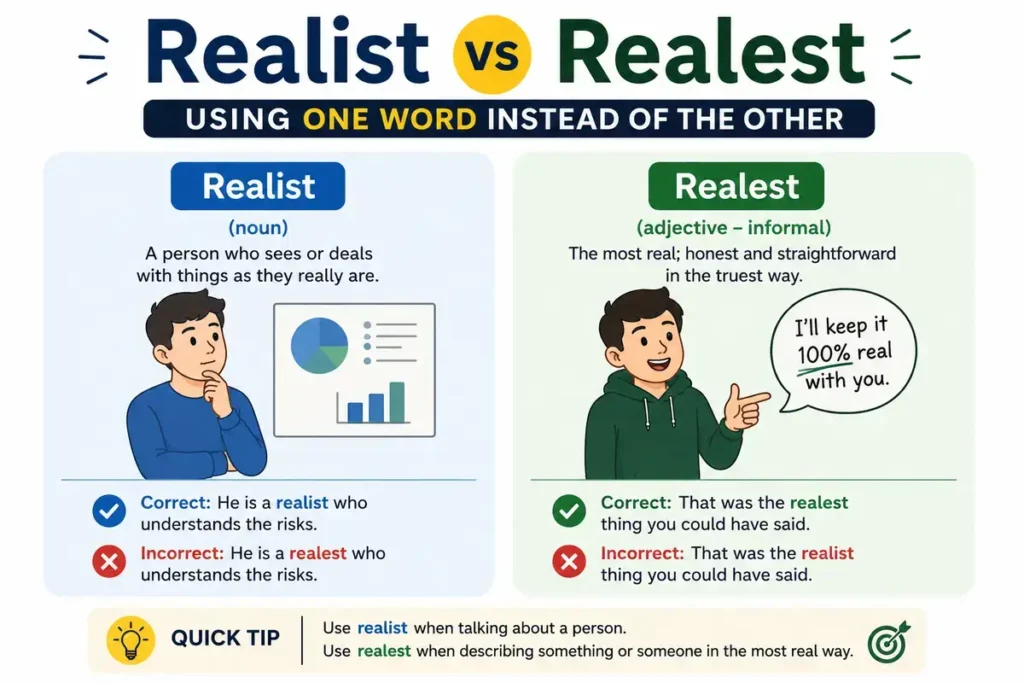
Using One Word Instead Of The Other
This is the most common error.
Incorrect:
She is the realist friend I have.
Correct:
She is the realest friend I have.
In this sentence, the speaker is comparing levels of authenticity, not describing someone’s outlook on life.
Assuming Realest Is Only Slang
Many people believe realest exists only in music or internet culture.
That is not accurate.
The word is recognized in English dictionaries because it follows the standard rule for forming a superlative adjective. It simply appears more often in informal communication than in academic or professional writing.
Treating Realist As An Adjective
A realist is a noun.
Incorrect:
He gave a realist answer.
Correct:
He gave a realistic answer.
This mistake happens because writers confuse realist with realistic, which is the adjective form.
Confusing Realist With Realistic
Although these words are closely related, they are not interchangeable.
Think of them this way.
- A realist is a person.
- Realistic describes an idea, plan, expectation, or object.
Examples:
- She is a realist.
- She has a realistic plan.
Understanding this distinction makes many grammar mistakes disappear.
Like realist vs realest, another frequently confused spelling pair shows how a single misplaced letter can completely change whether a word is correct.
Realist vs Realest Pronunciation Tips
Both words begin with the same sound because they share the same root.
Realist
IPA:
/ˈriːəlɪst/
Pronunciation:
REE uh list
Realest
IPA:
/ˈriːəlɪst/ or /ˈriːələst/
Pronunciation:
REE uh list or REE uh lest
In everyday conversation, native speakers pronounce both naturally without placing heavy emphasis on the ending. The surrounding sentence usually makes the meaning clear.
Etymology And Word Origin
The history of these words explains why they look alike but have different meanings.
The adjective real comes from the Late Latin word realis, meaning actual or genuine. As English evolved, new words formed by adding common suffixes.
The suffix ist created realist, referring to a person associated with realism or practical thinking. Over time, the word also became important in philosophy, politics, literature, and psychology.
The ending est forms the superlative degree of many short adjectives. That same pattern produced realest, meaning the most real, genuine, or authentic.
Although both words come from the same root, their development followed different grammatical paths. One became a noun, while the other remained an adjective.
Regional Usage
The meanings stay the same across major English speaking countries, but usage patterns vary slightly.
American English
American speakers use realist regularly in education, politics, psychology, business, and everyday conversation.
Realest appears more often in music, entertainment, sports, and social media. Younger speakers generally use it more frequently than older generations.
British English
British English also recognizes both words.
Realist appears commonly in academic and professional writing. Realest exists but is less common in formal contexts. Writers often prefer phrases such as most genuine or most authentic.
Australian English
Australian English follows a similar pattern.
Realist is standard across all forms of writing, while realest appears mainly in informal speech and popular culture.
Canadian English
Canadian English combines influences from both American and British English.
You’ll encounter realist regularly in schools, newspapers, and books. Realest is understood by native speakers but is used more often in casual conversation than in formal writing.
Overall, the meaning remains consistent regardless of region. Only the frequency and level of formality change.
Grammar Rules
Understanding the grammar behind these words removes most confusion.
Part Of Speech
Each word belongs to a different grammatical category.
- Realist is a noun.
- Realest is a superlative adjective.
Because they perform different jobs, they cannot replace each other.
Sentence Structure
A noun usually identifies a person.
Example:
Emma is a realist.
An adjective describes a noun.
Example:
Emma is the realest person in our group.
The grammar changes because the purpose of each word changes.
Plural Form
The plural of realist is realists.
Examples:
- Many realists supported the proposal.
- Political realists often emphasize practical solutions.
Since realest is an adjective, it does not have a plural form.
Comparative Forms
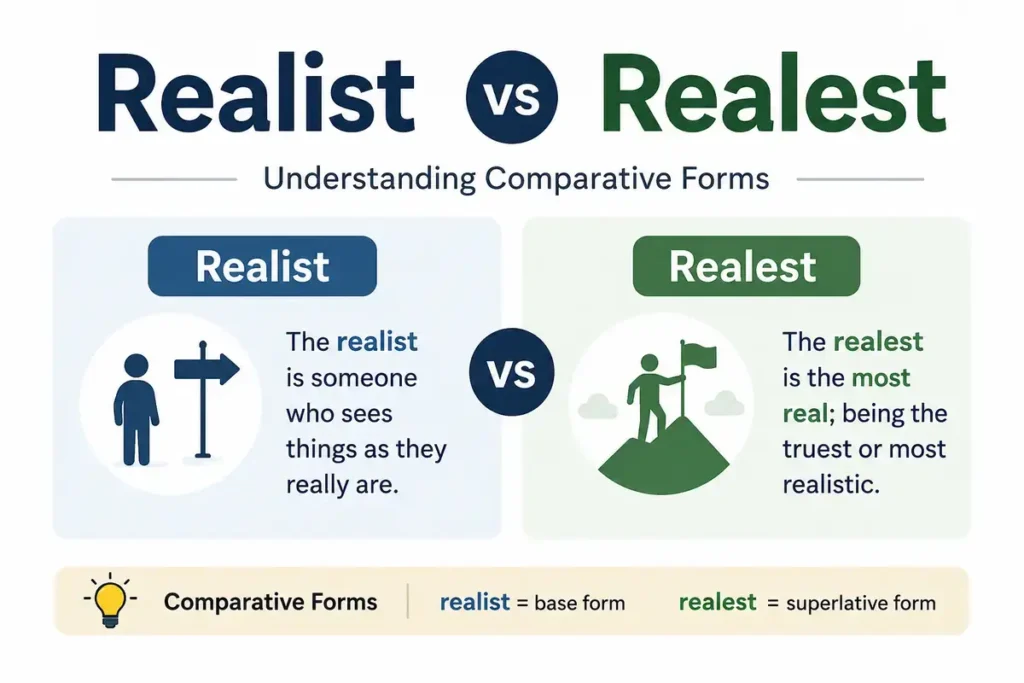
English forms comparisons like this.
- Real.
- Realer.
- Realest.
In practice, many native speakers prefer more real and most real in formal writing because they sound smoother. Still, realest remains grammatically acceptable and widely understood, especially in informal English.
Realist Meaning In Psychology
In psychology, a realist is generally someone who evaluates situations based on observable facts instead of unrealistic expectations or wishful thinking.
Realism does not mean negativity. A realist can be hopeful and optimistic while still recognizing challenges and limitations. This balanced perspective often helps people make thoughtful decisions because they consider evidence before reaching conclusions.
Psychologists sometimes discuss realism alongside optimism and pessimism to explain different ways people interpret events. None of these perspectives is automatically right or wrong. Each has strengths depending on the situation.
Realist Vs Idealist
People often compare a realist with an idealist because the two approaches represent different ways of thinking.
A realist focuses on what is practical and achievable. An idealist focuses on what could be possible under the best circumstances.
Here is a simple comparison.
| Realist | Idealist |
|---|---|
| Focuses on facts | Focuses on possibilities |
| Values practicality | Values ideals and vision |
| Plans around reality | Plans around aspirations |
| Expects obstacles | Believes obstacles can often be overcome |
Most people are not completely one or the other. Depending on the situation, someone may think like a realist in one area of life and an idealist in another.
Related Words And Commonly Confused Terms
Learning a few related words makes it much easier to understand how these terms fit into everyday English. Some belong to the same word family, while others are commonly confused because they have similar meanings or spellings.
Here are the words people most often search alongside these terms.
| Word | Meaning | Part of Speech |
|---|---|---|
| Real | Genuine or true | Adjective |
| Reality | The state of things as they actually exist | Noun |
| Realism | A philosophy or approach based on facts and practical thinking | Noun |
| Realistic | Practical and based on reality | Adjective |
| Realistically | In a practical or sensible way | Adverb |
| Idealist | A person guided by ideals or high principles | Noun |
| Idealistic | Guided by ideals rather than practical considerations | Adjective |
| Authentic | Genuine and trustworthy | Adjective |
| Genuine | Truly what something claims to be | Adjective |
| Practical | Focused on realistic solutions | Adjective |
Understanding this word family helps you choose the right term without second guessing yourself. For example, a realist usually has a realistic outlook and often values realism when making decisions.
Realist Meaning In Everyday Life
Outside philosophy and psychology, people use realist to describe someone who stays grounded and makes decisions based on facts instead of emotions alone.
A realist is not someone who lacks hope. In fact, many successful leaders, business owners, teachers, and parents are realists because they balance optimism with practical thinking. They prepare for challenges, consider evidence, and make informed decisions without ignoring possible risks.
In everyday conversation, calling someone a realist is usually a compliment. It suggests they are dependable, level headed, and capable of seeing situations clearly.
Realest In Modern Culture
The word realest has become especially popular over the past two decades through music, sports, podcasts, and social media. It often describes someone who is honest, loyal, authentic, or true to themselves.
For example, fans may describe an athlete as the realest player on the team because they admire that person’s honesty and consistency. A listener might say an interview was the realest conversation they had heard because it felt sincere and unfiltered.
Although the word appears frequently in popular culture, formal writers often replace it with expressions such as most authentic, most genuine, or most sincere when writing for academic or professional audiences.
What Native Speakers Actually Say
Native speakers naturally choose different words depending on the situation.
In professional writing, you’ll often read sentences like these.
- She is a realist with years of leadership experience.
- The report presents a realistic assessment of the project.
- The author takes a realist approach to international relations.
In casual conversation, people are more likely to say things such as:
- He is the realest person I know.
- That was the realest advice anyone gave me.
- She always keeps it real.
Notice that realest appears most often in spoken English and informal communication, while realist is common in both formal and informal contexts.
Expert Language Insight
As an editor, one of the easiest ways to avoid mistakes is to identify the job each word performs before you write it.
Start by asking yourself a simple question.
Are you talking about a person with a practical outlook, or are you describing the highest level of authenticity?
If you’re referring to someone’s mindset, choose realist. If you’re comparing people or things based on how genuine they are, realest is the appropriate choice in informal contexts.
Another useful habit is to think about your audience. Academic papers, business reports, and professional publications usually favor realist because it has a precise meaning and a long history in formal English. Realest works well in conversational writing, interviews, creative content, and social media where a more relaxed tone feels natural.
Good writing is not about choosing the more impressive word. It is about choosing the word that communicates your meaning clearly and fits the context.
Expanding your vocabulary with contrasting descriptive words can make your writing more precise, especially when choosing between words that express very different attitudes or behaviors.
Frequently Asked Questions
Is realest a word?
Yes. Realest is a legitimate English word and the superlative form of real. It means the most genuine, authentic, or truthful. Although it is grammatically correct, it appears much more often in informal speech, music, and social media than in formal writing.
What is the difference between a realist and realest?
A realist is a person who approaches situations with practical thinking and accepts reality as it is. Realest is an adjective that describes someone or something as the most authentic or genuine. Since one is a noun and the other is an adjective, they cannot be used interchangeably.
What does realist mean?
A realist is someone who bases opinions and decisions on facts, evidence, and practical experience rather than unrealistic expectations. The term is also used in philosophy, politics, psychology, literature, and international relations.
Can realest be used in formal writing?
It can, but it is uncommon. In formal contexts, writers often choose alternatives such as most authentic, most genuine, or most sincere because they sound more natural in academic and professional communication.
What is the opposite of a realist?
The most common opposite is idealist. A realist focuses on practical reality, while an idealist places greater emphasis on goals, ideals, and possibilities. Most people display qualities of both depending on the situation.
Why do people confuse these words?
The confusion happens because both words share the same root and look similar. However, they belong to different parts of speech and express different ideas. Understanding their grammatical roles makes the distinction much easier.
Do dictionaries recognize both words?
Yes. Modern English dictionaries recognize both realist and realest. The main difference is not correctness but usage. Realist appears much more frequently in formal English, while realest is primarily associated with informal communication.
Which word should I use?
Choose the word that matches your meaning. Use realist when referring to a person with a practical outlook. Use realest only when describing someone or something as the most genuine or authentic. If you’re writing for a formal audience, consider using most authentic or most genuine instead of realest.
Conclusion
Choosing between these two words becomes much easier once you understand their purpose. A realist is someone who sees the world through a practical lens and makes decisions based on facts. Realest, on the other hand, describes the highest level of authenticity or sincerity and is most common in casual conversation.
Although both words are correct, they are not interchangeable because they belong to different parts of speech. One names a person, while the other describes a quality. Paying attention to that distinction will help you avoid common grammar mistakes and communicate your ideas more clearly.
When writing, always think about your audience and the context. In formal communication, realist is widely accepted and frequently used. Realest works best in informal settings where a conversational tone feels appropriate.
When deciding between realist vs realest, think about what you want to communicate. Use realist for a person with a practical outlook and realest to describe the most genuine or authentic person or thing. Choosing the right word for the context will make your writing clearer, more accurate, and more natural.