Have you ever finished writing a sentence and wondered if you should use afterward vs afterword? These two words look almost identical and sound exactly alike in standard American English, but they have completely different meanings. Choosing the wrong one can change the meaning of your sentence or make your writing look less polished.
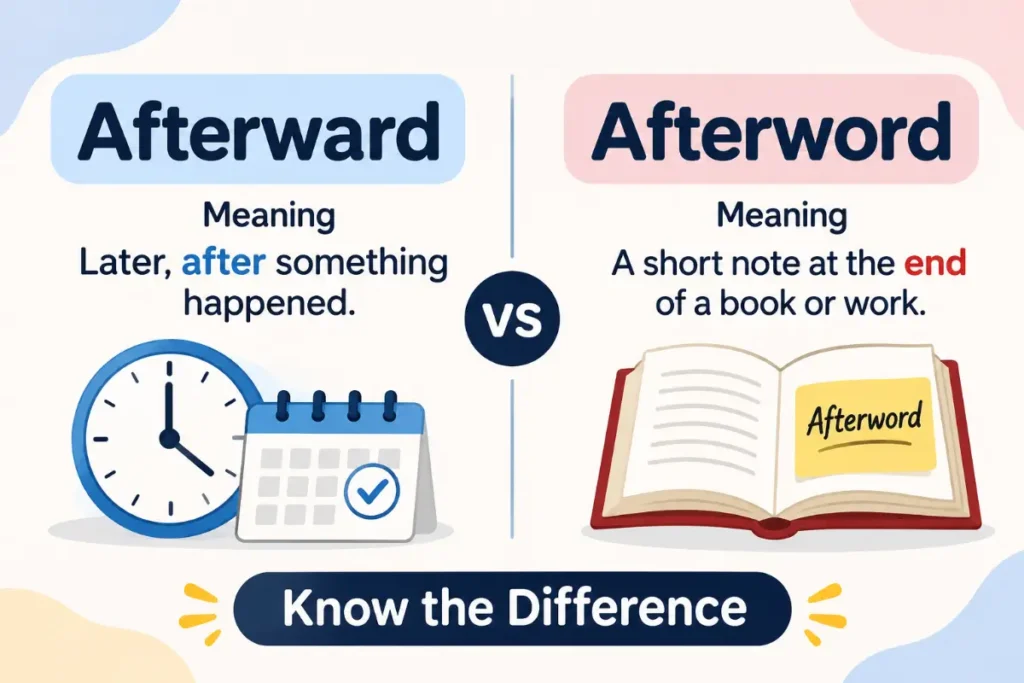
The difference is simple once you understand what each word describes. Afterward is an adverb that means later or after something happens. You use it when talking about time, events, or the order in which things occur. Afterword, on the other hand, is a noun that refers to a short section at the end of a book. An author, editor, or another contributor may use it to share final thoughts, explain the background of the work, or provide additional information.
The confusion often comes from their similar pronunciation and nearly identical spelling. However, one ends in -ward, while the other ends in -word. This guide explains their meanings, grammar rules, pronunciation, and differences with practical examples so you can choose the correct word in conversations, emails, academic assignments, and professional writing.
Quick Answer
Afterward means later or after a particular event. It is an adverb used to describe when something happens. Afterword is a noun that refers to an additional section at the end of a book. For example, “We went to dinner afterward” describes time, while “The author included an afterword” refers to a book section.
What Is the Difference Between Afterward and Afterword?
The main difference is their meaning and grammatical function. Although both words sound the same in American English, they are not interchangeable.
Afterward describes the timing of an event. You use it when something happens after another activity, situation, or experience. It answers the question “When?”
Afterword refers to a written section that appears near the end of a book, usually after the main text. It answers the question “What section of the book?”
Here is a simple comparison:
| Feature | Afterward | Afterword |
|---|---|---|
| Part of speech | Adverb | Noun |
| Meaning | Later or after something | A section at the end of a book |
| Main purpose | Describes time | Provides additional written information |
| Common context | Conversations, events, stories, emails | Books, novels, memoirs, nonfiction |
| Pronunciation | /ˈæftərwərd/ | /ˈæftərwərd/ |
| Example | We talked afterward. | The book has an afterword. |
| Can describe an event’s timing? | Yes | No |
| Can name a book section? | No | Yes |
The easiest way to remember the distinction is to focus on the final part of each word. Afterward contains ward, which appears in other words connected to direction or movement, such as forward and backward. Afterword contains word, which relates to writing, language, and books.

What Does Afterward Mean?
Afterward is an adverb that means later, following that, or after a particular event or action. It helps explain the order in which things happen.
For example:
“We had lunch and went shopping afterward.”
In this sentence, afterward tells the reader that shopping happened after lunch. It does not name a place, object, or written section. Instead, it provides information about time.
You can use the word in casual conversations, stories, professional emails, academic writing, and everyday communication.
Afterward as an Adverb
An adverb modifies a verb, adjective, or another adverb. In this case, afterward provides information about when an action takes place.
Consider these examples:
- We watched a movie and discussed it afterward.
- She completed her homework and called her friend afterward.
- The meeting ended, and everyone went home afterward.
- He apologized afterward for his rude comments.
- They visited the museum and had dinner afterward.
In each sentence, afterward connects two events in time. It tells the reader that one action happened following another.
You can also use the word at the beginning or middle of a sentence.
At the beginning:
“Afterward, we stopped at a coffee shop.”
In the middle:
“We afterward realized that we had taken the wrong road.”
At the end:
“We stopped at a coffee shop afterward.”
The final position is especially natural in everyday American English. However, the best placement depends on sentence structure and emphasis.
When Should You Use Afterward?
Use afterward when you want to explain that something happened later than another event.
Common situations include:
- Describing activities that happen in sequence.
- Explaining what happened following a meeting.
- Talking about plans after dinner or lunch.
- Sharing the next event in a story.
- Describing the result of an earlier action.
- Writing about events in chronological order.
For example, imagine that you attend a job interview in the morning. Later, you send a thank-you email to the interviewer.
You could write:
“I completed my interview at 10 a.m. and sent a follow-up email afterward.”
The word makes the order of events clear without repeating the entire time reference.
Synonyms and Related Words for Afterward
Several words and expressions have a similar meaning. You can use them to avoid repetition or adjust the tone of your writing.
| Alternative | Meaning | Example |
|---|---|---|
| Later | At a future time | I will call you later. |
| Subsequently | After something else | The company subsequently changed its policy. |
| Afterwards | Later or following an event | We went home afterwards. |
| After that | Following a particular event | We ate dinner. After that, we watched TV. |
| Then | Next in a sequence | She finished work, then went shopping. |
| Following that | After the mentioned event | Following that, we started another project. |
| Thereafter | From that time onward or after that | The agreement was revised thereafter. |
These alternatives are not always identical in tone or meaning. For example, subsequently and thereafter often sound more formal than later or then. In casual American English, afterward is usually a natural and straightforward choice.
What Does Afterword Mean?
Afterword is a noun that refers to a section placed at the end of a book. It usually appears after the main text and may be written by the author, editor, translator, or another contributor.
An afterword gives readers additional information about the book. It may explain how the author developed the idea, discuss the historical background, provide updates, or reflect on the message of the work.
For example:
“The novelist included an afterword explaining the inspiration behind the story.”
Here, afterword names a specific part of the book. It does not describe when the novelist explained something.
What Is the Purpose of an Afterword?
An afterword gives readers information that complements the main content. It is not usually part of the central story or argument. Instead, it offers context, reflection, or additional insight after the main work has finished.
Authors and publishers may use this section for several reasons.
1. To explain the inspiration behind a book
An author may describe the real events, people, or experiences that influenced the writing.
Example: “The author discussed her childhood experiences in the afterword.”
2. To provide historical context
A writer may explain the time period, cultural background, or historical events connected to the book.
Example: “The afterword provides useful historical information about the events described in the novel.”
3. To share personal reflections
Authors sometimes use an afterword to discuss their writing journey, challenges, or thoughts about the completed work.
Example: “He shared his thoughts about finishing the memoir in the afterword.”
4. To explain changes in a new edition
A revised edition may include an afterword that discusses updates, corrections, or new developments since the original publication.
Example: “The new edition includes an afterword about the changes made to the original text.”
5. To offer additional information
An afterword may answer questions, clarify certain details, or explain something that readers might find useful after completing the main content.
Example: “The editor added an afterword to explain the translation choices.”

Who Writes an Afterword?
An afterword can be written by different people depending on the purpose of the book.
- The author: Shares personal thoughts, explains the writing process, or discusses the book’s message.
- The editor: Provides information about revisions, publication decisions, or the development of the text.
- A guest contributor: Offers an independent perspective or explains the book’s importance.
- The translator: Discusses translation choices, cultural references, or challenges in adapting the original work.
For example, a historical novel might include an afterword written by a historian who explains the real events behind the fictional story.
Where Does an Afterword Appear in a Book?
An afterword usually appears after the main text. Its exact position can vary depending on the book’s design and publishing structure.
A typical book may follow this order:
- Title page
- Copyright page
- Dedication
- Preface or introduction
- Main chapters
- Conclusion or final chapter
- Afterword
- Acknowledgments
- Notes or references
- Index
This is only a general example. Not every book includes all these sections, and publishers may arrange the final pages differently.
The important point is that an afterword comes after the main content and adds information for the reader.
Afterward vs Afterword in Sentences
The best way to understand the difference is to compare the words in realistic situations. One describes when something happens, while the other identifies a section of a book.
Examples of Afterward in Everyday Conversations
- “Let’s finish dinner and go for a walk afterward.”The walk will happen after dinner.
- “I will explain everything afterward.”The speaker plans to provide an explanation later.
- “We met at the park and went for coffee afterward.”Coffee followed the meeting at the park.
- “She felt nervous before the presentation but relaxed afterward.”She became relaxed after the presentation.
- “Call me afterward so we can discuss the details.”The speaker wants a call after another activity or event.
- “They went shopping and watched a movie afterward.”Watching the movie happened after shopping.
- “I did not understand the instructions at first, but everything became clear afterward.”The situation became clearer later.
- “He apologized afterward because he realized his mistake.”The apology came after he recognized the problem.
- “We attended the wedding and visited our relatives afterward.”The family visit happened following the wedding.
- “The doctor examined me and explained the results afterward.”The explanation came after the examination.
Examples of Afterword in Books and Writing
- “The author included an afterword at the end of the novel.”The book contains an additional section after its main story.
- “I enjoyed reading the afterword because it explained the story’s inspiration.”The speaker liked the additional information.
- “The editor wrote the afterword for the revised edition.”The editor contributed a section at the end of the book.
- “The afterword discusses the historical background of the characters.”The section provides extra historical context.
- “You can find the author’s personal reflections in the afterword.”The writer shares thoughts after the main text.
- “The publisher requested an afterword from a well-known historian.”A historian was asked to contribute an additional section.
- “The afterword helped me understand the author’s message.”The final section provided useful insight.
- “I usually read the afterword after finishing the main chapters.”The reader saves the additional section until the main content is complete.
- “The new edition contains an afterword written several years after the original publication.”The book includes a later contribution.
- “Her afterword explains why she decided to write the memoir.”The section discusses the author’s motivation.
Examples in Emails and Workplace Communication
Both words can appear in professional writing, but they serve different purposes.
Afterward:
- “I will send you the updated report afterward.”
- “We can discuss the budget after the meeting afterward.”
- “Please contact the client afterward to confirm the details.”
- “The team reviewed the proposal and shared feedback afterward.”
- “I will complete the remaining tasks afterward.”
The second example is unnecessarily repetitive. A more natural version is: “We can discuss the budget after the meeting.”
Afterword:
- “The publisher requested an afterword for the new edition.”
- “Please review the afterword before approving the final manuscript.”
- “The author added an afterword to explain the research process.”
- “The editor suggested including an afterword with additional context.”
- “The final manuscript contains an introduction, ten chapters, and an afterword.”
These examples show that afterword is appropriate when discussing a book or manuscript rather than the timing of workplace activities.
Examples in Academic Writing
Afterward:
- “The researchers collected the responses and analyzed the data afterward.”
- “Students completed the experiment and discussed the results afterward.”
- “The professor explained the theory and answered questions afterward.”
- “The class visited the laboratory and wrote their observations afterward.”
- “The historical event was examined in greater detail afterward.”
Afterword:
- “The author included an afterword discussing the book’s academic contribution.”
- “The afterword provides additional context about the research.”
- “The editor wrote an afterword explaining the revised terminology.”
- “The textbook contains an afterword about the development of the subject.”
- “Students should read the afterword for additional information about the author.”
Common Mistakes When Using These Words
Because the two words sound alike, writers sometimes select one without considering its meaning. Learning the common mistakes can help you avoid errors in professional and everyday communication.
Using Afterword When You Mean Later
Incorrect: “We went to the restaurant afterword.”
Correct: “We went to the restaurant afterward.”
The sentence describes an activity that happened later. It does not refer to a book section, so afterward is the correct choice.
Using Afterward When Referring to a Book Section
Incorrect: “The author included an afterward at the end of the novel.”
Correct: “The author included an afterword at the end of the novel.”
The sentence names a written section of the book. Since afterword is a noun that refers to this section, it is the appropriate word.
Assuming Both Words Are Interchangeable
Incorrect: “I read the afterward to learn more about the author’s life.”
Correct: “I read the afterword to learn more about the author’s life.”
The first sentence uses an adverb where a noun is needed. The second sentence correctly identifies the final section of the book.
Replacing Afterward With Afterword in a Sequence
Incorrect: “We finished the meeting and had lunch afterword.”
Correct: “We finished the meeting and had lunch afterward.”
The sentence explains the order of two activities. Afterward provides the required time reference.
Confusing Afterword With an Epilogue
An afterword and an epilogue can both appear near the end of a book, but they have different purposes.
An epilogue is a concluding section of a story that provides information about what happens after the main events. It is usually part of the narrative itself.
An afterword is an additional section that discusses the book, its background, its meaning, or the author’s experience.
For example:
- Epilogue: The story reveals what happened to the main characters ten years later.
- Afterword: The author explains why she chose that ending.
Understanding this difference helps you use the correct publishing and literary terminology.
Afterword vs Epilogue vs Foreword
These three terms are often confused because they refer to different sections of a book. However, their positions and purposes are not the same.
| Term | Meaning | Typical Position |
|---|---|---|
| Afterword | Additional information or reflections about a book | Near the end |
| Epilogue | A concluding part of a narrative | At the end of the story |
| Foreword | An introductory section usually written by someone other than the author | Before the main text |
Afterword
An afterword provides additional information after the main content. It may discuss the author’s inspiration, historical background, or the significance of the book.
Example: “The historian wrote an afterword explaining the historical accuracy of the novel.”
Epilogue
An epilogue continues or completes a story after the main narrative has ended. It may reveal what happened to the characters or show the long-term results of the story’s events.
Example: “The epilogue reveals that the two friends reunited many years later.”
Foreword
A foreword appears near the beginning of a book. It is usually written by someone other than the author and may introduce the work, explain its importance, or recommend it to readers.
Example: “A respected professor wrote the foreword for the textbook.”
A simple way to remember the three terms is to think about their position. A foreword comes before the main text, an epilogue completes the story, and an afterword adds information after the main content.
Pronunciation of Afterward and Afterword
Both words are pronounced the same way in standard American English. They are homophones, meaning they share the same pronunciation but have different spellings and meanings.
Their pronunciation is generally represented as:
- Afterward: /ˈæftərwərd/
- Afterword: /ˈæftərwərd/
You can divide the pronunciation into parts:
- Af: The first syllable begins with a short A sound.
- Ter: The middle syllable contains the familiar sound in the word after.
- Ward or word: The final syllable has a similar pronunciation in both words.
Both usually have three syllables: af-ter-ward.
The identical pronunciation explains why spelling mistakes happen. When you hear either word in conversation, you cannot determine its written form from the sound alone. You need to understand the context.
For example:
“We will discuss the issue afterward.”
This sentence refers to a later discussion.
“The book includes an afterword.”
This sentence refers to a written section.
The surrounding words and meaning make the intended spelling clear.
American and British English Usage
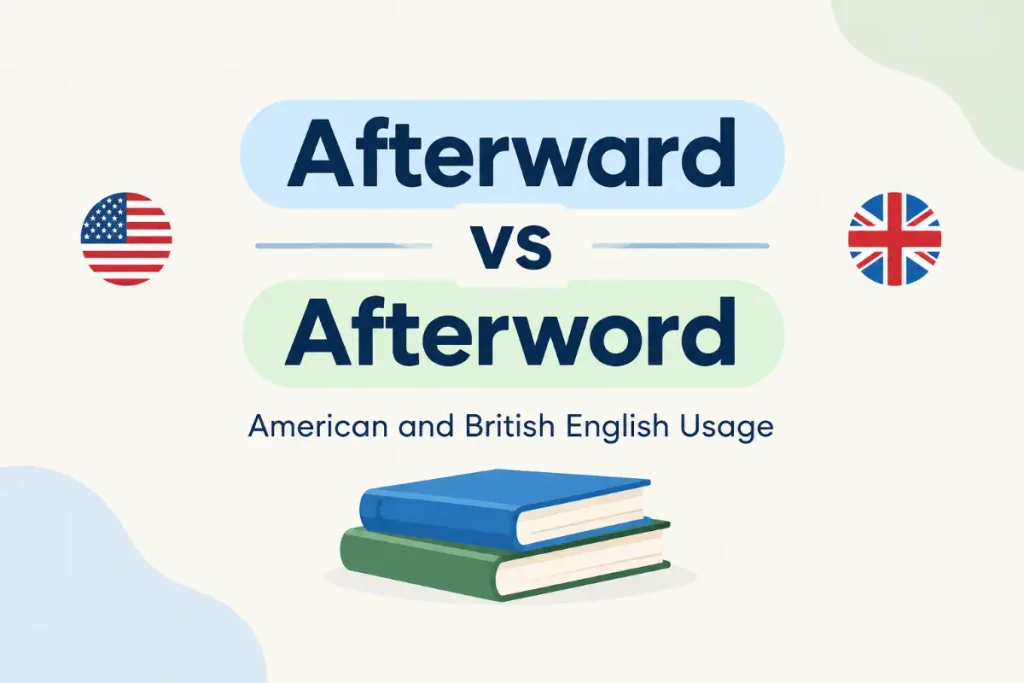
Both spellings are accepted in American and British English, but there is a small regional preference worth knowing.
American English commonly uses afterward without a final S. British English often uses afterwards, although both forms are understood.
The word afterword has the same meaning in American and British English. It refers to an additional section at the end of a book.
Here is a simple comparison:
| Region | Common Time Adverb | Book Section |
|---|---|---|
| American English | Afterward | Afterword |
| British English | Afterwards or afterward | Afterword |
| Canadian English | Afterward or afterwards | Afterword |
| Australian English | Afterwards or afterward | Afterword |
The main distinction remains unchanged across these varieties. Afterward and afterwards describe time, while afterword refers to a book section.
Is Afterwards Correct in American English?
Yes. Afterwards is a valid English adverb and is understood by American readers. However, afterward is generally the preferred form in standard American English.
For example:
American preference: “We went out for dinner afterward.”
Also correct: “We went out for dinner afterwards.”
Both sentences communicate the same idea. If you are writing for a US audience and want to follow common American usage, choose afterward.
How to Remember the Difference
A simple memory trick can help you select the right spelling without checking a dictionary every time.
Remember Ward Means Time or Direction
Afterward ends with ward, just like forward, backward, and toward. These words are often associated with movement, direction, or progression.
Think of afterward as moving forward in time from one event to the next.
Example: “We finished the exam and went home afterward.”
The sentence describes what happened next.
Remember Word Means Writing
Afterword contains the complete word word. This connection makes it easier to remember that an afterword belongs to a book or another written work.
Example: “The author included an afterword about the writing process.”
The final section contains additional words from the author or another contributor.
Use a Simple Question Test
When you are unsure which spelling to choose, ask yourself what your sentence is describing.
- Are you talking about when something happens? Use afterward.
- Are you naming a section at the end of a book? Use afterword.
For example:
“We will talk afterward.”
Ask: When will we talk? Later. Therefore, use afterward.
“The author wrote an afterword.”
Ask: What did the author write? A section at the end of a book. Therefore, use afterword.
This quick test works in conversations, emails, essays, and professional documents.
Frequently Asked Questions
Is Afterward or Afterword Correct?
Both are correct English words, but they have different meanings. Afterward is an adverb meaning later or following an event. Afterword is a noun referring to an additional section at the end of a book. Choose the spelling based on the meaning of your sentence.
What Is the Difference Between Afterward and Afterwards?
Afterward and afterwards both mean later or after something happens. American English generally prefers afterward, while British English commonly uses afterwards. Both forms are accepted, and neither changes the basic meaning of the sentence.
Is Afterword One Word or Two Words?
Afterword is written as one word. It refers to a section at the end of a book that provides additional information, commentary, or reflections. It is not normally written as two separate words.
Is Afterward a Formal Word?
Yes, afterward is appropriate in both formal and informal writing. You can use it in academic papers, business emails, reports, stories, and casual conversations. It is a natural way to describe the timing of an event without repeating a specific time reference.
What Is an Afterword in a Book?
An afterword is a section near the end of a book that provides additional information about the work. It may discuss the author’s inspiration, historical background, writing process, or the meaning of the book. The author, editor, translator, or another contributor can write it.
Are Afterward and Afterword Homophones?
Yes, they are homophones in standard American English because they have the same pronunciation but different spellings and meanings. Afterward describes time, while afterword names a written section at the end of a book.
Is an Afterword the Same as an Epilogue?
No. An afterword provides additional information or commentary about a book, while an epilogue is part of a story that concludes the narrative or explains what happens later to the characters. Both can appear near the end of a book, but their purposes differ.
Can I Use Afterword in a Sentence About Time?
No, not when you mean later or following an event. Use afterward instead. For example, write “We discussed the problem afterward,” rather than “We discussed the problem afterword.” The latter uses a noun where an adverb is needed.
Conclusion
The difference between these two words comes down to meaning and grammatical function. Afterward is an adverb that tells readers when something happens, while afterword is a noun that names an additional section at the end of a book. Both words sound alike in American English, so context is the best way to choose the correct spelling.
Remember the simple trick: ward connects with moving forward in time, while word connects with writing and books. Use afterward when describing what happens later, and choose afterword when discussing a book’s final written section. Once you understand this distinction, you can use both words confidently in everyday conversations and professional writing.