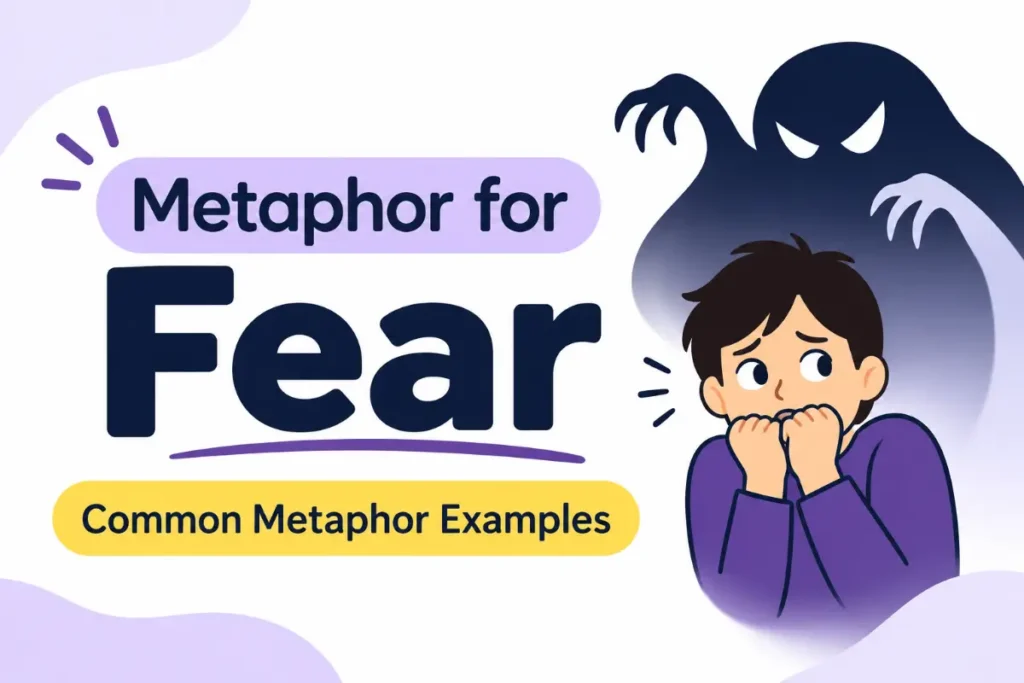
Fear is often described through the senses: a chill on the skin, a racing heart, a darkness closing in. Metaphors make those sensations visible, and they help readers feel what a character feels without a long explanation.
This guide shares 40 metaphors for fear, each with a plain meaning, plus example sentences, a scale from mild unease to full panic, tips for fiction and essays, and a list of clichés to replace. It is part of our collection of metaphor examples by topic, where you can browse every theme in one place.
What Is a Metaphor for Fear?
A metaphor for fear describes the feeling as something else, without using “like” or “as.” “She was frightened” tells the reader a fact. “Fear was ice water in her veins” lets them feel the cold. The comparison is not literal. It borrows the qualities of the image, such as cold, darkness, weight or a trap, to show what fear is like from the inside.
Everyday speech is full of fear metaphors. People say they were frozen with fear, haunted by a memory, paralyzed by doubt or walking on eggshells. Because these phrases are so familiar, most of us stop noticing them. Writers who notice them can choose fresher ones.
Why Do We Use Metaphors for Fear?
Fear is a body reaction before it is a thought. The heart speeds up, the skin goes cold, the muscles tighten and breathing changes. Writers use cold, darkness, shadows and traps because those are what fear feels like: shrinking, freezing and being unable to see a way out.
Fear also depends on what we cannot see. A sound in the dark is scarier than the same sound in daylight. That is why so many fear metaphors involve hidden things: fog, locked rooms, shadows and the unknown. A good metaphor makes the reader’s own body respond.
Fear as Darkness and Shadows
Darkness hides things, and fear grows when we cannot see clearly.
- Fear is a shadow that grows at night. It seems bigger when you cannot see clearly.
- The dark was a hungry mouth. Darkness felt like it could swallow her.
- Dread was a fog in the hallway. A vague threat you cannot see through.
- Her worries were ghosts in the attic. Unseen fears hiding in the mind.
- Night was a curtain hiding a thousand threats. Not seeing makes imagination run wild.
Fear as Cold and Body Sensations
Fear is felt in the body, so these images use cold, pressure and shaking.
- Fear is a cold hand on your shoulder. A sudden, chilling sense that something is wrong.
- Fear was ice water in his veins. His whole body went cold and still.
- Her heart was a drum in a tiny room. Pounding loudly and with nowhere to go.
- Panic was a vise around his chest. A tight, crushing feeling.
- Her legs were water. Weak and shaky with fear.
Fear as Monsters and Traps
These images give fear a shape, either a creature that threatens or a trap that holds.
- Fear is a monster under the bed. A threat that feels real even if it is unseen.
- He was a deer in the headlights. Frozen and unable to act.
- Her fear was a trap with no door. She felt stuck with no way out.
- Doubt was a snake in the grass. A hidden danger that could strike anytime.
- The unknown is a locked room. Not knowing what is inside makes it scarier.
Fear as Water, Falling and Heights
Water and drops suggest losing your footing and being overwhelmed.
- Fear is a rising tide. It starts small, then slowly takes over.
- She was drowning in dread. Overwhelmed and unable to catch her breath.
- The future was a cliff edge. One step could mean a long drop.
- Fear is a trapdoor beneath your feet. A sudden drop when you least expect it.
- He stood at the edge of a dark pool. Hesitating before something frightening.
Fear of the Unknown and the Future
Not knowing what comes next is one of the oldest sources of fear.
- The future was an unlit staircase. Each step felt uncertain in the dark.
- Tomorrow was a closed door with noises behind it. Not knowing what was inside made her afraid.
- He stared at a blank map with the edges torn off. He had no sense of where he was headed.
- The path ahead was a bridge with no far side. He could not see where it ended.
- The news was a fog bank rolling in. It slowly hid everything familiar.
Fear in the Mind
Some fear lives in thoughts, repeating and growing without a clear cause.
- Fear was a spider in the corner of his thoughts. Always there, quietly spinning.
- Her mind was a haunted house at midnight. Every thought creaked and echoed.
- A whisper of doubt kept echoing. Small at first, then louder with every repeat.
- Worry was a splinter in her thoughts. Small but impossible to ignore.
- His imagination was a projector playing horror films. His mind pictured the worst.
Fear That Freezes You
Fear can stop the body completely, and these metaphors capture that stillness.
- Fear turned him into a statue. He was unable to move.
- Her feet were glued to the floor. She was stuck in place.
- Time froze like ice around his words. He could not speak.
- He held his breath like a drawn bowstring. Tense and waiting.
- Panic was a cage that closed around her thoughts. She could not think clearly.

Facing and Overcoming Fear
Not every fear metaphor is about being trapped. Some show fear shrinking or being faced.
- Courage is a lantern that lights only the next step. Fear remains, but you can still move forward.
- Naming his fear shrank the dragon to the size of a dog. Understanding made it smaller.
- She crossed the bridge one plank at a time. She faced fear step by step.
- Fear is a coat she learned to wear and then take off. It is a feeling that can pass.
- The monster in the closet was only a coat on a hook. Fear shrinks when you look at it closely.
Metaphors for Fear in Sentences and Paragraphs
Here are short examples that show fear metaphors working inside real sentences.
- The hallway at night was a throat, and she was walking into it.
- His fear was a rising tide, quiet at first, then up to his chest before he noticed.
- When the phone rang at 3 a.m., dread was ice water down her spine.
- The audience was a sea of eyes, and she was a deer in the headlights.
Here is a longer example that builds one image across a paragraph:
The basement stairs were a throat, and every step took Maya deeper into it. The air grew colder, her heartbeat grew louder, and the light from the doorway shrank behind her to a coin, then a dot, then nothing. By the last step, fear was a hand on the back of her neck, patient and sure.
And here is a quieter example, showing fear as a mental habit instead of a sudden scare:
Before every presentation, Dev’s mind became a haunted house. Each doubt creaked on its own floorboard: the forgotten slide, the cracked voice, the silent room. By the time he stood up, the house was full.
The Fear Intensity Scale
Fear ranges from a tiny flicker to full panic. Matching your metaphor to the level keeps your writing believable.
| Level | Feeling | Metaphor | What it shows |
|---|---|---|---|
| Mild | Uneasy | A small draft slipped under the door of his mind. | A faint sense that something is off |
| Low | Nervous | Her stomach was a washing machine on spin. | Churning and unsettled |
| Medium | Scared | Fear was a cold hand on his shoulder. | A clear sense of threat |
| High | Terrified | Terror was ice water in her veins. | Overwhelming, body-wide fear |
| Extreme | Panic | Panic was a vise around his chest. | Crushing, hard to breathe |
| Long-term | Dread | Dread was a fog that never lifted. | Constant background fear |
How Writers Use Fear Metaphors
Fear is the engine of horror, thrillers, mysteries and many serious stories. Writers use metaphors for fear in a few smart ways.
Make ordinary things menacing. A hallway becomes a throat, a doorknob becomes a held breath, a quiet house becomes a trap. Turning familiar objects into threats makes the reader feel unsafe in everyday places.
Delay the reveal. Fear grows when the reader is still imagining. A metaphor can hint at what is coming, such as “the silence was a held breath,” without showing the danger itself.
Use the senses. Cold, sound, touch and smell create fear faster than description alone. A metaphor that mixes two senses, like “fear was a cold whisper,” can be especially effective.
Keep it restrained. In suspense writing, one sharp image beats a pile of them. Too many metaphors make the fear feel like decoration instead of danger.
Adjust for the reader. In stories for young readers, gentle images like shadows, fog and monsters that turn out to be coats on hooks suit the tone. In adult fiction, the same moment might use colder, darker images.
How to Use Fear Metaphors in School Essays
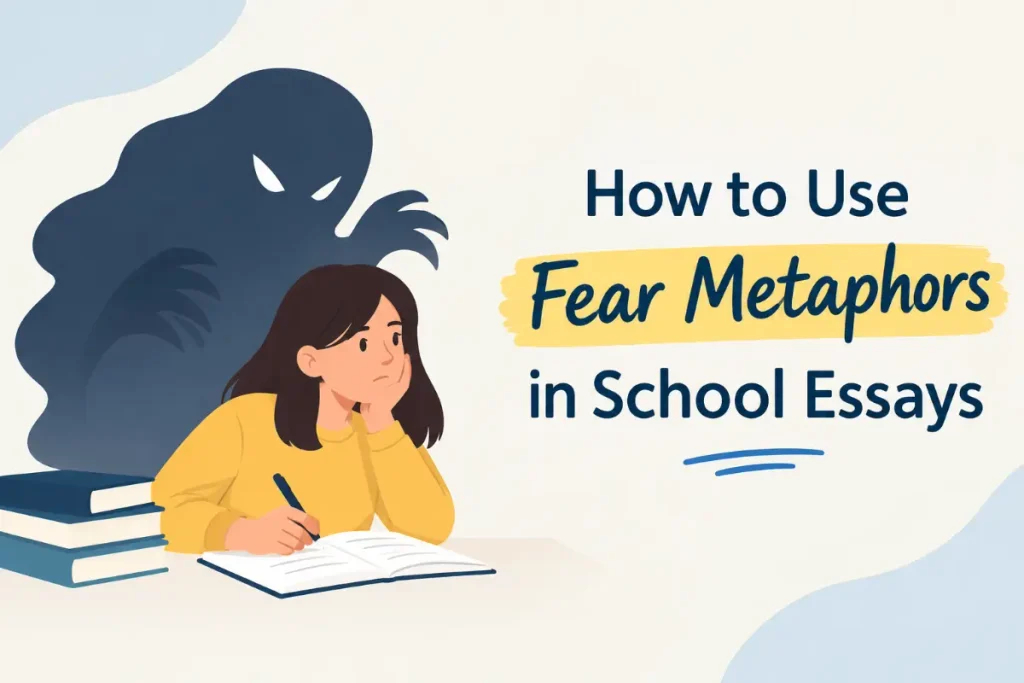
If you are asked to analyze a metaphor for fear in a poem or story, follow three steps: find it, explain it and show its effect.
- Find it. Look for a comparison that says fear is something, such as “fear was a rising tide.”
- Explain it. Say what the two things share. A tide rises slowly and cannot be stopped, so the comparison shows fear growing until it takes over.
- Show the effect. Say what the reader feels, such as tension, dread or sympathy for the character.
Here is a short sample paragraph:
The writer describes the child’s fear as “a monster under the bed.” This metaphor suggests that the fear feels real even though the child cannot see it. The word “under” shows that the danger is hidden, which makes the reader feel the child’s helplessness. As a result, the reader shares the child’s anxiety.
When you write your own metaphor in an essay, add a sentence that explains what it shows. A metaphor with no explanation leaves the reader guessing.
Common Fear Metaphors and Clichés to Avoid
Some fear phrases are so common that readers barely notice them. Try replacing them with fresher images when you can.
| Common phrase | Fresher alternative |
|---|---|
| Blood ran cold | His veins filled with winter. |
| Scared stiff | She went still as a photograph. |
| Heart in his mouth | His heart was a bird beating against a closed hand. |
| Frozen to the spot | The floor had a grip on her shoes. |
| Shaking like a leaf | His hands were a flag in a rising wind. |
| Cold feet | His courage had slipped out the back door. |
Other mistakes to watch for:
- Mixing images. “Fear was a cold hand that flooded over her like a wave” blends too many pictures. Choose one.
- Overdoing it. If every sentence is a metaphor, the reader stops feeling anything.
- Telling instead of showing. A metaphor should add a feeling, not repeat the word “scared.”
- Mismatch. Calling mild nerves a nightmare makes writing sound exaggerated.
Try It Yourself: Write a Fear Metaphor in Five Steps
Use these steps with any situation.
- Choose a moment. For example: standing outside the principal’s office.
- Decide the level. Is it a small worry or full panic?
- Pick a source. Think of weather, water, animals, darkness, machines or old houses.
- Write three versions. For example: The door was a mouth. / My stomach was a washing machine. / The hallway was a long throat.
- Choose the strongest and add a body detail. The door was a mouth, and my hands were so cold I tucked them under my arms.
Try the same moment as a calm, brave scene and notice how the images change.
Frequently Asked Questions
What Is a Good Metaphor for Fear?
“Fear is a shadow that grows in the dark” is a strong metaphor because fear often feels bigger when you cannot see its cause. For quieter or sudden fear, you could also use “a pot with the lid on” or “a cold hand on your shoulder.”
Is “Butterflies in My Stomach” a Metaphor?
“Butterflies in my stomach” is an idiom built on a metaphor. It describes nervous excitement as if insects were moving inside your stomach.
What Is the Difference Between Fear and Anxiety Metaphors?
Fear usually points to a clear, immediate threat, so its metaphors often involve monsters, cold and traps. Anxiety describes ongoing worry, so its metaphors tend to involve noise, tangles and pressure. See our guide to metaphors for anxiety.
Can I Describe Fear With a Simile?
Yes. “Her heart pounded like a drum” is a simile because it uses the word “like” to make a comparison. A metaphor would say, “Her heart was a drum.”
What Is a Metaphor for Fear of the Unknown?
Images of darkness and hidden things work best. For example, an unlit staircase, a closed door, a fog bank or a blank map can represent fear of the unknown. These images show how fear grows when we cannot see what lies ahead.
What Is a Metaphor for Overcoming Fear?
Try a lantern lighting the next step, a bridge crossed one plank at a time, or a dragon that shrinks when it is named. These metaphors show that fear may still exist but can become smaller and easier to manage.
Why Is Darkness So Common in Fear Metaphors?
Darkness hides information, allowing the mind to fill the gaps with worst-case scenarios. It also connects to an old human survival instinct, making it a powerful and familiar symbol of fear in stories.
Conclusion
Fear is a feeling of the body and the imagination, and the best fear metaphors speak to both: cold hands, hungry darkness, rising water. They work because they make readers feel the threat, not just read about it. And fear is not only about being trapped. The strongest writing also shows fear shrinking, being named and being faced.
When you write about fear, match the size of the image to the size of the feeling, lean on the senses and stay restrained so the image can do its work. Avoid worn-out phrases when you can, and explain your metaphor in essays. One sharp comparison will unsettle a reader far more than a pile of them.
Related Metaphors
- For worry that lingers long after the scare, read metaphors for anxiety.
- To compare fear with a hotter feeling, see metaphors for anger.
- If you are writing about facing the unknown, try metaphors for change.