
Money can open doors, create opportunities, and bring a sense of security, but it can also slip away faster than we expect. It touches nearly every part of life, which makes it a rich subject for figurative language. Think of money as a key, a safety net, or a river that never stops flowing. Each metaphor offers a different way to understand its value and influence.
In this collection, you’ll find 40 metaphors for money, with straightforward explanations and example sentences. Some capture the struggle of having empty pockets, while others paint a picture of wealth, financial freedom, and abundance.
Whether you’re writing an essay, a business piece, or a story, these expressions can help you communicate ideas about money more vividly. You’ll also discover practical writing tips and alternatives to familiar, overused phrases. Explore more topics in our metaphor examples by topic collection.
A quick note: these examples are for understanding language and for writing. They are not financial advice.
What Is a Metaphor for Money?
A metaphor for money describes it as something else, without using “like” or “as.” “She spent her paycheck quickly” states a fact. “Her wallet was a sieve” makes you see money slipping through. The comparison is not literal. It borrows the qualities of the image, such as flow, weight, power or growth, to show how money behaves and how it feels to deal with it.
We use money metaphors in everyday speech without noticing: cash flow, liquid assets, a financial cushion, drowning in debt, a nest egg, money burning a hole in your pocket. Because they are so common, most of us stop hearing them. Writers who notice them can use them with care.
Why Do We Use Metaphors for Money?
Money is an abstract idea. A coin or a number on a screen has no meaning until we connect it to things we can feel: safety, freedom, stress, power or pride. Metaphors make those connections visible. A budget becomes a map. Debt becomes a chain. Savings become a dam.
Money also carries strong emotions. People feel fear, joy, shame and hope around it. Metaphors let writers handle those feelings honestly, without lecturing. An image of a leaky boat shows money worry more gently than a long explanation.
Money as Water and Flow
Water images are the most common, because money moves, rises, falls and can run dry.
- Money is a river that flows through your hands. It moves quickly if you do not plan.
- Savings were a deep well. A resource she could draw on when needed.
- Her wages were a stream that dried up in summer. Income that disappeared when she needed it most.
- Expenses were a leak in the boat. Small losses added up.
- Cash flow was a tide, in and out all month. It rose and fell with no steady pattern.
Money as a Tool, a Sword and a Seed
These images show money as something you use, with good and bad outcomes.
- Money is a double-edged sword. It can help you or hurt you, depending on how it is used.
- Money is a tool, not a master. It should serve you, not rule you.
- Money was fuel for the dream. It powered progress.
- A small investment is a seed. It grows over time with care.
- Money opened doors, but not all of them. It had limits.
Debt as Chains, Weight and Quicksand
These images show how heavy and trapping debt can feel.
- Debt is a chain around the ankle. It slows every step you take.
- Credit card debt was quicksand. The harder he struggled, the deeper he sank.
- The loan was an anchor dragging behind the boat. It held back progress.
- Bills were snow that kept piling up. They built up faster than she could clear them.
- Interest was a snowball rolling downhill. It grew faster and faster with time.
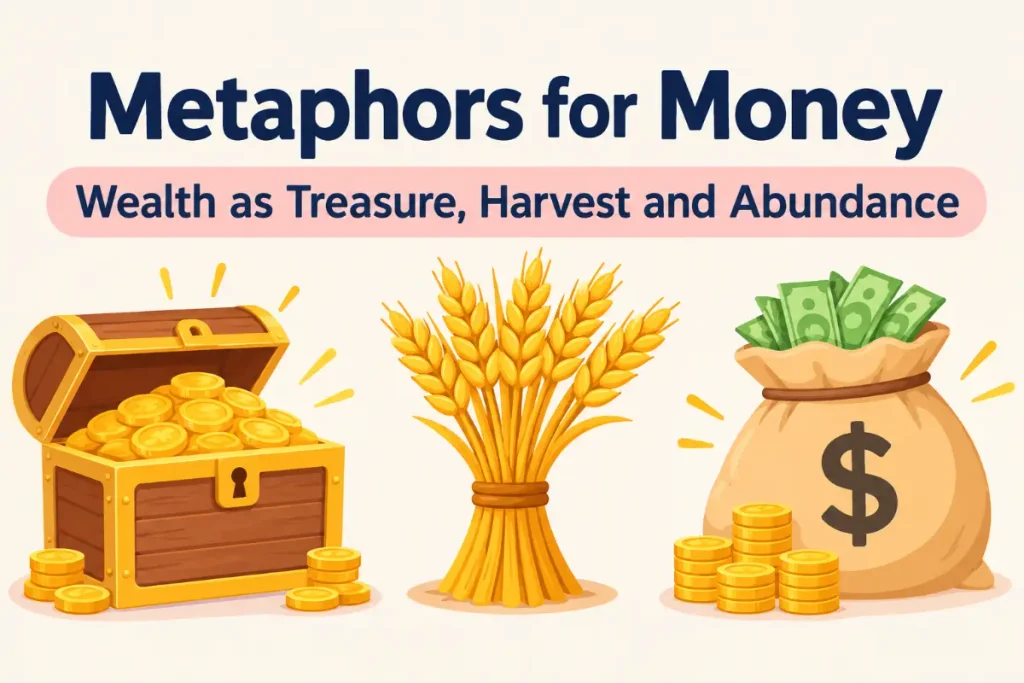
Wealth as Treasure, Harvest and Abundance
These images show plenty, with all its joys and worries.
- Wealth was a treasure chest he had to guard. Valuable, but a source of worry.
- Her bank account was an overflowing harvest. Plenty after long work.
- The windfall was rain after drought. Sudden relief.
- The market was a gold rush. Excitement and risk together.
- He lived in a castle with a moat of money. Wealth as protection and distance.
Saving and Budgeting
These images show planning, discipline and security.
- A budget is a map for your money. It shows where it goes and where it should go.
- Savings were a dam against hard times. They held back the flood of bad luck.
- Every saved dollar was a brick in the wall. Small amounts built security.
- Her emergency fund was an umbrella kept by the door. Ready for rain.
- Saving was planting an orchard for later. Patient work for a future reward.
Spending and Temptation
These images show how easily money can disappear.
- Money burned a hole in his pocket. He could not wait to spend it.
- Her wallet was a sieve. Money slipped through without being noticed.
- The sale was a siren song. Tempting and hard to resist.
- The credit card was a sugar rush. A quick pleasure with a cost later.
- Cash was footprints in the tide. It was gone almost as soon as it appeared.
Money, Power and Status
These images show money as influence, with its benefits and burdens.
- Money is a megaphone. It makes some voices louder than others.
- Wealth was a crown that weighed on his head. Power came with responsibility and pressure.
- Her fortune was a gold cage. Rich, but not free.
- The deal was a chess game, and money was the queen. The most powerful piece on the board.
- Money talks, and at the meeting it spoke in a whisper. Influence used quietly.
Money, Time and Meaning
These images look beyond money to what it can and cannot give.
- Time is money. Time is valuable and should not be wasted.
- Generosity is a coin that grows when spent. Giving increases the giver’s sense of wealth.
- Her wealth was a full table with room for friends. Rich in relationships.
- Money is a road, not a destination. It is a means to something else.
- He was rich in time, a fortune no bank could hold. Valuable things that cannot be bought.
Metaphors for Money in Sentences and Paragraphs
Here are short examples showing money metaphors in real sentences.
- By the end of the month, her paycheck was a river that had already reached the sea.
- The loan was an anchor, and every payment lifted it by a link.
- He treated his savings as a dam, and the winter floods never reached his door.
- Her wallet was a sieve, and she finally decided to find the holes.
Here is a longer example that builds one image across a paragraph:
For years, Lena’s money was a river with no banks. It came in on the first of the month and was gone by the tenth, carried off in a hundred tiny streams: coffee, subscriptions, small treats. When she finally built a budget, it was like laying stones along the water. The river was still there, but now it ran where she wanted it to, and for the first time a quiet pool began to form.
And here is a shorter example about the cost of wealth:
The penthouse was a glass crown. It gave Victor the whole city, and it took away the sound of his neighbors’ voices.
The Money Scale
Money situations come in different sizes, and the best metaphors match them.
| Level | Situation | Metaphor | What it shows |
|---|---|---|---|
| Empty | Running out | Her wallet was an empty well. | Nothing left to draw on |
| Tight | Barely enough | The month was a rope pulled thin. | Stretched to the limit |
| Stable | Comfortable | Her savings were a dam against hard times. | Safe and steady |
| Growing | Building wealth | A small investment is a seed. | Slow, patient growth |
| Wealthy | Plenty | Her bank account was an overflowing harvest. | Abundance |
| In debt | Owing money | Debt is a chain around the ankle. | Weight and limits |
How Writers Use Money Metaphors
Money appears in stories, essays, speeches and everyday writing. A few techniques help.
Match the image to the feeling. Water suggests flow and loss, a chain suggests debt, a harvest suggests abundance and a dam suggests security. Choose the one that fits.
Use details from the character’s world. A farmer might call money rain, a sailor might call it a tide and a baker might call it dough that must be kneaded. Images from the character’s life make writing feel real.
Show emotion, not just numbers. A metaphor can show how money feels, such as a stone in the stomach before rent day. Readers connect more with feelings than with figures.
Avoid stereotypes. Do not suggest that rich people are all greedy or that poor people are all unlucky. Metaphors should describe situations, not groups.
Balance money with other values. Stories that show only money can feel flat. Images of time, friends and generosity add depth.
Be gentle with hardship. Money stress is real for many readers. Avoid mocking it, and treat debt and struggle with respect.
How to Use Money Metaphors in Essays and Business Writing
In a school essay, follow three steps: find the metaphor, explain it and show its effect.
- Find it. Look for a comparison that says money is something, such as “money is a double-edged sword.”
- Explain it. Say what the two things share. A double-edged sword can protect or wound, so the comparison shows that money can help or harm depending on how it is used.
- Show the effect. Say what the reader feels, such as caution, curiosity or reflection.
Here is a short sample paragraph:
The writer describes the inheritance as “a gold cage.” This metaphor suggests that the money gives comfort but also limits freedom. The word “cage” shows that the character feels trapped, while “gold” shows that the trap looks attractive. As a result, the reader sees that wealth does not always bring happiness.
In business writing, money metaphors can make complex ideas simple. “Cash flow is the lifeblood of the company” or “a budget is a map” helps readers understand quickly. Keep them clear and avoid mixing them, and remember that metaphors do not replace facts and figures.

Common Money Clichés to Avoid
Many money phrases are so familiar that readers barely notice them. Try fresher images when you can.
| Common phrase | Fresher alternative |
|---|---|
| Cash cow | A quiet tap that never ran dry. |
| Break the bank | One more purchase and the vault would crack. |
| Nest egg | A small basket of savings tucked under the eaves. |
| Rolling in dough | Money piled up like autumn leaves on the lawn. |
| Money does not grow on trees | Every dollar had to be carried home from somewhere. |
| Drowning in debt | The bills rose around him like floodwater in a basement. |
Other mistakes to watch for:
- Mixing images. “Money is a river that burns like fire” blends two pictures. Choose one.
- Moralizing. Avoid suggesting that money is simply good or bad. Show its complexity.
- Offering advice as fact. Metaphors illustrate ideas but do not replace professional financial advice.
- Insensitivity. Be careful when writing about poverty or debt. Treat people with dignity.
Try It Yourself: Write a Money Metaphor in Five Steps
Use these steps with any situation.
- Choose a moment. For example: opening a first paycheck.
- Decide the feeling. Is it pride, relief, worry or surprise?
- Pick a source. Think of water, plants, tools, weight, weather or travel.
- Write three versions. For example: The check was a small seed. / My first paycheck was a river I had never seen. / The number on the screen was a key.
- Choose the best one and add a detail. My first paycheck was a seed, and I carried it home like a plant I was afraid to drop.
Now write a second version about debt, using a chain, an anchor or a snowball.
Frequently Asked Questions
What is a good metaphor for money?
“Money is a river that flows through your hands” and “money is a double-edged sword” are both clear and popular. One shows flow, and the other shows good and harm.
What is a metaphor for debt?
Try a chain around the ankle, quicksand, an anchor or a snowball rolling downhill. They show weight, trapping and growth over time.
What is a metaphor for savings?
Images of protection and growth work best: a dam, a well, an umbrella by the door or an orchard. They show security and patience.
Is “time is money” a metaphor?
Yes. It compares time to money to show that time is valuable and should not be wasted. For more examples, see our guide to metaphors for time.
What is a metaphor for wealth?
Try a treasure chest, an overflowing harvest, a castle with a moat or a gold cage. Each shows a different side of wealth: plenty, protection or restriction.
What is the difference between a money metaphor and an idiom?
An idiom like “break the bank” is a fixed phrase that many people use. A metaphor is a fresh comparison you can create, such as “her wallet was a sieve.”
Are money metaphors appropriate for school assignments?
Yes. They work well in essays, poems and business writing. Explain what the image shows and keep the language suitable for your audience.
Conclusion
Money can represent freedom, security, pressure, or even temptation, depending on how we describe it. A river, a safety net, or a heavy chain can each reveal a different side of its influence. The most effective metaphors go beyond wealth and spending to show how money shapes people’s choices, relationships, and everyday lives.
When using these metaphors, choose images that fit your message and feel natural in context. Add meaningful details, avoid clichés, and consider the emotions behind financial struggles. Whether you’re writing a story, essay, or personal reflection, the right metaphor can turn an ordinary discussion about money into something readers genuinely connect with.
Related Metaphors
- For the work that earns it, read our guide to metaphors for work.
- To explore what people hope to gain, see success metaphors.
- For the setbacks that can come with money, try metaphors for failure.