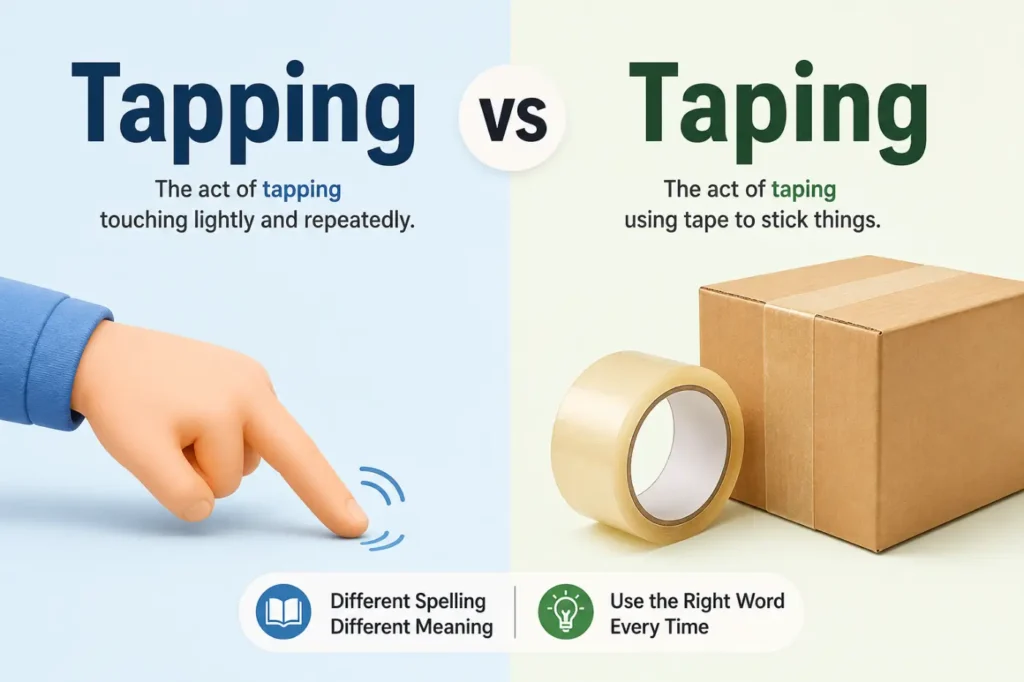
The difference between tapping vs taping comes down to one letter, but that small difference changes the meaning completely. If you are writing about touching something lightly, you need tapping. If you are writing about using tape, securing something with adhesive material, or recording a performance, you need taping.
The confusion is understandable because both words come from short base verbs and sound very similar in everyday speech. The difference becomes even harder to notice in fast conversation. Many people also see both forms online and wonder if they are simply alternate spellings of the same word.
They are not.
Tapping comes from tap and usually means touching or striking something lightly and repeatedly. Taping comes from tape and means using tape or recording something on tape or another medium. The correct choice depends entirely on the action you want to describe.
This guide will explain the difference in plain English. You will learn the meaning of each word, how the spelling changes, how native speakers use them, common grammar patterns, pronunciation, real sentence examples, and the mistakes that cause the most confusion. By the end, choosing the right form should feel as easy as recognizing the difference between a light knock and a strip of adhesive tape.
Quick Definition
Tapping means touching or striking something lightly, often more than once. Taping means attaching something with tape or recording an event or performance. The words sound similar but have different meanings and come from different base verbs. Use tapping for light touches and taping for tape or recording.
Quick Answer
The correct word depends on the meaning.
- Tapping comes from tap and means touching or striking lightly. Example: She was tapping her fingers on the desk.
- Taping comes from tape and means using tape to attach or secure something. Example: He was taping the package shut.
- Taping can also mean recording something. Example: The crew was taping the television show.
A quick memory trick is simple. Tapping has tap inside it. Taping has tape inside it. Think about the base word first, then add the ending.
Comparison Table
| Feature | Tapping | Taping |
|---|---|---|
| Base word | Tap | Tape |
| Part of speech | Present participle or gerund | Present participle or gerund |
| Standard spelling | Yes | Yes |
| Main meaning | Touching or striking lightly | Using tape or recording |
| Word origin | Germanic and Old English roots | From the word tape |
| Common contexts | Fingers tapping, tapping a screen, tapping a shoulder | Taping a box, taping an injury, taping a show |
| Formality level | Neutral | Neutral |
| Usage frequency | Very common | Very common |
| Example | She kept tapping her foot. | He was taping the package. |
The key difference is the base verb. Tap becomes tapping by doubling the final consonant before adding ing. Tape becomes taping by dropping the final silent e before adding ing. That spelling difference reflects two completely different verbs.
If you’re unsure whether taping or tapping is correct, you’ll probably also find it helpful to avoid common spelling mistakes like mentioned when writing.
Meaning Of Both Terms
What Does Tapping Mean
Tapping is the present participle and gerund form of tap. The verb tap generally means to touch, hit, or strike something lightly. The action may happen once or repeatedly.
For example:
- She was tapping on the window.
- He tapped me on the shoulder.
- The child kept tapping the table with a pencil.
- I was tapping the screen to open the app.
The action does not usually involve a powerful blow. A tap is light and controlled. That is why the word can describe everything from touching a phone screen to making a quiet rhythmic sound with your fingers.
The word also has several figurative meanings. Someone can tap into a resource, skill, or source of information. A company might tap into a new market. A writer might tap into personal experience for inspiration.
In these expressions, the physical idea of making contact develops into the broader idea of accessing or using something.
What Does Taping Mean
Taping is the present participle and gerund form of tape.
The most common meaning involves using tape to attach, cover, secure, repair, or hold something in place.
Examples include:
- She was taping the poster to the wall.
- He spent the afternoon taping the boxes shut.
- The nurse was taping the bandage in place.
The word also has another important meaning. Taping can mean recording an event, program, interview, performance, or other content.
Examples include:
- The crew was taping the next episode.
- We are taping the interview tomorrow.
- The show was taped in front of a live audience.
Historically, this meaning came from recording on magnetic tape. Today, people still use taping even though many recordings are made digitally. Language often keeps an older expression long after the original technology changes.
Key Differences
The central difference is meaning. Tapping describes light contact or a light repeated strike. Taping describes using tape or making a recording.
The two words may sound similar, but the surrounding words usually make the intended meaning clear.
Compare these sentences:
- She was tapping the screen.
- She was taping the screen.
The first sentence means she was touching the screen lightly. The second means she was attaching tape to the screen or perhaps covering it with tape.
The difference becomes even clearer with common objects.
Difference In Meaning
Tapping involves contact.
You might tap:
- A door.
- A shoulder.
- A keyboard.
- A phone screen.
- A table.
- Your foot.
Taping involves tape or recording.
You might tape:
- A box.
- A poster.
- A wire.
- A bandage.
- A television show.
- An interview.
Difference In Spelling
The spelling follows two different rules.
Tap + ing = tapping
The final consonant is doubled.
Tape + ing = taping
The final silent e is removed.
This pattern appears in many English verbs.
For example:
- Run becomes running.
- Sit becomes sitting.
- Plan becomes planning.
- Make becomes making.
- Write becomes writing.
- Hope becomes hoping.
The spelling of the base verb determines the form.
Difference In Grammar
Both words can function as present participles or gerunds. As present participles, they appear in continuous verb phrases.
- She is tapping on the desk.
- He is taping the package.
As gerunds, they function as nouns.
- Tapping can be distracting.
- Taping the boxes took all morning.
The grammar is similar, but the meaning remains different.
Difference In Context
The surrounding nouns often provide an immediate clue. Words commonly associated with tapping include:
- Fingers.
- Feet.
- Screens.
- Keys.
- Shoulders.
- Windows.
Words commonly associated with taping include:
- Boxes.
- Packages.
- Posters.
- Wires.
- Bandages.
- Shows.
Context is one of the strongest tools native speakers use to understand the difference quickly.
Which One Is Correct
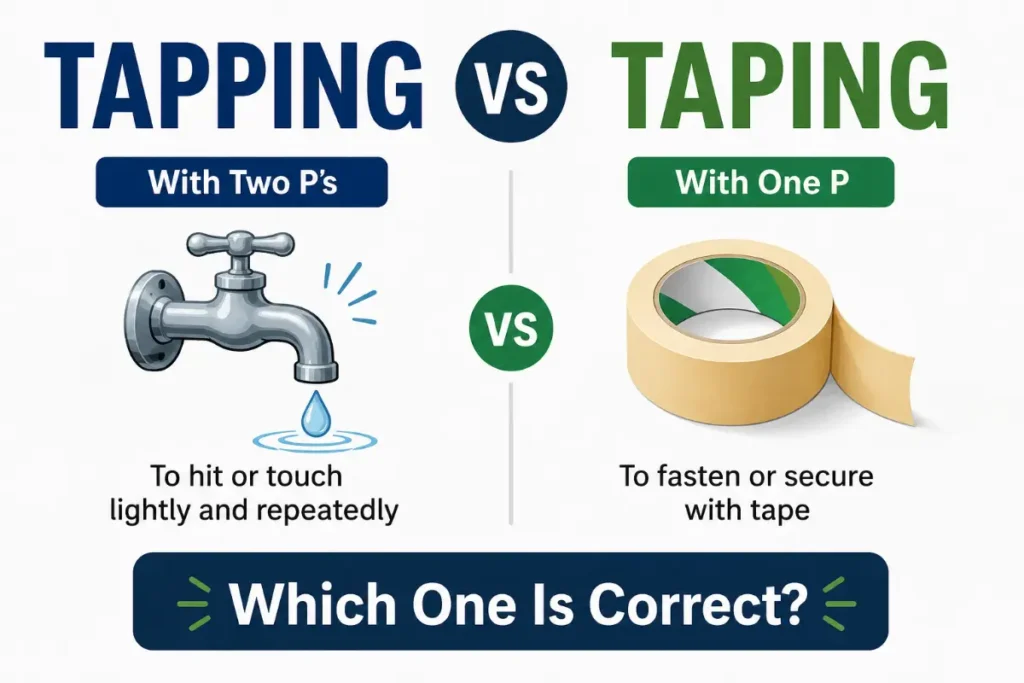
Both tapping and taping are correct words. The important question is which one matches your meaning. Use tapping when the action comes from tap.
Examples:
- She was tapping her foot.
- He was tapping on the glass.
- I kept tapping the button.
- The student was tapping a pencil against the desk.
Use taping when the action comes from tape.
Examples:
- She was taping the package.
- He was taping a note to the door.
- The crew was taping the interview.
- They were taping the injured ankle.
A useful editing test is to remove ing and check the base word.
If the base word is tap, write tapping.
If the base word is tape, write taping.
That simple test solves most spelling problems immediately.
Pronunciation Guide
The pronunciation of these words is close enough to cause confusion, especially in fast speech.
Tapping
IPA pronunciation: /ˈtæpɪŋ/.
Syllable breakdown: tap ping.
The first syllable sounds like the word tap. The second syllable is the common ing ending.
Taping
IPA pronunciation: /ˈteɪpɪŋ/.
Syllable breakdown: tape ing.
The first syllable contains the long a sound found in words such as day, name, and late.
The Main Sound Difference
The most important difference is the vowel.
Tapping begins with the short a sound.
Taping begins with the long a sound.
Compare:
- Tapping sounds like TAP ing.
- Taping sounds like TAYP ing.
The spelling helps explain the pronunciation. In taping, the final e in tape is silent, but it changes the vowel sound. This is known as a silent e or magic e pattern.
Common Pronunciation Mistakes
Some learners pronounce both words almost identically. That can make the difference difficult to hear.
The most common mistakes include:
- Pronouncing tapping with the long a sound from tape.
- Pronouncing taping with the short a sound from tap.
- Saying the final ing too strongly and losing the difference in the first syllable.
The best practice is to say the base verbs first.
Tap. Tapping.
Tape. Taping.
Once the vowel difference becomes familiar, the two forms are much easier to distinguish.
How To Remember The Difference
The easiest memory trick is to look inside each word.
- Tapping contains tap.
- Taping contains tape.
Then connect each base word to its meaning.
- Tap means touch or strike lightly.
- Tape means adhesive material or a recording.
Here are a few quick comparisons.
- Tapping the screen means touching the screen.
- Taping the screen means attaching tape to the screen.
- Tapping the box means lightly touching or striking it.
- Taping the box means using tape to close or secure it.
- Tapping a show is not the standard expression for recording it.
- Taping a show means recording it.
A second memory trick focuses on the spelling.
When tap receives ing, the final consonant is doubled.
tap + ing = tapping
When tape receives ing, the silent e disappears.
tape + ing = taping
This is not an arbitrary difference. It follows common English spelling patterns.
Examples In Sentences
The fastest way to understand the difference is to see both forms in natural situations. The meaning becomes clear once you connect each word to its base verb.
Examples Using Tapping
- She was tapping her fingers on the desk while waiting for the meeting to begin.
- I kept tapping the screen, but the app still would not open.
- The rain was tapping softly against the bedroom window.
- He was tapping his foot to the music.
- The student started tapping a pencil against the table during the test.
- She tapped me on the shoulder to get my attention.
- The child was tapping on the aquarium glass.
- Try tapping the icon twice if the first touch does not work.
- Someone was tapping lightly on the door.
- He spent the entire flight tapping away at his keyboard.
Each example describes light contact or a light repeated sound. The action can be physical, rhythmic, or digital.
Examples Using Taping
- She was taping the package shut before taking it to the post office.
- He spent the afternoon taping the poster to the wall.
- The trainer was taping the athlete’s ankle before the game.
- We were taping the loose cable to the floor to prevent anyone from tripping.
- The crew is taping a new episode of the comedy show today.
- They were taping the interview in a quiet studio.
- I am taping the broken box until I can replace it.
- She was taping the edges of the painting before applying the colour.
- The students were taping their project pieces together.
- The production team was taping the final scene in the city centre.
These examples involve adhesive tape, medical support, temporary repairs, or recording. The surrounding context usually makes the meaning obvious.
Learning the difference between taping and tapping becomes easier when you practise understanding similar word pairs that are often confused in English.
Tapping vs Taping Common Mistakes
The most common error is choosing the wrong base verb. Writers often hear a similar sound and then guess the spelling. That approach fails because the two forms represent different actions.
Writing Taping When You Mean Tapping
Suppose you write:
He was taping his fingers on the desk.
That sentence suggests he was attaching tape to his fingers. If you mean he was making a light repeated sound with his fingers, the correct sentence is:
He was tapping his fingers on the desk.
The object and the action must match.
Writing Tapping When You Mean Taping
Now consider:
She was tapping the box shut.
That means she was lightly striking the box. It does not mean she used adhesive tape.
The correct sentence is:
She was taping the box shut.
This is one of the easiest errors to catch because the meaning changes completely.
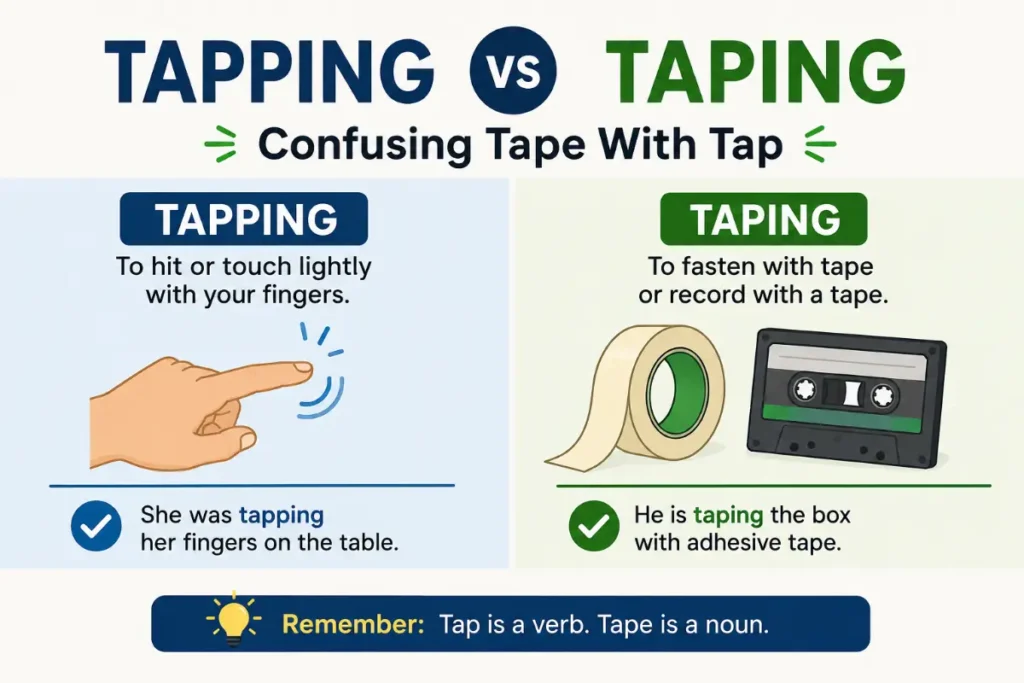
Confusing Tape With Tap
The base words are different.
- Tap means to touch or strike lightly.
- Tape is a strip or roll of adhesive material. It can also refer to a recording or the act of recording.
That distinction gives you a reliable editing method. Remove the ing ending and ask which base word you need.
Forgetting The Double Consonant
The spelling taping is sometimes incorrectly written as tapping when the writer means using tape. The reverse mistake also happens.
Remember:
Tap becomes tapping.
Tape becomes taping.
Confusing Tapped And Taped
The past tense forms create another common problem.
Tapped is the past tense of tap.
Taped is the past tense of tape.
Compare:
- She tapped the screen.
- She taped the note to the screen.
The first sentence describes a light touch. The second describes attaching something with adhesive material.
Internet And Autocorrect Confusion
Online writing creates additional confusion because autocorrect may not always understand the intended meaning. A sentence about a phone screen may contain tapping, while a sentence about a package may require taping.
The same problem appears in quick messages and social media posts. People often type quickly and rely on sound rather than checking the base verb.
Professional writing deserves a quick review. A single letter can change the action being described.
Tapped And Taped Explained
The past tense forms deserve special attention because they are easy to confuse.
Tapped Meaning
Tapped is the past tense and past participle of tap.
It means touched or struck lightly.
Examples include:
- She tapped on the window.
- He tapped me on the shoulder.
- I tapped the button by mistake.
- The bird tapped its beak against the glass.
The spelling follows the same consonant doubling rule as tapping.
Tap + ed = tapped.
The final consonant is doubled because the base verb is a short one syllable word ending in a consonant after a short vowel sound.
Taped Meaning
Taped is the past tense and past participle of tape.
It means attached with tape or recorded.
Examples include:
- She taped the photograph to the wall.
- He taped the package securely.
- The interview was taped yesterday.
- The medical staff taped his ankle.
The final silent e remains in the past tense form.
Tape + ed = taped.
This gives you another useful comparison.
Tapped comes from tap.
Taped comes from tape.
The difference is small in writing but significant in meaning.
Etymology And Word Origin
The verb tap has a long history in English. It is connected to older Germanic language roots and has been used for centuries to describe a light blow or touch.
The basic physical meaning came first. A person could tap on a door, tap a surface, or tap another person lightly. Over time, the word developed additional meanings.
Today, tap can describe:
- A light physical strike.
- A touch on a digital screen.
- Accessing a source of information.
- Selecting someone for a role.
- Drawing liquid from a container.
For example, a company may tap into a new market. A coach may tap a young player for an important role. A user may tap an icon on a smartphone.
The noun tape has a different history. It originally referred to a narrow strip or band of material. Over time, the word became associated with adhesive products and recording technology.
This produced several modern meanings.
- Adhesive tape.
- Measuring tape.
- Audio tape.
- Video tape.
- A recorded event.
Even though modern recordings are usually digital, the verb tape remains common. People still say they are taping a show even when the recording is saved electronically.
Regional Usage
There is no major spelling difference between American English, British English, Australian English, and Canadian English for these forms. The distinction between tapping and taping remains consistent across the major varieties of English.
American English
American speakers use tapping for light touching and taping for using tape or recording.
Examples include:
- She is tapping on the window.
- He is taping the package.
- The network is taping a new episode.
British English
British English follows the same distinction. The spelling and meanings are essentially the same.
The main difference may come from vocabulary around the action. For example, a British speaker may use sellotape for a common type of clear adhesive tape, while an American speaker may say Scotch tape in a brand based expression.
The verbs themselves do not change.
Australian English
Australian English also uses tapping and taping according to the same grammatical and spelling rules.
A person can be tapping a screen or taping a box. The context determines the meaning.
Canadian English
Canadian English follows the same standard distinction. Both forms are used in everyday, academic, and professional writing.
The spelling is not a regional variation like colour and color. The choice depends on the base verb rather than the country.
Grammar Rules
The grammar behind these words is simple once you understand the base verbs.
Present Continuous
Both forms can appear in the present continuous tense.
Subject + am is or are + verb ending in ing
Examples:
- She is tapping the screen.
- They are tapping their feet.
- He is taping the package.
- We are taping the interview.
The helping verb shows the tense. The ing form describes an action in progress.
Past Continuous
Both words can also appear in the past continuous.
Examples:
- She was tapping on the glass.
- He was tapping his fingers.
- They were taping the boxes.
- The crew was taping the show.
As Gerunds
An ing form can function as a noun.
Examples:
- Tapping on the desk can distract other people.
- Taping the package took several minutes.
- Tapping the screen is the fastest way to open the app.
- Taping the wires together is only a temporary solution.
The form looks like a verb but functions as the subject or object of the sentence.
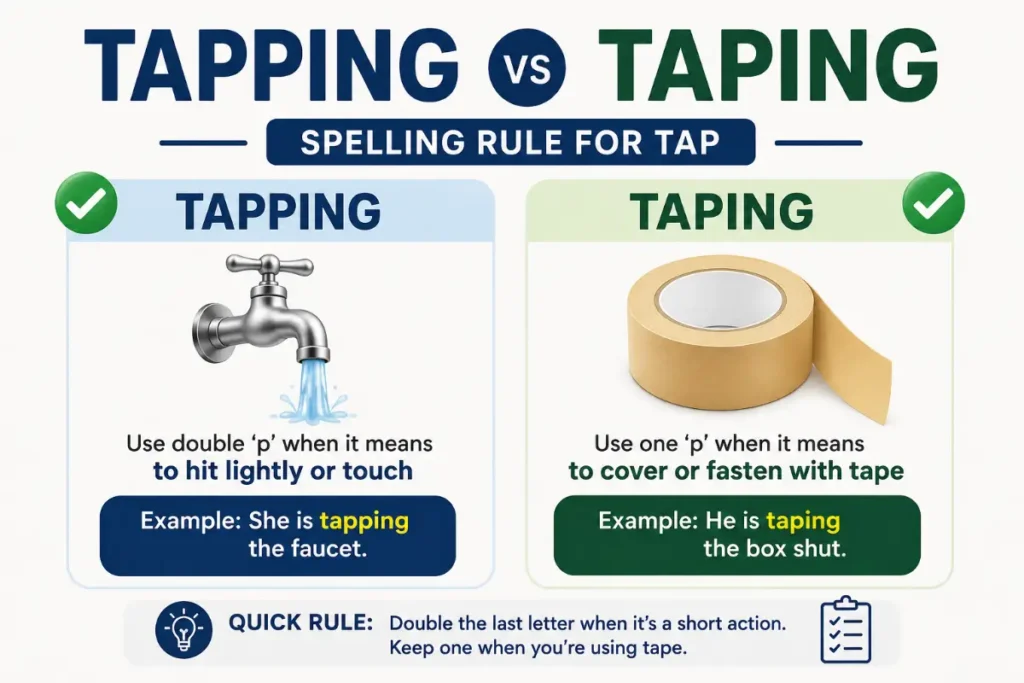
Spelling Rule For Tap
The word tap is a one syllable verb with a short vowel sound and a single final consonant. When you add ing or ed, the final consonant is doubled.
- Tap becomes tapping.
- Tap becomes tapped.
This pattern also appears in words such as:
- Run becomes running.
- Stop becomes stopping.
- Plan becomes planned.
- Drop becomes dropped.
Spelling Rule For Tape
The word tape ends in a silent e.
When you add ing, the silent e is removed.
- Tape becomes taping.
When you add ed, the e remains.
- Tape becomes taped.
This pattern is common in English.
- Make becomes making.
- Hope becomes hoping.
- Move becomes moving.
- Bake becomes baking.
Real Life Usage Examples
These words appear in many areas of daily life, so understanding the context makes the distinction easier to remember.
Daily Conversation
People use tapping when talking about phones, doors, windows, tables, and body movements.
Examples include:
- I was tapping on the screen.
- Stop tapping your foot.
- Someone is tapping at the door.
People use taping when talking about repairs, packages, injuries, and recordings.
Examples include:
- I am taping the box.
- She is taping the poster to the wall.
- They are taping the interview today.
Academic Writing
Academic writing often uses tapping to describe physical actions or technology.
A research paper might describe a participant tapping a screen to select an answer.
The word taping may appear in research involving recordings, data collection, interviews, or physical materials.
For example:
The researchers were taping the interviews for later analysis.
Professional Communication
In the workplace, both forms appear frequently.
A project manager might write:
The team is taping the cables to the floor for safety.
A software trainer might write:
Tap the icon to continue.
A media producer might write:
The crew is taping the presentation this afternoon.
Clear spelling matters because the wrong word can create confusion about the task.
Literature
Writers use tapping to create sound and movement.
A sentence such as Rain was tapping against the window creates a quiet auditory image.
The word taping is less common in literary description unless the story involves recording or attaching something with tape.
Media
Television and film production traditionally use taping to describe recording a program.
For example:
The audience watched the taping of a late night show.
Even though digital recording has replaced physical tape in much of the industry, the expression remains part of everyday language.
While improving your spelling, it’s worth checking another commonly misspelled word to avoid errors that can easily slip into everyday writing.
Related Words And Confused Terms
The difference between tapping and taping becomes easier once you connect each word to its related vocabulary. Many mistakes happen because learners remember the sound but forget the base verb.
Here are the most useful related terms.
- Tap means to touch or strike lightly.
- Tapped is the past tense of tap.
- Tapping is the present participle or gerund form of tap.
- Tape means adhesive material or a recording.
- Taped is the past tense of tape.
- Taping is the present participle or gerund form of tape.
- Tapper can refer to a person or tool that taps.
- Tappable describes something that can be tapped.
- Tape measure is a flexible measuring tool.
- Tape recorder is a device used to record sound.
The most important comparison is simple.
Tap → tapped → tapping.
Tape → taped → taping.
The two families of words should stay separate in your mind. If the action involves a light touch, think tap. If it involves adhesive material or recording, think tape.
Tapping Vs Taping Vs Tape
These three forms are closely connected in spelling but not in meaning.
Tapping describes an action involving light contact.
She is tapping on the window.
Taping describes an action involving tape or recording.
He is taping the package.
Tape is the base noun or verb.
As a noun:
The tape is on the desk.
As a verb:
Please tape the note to the wall.
The same distinction applies to the past forms.
Tapped means touched or struck lightly.
Taped means attached with tape or recorded.
A single letter separates the two past tense forms, but the meaning changes completely.
Expert Language Insight
From an editor’s perspective, the best way to handle this confusion is to focus on the base verb rather than the final ing ending. The endings are identical. The meanings are not.
When proofreading a sentence, remove ing mentally and ask what action is taking place.
- If the sentence means touching lightly, the base verb is tap.
- If the sentence means using adhesive material or recording, the base verb is tape.
- This method is more reliable than trying to memorize isolated spellings.
Native speakers also use context almost automatically. A sentence about fingers, a screen, or a window strongly suggests tapping. A sentence about a package, poster, injury, or television recording points toward taping.
Another useful editorial observation involves the word tapped. In modern English, it has meanings that go beyond physical contact. A person can be tapped for a job, tapped for a leadership role, or tapped as a replacement. In these expressions, the original sense of selecting or touching has developed into the idea of choosing someone.
The word tape has also expanded beyond physical adhesive material. A show can be taped, an interview can be taped, and a conversation can be taped even when the recording is entirely digital.
That is a normal feature of language. Words often outlive the technology or physical objects that first gave them meaning.
For practical writing, remember these three rules.
- Use tapping for light touching or striking.
- Use taping for applying tape or recording.
- Use tapped for the past tense of tap and taped for the past tense of tape.
If you apply those rules consistently, the distinction becomes straightforward.
Frequently Asked Questions About Tapping vs Taping
What is the difference between tapping and taping?
Tapping comes from tap and means touching or striking something lightly. Taping comes from tape and means attaching something with tape or recording something. For example, She was tapping the screen describes light contact, while She was taping the box means she was using adhesive tape to secure it.
Is it taping or tapping?
Both spellings are correct, but they have different meanings. Use tapping when the base verb is tap, as in tapping your fingers. Use taping when the base verb is tape, as in taping a package. Check the base word before adding ing to choose the correct form.
What does tapping mean?
Tapping means touching or striking something lightly, often repeatedly. You can tap a screen, tap a table, tap on a door, or tap someone on the shoulder. The word can also describe rhythmic movement, such as tapping your foot to music.
What does taping mean?
Taping usually means using tape to attach, secure, cover, or repair something. For example, you can tape a box shut or tape a poster to a wall. It can also mean recording a show, interview, performance, or other event.
What is the difference between tapped and taped?
Tapped is the past tense of tap and means touched or struck lightly. Taped is the past tense of tape and means attached with tape or recorded. Compare He tapped the screen with He taped the note to the screen. The spelling reflects two different base verbs and two different actions.
Why does tap become tapping?
The final consonant in tap is doubled before adding ing because tap is a short one syllable verb with a short vowel sound followed by one final consonant. Therefore, tap + ing becomes tapping. The same spelling pattern appears in words such as run becoming running.
Why does tape become taping?
The final silent e in tape is removed before adding ing. Therefore, tape + ing becomes taping. The same pattern appears in words such as make becoming making and hope becoming hoping.
Can taping mean recording?
Yes. Taping can mean recording a show, interview, performance, meeting, or other event. The expression developed when audio and video were commonly recorded on physical tape. Today, people still use the verb even when the recording is made digitally.
Conclusion
The difference between tapping and taping is simple once you identify the base verb. Tapping comes from tap and describes light touching or striking. Taping comes from tape and describes using adhesive tape or recording something.
The past tense forms follow the same distinction. Tapped means touched or struck lightly. Taped means attached with tape or recorded. The spelling may differ by only one letter, but the meaning changes completely.
The most reliable way to choose the right word is to remove the ing ending and ask what action you mean. If the answer is tap, use tapping. If the answer is tape, use taping. Keep that simple test in mind and the confusion disappears. Tap for a light touch. Tape for adhesive material or recording.