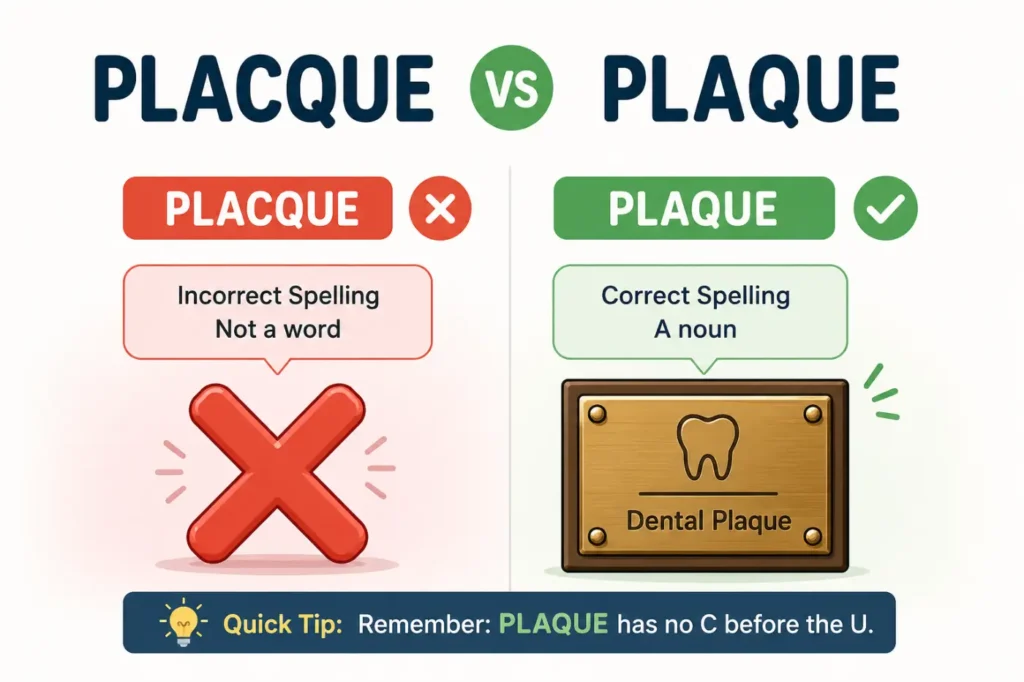
The spelling placque vs plaque confuses many people because both forms look almost identical and sound the same. You may see placque in an online post or product listing and wonder if it is simply another accepted spelling of the word. In most cases, the answer is no.
Plaque is the standard English spelling. It can refer to a decorative or commemorative tablet, a dental deposit, a buildup inside blood vessels, or a flat object used for recognition and display. Placque is generally considered a misspelling in modern standard English, although it may appear in informal writing, names, or unusual product listings.
The confusion is understandable. The word has a French history, its pronunciation does not clearly reveal the spelling, and many English words ending in que create uncertainty for learners. The meaning also changes depending on context. A plaque on a wall is not the same thing as dental plaque or arterial plaque.
This guide explains the difference clearly. You will learn the correct spelling, the meaning of each form, pronunciation, word origin, medical usage, examples, grammar, regional patterns, common mistakes, and the difference between a plaque and related words such as placard. You will also see how native speakers and professional editors handle the word in real writing.
Quick Definition
Plaque is the standard English spelling. It can mean a flat commemorative tablet, a decorative award, a bacterial film on teeth, or a buildup of substances in the body. Placque is generally a misspelling and should not be used in standard writing unless it appears as part of a specific name or title.
Quick Answer
The correct spelling is plaque. Placque is generally not the standard spelling in modern English. Use plaque when referring to a commemorative tablet, an award, a decorative wall piece, dental buildup, or a medical deposit inside an artery.
For example:
- The school placed a plaque on the wall.
- She received a plaque award for her achievements.
- Regular brushing helps remove dental plaque.
- The doctor explained how arterial plaque can affect blood flow.
Comparison Table
| Feature | Plaque | Placque |
|---|---|---|
| Standard spelling | Yes | No in ordinary modern English |
| Part of speech | Noun | Usually an incorrect spelling of plaque |
| Main origin | French and related European language roots | Variant spelling influenced by the standard form |
| Meaning | Commemorative tablet, award, dental deposit, or medical buildup | Usually intended to mean plaque |
| Formality | Standard and appropriate in formal writing | Nonstandard |
| Common contexts | Awards, monuments, dentistry, medicine, history, architecture | Informal mistakes and occasional names |
| Usage frequency | Common | Very uncommon |
| Example | The city installed a plaque to honor the author. | The word is usually corrected to plaque. |
The important point is simple. These two spellings are not equal alternatives in standard English. Plaque is the form you should use in ordinary writing.
Meaning Of Both Terms
The easiest way to understand the difference is to examine each spelling separately.
What Does Plaque Mean
Plaque is a noun with several related meanings. At its core, it often refers to a flat layer or flat object. The word commonly describes:
- A flat tablet attached to a wall or monument.
- An award given to recognize an achievement.
- A sticky film of bacteria that forms on teeth.
- A buildup of substances inside blood vessels.
- A flat deposit associated with certain medical conditions.
The exact meaning comes from context.
For example, if someone says, The museum installed a plaque, they probably mean a commemorative tablet containing information about a person, event, or place.
If a dentist talks about plaque, the meaning is different. In that context, the word refers to a sticky bacterial film that forms on teeth.
A doctor might use the word in another medical context. Arterial plaque refers to a buildup inside the walls of arteries. In medical writing, the term may describe deposits involving fats, cholesterol, calcium, and other substances. The spelling stays the same even though the subject changes.
What Does Placque Mean
Placque is generally not the accepted standard spelling of the word in modern English. Most of the time, a person who writes placque intends to write plaque.
This error is easy to understand because English contains many words with unusual letter combinations. The ending que appears in words such as antique, unique, and boutique, while the sound of the word itself does not help the writer remember the exact spelling.
In standard writing, the safest approach is simple. Use plaque for the object, award, dental deposit, or medical buildup. If you encounter Placque as part of a business name, product name, username, or official title, preserve that spelling only because it is part of the specific name. That situation is different from using the word as ordinary English.
Just as it’s important to distinguish the difference between immerse and emerse, knowing whether to use plaque or placque helps you avoid common spelling mistakes in formal writing.
Key Differences Between The Two Spellings
The main difference is not meaning. It is standardness. When people write placque, they almost always intend the same meaning as plaque. The problem is that the extra c does not belong in the standard spelling.
Meaning Differences
There is no established everyday meaning that separates placque from plaque. In ordinary English:
- Plaque is the correct word.
- Placque is usually a spelling error.
- Readers generally understand the intended meaning from context.
This is different from pairs such as affect and effect, where both words are correct but have different meanings.
Tone Differences
The standard form plaque works in every register. You can use it in:
- Casual conversation.
- School writing.
- Academic writing.
- Medical communication.
- Business communication.
- Historical writing.
The form placque can make writing look careless if it is used accidentally. In a professional document, a spelling error in a simple common noun may distract readers from the message.
Grammar Differences
There is no meaningful grammar difference between the two forms because only plaque functions as the standard English noun. The word can appear as:
- A singular noun.
- A plural noun.
- A noun modifier in compounds.
Examples include:
- One plaque.
- Several plaques.
- A plaque award.
- Dental plaque.
- Arterial plaque.
The plural form is plaques.
Regional Differences
Unlike some spelling differences between American and British English, this word does not normally change spelling across major English varieties.
- American English uses plaque.
- British English uses plaque.
- Australian English uses plaque.
- Canadian English uses plaque.
The alternative spelling does not represent a standard regional preference.
Context Differences
Context changes the meaning of plaque, but it does not make placque correct.
For example:
- Historical context means a commemorative tablet.
- Awards context means a recognition item.
- Dental context means bacterial buildup on teeth.
- Medical context means a deposit or buildup in the body.
- Architectural context may involve a decorative or informational tablet.
Understanding context is therefore more important than trying to find a different spelling for each meaning.
Placque vs Plaque Which Spelling Is Correct
Plaque is the correct spelling in standard English. Use it when you are talking about a memorial tablet, an award, dental buildup, or a medical deposit.
The word appears in dictionaries, medical terminology, historical writing, and everyday English. It is also the form used by professional editors and educational materials.
The spelling placque should normally be corrected.
There is one practical exception. A company, organization, artist, product, or online account may intentionally use Placque as part of its official name. Proper names can use creative spellings. In that case, preserve the official spelling when referring to that specific entity.
The distinction is important because proper names do not change the ordinary spelling of a word.
For example, if a company calls itself Placque Designs, you should write the company name exactly as it is officially presented. However, if you are writing a sentence about a commemorative tablet, write plaque.
Plaque Pronunciation Guide
The pronunciation is one reason the spelling causes confusion.
IPA Pronunciation
In common English pronunciation, plaque is pronounced:
/plæk/
It sounds like:
plak
The word has one syllable.
Syllable Breakdown
Plaque
One syllable.
The ending que does not create an extra syllable. The word sounds similar to black with the initial sound changed.
Common Pronunciation Mistakes
Some learners try to pronounce every written letter. That can lead to forms such as plak way or plah kay, which are not the usual English pronunciation.
The correct pronunciation is short and direct.
- Begin with the pl sound.
- Use the short a sound found in black.
- End with a k sound.
The final letters que represent the k sound.
This spelling pattern appears in several English words with French influence, so the written form does not always give learners an obvious pronunciation guide.
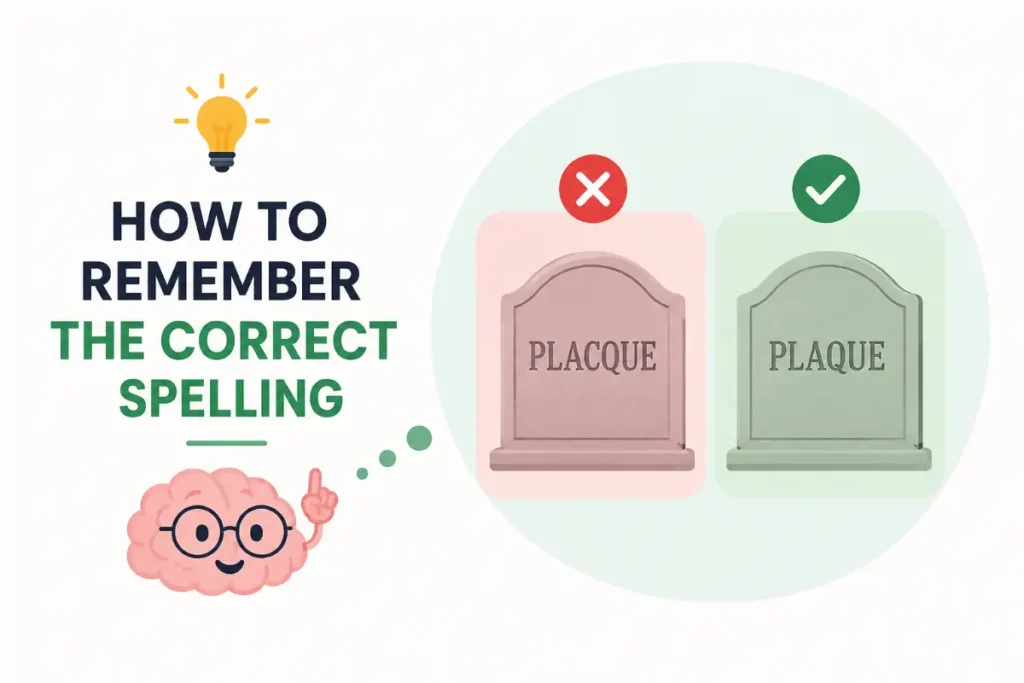
How To Remember The Correct Spelling
A useful memory trick is to connect the word with its most familiar image. Think of a plaque on the wall. The standard spelling is:
P L A Q U E
You can also remember that the word ends with que, not cque. A simple editing check is to ask:
- Am I talking about an award, a wall tablet, dental buildup, or a medical deposit?
If the answer is yes, the spelling is almost certainly plaque. Another helpful method is to connect related phrases.
- Plaque award.
- Plaque on the wall.
- Dental plaque.
- Arterial plaque.
- Plaque inscription.
Seeing the correct spelling in several different contexts helps it stick naturally.
Professional writers do not need to memorize every possible variation. They rely on the standard form and check unusual spellings when a proper name is involved.
Examples In Sentences
The best way to understand a confusing word is to see how native speakers actually use it. The examples below cover the main meanings of plaque and show why placque is normally treated as a spelling mistake rather than a separate standard word.
Examples With Plaque
- The city installed a bronze plaque on the wall to honor the scientist who lived there.
- The university presented the retiring professor with a plaque recognizing her thirty years of service.
- The dentist explained that brushing twice a day helps prevent the buildup of dental plaque.
- A small plaque near the entrance explains the history of the old building.
- The company gave him a plaque award for his outstanding contribution to the project.
- The museum placed a historical plaque beside the house where the author was born.
- The doctor explained that plaque buildup inside the arteries can affect blood flow.
- The school added a new plaque to the hallway after winning the national championship.
- The memorial plaque contains the names of local residents who served during the war.
- Regular dental cleanings can remove hardened deposits that develop from plaque.
These examples show how the same spelling works across historical, professional, dental, medical, educational, and everyday contexts.
Examples With Placque
Because placque is generally not the standard spelling, it is difficult to create ordinary examples where it is correct. In most sentences, an editor would replace it with plaque.
For example:
- Incorrect: The school presented him with a placque.
- Correct: The school presented him with a plaque.
- Incorrect: The dentist explained how to remove placque.
- Correct: The dentist explained how to remove plaque.
- Incorrect: A historical placque stood outside the building.
- Correct: A historical plaque stood outside the building.
- Incorrect: She received a gold placque for her achievement.
- Correct: She received a gold plaque for her achievement.
- Incorrect: The museum added a placque to the wall.
- Correct: The museum added a plaque to the wall.
The only time the spelling with c may remain unchanged is when it is part of an official name, title, or brand. In that situation, you are reproducing a proper name rather than using the ordinary English noun.
Common Mistakes
The most common error is adding an unnecessary c before the que ending. This happens because the pronunciation does not clearly reveal the spelling.
Adding An Extra C
The incorrect form placque looks visually plausible. The standard form is simply plaque.
Remember that the word already contains the letters needed to produce the final k sound. The extra c is unnecessary.
Assuming The Two Forms Are Regional Variants
Some English words have different spellings in different countries. For example, American English uses color, while British English uses colour.
That pattern does not apply here.
English speakers in the United States, United Kingdom, Australia, and Canada generally use plaque.
Confusing Plaque With Placard
These words are related in the broad sense that both can involve a flat display, but they are not interchangeable.
A plaque is usually a durable tablet used for commemoration, information, decoration, or recognition.
A placard is generally a sign or notice that displays information, often for public viewing.
For example:
- The city placed a plaque on the historic building.
- The protesters carried a placard with a message.
A plaque tends to feel permanent and commemorative. A placard is usually a sign designed to communicate a message.
Confusing Different Medical Meanings
The word also appears in several medical contexts.
Dental plaque is a sticky film of bacteria that forms on teeth.
Arterial plaque refers to deposits that build up inside artery walls.
Atherosclerotic plaque is a more specific medical term used when discussing the buildup associated with atherosclerosis.
These meanings are related by the idea of a deposit or layer, but they describe different situations.
Copying A Spelling Error Online
Online content contains many mistakes. A misspelled word can appear repeatedly across product pages, forums, social media posts, and low quality articles.
Repeated exposure does not make a spelling standard.
This is especially important when researching uncommon words. Always compare a questionable spelling with reliable dictionaries, professional publications, or established reference sources instead of assuming that frequent online use proves correctness.
Etymology And Word Origin
The history of plaque explains both its unusual spelling and its broad range of meanings.
The word entered English through French. The French word plaque referred to a plate, tablet, or flat piece. It is related to the idea of something flat or layered.
As the word developed in English, it acquired several specialized meanings.
One meaning referred to a flat tablet placed on a building, monument, or other structure. This use naturally led to commemorative plaques and historical plaques.
Another meaning developed in medicine and dentistry. A visible or measurable deposit can resemble a flat layer or patch, so the same word became useful for describing biological buildup.
This is a common pattern in language. A physical object gives rise to a metaphorical or technical meaning. The basic idea of a flat plate or deposit connects several modern uses:
- A bronze plaque on a wall.
- A recognition plaque presented at an event.
- Dental plaque covering the surface of teeth.
- Arterial plaque developing within blood vessels.
These meanings may seem unrelated at first. The historical connection becomes clearer when you focus on the shared concept of a distinct layer, plate, or deposit.
The spelling placque does not represent a separate historical development that has become a standard English alternative. It is generally an accidental variation of the established form.
If you enjoy learning about frequently confused spellings, you’ll also find it useful to understand why wholly is the correct spelling and how it differs from the common misspelling wholey.
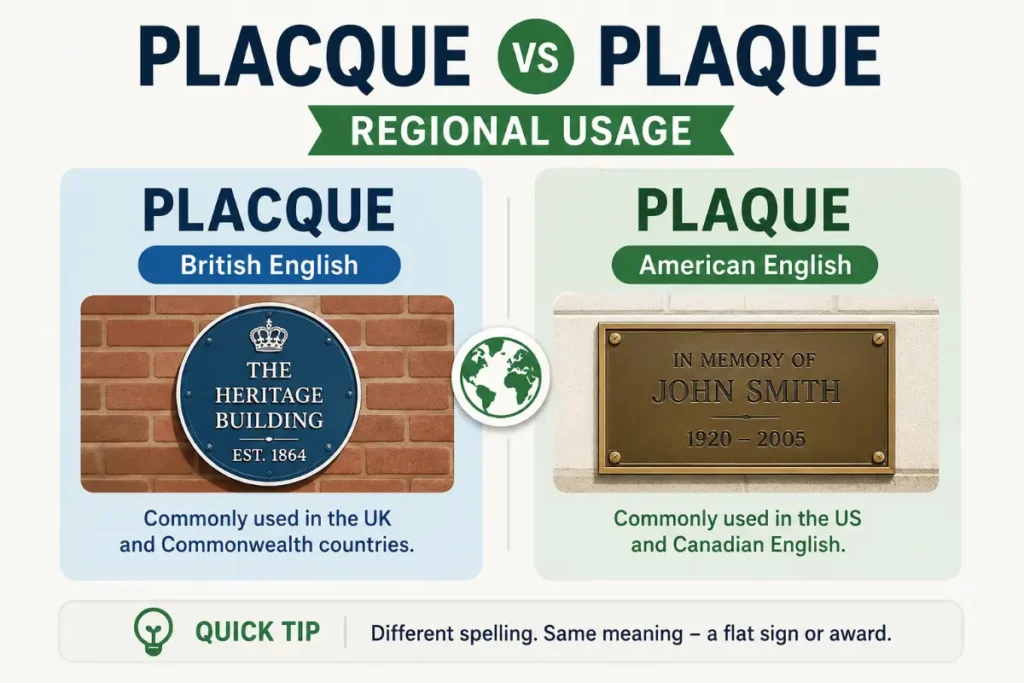
Regional Usage
The spelling remains remarkably consistent across major varieties of English.
American English
American English uses plaque in everyday speech, education, medicine, dentistry, journalism, and business. You might see phrases such as:
- Commemorative plaque.
- Award plaque.
- Dental plaque.
- Arterial plaque.
- Historical plaque.
The spelling placque is generally treated as an error unless it belongs to a specific name.
British English
British English also uses plaque as the standard spelling.
Historical plaques are especially common in public spaces, where buildings, homes, and locations may display information about notable people or events connected with them. The standard spelling remains the same in medical and dental contexts.
Australian English
Australian English follows the same spelling convention. The word appears in discussions of awards, public history, dentistry, medicine, architecture, and memorials. The alternative form is not a normal regional spelling.
Canadian English
Canadian English also uses plaque. These writing may combine spelling patterns associated with British and American English, but this particular word does not normally change.
The same standard form works in formal and informal contexts.
Placque vs Plaque Grammar Rules
The word is grammatically straightforward because it functions primarily as a noun.
Plaque As A Countable Noun
When referring to a physical object such as an award or commemorative tablet, plaque is countable.
Examples include:
- The building has one plaque near the entrance.
- The museum displays several plaques.
- The committee ordered three plaques for the ceremony.
- The singular form is plaque.
- The plural form is plaques.
Plaque As An Uncountable Medical Noun
In some medical and dental contexts, the word is commonly used as an uncountable noun when referring to a substance or buildup.
For example:
- Brushing helps remove plaque.
- The dentist found a significant amount of plaque.
- The treatment is designed to reduce plaque buildup.
You can also use the plural plaques when referring to separate deposits or distinct formations in a medical or scientific context.
Common Compound Expressions
The word frequently appears before another noun to create a compound phrase. Common examples include:
- Plaque award.
- Plaque inscription.
- Plaque presentation.
- Plaque ceremony.
- Dental plaque.
- Arterial plaque.
- Amyloid plaque.
- Historical plaque.
- Memorial plaque.
- Bronze plaque.
The meaning becomes more specific through the word that follows.
Adjective And Noun Confusion
Some writers mistakenly assume that plaque can function as an adjective because it appears before another noun.
In phrases such as plaque award or plaque ceremony, it remains a noun used attributively. In simple terms, one noun is helping describe another noun. This is common in English.
For example:
- School bus.
- Coffee cup.
- Plaque award.
The first word helps identify the type of object but does not automatically become a separate adjective.
Placque vs Plaque Real Life Usage Examples
The word appears in far more situations than many learners realize.
Plaque On The Wall
A plaque on the wall often provides information or honors a person.
For example, a historic home may have a plaque explaining who lived there. A school may display a plaque recognizing an important achievement. A business may install a plaque commemorating its founding.
These objects are usually designed to last for many years.
Plaque Award
A plaque award is a physical recognition item presented to someone for achievement, service, performance, or contribution. It may contain:
- The recipient’s name.
- The organization name.
- The achievement.
- The date.
- A logo.
- A short message.
The phrase is common in schools, workplaces, sports organizations, conferences, and professional events.
Medical Plaque Definition
In medical language, plaque has several specialized meanings.
In dentistry, it refers to a sticky film containing bacteria that forms on teeth. If it is not removed effectively, it can contribute to tooth decay and gum disease.
In cardiovascular medicine, plaque can refer to deposits that build up inside artery walls. Medical professionals may use more specific terms to describe the type, location, and composition of the deposit.
In neurology, plaques may refer to specific abnormal structures associated with certain diseases. The meaning depends entirely on the medical context.
The word therefore cannot be defined with only one sentence for every situation. Context matters.
Academic Writing
Academic writers use the word in history, archaeology, medicine, dentistry, biology, chemistry, and materials science. The spelling remains plaque regardless of the field.
A historical researcher may study commemorative plaques. A dental researcher may investigate bacterial plaque. A medical researcher may examine arterial or neurological plaques.
Professional Communication
Businesses use the word in award ceremonies, recognition programs, manufacturing, architecture, and healthcare. Examples include:
- The company ordered engraved plaques for the annual ceremony.
- The facility installed a plaque beside the main entrance.
- The dentist discussed plaque control with the patient.
Literature And Media
Writers may use plaque to establish a sense of place or history.
A character might read a plaque outside an old building. A documentary might show a memorial plaque during a historical segment. A news report might describe a plaque being unveiled at a public ceremony.
The word often carries a sense of permanence, recognition, or recorded history.
Plaque And Placard
These words are sometimes confused because both can refer to flat objects that display information. The difference is mainly purpose and form.
A plaque is generally:
- Durable.
- Commemorative.
- Decorative.
- Informational.
- Used for recognition.
A placard is generally:
- A sign.
- A notice.
- A displayed message.
- Used for communication.
- Often temporary or portable.
Consider these examples.
- The historical plaque explained the building’s significance.
- The protester held a placard demanding reform.
A plaque tends to mark or honor something. A placard tends to communicate something. The two words may overlap in certain situations, but they are not interchangeable.
Related Words And Confused Terms
Understanding related words helps clarify the meaning of plaque and prevents several common mix-ups. The word can describe a physical tablet, a recognition award, a dental deposit, or a medical buildup, so nearby terms may look similar while serving very different purposes.
Plaque And Placard
As discussed earlier, a plaque is usually a durable tablet that commemorates, identifies, honors, or records something. A placard is generally a sign or notice designed to communicate information.
A plaque might be attached permanently to a building. A placard might be carried during a demonstration or displayed temporarily in a shop.
Plaque And Plate
A plate is a broad term for a flat object. It can refer to a dish, a metal piece, a printing plate, or a flat layer in science and engineering.
A plaque is more specific. It often has a commemorative or informational purpose when referring to an object. In medical and dental contexts, it refers to a particular type of deposit or buildup.
Plaque And Tablet
A tablet can mean a flat slab or a medicinal pill. A plaque may also be a flat slab, but the two words are not automatically interchangeable.
A stone tablet might contain an ancient inscription. A commemorative plaque might honor a person or event on a modern building.
Plaque And Sign
A sign communicates information. A plaque can also communicate information, but it usually has a more permanent or commemorative purpose.
A sign might say Entrance or Parking Only. A plaque might explain the history of a building or recognize a person who contributed to an organization.
Dental Plaque And Tartar
These terms are often confused in everyday conversation.
Dental plaque is a sticky film of bacteria that forms on teeth. If it remains on the teeth and hardens, it can become tartar, also called dental calculus.
The two terms are related, but they do not mean exactly the same thing.
Arterial Plaque And Cholesterol
People often use cholesterol buildup and arterial plaque as if they mean precisely the same thing. In medical language, the relationship is more complex.
Arterial plaque can contain cholesterol and other substances. The exact composition and medical significance depend on the condition being discussed.
For general writing, it is best to use the medical term that matches the source or professional context.
Plaque And Plack
Plack is a different word and is not the standard spelling of the object or medical deposit discussed in this article.
Because the pronunciation of plaque ends with a k sound, some learners may guess spellings such as plack or placque. The standard form remains plaque.
Semantic Relationships
From an NLP and semantic perspective, the word connects with several concepts.
For a commemorative object, related terms include:
- Memorial.
- Marker.
- Tablet.
- Inscription.
- Award.
- Recognition.
- Dedication.
Related terms for dentistry include:
- Bacteria.
- Teeth.
- Gums.
- Brushing.
- Flossing.
- Tartar.
- Dental hygiene.
For medicine, related terms include:
- Deposit.
- Buildup.
- Artery.
- Cholesterol.
- Atherosclerosis.
- Tissue.
- Lesion.
These semantic relationships help search engines understand the topic, but they also help human readers understand how the word changes meaning across different fields.
Many English learners confuse similar-looking words, so it’s worth exploring when to use tapping instead of taping alongside mastering the correct spelling of plaque.
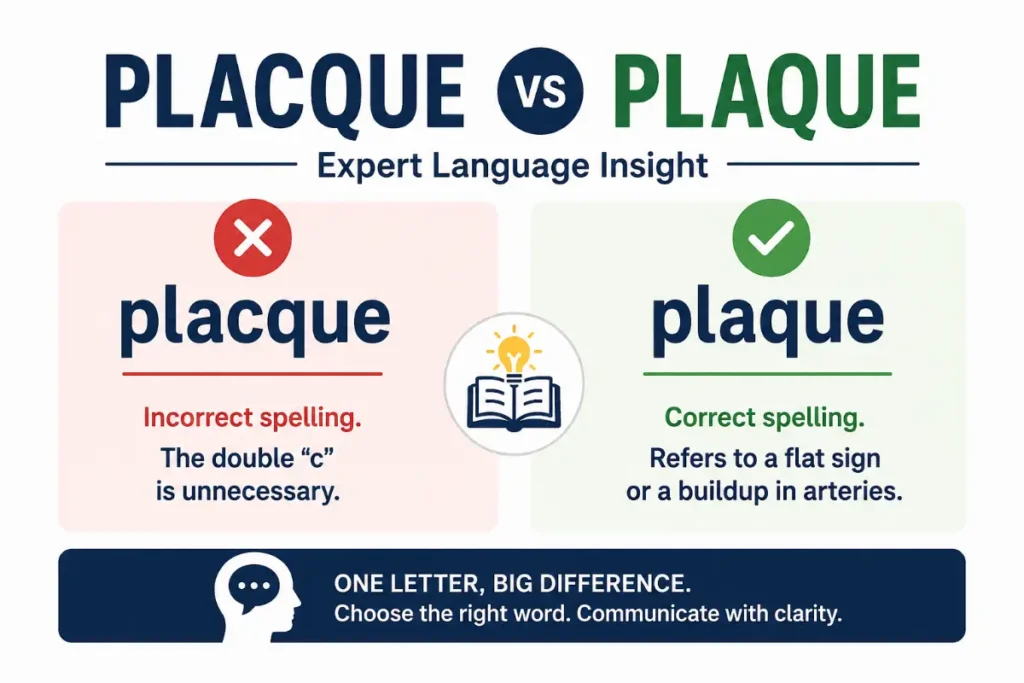
Expert Language Insight
An experienced editor would treat this as a straightforward spelling decision rather than a true word comparison. The important distinction is that plaque is the standard English word, while placque is generally a misspelling.
The more interesting language question is why the error feels so plausible. English spelling often preserves historical patterns that pronunciation no longer makes obvious. In this case, the final que represents a k sound, so the spoken word offers little help when someone is trying to reconstruct the written form.
That is why context is more useful than sound. If you are writing about a memorial tablet, an award, dental buildup, or a medical deposit, the spelling is the same every time.
A professional editor would also look at the intended audience. A spelling mistake in a casual message may cause little trouble. The same error on an engraved award, historical marker, medical document, or professional website can be much more noticeable.
There is also an important distinction between a standard word and a proper name. If an organization officially uses Placque in its name, that spelling should be preserved when referring to the organization. Creative names can break ordinary spelling conventions. That does not make the creative spelling a standard alternative in general English.
The best practical rule is simple. Use plaque in normal writing. Preserve Placque only when it is part of an official name or title.
Frequently Asked Questions About Placque vs Plaque
Is placque or plaque the correct spelling?
Plaque is the standard spelling in modern English. It can refer to a commemorative tablet, an award, dental buildup, or a medical deposit. Placque is generally considered a misspelling and should not be used in ordinary writing unless it appears as part of a specific official name or title.
What is the difference between placque and plaque meaning?
In standard English, there is no established meaning difference between the two spellings. Plaque is the accepted word. People who write placque usually intend the same meaning but have added an unnecessary c. The context determines if the word refers to an award, wall tablet, dental buildup, or medical deposit.
How do you pronounce plaque?
Plaque is pronounced /plæk/ and has one syllable. It sounds similar to plak. The letters que at the end produce a k sound. The word is not normally pronounced with an extra syllable or with the sound of the individual letters being read separately.
Is plaque a medical term?
Yes. Plaque is used in several medical and dental contexts. Dental plaque is a sticky bacterial film that forms on teeth. Arterial plaque refers to deposits that can build up inside artery walls. In specialized medical writing, the exact meaning depends on the body system and condition being discussed.
What is the difference between a plaque and a placard?
A plaque is usually a durable tablet used for commemoration, recognition, identification, or historical information. A placard is generally a sign or notice designed to communicate a message. A plaque may be permanently attached to a building, while a placard is often portable or temporary.
Is plaque the correct spelling for an award?
Yes. A recognition item given to honor an achievement is commonly called a plaque. For example, a school may present a student with a plaque for academic achievement, or a company may give an employee a plaque for years of service. The phrase plaque award is also commonly used.
How do you spell plaque on the wall?
The correct spelling is plaque. A plaque on the wall may commemorate a person, explain the history of a building, recognize an achievement, or provide information about an important event. The spelling does not change based on the plaque’s purpose.
Why do people spell plaque as placque?
The error probably comes from the unusual relationship between spelling and pronunciation. The word ends with que, which already represents a k sound. Some writers add c because the extra letter makes the spelling look more familiar or because they have encountered the incorrect form online.
Conclusion
The correct spelling is plaque. Use this form for a commemorative tablet, an award, a historical marker, dental buildup, or a medical deposit. It is the standard spelling across American, British, Australian, and Canadian English.
Placque is generally not a standard alternative. In most ordinary sentences, it is simply a misspelling of plaque. The only practical exception is an official name, brand, title, or organization that intentionally uses the unusual spelling.
The word itself has several meanings, but the spelling stays consistent. A plaque on the wall, a plaque award, dental plaque, and arterial plaque all use the same form. Context changes the meaning. It does not change the spelling.
Remember the simple rule: if you mean the standard English word, write plaque. That one spelling works across history, education, awards, dentistry, medicine, architecture, and everyday communication.