If you have searched for Antonym for Metaphor, you are probably expecting a single word that means the opposite of a metaphor. The answer is not as straightforward as it seems. Unlike words such as hot and cold or success and failure, metaphor does not have one universally accepted antonym in English.
The closest opposite is literal language because it expresses ideas exactly as they are without symbolic or imaginative comparison. A metaphor, on the other hand, describes one thing by referring to another to create a deeper meaning or vivid image.
The confusion comes from the way people use the word antonym. Some assume every English word has a direct opposite, but figures of speech do not always work that way. Literary devices describe writing techniques rather than opposing concepts, so finding an exact antonym is often impossible.
This guide explains the closest opposite to a metaphor, why no official antonym exists, how metaphor differs from literal language, and how related terms such as simile, analogy, symbolism, and figurative language fit into the discussion. You will also find examples, grammar guidance, pronunciation tips, and expert writing advice that make the topic easy to understand.
Quick Definition
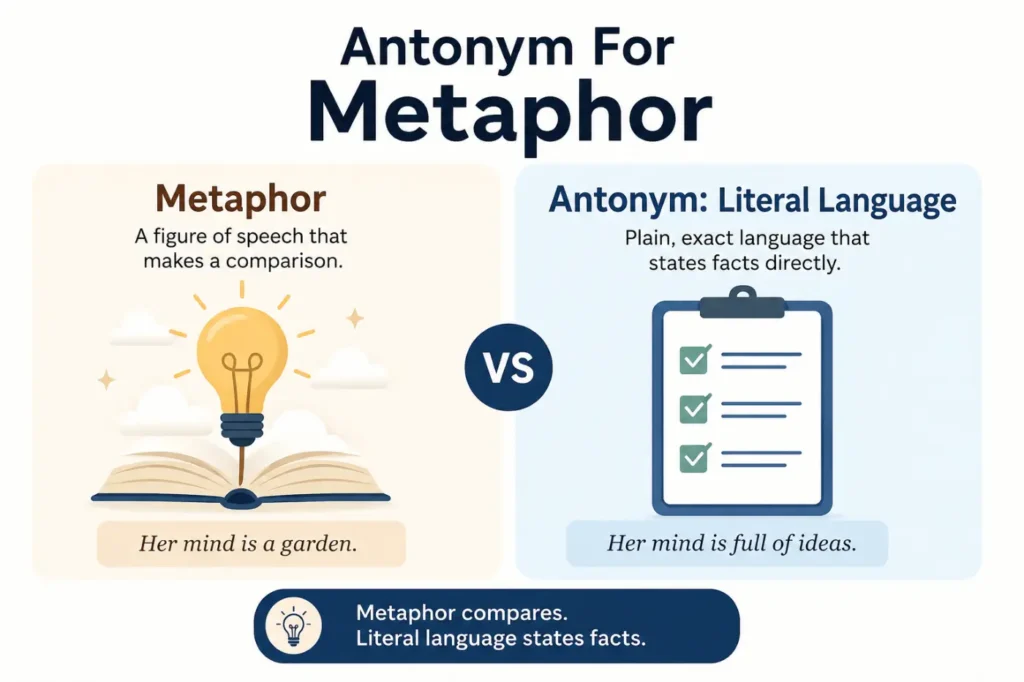
There is no official antonym for metaphor in English. The closest conceptual opposite is literal language, which communicates exactly what the speaker or writer means without using figurative comparisons. While a metaphor creates an implied comparison, literal language states facts directly and leaves little room for symbolic interpretation.
Quick Answer
If you only need a quick answer, remember these points.
- Metaphor has no universally accepted antonym.
- Literal language is the closest opposite in meaning.
- A metaphor creates an implied comparison.
- Literal language communicates facts directly.
- Writers use metaphors for imagery, while literal language focuses on clarity and precision.
Comparison Table
| Feature | Metaphor | Literal Language |
|---|---|---|
| Part of speech | Noun | Noun phrase |
| Origin | Greek | Latin and Old French roots |
| Meaning | A figure of speech that compares two unlike things without using like or as | Language that expresses the exact meaning without figurative comparison |
| Correct usage | Literary and everyday communication | Everyday, academic, legal, and technical communication |
| Formality | Used in both formal and informal writing | Used in all writing styles |
| Common contexts | Literature, speeches, poetry, storytelling, advertising | Instructions, textbooks, reports, contracts, journalism |
| Usage frequency | Very common | Extremely common |
| Example | Time is a thief. | Time passes quickly. |
To expand your vocabulary further, explore other figurative language alternatives that can express comparisons and symbolic ideas in different ways.
What Is A Metaphor
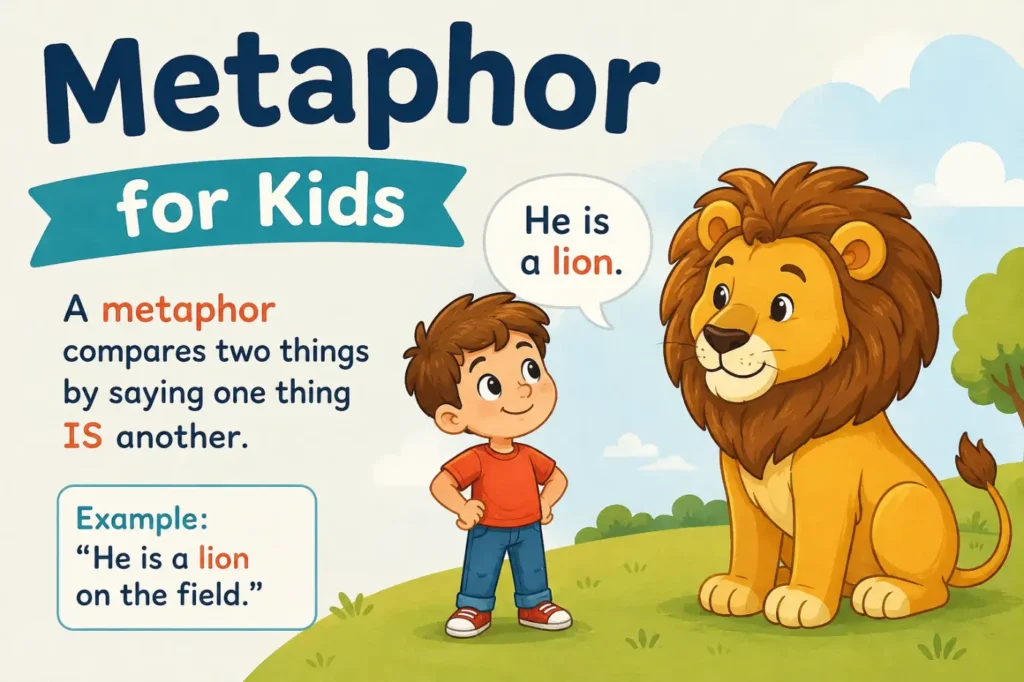
A metaphor is a figure of speech that describes one thing by saying it is another. Instead of making a direct comparison with words such as like or as, it creates an implied comparison that helps readers picture an idea more clearly.
For example, consider the sentence:
The classroom was a zoo.
The classroom is not literally a zoo. The writer compares the noisy classroom to a zoo to create a vivid mental image.
Metaphors appear everywhere, not just in literature. People use them naturally in conversations, speeches, movies, songs, advertisements, and news articles because they make language more memorable.
Common examples include:
- Her smile was sunshine.
- Ideas are seeds.
- He has a heart of stone.
- The city never sleeps.
- Life is a journey.
These expressions communicate meaning through imagination rather than literal description.
Is There An Antonym For Metaphor
This question has a simple answer but requires a little explanation.
Unlike many vocabulary words, metaphor does not have a single dictionary antonym. That is because it names a writing technique instead of describing a quality with an obvious opposite.
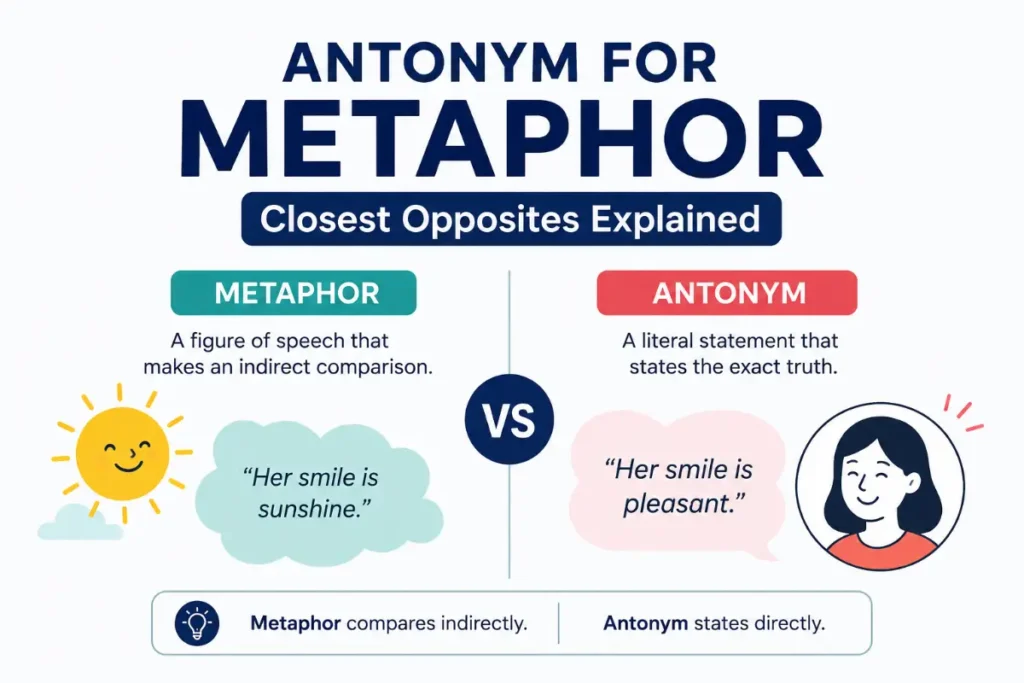
Language experts generally agree that literal language is the closest conceptual opposite. Literal language presents information exactly as intended without relying on symbolism, imagery, or implied comparisons.
Compare these two sentences.
Metaphor
The project was a marathon.
Literal language
The project took a very long time to finish.
Both sentences communicate a similar idea, but they do it in different ways. One relies on imagination, while the other explains the situation directly.
That distinction is why teachers, editors, and writing guides often describe literal language as the practical opposite of metaphor, even though it is not a formal dictionary antonym.
Closest Opposites Explained
Since there is no official antonym, several related terms appear in discussions about this topic. Some are closer than others.
Literal Language
This is the strongest answer because it avoids figurative meaning completely.
Example:
Metaphor
Her words were daggers.
Literal language
Her words were harsh and hurtful.
Direct Language
Direct language communicates ideas clearly and plainly. Although it may include figurative expressions in some situations, it usually focuses on straightforward communication.
Plain Language
Plain language aims to make information easy to understand. It is commonly used in government documents, business communication, healthcare, and education.
While plain language often uses literal wording, its primary goal is clarity rather than serving as the opposite of metaphor.
Factual Language
Factual language presents information based on observable facts instead of imagery or symbolism.
For example:
The mountain is 2,500 meters high.
This statement describes reality without figurative expression.
Among these options, literal language remains the closest and most widely accepted opposite.
Key Differences
Although metaphor and literal language can communicate the same basic idea, they achieve that goal in very different ways.
Here are the most important differences.
- A metaphor creates an implied comparison, while literal language states facts directly.
- A metaphor encourages imagination, while literal language reduces ambiguity.
- Metaphors often appear in literature, speeches, advertising, and storytelling, while literal language dominates textbooks, manuals, contracts, and news reporting.
- Readers interpret metaphors beyond their surface meaning, while literal language usually requires no interpretation.
- Metaphors add emotion and imagery, while literal language emphasizes accuracy and clarity.
Neither approach is better than the other. Skilled writers choose the one that best fits their audience and purpose.
Pronunciation Guide
Knowing how to pronounce important language terms correctly helps you speak with confidence during discussions, presentations, and classroom activities.
Metaphor
IPA
/ˈmet.ə.fɔːr/
Syllable Breakdown
met uh for
Literal
IPA
/ˈlɪt.ər.əl/
Syllable Breakdown
lit er uhl
Common Pronunciation Mistakes
Some learners place too much stress on the final syllable of metaphor. Native speakers emphasize the first syllable instead.
Another common mistake is dropping the middle vowel in literal, causing the word to sound rushed. Speaking each syllable clearly improves both pronunciation and comprehension.
How To Remember The Difference
Many students understand the definitions but still hesitate when deciding if a sentence is metaphorical or literal. A simple way to remember the distinction is to ask yourself one question.
Is the sentence asking me to imagine something, or is it describing reality exactly as it is?
If the sentence creates a picture in your mind through an implied comparison, it is a metaphor.
Example:
His mind is a computer.
If the sentence simply states the facts without symbolic meaning, it uses literal language.
Example:
He remembers information very quickly.
Another helpful tip is to think about the purpose of the sentence.
- Metaphors make writing vivid, expressive, and memorable.
- Literal language makes writing precise, direct, and easy to understand.
Once you begin looking at the writer’s purpose instead of individual words, identifying the difference becomes much easier.
Examples In Sentences
The easiest way to understand the difference is to compare figurative language with literal language side by side. Notice how the first group creates an image or implied comparison, while the second group communicates the same idea in a direct way.
Metaphor Examples
Each sentence below uses a metaphor to add imagery or emotional impact.
- Her voice was velvet during the interview.
- The classroom became a battlefield before the exam.
- His ideas are the building blocks of our success.
- Time is a thief that steals precious moments.
- The internet is a highway filled with endless information.
- Their friendship is an unbreakable bridge.
- She carried the weight of the world on her shoulders.
- The city is a living organism that never truly rests.
- His determination became the engine behind the team’s progress.
- Knowledge is a key that opens countless doors.
These examples do not describe reality literally. Instead, they compare one thing with another to make the message more vivid and memorable.
Literal Language Examples
These sentences express similar ideas without using figurative comparisons.
- Her voice sounded calm and pleasant during the interview.
- The classroom became noisy before the exam.
- His ideas helped the team succeed.
- Time passes quickly.
- The internet contains an enormous amount of information.
- Their friendship remained strong for many years.
- She had many responsibilities to manage.
- The city stays busy throughout the day and night.
- His determination helped the team achieve its goals.
- Knowledge creates more opportunities for learning and success.
Literal language focuses on clarity. The reader does not need to interpret hidden meanings because the message is expressed exactly as intended.
Common Mistakes
People often confuse metaphors with other language techniques or misunderstand what counts as an opposite. Recognizing these mistakes will help you use literary terms more accurately.
Assuming Every Word Has An Antonym
This is the most common misunderstanding.
Not every English word has a direct opposite. A metaphor is a literary device rather than a descriptive adjective, so there is no universally accepted antonym in dictionaries.
Confusing Metaphor With Simile
Although both create comparisons, they work differently.
- A metaphor says one thing is another.
- A simile compares two things using like or as.
For example:
Metaphor:
Life is a journey.
Simile:
Life is like a journey.
The meaning is similar, but the structure is different.
Treating Literal Language As A Literary Device
Literal language is not a figure of speech. It simply communicates ideas directly without relying on symbolism, exaggeration, or imaginative comparison.
Believing Figurative Language Means The Same Thing
A metaphor is one type of figurative language, but figurative language includes many other techniques.
These include:
- Similes.
- Personification.
- Hyperbole.
- Idioms.
- Symbolism.
- Allusion.
Using these terms interchangeably creates confusion because each serves a different purpose.
Etymology And Word Origin
Understanding where these terms came from helps explain why they are used the way they are today.
The word metaphor comes from the Ancient Greek word metaphora, meaning transfer or carry across. It combines two Greek elements that describe the act of transferring meaning from one idea to another.
Greek scholars used the term to explain how language could communicate ideas indirectly by applying the qualities of one object to another.
The word literal has a different history. It comes from the Latin word littera, meaning letter. Over time, it developed into a term describing language that follows the exact meaning of the words without figurative interpretation.
Today, both concepts remain central to English grammar, literature, rhetoric, and communication.
Regional Usage
The understanding of metaphors remains remarkably consistent across major English speaking countries. Unlike spelling differences such as color and colour, the definition of a metaphor does not change.
American English
American schools introduce metaphors in elementary language arts classes and continue teaching them through high school and college. They appear regularly in literature, speeches, journalism, advertising, and everyday conversation.
British English
British English follows the same literary principles. Students learn to identify and interpret metaphors while studying poetry, novels, and classic literature.
Australian English
Australian classrooms also emphasize figurative language as part of reading and writing instruction. Writers frequently use metaphors in news articles, public speaking, and creative writing.
Canadian English
Canadian English treats metaphors in the same way. Educational resources, dictionaries, and writing guides define the term consistently across provinces.
Although accents and spelling conventions differ among English speaking countries, the concept of a metaphor remains the same.
Grammar Rules
A metaphor is classified as a noun because it names a literary device rather than describing an action or quality.
Part Of Speech
Metaphor functions as a common noun.
Examples:
- The author used a powerful metaphor.
- That metaphor strengthens the paragraph.
- Students identified every metaphor in the poem.
Plural Form
The regular plural form is:
Metaphors
Examples:
- The novel contains several memorable metaphors.
- Great speeches often include carefully chosen metaphors.
Sentence Structure
A metaphor usually follows a simple pattern.
Subject + linking verb + metaphor
Examples:
- Her smile is sunshine.
- Knowledge is power.
- The world is a stage.
This structure creates an implied comparison without using words such as like or as.
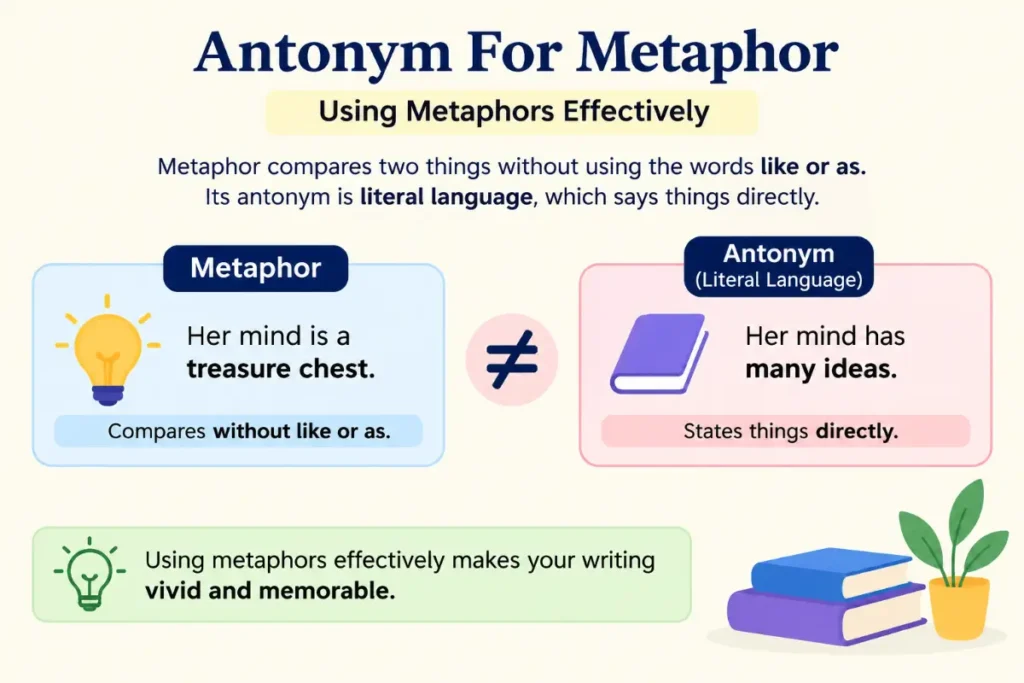
Using Metaphors Effectively
Strong metaphors should feel natural and support the message rather than distract from it.
Good writers choose comparisons that readers can understand quickly. If the comparison is too unusual or unrelated, the intended meaning may become unclear.
Real Life Usage Examples
Metaphors are far more common than many people realize. They appear in everyday conversations, professional writing, advertising, politics, education, and entertainment.
Daily Conversation
People naturally use figurative language without thinking about it.
Examples include:
- I am drowning in paperwork.
- That idea sparked my interest.
- We reached a crossroads in the project.
Although these expressions are not literally true, native speakers understand them immediately.
Academic Writing
Teachers encourage students to recognize metaphors when analyzing novels, poetry, speeches, and essays. Literary analysis often explores how metaphors shape tone, theme, and character development.
Professional Communication
Business writers occasionally use metaphors to simplify complex ideas.
Examples include:
- Our roadmap outlines the next stage of growth.
- This strategy is the foundation of the project.
- The proposal opened new doors for the company.
Professional writing uses metaphors carefully so the message remains clear.
Literature
Many famous authors rely on metaphors to make their writing more memorable. A well chosen metaphor can communicate emotion, create vivid imagery, and reveal deeper meaning in just a few words.
Media And Advertising
Advertisers frequently use metaphors because they help audiences remember products and ideas.
Expressions such as fuel your future or unlock your potential create emotional connections without describing literal events.
Understanding these examples makes it much easier to recognize figurative language in books, speeches, films, advertisements, and everyday conversations.
Related Words And Confused Terms
Many literary terms are closely connected to metaphors, but they are not interchangeable. Understanding the differences helps you choose the right term when reading, writing, or analyzing language.
| Term | Meaning | How It Differs |
|---|---|---|
| Metaphor | An implied comparison between two unlike things | States one thing is another. |
| Simile | A comparison using like or as | Makes the comparison explicit. |
| Analogy | An extended comparison used to explain an idea | Usually longer and more detailed than a metaphor. |
| Symbolism | Using an object or action to represent a deeper meaning | Represents an idea rather than making a direct comparison. |
| Personification | Giving human qualities to nonhuman things | A specific type of figurative language. |
| Literal language | Words used in their ordinary meaning | The closest conceptual opposite of a metaphor. |
You may also come across these related search terms.
- Metaphor antonym and synonym.
- Synonym for metaphor.
- Antonym for simile.
- Metaphor part of speech.
- Another word for metaphor that starts with A.
- Metaphor synonym 8 letters.
- Antonym of meta.
Metaphor Antonym And Synonym
The closest antonym is literal language because it avoids figurative meaning.
Common synonyms depend on the context. These include:
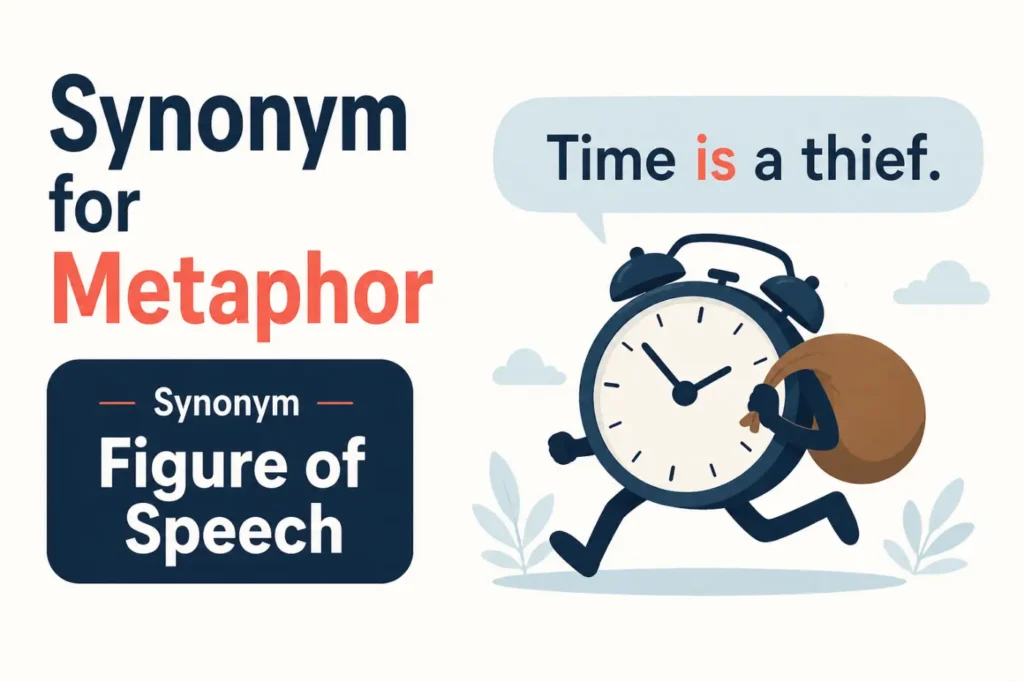
- Figure of speech.
- Figurative expression.
- Symbolic comparison.
- Image.
- Analogy. (In some contexts, but not as a perfect synonym.)
Synonym For Metaphor
No single synonym replaces metaphor in every sentence. However, writers often use these related terms when discussing literary techniques.
- Figure of speech.
- Figurative device.
- Literary device.
- Symbolic expression.
- Comparison. (General use only.)
Antonym For Simile
Like metaphor, simile has no universally accepted dictionary antonym. The closest conceptual opposite is also literal language because it avoids figurative comparison altogether.
Another Word For Metaphor That Starts With A
People often search for an alternative beginning with the letter A.
The closest options are:
- Analogy.
- Allegory.
Neither is a true synonym.
An analogy explains an idea through an extended comparison, while an allegory is a complete narrative with symbolic meaning.
Metaphor Synonym 8 Letters
Some users search specifically for an eight letter synonym.
There is no perfect eight letter replacement for metaphor. Depending on the context, writers sometimes consider analogy as the closest related term because it also involves comparison, although the meanings are not identical.
Metaphor Part Of Speech
Metaphor is a countable common noun.
Examples include:
- The metaphor strengthens the paragraph.
- Her essay contains several metaphors.
Antonym Of Meta
The prefix meta means beyond, after, about itself, or self referring, depending on the context.
There is no single accepted antonym for the prefix because its meaning changes across subjects such as philosophy, linguistics, and computer science. The opposite depends on the context in which meta is being used.
Expert Language Insight
One of the biggest misconceptions about literary terminology is the belief that every word must have a direct opposite. Language does not always work that way.
Experienced editors and English teachers rarely search for an exact antonym to metaphor. Instead, they focus on the contrast between figurative language and literal language because that distinction helps readers understand how ideas are communicated.
Native speakers move between these styles naturally. A journalist reporting facts usually relies on literal language. A novelist, poet, or speechwriter often uses metaphors to create imagery, emotion, and memorable phrasing.
The best writers know when each approach serves the reader. A metaphor can make an abstract idea vivid, while literal language removes ambiguity and improves precision. Choosing between them depends on your purpose, audience, and context rather than a fixed writing rule.
Frequently Asked Questions
What is the antonym for metaphor?
There is no official dictionary antonym for metaphor. The closest conceptual opposite is literal language because it expresses ideas directly without using figurative comparisons or symbolic meaning.
Is literal language the opposite of a metaphor?
Yes. Although it is not a formal dictionary antonym, most language experts, teachers, and writing guides consider literal language the closest opposite because it communicates the exact meaning instead of creating an implied comparison.
Does metaphor have a synonym?
No single word replaces metaphor in every situation. Depending on the discussion, people may use related terms such as figure of speech, figurative device, or symbolic expression, but each has its own meaning and scope.
Is a simile the opposite of a metaphor?
No. A simile is another type of figurative language. It compares two things by using like or as, while a metaphor makes the comparison directly. Both belong to the same family of literary devices.
What part of speech is metaphor?
Metaphor is a common noun. It names a literary device rather than describing an action or quality. The plural form is metaphors.
Why do people search for an antonym?
Many English words have direct opposites, so learners naturally expect the same pattern here. However, literary devices describe writing techniques, and those techniques often do not have true antonyms.
Can metaphors appear in everyday conversation?
Yes. Native speakers use metaphors constantly without realizing it. Expressions such as time is money, breaking the ice, and food for thought have become a natural part of everyday English.
Should I avoid metaphors in formal writing?
Not always. Metaphors can strengthen speeches, essays, and persuasive writing when they clarify an idea. In highly technical, legal, or scientific documents, literal language is usually a better choice because it reduces ambiguity.
Conclusion
If you came looking for a single word that serves as the opposite of metaphor, the answer is simple. No universally accepted antonym exists. The closest conceptual opposite is literal language because it communicates ideas exactly as they are instead of using figurative comparison.
Understanding this distinction is more valuable than memorizing a single term. It helps you recognize how writers shape meaning, choose the right language for different audiences, and appreciate the role figurative expressions play in communication.
Use metaphors when you want to create imagery, emotion, or memorable writing. Choose literal language when clarity, accuracy, and precision matter most. Knowing when to use each approach will make your writing stronger and your reading more insightful.