English can be surprisingly tricky when two words look almost identical but only one belongs in standard usage. Encode vs incode is a good example. If you have seen both forms online or in programming discussions, it is reasonable to wonder if they represent two different technical concepts or simply different spellings.
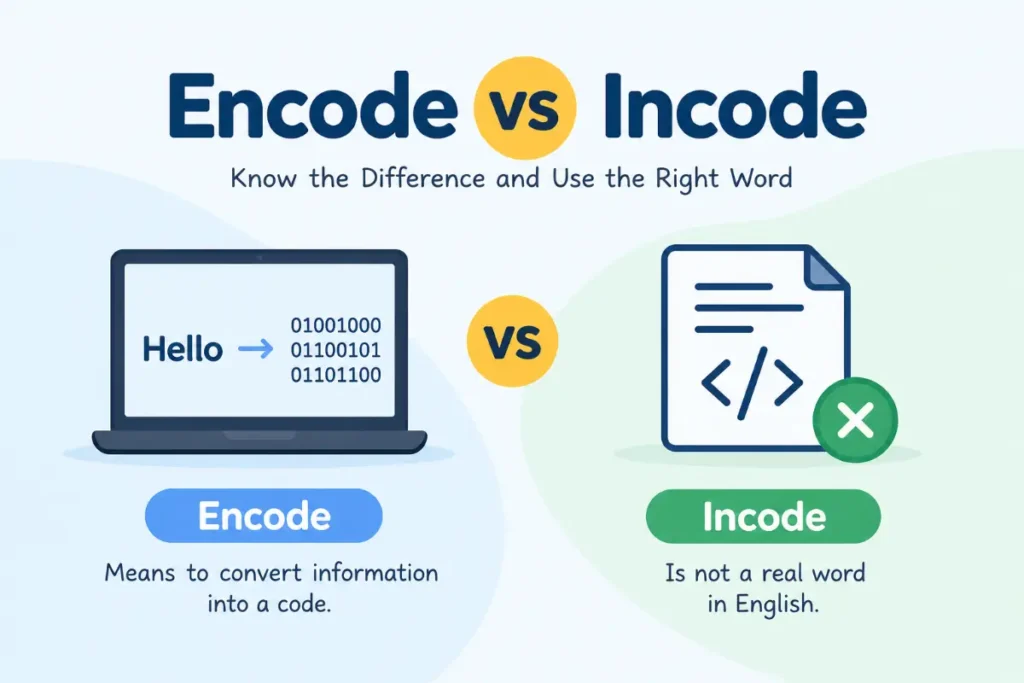
The direct answer is that encode is the standard English word. It means to convert information into a particular form or format so it can be stored, transmitted, processed, or understood by a specific system. Incode is not normally used as a standard English equivalent of encode. It may appear in specialized names, software terminology, product names, or as an informal mistake, but it does not replace the established verb.
The confusion becomes stronger in computing because terms such as encoding, encoded data, decode, and code appear together constantly. Someone who knows that code is related to information processing may naturally assume that incode should also be a valid verb.
This guide clears up that confusion. You will learn the meaning of both forms, the correct spelling, how encoding works in computers, common mistakes, pronunciation, grammar, examples, regional usage, and the situations in which you might encounter the unusual form.
Quick Definition
Encode is the standard verb meaning to convert information into a particular code, format, or representation. Incode is not the standard English equivalent. In computing, writing, and professional communication, use encode when describing the process of converting information into another form.
Quick Answer
The correct standard word is encode. It means to convert information into a coded or formatted representation. For example, software can encode text as UTF 8 or encode audio into a digital format. Incode is generally not a standard synonym for encode and should not be used as a replacement in ordinary English or technical writing.
Comparison Table
| Feature | Encode | Incode |
|---|---|---|
| Part of speech | Verb | Not normally a standard English verb |
| Standard form | Yes | No as a general equivalent |
| Basic meaning | Convert information into a code or format | Usually an informal or mistaken form of encode |
| Word origin | English formation based on en plus code | Later formation or nonstandard usage |
| Formality | Standard | Nonstandard unless part of a proper name or specialized term |
| Common contexts | Computing, mathematics, linguistics, media, communication | Occasional software names, informal writing, specialized usage |
| Usage frequency | Common | Very uncommon |
| Related noun | Encoding | No widely accepted equivalent meaning the same thing |
| Opposite process | Decode | Decode is not normally paired with incode |
| Example | The application will encode the text as UTF 8. | Incode is not normally used in this sentence. |
The table reveals an important point. These are not two standard alternatives like color and colour. English has a well established word for the process: encode.
Similar spelling questions can be tricky in English, especially when choosing between terms that look almost identical, such as which form is correct for debts.
Meaning Of Both Terms
Understanding the individual forms makes the distinction much easier.
What Does Encode Mean
Encode means to transform information into another representation according to a particular system, set of rules, or format.
The information can be almost anything. It might be text, numbers, images, sound, video, or another type of data. The goal is to represent that information in a form suitable for a particular purpose.
For example, a computer can encode a character into a sequence of bytes. A video application can encode raw video into a compressed format. A communication system can encode information into a signal that can travel through a transmission channel.
In ordinary language, the word can also describe communication.
Someone might encode a message using symbols or a secret system so that another person needs the appropriate method to interpret it.
The central idea remains the same: information is transformed into a particular representation.
That concept gives us several related forms.
- Encode is the verb.
- Encoding is the process.
- Encoded describes information that has already been transformed.
- Encoder is a person, device, or software component that performs the transformation.
- Decode means to convert encoded information back into an understandable or usable form.
What Does Incode Mean
The phrase incode means can be confusing because it does not have one universally accepted standard meaning comparable to encode.
In ordinary English, incode is generally not the word you want when you mean converting information into a code or format. If you are writing a sentence such as “The program will ___ the image,” the standard choice is encode.
However, you may encounter incode in particular technical environments or names. A software company, library, application, programming project, or proprietary system can choose almost any name it wants. A specialized term can also develop inside a particular community.
That does not automatically make it a general English word.
This distinction matters for editors and technical writers. A term can exist somewhere on the internet without being an accepted replacement for a standard dictionary word.
If you encounter incode in documentation, examine the surrounding context. It may be:
- A product or project name.
- A specialized term.
- A programming identifier.
- A company name.
- A typo for encode.
- A community specific expression.
Unless the context establishes a specific meaning, encode is the correct choice.
Key Differences
The most important difference is not pronunciation or regional preference. It is standard usage. Encode has a clear established meaning in English. Incode does not function as its standard counterpart.
Meaning Difference
The verb encode describes a transformation of information into a particular representation.
For example:
- The application encodes the image before sending it to the server.
Here, the meaning is precise. The software changes the representation of the image according to an encoding method. By contrast, replacing encode with incode creates a sentence that sounds unfamiliar and nonstandard.
Grammar Difference
Encode behaves like an ordinary English verb.
You can write:
- Encode the data.
- The system encodes the message.
- The files were encoded.
- The application is encoding the video.
- We need to encode the information.
This gives the word a complete grammatical family.
Incode does not have the same established grammatical role in standard English.
Technical Difference
In computing, encode has a precise and widely recognized meaning. Encoding can involve converting information into a particular character representation, data format, transmission format, or media format.
For example, text encoding determines how characters are represented as data. UTF 8 is a familiar example. Video encoding converts raw or uncompressed video into a format designed for storage, playback, or transmission.
Audio encoding performs a similar transformation for sound. The technical field therefore has an extensive vocabulary built around encode and encoding.
Regional Difference
There is no major American versus British spelling distinction here.
- American English uses encode.
- British English uses encode.
- Australian English uses encode.
- Canadian English uses encode.
The standard form does not change simply because the audience lives in a different English speaking country.
Which One Is Correct
For normal English, professional writing, academic work, and computer terminology, encode is the correct word. Use it when you mean to convert information into a coded, structured, or formatted representation.
Examples include:
- Encode a message.
- Encode text.
- Encode an image.
- Encode audio.
- Encode video.
- Encode data.
- Encode a character.
- Encode a signal.
You should not replace encode with incode merely because the latter looks like it could logically mean putting something into code.
English does not always form words as logically as learners expect. The fact that en can suggest putting something into a state does not mean every possible combination becomes a standard English word.
This is one reason dictionary based usage matters. A word can look perfectly reasonable and still not be the conventional choice.
Pronunciation Guide
Pronunciation can add another layer of confusion because encode has a straightforward pronunciation that is worth learning.
IPA Pronunciation
Encode
/ɪnˈkoʊd/ in American English.
British pronunciation is commonly represented as:
/ɪnˈkəʊd/.
The difference comes from the vowel used in the word code across different English varieties.
Syllable Breakdown
The word has two syllables.
en code
The stress falls on the second syllable.
en CODE
Common Pronunciation Mistakes
Learners sometimes place too much stress on the first syllable or pronounce the ending as though it were a separate word.
A natural pronunciation keeps the first syllable light and gives the main emphasis to code.
Because encode is common in technical English, becoming comfortable with its pronunciation is useful for meetings, presentations, programming discussions, and classroom conversations.
How To Remember The Correct Word
A useful memory trick is to connect the word directly with its established pair.
Encode → Decode
The two verbs describe opposite stages of an information process.
Something can be encoded into a particular representation and later decoded into a form that a person or system can interpret.
For example:
Original information → Encode → Encoded representation → Decode → Usable information
This relationship is far more useful than trying to decide if incode sounds logical. You can also remember the noun encoding. If you naturally say encoding, the corresponding verb is encode.
For example:
- Encode the file.
- The encoding process begins.
- The file has been encoded.
- The decoder reads the encoded data.
These forms belong to the same word family.
A final practical rule is simple: If you mean converting information into a code or format, use encode.
What Encode Means In Computer Terms
The phrase encode in computer searches often come from people trying to understand what a computer actually does when it encodes information.
In computing, encoding means representing information according to a defined system or format.
Computers ultimately work with digital data. Different kinds of information need agreed representations so software and hardware can store, process, transmit, and interpret them correctly.
Text provides a good example.
A human sees a character such as A. A computer does not store that character as an abstract letter floating inside memory. It stores a numerical representation according to an encoding system.
With UTF 8, for example, characters are represented using specific sequences of bytes. The same broad idea applies to media.
An audio encoder can transform raw sound into a digital format. A video encoder can transform video into a compressed representation. An image format can provide rules for storing visual information.
The details differ, but the basic concept remains consistent: encoding establishes a representation that a computer system can work with.
This is why encoding appears so frequently in programming and information technology.
English also has many confusing word pairs where a small spelling change can create words with surprisingly different meanings, making context essential.
Encode In Computer Programming
In programming, the exact meaning depends on what is being encoded.
A developer might encode text before placing it into a URL. Software may encode binary information as Base64 for a particular transmission or storage purpose. An application may encode characters according to a character encoding standard.
The surrounding context determines the technical process.
That distinction is important because encoding is not the same thing as encryption.
Encoding is generally designed to represent information in a different form. Encryption is designed to protect information from unauthorized access by using a cryptographic method.
For example, Base64 is an encoding scheme. It is not encryption.
That difference is one of the most useful concepts for anyone learning technical terminology.
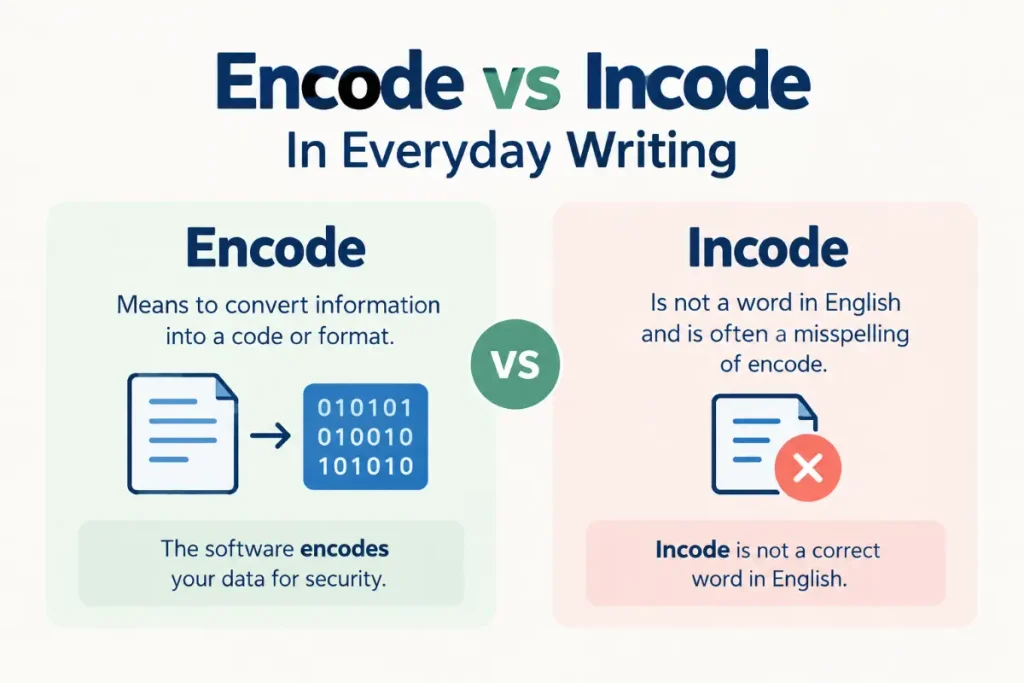
Encode Vs Incode In Everyday Writing
The distinction becomes even simpler outside computing.
If you are writing an email, article, school assignment, instruction manual, or report, choose encode when you need this meaning.
For example:
- The device can encode the audio into several formats.
That sentence sounds natural because it uses an established verb with a clear technical meaning.
Using incode in the same position would make the sentence look like a spelling mistake unless you were referring to a specific name.
This is an important editorial principle. Familiarity is not the same as correctness. You may see an unusual spelling many times online, but repetition alone does not make it the standard form.
When a word appears in professional documentation, established dictionaries, technical standards, and reputable publications, those sources provide much stronger evidence of standard usage than an isolated social media post or forum comment.
Examples In Sentences
Seeing the correct word inside a sentence makes its meaning much easier to understand. Encode is a standard English verb, so it can appear in technical writing, everyday communication, academic work, and many other contexts. The meaning usually involves changing information into a particular form, representing something through a system, or converting data so another system can store, process, or transmit it.
- The software can encode the video before uploading it.
- The application will encode the password before storing the information.
- Engineers use special formats to encode digital signals.
- The device can encode audio into a compressed file.
- The program needs to encode the message before sending it.
- The camera automatically encodes recorded footage into a digital format.
- The website uses a standard method to encode special characters.
- The researcher used symbols to encode the collected information.
- The system can encode text using several character formats.
- The computer must encode the data before transferring it.
These examples show why the word appears so often in technology and computing. However, its use is not limited to computers. You can also use it when describing information represented through symbols, language, numbers, signals, or another structured system.
For example, a teacher might say that a message is encoded using symbols. A scientist might encode observations into categories for analysis. A communication system might encode a signal before transmitting it. In every case, the basic idea is the same: information is being represented in a particular form.
The spelling incode does not normally replace encode in these sentences. If you are writing about data conversion, information representation, programming, communication systems, or similar subjects, encode is the appropriate standard form.
Common Mistakes
One of the most common mistakes is assuming that incode is simply another spelling of encode. The similarity between the words makes this mistake understandable, especially because English contains many words that begin with the prefix in.
However, spelling patterns do not always work that way. The word you need for converting or representing information is encode. Adding an extra letter at the beginning changes the word into something that is not the normal standard form for this meaning.
Another common mistake happens when people type quickly. Since words such as include, inside, input, and incode may look familiar, the fingers can easily produce the wrong spelling. A quick spell check may catch the problem, but understanding the meaning makes the correction easier to remember.
Here are some common incorrect and correct patterns.
- Incorrect: The program will incode the file.Correct: The program will encode the file.
- Incorrect: We need to incode this message.Correct: We need to encode this message.
- Incorrect: The system incodes the information.Correct: The system encodes the information.
- Incorrect: This software can incode audio.Correct: This software can encode audio.
- Incorrect: The data was incoded before transmission.Correct: The data was encoded before transmission.
The mistake can also appear in related forms. The standard forms include encode, encodes, encoded, and encoding.
For example, you can write:
- The system encodes the data.
- The system encoded the data yesterday.
- The system is encoding the data now.
- The system can encode the data automatically.
The same basic spelling pattern remains throughout these forms.
A second mistake involves confusing encoding with encryption. The two concepts can overlap in technical discussions, but they are not automatically the same thing. Encoding generally changes information into another representation or format. Encryption is specifically designed to protect information by making it unreadable without the appropriate key or method of decryption.
For example, converting text into a character encoding is not the same process as encrypting confidential information. Using the correct terminology makes technical writing much clearer.
Etymology And Word Origin
The word encode comes from the combination of en and code. The basic idea is to put something into a code or represent it using a particular coding system.
The word code has a long history connected with systems of rules, symbols, and written representations. Over time, the concept of coding expanded beyond secret messages and formal rules. Modern English uses code in areas such as computing, communication, mathematics, information theory, and data processing.
The development of computing gave encode an even more important role. Computers cannot work directly with every form of human information in its original presentation. Text, images, audio, video, and other forms of information often need to be represented in formats that digital systems can process.
That is why terms such as encoding, encoded data, and character encoding are common in technology.
The suffix and word formation also explain why encode should not normally be changed to incode. The word is built around code, producing the established verb encode. The extra in does not create the standard technical verb used for this concept.
Understanding the origin can therefore make the spelling easier to remember. Think of it as putting information into a code. The resulting verb is encode.
Regional Usage
The spelling encode is standard across the major varieties of English. American English, British English, Australian English, and Canadian English all use the same spelling for the normal verb.
Unlike some spelling differences between American and British English, this word does not normally change from one region to another.
For example, an American writer might say:
- The program encodes the video automatically.
A British writer can use the same wording:
- The program encodes the video automatically.
Australian and Canadian writers also use encode in technical and general contexts.
This is useful for international communication because you do not need to switch spellings based on the country of your audience. The same standard form works in software documentation, academic writing, technical manuals, websites, and everyday explanations.
The confusion with incode is therefore not usually a British versus American spelling issue. It is better understood as a spelling error or a nonstandard form in contexts where encode is intended.
Regional vocabulary can sometimes create genuine spelling differences. Words such as color and colour, or center and centre, demonstrate this clearly. Encode does not normally belong to that category.
For a global English audience, the safest choice is simple: use encode when you mean converting or representing information through a code or format.
Grammar Rules
Encode is a regular transitive verb. This means it can normally take a direct object.
For example:
- The application encodes the file.
Here, application is the subject, encodes is the verb, and file is the object.
The basic verb forms are straightforward.
| Form | Example |
|---|---|
| Base form | encode |
| Third person singular | encodes |
| Past tense | encoded |
| Past participle | encoded |
| Present participle | encoding |
You can use the base form after modal verbs.
For example:
- The program can encode the file.
- The device will encode the signal.
- The system should encode the information first.
You use encodes with a third person singular subject in the present tense.
For example:
- The software encodes the video.
- This device encodes audio automatically.
- The application encodes each file separately.
The past tense and past participle are both encoded.
For example:
- The program encoded the data yesterday.
- The information was encoded before transmission.
- The files have been encoded successfully.
The ing form is encoding.
For example:
- The computer is encoding the video.
- The software is currently encoding the audio.
- Encoding large files can take several minutes.
The noun form is encoding. It describes the process or method of converting information into another representation.
For example:
- The encoding process changed the original data into a compatible format.
Another important grammar point is the difference between encode and decode. These verbs describe opposite stages of a communication or information process.
You encode information when you convert it into a particular representation. You decode it when you convert that representation back into an understandable or usable form.
For example:
- The sender encodes the message, and the receiver decodes it.
This relationship provides another useful memory trick. Encode moves information into a code or representation. Decode moves coded information back toward its original meaning.
Real Life Usage Examples
You encounter encoding in more places than you might realize. The process happens behind many ordinary digital activities, even when users never see the technical details.
Websites And Browsers
Websites rely on encoding to represent text correctly. Character encoding helps browsers understand how letters, numbers, symbols, and other characters should be represented.
For example, a website may specify a character encoding so the browser displays its content correctly. Without compatible encoding, some characters can appear incorrectly or become difficult to read.
A developer might therefore write:
- The webpage uses UTF 8 encoding.
The term encoding describes the process or system used to represent the characters.
Video Streaming
Video services need to prepare large amounts of visual information for storage and delivery. Encoding can convert video into a format suitable for playback and distribution.
When you upload a video, the service may process and encode it into several versions. Those versions can support different screen sizes, connection speeds, or playback requirements.
That is why video encoding is an important part of modern digital media.
Audio Files
Music and other recordings also rely on digital encoding. Audio information can be represented in different digital formats depending on the intended use.
For example, a recording may be encoded into a format designed for efficient storage or playback.
The choice of format can influence factors such as file size, compatibility, and audio quality.
Messaging Systems
Digital messages may also involve encoding. A communication system needs a way to represent information so that it can be transmitted and interpreted correctly.
A simple example is a system that converts characters into numerical or binary representations before transmission.
The receiver then uses the appropriate decoding process to interpret the information.
Programming
Developers regularly work with encoded data. A program may encode text before sending it to another service or encode information before placing it into a particular file format.
For example, an application may encode a URL so that special characters are represented safely within the address.
Encoding is also common when software communicates through APIs, processes files, or handles data received from external systems.
QR Codes
QR codes provide a familiar visual example of information being represented through a structured system. Information is converted into a machine readable pattern that a scanner can interpret.
The exact technical process is more complex than simply replacing letters with symbols, but the general concept of representing information in a structured form fits the broader idea of encoding.
Data Storage
Files often use specific formats and encoding methods to represent information. Text documents, images, audio files, and videos all need structured digital representations.
When software reads a file, it needs to understand the representation used inside that file. Compatible encoding allows the system to interpret the stored information correctly.
Email systems can use encoding to represent content and attachments in ways that allow them to travel through communication systems safely and consistently.
This becomes especially important when an email contains characters, attachments, or content that cannot be transmitted directly in its original form.
Digital Communication
Telecommunication systems use encoding to represent information for transmission. Signals can be encoded into forms that communication equipment can send, receive, process, and interpret.
This concept appears in networking, wireless communication, digital broadcasting, and many other technologies.
Data Analysis
Encoding also appears outside traditional software development. Data analysts may encode categories into numerical values so statistical or machine learning systems can process them.
For example, a dataset containing categories such as “small,” “medium,” and “large” might represent those categories numerically for analysis.
In this context, encoding does not necessarily mean protecting the information. It means representing information in a form that another system or process can work with.
That distinction is important because encode is a broad word. Its meaning depends on the context, but the central idea remains the representation or conversion of information into a particular form.
Related Words And Confused Terms
Understanding related words makes the difference between similar technical terms much easier to remember. Several words are closely connected to encode, but they do not all mean the same thing.
Encoding
Encoding is the process of converting information into a particular representation or format. It is the noun or present participle form associated with the verb encode.
For example:
- The encoding process took several minutes.
In computing, encoding can involve converting text, audio, video, or other information into a format that a particular system can handle.
Encoded
Encoded is the past tense and past participle form of encode.
For example:
- The file was encoded before it was uploaded.
It describes information that has already gone through an encoding process.
Decoder
A decoder is something that converts encoded information back into a usable or understandable representation.
For example, a media player may contain software that decodes an encoded audio or video file so you can play it.
Decode
Decode describes the reverse process of interpreting or converting coded information.
For example:
- The receiver decodes the signal before displaying the message.
A useful way to remember the relationship is simple. You encode information into a representation, then decode that representation when you need to interpret it.
Code
Code can refer to a system of symbols, instructions, rules, or representations. In computing, it can also refer to instructions written for a computer.
The word is broader than encode. A code can be a system used to represent information, while encoding is the process of putting information into that representation.
Encryption
Encryption is another term that people sometimes confuse with encoding. Both can involve transforming information, but their purposes are different.
Encoding generally focuses on representing information in another format or structure. Encryption focuses on protecting information from unauthorized access by transforming it using a cryptographic method.
For example, converting text into UTF 8 is an encoding process. Encrypting confidential information with a cryptographic algorithm is an encryption process.
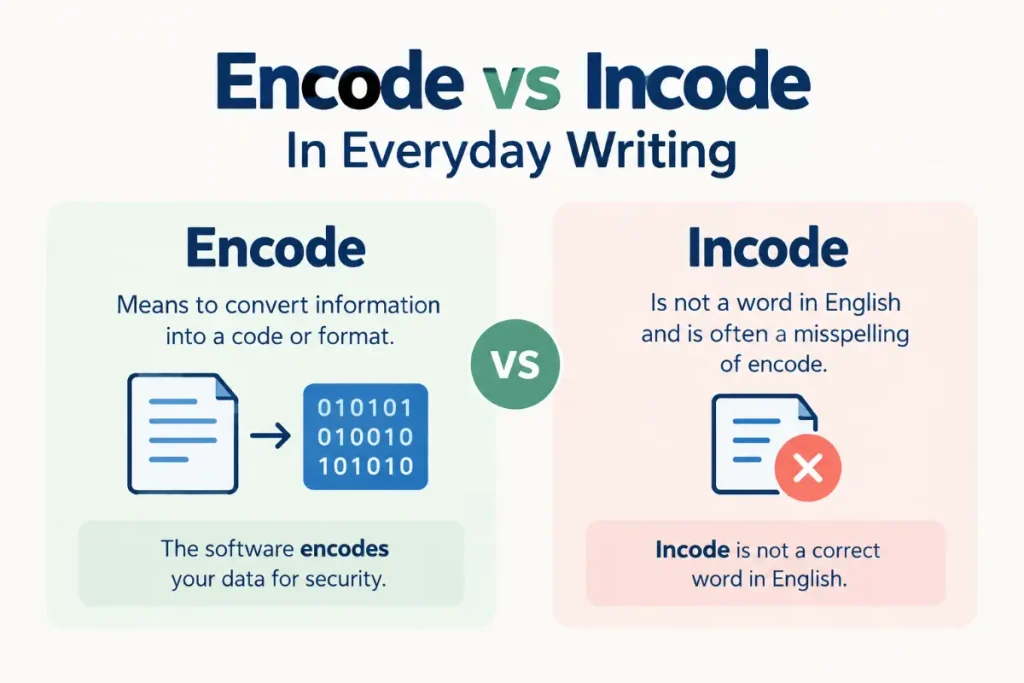
Serialization
Serialization means converting an object or data structure into a format that can be stored or transmitted and later reconstructed.
Encoding and serialization can overlap in practical software development, but they are not identical concepts. Encoding is a broader idea involving representation, while serialization specifically concerns representing data structures in a form suitable for storage or transmission.
Transcoding
Transcoding means converting information from one encoding or format into another.
For example, a video service may transcode a video from one format into several versions suitable for different devices.
This gives you a useful terminology chain:
- Encode means convert information into a representation.
- Decode means interpret or convert encoded information back.
- Transcode means convert from one representation or format to another.
- Encrypt means transform information for security.
Keeping these distinctions clear helps prevent technical writing from becoming vague or inaccurate.
Expert Language Insight
The most important language lesson is that encode is the established standard verb for putting information into a code or representation. The spelling incode should not normally be used as a replacement for it.
The confusion probably comes from the way English forms many words with prefixes. Words such as include, input, and inside can make incode look plausible at first glance. However, familiar looking patterns do not automatically create standard English words.
For writers, the safest approach is to focus on meaning before spelling. If you are describing the conversion or representation of information, think of the phrase put into a code. That naturally points you toward encode.
This approach is especially useful for technical writing because technology contains many pairs of terms that look similar but perform different functions.
For example, encode and decode are related opposites. Encryption and decryption form another pair. Compression and decompression form another. Learning these relationships gives you a stronger understanding than memorizing isolated spellings.
Another useful point is that encoding is not automatically about secrecy. This is one of the most common conceptual mistakes in technical discussions. A system can encode information simply to make it compatible with a particular format or communication method.
For example, character encoding helps computers represent text. It does not automatically make that text secret.
The same principle applies to multimedia. Audio and video can be encoded into formats that allow efficient storage, transmission, or playback. The purpose can be compatibility and efficiency rather than security.
Good technical writing therefore uses the most precise term available. If the purpose is representation, encoding is appropriate. If the purpose is confidentiality, encryption is usually the more accurate term.
This distinction matters for programmers, students, technical writers, editors, and anyone explaining digital systems to a general audience.
If you are comparing regional spelling conventions, understanding the American and British spelling difference can also help you use similar words correctly.
FAQs
Is incode a correct word?
Incode is not the standard spelling to use when you mean converting information into a code or another representation. In that context, the correct verb is encode.
What does encode mean?
Encode means to convert or represent information using a particular code, system, format, or representation. In computing, it commonly describes converting data into a form that a program or device can store, process, or transmit.
What is encoding in computer terms?
In computer terms, encoding is the process of representing information in a specific digital format or coding system. Examples include character encoding, audio encoding, video encoding, and data encoding.
What is an example of encode?
A simple example is:
- The software will encode the video before uploading it.
Here, encode means that the software converts the video into a particular digital representation or format.
Is encode the same as encrypt?
No. Encoding and encryption have different primary purposes. Encoding generally changes how information is represented, while encryption transforms information to protect it from unauthorized access.
What is the difference between encode and decode?
Encode means converting information into a particular representation. Decode means interpreting or converting encoded information back into a usable form.
For example, a system may encode a message before transmission and decode it after receiving it.
What is the past tense of encode?
The past tense is encoded.
For example:
- The application encoded the file successfully.
The past participle is also encoded.
For example:
- The file has been encoded.
What is the noun form of encode?
The most common noun is encoding.
For example:
- The encoding of the data took several seconds.
The word encoder can also refer to a device, program, or component that performs encoding.
Can encode be used outside computers?
Yes. Although the word is extremely common in computing, its meaning is broader. Information can be encoded using symbols, numbers, signals, categories, or other systems.
For example, researchers can encode observations into categories for analysis.
Why do people write incode instead of encode?
The mistake may come from the visual similarity of the words or from assuming that in works as a prefix in the same way it does in other English words. However, for the standard meaning involving codes and information representation, encode is the established form.
Conclusion
The difference between encode and incode is straightforward once you connect the spelling to the meaning. Encode is the standard English verb used when information is converted into a code, format, representation, or structured form.
You will encounter it frequently in computing, programming, websites, digital communication, audio, video, data analysis, and many other technical fields. The related forms are also easy to recognize: encodes, encoded, and encoding.
The spelling incode can look convincing because English contains many words beginning with in. However, it should not be used as a substitute for encode when discussing information conversion or representation.
The easiest memory trick is to connect the word directly to code. When you put information into a code, you encode it. When you interpret coded information, you decode it.
It is also worth keeping encoding separate from encryption. Encoding changes representation, while encryption focuses on security. That small distinction can make a big difference in technical writing.
So, if you are writing an email, school assignment, software guide, website article, programming document, or technical explanation, choose encode for this meaning. It is the clear and standard choice.