Confusing affect vs effect is common because the two words sound almost identical in everyday American English, yet they usually perform different jobs in a sentence. The easiest distinction is that affect is most often a verb meaning to influence something, while effect is most often a noun meaning the result or consequence of something. For example, stress can affect your sleep, and poor sleep can have an effect on your mood.
That basic rule solves most cases, but it does not explain every use. Both words can also function in less common grammatical roles, and terms such as side effect, emotional affect, and effect change can create additional confusion. The pronunciation can also make spelling harder because the words are often pronounced alike.
This guide explains the difference in plain American English. You will see how each word works in a sentence, learn practical memory tricks, examine common mistakes, and understand special uses in psychology, medicine, business, academic writing, and everyday communication.
Quick Answer
Affect is usually a verb meaning to influence something. Effect is usually a noun meaning the result of an action or event. For example, “The weather affected our plans” uses affect as a verb, while “The weather had an effect on our plans” uses effect as a noun.
Understanding commonly confused words becomes easier when you focus on how each term functions in context, much like the difference between busyness and business.
Affect vs Effect In A Sentence
The fastest way to understand the difference is to look at the grammatical job each word performs.
Affect usually describes an action. Something affects something else.
Effect usually names a result. Something has an effect.
Compare these sentences:
- The loud noise affected my concentration.
- The loud noise had an effect on my concentration.
The meaning is almost the same, but the grammar changes. In the first sentence, affected is the verb. In the second sentence, effect is the noun.
Another useful pair is:
The new policy affected employees.
The new policy had an effect on employees.
The first sentence says the policy influenced employees. The second talks about the result or consequence of that influence.
This distinction works in a large majority of everyday sentences.
The Main Difference Between Affect And Effect
The simplest distinction is based on meaning and grammatical function.
| Feature | Affect | Effect |
|---|---|---|
| Most common part of speech | Verb | Noun |
| Basic meaning | To influence | A result or consequence |
| Common pattern | Affect someone or something | Effect on someone or something |
| Example | The change affected sales. | The change had an effect on sales. |
| Common phrase | Affect behavior | Side effect |
| Less common use | Noun in psychology | Verb meaning to cause or bring about |
| American English | Standard | Standard |
Think of affect as something happening to another thing through influence. Think of effect as the outcome that follows.
This is not an absolute rule because English has exceptions. Effect can be a verb, and affect can be a noun in specialized psychological writing. Still, the noun versus verb distinction is the most useful starting point for everyday writing.
What Does Affect Mean
Affect is most commonly a verb meaning to influence, change, or have an impact on something or someone.
It describes an action or influence rather than the result itself.
For example:
Lack of sleep can affect your ability to concentrate.
Here, lack of sleep influences concentration.
The price increase affected customer demand.
The price increase changed or influenced demand.
The storm affected several flights.
The storm had an influence on flight operations and caused changes to the normal schedule.
The word can describe physical, emotional, social, financial, environmental, or practical influence.
Common structures include:
- Affect a person.
- Affect a decision.
- Affect performance.
- Affect behavior.
- Affect the outcome.
- Affect the environment.
- Affect sales.
- Affect someone’s health.
The word does not necessarily mean that the influence is negative. An event can affect something positively, negatively, or simply by changing it.
The training program positively affected employee performance.
The program influenced performance in a favorable way.
What Does Effect Mean
Effect is most commonly a noun meaning a result, consequence, or outcome produced by an action, event, or condition.
For example:
The storm had a major effect on transportation.
The storm caused a noticeable result in transportation.
The medication caused several side effects.
The side effects are results associated with taking the medication.
The new rule had little effect on attendance.
The rule produced little change in attendance.
A very common grammatical pattern is:
have an effect on
Examples include:
- Have an effect on behavior.
- Have an effect on prices.
- Have an effect on performance.
- Have an effect on health.
- Have an effect on the environment.
You can also use effect with verbs such as cause, produce, create, reduce, and measure.
The treatment produced a noticeable effect.
Researchers measured the effect of the intervention.
Affect And Effect Examples In Sentences
Seeing the words in different contexts makes the distinction easier to remember.
Examples With Affect
- The rain affected traffic throughout the morning.
- Lack of sleep can affect your memory.
- The new schedule affected everyone on the team.
- Rising prices have affected household budgets.
- The announcement affected consumer confidence.
- Bright lights can affect some people’s sleep patterns.
- The delay affected our travel plans.
- Social media can affect the way people communicate.
- The temperature affected the quality of the final product.
- A strong opening can affect how readers respond to an article.
In each example, affect functions as a verb. It tells us that something influences another person, thing, condition, or outcome.
Examples With Effect
- The rain had a major effect on traffic.
- Lack of sleep can have a negative effect on memory.
- The new schedule had little effect on productivity.
- Rising prices have an effect on household budgets.
- The announcement had an immediate effect on consumer confidence.
- The medication may cause side effects.
- The delay had an unexpected effect on our travel plans.
- Social media has a significant effect on communication.
- The temperature had an effect on the final product.
- The opening paragraph had a strong effect on readers.
In these examples, effect functions as a noun. It identifies the result or consequence.
A Simple Way To Remember The Difference
One popular memory trick is:
Affect is an Action. Effect is an End result.
The connection is not a complete grammar rule, but it works well for everyday situations.
When you need a verb meaning influence, choose affect.
When you need a noun meaning result, choose effect.
Another useful test is to look at the words around the blank.
If the sentence says:
The decision will ___ sales.
You need a verb. The correct word is affect.
If the sentence says:
The decision will have an ___ on sales.
You need a noun. The correct word is effect.
This works because have an is followed by a noun. The phrase have an effect on is one of the most useful patterns to memorize.
Common Mistakes
Most errors happen because the words sound similar. Writers sometimes choose the spelling that feels familiar rather than checking the grammatical role.
Mistake One Using Effect As The Ordinary Verb
Incorrect:
The new law will effect consumer behavior.
Correct:
The new law will affect consumer behavior.
The intended meaning is that the law will influence consumer behavior, so affect is the appropriate verb.
Mistake Two Using Affect As A Noun
Incorrect:
The new policy had a significant affect on sales.
Correct:
The new policy had a significant effect on sales.
The phrase had a significant requires a noun here. The intended meaning is a result or consequence.
Mistake Three Confusing Side Effect With Side Affect
The correct phrase is:
side effect
A side effect is an additional result that occurs alongside the primary intended result, especially in medical contexts.
The doctor explained the possible side effects.
The spelling side affect is normally incorrect in this context.
Mistake Four Assuming Effect Always Means Something Negative
Effect is neutral. It does not automatically describe a bad result.
The new program had a positive effect on attendance.
The new design had a beneficial effect on customer satisfaction.
The result can be positive, negative, or neutral.
Mistake Five Assuming Affect Always Means Emotional Influence
In ordinary English, affect means influence in a broad sense.
The storm affected flights.
Nothing emotional is involved.
The word can describe physical conditions, business results, decisions, behavior, schedules, relationships, and many other things.
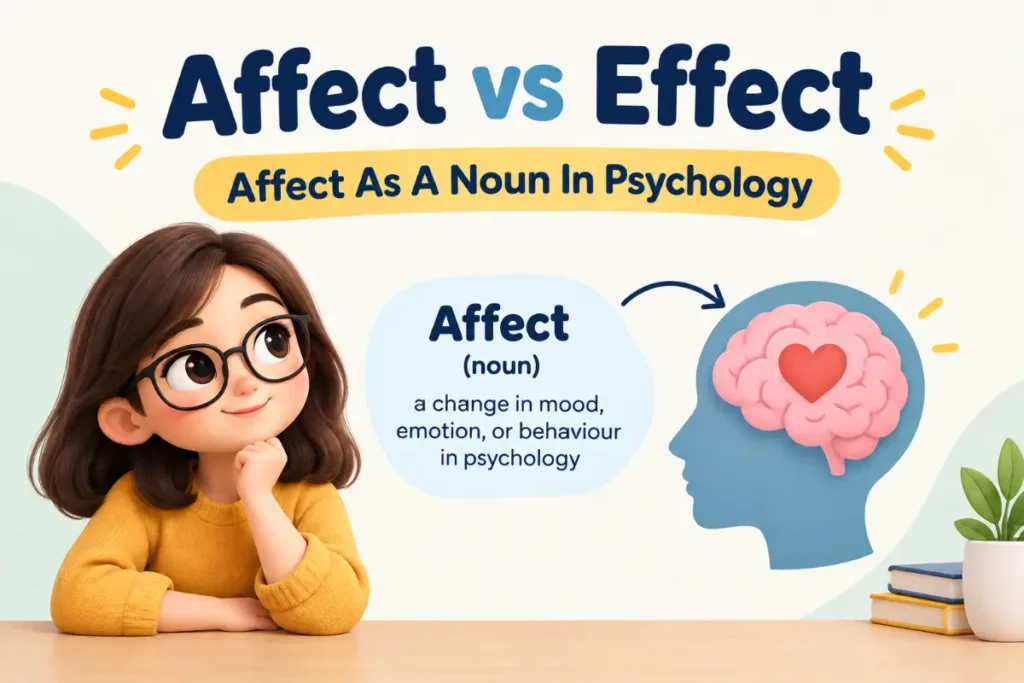
Affect As A Noun In Psychology
There is an important specialized use of affect as a noun. This meaning appears frequently in psychology, psychiatry, neuroscience, and clinical writing.
In this context, affect refers to the observable expression of emotion.
For example:
The patient displayed a flat affect.
Here, affect is not a verb. It is a specialized noun describing outward emotional expression.
This meaning is different from the ordinary verb affect.
A related term is mood, but the two concepts are not identical in clinical language. Mood generally refers to a person’s internally experienced emotional state, while affect refers to the observable expression of emotion.
Because this noun usage is specialized, most general readers are more likely to encounter affect as a verb.
Effect As A Verb
Effect can also function as a verb, although this use is less common in ordinary conversation.
As a verb, effect means to cause, bring about, or make something happen.
For example:
The new leadership hopes to effect meaningful changes.
Here, the meaning is not simply to influence change. It is to bring the changes about.
This distinction can be useful:
Affect change means to influence change.
Effect change means to bring change about.
The difference is subtle but meaningful in formal writing.
Consider:
The economic downturn affected the company’s plans.
The downturn influenced the plans.
The new strategy effected major changes in the company’s operations.
The strategy brought those changes about.
The verb effect is more formal and less common than the everyday verb affect. Writers should not substitute it for affect simply because the two words are commonly confused.
Similar spelling can also cause confusion between unrelated words, as channel and Chanel explained in another useful word comparison.
Pronunciation Guide
In many varieties of American English, affect and effect have nearly identical pronunciation when they are used in their most common forms.
Affect As A Verb
IPA: /əˈfɛkt/
A simple pronunciation guide is:
uh FEKT
The stress falls on the second syllable.
Effect As A Noun
IPA: /ɪˈfɛkt/
A simple pronunciation guide is:
ih FEKT
The second syllable receives the main stress.
The initial vowel sound provides the main difference in their common pronunciations, although the distinction can be subtle in rapid speech.
This is one reason spelling errors happen. Hearing the word alone may not provide enough information to determine which spelling belongs in a sentence.
Word Origin And Etymology
The two words have different historical paths even though their modern meanings are closely connected.
Affect comes from Latin afficere, meaning to do something to, act upon, or influence. It entered English through French and developed into a verb associated with influencing or producing an impact on something.
Effect comes from Latin effectus, related to the idea of accomplishment, execution, or a result produced by an action. It also entered English through French.
Their shared history helps explain why their meanings are related. An action can affect something, and the resulting change can be its effect.
The modern English distinction is therefore not based simply on spelling. The two words developed into separate vocabulary items with different grammatical functions and related meanings.
American English Usage
American English uses both words in the same basic way as other major varieties of standard English.
For everyday US writing, the most useful pattern remains:
Affect = influence.
Effect = result.
American readers commonly encounter affect in phrases such as:
- Affect performance.
- Affect behavior.
- Affect sales.
- Affect decision making.
- Affect health.
They commonly encounter effect in phrases such as:
- Have an effect on.
- Cause an effect.
- Side effect.
- Long term effect.
- Economic effect.
- Positive effect.
- Negative effect.
British, Canadian, and Australian English also use these words with essentially the same standard distinction. There is no major regional spelling difference that changes affect into effect or vice versa.
Grammar Rules For Affect And Effect
Grammar provides one of the fastest ways to choose the right word.
Affect As A Verb
Because affect is normally a verb in everyday English, it can change according to tense and subject.
Present:
The noise affects my concentration.
Past:
The noise affected my concentration.
Future:
The noise will affect my concentration.
Present perfect:
The noise has affected my concentration.
With a modal:
The noise could affect my concentration.
The object of the verb is the person or thing being influenced.
The weather affected our plans.
Here, weather is the subject, affected is the verb, and our plans is the object.
Effect As A Noun
Effect behaves like a normal countable noun when referring to an individual result.
Singular:
The change had an effect on sales.
Plural:
The changes had several effects on sales.
Possessive:
The drug’s effects were carefully monitored.
A very common structure is:
have an effect on
For example:
Exercise can have a positive effect on sleep.
Another common structure is:
the effect of
For example:
Researchers studied the effect of stress on memory.
These distinctions are especially useful when a word describes a place or community, so it helps to understand how villages differ from subdivisions.
Formal And Casual Usage
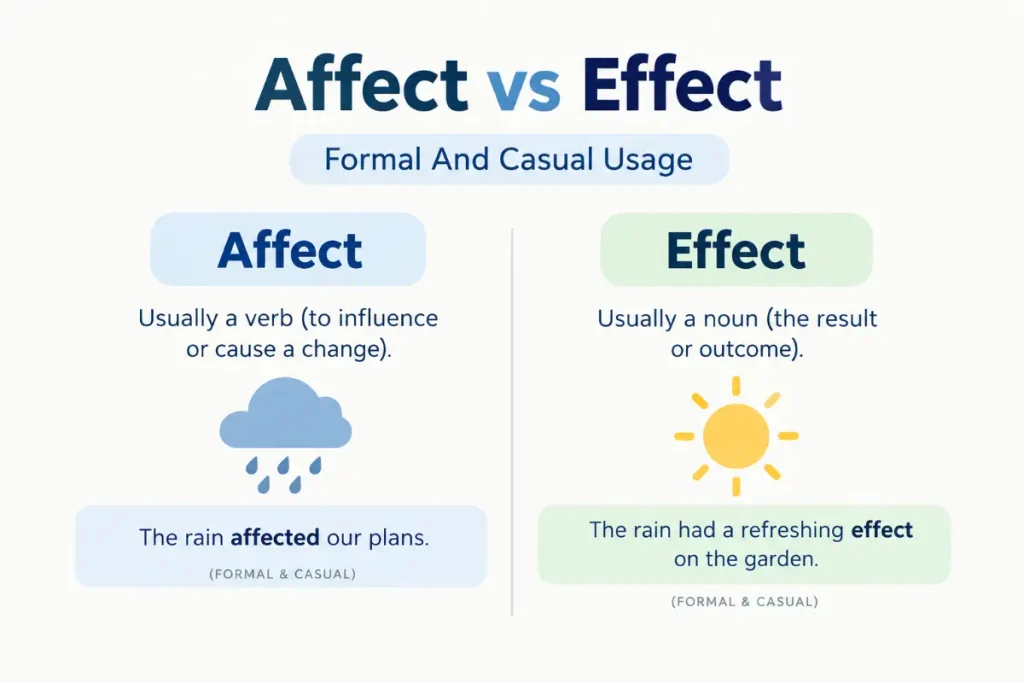
Both words are neutral and suitable for everyday and professional communication. The main issue is not formality but grammatical function.
In a casual text, you might write:
That really affected me.
In a workplace email, you could write:
The delay affected the project timeline.
In academic writing, you might see:
The researchers examined the effect of sleep deprivation on memory.
The same basic distinction remains intact across these settings.
The specialized noun affect is different. It appears much more often in clinical or psychological writing than in casual conversation.
Likewise, the verb effect can sound formal:
The organization plans to effect substantial changes.
In ordinary conversation, people are more likely to say:
The organization plans to make substantial changes.
Real Life Usage
The difference becomes easier when you see how people actually use the words in familiar situations.
At Work
The staffing shortage affected productivity.
The staffing shortage had an effect on productivity.
Both sentences communicate a similar idea. The first emphasizes the influence as an action. The second emphasizes the resulting impact.
At School
The new schedule affected students’ attendance.
The new schedule had a noticeable effect on attendance.
In Healthcare
The medication may affect your sleep.
The medication may have an effect on your sleep.
In Business
Higher prices affected customer demand.
Higher prices had an effect on customer demand.
In Everyday Conversation
That conversation really affected me.
That conversation had a lasting effect on me.
These paired examples show that the distinction is not about completely different subjects. The same situation can involve both words.
Related Words And Useful Expressions
Several expressions can help reinforce the distinction.
Common Expressions With Affect
- Affect behavior.
- Affect performance.
- Affect someone’s decision.
- Affect the outcome.
- Affect demand.
- Affect emotions.
- Affect communication.
- Affect the environment.
Common Expressions With Effect
- Have an effect on.
- Cause an effect.
- Produce an effect.
- Positive effect.
- Negative effect.
- Side effect.
- Long term effect.
- Immediate effect.
- Lasting effect.
- Ripple effect.
The phrase cause and effect is especially important. Cause identifies what produces an outcome, while effect identifies the outcome itself.
For example:
Heavy rain caused flooding.
Heavy rain is the cause.
Flooding was the effect.
This relationship provides another useful mental connection for remembering the noun.
Which Word Should You Use
When you are unsure, first identify what the sentence needs.
If you need a verb meaning influence, use affect.
Will this affect my plans?
If you need a noun meaning result, use effect.
Will this have an effect on my plans?
If you see have an, the, an, several, positive, or negative immediately before the blank, a noun may be required. That does not automatically guarantee effect, but it is a useful clue.
If the sentence already contains a subject that needs a verb, affect may be the correct choice.
The best approach is to look at the complete sentence rather than trying to memorize the words in isolation.
Frequently Asked Questions
Which Is Correct Affect Or Effect
Both are correct words, but they usually have different grammatical jobs. Affect is normally a verb meaning to influence. Effect is normally a noun meaning a result or consequence. The correct choice depends on the sentence. For example, “The news affected me” uses the verb, while “The news had an effect on me” uses the noun.
What Is The Easiest Way To Remember Affect And Effect
A useful memory aid is Affect is an Action and Effect is an End result. Use affect when you mean influence something. Use effect when you mean the result of something. This shortcut handles most everyday sentences, although it does not cover the specialized noun affect or the less common verb effect.
Is It Affect Me Or Effect Me
The usual phrase is affect me. Here, affect is a verb meaning influence. For example, “Will this change affect me?” is correct. Effect me is not the normal choice when you mean influence. Effect can be a verb in formal language, but that use means to bring something about rather than simply to influence someone.
Is It Side Effect Or Side Affect
The correct phrase is side effect. In this expression, effect is a noun meaning a result that occurs in addition to the primary intended result. Side effect is especially common in medical discussions, but the phrase can also describe unintended consequences in other contexts.
Can Affect Be A Noun
Yes. Affect can be a noun in psychology and clinical writing. In that specialized context, it refers to the observable expression of emotion. For example, “The patient displayed a flat affect.” This meaning is different from the common verb affect, which means to influence.
Can Effect Be A Verb
Yes. Effect can function as a verb meaning to bring about, cause, or make something happen. For example, “The new policy effected major changes” means the policy brought those changes about. This use is more formal and less common than the ordinary verb affect.
What Is The Difference Between Affect And Effect In Psychology
In psychology, affect can refer to observable emotional expression, while effect retains its ordinary meaning of a result or consequence. For example, a clinician may describe someone’s affect, while a researcher may discuss the effect of an experience on behavior. The specialized psychological use of affect is why context matters.
Does American English Use Affect And Effect Differently
American English follows the same basic distinction used in other major forms of standard English. Affect is normally the verb meaning influence, while effect is normally the noun meaning result. British, Canadian, and Australian English do not generally use a different spelling to express this basic distinction.
Conclusion
The easiest way to remember affect vs effect is to focus on the grammatical role and meaning. Affect is usually a verb meaning to influence, while effect is usually a noun meaning a result or consequence. You can affect a person’s decision, and that decision can have an effect on what happens next.
There are exceptions. Affect can be a specialized noun in psychology, and effect can be a formal verb meaning to bring something about. Those uses are legitimate, but they are much less common in ordinary American English.
For everyday writing, start with the simple rule: affect means influence, and effect means result. Then check the entire sentence when the context is more specialized. That approach will help you choose the right word in emails, school assignments, professional documents, and everyday communication.