
The difference between principal vs principle can be confusing because the two words sound exactly alike in standard American English, yet they have completely different meanings and grammatical uses. One can describe a person, an amount of money, or something most important. The other refers to a basic rule, belief, or guiding idea.
The easiest way to remember the distinction is to connect each spelling with its main meaning. Principal can refer to a person who leads a school or to the original amount of money involved in a loan or investment. It can also work as an adjective meaning most important. Principle is a noun meaning a fundamental rule, belief, or standard that guides behavior, decisions, or a system.
This distinction matters in everyday writing, education, finance, business, and professional communication. A single letter changes the meaning completely. This guide explains the difference between the two words, shows how to use each one naturally, covers money and interest, explains pronunciation and word origins, and gives practical examples you can use as a quick reference.
Quick Answer
Principal usually means a school leader, the original amount of money in a loan or investment, or something most important. Principle means a basic rule, belief, or standard that guides behavior or decisions. A simple memory trick is principal has a person and money meaning, while principle means a rule or belief.
When distinguishing between principal vs principle, it can also help to review other commonly confused word pairs, such as advice and advise correctly, where one word functions as a noun and the other as a verb.
What Does Principal Mean
Principal has several important meanings, so context matters. In American English, one common use refers to the head of a school. Another important use appears in finance, where the principal is the original amount of money borrowed or invested before interest or other changes are considered. As an adjective, principal means most important or primary.
These meanings may seem unrelated at first, but they share the general idea of something or someone being first in importance, rank, or position. You might talk about the school principal, the principal of a loan, or the principal reason for a decision.
Principal As A School Leader
In the United States, a principal is the person who leads a school. The principal typically has administrative responsibilities and may oversee teachers, students, staff, school policies, and daily operations.
For example:
- The principal welcomed the students on the first day of school.
- The principal met with the teachers after the meeting.
- Parents spoke with the principal about the new school policy.
- The assistant principal handled the afternoon announcements.
In this meaning, principal is a noun. It commonly refers to the head of an elementary school, middle school, or high school.
A useful memory trick is to associate the spelling principal with a pal. The phrase the principal is your pal is a popular mnemonic because the word contains the letters pal. It is only a memory device, not an explanation of the word’s actual origin.
Principal In Finance
In financial contexts, principal refers to the original amount of money borrowed or invested. This meaning is especially important when discussing loans, mortgages, bonds, investments, and interest.
For example, suppose you borrow $20,000 for a car. The original $20,000 is the principal of the loan. Interest is calculated according to the loan terms, and your payments may reduce the outstanding principal over time.
Consider these examples:
- The borrower made a large payment toward the principal.
- A lower principal balance can reduce the amount of interest charged over time.
- The loan has a principal of $20,000.
- The investor received the principal when the bond matured.
The exact way interest is calculated depends on the financial product and its terms, but the basic distinction remains useful. Principal is the amount itself, while interest is the additional amount charged or earned according to the applicable arrangement.
Principal As An Adjective
Principal can also be an adjective meaning most important, main, or primary. This use appears in formal and everyday writing.
- The principal reason for the change was cost.
- Safety was the principal concern during the project.
- The principal goal is to improve customer service.
- Her principal responsibility is managing the department.
Here, principal does not refer to a school leader or money. It describes the thing that is most important.
This meaning can be easy to overlook because many readers first learn principal in connection with schools. In professional and academic writing, however, the adjective appears regularly.
What Does Principle Mean
Principle is a noun that refers to a fundamental rule, belief, standard, or idea that guides behavior, decisions, or the way something operates. It often describes an idea that someone considers important enough to use as a basis for action.
For example, honesty can be a personal principle. A business may operate according to principles of fairness and transparency. A scientific or engineering principle can describe a basic idea that explains how something works.
Consider these examples:
- Honesty is one of her strongest principles.
- The organization operates according to several important principles.
- He refused to compromise his principles.
- The design is based on a simple engineering principle.
- Fairness should be a guiding principle in the workplace.
Unlike principal, principle does not normally refer to a school leader or the original amount of a loan.
Principle As A Moral Belief
One common use of principle relates to personal values and moral standards. A principle can influence how someone behaves or makes decisions.
For example, someone might say:
I would not accept the offer because it goes against my principles.
The speaker is referring to personal standards or beliefs. The word does not mean a person, a payment, or an amount of money.
Other examples include:
- She believes strongly in the principle of equal treatment.
- He made the decision on principle.
- They refused to break an important principle.
- The company says honesty is one of its core principles.
Principle As A Basic Rule Or Idea
Principle can also describe a basic rule or idea behind a system. This use is common in science, mathematics, engineering, law, business, and other fields.
For example, the principle of conservation of energy refers to a fundamental concept in physics. In business, a company might establish principles that guide how employees interact with customers.
The meaning can therefore extend beyond morality. A principle is not always a personal belief about right and wrong. It can simply be a foundational idea or rule.
Principal vs Principle Comparison
The easiest way to understand the distinction is to compare their main functions and meanings.
| Feature | Principal | Principle |
|---|---|---|
| Part of speech | Noun or adjective | Noun |
| Main meanings | School leader, original money amount, most important | Basic rule, belief, standard, or idea |
| Finance meaning | Original amount borrowed or invested | Not normally used for money |
| School meaning | Head of a school | Not used for the school leader |
| Moral meaning | Not normally used | Personal or ethical belief |
| Adjective use | Yes | No |
| Example | The principal spoke to the students. | Honesty is an important principle. |
| Memory clue | Principal has a person and money meaning | Principle means a rule or belief |
The most important distinction is simple. Principal has several concrete meanings, including a school leader and an amount of money. Principle refers to an underlying rule, belief, or standard.
Principal vs Principle In Money
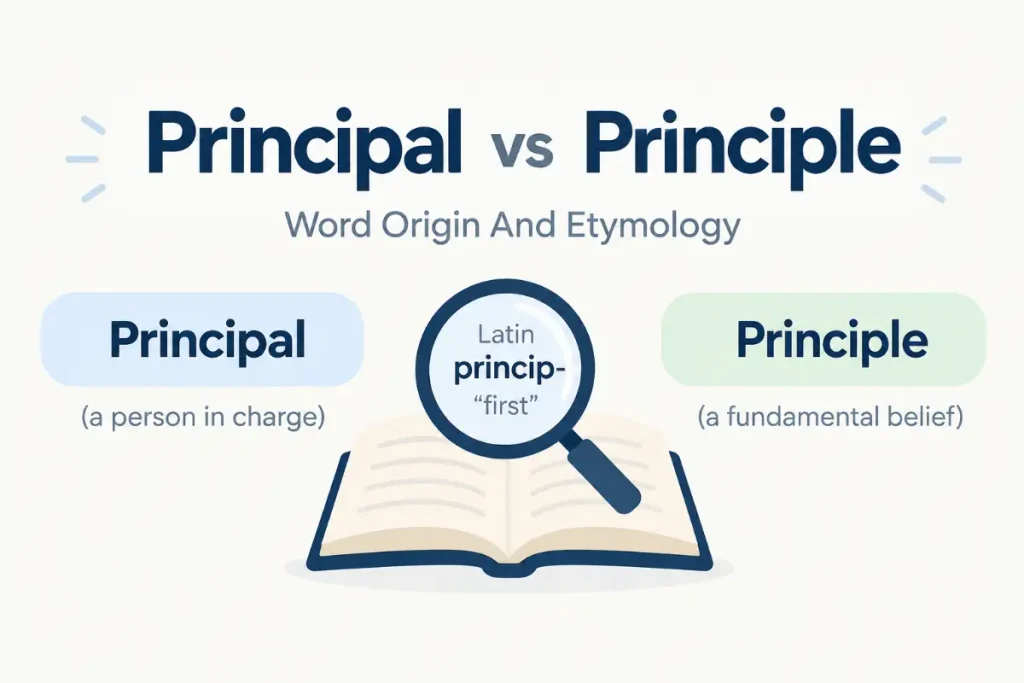
Financial writing is one of the places where the difference matters most. The correct word for the original amount of a loan or investment is principal.
For a loan, the principal is generally the amount initially borrowed. As payments are made, part of each payment may go toward reducing the outstanding principal, while another part may cover interest and potentially other charges depending on the loan agreement.
For example:
The borrower paid $500 toward the principal.
This means the payment reduced the amount of money still owed as principal.
You might also see phrases such as:
- principal balance
- principal payment
- loan principal
- principal amount
- principal and interest
- remaining principal
The word principle is not correct in these financial expressions. Writing principle payment instead of principal payment changes the word and creates a spelling error.
Principal And Interest
Principal and interest are two different parts of many loan arrangements. The principal refers to the amount borrowed, while interest refers to the cost charged for borrowing the money according to the loan’s terms.
For example:
My monthly payment includes both principal and interest.
As a borrower makes payments, the amount of outstanding principal can decrease. The precise allocation of each payment depends on the loan structure and payment schedule.
The same distinction appears in investment contexts. A financial product may return the original principal at maturity, depending on its terms.
Principal Payment
A principal payment is a payment applied toward reducing the principal balance of a loan. Paying down principal can affect the remaining balance and, depending on the loan structure, future interest costs.
For example:
She made an extra principal payment on her mortgage.
Here, principal clearly refers to the money originally borrowed and still outstanding.
Principal vs Principle For A Teacher
If you are talking about the head of a school, the correct word is principal.
The principal met with the teachers after school.
The person leading the school is the principal. Principle would be incorrect in this context.
This is one of the most common places where the two words are confused, especially because their pronunciation is the same. Students sometimes remember the spelling incorrectly and write principle when referring to a school administrator.
A useful memory device is:
The principal is your pal.
The word principal contains pal, which can help you remember the spelling when talking about the head of a school. Again, this is simply a mnemonic. It is not the historical origin of the word.
Principal As Most Important
Another meaning of principal is main, primary, or most important. This use can appear before a noun.
For example:
- The principal reason for the delay was bad weather.
- Our principal concern is customer safety.
- The principal objective is to reduce unnecessary costs.
- Her principal duty is supervising the team.
- The principal issue remains unresolved.
You can often replace principal with main or primary without changing the basic meaning.
For example:
The principal reason was cost.
can become:
The main reason was cost.
This provides another useful way to recognize the adjective. If the sentence needs a word meaning main or primary, principal may be the correct choice.
Like principal vs principle, desert vs dessert is another common spelling mix-up that can cause confusion because the two words look and sound similar but have completely different meanings.
How To Remember Principal And Principle
A good memory trick can make this distinction much easier.
For principal, remember three common meanings:
Principal = person, money, or main.
The person can be a school principal. The money can be the principal of a loan or investment. The adjective can mean the main or most important thing.
For principle, remember:
Principle = rule or belief.
A principle can guide behavior, decisions, an organization, or a system.
Another useful method is to ask what kind of sentence you are writing. If you are talking about a school leader, money, or something most important, think principal. If you are talking about a rule, standard, belief, or foundational idea, think principle.
Principal vs Principle Examples
Examples become especially useful when the words appear in different contexts. The following sentences show the most common uses.
Examples With Principal
- The principal announced the new school schedule.
- The principal met with the student’s parents.
- The loan principal was $25,000.
- She made an extra payment toward the principal.
- The principal balance is lower than it was last year.
- Safety is the principal concern at the construction site.
- Cost was the principal reason for choosing the new supplier.
- The principal objective of the project is to improve efficiency.
- The investor received the principal at maturity.
- The principal investigator reviewed the research results.
These examples demonstrate the three major meanings. Some refer to a school leader, some refer to money, and others use principal to mean main or most important.
Examples With Principle
- Honesty is an important principle in her life.
- The company operates according to several core principles.
- He refused to compromise his principles.
- The decision was based on the principle of fairness.
- The engineer explained the basic principle behind the machine.
- She stood by her principles even when the decision was difficult.
- The policy reflects the principle that everyone deserves equal treatment.
- The experiment demonstrates an important scientific principle.
- They designed the system around a simple operating principle.
- He objected to the proposal on principle.
These examples show that principle can refer to personal values, ethical standards, scientific ideas, organizational rules, and other foundational concepts.
Common Mistakes With Principal And Principle
Because the two words sound the same, spelling mistakes are easy to make. The best way to avoid them is to identify the meaning before choosing the spelling.
Mistake With A School Principal
Incorrect: The principle spoke at the assembly.
Correct: The principal spoke at the assembly.
The word refers to the head of the school, so principal is correct.
Mistake With Loan Principal
Incorrect: I made a payment toward the principle.
Correct: I made a payment toward the principal.
The sentence refers to money borrowed and still owed. The financial term is principal.
Mistake With A Moral Principle
Incorrect: Honesty is an important principal.
Correct: Honesty is an important principle.
The sentence describes a belief or standard that guides behavior, so principle is correct.
Mistake With Main Or Primary
Incorrect: The principle reason for the change was cost.
Correct: The principal reason for the change was cost.
Here, principal means main or primary.
A Simple Meaning Test
When you are uncertain, replace the word with a simpler phrase.
If you can replace it with:
- school leader, use principal.
- original loan or investment amount, use principal.
- main or primary, use principal.
- rule, belief, or standard, use principle.
This test works because it focuses on meaning rather than pronunciation.
Grammar Rules For Principal And Principle
Principal can function as both a noun and an adjective. As a noun, it can refer to a school administrator or a financial amount. As an adjective, it means main or most important.
Principle is a noun. It refers to a basic rule, belief, standard, or foundational idea.
Consider the grammatical difference in these sentences:
The principal called the parents.
Here, principal is a noun referring to a person.
The principal reason was cost.
Here, principal is an adjective modifying reason.
Honesty is an important principle.
Here, principle is a noun referring to a belief or standard.
This distinction can help you spot the correct spelling quickly. If the sentence needs a noun referring to a rule or belief, principle is likely the answer. If it needs an adjective meaning main, principal is the only one of the two that fits.
Principal Investigator And Other Professional Uses
Principal appears in several professional titles and expressions beyond school administration and finance. One common example is principal investigator, a term used for the person with primary responsibility for a research study or project.
For example:
The principal investigator reviewed the study results.
In this expression, principal means the person with the primary or leading role.
Other professional uses can include principal architect, principal engineer, or similar titles. The exact responsibilities attached to these titles vary by organization, but the word generally signals a senior or leading role.
Do not replace principal with principle in these expressions. The word refers to importance, rank, or primary responsibility rather than a rule or belief.
Pronunciation Of Principal And Principle
In standard American English, principal and principle are homophones. They are generally pronounced the same, even though they have different spellings and meanings.
Both are commonly represented approximately as /ˈprɪnsəpəl/. The first syllable sounds like prin, followed by a sound similar to suh, and then puhl.
Because the words sound alike, pronunciation cannot tell you which spelling to choose. This is different from many spelling problems where saying a word aloud helps identify it. Here, you need to use the context.
For example, these sentences sound similar except for their surrounding meaning:
The principal spoke to the students.
The principle guided the decision.
The pronunciation alone does not tell you which spelling belongs on the page. The meaning does.
Word Origin And Etymology
The two words have different historical roots despite their identical modern pronunciation.
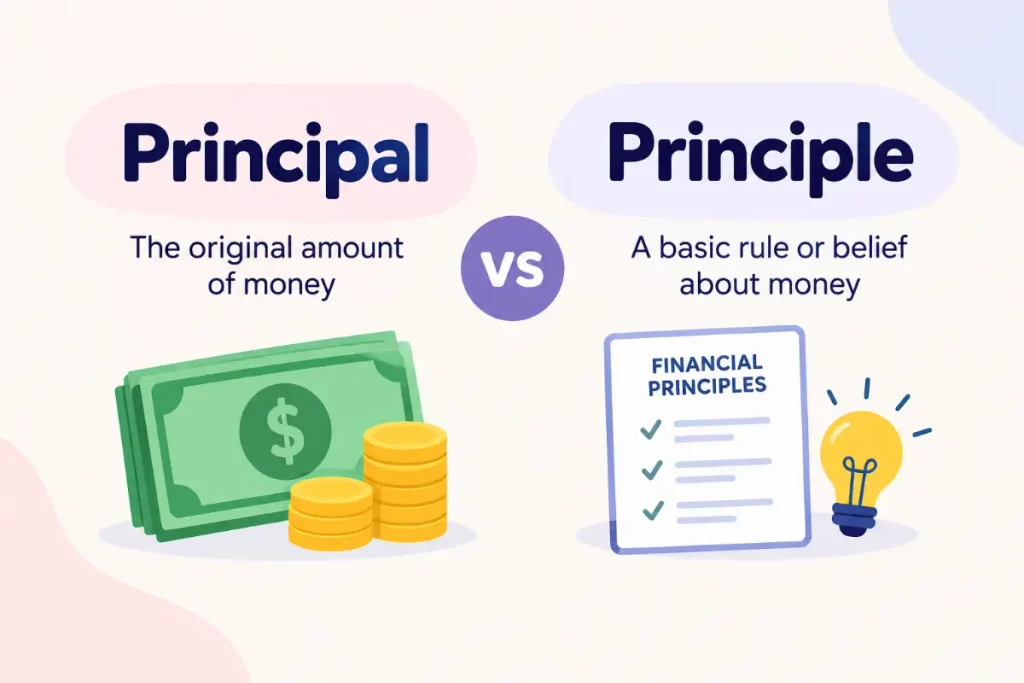
Principal comes from Latin principalis, meaning something like first in importance or chief. It is related to the Latin princeps, associated with the idea of being first or foremost. This history connects naturally with the modern meanings of principal as main, leading, or primary.
Principle comes through Old French and Latin forms connected with principium, meaning a beginning or foundation. Over time, its meaning developed toward a foundational rule, belief, or idea.
The shared historical connection helps explain why the words look similar. Their meanings, however, developed along different paths, which is why modern English treats them as separate words.
American English Usage
American English uses both principal and principle as standard words, with the meanings described above. There is no American spelling variation that makes principle correct for a school leader or principal correct for a moral rule.
British, Canadian, and Australian English also use the same basic distinction. The words can appear in similar financial, educational, professional, and ethical contexts across these varieties of English.
The most important point for US readers is simple: spelling does not change based on American versus British usage in this case. The correct form depends on meaning.
Formal And Casual Usage
Both principal and principle are neutral standard English words. They are appropriate in casual conversation, workplace communication, academic writing, business documents, and formal writing when the meaning fits.
The difference is not one of formality. It is one of meaning.
For example, principal balance is appropriate in a financial document, while core principle is appropriate when describing a company’s guiding values. Similarly, school principal is the standard term in everyday American English and in official school communication.
Because the words sound identical, writers should pay particular attention to spelling in professional documents. A single incorrect letter can make an otherwise polished sentence look careless or change its meaning.
Learning to tell compliment and complement apart can also strengthen your understanding of word pairs whose similar spelling or pronunciation makes them easy to confuse.
Related Words And Similar Confusions
English contains many word pairs that sound alike or look similar but have different meanings. Learning principal and principle can help you recognize the same pattern elsewhere.
Compliment And Complement
Compliment means a positive remark or expression of praise. Complement refers to something that completes, matches, or enhances another thing.
She gave me a compliment about my presentation.
The sauce complements the dish.
Affect And Effect
Affect is commonly used as a verb meaning to influence. Effect is commonly used as a noun meaning a result.
The weather affected the flight.
The delay had an unexpected effect.
Advice And Advise
Advice is a noun meaning a recommendation or guidance. Advise is a verb meaning to give guidance.
Thank you for your advice.
I advise you to review the contract.
These examples show why spelling and grammatical function both matter. A small change in letters can signal an entirely different word.
Expert Language Insight
The biggest mistake people make with principal and principle is trying to remember only one definition for each word. That approach can fail because principal has several common meanings. It can identify a school leader, describe the original amount of money in a financial arrangement, or mean main or most important.
A better approach is to build a meaning map. Think of principal as connected with a leading person, original money, or primary importance. Think of principle as connected with a rule, belief, standard, or foundational idea.
Context does most of the work. In The principal addressed the students, the word clearly identifies a person. In The principal balance decreased, it refers to money. In The principal reason was cost, it means main. In Honesty is a principle, it refers to a guiding belief.
Another useful editing habit is to slow down when you see the sound prinsuhpuhl in your head while proofreading. Ask what the sentence means before checking the spelling. If you train yourself to connect spelling with meaning rather than sound, the distinction becomes much more automatic.
Frequently Asked Questions
Which is correct principal or principle
Both principal and principle are correct words, but they have different meanings. Use principal for a school leader, the original amount of money in a loan or investment, or something main or most important. Use principle for a rule, belief, standard, or foundational idea.
What is the difference between principal and principle in money
In financial language, principal is the correct word. It refers to the original amount borrowed or invested, or the remaining amount of that original balance. Principle is not the correct spelling for this financial meaning. Common expressions include principal balance, principal payment, and principal and interest.
Is the principal a teacher
A school principal is an educational administrator who leads a school. A principal may have teaching experience, but the title itself refers to the person responsible for school leadership and administration. In American English, the correct spelling for this role is principal, not principle.
How do you remember principal and principle
A useful memory trick is to remember principal as the word for a school leader, money, and something main. Principle means a rule, belief, standard, or foundational idea. You can also remember the phrase the principal is your pal when you need to recall the spelling of the school title.
Does principal mean most important
Yes. Principal can be an adjective meaning main, primary, or most important. For example, The principal reason for the decision was cost means that cost was the main reason. This adjective meaning is separate from the noun meaning of a school leader or financial principal.
Are principal and principle pronounced the same
Yes. In standard American English, principal and principle are generally pronounced the same. They are homophones, which means they sound alike while having different meanings and spellings. Because pronunciation does not distinguish them, you need to use the sentence’s meaning and grammatical function to choose the correct spelling.
Is principal only used for schools and money
No. Principal has several meanings. It can refer to a school leader, the original amount of money borrowed or invested, or something that is main or most important. It also appears in professional titles such as principal investigator and principal engineer, where it generally indicates a leading or primary role.
Can principle mean a scientific rule
Yes. Principle can refer to a foundational idea or rule in science, mathematics, engineering, and other fields. For example, a scientific principle can describe a basic concept that helps explain how something works. The word is not limited to personal morality or ethical beliefs.
Conclusion
The difference between principal vs principle becomes much easier when you connect each spelling with its meaning. Principal can refer to a school leader, the original amount of money in a loan or investment, or something main or most important. Principle refers to a fundamental rule, belief, standard, or foundational idea.
When you are unsure, focus on the context. If you are talking about a school leader, money, or the main part of something, choose principal. If you are talking about a rule, value, belief, or basic idea, choose principle. Since the two words sound alike, meaning is the best guide to spelling.