If you’ve ever paused over peak vs peek vs pique you’re not alone. These three words sound exactly the same in most American English speech but they have completely different meanings and grammatical jobs. One refers to the highest point. Another means taking a quick look. The third can mean stimulating interest or causing irritation.
The confusion gets worse because all three spellings appear in familiar expressions. You might reach the peak of your career. You might take a peek at an email. You might say that a new idea piqued your interest. A single letter changes the word but also changes the entire meaning of the sentence.
The good news is that the distinction is simple once you connect each spelling to its core idea. This guide explains the meanings of all three words, shows how native American English speakers use them, covers pronunciation, explains common mistakes, and gives plenty of practical examples. You’ll also learn why piqued my interest is correct and why peaked my interest usually means something very different.
Quick Answer
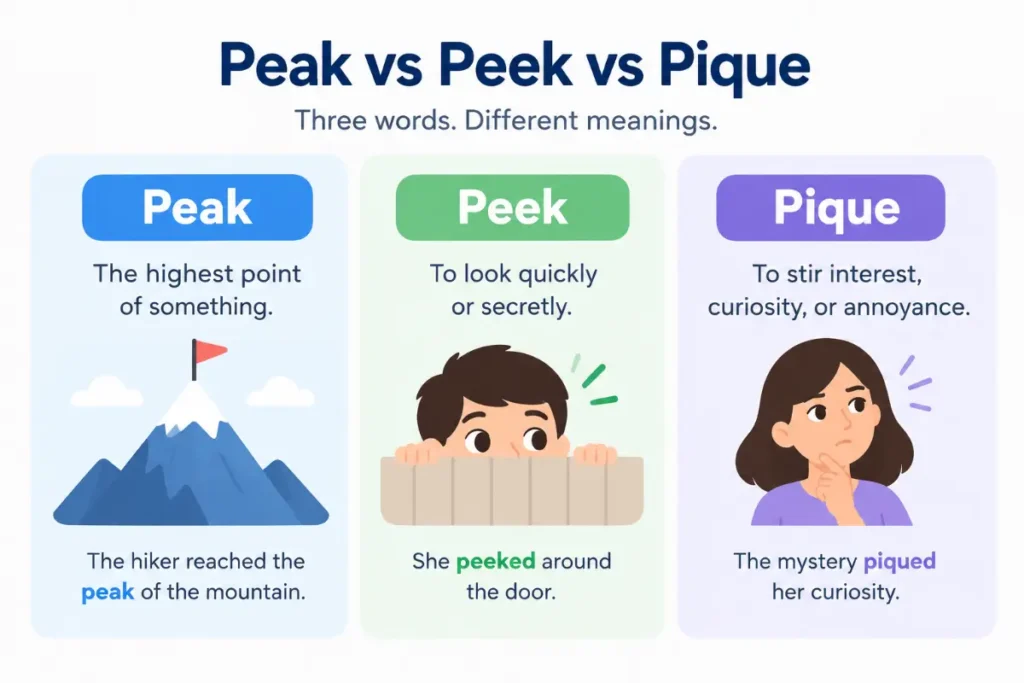
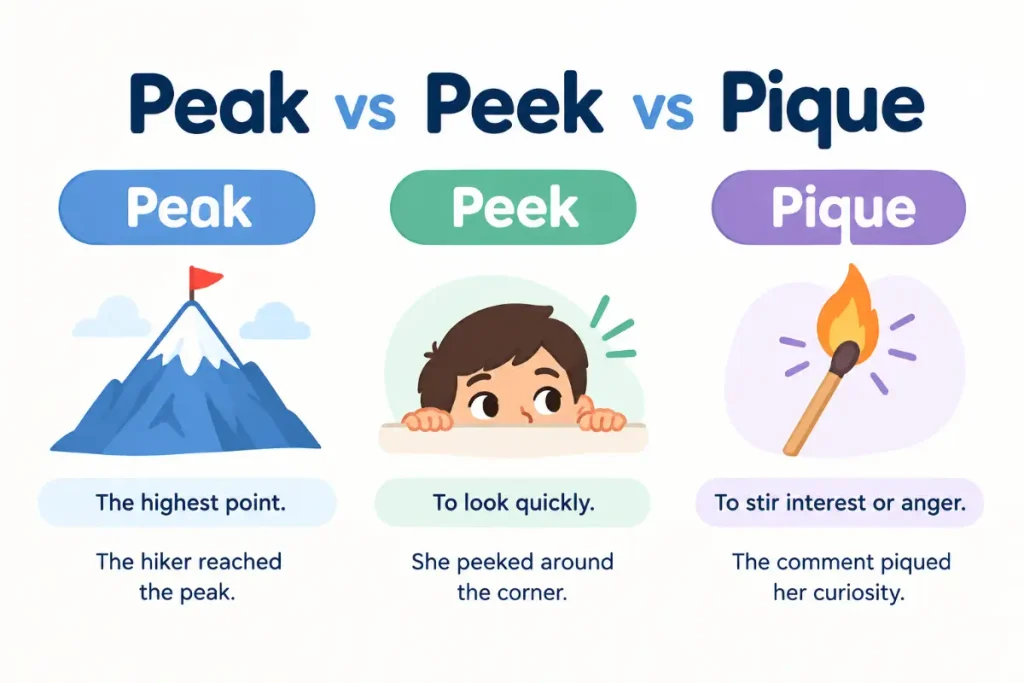
Peak means the highest point or level. Peek means to look quickly or secretly. Pique means to stimulate interest or curiosity and can also mean to annoy or offend. All three usually sound the same in American English. Remember peak for high points, peek for looking, and pique for interest or irritation.
What Peak Means
Peak is connected to the idea of height. As a noun it means the highest point of something. It can describe a physical height such as the top of a mountain or an abstract high point such as the best period of a career.
Peak can also work as a verb. In that use it means to reach the highest level or point. It can describe prices, performance, activity, popularity, physical ability, demand, or many other measurable things.
As an adjective, peak describes the highest level of activity, demand, quality, or intensity.
The easiest mental image is a mountain. The peak is the point at the top.
Here are the most common uses.
- The hikers finally reached the peak of the mountain.
- Her career reached its peak after she won the award.
- Gas prices peaked during the summer.
- The athlete is performing at her peak.
- Traffic usually reaches its peak around five o’clock.
- The restaurant is busiest during peak hours.
- Sales peaked in December.
- The movie became popular at the peak of its success.
Notice that peak does not require a literal mountain. English speakers commonly use it for abstract high points too.
You can reach the peak of your career. A business can experience peak demand. A singer can perform at peak level. A season can reach its peak. The common idea is always a high point.
Like “peak,” “peek,” and “pique,” another commonly confused pair can sound similar while serving completely different grammatical roles and meanings.
What Peek Means
Peek is about looking. As a verb it means to take a quick or brief look. It often suggests that the look is short or slightly secretive.
As a noun, a peek means a quick look.
Think of peek as opening a door just a little and looking inside. The action is visual and usually brief.
Here are natural examples.
- Can I peek inside your bag?
- She took a peek at the menu before ordering.
- I couldn’t resist taking a peek at the gift.
- He peeked through the window.
- Take a quick peek at this photo.
- The child peeked around the corner.
- I’ll take a peek at the schedule.
- She peeked at her phone during the meeting.
Peek can be neutral or slightly playful. It can also describe looking at something secretly.
For example, if someone says, I took a peek at the answers, the sentence may suggest that the person looked when they were not supposed to.
The noun and verb forms are both common.
As a noun, you can take a peek.
As a verb, you can peek at something.
That small difference in sentence structure is useful to remember.
What Pique Means
Pique is the word that causes the most trouble because its meaning is less concrete than the other two.
As a verb, pique can mean to stimulate curiosity, interest, or attention. It often appears in the expression piqued my interest.
For example:
The unusual story piqued my interest.
This means the story made me interested or curious.
Pique can also mean to offend, annoy, or hurt someone’s pride. That meaning appears less often in everyday American conversation but remains valid.
For example:
His comment piqued her pride.
In this context, pique does not mean interest. It means that something touched or irritated her pride.
As a noun, pique can refer to a feeling of irritation or wounded pride.
The word is more formal than peak and peek. You’ll see it often in writing, journalism, professional communication, and descriptions of curiosity.
The most useful connection is simple.
Pique is about interest, curiosity, irritation, or pride.
That gives you a strong way to separate it from the other two words.
Peak vs Peek vs Pique Differences
| Feature | Peak | Peek | Pique |
|---|---|---|---|
| Main meaning | Highest point or level | Quick look | Stimulate interest or cause irritation |
| Common part of speech | Noun, verb, adjective | Noun, verb | Verb, noun |
| Core idea | Height | Looking | Interest or irritation |
| Example phrase | Peak performance | Take a peek | Piqued my interest |
| Typical context | Mountains, careers, prices, activity | Photos, rooms, gifts, screens | Curiosity, interest, pride |
| Pronunciation | Usually sounds like peek | Usually sounds like peak | Usually sounds like peak |
| US usage | Very common | Very common | Common but more specialized |
The pronunciation creates the confusion. The meaning creates the distinction.
If you can identify the idea in your sentence, the spelling becomes much easier.
Is the sentence about a high point? Use peak.
Is someone looking? Use peek.
Is something creating curiosity or irritation? Use pique.
How Peak Works in Everyday English
Peak appears in far more situations than mountains and geography.
People use it to describe the highest point of a process, period, experience, or measurement. That makes it especially common in business, sports, science, news writing, and everyday conversation.
A manager might say:
Customer demand reached its peak in July.
A sports commentator might say:
He’s playing at the peak of his ability.
A friend might say:
That was the peak of my vacation.
The word can also describe timing.
Peak hours are the busiest or most active times. You might hear peak traffic, peak season, peak demand, or peak hours.
For example:
- The gym is crowded during peak hours.
- Hotel prices rise during peak season.
- The store sees peak demand before Christmas.
- We should leave early to avoid peak traffic.
Peak can also work as a verb.
When something peaks, it reaches its highest point.
For example:
The temperature peaked at 98 degrees.
Sales peaked in November.
The word can describe a temporary high point. Something can peak and then decline.
That distinction matters because peak does not simply mean good. It means the highest point in a particular context.
How Peek Works in Everyday English
Peek is much more visual.
- You peek at something.
- You peek inside something.
- You peek through something.
- You take a peek at something.
The word often describes a quick action rather than a long period of looking.
Compare these sentences:
I looked at the report.
I peeked at the report.
The first sentence is neutral and does not tell us how long the person looked. The second suggests a quick or brief look.
Peek can also add a sense of secrecy.
For example:
The kids peeked at the presents before Christmas.
The employee peeked at the answer sheet.
The first example is playful. The second suggests that the person may have been doing something they should not have done.
You’ll also see peek in phrases such as sneak a peek. This means to take a quick look secretly or quietly.
For example:
I sneaked a peek at the surprise decorations.
In American English, sneak a peek is a familiar everyday expression.
Why Piqued My Interest Is Correct
Piqued my interest is the standard expression when something makes you curious or interested.
For example:
The unusual headline piqued my interest.
The book’s title piqued my interest.
Her explanation piqued my interest in the subject.
The verb pique means to stimulate curiosity or interest. The phrase therefore means that something caught your attention and made you want to know more.
A common mistake is writing peaked my interest.
That spelling changes the meaning. Peak is associated with reaching a highest point. It does not normally mean causing curiosity.
You may see phrases such as peaked my interest online because the three words sound identical in many varieties of English. That sound similarity makes the error easy to make.
For careful writing, use piqued when you mean that something stimulated your curiosity.
A useful memory trick is this:
Pique connects with curiosity.
Peak connects with a high point.
Peek connects with looking.
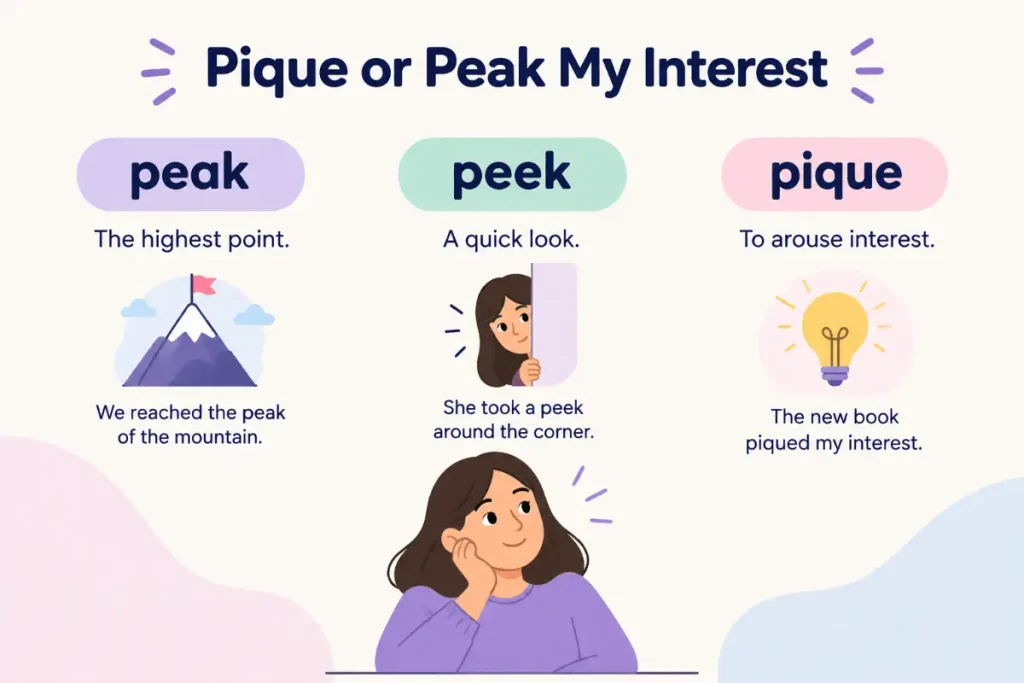
Pique or Peak My Interest
When you want to say that something made you interested or curious, use pique my interest.
For example:
That documentary might pique my interest.
The new course could pique her interest.
The strange message piqued his interest.
Peak my interest is not the standard expression for this meaning.
The difference becomes clearer if you replace the phrase with a simpler expression.
Pique my interest means make me curious.
Peak means reach the highest point.
Those ideas do not mean the same thing.
You can say:
The story piqued my interest.
You cannot normally say:
The story peaked my interest.
If you mean that interest itself reached its highest level, however, peak can be appropriate.
For example:
My interest in photography peaked during college.
Here peak works because the sentence describes the highest point of the speaker’s interest over time.
That distinction is subtle but important. Pique describes something causing interest. Peak describes interest reaching its highest level.
English has many examples of similar-sounding words with different meanings, making context especially important when choosing the right word.
Peak vs Peek vs Pique Examples
The fastest way to understand these words is to see them in different contexts.
Examples With Peak
- The climbers reached the peak just before sunset.
- Her confidence was at its peak during the final presentation.
- Online orders peaked during the holiday season.
- The team reached peak performance in the second half.
- Traffic is usually at its peak around six in the evening.
- The mountain’s highest peak was covered in snow.
- The company expects demand to peak in December.
- He played the best tennis of his career at the peak of his form.
- Summer is the peak season for tourism in the area.
- The temperature peaked at 102 degrees.
Each example involves height, a high point, or the highest level of something.
Examples With Peek
- Can I take a peek at your new phone?
- She peeked through the doorway.
- He took a quick peek at the schedule.
- The children peeked at the presents.
- I’ll peek inside the box before we move it.
- She sneaked a peek at the birthday decorations.
- Take a peek at this email before I send it.
- The cat peeked around the corner.
- He peeked through the blinds.
- I wanted to peek at the menu before choosing a restaurant.
Every example involves looking briefly or secretly.
Examples With Pique
- The unusual question piqued my interest.
- The documentary piqued her curiosity.
- His explanation piqued my interest in astronomy.
- The mysterious package piqued their curiosity.
- The headline piqued his interest.
- The new research piqued the professor’s interest.
- That strange detail piqued my curiosity.
- The job description piqued her interest.
- The unexpected result piqued the team’s curiosity.
- The comment piqued his pride.
The first nine examples use pique in connection with curiosity or interest. The last example shows its less common meaning related to pride or irritation.
Common Mistakes With These Words
The most common errors happen because peak, peek, and pique sound alike.
Mistake With Piqued My Interest
Incorrect: The article peaked my interest.
Correct: The article piqued my interest.
Use piqued when something makes you curious or interested.
Mistake With Peek
Incorrect: We reached the peek of the mountain.
Correct: We reached the peak of the mountain.
A mountain has a peak because the word refers to its highest point.
Mistake With Peak
Incorrect: I took a peak at the report.
Correct: I took a peek at the report.
You take a peek when you look briefly.
Mistake With Pique
Incorrect: The mystery peaked my curiosity.
Correct: The mystery piqued my curiosity.
The mystery stimulates curiosity, so pique is the correct choice.
Mistake With Interest
Incorrect: My interest in the subject piqued last year.
Correct: My interest in the subject peaked last year.
If your interest reached its highest level, use peaked.
This last pair is especially useful because both words can appear naturally with interest. The meaning changes depending on what the sentence describes.
The Difference Between Pique and Peak With Interest
This is one of the most useful distinctions to understand.
Pique means to cause interest.
Peak means to reach the highest level.
Compare these sentences:
The book piqued my interest.
My interest in the book peaked after the first chapter.
In the first sentence, the book causes curiosity.
In the second sentence, the speaker’s interest reaches its highest point.
The same noun can therefore appear with both verbs, but the verbs describe different relationships.
Think of it as cause versus high point.
Something piques your interest.
Your interest peaks.
That simple distinction solves many spelling problems.
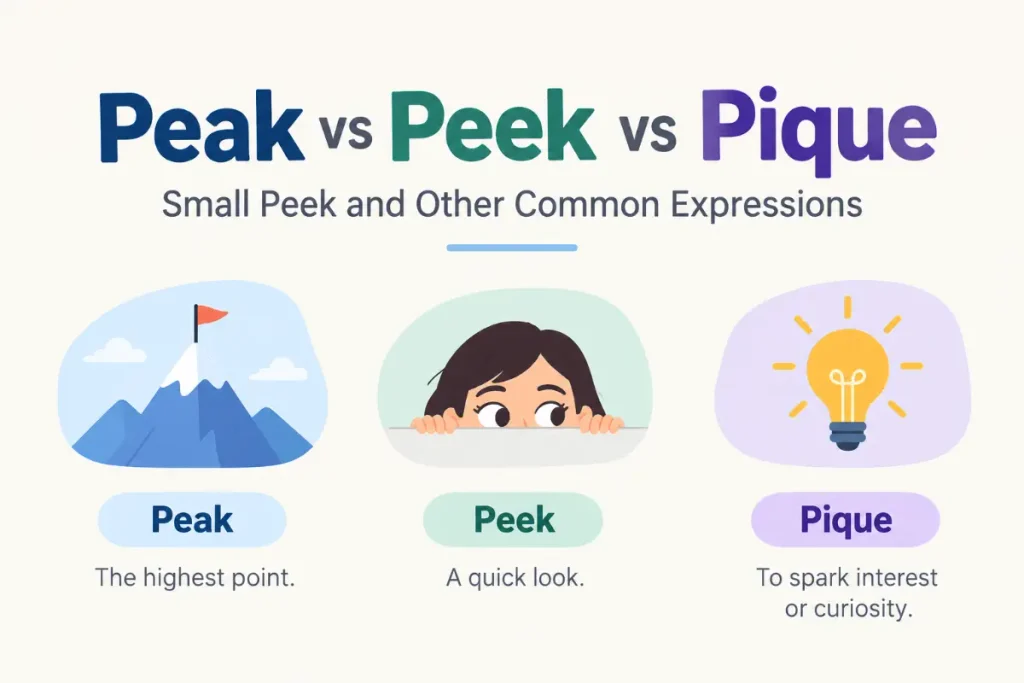
Small Peek and Other Common Expressions
The phrase small peek is understandable, but native speakers often use quick peek, brief peek, or simply peek when they mean a short look.
For example:
Can I take a quick peek?
I took a brief peek at the document.
Let me have a peek.
A peek already suggests a short look, so adding small is not usually necessary. It is not grammatically wrong, but it can sound less natural than quick peek or brief peek in many contexts.
Other common expressions include:
- Take a peek.
- Have a peek.
- Sneak a peek.
- Peek inside.
- Peek through the window.
- Peek at the screen.
- Take a quick peek.
These phrases are especially common in casual conversation and everyday writing.
Pronunciation of Peak Peek and Pique
In most American English speech, peak, peek, and pique are pronounced the same way.
The pronunciation is approximately /piːk/.
A simple pronunciation guide is peek.
All three have the long ee sound found in words such as see and green.
That makes them homophones. Homophones are words that sound alike but have different meanings and spellings.
This is why listening alone cannot tell you which spelling to use. Context has to do the work.
If someone says, The story piqued my interest, you hear the same final sound as in peaked my interest. The spelling becomes clear from the meaning.
Pronunciation therefore provides no reliable spelling shortcut here. You need to connect the word with its meaning.
Word Origins That Explain the Spellings
The three words have different histories even though modern pronunciation brings them together.
Peak developed from words associated with a pointed summit or top. Its modern meaning still strongly reflects that physical image and later expanded into abstract high points.
Peek developed from a word associated with looking quickly or cautiously. Its meaning has remained closely connected to brief or secret observation.
Pique entered English from French. Its history is connected with ideas of sharpness, irritation, and stimulation. The sense involving curiosity developed into the modern expression pique someone’s interest.
The different origins explain why the spellings are so unrelated. They are not three versions of the same word. They are separate words that happen to sound alike.
Formal and Casual Usage
Peak and peek are both ordinary words that work naturally in casual and professional communication.
You can use peak in a business report, a conversation, an email, or a news story.
For example:
Sales reached their peak in October.
Peek is also normal in everyday communication, although it tends to sound more casual when used in expressions such as take a peek.
For a workplace email, you might write:
Please take a quick look at the attached report.
You could also write:
Please take a quick peek at the attached report.
The second sentence is more conversational. The first is more neutral.
Pique is somewhat more formal in everyday use. Piqued my interest is perfectly natural, especially in writing, but it has a slightly more polished feel than simple phrases such as made me curious or got my attention.
That does not make pique difficult or overly formal. It simply means that context affects how natural the word feels.
A Simple Memory Trick
If you regularly mix these words up, connect each spelling to one clear idea.
Peak means high.
Imagine the top of a mountain.
Peek means look.
Imagine someone peeking around a door.
Pique means interest.
Imagine curiosity suddenly waking up.
You can also remember three short phrases:
- Reach the peak.
- Take a peek.
- Pique my interest.
These expressions create strong mental links between spelling and meaning.
Once those links become familiar, the words become much easier to choose while writing.
Understanding a subtle word-choice difference can prevent confusion and help you communicate your meaning more precisely.
How to Choose the Right Word
When you are unsure which spelling belongs in your sentence, do not focus on how the word sounds. Ask what the sentence means.
- If the idea involves the highest point, use peak.
- If the idea involves looking, use peek.
- If the idea involves stimulating curiosity or interest, use pique.
- If the idea involves reaching the highest level of interest, use peak.
For example:
The movie piqued my interest.
My interest in the movie peaked near the end.
I took a peek at the movie schedule.
The movie reached its peak popularity in July.
All four sentences are correct because each word matches the intended meaning.
This approach is much more reliable than trying to remember spelling in isolation.
Frequently Asked Questions
Which is correct peak or peek?
Both peak and peek are correct words, but they have different meanings. Peak refers to a highest point or level. Peek means to take a quick look. For example, you can reach the peak of a mountain or take a peek at a document.
What does pique mean?
Pique can mean to stimulate interest or curiosity. In the phrase piqued my interest, it means that something made you curious or interested. Pique can also describe irritation or wounded pride in certain contexts.
Is piqued my interest correct?
Yes. Piqued my interest is the standard expression when you mean that something made you curious or interested. For example, The unusual headline piqued my interest. Piqued is the past tense of pique in this use.
Is peaked my interest correct?
Peaked my interest is generally not the standard expression when you mean that something caused curiosity. Use piqued my interest for that meaning. Peaked can correctly describe interest reaching its highest point, as in My interest in the subject peaked during college.
Are peak peek and pique pronounced the same?
In most American English speech, peak, peek, and pique are homophones. They are commonly pronounced /piːk/. Their identical pronunciation explains why writers often confuse their spellings.
What is the difference between pique my interest and peak my interest?
Pique my interest means make me curious or interested. Peak my interest does not normally express that idea. Peak can describe interest reaching its highest point, as in My interest peaked after I read the first chapter.
Is peek formal or informal?
Peek is a standard English word and is not incorrect in formal writing. Still, expressions such as take a peek often sound more conversational than alternatives such as take a brief look. In professional writing, choose the wording that best matches the tone and purpose.
What does take a peek mean?
Take a peek means to look at something briefly. It can describe an ordinary quick look or a slightly secretive look. For example, Take a peek at this photo means Look at this photo briefly.
Final Takeaway
Peak, peek, and pique sound alike in American English but they perform very different jobs. Peak describes a high point or the highest level. Peek means taking a quick look. Pique means stimulating interest or curiosity and can also relate to irritation or wounded pride.
The phrase piqued my interest is the correct choice when something makes you curious. Use peaked when interest itself reaches its highest point. When you see peak vs peek vs pique in your writing, focus on the meaning first and the spelling will usually follow naturally. Think high point, quick look, and curiosity. Those three ideas are enough to keep these easily confused words straight.