If you have ever wondered about waive vs wave, the difference comes down to meaning and context. Waive means to give up a right, requirement, fee, claim, or condition. Wave usually means to move your hand or another object back and forth, but it can also mean a moving swell of water, a surge of activity, or a signal. The two words sound alike but have very different uses.
This is a classic homophone problem in English. You hear the same basic sound, but the spelling changes because the meaning changes. That can make the words especially easy to mix up in emails, school assignments, workplace messages, and online writing.
The good news is that the distinction is straightforward once you connect each spelling with its main idea. If you are giving something up or choosing not to enforce a requirement, use waive. If you are moving your hand, talking about ocean water, or describing a surge, use wave. The examples and explanations below will help you recognize the difference quickly and use both words naturally.
Quick Answer
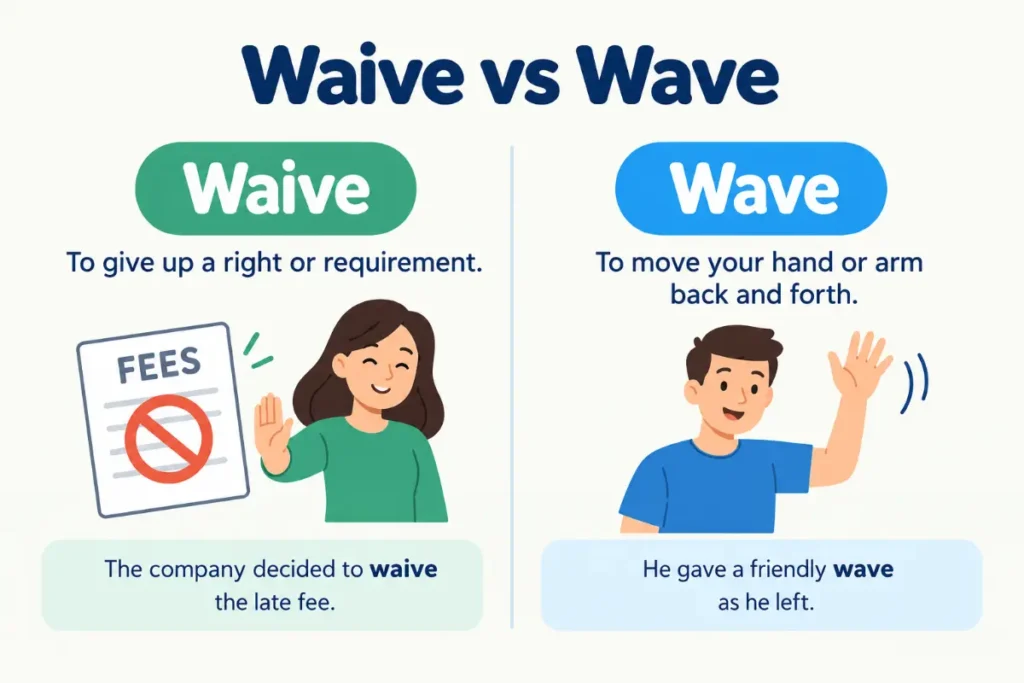
Waive means to voluntarily give up or set aside a right, rule, requirement, fee, or claim. Wave can mean moving your hand back and forth, a moving swell of water, or a surge of something. Use waive for giving something up and wave for movement, water, signals, or surges.
What Does Waive Mean
Waive is a verb that means to voluntarily give up a right, claim, requirement, condition, or privilege. It can also mean choosing not to enforce something that normally applies. The word often appears in legal, financial, business, medical, academic, and administrative situations.
For example, a company might say, “We will waive the application fee for returning customers.” This means the company normally charges the fee but has decided not to require payment in this situation.
You can also waive a requirement. A university might waive a prerequisite for a student who has relevant professional experience. In that case, the university is choosing not to require a condition that normally applies.
The word often involves some kind of permission or decision. Someone with the authority to enforce a requirement decides to give it up or not apply it. That is why waive appears so often in formal communication.
Waive In Simple Terms
Think of waive as giving something up or letting a requirement go.
If you waive a fee, you do not require someone to pay it. If you waive a right, you voluntarily give up that right. If a company waives a rule, it chooses not to enforce the rule in a particular situation.
Here are some common examples.
- The bank agreed to waive the monthly fee.
- The school may waive the application fee for eligible students.
- The customer asked the company to waive the cancellation charge.
- The doctor cannot waive the hospital’s safety requirements.
- The organization decided to waive the usual registration requirement.
In each sentence, waive involves giving up, removing, or not enforcing something.
Like “waive” and “wave,” commonly confused word pairs can look or sound similar while having completely different meanings.
What Does Wave Mean
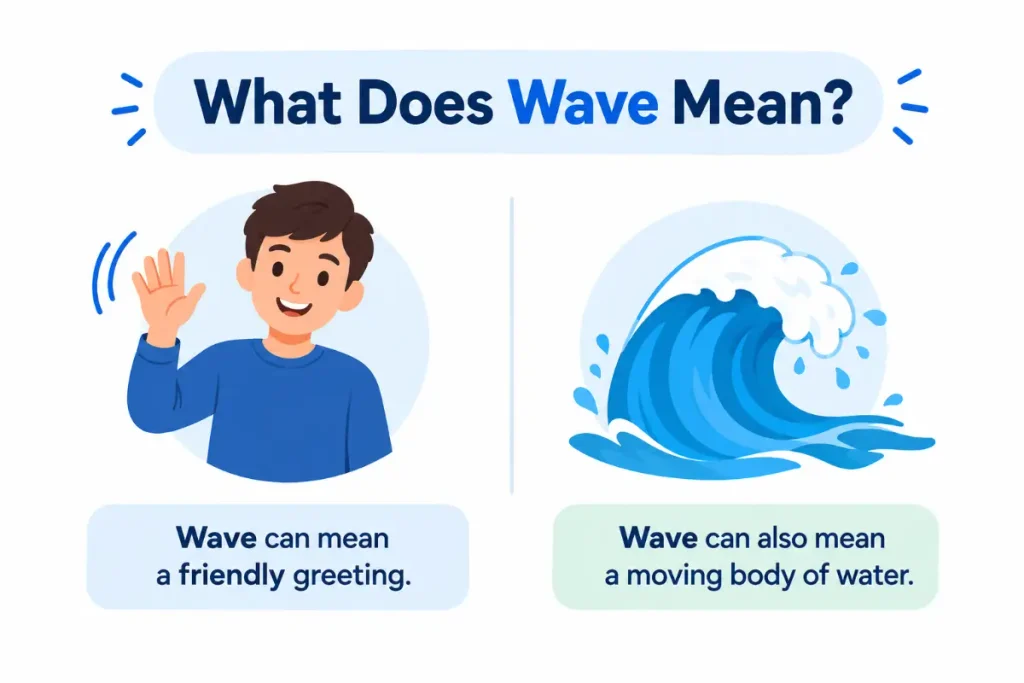
Wave has several meanings, and it can function as both a noun and a verb. As a verb, it can describe moving your hand or another object back and forth. As a noun, it can refer to a moving body of water, a surge of activity, or a particular movement or trend.
You might wave to a friend across a parking lot. You might wave goodbye at an airport. A lifeguard might wave a flag to signal swimmers. In these examples, wave involves movement or signaling.
The noun has broader uses. A wave can be a swell of ocean water, such as “A large wave crashed onto the shore.” It can also describe a sudden increase in something, as in “The city experienced a wave of new businesses.”
Because wave has several meanings, it appears in many everyday contexts. Unlike waive, it does not involve voluntarily giving up a right or requirement.
Wave As A Verb
As a verb, wave commonly means to move something back and forth or from side to side. The movement can communicate a greeting, farewell, warning, signal, or other message.
For example, someone might wave at a neighbor from across the street. A teacher might wave students toward the classroom. A driver might wave another driver through an intersection.
Wave can also describe something moving through the air or another medium. You can wave a flag, wave a hand, or wave a piece of paper.
Wave As A Noun
As a noun, wave can describe a moving ridge or swell of water. It can also describe a period or surge of something.
For example, “A huge wave hit the beach” uses wave to describe water. “A new wave of restaurants opened downtown” uses wave metaphorically to describe a noticeable increase.
This broader meaning explains why wave is much more versatile in everyday English than waive.
Waive vs Wave Grammar
The two words are homophones, which means they sound alike but have different spellings and meanings. Their grammatical roles differ in practice because waive is a verb, while wave can function as both a verb and a noun.
Waive is normally used as a verb because it describes an action involving a right, fee, condition, requirement, or claim. Its forms include waive, waives, waived, and waiving.
For example, “The company waived the fee” uses the past tense. “The company is waiving the fee” uses the present participle. “The company will waive the fee” uses the base form after the modal verb will.
Wave has more grammatical flexibility. As a verb, it can appear as wave, waves, waved, and waving. As a noun, it can be singular or plural.
For example, “She waved to her friend” uses wave as a verb. “The wave was unusually large” uses wave as a noun. “Several waves reached the shore” uses the plural noun.
The Main Difference Between The Two Words
The easiest way to separate these words is to focus on the action or image behind them.
Waive involves giving something up, removing a requirement, or choosing not to enforce something. Wave involves movement, signaling, water, or a surge.
| Feature | Waive | Wave |
|---|---|---|
| Main function | Verb | Verb and noun |
| Core meaning | Give up or set aside something | Move back and forth or describe a swell or surge |
| Common context | Fees, rights, rules, requirements, claims | Greetings, signals, water, movement, trends |
| Typical tone | Often formal | Everyday and highly versatile |
| Example | The company waived the fee. | She waved goodbye. |
| Related forms | Waived, waiving, waives | Waved, waving, waves |
A useful test is to replace the word with give up or let go. If that meaning fits, choose waive. If you are talking about movement, a greeting, water, or a surge, choose wave.
Waive Or Wave A Fee
One of the most common questions involves fees. The correct expression is waive a fee.
If a business decides not to charge a fee that normally applies, it waives the fee.
For example, a customer service representative might write, “We can waive the processing fee for your order.” The company is not physically moving anything. It is choosing not to require payment.
Here are several natural examples.
- The bank agreed to waive the annual fee.
- We can waive the service charge this time.
- The university waived the application fee for qualified students.
- The airline agreed to waive the change fee.
- The landlord offered to waive the late fee.
- Customer service said they would waive the replacement charge.
- The clinic may waive the consultation fee for eligible patients.
- The company decided to waive the registration fee.
Using wave in these sentences would be incorrect because none of them involves movement or a signal.
Incorrect: The bank agreed to wave the annual fee.
Correct: The bank agreed to waive the annual fee.
The difference is only one letter in spelling, but the meaning changes completely.
How To Use Waive Correctly
Waive commonly appears with nouns that represent obligations, conditions, rights, or charges. The object of the verb is usually something that can be given up or not enforced.
Common combinations include:
- Waive a fee.
- Waive a charge.
- Waive a requirement.
- Waive a right.
- Waive a condition.
- Waive a penalty.
- Waive a claim.
- Waive a deadline.
- Waive a restriction.
- Waive a rule.
The word is particularly common in formal writing. You may encounter it in contracts, application forms, school policies, customer service messages, insurance documents, employment agreements, and legal communication.
For example, “By signing this form, you agree to waive certain claims.” This sentence uses waive in a legal context because a person is voluntarily giving up a right or claim.
The word does not necessarily mean that something disappears permanently. The exact effect depends on the situation. A company might waive one fee for one customer without eliminating the fee for everyone else.
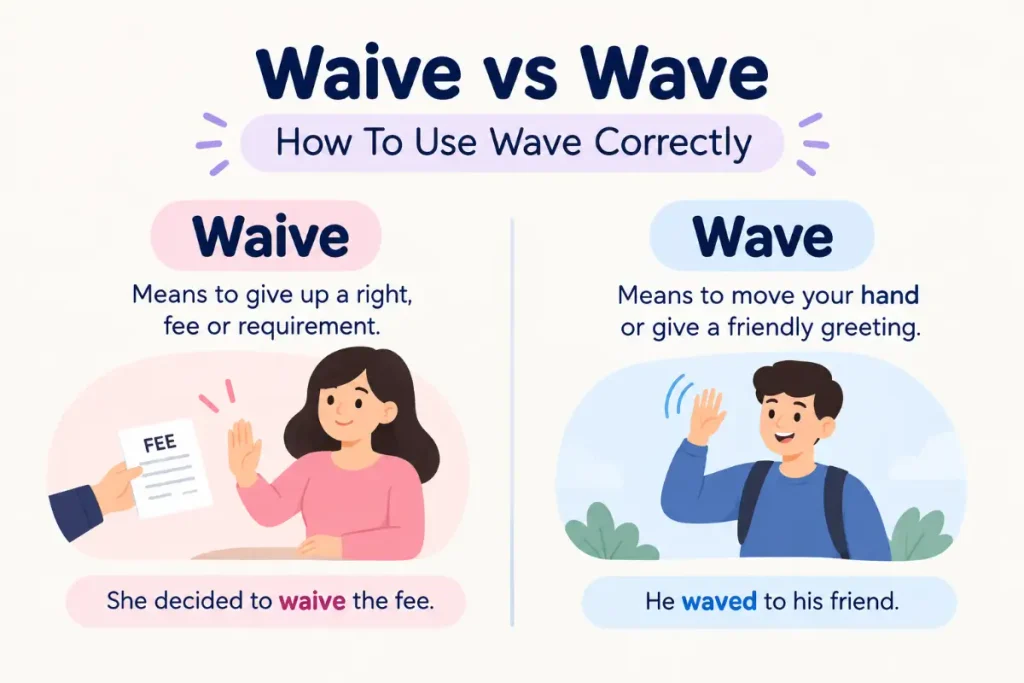
English has many similar-sounding English words that can be easy to mix up when their meanings or grammatical uses differ.
How To Use Wave Correctly
Wave has several common patterns, so context matters.
As a verb, you can wave at someone.
“She waved at her neighbor.”
You can wave to someone.
“He waved to his parents from the stage.”
You can also wave an object.
“The official waved a flag to signal the runners.”
As a noun, wave can describe water.
“A large wave reached the shore.”
It can also describe a surge.
“A new wave of customers arrived after the announcement.”
Wave is therefore much more flexible than waive. If the sentence involves movement, a greeting, a signal, water, or a surge, wave is probably the correct spelling.
Wave Meaning In Different Contexts
The basic meaning of wave changes slightly depending on the context, but the central idea of movement remains useful.
In everyday communication, a wave can be a hand gesture used to say hello or goodbye. Someone might wave from across a room, wave to a neighbor, or wave goodbye at a train station.
In nature, a wave can refer to a moving swell of water. Ocean waves can be small and gentle or large and powerful.
In science, wave has a more technical meaning. It can describe a disturbance that transfers energy through a medium or space. Sound waves and electromagnetic waves are familiar examples.
In society and culture, wave can describe a surge or period of increased activity. A city might experience a wave of new development. A political movement might be described as a new wave of support.
These meanings may seem different, but they all connect to movement or progression.
Waive vs Wave Examples
The clearest way to learn these words is to compare them in realistic sentences. The examples below cover everyday communication, work, school, customer service, and formal writing.
Examples With Waive
- The hotel agreed to waive the cancellation fee.
- The professor agreed to waive the prerequisite for students with relevant experience.
- The company will waive the delivery charge for orders over the required amount.
- The customer asked the bank to waive the overdraft fee.
- The school may waive the application requirement in special circumstances.
- The organization decided to waive the usual registration fee.
- The contract allows the parties to waive certain requirements.
- The manager offered to waive the late payment penalty.
- The clinic agreed to waive the consultation fee.
- The customer signed a form agreeing to waive the claim.
These sentences all involve giving something up, removing an obligation, or choosing not to enforce a condition.
Examples With Wave
- She waved to her friend from across the street.
- He waved goodbye before getting into the car.
- The child waved at the camera.
- A large wave knocked over the beach chair.
- The runner waved to the crowd after crossing the finish line.
- The official waved a flag to signal the start of the race.
- A new wave of customers arrived after lunch.
- The fans waved their hands during the concert.
- The storm produced unusually high waves along the coast.
- The teacher waved the students toward the entrance.
These sentences involve movement, signaling, water, or a surge rather than giving something up.
Wave Off Meaning
Wave off is a phrasal verb with several related meanings. It can mean to signal that someone should go away or continue moving. It can also mean to dismiss, reject, or indicate that something is not necessary.
For example, “The security guard waved off the driver” can mean that the guard signaled the driver to move along. The physical gesture provides the basis for the expression.
Wave off can also describe dismissing an idea or concern. If someone waves off a warning, they treat it as unimportant or choose not to take it seriously.
For example, “She waved off the criticism and continued working.” The sentence means she dismissed or ignored the criticism.
This expression uses wave, not waive, because it comes from the physical idea of making a waving gesture.
Common Mistakes With These Words
The most common mistake is using wave when you mean waive. This often happens with fees, charges, requirements, and rights because these contexts are strongly associated with waive.
Incorrect: The company agreed to wave the fee.
Correct: The company agreed to waive the fee.
Another mistake occurs when someone uses waive for a physical gesture.
Incorrect: She waived goodbye from the window.
Correct: She waved goodbye from the window.
You may also see the wrong spelling in phrases involving ocean water.
Incorrect: A large waive hit the boat.
Correct: A large wave hit the boat.
The pronunciation does not help much because the words sound alike. You need to identify the meaning from the surrounding sentence.
Pronunciation
Waive and wave are pronounced the same way in standard American English. Both are commonly pronounced /weɪv/. They rhyme with words such as save, gave, and brave.
This is why the distinction can be difficult in conversation. If someone says, “The company will waive the fee,” you cannot determine the spelling from the sound alone. The context tells you which meaning is intended.
This makes spelling especially important in written communication. If you are writing an email about a charge, requirement, or right, pause for a moment and make sure you have written waive.
Word Origins And Etymology
The similar pronunciation of waive and wave can make them seem historically connected, but their histories are different.
Wave developed from Old English and Germanic roots associated with movement and waving. Its modern meanings grew from the physical movement of something back and forth and the movement of water.
Waive entered English through Anglo French and developed from a legal and formal sense involving the abandonment or relinquishing of a right or claim. Its history helps explain why the word remains especially common in legal and administrative contexts.
Their different origins reflect their different meanings. Wave is associated with movement, while waive developed around the idea of giving something up or setting something aside.
Formal And Casual Usage
Waive tends to appear more often in formal communication because people frequently use it when discussing policies, fees, contracts, requirements, and rights. It is completely standard in professional American English.
For example, a customer service email might say, “We have decided to waive the processing fee.” That sounds natural and professional.
Wave is extremely common in casual and formal communication alike. You might wave to a friend, wave at a camera, wave a flag, or describe waves in an academic paper.
The difference is not about one word being formal and the other being informal. It is about meaning. Waive often appears in formal contexts because the situations that involve waiving something tend to be administrative or contractual.
Real Life Usage In The United States
Americans encounter waive frequently in situations involving money and policies. Banks may waive fees. Hotels may waive cancellation charges. Schools may waive application requirements. Businesses may waive service charges to resolve a customer complaint.
Wave appears everywhere in everyday communication. People wave hello, wave goodbye, wave to passing friends, wave at cameras, and wave objects to get attention. The noun also appears in conversations about beaches, weather, sports, crowds, technology, and social trends.
Consider a workplace example. A manager might write, “We will waive the late fee for this order because of the shipping delay.” That is a business decision. The same manager might later say, “Please wave to the camera before the meeting starts.” The words sound identical but their meanings could not be more different.
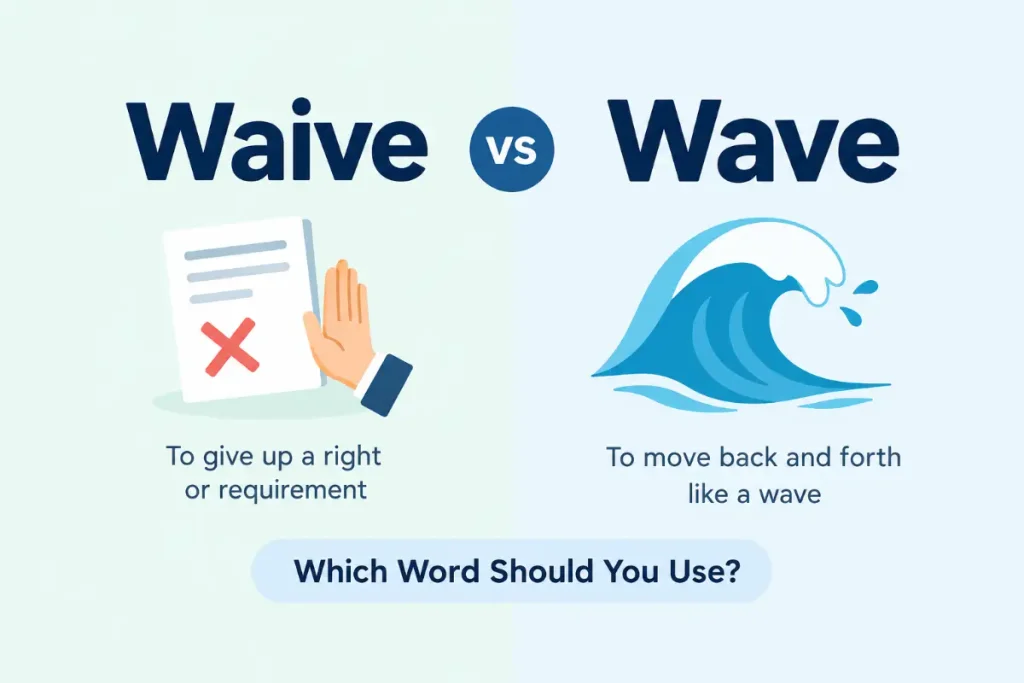
Understanding a subtle meaning difference can help you choose the right word and communicate your intended meaning more precisely.
Which Word Should You Use
Use waive when you mean to give up, remove, excuse, or choose not to enforce something.
Use wave when you mean to move your hand or an object, signal, describe moving water, or describe a surge.
A simple replacement test works well. If you can replace the word with give up, forgo, or not require, choose waive. If you can replace it with move back and forth, signal, swell, or surge, choose wave.
This approach is more reliable than trying to memorize the spelling alone. The meaning gives you the spelling.
Waive Vs Wave Exercises
Try completing each sentence with waive or wave. The goal is to identify the meaning before thinking about spelling.
- The company agreed to _____ the service fee.
- She _____ to her parents from the sidewalk.
- The university may _____ the application requirement.
- A large _____ hit the side of the boat.
- The customer asked the bank to _____ the penalty.
- The child _____ goodbye as the bus pulled away.
- The manager decided to _____ the late charge.
- A new _____ of customers arrived after the sale began.
- The official _____ the flag to start the race.
- The contract allows the parties to _____ certain rights.
The answers are:
- Waive.
- Waved.
- Waive.
- Wave.
- Waive.
- Waved.
- Waive.
- Wave.
- Waved.
- Waive.
Notice how the surrounding nouns and verbs make the answer clear. Fees, requirements, penalties, charges, and rights point toward waive. Greetings, flags, water, crowds, and physical movement point toward wave.
Expert Usage Tips
When you edit your own writing, do not focus only on how the word sounds. Since waive and wave are homophones, pronunciation cannot tell you which spelling belongs on the page. Instead, identify the action or idea first.
A useful editing question is, “Is someone giving something up?” If the answer is yes, you probably need waive. If the sentence describes someone moving a hand, moving an object, signaling, water, or a surge, wave is the natural choice.
Pay special attention to business communication. Phrases such as waive the fee, waive the charge, waive the requirement, and waive the penalty are extremely common. If you are writing a professional email and see a sentence such as “We can wave the fee,” correct it to “We can waive the fee.”
Also remember that waived is the past tense of waive. For example, “The company waived the fee yesterday.” Waved is the past tense of wave. For example, “She waved at me yesterday.” The extra spelling difference becomes more visible in the past tense, but the same meaning distinction remains.
Frequently Asked Questions
What is the difference between waive and wave
Waive means to give up or remove a right, fee, requirement, condition, or claim. Wave can mean to move your hand or an object back and forth, describe moving water, or describe a surge. For example, a company can waive a fee, while a customer can wave goodbye. The words sound alike but have different meanings.
Is it waive or wave a fee
The correct expression is waive a fee. If a business decides not to charge a fee that normally applies, it waives the fee. For example, “The bank agreed to waive the annual fee.” Wave is incorrect in this context because no physical movement or signal is involved.
Is it waive or wave goodbye
The correct expression is wave goodbye. When you move your hand to signal farewell, you wave. For example, “She waved goodbye before getting into the car.” Waive would be incorrect because the action involves a physical gesture rather than giving up a right or requirement.
What does wave mean
Wave can mean to move your hand or another object back and forth as a greeting, farewell, or signal. As a noun, it can describe moving water or a surge of something. For example, you can wave to a friend, watch an ocean wave, or experience a wave of new customers.
What does waive mean
Waive means to voluntarily give up, remove, or choose not to enforce something. Common examples include waiving a fee, waiving a requirement, waiving a penalty, or waiving a right. The word is especially common in business, legal, academic, financial, and administrative contexts.
Is waive a verb
Yes. Waive is a verb that describes the act of voluntarily giving something up or choosing not to enforce a requirement. Its common forms include waive, waives, waived, and waiving. For example, “The company waived the fee” uses the past tense of waive.
What is the difference between waived and waved
Waived is the past tense of waive and means someone gave up, removed, or did not enforce something. Waved is the past tense of wave and describes a physical gesture or movement. For example, “The bank waived the fee” means the bank removed the charge, while “She waved at the driver” describes a hand gesture.
How can I remember waive and wave
Think of waive when something is being given up or removed. Think of wave when something is moving, signaling, or swelling. A useful memory pair is “waive the fee” and “wave goodbye.” If you connect each spelling with one familiar phrase, the distinction becomes much easier to recall.
Conclusion
The difference between waive vs wave is simple once you focus on meaning. Waive means to give up, remove, excuse, or choose not to enforce something. Wave refers to movement, a greeting, a signal, water, or a surge. The words sound alike, but their uses are clearly different.
When you are talking about money, rights, requirements, charges, or penalties, think waive. When you are talking about waving goodbye, moving an object, ocean water, or a surge of activity, think wave. If you remember the familiar phrases “waive a fee” and “wave goodbye,” you will have a reliable shortcut for choosing the correct spelling in everyday and professional writing.