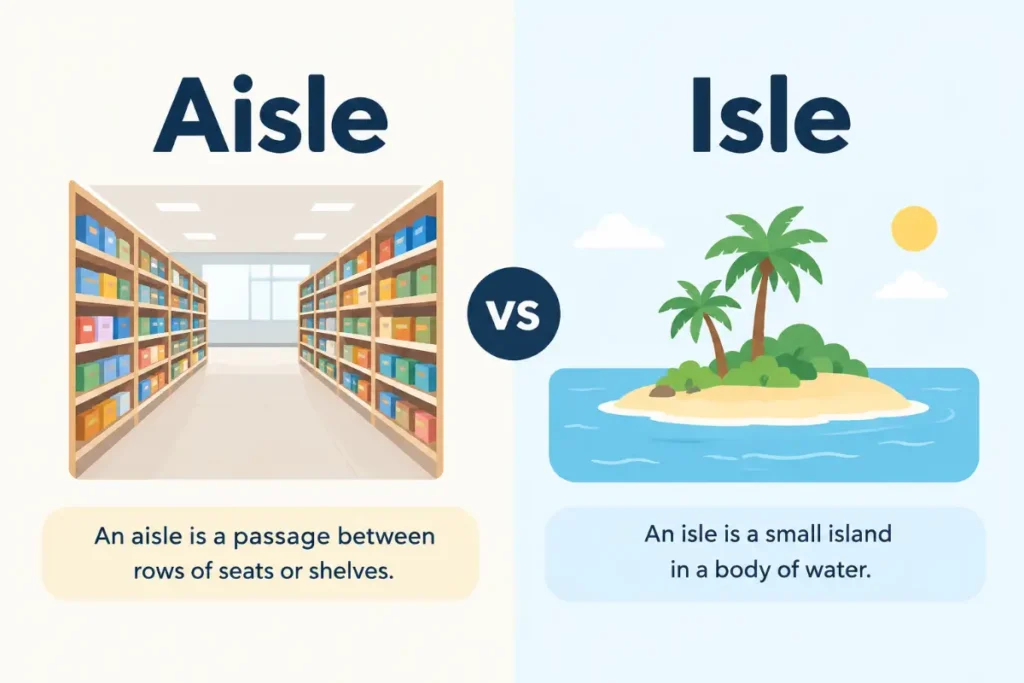
The difference between aisle vs isle comes down to two very different meanings. Aisle means a passage between rows of seats, shelves, or other objects. Isle means an island, especially a small one. They sound exactly the same in standard American English, which makes them easy to confuse when you are writing from memory.
You will see aisle in places such as grocery stores, airplanes, theaters, churches, and wedding venues. Isle usually appears when someone is talking about geography, travel, or a particular island. A wedding can have an aisle, but a destination can be an isle. A supermarket has aisles, while an island is an isle.
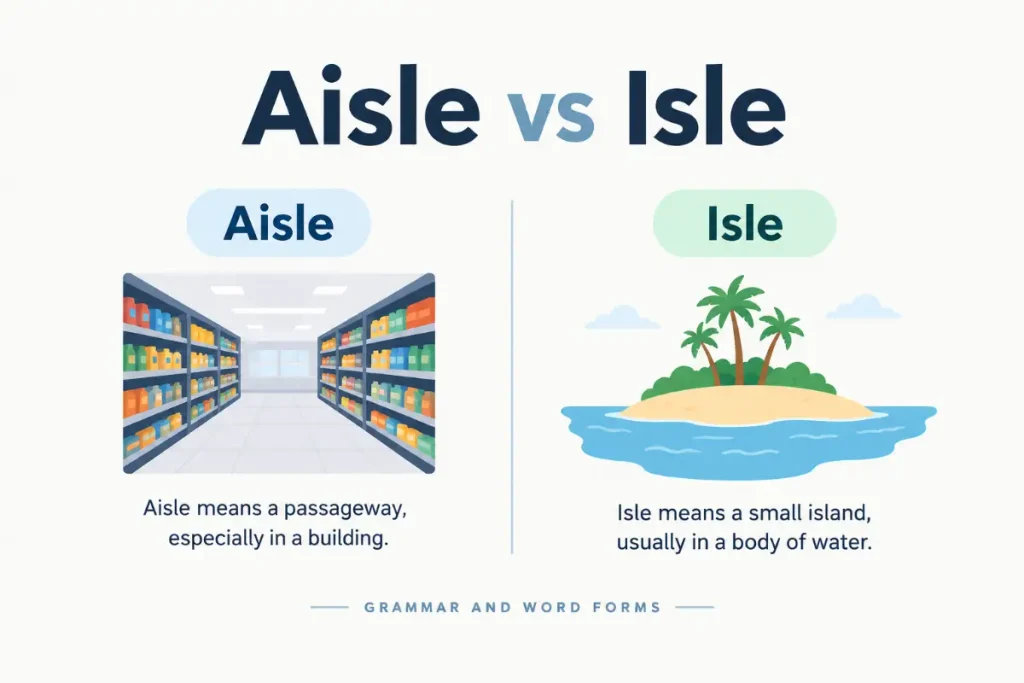
The spelling becomes much easier once you connect each word with a mental picture. Think of an aisle as a path you walk through. Think of an isle as land surrounded by water. This guide explains the meanings, pronunciation, etymology, common mistakes, wedding usage, store usage, sentence examples, and practical ways to remember the difference.
Quick Answer
Aisle is a passage between rows of seats, shelves, or other objects. Isle means an island. They are pronounced the same in American English but have different meanings and spellings. You walk down an aisle at a grocery store or wedding, while you visit an isle when referring to an island.
Like “aisle” and “isle,” easily confused word pairs can sound similar while having completely different meanings and uses.
What Does Aisle Mean
Aisle is a noun that means a walkway or passage between rows of things. You can find an aisle between supermarket shelves, theater seats, airplane seats, church pews, or other organized rows. The defining idea is a space that lets people move through or between those rows.
For example, if someone says, “The cereal is in the third aisle,” they mean you should look along the third passage between the store shelves. In an airplane, the aisle is the walkway between the seats. In a theater, an aisle separates sections of seats and gives people a route to enter or leave.
Aisle is common in everyday American English. You will hear and see it in shopping conversations, travel instructions, event planning, workplace directions, and descriptions of buildings. It can also appear in figurative or familiar expressions, especially when people talk about weddings or political cooperation.
The plural is aisles. For example, you might say, “The store has wide aisles,” or “Guests filled the aisles before the ceremony began.”
Aisle in Simple Terms
The easiest definition is a passage you walk through. If you can picture yourself walking between two rows of seats or shelves, you probably need aisle.
Think about a grocery store. You push your cart down an aisle while looking at products on both sides. Think about an airplane. You walk down the aisle to reach your seat. Think about a wedding. The bride or groom may walk down the aisle during the ceremony.
The word can refer to more than a physical walkway. In American political writing, for example, you may hear the phrase “across the aisle.” This describes cooperation between people or groups with different political positions, especially members of opposing parties.
What Does Isle Mean
Isle is a noun that means an island. It often refers to a relatively small island and can sound literary, geographic, or traditional. The word appears frequently in names and descriptions of islands around the world.
For example, “They spent a week on a remote isle” means they spent a week on a remote island. The word does not describe a walkway, a store passage, or a row of seats.
Isle can sound more poetic than the everyday word island. In ordinary American conversation, most people simply say island. You are more likely to encounter isle in geographic names, travel writing, literature, historical references, or expressions that have become established names.
Examples include references to the Isle of Man or the Isles of Scilly. In these names, isle is part of the established geographic name.
Isle in Simple Terms
Think of isle as a small island surrounded by water. If you are talking about land in the middle of a lake, sea, or ocean, isle may be appropriate when the context or name calls for it.
For example, “The travelers sailed to a secluded isle” describes a small island. The word has nothing to do with walking between rows.
A simple memory picture can help. Imagine blue water surrounding a small piece of land. That is an isle. Now imagine two rows of supermarket shelves with a path between them. That is an aisle.
Aisle vs Isle Meaning
The core difference is simple.
| Feature | Aisle | Isle |
|---|---|---|
| Part of speech | Noun | Noun |
| Meaning | A passage between rows | An island |
| Main idea | A walkway or passage | Land surrounded by water |
| Common places | Stores, airplanes, theaters, churches | Oceans, seas, lakes, geographic names |
| Plural | Aisles | Isles |
| Pronunciation | Same as isle | Same as aisle |
| Example | Walk down the aisle | Visit a tropical isle |
The two words are homophones. That means they have the same pronunciation but different meanings and spellings. Homophones can cause spelling mistakes because you cannot always tell which word someone means from the sound alone.
Context solves the problem. If someone says, “The milk is down the aisle,” you know they mean a store passage. If someone says, “They visited a small isle,” the surrounding meaning tells you that they mean an island.
Why Aisle and Isle Sound the Same
The pronunciation of these words is one of the main reasons people confuse them. In standard American English, aisle and isle are pronounced the same.
Both are commonly pronounced /aɪl/. A simple pronunciation guide is eye-l.
The word aisle contains several letters that are not pronounced. The same is true of isle, which has a silent s. The spelling therefore gives you little help when you hear either word aloud.
This creates a classic homophone problem. Other familiar English examples include pair and pear, flower and flour, and right and write. The words sound alike, but their meanings and spellings differ.
If you hear someone say, “I will meet you in the aisle,” you need the context to know which spelling belongs on the page. If the meeting is in a grocery store, airplane, or theater, aisle is the correct spelling. If someone is talking about an island, isle is correct.
Aisle vs Isle Pronunciation
The pronunciation is straightforward in American English.
Aisle: /aɪl/
Isle: /aɪl/
Both sound like the word I’ll in everyday speech. The initial letters do not create different sounds. In aisle, the letters ai produce the long i sound, while the s is silent. In isle, the s is also silent and the word ends with the same long i sound.
This is one reason spelling can be difficult for English learners. You cannot rely on pronunciation to distinguish the two words. Instead, you need to connect each spelling with its meaning.
A useful trick is to remember that aisle has an A, and you often find an aisle in an area such as a store, airplane, or auditorium. For isle, think of an island. The shared beginning can remind you of the connection.
Aisle or Isle in a Store
When you are talking about a passage between store shelves, the correct word is aisle.
You might say, “The pasta is in aisle five.” You could also ask, “Which aisle has the cleaning supplies?” In both cases, aisle describes the space between rows of products.
Using isle in this context is incorrect because isle means an island. A supermarket does not normally have islands of land between its shelves.
The same distinction applies to many retail settings. A department store has aisles. A hardware store has aisles. A pharmacy has aisles. A warehouse may have aisles between storage racks.
You can also use aisle for a passage in other buildings. For example, a movie theater has aisles between sections of seats. An airplane has an aisle between the rows of seats. A church may have a central aisle between pews.
“Aisle” and “isle” are just one example of another common usage mix-up where understanding the distinction makes your writing more precise.
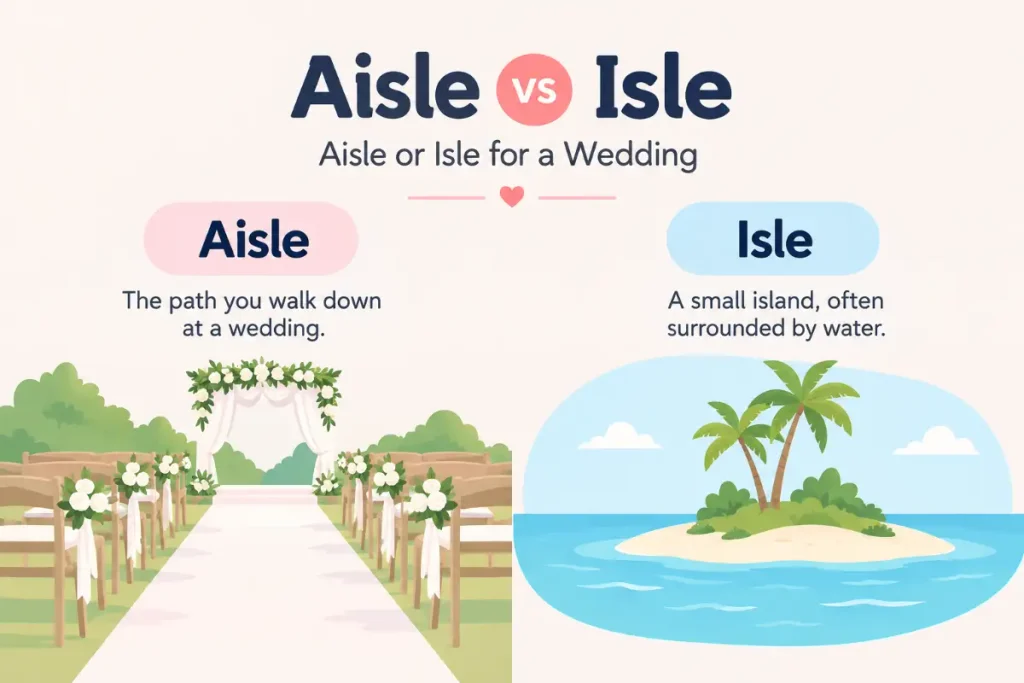
Aisle or Isle for a Wedding
For weddings, the correct word is aisle.
You walk down the aisle during a traditional wedding ceremony. The aisle is the passage between rows of chairs or seats leading toward the ceremony space.
For example, you might write, “The bride walked slowly down the aisle as the music began.” You could also say, “The flower girl walked down the aisle before the bride.”
The phrase walk down the aisle is so closely associated with marriage that it can also be used figuratively. Someone might say, “They are finally walking down the aisle,” meaning they are getting married.
Isle would not be correct in this context unless the wedding itself is taking place on an island and you are actually discussing the island. Even then, the wedding ceremony still has an aisle if the venue has a passage between rows of seats.
For example, “They got married on a beautiful isle and walked down a flower covered aisle.” The first word refers to the island. The second refers to the wedding passage.
Aisle vs Isle Examples
Seeing the words in different contexts is one of the best ways to make the distinction stick.
Examples With Aisle
- The bread is in the fourth aisle.
- I left my bag in the airplane aisle.
- Please keep the aisle clear for other customers.
- She walked down the aisle toward the altar.
- We found the batteries in the electronics aisle.
- The theater has a wide aisle between the seats.
- He moved his cart to the side of the aisle.
- The flight attendant asked passengers not to block the aisle.
- The bride’s father walked beside her down the aisle.
- The store employee directed us to the frozen food aisle.
These examples all involve a passage or walkway. That is the central meaning of aisle.
Examples With Isle
- They spent their vacation on a quiet tropical isle.
- The boat carried tourists to a nearby isle.
- The remote isle has only a few hundred residents.
- The travelers photographed the rocky isle from the water.
- The novel takes place on a mysterious isle.
- They explored several small isles during the cruise.
- The lighthouse stands on a remote isle.
- The island is sometimes described as a beautiful isle.
- The sailors spotted a distant isle on the horizon.
- The couple chose a private isle for their vacation.
These examples all involve islands or land surrounded by water.
Common Mistakes With Aisle and Isle
The most common mistake is using isle when you mean a passage.
Incorrect: Please leave your cart out of the isle.
Correct: Please leave your cart out of the aisle.
The store has a passage between its shelves, so aisle is the correct word.
Another common mistake occurs with weddings.
Incorrect: The bride walked down the isle.
Correct: The bride walked down the aisle.
The ceremony has a walkway between the rows of seats. It does not have an island.
The reverse mistake happens when someone writes aisle to describe an island.
Incorrect: They stayed on a beautiful tropical aisle.
Correct: They stayed on a beautiful tropical isle.
In everyday American English, island would usually be more natural than isle in this sentence. Still, isle is grammatically correct when you want that particular word or when it appears in a geographic name.
Why These Words Are Easy to Confuse
The biggest reason is pronunciation. Since aisle and isle sound exactly the same, listening does not help you choose the spelling.
The second reason is that both words are relatively short and contain silent letters. Aisle has an unusual spelling that does not closely match its pronunciation. Isle also contains a silent s, making the spelling less intuitive.
The third reason is that people often encounter these words in different contexts without consciously learning the distinction. Someone may hear “walk down the aisle” many times before realizing how aisle is spelled. Someone else may see a geographic name containing isle and later assume it can describe a store passage.
The solution is not to memorize complicated rules. It is to attach each spelling to a clear image.
Aisle equals passage. Isle equals island.
Aisle vs Isle Etymology
The different meanings of these words become clearer when you look at their histories.
Aisle comes from a word related to a wing or side of a building. Its history can be traced through Old French forms to Latin ala, meaning wing. The architectural sense developed because a side section of a church or other building could be understood as a wing or passage beside the central area.
Over time, aisle developed its modern sense of a passage between rows of seats, shelves, or other objects. Its spelling reflects its historical development rather than its modern pronunciation.
Isle has a different history. It comes through Old French from Latin insula, meaning island. That root is also related to words connected with islands and insular ideas.
The two words therefore have completely different origins even though their modern pronunciations are identical. Their histories reinforce the modern distinction: aisle is associated with a passage, while isle is associated with an island.
Aisle and Isle in American English
Both words are standard in American English, and neither represents an American versus British spelling difference. The distinction is based on meaning rather than regional spelling.
American speakers commonly use aisle in stores, airplanes, churches, theaters, buses, and other places with rows or sections. The word appears frequently in everyday directions and conversations.
Isle is less common in ordinary American speech because Americans usually say island instead. Isle still appears in geographic names and more literary or descriptive writing.
For example, “We visited an island in the Caribbean” sounds completely natural in everyday American English. “We visited a Caribbean isle” is also correct, but it has a more literary or descriptive flavor.
The important point is that isle is not an incorrect version of island. It is a valid word with a somewhat narrower and more formal or poetic feel.
Grammar and Word Forms
Both aisle and isle are nouns. They can be singular or plural.
- The singular forms are aisle and isle.
- The plural forms are aisles and isles.
For example, “The store has twelve aisles” uses the plural of aisle. “The ship passed several small isles” uses the plural of isle.
You can use both words with common determiners such as a, an, the, this, that, these, and those. You can also use possessive forms when needed.
For example, “The aisle was blocked” uses the singular. “The aisles were crowded” uses the plural. “The isle’s beaches were beautiful” uses a possessive form referring to the island.
There is no special grammar rule that separates them beyond their meanings. The main challenge is choosing the correct spelling.
Related Words That Can Help
Several related words can reinforce the meaning of each term.
Words associated with aisle include walkway, passage, corridor, row, seating, shelves, store, airplane, theater, and church. These words create a physical image of movement between organized spaces.
Words associated with isle include island, coast, ocean, sea, shore, beach, archipelago, and territory. These words point toward geography and land surrounded by water.
Notice that the semantic groups are completely different. If the surrounding vocabulary includes shelves and shopping carts, aisle is likely. If it includes beaches and boats, isle may be appropriate.
Context is especially useful when writing because the sound of the words gives you no clue.
When to Use Island Instead of Isle
Although isle is correct, island is often the more natural choice for American readers. Isle can sound literary, poetic, old fashioned, or geographically specific depending on the context.
For example, “We rented a house on an island in Florida” sounds completely ordinary. “We rented a house on an isle in Florida” sounds more stylized.
That does not mean isle is wrong. It simply has a different tone. Writers sometimes choose it because it creates a particular mood or because it appears in a proper name.
Use island when you want the clearest everyday term. Use isle when it fits the tone, appears in an established geographic name, or helps create a more literary description.
Real Life Usage
You are likely to encounter aisle far more often in everyday American life. Grocery shopping, air travel, weddings, theaters, churches, and large stores all provide common situations where the word appears.
For example, an employee might tell a customer, “The shampoo is in aisle seven.” A flight attendant might say, “Please keep the aisle clear.” A wedding planner might explain, “The couple will enter through the center aisle.”
Isle tends to appear less often in casual conversation. You may encounter it in travel descriptions, geographic names, historical writing, books, songs, and descriptive prose. Most people would simply say island when talking casually about a piece of land surrounded by water.
Understanding that difference can help your writing sound more natural. You do not need to use isle simply because it is a synonym for island. Choose the word that fits your audience and tone.
A Simple Memory Trick
The easiest memory trick is to remember that aisle has an A and an aisle is an area you walk through. Picture the shelves in a grocery store and imagine yourself walking between them. That mental picture connects aisle with movement and passage.
For isle, think of an island. Both words begin with the same sound and describe land surrounded by water.
Another useful trick is to remember the phrase walk down the aisle. Weddings make the phrase especially memorable. If you are talking about walking, shopping, seating, or shelves, aisle is usually the answer.
If you are talking about boats, beaches, oceans, or land surrounded by water, think isle or, more commonly, island.
Which Word Should You Use
Use aisle when you mean a passage between rows, shelves, seats, or other objects. This is the word you need for grocery stores, airplanes, theaters, churches, and weddings.
Use isle when you mean an island, particularly when the word appears in a geographic name or when you want a more literary description. In ordinary American conversation, island is usually the more natural choice.
A quick substitution test can also help. If you can replace the word with walkway, choose aisle. If you can replace it with island, choose isle.
For example, “The chips are in the walkway” gives you the clue that aisle is correct. “They visited a small island” gives you the clue that isle could work.
If you’re building your vocabulary, learning words that sound alike but differ in spelling and meaning can help you avoid common writing mistakes.
Frequently Asked Questions
What is the difference between aisle and isle
Aisle means a passage between rows of seats, shelves, or other objects. Isle means an island. They are homophones, so they sound the same but have different meanings and spellings. You walk down an aisle at a wedding or shop in a store aisle, while an isle is a piece of land surrounded by water.
Is aisle or isle correct in a store
Aisle is correct in a store. A grocery store has aisles between its shelves, and you might say, “The cereal is in aisle six.” Isle would be incorrect in this context because it means an island. The same rule applies to department stores, pharmacies, hardware stores, and other shops.
Is it aisle or isle for a wedding
The correct word is aisle. A person walks down the aisle during a traditional wedding ceremony. The aisle is the passage between rows of seats leading toward the ceremony space. Isle would refer to an island, so it is not the correct spelling for the wedding expression.
Are aisle and isle pronounced the same
Yes. In standard American English, both aisle and isle are commonly pronounced /aɪl/. They sound like the word “I’ll.” The spelling therefore cannot be determined from pronunciation alone. You need to use the meaning and context to choose the correct form.
What does isle mean
Isle means an island. It often refers to a small island and can have a literary, geographic, or traditional tone. Americans commonly use island instead in everyday conversation. Isle also appears in established geographic names such as the Isle of Man.
Why is aisle spelled that way
Aisle has a historical spelling connected with its development from French and Latin words associated with a wing or side section of a building. Its modern pronunciation changed over time while the spelling retained historical features. That is why several letters in aisle are not pronounced today.
Is isle another word for island
Yes. Isle can mean island, especially a relatively small island or one referred to in a literary or geographic context. However, island is generally more common in everyday American English. You can use isle when the tone or context suits it, but you do not need to replace island with isle.
What is an easy way to remember aisle and isle
Remember aisle equals passage and isle equals island. Picture yourself walking through a grocery store aisle or down a wedding aisle. Then picture a small island surrounded by water. These two mental images make the spelling difference much easier to remember.
Conclusion
The difference between aisle vs isle is simple once you connect each word with its meaning. Aisle means a passage between rows of shelves, seats, or other objects, while isle means an island. They are pronounced the same in American English, which explains why the spelling can be confusing.
Use aisle for grocery stores, airplanes, theaters, churches, and weddings. Use isle for an island, especially in geographic names or descriptive writing. In everyday American English, island is often the more natural choice than isle. When you are unsure, remember one simple pair: aisle is a path, isle is land surrounded by water.