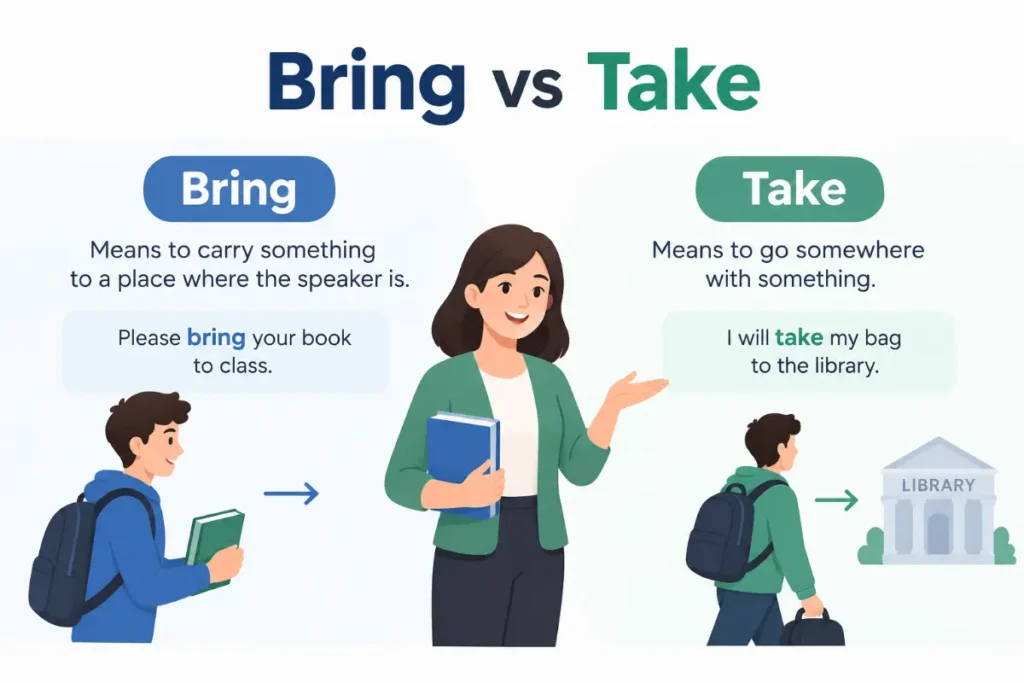
The difference between bring vs take comes down to direction. Bring usually means moving something or someone toward the speaker or another place being treated as the destination. Take usually means moving something or someone away from the speaker or from the current place to another destination. That sounds simple, but everyday conversations can make the choice less obvious.
The confusion often happens because both verbs describe movement from one place to another. The difference is not mainly about the object being moved. It is about the direction of that movement in relation to the speaker, listener, or destination. Once you focus on where the person or thing is going, the choice becomes much easier.
You might say, “Bring your laptop to the meeting,” because the laptop is moving toward the meeting location. You might say, “Take your laptop home,” because the laptop is moving away from the current location. This guide explains the grammar behind the two verbs, shows how native speakers use them, covers common mistakes, and gives practical examples for everyday American English.
Quick Answer
Bring means to move something or someone toward the speaker, listener, or a relevant destination. Take means to move something or someone away from the speaker or current location toward another place. You bring something here or there with the destination in focus. You take something from here to another place.
What Does Bring Mean
Bring is a verb that describes movement toward a place, person, or situation that matters in the conversation. The destination can be the speaker’s location, the listener’s location, or another place that has become the focus of the discussion. The key idea is movement toward a relevant destination.
For example, if you are having a party at your house and tell a friend, “Bring some snacks,” you are asking the friend to carry snacks toward your house. The friend is moving the snacks from another location to the place where you will be. The same idea applies to sentences such as “Bring your notes to class” and “Bring your ID to the appointment.”
Bring can also work with people. You might say, “Bring your sister to the party,” because your sister will be moving toward the party. You can also use bring for animals and objects, as in “Bring the dog inside” or “Bring your coat with you.”
The destination does not always have to be physically close. You can say, “Bring the documents to my office tomorrow,” even if the documents are currently somewhere else. What matters is the direction toward the place that has been established as the destination.
Like “bring” and “take,” another commonly confused pair can cause confusion when two words sound similar but have completely different meanings.
What Does Take Mean
Take describes movement away from the speaker, listener, or current location toward another destination. It is often used when the destination is different from the place where the speaker is or where the conversation is centered.
For example, if you are at home and tell your child, “Take your backpack to school,” you are asking the child to move the backpack away from home and toward school. You could also say, “Take these files to the front desk,” when the files are currently with you and need to go somewhere else.
Take works with people as well as objects. You might say, “Take your brother to the airport,” meaning that your brother will be transported from the current location to the airport. You can also take a dog to the veterinarian, take a friend to dinner, or take your car to a mechanic.
The verb can also describe movement from one point to another when the speaker is not traveling with the object or person. For example, “Please take these packages to the mailroom” asks someone to move the packages from their current location to another destination.
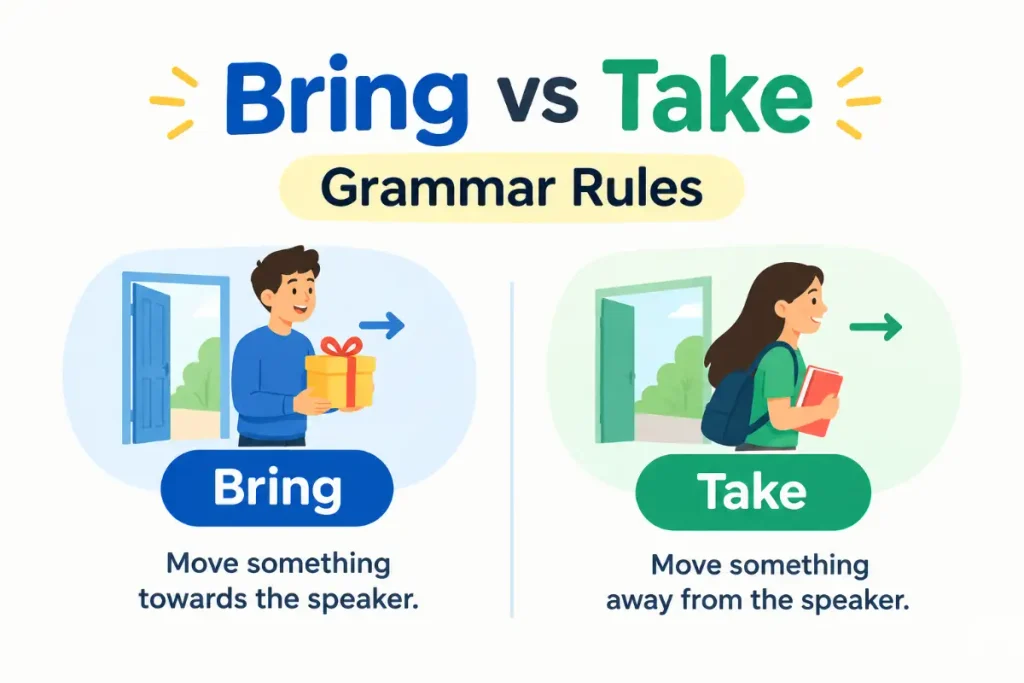
Bring vs Take Grammar Rules
The basic grammar rule is easier than it first appears. Use bring for movement toward a person, place, or destination that is the focus of the conversation. Use take for movement away from that point toward another destination.
Consider this exchange:
“Can you bring your report to my office?”
“Sure. I will bring it this afternoon.”
The report is moving toward the speaker’s office, so bring makes sense.
Now consider this exchange:
“Can you take these reports to the accounting department?”
“Sure. I will take them after lunch.”
The reports are moving away from the current location to another department, so take is appropriate.
The important point is that bring and take do not simply mean “carry.” Both can describe carrying or transporting something, but the direction determines the natural choice.
The Direction Rule
A simple way to remember the distinction is to imagine an arrow.
Bring → toward the relevant destination.
Take → away from the relevant starting point.
Suppose you are sitting at home and talking to your friend who is at work. You might say, “Bring the paperwork home tonight.” The paperwork will move toward the place where you are or the place you have established as the destination.
Now imagine that you are already at work and tell your coworker, “Take the paperwork to the manager.” The paperwork needs to move from the current location to another place.
This is why the same object can be used with either verb in different situations. You can bring a book to the library or take a book from the library. You can bring food to a picnic or take food from the picnic. The object does not determine the verb. The direction does.
Bring or Take Someone Somewhere
The same rule applies when the object is a person.
Use bring when someone is moving a person toward the relevant destination.
For example:
- Bring your brother to the party.
- Can you bring your daughter to my office?
- Please bring your parents to dinner.
- Bring the kids inside before it gets dark.
Use take when someone is moving a person away from the current location toward another destination.
For example:
- Take your brother to the airport.
- Can you take your daughter to school?
- Please take your parents home after dinner.
- Take the kids to the park this afternoon.
The same person can be brought in one situation and taken in another. Imagine a child at home. A parent might say, “Bring your sister to the kitchen.” The sister is moving toward the speaker. Later, the parent might say, “Take your sister to school.” The sister is moving away from home toward school.
Bring vs Take Examples
Real examples are often the fastest way to understand the distinction. The following sentences cover common situations you might encounter at home, at work, at school, and in everyday conversations.
Examples With Bring
- Please bring your laptop to the meeting.
- Can you bring some water when you come over?
- Bring your receipt to the customer service desk.
- Please bring your completed form to the appointment.
- I asked Sarah to bring dessert to the party.
- Bring your jacket because it might get cold tonight.
- Can you bring the documents to my office?
- The teacher told students to bring their books to class.
- Please bring your ID when you arrive.
- We asked our neighbors to bring chairs for the backyard gathering.
In each example, the item or person is moving toward a destination that matters in the conversation. The destination may be the speaker’s location or another place that has become the focus.
Examples With Take
- Please take your laptop home tonight.
- Can you take these files to the front desk?
- Take an umbrella because it may rain later.
- Please take the package to the shipping department.
- I need to take my car to the mechanic.
- Can you take the kids to school tomorrow?
- Please take your receipt with you.
- She took her dog to the veterinarian.
- Take these documents to the manager before the meeting.
- He took some food to his neighbor.
Here the movement generally goes away from the current point toward another destination. The destination is not being treated as the place toward which the speaker is directing the action with bring.
Bring and Take in Questions
Questions can make the distinction feel less obvious because the speaker may not directly state the destination. Context usually supplies the missing information.
Imagine you are hosting dinner and ask your friend, “Can you bring anything?” The implied destination is your home. Your friend understands that anything they bring will come toward the gathering.
Now imagine you are leaving a restaurant and ask your friend, “Can you take these leftovers?” The food is moving away from the current location with your friend.
Another common example is a phone conversation. Someone might ask, “Should I bring anything?” if they are coming to your house. The expected movement is toward you or the place where you will meet.
If someone is leaving your house and you say, “Can you take this package to the post office?” the movement goes away from the current location. Take is the natural choice.
Bring vs Take in Workplace English
Professional communication often makes the distinction especially important because the destination may be an office, department, meeting room, or client location.
You might write, “Please bring the signed contract to the meeting.” The contract needs to come to the meeting location. You could also write, “Please take the signed contract to the legal department.” The contract needs to move from the current location to another department.
In workplace conversations, context can change the correct verb. Suppose you are sitting in the conference room and ask an employee to get a report from their desk. You might say, “Please bring the report to the conference room.” If you are standing at the employee’s desk and asking them to deliver the report to the conference room, bring can still be natural because the conference room is the destination established by the conversation.
This shows why the rule is not simply “bring means toward me and take means away from me.” The destination can become the conversational focus even when the speaker is not physically located there.
Bring vs Take in Everyday Conversation
Everyday speech often makes these verbs sound more flexible because native speakers rely heavily on shared context. If two people are discussing a destination, bring can refer to movement toward that destination even if neither person is physically there at the moment.
For example, imagine two coworkers discussing a weekend barbecue at a friend’s house. One says, “I am going to bring some burgers.” That sounds natural because the barbecue is the established destination.
Similarly, a parent might tell a child, “Take your shoes upstairs.” The destination is upstairs and the movement is away from the child’s current location. The speaker does not need to explain the direction because everyone understands the setting.
In casual conversation, people may occasionally use bring and take differently because of regional habits, conversational perspective, or an implied destination. That does not make the basic distinction useless. It means real speech depends on context rather than a mechanical rule.
Understanding similar-sounding English words such as “aisle” and “isle” can also help you choose the right word based on context.
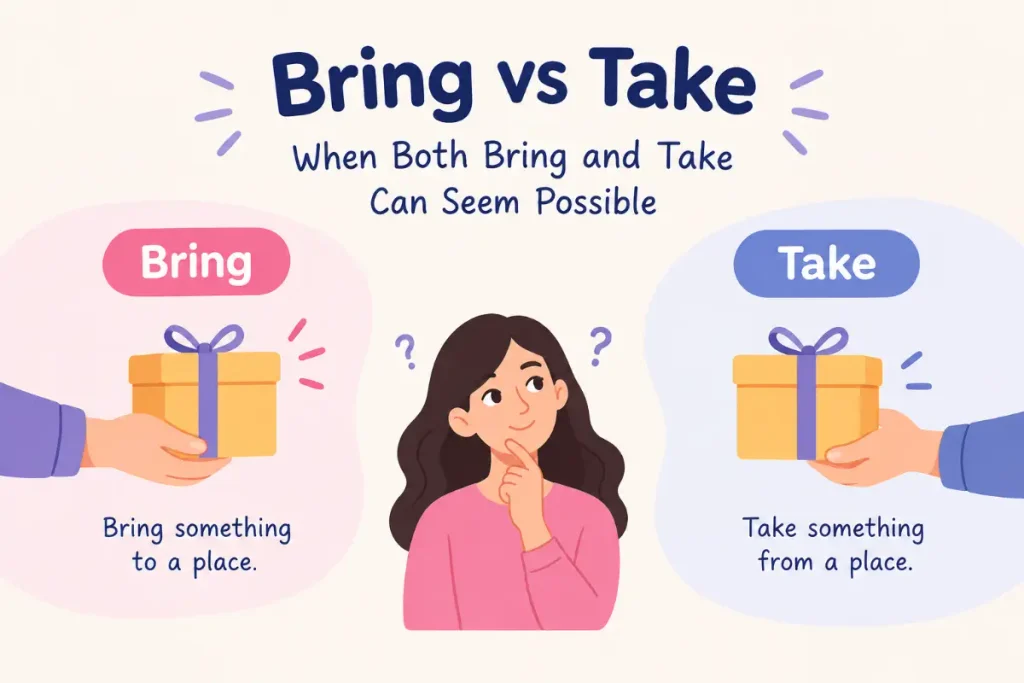
When Both Bring and Take Can Seem Possible
Some sentences can make both verbs seem possible because the speaker can frame the movement from different perspectives. The choice depends on the destination being treated as the point of reference.
Imagine someone is going to a friend’s house and asks, “Should I bring my laptop?” If the friend is at the house, bring is natural because the laptop is moving toward the friend.
Now imagine two people are at the office discussing the same person’s trip to that house. Someone might say, “He is going to take his laptop to John’s house.” The movement is described from the office as the starting point toward another destination.
The object has not changed. The person’s physical movement has not changed. What changes is the perspective used to describe the direction.
This is one reason advanced learners sometimes find bring and take confusing. The distinction depends on the speaker’s viewpoint and the conversational destination rather than on a fixed property of the action.
Common Mistakes With Bring and Take
One common mistake is using take when the destination is clearly the speaker’s current location.
Incorrect: “Take your homework to me after class.”
Correct: “Bring your homework to me after class.”
The homework is moving toward the speaker, so bring is the natural choice.
Another mistake is using bring for movement away from the current destination.
Incorrect: “Bring these files to the warehouse.”
Correct: “Take these files to the warehouse.”
This correction assumes the speaker and listener are currently somewhere other than the warehouse and the warehouse is simply the destination. If the speaker is at the warehouse and is telling someone to move the files toward that location, bring can become appropriate.
A third mistake happens when writers memorize a rigid rule such as “bring always means toward the speaker.” That shortcut works in many situations but does not cover every natural use. The destination can be the listener, a shared meeting place, a home, or another location that has become the focus of the conversation.
Incorrect Use of Bring and Take
Context is essential when correcting these verbs. A sentence that looks wrong in isolation may become correct when the surrounding situation changes.
Consider, “Can you bring the package to the warehouse?” If the speaker is currently at the warehouse, bring is completely natural. The package is moving toward the speaker’s location.
Now consider the same sentence when the speaker is at home and the listener is also at home. In that context, “Can you take the package to the warehouse?” is the natural choice because the package is leaving the current location for another destination.
This is why it is risky to correct bring and take without considering the situation. The safest approach is to identify the point of reference first. Then determine if the movement goes toward that point or away from it.
Bring vs Take Grammar With Come and Go
A helpful connection exists between bring and come, and between take and go. Bring often describes movement that corresponds to coming toward a relevant destination. Take often describes movement that corresponds to going somewhere else.
For example:
“Can you bring your notes when you come to my house?”
“Can you take these papers when you go to the office?”
The relationship is not an absolute grammatical rule, but it is a useful memory aid. If you naturally think of the movement as someone coming toward the destination, bring often fits. If you think of the movement as someone going away from the current point toward another place, take often fits.
This connection can make the verbs easier to remember for learners who already understand the difference between come and go.
Bring vs Take in Different Tenses
Both verbs follow ordinary English verb patterns, but their forms are worth remembering because the past tense of take is irregular.
The forms of bring are:
- Bring.
- Brings.
- Brought.
- Bringing.
The forms of take are:
- Take.
- Takes.
- Took.
- Taken.
- Taking.
For example, “Please bring your notes tomorrow” uses the base form. “She brought her notes yesterday” uses the past tense.
With take, “Please take your notes home” uses the base form, while “She took her notes home yesterday” uses the past tense. In perfect constructions, you use taken, as in “She has taken the documents to the office.”
Remembering these forms matters because some learners know the difference between bring and take but still confuse brought, took, and taken.
Bring vs Take With Objects and People
Both verbs can describe moving objects, people, animals, or things that are treated as destinations or companions. The grammatical structure is flexible.
With an object, you can say, “Bring your passport to the airport.” You can also say, “Take your passport to the airport.” The correct choice depends on the speaker’s point of reference and the situation.
With people, the same principle applies. “Bring your friend to my house” directs movement toward the speaker’s home. “Take your friend to the airport” directs movement away from the current location toward the airport.
With animals, you might say, “Bring the dog inside” when the dog needs to move toward the indoor location where the speaker is. You might say, “Take the dog outside” when the dog needs to move away from the indoor location.
American English Usage
Bring and take are standard in American English, and the basic distinction is also recognized across major varieties of English. There is no special American spelling that changes the meaning. The main challenge is understanding how speakers establish a point of reference.
British, Canadian, and Australian speakers also use bring and take according to direction and context. Small differences can appear in conversational habits, but the central distinction remains broadly consistent.
For US readers, the most useful approach is not to memorize regional exceptions. Instead, identify the destination and ask how the movement relates to the conversational focus. That method works naturally across everyday American English.
Formal and Casual Usage
Bring and take are ordinary everyday verbs. They are not especially formal or informal, so you can use them in casual conversation, professional emails, school assignments, customer communication, and academic writing.
The main difference between formal and casual writing comes from the surrounding vocabulary. In a workplace email, you might write, “Please bring the signed form to the meeting.” In a text message, you might write, “Can you bring the form?”
The verbs themselves do not need to be replaced with more complicated alternatives. In fact, simple verbs such as bring and take often make professional writing clearer. Choosing the correct one is more important than trying to sound sophisticated.
A Simple Test for Choosing the Right Verb
When you are unsure, pause and identify the destination. Ask yourself where the person or thing is moving and which location matters in the conversation.
If the movement is toward the speaker, listener, or established destination, bring usually works.
If the movement is away from the current point toward another destination, take usually works.
Try the test with this sentence: “Please ___ your resume to the interview.” If you are talking about the interview as the destination, bring is natural: “Please bring your resume to the interview.”
Now try this one: “Please ___ these files to the storage room.” If the storage room is another destination away from the current location, take is natural.
The key is perspective, not the object itself.
Bring vs Take Exercises
Try choosing bring or take in each sentence before checking the answers.
- Can you ___ your ID to the appointment?
- Please ___ these boxes to the garage.
- Should I ___ anything to the party?
- Please ___ your umbrella with you when you leave.
- Can you ___ your sister to my house?
- I need to ___ my car to the repair shop.
- Please ___ the report to my office.
- She will ___ the documents to the courthouse.
- Remember to ___ your jacket when you come over.
- Can you ___ these dishes to the kitchen?
The answers depend on the intended destination and point of reference. A natural set of answers in common contexts is:
- Bring.
- Take.
- Bring.
- Take.
- Bring.
- Take.
- Bring.
- Take.
- Bring.
- Take.
The exercise becomes much easier when you stop treating the verbs as synonyms for carry. Ask where the item is going in relation to the conversational point of reference.
Another useful word-choice comparison is “waive” versus “wave,” which shows why checking a word’s meaning and grammatical role matters.
Bring vs Take Quiz
Test yourself with these situations.
Question One
You are hosting dinner at your house and your friend is coming over. You ask, “Can you ___ some dessert?”
The answer is bring because the dessert is moving toward the place where you are hosting the dinner.
Question Two
You are at home and ask your son to deliver a package to the post office. You say, “Please ___ this package to the post office.”
The answer is take because the package is moving away from the current location toward the post office.
Question Three
You are at work and your manager asks you to move a file to her office. She says, “Please ___ the file to my office.”
The answer is bring because her office is the destination she has established as the point of reference.
Question Four
You are leaving your friend’s house and your friend asks you to deliver a book to the library. Your friend says, “Please ___ this book to the library.”
The answer is take because the book is leaving the friend’s location and going to another destination.
The best way to improve is to practice with real situations rather than memorize isolated sentences. Ask yourself who is speaking, where the relevant destination is, and where the object or person is moving.
Frequently Asked Questions
What is the difference between bring and take
Bring generally describes movement toward the speaker, listener, or another destination that is the focus of the conversation. Take generally describes movement away from that point toward another destination. You bring something to a meeting when the meeting is the relevant destination. You take something from your current location to another place.
Should I say bring or take someone somewhere
Use bring when you are describing movement toward the speaker, listener, or an established destination. Use take when describing movement away from the current point toward another place. You might say, “Bring your brother to my house,” but “Take your brother to the airport.” The destination and perspective determine the choice.
Can bring and take mean the same thing
They can describe the same physical movement from different perspectives. For example, a person traveling to a friend’s house could be described as bringing a laptop when the friend’s house is the conversational destination. Someone describing the same trip from another location might use take. The viewpoint changes the natural verb.
Is bring more common with come and take with go
Bring often pairs naturally with the idea of coming toward a destination, while take often pairs with the idea of going somewhere else. This is a useful memory aid rather than an absolute rule. For example, “Bring your notes when you come over” and “Take your notes when you go home” both sound natural.
What is the past tense of bring and take
The past tense of bring is brought. The past tense of take is took. For example, “She brought the documents to the meeting” and “She took the documents to the office.” The past participle of take is taken, as in “She has taken the documents to the manager.”
Why do people confuse bring and take
People confuse these verbs because both describe moving someone or something from one place to another. The difference depends on perspective and destination rather than the object being moved. The same item can be brought in one situation and taken in another. Context therefore matters more than memorizing a fixed list of objects.
Is bring or take correct in American English
Both are correct and common in American English. The correct choice depends on the direction of movement in context. Use bring for movement toward the relevant speaker, listener, or destination. Use take for movement away from that point toward another destination.
What is the easiest way to remember bring and take
Think about the destination first. If something is moving toward the place or person that matters in the conversation, use bring. If it is moving away from the current point toward another destination, use take. You can also connect bring with coming toward a place and take with going somewhere else.
Conclusion
The difference between bring vs take is mainly about direction and perspective. Bring describes movement toward the speaker, listener, or a destination that has become the focus of the conversation. Take describes movement away from the current point toward another destination.
The easiest way to choose correctly is to picture the movement before you write the sentence. Ask where the person or thing is going and identify the relevant point of reference. If the movement comes toward that point, bring is usually the natural choice. If it moves away from that point, take is usually the better choice. Once you start thinking about direction instead of simply memorizing the verbs, the distinction becomes much more intuitive.