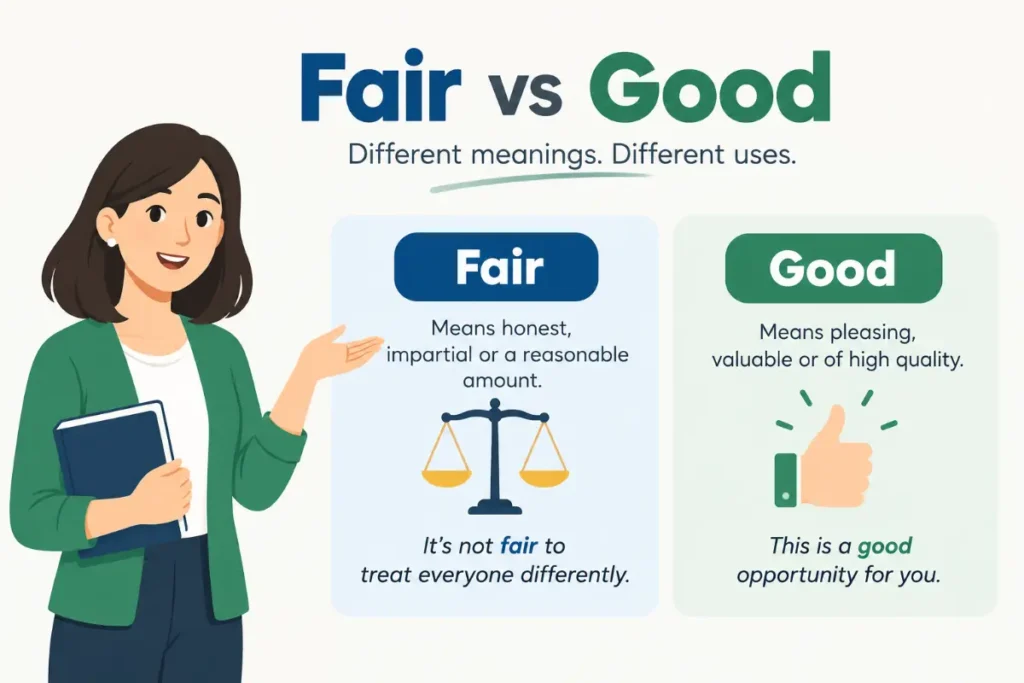
When you compare fair vs good, the difference can seem surprisingly small. Both words can describe quality, condition, performance, treatment, or an overall impression, but they do not carry the same level of approval. Fair usually means acceptable or average but not especially good. Good normally signals a clearly positive result or condition.
The exact meaning depends on the situation. A fair grade may mean a student performed adequately but still has room to improve. A good grade suggests stronger work. A used car in fair condition may be functional but show noticeable wear, while a car in good condition is generally better maintained and has fewer problems.
This distinction matters in everyday conversation, workplace communication, product descriptions, reviews, school evaluations, and real estate listings. The words can also express fairness or equal treatment, which gives fair a meaning that good does not have. Understanding the context helps you choose the right word instead of treating fair as simply a weaker version of good.
Quick Answer
Fair usually means acceptable, average, or reasonably satisfactory. Good means satisfactory to positive and generally better than fair. For condition ratings, fair often suggests noticeable wear or limitations, while good suggests solid condition with fewer concerns. Fair can also mean just or impartial, a meaning that good does not share.
Fair vs Good Meaning
The most useful way to understand the difference is to think of fair as a middle point and good as a stronger positive judgment. Fair often tells the reader that something meets a basic standard but does not stand out. Good usually tells the reader that something performs well or has desirable qualities.
For example, if a teacher says a student’s work is fair, the teacher may mean that the assignment meets some expectations but needs improvement. If the teacher calls the work good, the student has likely done a stronger job and met the expectations more successfully.
The words also differ in emotional tone. Fair can sound mildly positive, neutral, or even slightly disappointing depending on the context. Good usually sounds more clearly positive, although its exact strength depends on the speaker and situation.
Consider these examples.
- The restaurant was fair.
- The restaurant was good.
The first sentence suggests that the experience was acceptable but not impressive. The second gives a more favorable impression. Neither sentence tells us exactly what the speaker liked or disliked, but good generally leaves the reader with a better overall impression.
Just as understanding fair and good depends on context, knowing the difference between bring vs take can help you choose the right word in everyday communication.
What Fair Means
Fair has several important meanings in American English. In quality ratings, it usually means acceptable but below good. In discussions about people and behavior, it can mean just, reasonable, or impartial. It can also refer to a public event or exhibition, such as a county fair or state fair.
When fair describes quality or condition, it often sits somewhere around the middle of a rating scale. Imagine a simple range from poor to fair to good to excellent. Fair would indicate that something has some positive qualities but also noticeable limitations.
For example, a person might say, “The apartment is in fair condition.” That statement does not necessarily mean the apartment is unsafe or unusable. It suggests that the apartment works for its purpose but may have visible wear, older features, minor problems, or other issues that keep it from receiving a higher rating.
Fair can also describe performance. If someone says, “She did fair on the exam,” that usage is common in some forms of everyday speech, but did fairly well is generally more natural in careful American English. When fair functions as an adjective, however, sentences such as “She received a fair score” are completely standard.
Fair As A Quality Rating
When fair describes quality, condition, or performance, it usually signals an acceptable level that falls short of good. It can be useful when you want to give an honest assessment without calling something poor.
For example, a used sofa might be described as being in fair condition because it remains usable but has stains, scratches, worn fabric, or other visible signs of age. A book with a damaged cover but readable pages might also receive a fair condition rating.
Fair is therefore a flexible rating word. It does not always mean bad. Instead, it often tells the reader that something has meaningful limitations.
What Good Means
Good is one of the most common positive adjectives in American English. It can describe quality, performance, condition, behavior, taste, skill, health, or overall satisfaction. Its meaning changes slightly with context, but it generally expresses approval or a favorable judgment.
If someone says, “The movie was good,” they are giving the movie a positive evaluation. The statement is not as strong as excellent or outstanding, but it clearly communicates approval.
Good can also describe condition. A used laptop in good condition is generally expected to function properly and show relatively limited signs of wear. A good condition rating usually creates a more favorable impression than a fair condition rating.
The word is also useful in professional and academic settings. You can describe a good proposal, good performance, good results, good communication, or good progress. Because good is so common, it often sounds natural and direct rather than overly formal.
The Main Difference Between Fair And Good
The central difference is degree of quality. Fair usually indicates an acceptable or average level, while good normally indicates a clearly satisfactory or positive level.
Think of a simple scale:
| Rating | General meaning |
|---|---|
| Poor | Below an acceptable standard |
| Fair | Acceptable but limited or average |
| Good | Solid and satisfactory |
| Very good | Strong and clearly above average |
| Excellent | Outstanding or exceptionally strong |
This scale is not universal. Different companies, schools, websites, and rating systems may define these labels differently. Still, the general relationship between fair and good remains useful.
If a seller describes a used phone as being in fair condition, you should expect more wear than you would from a phone described as being in good condition. If a manager says an employee’s performance is fair, the employee may be meeting some expectations but still needs improvement. If the manager says the performance is good, the assessment is more favorable.
Fair vs Good vs Good Condition
The phrase good condition deserves special attention because condition ratings are common in product listings, vehicles, real estate, furniture sales, and online marketplaces.
When something is in fair condition, it is generally usable but has noticeable signs of wear or some limitations. The item may still perform its basic function, but the buyer should expect imperfections.
When something is in good condition, it is generally well maintained and functional, with fewer visible problems. It may have some ordinary signs of use, but they are usually less significant than those associated with fair condition.
For example, imagine two used bicycles. A bicycle in fair condition might have scratched paint, worn tires, surface rust, and components that need adjustment. A bicycle in good condition might show normal use but have working brakes, solid tires, a clean frame, and properly functioning gears.
The difference is not always dramatic. A seller should describe the actual condition rather than assuming every marketplace uses the same rating scale. When buying something, look beyond the single rating and read the detailed description.
English has many commonly confused word pairs, so paying attention to meaning and context is essential for precise writing.
Fair vs Good In Clothing
The distinction becomes especially useful when describing used clothing. A clothing item in fair condition may have noticeable fading, stains, loose stitching, small holes, worn fabric, or other visible imperfections.
Clothing in good condition generally has been used but remains presentable and functional. It may have minor signs of wear, but the problems should not significantly affect its appearance or usefulness.
For example, a vintage jacket with noticeable fading and a small repaired tear might reasonably be described as being in fair condition. A vintage jacket with light signs of use, intact stitching, and no major stains could be described as being in good condition.
For online clothing listings, precise descriptions are better than relying on the rating alone. Instead of writing only “good condition,” explain the actual wear. That gives buyers a clearer picture and makes the description more trustworthy.
Fair vs Good Examples
The easiest way to understand the difference is to see the words used in different situations. The same rating can feel slightly different depending on the subject.
Examples With Fair
- The hotel room was fair but needed some repairs.
- She received a fair score on the first exam.
- The used car is in fair condition.
- His performance was fair but could improve.
- The restaurant received a fair review from local customers.
- The jacket is in fair condition and shows noticeable wear.
- The apartment is in fair shape for its age.
- The team’s first half performance was fair.
- The laptop works well enough, but I would rate its condition as fair.
- The book is in fair condition with some damage to the cover.
These examples show that fair often communicates adequacy without strong praise. It can be honest and useful when something meets a basic standard but has limitations.
Examples With Good
- The hotel room was good and comfortably furnished.
- She received a good score on the first exam.
- The used car is in good condition.
- His performance was good throughout the project.
- The restaurant received a good review from local customers.
- The jacket is in good condition with only minor signs of wear.
- The apartment is in good shape for its age.
- The team’s second half performance was good.
- The laptop is in good condition and works properly.
- The book is in good condition with only light wear.
The difference is clear when the examples are placed side by side. Fair leaves more room for concerns or limitations. Good communicates a stronger overall assessment.
Fair vs Good In Everyday Conversation
In casual American conversation, both words are extremely common. The choice depends on how positive you want the statement to sound.
If someone asks, “How was the movie?” and you answer, “It was fair,” the listener may assume you did not enjoy it very much. You probably found it acceptable but not memorable. If you answer, “It was good,” the listener will generally understand that you enjoyed it.
This is one reason fair can sometimes sound more negative than its dictionary meaning suggests. Technically, fair can mean acceptable or reasonable. In conversation, however, saying something was fair may imply that it was merely adequate.
Consider this exchange.
“How was your dinner?”
“It was fair.”
The response sounds lukewarm.
“How was your dinner?”
“It was good.”
The response sounds clearly positive.
That difference in tone matters. The dictionary meaning gives you the basic definition, but real communication also depends on implication and context.
Fair Can Mean Just Or Reasonable
One major reason fair cannot simply be treated as a weaker synonym for good is that it has another important meaning. Fair can describe something that is just, impartial, or reasonable.
For example:
- The judge gave both sides a fair opportunity to speak.
- The manager made a fair decision.
- The company offers fair prices.
- Every student deserves fair treatment.
In these sentences, replacing fair with good would change the meaning. A good decision can be a decision that produces a favorable result. A fair decision is one that treats people reasonably or impartially.
This distinction is essential in workplace communication, legal contexts, education, relationships, and public discussions. Fair can describe the way people are treated, the way rules are applied, or the reasonableness of an arrangement.
Fair And Good Are Not Always Opposites
It is tempting to treat fair and good as opposites, but they are not. Bad is generally closer to the opposite of good. Unfair is the opposite of fair when fair means just or impartial.
For quality ratings, fair and good can occupy different points on a scale. Something can move from fair to good as its condition or performance improves. But fair can also express fairness rather than quality, and that meaning has nothing to do with the good versus bad scale.
For example, “The price is fair” means the price seems reasonable. “The price is good” could mean the price is attractive or favorable to the buyer. Those statements overlap in some contexts, but they do not communicate exactly the same idea.
Likewise, “She received fair treatment” means she was treated justly. “She received good treatment” suggests that the treatment was positive or satisfactory. The second sentence does not necessarily communicate impartiality.
Fair vs Good Synonyms
The best synonym depends on the meaning of fair or good in the sentence.
When fair means acceptable or average, useful alternatives include adequate, reasonable, satisfactory, moderate, acceptable, and average. These words are not perfect substitutes in every context. Adequate can sound less positive, while reasonable often emphasizes practicality or fairness.
When fair means just or impartial, useful alternatives include equitable, impartial, just, reasonable, and unbiased. In these contexts, good is not a direct synonym.
For good, useful alternatives include satisfactory, positive, favorable, effective, solid, enjoyable, worthwhile, and strong. The right option depends heavily on what you are describing.
For example, “a good solution” might become “an effective solution.” “A good movie” might become “an enjoyable movie.” “A fair price” might become “a reasonable price.” Replacing words with precise synonyms often makes writing clearer.
Fair vs Good vs Excellent
Many rating systems use several levels of quality, and excellent usually sits above good.
A simple progression is fair, good, very good, and excellent. Fair indicates an acceptable but limited result. Good indicates a solid positive result. Excellent indicates an exceptionally high level of quality or performance.
For example, consider a restaurant review. A fair restaurant may serve acceptable food but have slow service or an uncomfortable atmosphere. A good restaurant generally provides a satisfying overall experience. An excellent restaurant stands out because several aspects of the experience are especially strong.
The same progression can describe schoolwork. Fair work may meet some requirements but contain weaknesses. Good work meets expectations at a solid level. Excellent work goes beyond basic expectations and demonstrates a particularly high level of quality.
These ratings are descriptive rather than mathematical. A company may define its rating categories differently, so always check the specific criteria when a formal rating system is involved.
Fair And Good In Professional Writing
Professional writing benefits from precision. If you describe an employee’s performance as fair, readers may understand that the employee is meeting some expectations but has noticeable areas for improvement. If you describe the same performance as good, readers will likely interpret the assessment as clearly positive.
This difference can matter in performance reviews, recommendation letters, customer feedback, product evaluations, and internal reports. A manager should avoid vague praise when a more specific description is available.
For example, instead of writing, “Your communication is fair,” a manager could explain the actual issue. “Your communication is generally clear, but project updates need to be more consistent.” That sentence gives the employee something useful to act on.
Similarly, a customer service representative could say, “We received good feedback about the new process.” If the feedback was mixed, “The process received fair feedback” might sound vague. Specific details make the evaluation more credible.
Fair And Good In School
Teachers often use quality words such as fair, good, very good, and excellent to communicate performance. The exact meaning depends on the grading system and the teacher’s standards.
If a teacher says an essay is fair, the student may have addressed the main assignment but still have problems with organization, evidence, grammar, clarity, or depth. If the essay is described as good, the student has likely handled the major requirements successfully.
Students should also pay attention to the difference between a fair grade and a good grade. A fair grade means the grade is reasonable or justified. A good grade means the grade is favorable.
That creates an interesting distinction. A student might say, “I got a fair grade,” meaning the grade accurately reflects the quality of the work. The student might say, “I got a good grade,” meaning the grade was favorable. The two statements are not interchangeable.
Fair And Good In Product Listings
Product descriptions often use fair and good to summarize condition. These labels are useful, but they should not replace specific information about the item.
A fair condition phone may have scratches, dents, battery wear, or cosmetic damage while still functioning. A good condition phone may have ordinary signs of use but remain in stronger overall shape.
When writing a listing, avoid using good as a vague sales word if the product has significant defects. Describe the actual condition honestly. A clear description might say, “The laptop is in fair condition with scratches on the lid. The keyboard and display work properly.”
That approach is better than simply saying, “Good laptop.” Buyers need information about both strengths and limitations. Clear descriptions also reduce misunderstandings.
Common Mistakes With Fair And Good
One common mistake is assuming that fair always means bad. It does not. Fair often means acceptable, average, or reasonably satisfactory, although its tone can sound lukewarm in conversation.
Another mistake is assuming that good always means excellent. Good is positive, but it does not necessarily mean outstanding. If something is exceptional, words such as excellent, outstanding, exceptional, or superb may communicate the level more accurately.
A third mistake involves the fairness meaning of fair. Consider the sentence, “The company offered a fair price.” This usually means the price was reasonable. Saying “The company offered a good price” changes the emphasis and may suggest that the price was favorable or inexpensive.
A final mistake is treating rating labels as universal standards. A marketplace may define fair condition differently from another marketplace. Always check the specific rating criteria when making an important purchase or evaluation.
How Native Speakers Interpret The Difference
Context does a lot of work with these words. If someone says a movie was fair, an American listener will usually understand that the movie was not particularly impressive. If someone says the movie was good, the listener will generally hear a positive recommendation.
The same pattern appears with food, service, schoolwork, and products. Fair often creates a middle of the road impression, while good gives a more favorable impression.
Still, the meaning can change when fair refers to treatment or judgment. “The decision was fair” is generally positive because it means the decision was just or reasonable. “The decision was good” is broader and may refer to the quality or outcome of the decision.
That is why context matters more than simply memorizing a ranking. The word fair has several meanings, and good has an unusually broad range of uses.
Which Word Should You Use
Choose fair when something is acceptable, average, moderate, or reasonably satisfactory but has limitations. Choose good when something meets expectations at a clearly positive level. If you mean just or impartial, use fair rather than good.
For condition ratings, fair generally suggests more wear or limitations than good. For performance, fair often suggests that improvement is needed, while good indicates solid performance. For prices and treatment, fair can mean reasonable or just, which is a separate meaning from a quality rating.
When you are unsure, ask yourself what you are trying to communicate. If you are saying something is acceptable but not especially strong, fair may be right. If you are giving a clearly positive assessment, good is usually the safer choice.
If you’re building your vocabulary, prescribe and proscribe explained is another useful example of how similar-looking words can have very different meanings.
Frequently Asked Questions
What is the difference between fair and good
Fair usually means acceptable, average, or reasonably satisfactory, while good usually means clearly satisfactory or positive. In condition ratings, fair often indicates more wear or limitations than good. Fair also has a separate meaning of just or impartial, such as in “a fair decision.” Good does not carry that same meaning.
Is fair better than good
No. When fair and good describe quality or condition, good generally represents a higher level than fair. Fair usually means something is acceptable but has noticeable limitations. Good suggests stronger quality or condition. The exact scale can vary between companies and rating systems, so formal criteria should always be checked.
What does fair mean in condition ratings
Fair condition usually means an item remains usable but has noticeable wear, imperfections, or limitations. A used car in fair condition may have cosmetic damage or require some maintenance. A product described as good condition would generally be expected to have fewer significant issues and less noticeable wear.
Is fair a positive or negative word
Fair can be positive, neutral, or mildly negative depending on context. When it means just or reasonable, it is clearly positive. When it rates quality, it often means acceptable but not impressive. Saying that a movie was fair may sound lukewarm, while saying that a judge made a fair decision usually expresses approval.
Is good better than fair in clothing descriptions
Generally, yes. In used clothing descriptions, good condition usually indicates less wear and fewer visible flaws than fair condition. Clothing in fair condition may have noticeable fading, stains, repairs, loose stitching, or other imperfections. Sellers should describe specific defects instead of relying only on a condition label.
Is fair the same as average
Not always, but the meanings can overlap. Fair can describe something that is acceptable but below a stronger level of quality. Average describes something that is around the middle of a group or scale. A fair rating may reflect average performance, but the two words are not interchangeable in every context.
Is fair a synonym for good
Fair can overlap with good when both describe something acceptable or satisfactory, but they are not exact synonyms. Good usually communicates a stronger positive judgment. Fair can also mean just, impartial, or reasonable, which gives it meanings that good does not share.
Is fair better than poor
Generally, yes. When fair is used as a quality rating, it normally sits above poor because it suggests that something is still acceptable or usable. Poor indicates a lower level of quality or performance. A common informal scale might place poor below fair, followed by good and then excellent.
Conclusion
The difference between fair vs good comes down to degree and context. When fair describes quality or condition, it usually means acceptable, average, or satisfactory with noticeable limitations. Good generally communicates a stronger and more favorable assessment. In condition ratings, something in fair condition usually has more wear or problems than something in good condition.
Remember that fair has another major meaning. It can describe something just, impartial, or reasonable, as in a fair price or fair treatment. Good can sometimes overlap with fair in everyday language, but it does not carry that same idea of fairness. For clear American English, choose the word that matches the exact meaning you want your reader or listener to understand.