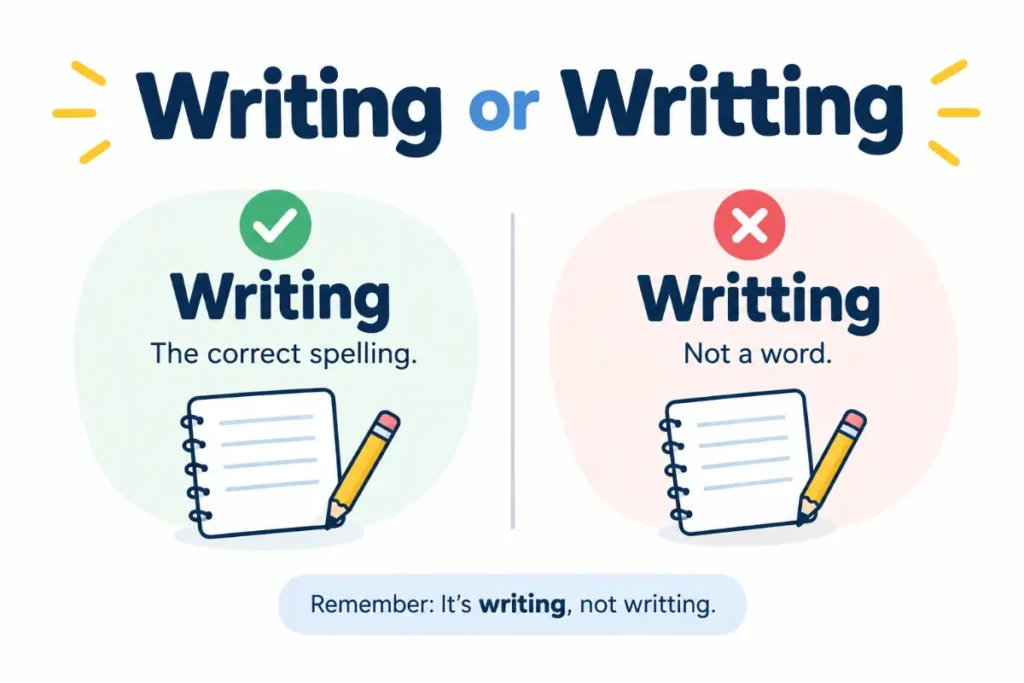
If you have ever wondered about writing or writting, the correct spelling is writing, with one T. Writting is a common spelling mistake, but it is not the standard spelling in American English. You might write a school essay, send a professional email, publish a blog post, or write a quick text message, but the spelling stays the same in every situation.
The confusion usually comes from the way English verbs change when we add endings. Many short verbs double their final consonant before adding ing, so writers sometimes assume that write follows the same pattern. However, write already ends in a silent E, and that E is dropped before adding ing. The result is writing, not writting.
Understanding this simple rule helps you avoid the mistake and recognize similar patterns in other English words. It also helps you distinguish writing from related forms such as write, writes, wrote, and written. Below, you will find clear spelling rules, practical sentence examples, common mistakes, pronunciation guidance, and explanations of how to use the word naturally in everyday conversation, school assignments, and professional communication.
Quick Answer
Writing is the correct spelling. Writting is incorrect in standard American English. The word comes from the verb write, which drops its final silent E before the ending ing is added. For example, you should write, “I am writing an email,” not “I am writting an email.”
Writing vs Writting Meaning and Spelling
The difference between these two forms is straightforward. Writing is a correctly spelled English word that can refer to the act of putting words on paper or a screen, the material someone has written, or the skill of expressing ideas through words. Writting is a misspelling of writing and should not appear in standard school, workplace, or published writing.
| Feature | Writing | Writting |
|---|---|---|
| Correct spelling | Yes | No |
| Part of speech | Noun or verb form | Incorrect spelling |
| Base verb | Write | Intended to be write |
| Meaning | The act or result of composing words | No standard meaning |
| American English usage | Standard | Nonstandard misspelling |
| Example | I am writing a report. | I am writting a report. |
The extra T in writting does not change the meaning because writting is not a separate standard English word. Readers will usually understand what you intended, but the error can make an otherwise polished message look careless. In academic assignments, job applications, business emails, and website content, always use writing.
Improving your writing skills involves more than correct spelling; understanding commonly confused expressions can also help you communicate dates and deadlines more clearly.
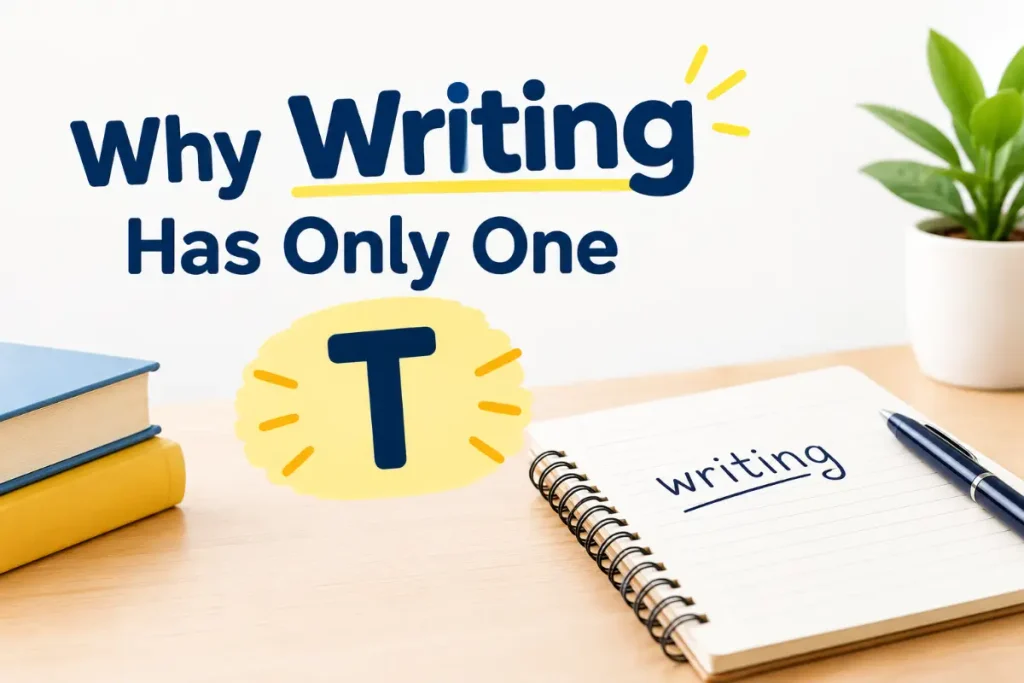
Why Writing Has Only One T
The correct spelling becomes easier to understand when you look at the base verb. The word write ends in a silent E, so you remove that E before adding ing. This gives you writ plus ing, which forms writing.
The spelling rule is different from the pattern used with some short verbs that double their final consonant. For example, run becomes running, sit becomes sitting, and stop becomes stopping. Writers sometimes apply that pattern to write and mistakenly produce writting, but the silent E changes the spelling process.
Here is the correct pattern.
1. Write becomes writing.
2. Make becomes making.
3. Take becomes taking.
4. Drive becomes driving.
5. Smile becomes smiling.
Notice that each base verb ends in a silent E. When you add ing, you remove the E instead of doubling the final consonant. The same rule explains why writing has one T rather than two.
What Does Writing Mean
Writing has several related meanings, and the intended meaning depends on the sentence. Most commonly, it refers to the activity of expressing thoughts, information, stories, or instructions through written language. It can also refer to a piece of written work or the general skill of communicating through words.
For example, “I enjoy writing” describes the activity. “Her writing is clear and engaging” refers to the quality or style of her work. “I finished the writing for my presentation” refers to the material she prepared.
Writing can cover many forms of communication, including essays, articles, books, reports, letters, emails, notes, captions, and text messages. It does not have to be formal or creative. Even a short message to a friend counts as writing because it communicates information through written words.
Writing as an Activity
When writing describes an activity, it refers to the process of creating written content. The activity might involve planning, drafting, revising, editing, or polishing a message. It can happen at school, at work, at home, or anywhere someone needs to communicate through text.
Consider these examples.
1. I am writing a research paper for my history class.
2. She spends thirty minutes writing in her journal every morning.
3. My brother is writing a thank you note to his teacher.
4. We practiced writing clear instructions for the science project.
5. He enjoys writing short stories in his free time.
In these sentences, writing describes an action or activity rather than a finished document.
Writing as a Skill or Type of Work
Writing can also describe someone’s ability to express ideas clearly. When a teacher says that a student’s writing has improved, the teacher is referring to the student’s overall skill. Similarly, a manager may praise an employee’s writing because reports and emails are easy to understand.
For example, “Good writing helps customers understand complicated information.” Here, writing refers to a communication skill. In “Her writing combines humor with practical advice,” the word refers to the style and quality of the work she produces.
The meaning can also refer to a specific written piece or material. A sentence such as “The writing on the sign was difficult to read” refers to the words or lettering displayed on the sign. Context makes the intended meaning clear.
Writing or Writting Grammar
The spelling rule is only one part of using writing correctly. You also need to understand how the word functions in a sentence. Writing is the ing form of the verb write, but it can serve different grammatical roles depending on how you use it.
When it follows a form of the verb be, writing commonly appears in a continuous verb tense. For example, “I am writing a letter” describes an action in progress. The same form can function as a noun, as in “Writing takes practice.”
Writing in Continuous Tenses
The present continuous tense uses a form of be followed by a verb ending in ing. It describes an action that is happening now or around the current period.
Examples include:
1. I am writing an email to my supervisor.
2. She is writing a new chapter for her book.
3. They are writing their final exam essays.
4. We were writing notes when the teacher entered the room.
5. He will be writing the report tomorrow morning.
In each example, writing is part of a verb phrase. The form of be changes according to the tense and subject, but the spelling of writing remains the same.
Writing as a Gerund
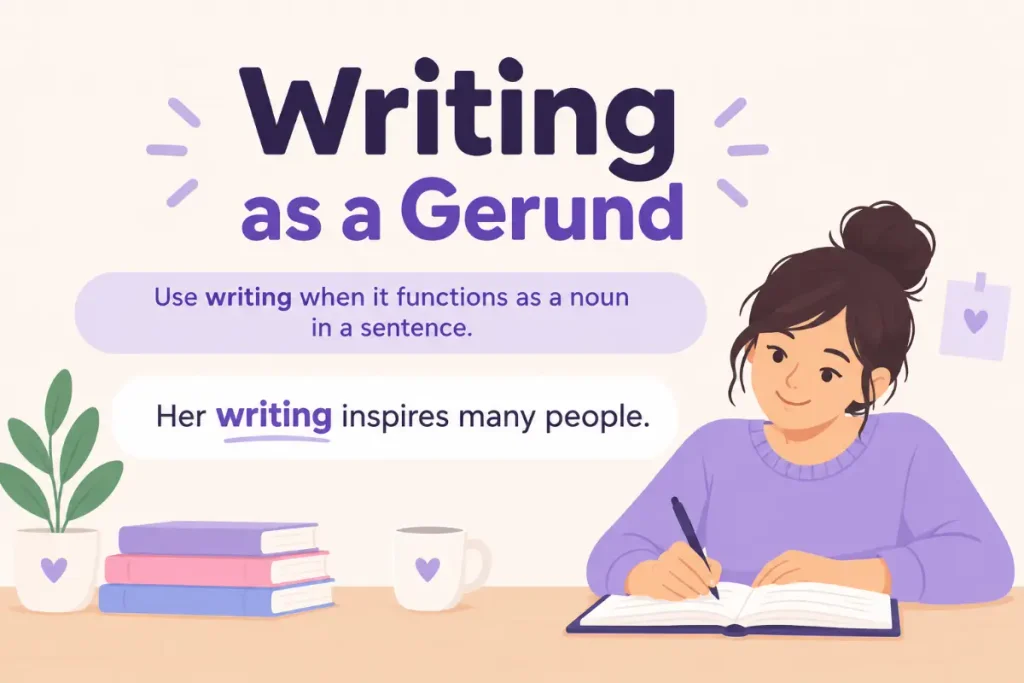
A gerund is a verb form ending in ing that functions as a noun. The word writing can fill this role when it names an activity rather than describing an action in progress.
For example, “Writing helps me organize my thoughts” uses writing as the subject of the sentence. In “She enjoys writing,” the word acts as the object of the verb enjoys. The spelling remains writing in both cases.
You can recognize this use by asking if the word names an activity. If it does, writing may be functioning as a gerund. You do not need to memorize the technical term to use it correctly, but understanding the pattern can help you build more natural sentences.
Writing as a Noun
Writing can also refer to written material or someone’s style. In “The writing on the wall was faded,” the word refers to visible words or marks. In “His writing is easy to follow,” it refers to the quality or style of his written communication.
The noun writing is generally uncountable when it refers to the activity or skill. You would normally say, “Writing takes patience,” rather than “A writing takes patience.” However, you can use expressions such as a piece of writing or several writing assignments when referring to individual works or tasks.
Along with learning the correct spelling of writing, avoiding common spelling and grammar mistakes can make your written communication more accurate and professional.
Writing in English Examples
The best way to remember the correct spelling is to see it in everyday sentences. Writing appears in casual conversation, classroom assignments, business communication, creative work, and online publishing. The spelling does not change between these contexts.
Everyday Conversation Examples
1. I am writing a grocery list before heading to the store.
2. Are you writing a birthday card for Mom?
3. She loves writing about her weekend adventures.
4. I was writing down the address when my phone rang.
5. He is writing a message to his friend.
These examples show how naturally the word fits into ordinary conversation. It can describe a simple daily task or a personal hobby.
School and Academic Examples
1. The students are writing essays about American history.
2. I need more practice writing introductions for research papers.
3. Her writing improved after she started revising each draft.
4. The teacher asked us to spend twenty minutes writing about the assigned topic.
5. He is writing a report on renewable energy for his science class.
In academic settings, writing can refer to both the activity and the final work. Students may practice writing, submit a piece of writing, or receive feedback on their writing skills.
Workplace and Professional Examples
1. I am writing an email to confirm the meeting time.
2. She is writing the first draft of the project proposal.
3. Our team is writing instructions for the new software.
4. He improved his professional writing by using shorter sentences.
5. The manager is writing a summary of the quarterly results.
Professional writing benefits from correct spelling because even a small error can distract readers from the message. Using writing correctly helps keep emails, reports, proposals, and other documents clear and credible.
Creative and Online Writing Examples
1. She is writing a mystery novel set in Chicago.
2. I enjoy writing captions for our travel photos.
3. The blogger spends each weekend writing new articles.
4. He started writing short stories when he was in high school.
5. They are writing scripts for a series of educational videos.
Writing covers many creative formats, from novels and poems to website articles and social media posts. Regardless of the format, the correct spelling is always writing.
I Am Writing or Writting
The correct phrase is I am writing. The phrase uses the present continuous tense, which describes an action happening now or during the current period. Writting is a spelling mistake, so it should never replace writing in this sentence.
For example, you might text a friend, “I am writing my assignment now.” You could also say, “I am writing an email to the customer,” in a workplace conversation. In both cases, the sentence follows the same grammatical pattern: subject plus am plus the ing form of the verb.
The same spelling applies to other subjects.
1. I am writing a letter.
2. You are writing a report.
3. He is writing a book.
4. She is writing a note.
5. We are writing a proposal.
6. They are writing a blog post.
The form of be changes to match the subject, but writing does not change. This is a useful rule to remember when composing emails, messages, assignments, or other everyday text.
Writing or Written
Written and writing both come from the verb write, but they serve different purposes. Writing is the ing form, which commonly describes an action in progress or names the activity of composing text. Written is the past participle, which appears in perfect tenses and passive constructions.
Compare these sentences: “I am writing a letter” and “I have written a letter.” The first sentence describes an action in progress. The second indicates that the letter has been written, with attention to the completed result.
Written also appears in passive sentences. For example, “The report was written by the manager” focuses on the report and identifies who created it. You would not replace written with writing in that sentence without changing the grammatical structure.
| Form | Main use | Example |
|---|---|---|
| Write | Base verb | I write every day. |
| Writes | Present tense with he, she, or it | She writes clearly. |
| Writing | Ing form or noun | I am writing a letter. |
| Wrote | Simple past tense | He wrote a report yesterday. |
| Written | Past participle | I have written three pages. |
Learning these forms together makes it easier to use the verb naturally. It also helps prevent confusion between spelling errors and legitimate grammatical forms.
Common Mistakes to Avoid
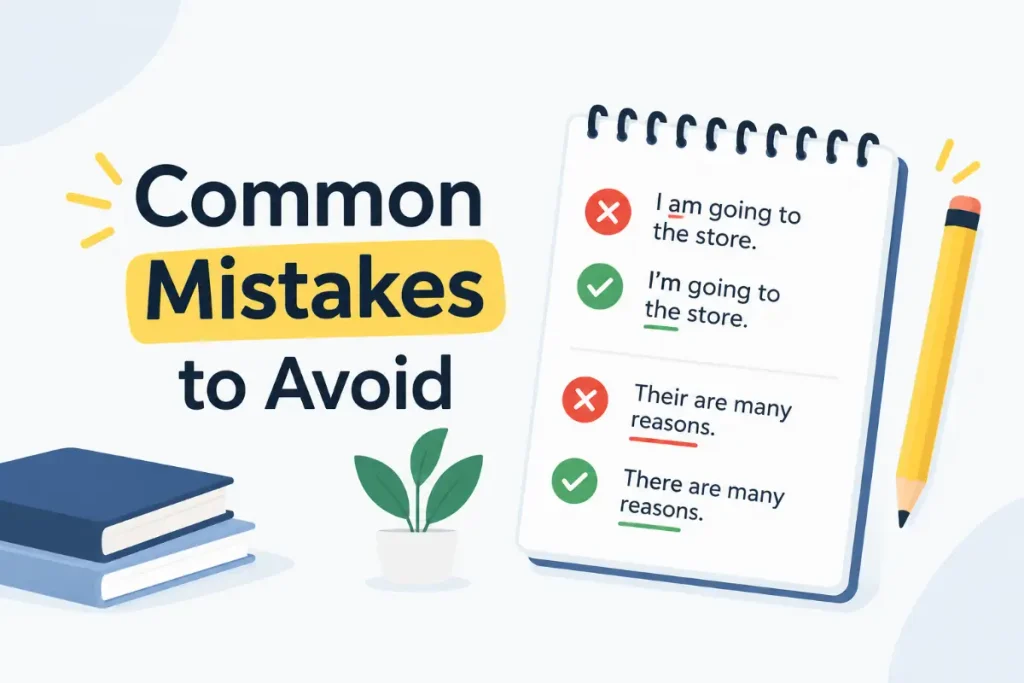
The most obvious mistake is adding an extra T to writing. However, writers sometimes make other errors because they confuse spelling rules, verb forms, or sentence structure. Checking the role of the word in the sentence can help you catch these problems.
Here are common errors and their corrections.
1. Incorrect: I am writting a report. Correct: I am writing a report. The silent E in write is removed before adding ing.
2. Incorrect: She is writeing a letter. Correct: She is writing a letter. The final E is dropped rather than retained.
3. Incorrect: I have writing the email. Correct: I have written the email. The present perfect tense requires have or has followed by the past participle written.
4. Incorrect: He writing a new article every week. Correct: He writes a new article every week. A simple present sentence needs the appropriate verb form.
5. Incorrect: They was writing the report. Correct: They were writing the report. The form of be must agree with the plural subject they.
Spellcheckers may catch writting, but they cannot always identify every grammatical problem. A sentence can contain correctly spelled words and still be grammatically wrong. Reading the complete sentence aloud or checking the verb pattern can help you identify mistakes that a spelling checker misses.
Writing Styles and Their Uses
Writing is not limited to one style or purpose. Different situations call for different ways of organizing ideas, choosing words, and addressing readers. Understanding the main writing styles can help you decide how to approach a school assignment, professional email, personal message, or creative project.
Narrative Writing
Narrative writing tells a story or describes a sequence of events. It often includes characters, a setting, and a clear progression from one event to another. Novels, short stories, memoirs, and personal anecdotes commonly use this style.
For example, a student writing about a memorable family vacation might describe what happened, where the family went, and how the experience changed their perspective. The purpose is to engage readers through events and experiences.
Descriptive Writing
Descriptive writing helps readers imagine a person, place, object, or experience. It uses specific details to create a clear picture. A travel article might describe a quiet beach, a crowded city street, or the colors of a sunset.
The goal is not simply to list facts. It is to help readers understand what something looks, sounds, feels, smells, or tastes like when those details are relevant.
Expository Writing
Expository writing explains a topic or provides information. It often appears in textbooks, school essays, workplace reports, instructions, and informational articles. The focus is on helping readers understand a subject clearly.
For example, an article explaining how solar panels generate electricity uses expository writing. The writer organizes information logically and explains the process without relying on a fictional story.
Persuasive Writing
Persuasive writing aims to convince readers to accept an argument or take a particular action. It uses reasons, evidence, examples, and sometimes emotional appeals to support a position. Opinion essays, advocacy letters, and many editorial articles use this style.
Effective persuasive writing addresses the reader’s likely concerns and explains why the argument deserves consideration. Strong claims need clear support rather than exaggerated language.
Creative and Professional Writing
Creative writing includes fiction, poetry, scripts, and other work that emphasizes imagination, voice, or artistic expression. Professional writing serves practical purposes, such as explaining a process, sharing information, proposing an idea, or documenting a decision.
The styles can overlap. A professional blog post might explain a subject using expository writing while including a brief story to make the information more engaging. The best approach depends on the audience and the goal.
How to Improve Your Writing
Correct spelling is an important starting point, but clear writing also depends on organization, word choice, grammar, and revision. You do not need complicated vocabulary to communicate effectively. Most readers appreciate writing that makes the main point clear and gives them enough information to understand it.
Start by identifying your purpose and audience. A message to a friend can sound relaxed, while a formal email may need a more professional tone. Once you know what the reader needs, organize your ideas in a logical order and use words that communicate your meaning directly.
After drafting, review the text for spelling and grammar. Look for repeated words, unclear sentences, missing information, and unnecessary details. Reading the text aloud can help you notice awkward phrasing and sentences that are difficult to follow.
Finally, use spelling and grammar tools as aids rather than substitutes for careful editing. Automated tools can identify many mistakes, but they may miss errors that depend on context. Building a habit of reviewing your own work will help you become a more confident writer over time.
If you want to strengthen your spelling skills, learning the correct spelling of commonly misspelled words is a practical way to avoid errors and improve the quality of your writing.
Frequently Asked Questions
Is writing or writting correct
Writing is correct, while writting is a misspelling. The verb write drops its final silent E before the ending ing is added. This produces writing with one T. Use the correct form in schoolwork, professional communication, social media posts, emails, and everyday messages.
Why is writing spelled with one T
Writing has one T because the base verb write ends in a silent E. When you add ing, you remove the E instead of doubling the final consonant. This differs from verbs such as run and sit, which become running and sitting. The spelling follows the standard pattern for verbs ending in a silent E.
Is writting ever correct in English
Writting is not a standard English spelling of the verb form writing. It may appear in typing mistakes, informal online posts, or other text containing spelling errors, but it should not be used in edited writing. If you mean the activity of composing words or the ing form of write, use writing.
How do you spell writing correctly
The correct spelling is W R I T I N G. Start with write, remove the final E, and add ing. Remembering the base verb is an easy way to avoid adding an extra T. The same spelling applies in American, British, Canadian, and Australian English.
Is writing a noun or a verb
Writing can function as either a noun or a verb form. In “I am writing a letter,” it is part of the verb phrase. In “Writing takes practice,” it names an activity and functions as a noun. The sentence structure determines its grammatical role.
What is the difference between writing and written
Writing is the ing form of write and can describe an ongoing action or name the activity. Written is the past participle used in constructions such as “I have written a letter” and “The report was written yesterday.” They come from the same verb but cannot be substituted freely.
Is writing an American or British spelling
Writing is the standard spelling in American and British English, as well as Canadian and Australian English. There is no regional spelling difference between writing and writting. The form with two Ts is a misspelling rather than an accepted variation.
What is an example of writing in a sentence
An example is, “I am writing a report for my history class.” In this sentence, writing describes an action that is currently in progress. Another example is, “Writing helps students organize their ideas,” where writing names an activity. Both sentences use the same correct spelling.
Conclusion
The correct spelling is writing, not writting. The word comes from write, which drops its final silent E before adding ing. This spelling rule also explains forms such as making, taking, and driving, so learning the pattern can help you avoid similar errors.
Writing can describe an ongoing action, the activity of composing words, or the written material someone produces. Its grammatical role depends on the sentence, but the spelling remains the same. When you are unsure, return to the base verb write and remember to remove the final E before adding ing. This simple check will help you write more accurately in school assignments, emails, professional documents, and everyday communication.