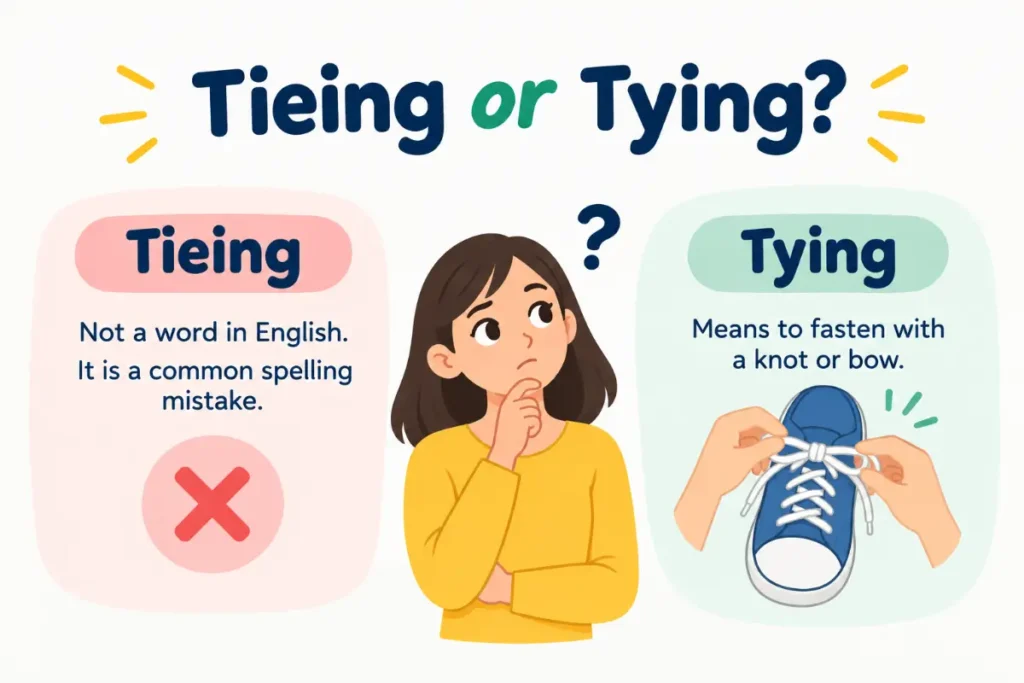
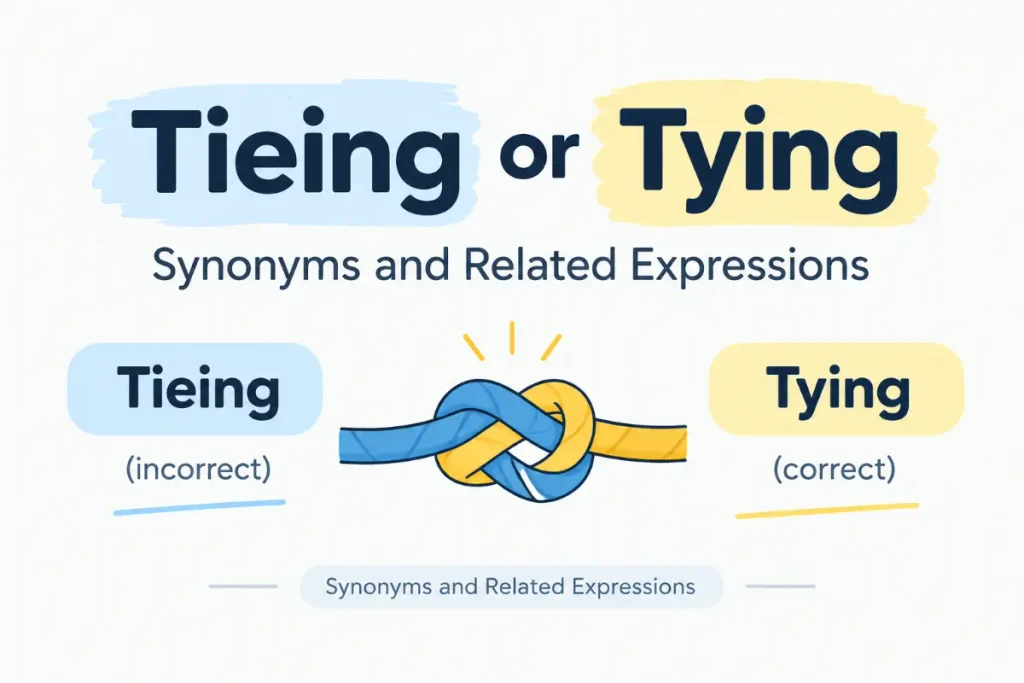
Tying is the correct and standard spelling in American English. Tieing is a common misspelling that results from applying the usual spelling pattern for adding ing to a verb. When you add ing to tie, you drop the final e and write tying. The same rule applies when you write about tying your shoes, tying your hair, tying a knot, or tying a game.
The confusion is understandable because many English verbs keep their final e in other forms, and spelling rules can feel inconsistent. For example, agree becomes agreeing, while make becomes making. The difference depends on the spelling pattern used by each verb.
If you are writing an email, completing a school assignment, posting on social media, or describing a tied score in a sports game, use tying. This guide explains the spelling rule, the meaning of the word, its different uses, and common expressions such as tying up, tying the knot, and tying a game. You will also find practical examples and answers to common questions so you can use the word confidently.
Quick Answer
Tying is correct. Tieing is a nonstandard spelling in modern American English. The verb tie becomes tying when you add ing because you remove the final e. Use tying in expressions such as tying shoes, tying hair, tying a knot, tying up a package, and tying a game.
Just as “tying” follows a specific spelling rule, choosing the correct verb form requires understanding how English verbs change in different grammatical contexts.
Why Tying Is Correct
The verb tie ends with the letter e. When you add the ending ing, you normally drop that final e to form tying. This spelling change keeps the word consistent with a common English pattern used with verbs such as write, drive, and smile.
Here is the basic transformation.
| Base verb | Correct ing form |
|---|---|
| Tie | Tying |
| Write | Writing |
| Drive | Driving |
| Smile | Smiling |
| Make | Making |
| Bake | Baking |
The spelling rule is straightforward in this case. You do not keep the final e in tieing, and you do not remove the i from the original word. Instead, the letters t and y come before the ending ing, producing tying.
Why Tie Does Not Become Tieing
English spelling rules can be confusing because adding ing does not always work the same way. Many verbs ending in a silent e lose that letter before the ending. For example, hope becomes hoping, and use becomes using. The verb tie follows this pattern, giving us tying.
The confusion often comes from looking at the base word and trying to preserve every letter. However, spelling conventions do not require that. In standard modern English, tying is the established form, and tieing should be avoided in ordinary writing.
What Does Tying Mean
Tying is the present participle and gerund form of the verb tie. The word has several meanings depending on context, but it generally involves fastening something, connecting things, creating a relationship, or making two competitors equal in score.
The most familiar meaning is fastening something with a string, cord, ribbon, lace, or similar material. For example, when you tie your shoes, you fasten the laces so the shoes stay securely on your feet. When you tie a package with ribbon, you use the ribbon to hold the package together or decorate it.
Tying can also describe connecting ideas or linking one thing to another. In sports, it can mean bringing the score level with an opponent. These meanings share a general idea of joining, connecting, or bringing things together.
Tying as a Verb Form
The word tying can perform different grammatical roles in a sentence. It can describe an action that is happening, appear after certain verbs, or function as a noun like a word that names an activity. Understanding these patterns will help you use it naturally.
For example, in “She is tying her shoes,” tying forms part of the present progressive verb phrase. In “Tying your shoes takes practice,” the word names an activity and functions as a gerund. Both sentences are correct, but the grammar differs.
You can also use tying after verbs such as start, continue, and practice. For instance, “He started tying the ribbon around the box” describes an action that began in the past. The spelling remains the same regardless of the grammatical function.
Tying vs Tieing in a Comparison
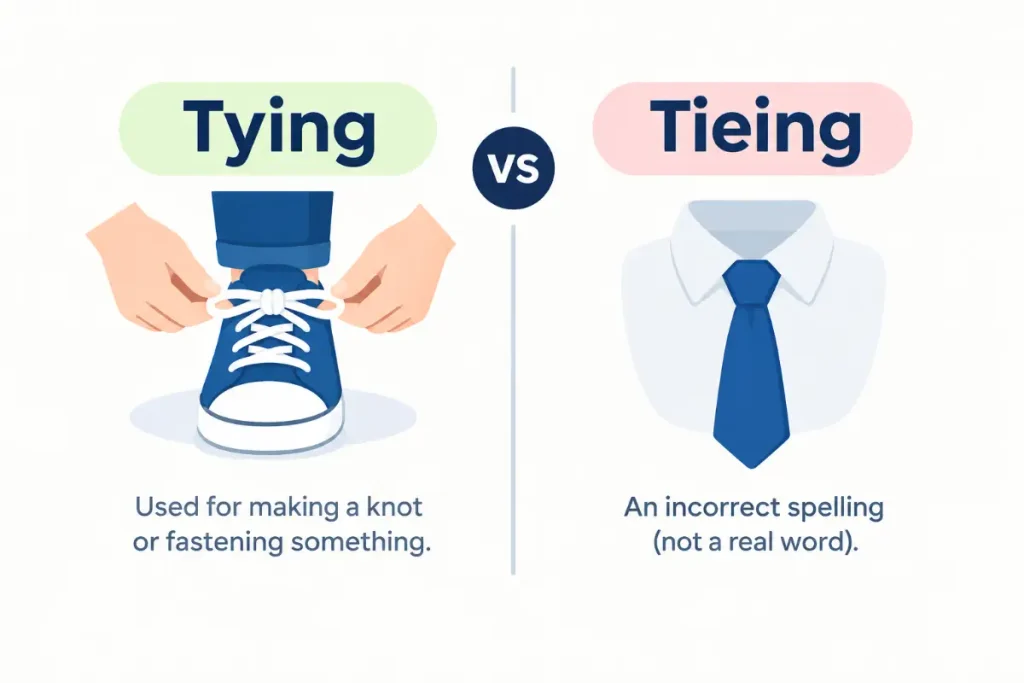
The difference between the two spellings is not a difference in meaning. The issue is standard spelling.
| Feature | Tying | Tieing |
|---|---|---|
| Standard spelling in American English | Yes | No |
| Base verb | Tie | Tie |
| Meaning | Fastening, connecting, or making a score equal | Intended to represent the same meanings |
| Grammatical form | Present participle or gerund | Nonstandard spelling |
| Appropriate for schoolwork | Yes | No |
| Appropriate for professional writing | Yes | No |
| Common examples | Tying shoes, tying a knot, tying a game | Avoid this spelling |
If you encounter tieing in an old document, quotation, or unusual source, the context may explain why it appears. However, there is no ordinary modern American usage distinction that requires you to choose tieing instead of tying. For everyday writing, school assignments, business communication, and published content, use tying.
How to Use Tying in a Sentence
The most common use of tying involves fastening something. You can use it to describe everyday activities, work tasks, sports, relationships, and connections between ideas. The surrounding words make the intended meaning clear.
Here are ten examples showing different uses.
1. I am tying my shoes before heading out for a walk.
2. She spent a few minutes tying a ribbon around the gift box.
3. Dad is tying the boat to the dock before the wind picks up.
4. The children practiced tying knots during their outdoor skills class.
5. He is tying his hair back before starting his workout.
6. The player scored in the final minute, tying the game at two goals apiece.
7. The manager is tying the bonus to the team’s performance.
8. The teacher is tying the lesson to a real world example.
9. She is tying the loose cables together to keep the desk organized.
10. The final chapter is tying together several ideas introduced earlier in the book.
Notice how the basic spelling stays the same even though the meanings change. The context tells you if the word refers to fastening, equalizing a score, connecting ideas, or linking a result to a condition.
Tying Shoes and Tying Hair
Two of the most common searches related to this spelling involve tying shoes and tying hair. Both expressions use the same standard form because they come from the verb tie. You do not change the spelling based on the object being fastened.
When you describe fastening shoelaces, write tying shoes or tying your shoes. For example, “My son is learning to tie his shoes” describes the skill, while “He is tying his shoes now” describes an action in progress. Both are correct, and neither requires the spelling tieing.
The same rule applies to hair. You can write “She is tying her hair into a ponytail” or “He prefers tying his hair back during exercise.” In both examples, tying describes gathering and securing the hair with an elastic band, ribbon, or another fastener.
Tying a Knot
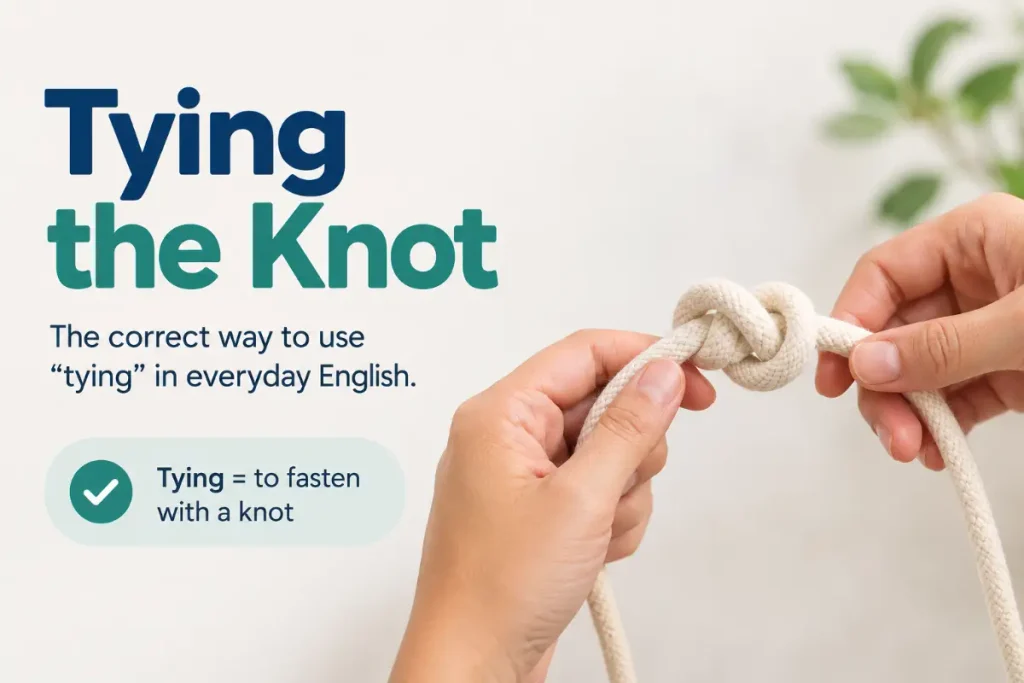
The expression tying a knot means fastening a rope, string, cord, or similar material by forming a knot. It appears in everyday instructions, outdoor activities, crafts, sailing, and many other situations. The spelling remains tying because the expression uses the same verb.
For example, “The camper is tying a knot to secure the tent” describes fastening a rope. “Practice tying a simple knot before your next camping trip” gives an instruction. In both sentences, tying is the correct form.
Tying the Knot
Tying the knot is also a common idiom that means getting married. The expression draws on the idea of joining two things together, using a knot as a symbol of a lasting bond. It is widely understood in American English and often appears in casual conversation, wedding announcements, and social media posts.
For example, “My cousin is tying the knot in June” means the cousin is getting married in June. You might also write, “They are tying the knot after dating for five years.” The phrase is informal and friendly, making it suitable for personal messages and celebratory posts.
Do not write tieing the knot in standard modern writing. The idiom does not have a special spelling rule. It follows the same rule as every other use of the verb tie.
Remembering the correct spelling of “tying” can be easier when you also learn to avoid a common English spelling mistake such as writing “ocassion” instead of “occasion.”
Is It Tying Up or Tieing Up
Tying up is the correct spelling. It uses the verb tie with the particle up, which can add the idea of fastening, securing, completing, or occupying someone or something.
The phrase has several meanings depending on context. You might be tying up a package, tying up loose ends on a project, or tying up someone’s time with a lengthy conversation. The spelling stays tying up in every case.
Consider these examples.
1. She is tying up the package before mailing it.
2. We are tying up the final details before the event.
3. The meeting is tying up most of my afternoon.
4. He is tying up the boat before leaving the marina.
5. The team is tying up loose ends before submitting the report.
The expression tying up loose ends is especially common in workplace communication. It means completing small unfinished tasks before considering a project done. For instance, “I am tying up a few loose ends before taking Friday off” sounds natural in an email or conversation.
The phrase can also mean keeping something occupied. If you say, “This paperwork is tying me up all morning,” you mean the work is taking your time and preventing you from doing other things. In all these situations, tieing up is not the standard spelling.
Tying a Game or Tying Into Something
The word tying also appears in sports and in expressions involving connections. These uses can seem unrelated to fastening a rope, but they follow the same spelling rule.
Tying a Game
In sports, tying a game means making the score equal to the opponent’s score. It does not necessarily mean the game has ended in a tie. Instead, it describes an action that brings the score level during play.
For example, “The quarterback threw a touchdown pass, tying the game with two minutes left.” The score became equal, but the game continued. Similarly, “She scored the winning team’s second goal, tying the game at two to two” describes a moment when both teams had the same score.
You can use the phrase in basketball, football, soccer, hockey, baseball, and other sports when the rules and scoring situation allow a team or player to equalize the score. In baseball, for instance, a run can tie the game. In basketball, a shot can tie the score late in the fourth quarter.
The correct phrase is tying a game, not tieing a game. If you are writing a sports recap, headline, school report, or social media update, use the standard spelling.
Tying Into Something
The phrase tying into can mean connecting one idea, topic, or event to another. It is common in conversation and informal professional communication. For example, “This section is tying into the main argument” means the section connects with the central point.
The expression can also have a more confrontational meaning in informal American English. To tie into someone can mean to criticize, attack, or confront that person, depending on context. Because this use can sound aggressive, it is important to consider the audience and intended meaning.
Here are examples of the connection meaning.
1. The new lesson is tying into what students learned last week.
2. Her presentation is tying into the company’s broader goals.
3. The final chapter is tying into the main theme of the novel.
For clearer professional writing, you can often replace tying into with connecting to, relating to, or supporting. For example, “This section connects to the main argument” may sound more direct than “This section is tying into the main argument.” The spelling of tying remains correct in either version.
Grammar Rules for Tying
The spelling of tying follows a common pattern for verbs ending in a silent e. When you add ing to tie, you remove the final e and keep the remaining letters. This produces tying, which serves as both a present participle and a gerund.
The verb also has several other forms that you should recognize. Its base form is tie, its simple past tense is tied, and its past participle is also tied. The third person singular present form is ties, as in “She ties her shoes quickly.”
| Verb form | Correct spelling | Example |
|---|---|---|
| Base form | Tie | I tie my shoes every morning. |
| Third person singular | Ties | He ties the rope securely. |
| Simple past | Tied | She tied the package yesterday. |
| Past participle | Tied | They have tied the boat to the dock. |
| Present participle | Tying | She is tying the ribbon. |
| Gerund | Tying | Tying knots requires practice. |
These forms may look different, but they all belong to the same verb. The spelling changes according to the grammatical form, not because the meaning of the verb has changed completely.
When to Use Tying
Use tying when the action is happening now, when you are describing an ongoing activity, or when the activity functions as a noun. For example, “He is tying the rope” describes an action in progress. “Tying a secure knot takes practice” uses the same form to name an activity.
You can also use tying after certain verbs. For example, “She started tying the ribbon” and “They continued tying the packages” are both correct. The spelling does not change after started or continued.
Do not confuse tying with tied. The sentence “She is tying her shoes” describes an action in progress, while “She tied her shoes” describes an action completed in the past. Both are correct, but the tense and meaning differ.
Why the Spelling Rule Works
English has a familiar spelling pattern in which a verb ending in a silent e loses that letter before the ending ing. You can see this pattern in words such as hope becoming hoping, dance becoming dancing, and write becoming writing. The verb tie follows the same general pattern, producing tying.
The rule does not mean that every verb ending in e behaves identically in every grammatical form. For example, see becomes seeing, and agree becomes agreeing. These words keep the two vowels together because their spelling and pronunciation patterns differ from those of verbs such as tie and write.
The practical lesson is to learn the established form of each verb rather than apply a rule mechanically to every word. In this case, tying is the standard form you should use in modern American English. Writing tieing adds a letter that does not belong in the accepted spelling.
Common Mistakes to Avoid
The most obvious mistake is adding ing without removing the final e. Writers sometimes assume that tie should become tieing because that seems to preserve the base word. However, standard spelling requires tying.
- Incorrect: She is tieing her shoes before class.
- Correct: She is tying her shoes before class.
The correction follows the established spelling rule for this verb. The same change applies to tying hair, tying a knot, tying a package, and tying a game.
Another mistake is confusing tying with tied. These forms have different grammatical uses, so you should not substitute one for the other simply because both come from tie.
- Incorrect: He is tied his shoes right now.
- Correct: He is tying his shoes right now.
The first sentence incorrectly combines is with the past form tied to describe an action in progress. The second sentence uses the present progressive correctly.
You should also avoid assuming that a spelling mistake becomes acceptable just because it appears online. Search results, social media posts, and informal messages can contain errors. When you are writing for school, work, or publication, choose the established form rather than copying an unfamiliar spelling.
English has many words with easily confused spellings, and knowing the difference between “scrapped” and “scraped” can help you avoid similar mistakes when writing.
Synonyms and Related Expressions
The best synonym for tying depends on the action you want to describe. If you mean fastening something, you might use securing, fastening, binding, or knotting. If you mean connecting ideas, you might choose linking, connecting, or joining.
These words are not perfect replacements in every sentence. For example, tying your shoes is the natural expression for fastening shoelaces, while securing a boat to a dock may emphasize keeping the boat safely in place. Similarly, tying together two ideas may mean connecting them in an explanation, while linking two ideas may sound more direct in academic writing.
Here are a few useful comparisons.
1. Tying a rope to a post means fastening the rope to the post.
2. Securing a load means making sure it stays in place.
3. Binding papers means holding sheets together, often with a cover or fastener.
4. Linking two arguments means showing how they relate.
5. Knotting a cord means forming a knot in it.
Choose the verb that best captures the action. You do not need to replace tying with a synonym if it already communicates your meaning clearly.
Is Tying Formal or Informal
Tying is a standard word that works in formal, neutral, and casual writing. Its suitability depends on the sentence rather than the word itself. You can use it in an academic paper, a workplace email, a set of instructions, a sports report, or a text message.
In an instruction manual, you might write, “Begin by tying the cord around the frame.” In a workplace email, you could say, “I am tying up the remaining details before the meeting.” In a casual message, “I am tying my shoes and heading out” sounds completely natural.
For formal writing, focus on clarity and context. If tying up loose ends sounds too casual for a technical report, you could write completing the remaining tasks. However, there is no need to avoid tying itself. It is correct in both professional and everyday settings.
Frequently Asked Questions
Is tieing or tying correct
Tying is correct. It is the standard spelling in modern American English because the final e in tie is dropped before adding ing. The spelling tieing is nonstandard and should be avoided in schoolwork, professional documents, and published content.
What is the meaning of tying
Tying means fastening, connecting, or joining something, depending on the context. It can describe fastening shoelaces, securing a package, gathering hair with an elastic band, or connecting ideas in a discussion. In sports, tying a game means making the score equal to the opponent’s score.
Is it tying up or tieing up
Tying up is correct. The expression can mean fastening something, completing the final details of a task, or occupying someone’s time. For example, “I am tying up a few loose ends before leaving the office” means you are finishing the remaining tasks.
Is it tying the knot or tieing the knot
Tying the knot is correct. This common idiom means getting married. For example, “They are tying the knot next summer” means they plan to get married next summer. The expression follows the same spelling rule as other uses of tying.
Is it tying a game or tieing a game
Tying a game is correct. In sports, it means scoring or making a play that brings the score level with the opposing team. For example, “The team scored in the final minute, tying the game at three to three.” The word does not mean the game has necessarily ended.
How do you spell tying in American English
The correct American English spelling is tying. You remove the final e from tie before adding ing. This spelling is also standard in British, Canadian, and Australian English, so there is no regional spelling difference to learn for this word.
What is the difference between tie and tying
Tie is the base form of the verb, while tying is its present participle and gerund form. You might say, “I tie my shoes every morning” or “I am tying my shoes now.” The first sentence describes a routine, while the second describes an action in progress.
What is another word for tying
Possible synonyms include fastening, securing, binding, knotting, connecting, and linking. The best choice depends on the context. Fastening and securing work well for physical objects, while connecting and linking are often better for ideas, concepts, or relationships.
Conclusion
When choosing between tieing or tying, always use tying in standard American English. The word follows the spelling rule that removes the final e from tie before adding ing. This rule applies to tying shoes, tying hair, tying a knot, tying up loose ends, and tying a game. The spelling stays the same across these different meanings and expressions.
If you are unsure, remember the base verb and its correct form: tie becomes tying, while its past tense becomes tied. Using the right form will help you write clearly in emails, school assignments, professional documents, and everyday messages. Once you learn the pattern, this common spelling confusion becomes easy to avoid.