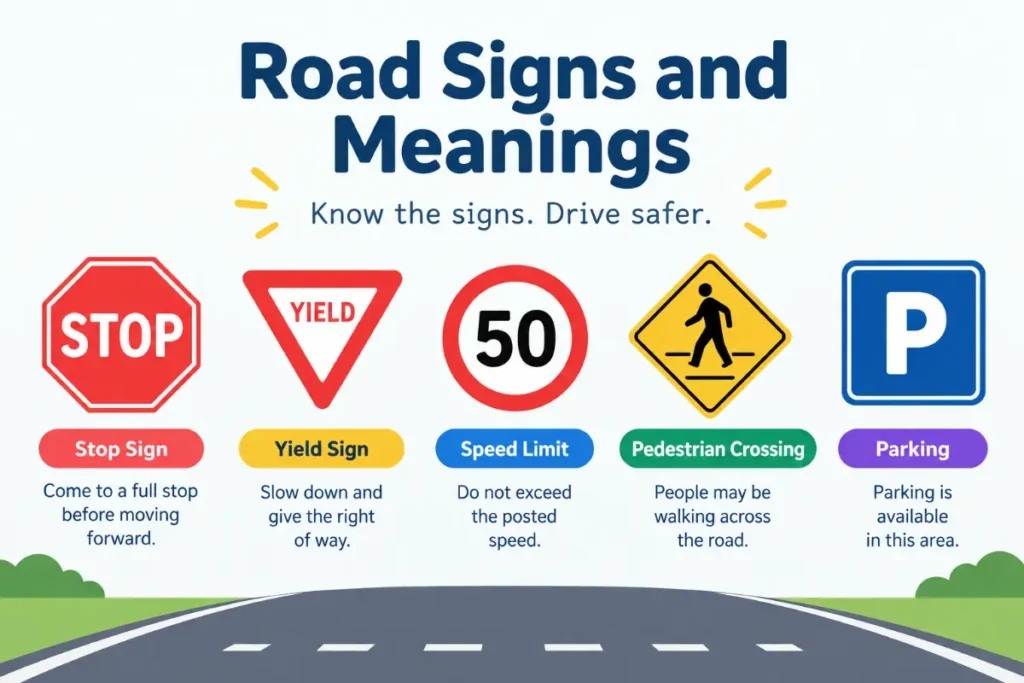
Road signs help drivers understand traffic laws, recognize hazards, find destinations, and make safe decisions on the road. From a red STOP sign to a yellow curve warning, each sign communicates important information that drivers need to recognize quickly. Learning these signs is essential for new drivers preparing for a learner’s permit, experienced motorists refreshing their knowledge, and anyone studying for a driving test in the United States.
Understanding road signs and meanings also helps you anticipate what is coming next. A warning sign may tell you to slow down before a sharp turn, a regulatory sign may prohibit a particular movement, and a guide sign may point you toward an interstate highway or nearby exit. Recognizing the shape and color of a sign can help you understand its purpose even when you cannot read every word immediately.
In the United States, traffic signs follow standards established in the Manual on Uniform Traffic Control Devices, commonly called the MUTCD. State transportation departments use these standards alongside applicable state laws to manage roads, intersections, highways, and school zones.
This guide explains the main types of traffic signs, their colors and shapes, important signs for driving tests, and state specific study considerations. You will also learn how to recognize common warning signs and understand what to do when you encounter them.
Quick Answer
US road signs communicate rules, warnings, directions, and information. The main categories include regulatory, warning, and guide signs, along with several specialized types. Red usually signals stopping or prohibition, yellow warns of hazards, orange indicates work zones, green provides directional guidance, and blue identifies certain services. Recognizing sign shapes and colors helps drivers respond safely and prepare for permit tests.
What Are the 7 Main Types of Traffic Signs and Their Colors?
Traffic signs in the United States serve several purposes, and their colors help drivers recognize those purposes quickly. A commonly used seven category breakdown includes regulatory, warning, guide, work zone, school related, railroad crossing, and recreation or cultural interest signs. Official classifications can vary depending on the specific MUTCD section and how signs are grouped.
Here are the major categories and their common colors.
| Sign type | Common color | Main purpose |
|---|---|---|
| Regulatory signs | Red, white, and black | Communicate traffic laws and restrictions |
| Warning signs | Yellow or fluorescent yellow green | Alert drivers to hazards or changing conditions |
| Guide signs | Green, blue, or brown | Provide directions, services, and destination information |
| Work zone signs | Orange with black lettering | Warn about road construction and maintenance |
| School signs | Fluorescent yellow green | Identify school zones and school related crossings |
| Railroad signs | Yellow and black, or red lights | Warn of railway crossings and approaching trains |
| Recreation and cultural interest signs | Brown with white lettering | Identify parks, historic sites, and recreational destinations |
These categories are useful for studying, but not every sign fits neatly into a single simplified group. For example, railroad crossing warnings can include circular advance warning signs, crossbuck signs, flashing lights, and gates. Their colors and shapes each communicate different information.
Regulatory Road Signs and Their Meanings
Regulatory signs tell drivers what they must do, what they must not do, and which traffic rules apply. Ignoring these signs can create dangerous situations and may result in a traffic citation.
STOP Sign
A STOP sign is an eight sided red sign with white lettering. Drivers must come to a complete stop at the stop line, before a marked crosswalk, or at the appropriate stopping point when markings are absent.
After stopping, check for pedestrians, cyclists, and other vehicles. Proceed only when the intersection is clear and it is your turn to move.
YIELD Sign
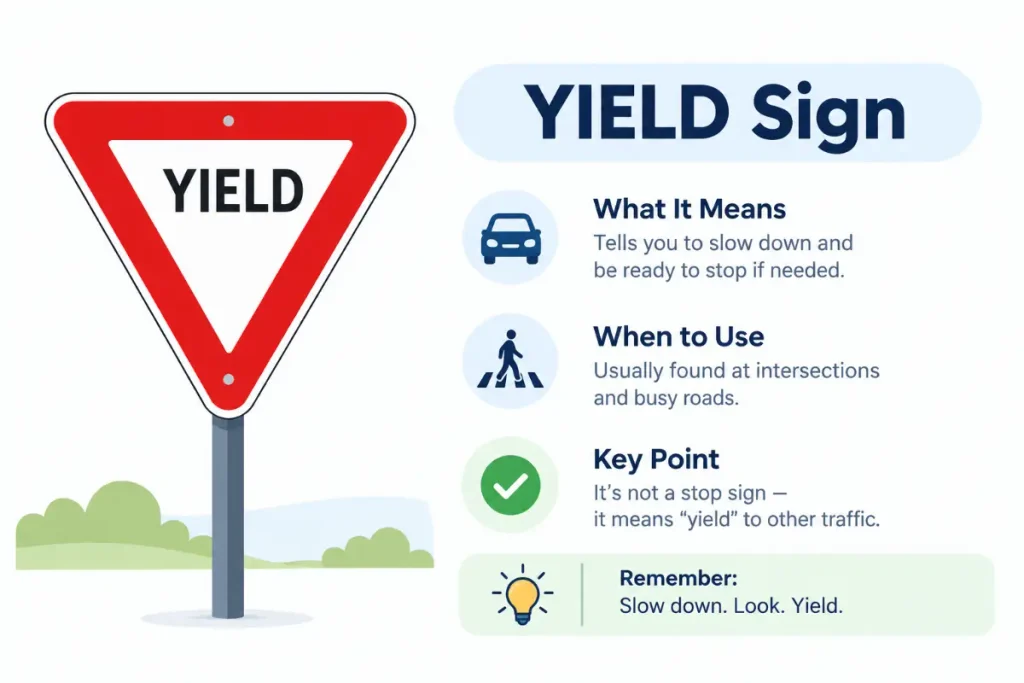
A YIELD sign is an inverted triangle with a red border and white center. It tells drivers to slow down and give the right of way to traffic or pedestrians as required by the situation.
You may continue without stopping if the way is clear and it is safe to proceed. Stop when necessary to avoid interfering with other road users.
Speed Limit Sign
Speed limit signs are generally white rectangles with black lettering. They display the maximum legal speed under the conditions and rules that apply to that road.
A posted speed limit is not a guarantee that driving at that speed is safe in every situation. Rain, snow, fog, traffic, and road construction may require you to travel more slowly.
DO NOT ENTER Sign
This sign usually features a red background with a white horizontal bar inside a white bordered shape. It warns drivers not to enter a roadway or ramp from that direction.
You may encounter it at one way street entrances, highway exit ramps, or restricted access points. Entering against the sign can put you directly in the path of oncoming traffic.
WRONG WAY Sign
A WRONG WAY sign typically has white lettering on a red background. It warns drivers that they are traveling against the permitted direction of traffic.
If you see this sign, do not continue forward. When safe, stop and correct your route without making a sudden or dangerous maneuver. On a highway, move to a safe location if possible and contact roadside assistance or emergency services when needed.
NO TURN Signs
NO LEFT TURN and NO RIGHT TURN signs prohibit the indicated turn. They commonly appear at intersections where a movement would create a conflict with other traffic or violate a local restriction.
Look for these signs before turning, even when a navigation app suggests a particular route. A traffic sign takes priority over the app’s directions.
ONE WAY Sign
A ONE WAY sign is generally a black and white rectangular sign with an arrow indicating the permitted direction of travel. It identifies a street or roadway where vehicles must travel in one direction.
Before entering, make sure your vehicle is pointed in the correct direction. Watch for additional signs governing turning movements and lane use.
NO U TURN Sign
A NO U TURN sign prohibits turning your vehicle around to travel in the opposite direction at that location. The sign may appear at busy intersections, divided highways, and locations with limited visibility.
Do not assume a U turn is allowed just because there is enough space to complete one. Follow posted restrictions and applicable state laws.
NO PARKING Sign
NO PARKING signs identify locations where parking is prohibited or restricted. Some signs specify hours, days, loading rules, or exceptions.
Read the full sign rather than relying on its headline alone. A restriction may apply only during certain hours or to a particular part of the curb.
Yellow Road Signs and Their Meanings
Yellow signs usually warn drivers about hazards, changes in the road, or conditions that require extra attention. They do not always require a stop, but they tell you to stay alert and adjust your speed or position when needed.
Sharp Turn and Curve Signs
A curved arrow on a yellow diamond shaped sign warns that the road bends ahead. A sharp turn sign indicates a more pronounced change in direction, while a curve sign alerts you to a bend that may require reduced speed.
Slow down before reaching the curve. Braking suddenly while turning can reduce tire grip and make it harder to maintain control, especially on wet or slippery pavement.
Winding Road Sign
A winding road sign shows a series of curves ahead. It warns that the road changes direction several times over a short distance.
Reduce your speed before entering the winding section and stay in your lane. Do not pass other vehicles unless the road markings and visibility clearly allow it.
Slippery When Wet Sign
This yellow warning sign commonly shows a car with curved skid marks behind it. It indicates that the road may become slippery during rain or other wet conditions.
Reduce your speed, leave more space between your vehicle and the one ahead, and avoid sudden braking or steering. Remember that some roads can remain slippery even after the rain has stopped.
Lane Ends Sign
A LANE ENDS sign warns that one lane will end ahead. Drivers may need to merge into an adjacent lane before reaching the narrowing point.
Check your mirrors and blind spots, signal your intention, and merge when there is a safe opening. Avoid speeding up to block another driver who is trying to merge.
Merge Sign
A MERGE sign warns that two traffic streams will join. It often appears where an entrance ramp meets a highway or where separate lanes combine.
Adjust your speed to fit safely into traffic and look for a suitable gap. Drivers already on the main roadway should remain alert and cooperate when it is safe to do so.
Pedestrian Crossing Sign
A pedestrian warning sign alerts drivers to a location where people may cross the road. These signs can appear near parks, busy streets, residential areas, and other places with pedestrian activity.
Slow down and watch both sides of the road. Yield to pedestrians as required by law, and never pass a vehicle stopped at a crosswalk without checking for people crossing in front of it.
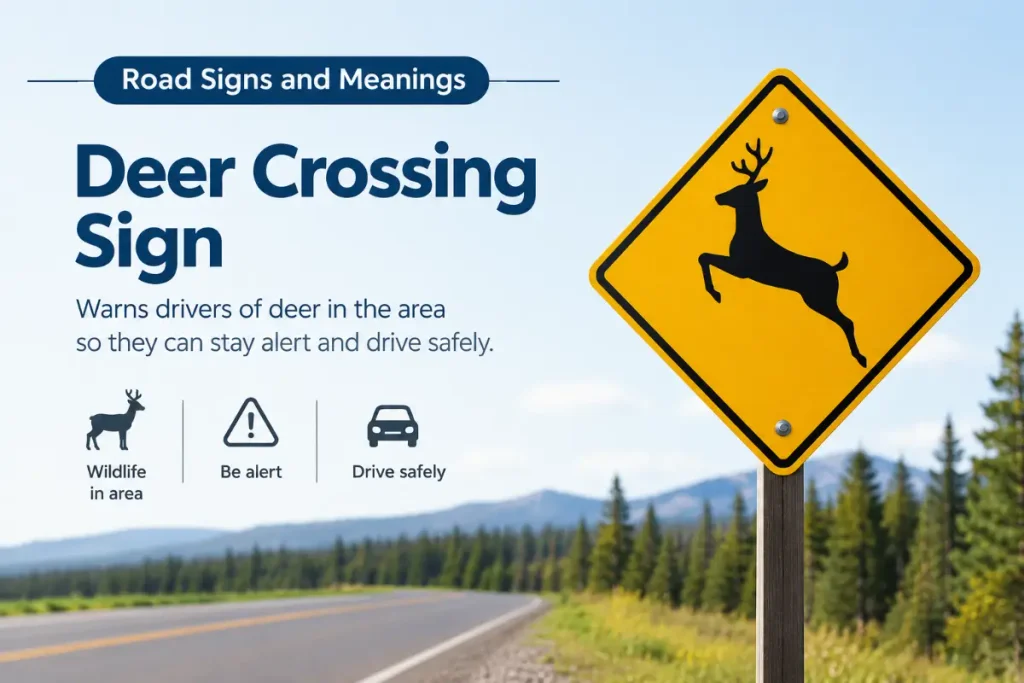
Deer Crossing Sign
A deer crossing sign warns that deer or other wildlife may enter the roadway. These signs are common in rural areas, wooded regions, and places where animals frequently cross.
Watch the roadside, particularly around dawn and dusk. If an animal appears, brake firmly when necessary and stay in control of your vehicle. Swerving suddenly can lead to a collision with another vehicle or a roadside obstacle.
Two Way Traffic Sign
A TWO WAY TRAFFIC sign warns drivers that traffic will travel in both directions ahead, often after a divided roadway ends or a one way section transitions to a two way road.
Stay on the correct side of the centerline and watch for oncoming traffic. Do not assume that the road continues as a divided highway simply because it did earlier.
Road Sign Shapes and What They Tell You
Recognizing a sign’s shape can help you identify its purpose before you read its message. Shape recognition is particularly useful when visibility is poor or you are approaching a sign at speed.
| Shape | Common meaning | Example |
|---|---|---|
| Octagon | Stop | STOP |
| Inverted triangle | Yield | YIELD |
| Diamond | Warning | Curve ahead |
| Pentagon | School related warning | School crossing |
| Round | Railroad warning | Railroad crossing ahead |
| Pennant | No passing zone warning | No passing zone |
| Rectangle | Regulatory or guide information | Speed limit or highway direction |
The shape provides a quick clue, but you should still read the sign whenever possible. Not every rectangular sign communicates the same type of instruction.
Why Is the STOP Sign an Octagon?
The eight sided shape makes a STOP sign easy to recognize from different angles and helps distinguish it from other traffic signs. Its distinctive shape is especially useful when the sign’s lettering is difficult to see.
Why Are Warning Signs Diamond Shaped?
Diamond shaped signs are commonly used for warnings because their shape is easy to distinguish from regulatory signs. When you see a yellow diamond, prepare for a possible change in road conditions, traffic patterns, or hazards.
What Are the 12 Road Signs?
There is no single official list of exactly 12 road signs used across the United States. However, the following 12 examples cover many of the signs that new drivers should learn first.
- STOP: Come to a complete stop and proceed when safe.
- YIELD: Give the right of way and stop if necessary.
- Speed Limit: Do not exceed the posted legal speed limit.
- DO NOT ENTER: Do not enter the roadway from that direction.
- WRONG WAY: You are traveling against the permitted direction.
- NO U TURN: Do not turn around at the marked location.
- NO LEFT TURN: Do not make a left turn where prohibited.
- Railroad Crossing: Watch for tracks and approaching trains.
- Pedestrian Crossing: Look for people crossing and yield as required.
- School Crossing: Watch for children and follow school zone rules.
- Slippery When Wet: Reduce speed and avoid sudden movements on wet pavement.
- Road Work Ahead: Prepare for construction, lane changes, or workers near the road.
These examples are a useful starting point for permit test preparation. You should also study signs that are common in your state and the roads you drive most often.
What Are the Five Road Signs and Their Meaning?
If you are just beginning to study, focus on these five essential signs first.
| Sign | Meaning | Driver action |
|---|---|---|
| STOP | Traffic must stop | Stop completely and check for hazards |
| YIELD | Give the right of way | Slow down and stop if necessary |
| Speed Limit | Maximum legal speed | Follow the posted limit and adjust for conditions |
| DO NOT ENTER | Entry is prohibited | Do not proceed in that direction |
| Railroad Crossing | Railway tracks are ahead | Look and listen for trains and obey crossing signals |
These signs cover different types of driving decisions. STOP and YIELD control right of way, speed limit signs regulate speed, DO NOT ENTER prevents wrong way movements, and railroad warnings alert you to a potentially serious hazard.
What Are the 10 Most Important Road Signs?
The most important signs are those that directly affect safety, right of way, speed, and the direction of travel. Ten especially useful signs to learn are STOP, YIELD, Speed Limit, DO NOT ENTER, WRONG WAY, NO TURN, Railroad Crossing, School Zone, Pedestrian Crossing, and Lane Ends.
Each sign requires a different response. STOP and YIELD control how you approach an intersection, while speed limit signs establish the posted maximum. DO NOT ENTER and WRONG WAY help prevent dangerous travel against traffic, and school and pedestrian signs remind you to watch for people who may be vulnerable in a collision.
Railroad crossing warnings deserve special attention because trains cannot stop quickly to avoid a vehicle. Lane Ends signs also matter because an unplanned merge can create sudden braking or sideswipe risks. Learn the sign’s appearance and the action it requires, not just its name.
Road Signs and Meanings for Permit Test Preparation
Studying for a learner’s permit involves more than memorizing sign names. You need to understand what each sign requires you to do and how to respond in realistic traffic situations. Questions may ask you to identify a sign from its description, explain its meaning, or choose the safest action.
How to Study DMV Road Signs and Meanings
Start with the signs that control right of way, including STOP, YIELD, and traffic signal signs. Next, learn warning signs for curves, merging lanes, pedestrians, school zones, and railroad crossings. Finish with regulatory signs covering parking, turning, speed limits, and lane restrictions.
Use flashcards to practice recognizing each sign by its shape, color, and message. Instead of simply reading the answer, cover the explanation and try to recall the correct action. Regular short practice sessions can help you remember the signs more effectively than a single long study session.
You should also study the official driver’s handbook published by your state’s motor vehicle agency. The handbook explains local laws and may include sign examples used in that state’s permit examination.
Road Signs and Meanings for a Driving Test
For a driving test, knowing the signs is only part of the task. You must demonstrate that you can follow them while controlling the vehicle, observing traffic, and responding safely to changing conditions.
For example, approaching a STOP sign means slowing down early, stopping completely at the appropriate point, and checking for traffic and pedestrians. Seeing a school zone sign means paying attention to the posted speed, operating hours, and children who may enter the roadway.
During your practice drives, point out signs and explain their meanings aloud. This helps you connect what you have memorized with the decisions you will need to make behind the wheel.
Road Signs and Meanings in Different States
Traffic signs follow national standards, but state laws, road layouts, and licensing procedures can differ. Drivers preparing for a permit test should use the handbook for the state where they plan to take the exam.
Road Signs and Meanings in Pennsylvania
People preparing for a Pennsylvania learner’s permit should study the Pennsylvania Driver’s Manual and review the traffic signs covered in it. Pay particular attention to right of way, school zones, speed limits, railroad crossings, and signs governing turning and parking.
Pennsylvania drivers may encounter rural roads, mountain curves, urban intersections, and highway construction zones. Understanding warning signs for changing road conditions is useful in all these settings.
Road Signs and Meanings in New York
New York drivers should study the New York State Driver’s Manual and learn the signs used on city streets, suburban roads, and highways. Pay attention to one way streets, turn restrictions, pedestrian crossings, school zones, and parking regulations.
Because New York includes dense urban areas as well as rural highways, drivers need to recognize both regulatory signs and warnings for changing road conditions. Always follow posted signs and the laws that apply to the specific location.
Road Signs and Meanings in South Carolina
Anyone preparing for a South Carolina permit or driving test should review the state’s official driver’s handbook. Study common regulatory signs, warning signs, highway guide signs, and signs associated with school zones and railroad crossings.
Drivers may encounter busy urban routes, rural roads, and areas with road construction. Recognizing curves, intersections, and lane changes ahead can help you make smoother and safer driving decisions.
Are Road Signs the Same in Every State?
Most standard US traffic signs use consistent colors, shapes, and designs because states follow national traffic control standards. However, specific rules, speed limits, parking restrictions, and some local sign applications may differ.
A sign’s basic meaning is generally consistent, but the legal requirements connected to it can depend on state law. That is why the official handbook for your licensing state should be your main study resource.
Road Sign Colors and Their Meanings
Colors help drivers recognize the purpose of a sign before they read its message. Learning these color associations can make driving and permit test preparation easier.
| Color | Typical meaning | Examples |
|---|---|---|
| Red | Stop, yield, or prohibition | STOP, DO NOT ENTER |
| Yellow | General warning | Curve ahead, slippery road |
| Fluorescent yellow green | School, pedestrian, or bicycle related warning | School crossing |
| Orange | Road work and temporary traffic conditions | Construction ahead |
| Green | Directional and destination guidance | Highway exit information |
| Blue | Motorist services or certain road user information | Gas, food, or lodging services |
| Brown | Recreation and cultural destinations | Parks and historic sites |
| White | Regulatory information | Speed limit, turn restrictions |
| Black and white | Rules, restrictions, and certain guidance messages | ONE WAY, lane use signs |
These are general associations rather than absolute rules. Some signs combine several colors, and the full design provides more information than the background color alone.
Common Mistakes to Avoid When Reading Road Signs
Memorizing signs is helpful, but misunderstandings can lead to unsafe decisions. Keep these common mistakes in mind as you study.
Confusing STOP and YIELD
A STOP sign requires a complete stop. A YIELD sign requires you to give the right of way and stop if needed. Slowing down without stopping at a STOP sign is not enough.
Treating the Speed Limit as a Required Speed
A speed limit establishes the posted maximum under applicable conditions. It does not mean you must travel at that speed when rain, traffic, poor visibility, or road hazards make it unsafe.
Ignoring Signs Because a Road Looks Familiar
Road conditions and traffic restrictions can change. Construction, temporary closures, and new traffic patterns may introduce signs that were not present the last time you drove there.
Looking Only at the Sign’s Color
Color helps you identify a sign’s general purpose, but shape, text, symbols, and placement also matter. Read the entire sign and look for additional panels that explain times, distances, or restrictions.
Following Navigation Instructions Over Posted Signs
A navigation app can provide useful directions, but it may not immediately reflect every road closure or traffic restriction. Always follow posted traffic controls and applicable laws.
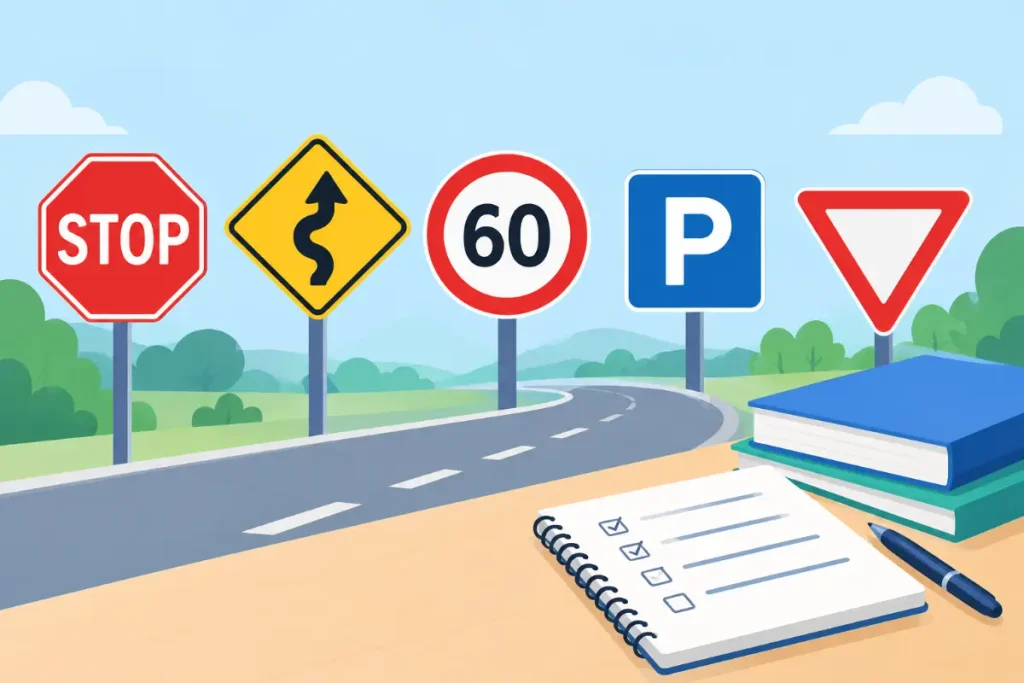
How to Prepare for a Road Signs Test
A simple study plan can help you learn traffic signs without feeling overwhelmed. Spend a few minutes each day reviewing common signs, testing your memory, and practicing how you would respond to each one on the road.
- Learn shapes first. Memorize the octagon for STOP, the inverted triangle for YIELD, and the diamond for warnings.
- Study colors next. Associate red with stopping or restrictions, yellow with warnings, and orange with work zones.
- Practice real situations. Imagine approaching a school crossing, a lane closure, or a railroad crossing and decide what action is safest.
- Take practice quizzes. Use questions based on your state’s official driver’s handbook.
- Review mistakes. Spend extra time on signs you confuse or forget.
- Apply your knowledge while driving. With a qualified supervising driver, identify signs along familiar routes and explain what each one requires.
If you are preparing for a permit test, prioritize your state’s handbook over unofficial quizzes. Practice materials can help reinforce your knowledge, but the official handbook is the best place to confirm local rules and testing requirements.
Conclusion
Learning road signs and meanings helps you recognize hazards, follow traffic laws, and make safer decisions behind the wheel. Start by understanding the main sign categories, colors, and shapes, then focus on important signs such as STOP, YIELD, Speed Limit, DO NOT ENTER, and Railroad Crossing. Each sign provides information that can help prevent confusion and reduce the risk of a crash.
If you are preparing for a learner’s permit or driving test, study the official handbook for your state and practice recognizing signs in real traffic situations. Memorization is a useful first step, but understanding the correct response is what matters most. The more familiar you become with traffic signs, the better prepared you will be to drive confidently and responsibly.