
The difference between woman vs women comes down to number. Woman is the singular form, used when talking about one adult female person. Women is the plural form, used when talking about two or more adult female people. Although the words have similar spellings, they have different pronunciations and grammatical uses.
For example, you would say, “That woman is my teacher” when referring to one person. If you are talking about several people, you would say, “Those women are my teachers.” Choosing the correct form helps your sentences sound natural and keeps your writing grammatically accurate.
This distinction can feel confusing because the spelling changes from woman to women, and the vowel sound changes too. In this guide, you will learn the meaning, pronunciation, grammar rules, sentence examples, common mistakes, and practical ways to remember the difference.
Quick Answer
Woman is the singular noun for one adult female person. Women is the plural noun for two or more adult female people. Woman is pronounced “WUHM uhn,” while women is pronounced “WIM in.” Use woman with singular verbs and women with plural verbs. For example, “The woman is here” and “The women are here.”
What Is the Difference Between Woman and Women
The main difference is grammatical number. Woman refers to one person, while women refers to more than one person. Both words are nouns, but they follow different rules when used with articles, demonstratives, pronouns, and verbs.
Here is a simple comparison:
| Feature | Woman | Women |
|---|---|---|
| Number | Singular | Plural |
| Meaning | One adult female person | Two or more adult female people |
| Pronunciation | WUHM uhn | WIM in |
| Article | A woman | Women |
| Demonstrative | This woman | These women |
| Verb agreement | The woman is | The women are |
| Possessive | Woman’s | Women’s |
| Example | A woman is waiting. | Three women are waiting. |
The easiest way to understand the difference is to count the people you are describing. If you are talking about one person, use woman. If you are talking about two or more people, use women.
For example:
- One woman is standing outside.
- Two women are standing outside.
- The woman works at the hospital.
- The women work at the hospital.
Notice that the noun changes and the verb may change with it. This is an important part of subject verb agreement in English.
What Does Woman Mean
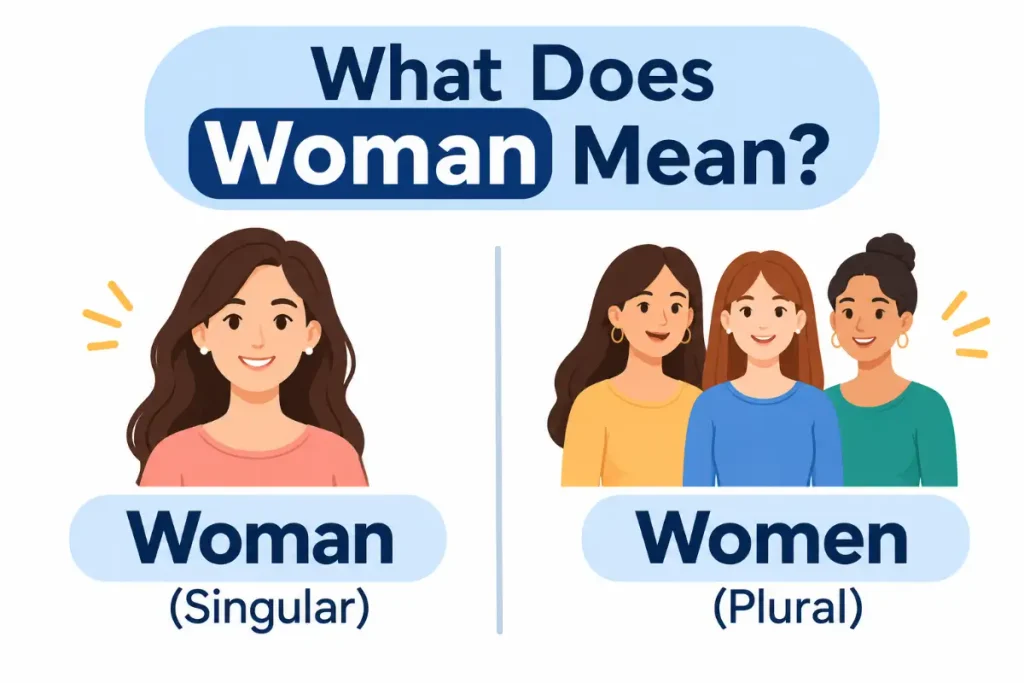
Woman is a singular noun that generally refers to one adult female person. It is commonly used in everyday conversation, professional communication, academic writing, news reporting, and many other contexts.
The word can refer to a person’s identity, role, relationship, occupation, or place in society. Its meaning depends on the surrounding sentence.
Examples:
- A woman entered the classroom.
- The woman beside me is a doctor.
- She is a talented woman.
- I spoke with a woman from California.
- The woman helped her neighbor.
In these examples, woman refers to one individual.
Woman as a Singular Noun
A singular noun identifies one person, place, thing, or idea. Woman is a singular countable noun, which means you can count individual people using it.
For example:
- One woman
- A woman
- This woman
- That woman
- Every woman
Because woman is countable and singular, it usually needs a singular determiner when used as a general noun in a sentence.
Correct: A woman is waiting outside.
Incorrect: Woman is waiting outside.
The incorrect sentence is missing an article or another appropriate determiner. You could also say “The woman is waiting outside” if you are referring to a particular person.
Woman in Everyday Conversation
Americans commonly use woman when identifying or describing one adult female person.
Examples:
- That woman is my aunt.
- A woman called you this morning.
- The woman at the front desk was helpful.
- I met a woman who lives in New York.
- She is a strong and independent woman.
The word is neutral in most ordinary situations. However, context and tone matter when discussing people. It is generally respectful to use the terminology a person prefers for herself.
What Does Women Mean
Women is the plural form of woman. It refers to two or more adult female people.
The word is commonly used when discussing groups, communities, families, coworkers, students, and people in public life.
Examples:
- The women are talking.
- Several women attended the meeting.
- These women are excellent teachers.
- Many women work in healthcare.
- The women in my family enjoy cooking.
Since women is plural, it usually works with plural verbs and plural determiners.
For example:
Correct: The women are waiting outside.
Incorrect: The women is waiting outside.
The second sentence uses a singular verb with a plural noun. In standard English, the plural subject women takes the plural verb are.
Women as a Plural Noun
A plural noun refers to more than one person, place, thing, or idea. Women is an irregular plural noun because it does not follow the usual pattern of adding s or es to the singular form.
Compare these examples:
| Singular | Plural |
|---|---|
| Woman | Women |
| Man | Men |
| Child | Children |
| Person | People |
| Tooth | Teeth |
| Foot | Feet |
These words change their spelling in different ways. You cannot always create a plural noun simply by adding an S.
For example, womans is not the standard plural form of woman. The correct form is women.
Women in Everyday Conversation
Women is useful when referring to a group of adult female people.
Examples:
- The women are preparing dinner.
- Three women joined our team.
- Those women are my neighbors.
- Many women enjoy outdoor activities.
- The women at the conference shared their ideas.
The plural form allows you to describe several people without repeating the singular noun.
How to Pronounce Woman and Women
One of the biggest reasons people confuse these words is their pronunciation. Although woman and women have similar spellings, they sound different in standard American English.
Woman
Pronunciation: /ˈwʊmən/
Woman sounds approximately like WUHM uhn. The first syllable contains a sound similar to the vowel in book. The second syllable is unstressed and sounds like “uhn.”
Women
Pronunciation: /ˈwɪmɪn/
Women sounds approximately like WIM in. The first syllable contains a short I sound, similar to the vowel in sit. The second syllable is also unstressed.
Why Do Woman and Women Sound Different
The spelling changes only slightly, but the pronunciation changes significantly. In woman, the first vowel sounds like the vowel in book. In women, the first vowel sounds like the vowel in sit.
The difference is mainly in the first syllable:
- Woman: WUH
- Women: WIH
Both words usually have two syllables in American English. The second syllable is reduced, meaning it is pronounced with less emphasis.
You should not pronounce women as “WOO men” or woman as “WEE man.” These pronunciations do not match standard American English.
Pronunciation Practice
Try reading these sentences aloud:
- The woman is wearing a blue dress.
- The women are wearing blue dresses.
- I met a woman at the store.
- I met several women at the store.
- One woman spoke, and three women listened.
Focus on the first vowel sound in each word. Repeating these sentences can help you recognize the difference in conversation.
Woman vs Women in Grammar
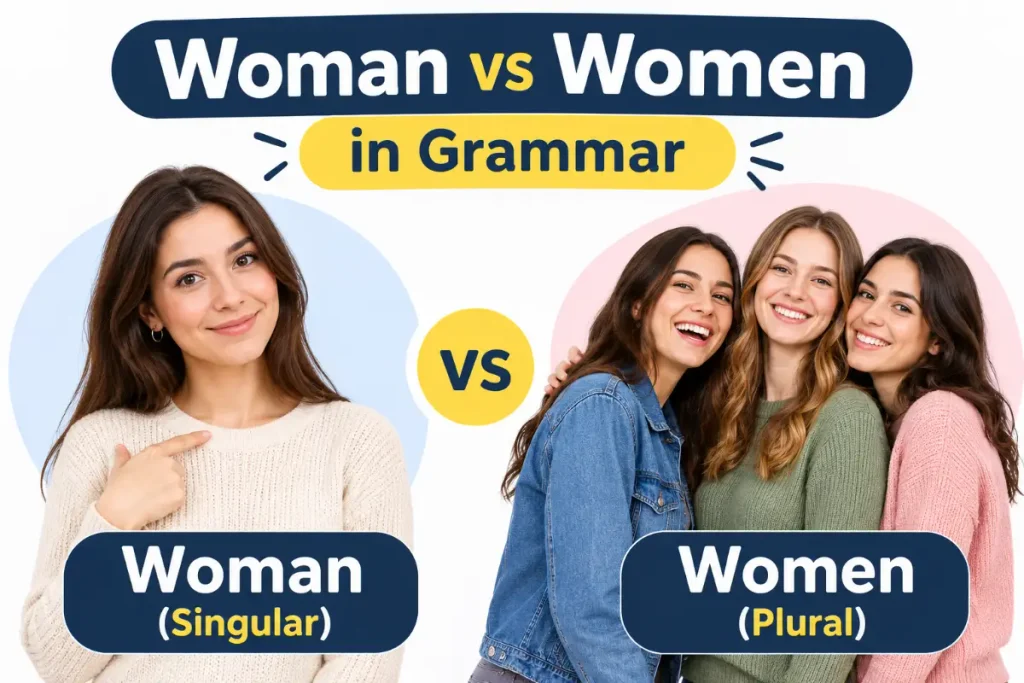
Understanding singular and plural grammar helps you choose the correct word in different sentence structures.
Singular and Plural Verb Agreement
The noun woman takes singular verbs, while women takes plural verbs.
| Singular | Plural |
|---|---|
| The woman is happy. | The women are happy. |
| A woman works here. | Women work here. |
| The woman has a car. | The women have cars. |
| She was invited. | They were invited. |
| The woman does her job well. | The women do their jobs well. |
This rule applies to the present tense, past tense, and other sentence structures.
For example:
Incorrect: The woman are waiting.
Correct: The woman is waiting.
Incorrect: The women was invited.
Correct: The women were invited.
The noun determines whether the verb should be singular or plural.
Using A and An With Woman
Woman begins with a consonant sound, so it takes the article a, not an.
Correct examples:
- A woman called me.
- A woman works in the office.
- A woman is standing near the door.
Incorrect example:
– An woman called me.
The article an is used before vowel sounds, not simply before words that contain vowel letters.
Women is plural, so it generally does not take a or an.
Correct: Women are working in the building.
Incorrect: A women is working in the building.
If you want to identify one person, use a woman. If you want to identify multiple people, use women.
Using This and These
Demonstratives help identify particular people or objects. The choice between this and these depends on whether the noun is singular or plural.
Use this woman for one person.
Examples:
- This woman is my manager.
- This woman helped me yesterday.
- This woman lives next door.
Use these women for more than one person.
Examples:
- These women are my coworkers.
- These women helped organize the event.
- These women live in the same neighborhood.
Similarly, use that woman for one person and those women for multiple people.
Incorrect: These woman are my friends.
Correct: These women are my friends.
Using Each and Every
Each and every generally take singular nouns in standard English.
Correct:
- Each woman received a certificate.
- Every woman has an opportunity to participate.
- Each woman was invited to the event.
Incorrect:
- Each women received a certificate.
- Every women has an opportunity to participate.
The words each and every refer to individual members of a group, so they are followed by the singular noun woman.
Woman and Women Examples in Sentences
Examples from everyday situations can help you recognize how each form works.
Everyday Conversation Examples
1. The woman at the grocery store helped me find the milk.
The sentence refers to one specific person.
2. A woman is waiting for her friend outside.
The singular noun describes one person.
3. The women are having lunch together.
Women refers to multiple people.
4. Two women walked into the coffee shop.
The number two makes the plural form necessary.
5. That woman is wearing a beautiful jacket.
That identifies one particular person.
6. These women are from different cities.
These identifies more than one person.
7. I spoke to a woman about the apartment.
The speaker had a conversation with one person.
8. Several women attended the wedding.
Several indicates a plural group.
9. The woman who lives upstairs is friendly.
The relative clause describes one woman.
10. The women who live upstairs are friendly.
The sentence describes multiple people.
Texting and Social Media Examples
These words also appear frequently in messages, captions, and social media posts.
- I met a woman who loves photography.
- Those women look amazing in their pictures.
- This woman always makes me laugh.
- The women in this video are talented.
- I saw a woman posting about her new business.
- These women inspire me every day.
In casual messages, people may shorten sentences or omit some words. However, woman and women still follow the same singular and plural rules.
For example, “That woman is hilarious” and “Those women are hilarious” remain grammatically correct in casual conversation.
Workplace and Professional Examples
Both forms are appropriate in formal and professional writing.
Examples:
- The woman leading the project has extensive experience.
- Several women applied for the position.
- The women on the committee reviewed the proposal.
- A woman from the marketing department will contact you.
- The organization supports women in leadership.
- Each woman received a copy of the report.
- The woman responsible for the presentation arrived early.
- Women in the industry continue to contribute valuable ideas.
These examples demonstrate how the words work in workplace communication, reports, and professional documents.
Academic and Educational Examples
Students often encounter these nouns in essays, research papers, and classroom discussions.
Examples:
- The woman in the novel represents courage.
- Many women contributed to scientific discoveries.
- The professor interviewed a woman for the study.
- The women in the experiment completed the questionnaire.
- Every woman in the class received a certificate.
- The researcher studied the experiences of women in education.
When writing academically, make sure your noun and verb agree. Also, use terminology that accurately reflects the people or group being discussed.
The Possessive Forms of Woman and Women
Possessive nouns show ownership, association, or a relationship.
The singular possessive form of woman is woman’s. The plural possessive form of women is women’s.
| Form | Meaning | Example |
|---|---|---|
| Woman | One person | The woman is a doctor. |
| Woman’s | Belonging to one woman | The woman’s bag is here. |
| Women | Multiple people | The women are doctors. |
| Women’s | Belonging to multiple women | The women’s bags are here. |
Woman’s in Sentences
Use woman’s when something belongs to or is associated with one woman.
Examples:
- The woman’s phone rang.
- I borrowed the woman’s umbrella.
- The woman’s opinion was important.
- The woman’s office is upstairs.
- The woman’s children attend school nearby.
The apostrophe comes before the S because the noun is singular.
Women’s in Sentences
Use women’s when something belongs to or is associated with multiple women.
Examples:
- The women’s team won the championship.
- The women’s restroom is downstairs.
- The women’s clothing department is on the second floor.
- The women’s meeting starts at noon.
- The women’s rights movement changed history.
Women is already a plural noun ending in S. To create its possessive form, add an apostrophe after the S.
Incorrect: Womens clothing
Correct: Women’s clothing
Incorrect: Womans team
Correct: Woman’s team, if referring to one woman, or women’s team, if referring to multiple women.
Common Mistakes With Woman and Women
Even experienced English speakers sometimes confuse singular and plural forms. The following mistakes are especially common.
Using Women for One Person
Incorrect: The women is my mother.
Correct: The woman is my mother.
The sentence refers to one person, so woman is the correct noun.
Using Woman for Multiple People
Incorrect: Three woman are waiting.
Correct: Three women are waiting.
The number three requires a plural noun.
Adding S to Woman
Incorrect: There are five womans in the room.
Correct: There are five women in the room.
Woman has an irregular plural form. You cannot create the standard plural by simply adding S.
Using a Singular Verb With Women
Incorrect: The women is ready.
Correct: The women are ready.
Women is plural, so it requires a plural verb.
Using a Plural Verb With Woman
Incorrect: A woman are speaking.
Correct: A woman is speaking.
A woman refers to one person, so the verb should be singular.
Confusing Woman’s and Women’s
Incorrect: The womens team played well.
Correct: The women’s team played well.
The correct plural possessive form includes an apostrophe after the S.
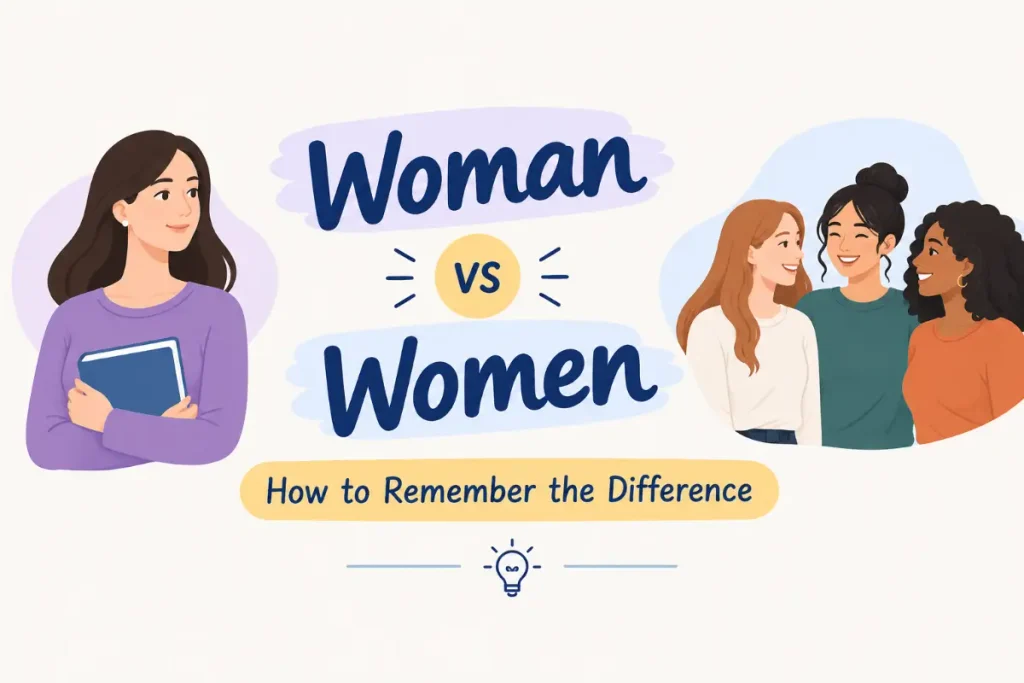
How to Remember the Difference
A few simple memory techniques can help you distinguish the singular and plural forms.
Remember the A and E Pattern
The singular form contains A:
Woman
The plural form contains E:
Women
You can remember the pattern this way:
- One woman.
- Two women.
The vowel changes from A to E when the word becomes plural.
Connect the Word With a Number
Think about the number of people you are describing.
- 1 woman
- 2 women
- 3 women
- 4 women
- 10 women
The noun changes to women once you are talking about more than one person.
Practice Singular and Plural Pairs
Try these pairs:
- A woman is walking. The women are walking.
- One woman works here. Three women work here.
- That woman is friendly. Those women are friendly.
- The woman’s coat is red. The women’s coats are red.
Reading these pairs aloud helps you recognize both the spelling and grammatical differences.
Check the Verb
- If you are unsure which noun to use, look at the verb.
- If the sentence uses is, was, has, or does, you may need the singular form woman.
- If the sentence uses are, were, have, or do, you may need the plural form women.
This is a useful clue, although you should always check the full sentence because other grammatical structures can affect verb choice.
Woman vs Women in American English
In American English, woman and women follow the same standard spelling and grammar rules used in other major varieties of English.
Woman is singular, and women is plural. Their meanings do not change significantly between American, British, Canadian, and Australian English.
The main differences you might notice involve pronunciation, accent, or sentence style rather than spelling.
For example:
- American English: The woman is waiting.
- British English: The woman is waiting.
- American English: The women are waiting.
- British English: The women are waiting.
Both forms are standard across these varieties.
Are Woman and Women Formal or Informal
Both words are neutral and suitable for formal and informal communication.
You can use them in:
- Everyday conversations.
- Text messages.
- Academic writing.
- Workplace emails.
- News articles.
- Business reports.
- Professional presentations.
The important factor is not formality but grammatical accuracy and respectful language.
Frequently Asked Questions
Is It Woman or Women for One Person?
Use woman when referring to one adult female person. For example, “The woman is my teacher.” Women is the plural form and refers to two or more people. If you are describing one individual, woman is the correct choice.
Is Women the Plural of Woman?
Yes, women is the plural form of woman. It is an irregular plural noun because it changes its spelling instead of simply adding S. For example, one woman becomes two women, and a woman becomes several women.
Why Is Women Pronounced Differently From Woman?
The first vowel sound changes between the two words. Woman is generally pronounced “WUHM uhn,” while women is pronounced “WIM in.” The difference comes from English pronunciation patterns, even though the spelling changes only slightly.
Which Is Correct Women Is or Women Are?
Women are is correct in standard English because women is a plural noun. For example, “The women are waiting outside.” Women is takes a singular verb and is generally incorrect when women refers to multiple people.
Is It Women’s or Womans?
Women’s is the standard plural possessive form, while woman’s is the singular possessive form. For example, “The woman’s bag” refers to one woman, and “The women’s bags” refers to multiple women. Womans is not the standard plural form.
Can I Say a Women?
No, a women is grammatically incorrect in standard English. The article a must be followed by a singular countable noun, so you should write “a woman.” Use women without a when referring to multiple people.
What Is the Difference Between Woman and Female?
Woman is a noun that generally refers to an adult female person. Female can function as an adjective or a noun and can describe people, animals, or biological sex. In everyday communication, woman is often more natural when referring to an adult person, while female may be appropriate in specific scientific or descriptive contexts.
Is Women Singular or Plural?
Women is plural. It refers to two or more people and normally takes plural verbs such as are, were, have, and do. The singular form is woman, which usually takes verbs such as is, was, has, and does.
Conclusion
The difference between woman vs women is simple once you understand singular and plural nouns. Woman refers to one adult female person, while women refers to two or more people. Remember that the singular form contains A and the plural form contains E.
Use woman with singular expressions such as a woman, this woman, and the woman is. Use women with plural expressions such as these women, several women, and the women are. Pay attention to verb agreement, articles, demonstratives, and possessive forms to keep your sentences accurate.
The easiest way to remember the distinction is to count the people you are describing. One person means woman. Two or more people means women. Practice this simple rule, and you will use both forms confidently in everyday conversations, academic writing, and professional communication.