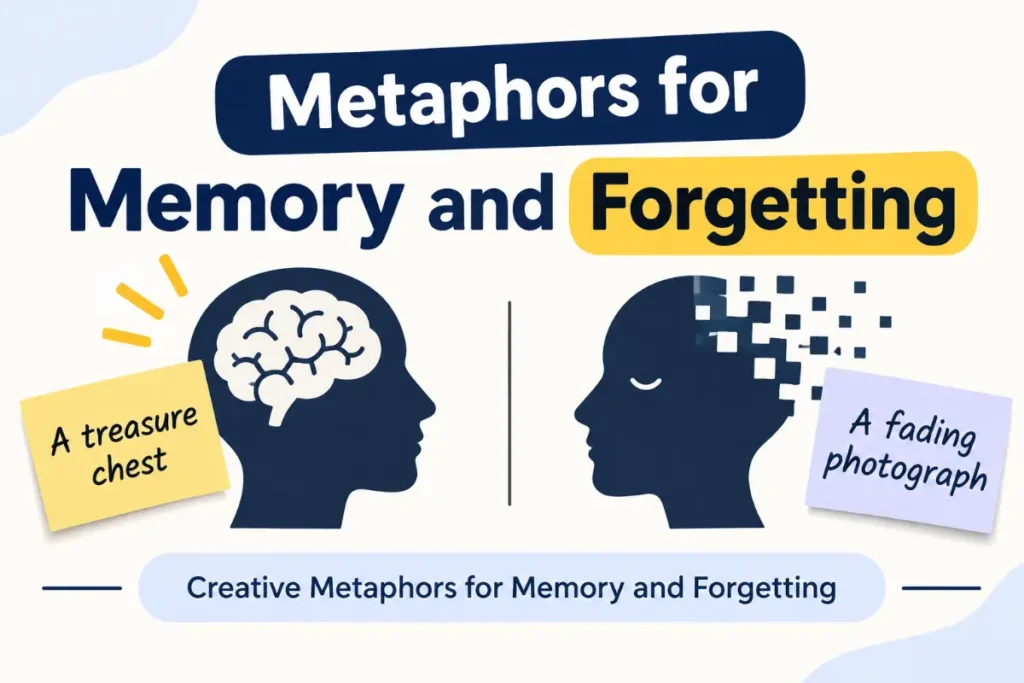
Some memories stay with us for decades, while others disappear before the day is over. A familiar smell can bring back an entire childhood moment, yet a simple name can slip from our minds in seconds. That’s what makes memory so fascinating—and why metaphors are such a powerful way to describe it.
Think of memory as a dusty attic, a fading photograph, or a river carrying pieces of the past. Each image reveals a different side of how we remember, revisit, and sometimes lose our experiences. These 40 metaphors for memory explore those ideas, with clear meanings and relatable example sentences.
Whether you’re writing a personal essay, memoir, or story, the right metaphor can make an abstract thought feel real. You’ll also find useful writing tips and fresh alternatives to overused expressions. For more inspiration, browse our metaphor examples by topic.
What Is a Metaphor for Memory?
A metaphor for memory describes remembering or forgetting as something else, without using “like” or “as.” “He remembered his childhood” states a fact. “His childhood was a scratched film reel” shows that parts are missing or blurry. The comparison is not literal. It borrows the qualities of the image, such as storage, flow, light or fading, to show how memory works and how it feels.
We use memory metaphors in daily speech without noticing: a trip down memory lane, a mind like a sieve, a photographic memory, something etched in my mind, a name on the tip of my tongue. These phrases show how naturally we picture the mind as a place, a machine or a book.
Why Do We Use Metaphors for Memory?
Memory cannot be seen or touched, so we borrow images from the physical world. Storage images, like attics and libraries, show that memories are kept. Water images show that they change. Light and fog images show that they fade. Each one captures a different truth about how remembering works.
Memory also carries emotion. A song can bring back a whole summer, and a smell can open a door to a kitchen from forty years ago. Metaphors help writers show that power. They also help us talk about forgetting, which can be funny, sad or frightening, with honesty and a little gentleness.
Memory as Storage: Attics, Libraries and Albums
Storage is the most common image for memory because it suggests that the past is kept somewhere.
- Memory is an attic full of boxes. Old moments are stored away, and some are dusty.
- Her mind was a library with no catalog. Everything was in there, but hard to find.
- His memory was a filing cabinet with one stuck drawer. One memory was hard to reach.
- Her memories were a photo album fading in the sun. Details blurred as time passed.
- The past was a locked trunk at the foot of the bed. Memories kept private and shut away.
Memory as Water and Rivers
Water images show memory as something that flows, changes and sometimes surprises us.
- Memory is a river that changes its course. Over time, stories shift.
- Childhood was a lake she could see to the bottom only on clear days. The past was visible only sometimes.
- Old memories were stones at the bottom of a stream. Still there, smoothed by time.
- Nostalgia was a tide that washed over him at dusk. A sudden wave of longing.
- The well of memory ran deepest at night. More memories rose when everything was quiet.
Memory as Film and Photographs
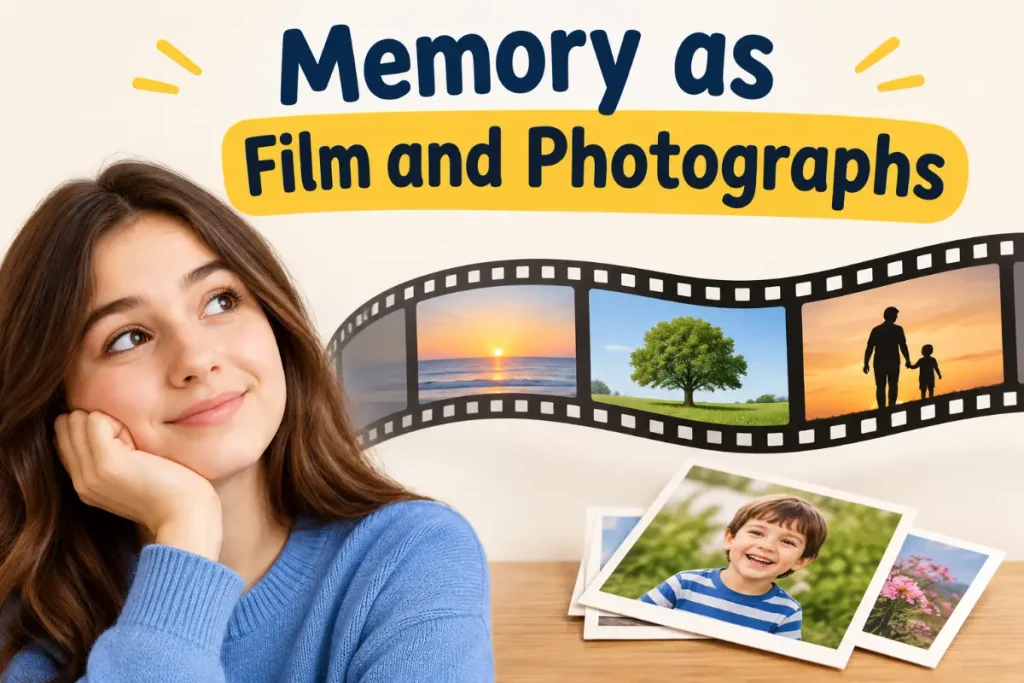
Film and photo images show memory as a replay of the past, with all the editing that involves.
- Remembering is editing a movie. Each replay changes the story a little.
- Her mind was a projector that never stopped. The past kept playing.
- The snapshot froze the moment while the rest of the day moved on. A photo kept one second and lost the rest.
- His childhood was a scratched film reel. Parts were missing or blurry.
- The smell of the bakery was a trapdoor into childhood. A scent that suddenly dropped him into the past.
Memory as Light, Fog and Fading
These images show how memories brighten, dim and blur over time.
- Memory is a candle that flickers. Sometimes bright, sometimes dim.
- The details were faded ink on old paper. Hard to read.
- Time was a fog creeping over the past. It hid more with each year.
- His mind was a mirror with a crack down the middle. Recall was broken and partial.
- Last summer was a lantern glowing at the edge of the field. A bright memory that stayed clear.
Memory as Thread, Quilts and Maps
These images show memory as something that connects moments and shapes a life.
- Memory is a thread through the eye of a needle. It links scattered moments.
- Her life was a quilt of remembered afternoons. Patches of the past stitched together.
- Old routes lingered on a map that had been redrawn. The past stayed in the mind after the world changed.
- Stories were breadcrumbs through a dark forest. They helped her find the way back.
- Memories were beads on a string. Small on their own, but connected.
Forgetting: Sand, Nets and Frost
These images show forgetting as slow, sudden or quietly natural.
- Forgetting was sand slipping through his fingers. Gradual and hard to stop.
- The name was a fish that slipped back into the water. So close, then gone.
- Time was an eraser on a chalkboard. Details were wiped away.
- Her mind was a net with wide holes. Small things slipped through.
- The dream was frost on the window, gone by breakfast. It disappeared as the day warmed.
Memory, Nostalgia and Emotion
Memories are not neutral. These images show the feelings that come with them.
- Nostalgia is a warm blanket with a hole in it. Comfort mixed with a touch of loss.
- Memories of home were a treasure chest she opened on lonely nights. A valued source of comfort.
- His regret was a splinter in an old photograph. A small, painful part of a happy picture.
- The song was a key that opened a locked room. Music brought back a hidden past.
- Some memories are ghosts that walk through the house. They return and haunt, whether we want them or not.
Memory, the Brain and Learning
These images show memory as something we train and use.
- Memory is a muscle that grows with use. Practice makes it stronger.
- Her mind was a sponge soaking up facts. Quick to absorb new information.
- His memory was a hard drive nearing full. Little room left for anything new.
- The brain is a garden where unused paths grow over. Memories that are not revisited fade.
- A mnemonic is a hook to hang a fact on. A trick that makes something easy to recall.
Metaphors for Memory in Sentences and Paragraphs
Here are short examples showing memory metaphors in real sentences.
- When she opened the old trunk, the past was an attic, and every box held a different year.
- His grandmother’s recipes were a thread through the eye of a needle, tying three generations together.
- The smell of rain on hot pavement was a trapdoor into the summer he turned ten.
- By ninety, her memory was a lantern at the edge of the field: dim, but still lit for the people she loved.
Here is a longer example that builds one image across a paragraph:
The old house was a photo album left in the sun. The front hall had faded to a pale yellow, the kitchen had lost its edges, and the staircase was only a suggestion. But in the corner of the living room, the afternoon light still fell the same way it always had, sharp and warm, and for one moment Ravi could see everything: his father’s chair, the clatter of plates, the smell of onions in oil. The picture was never complete, but that corner was as bright as the day it was taken.
And here is a shorter example about forgetting:
He knew the word. He could feel its shape. It was a fish that slid between his fingers every time he reached for it, flashing silver in the dark water of his mind.
The Memory Scale
Memories come in different clarity, and the best metaphors match them.
| Level | Type | Metaphor | What it shows |
|---|---|---|---|
| Fresh | A recent memory | The morning was a lantern still warm. | Clear and close |
| Clear | A strong memory | Last summer was a lantern at the edge of the field. | Bright and lasting |
| Fading | An older memory | Her memories were a photo album fading in the sun. | Slowly blurring |
| Foggy | A hazy memory | Time was a fog creeping over the past. | Hard to see |
| Lost | A forgotten memory | Forgetting was sand slipping through his fingers. | Gone and hard to catch |
| Revived | A memory that returns | The song was a key that opened a locked room. | Sudden and vivid |
How Writers Use Memory Metaphors
Memory is at the heart of memoirs, family stories, mysteries and many poems. A few techniques help.
Use sensory triggers. Smell, music and taste are strong memory doors. A metaphor like “the smell of rain was a trapdoor into childhood” shows how a small detail can bring back a whole world.
Show that memory is unreliable. People do not remember events exactly as they happened. Images of editing, fading and rivers that change course show this honestly and can add depth to a narrator.
Match the image to the kind of memory. A scratched film suggests broken or partial memory. A lantern suggests a bright, treasured one. A ghost suggests a haunting one. Choose the one that fits.
Use setting to anchor it. An attic, a kitchen or an old street can hold memory in a story. A metaphor then names what the place means.
Balance nostalgia with truth. Memory can make the past look sweeter than it was. Writers can use that, as in “nostalgia is a warm blanket with a hole in it,” to show both comfort and loss.
Treat forgetting with care. Forgetting can be funny, sad or frightening. Avoid mocking people who struggle with memory, and let the metaphor show feeling, not judgment.
How to Use Memory Metaphors in Essays and Memoirs
In a school essay, follow three steps: find the metaphor, explain it and show its effect.
- Find it. Look for a comparison that says memory is something, such as “memory is an attic full of boxes.”
- Explain it. Say what the two things share. An attic holds old things that are rarely visited, so the comparison shows that memories are stored and sometimes forgotten.
- Show the effect. Say what the reader feels, such as nostalgia, curiosity or sadness.
Here is a short sample paragraph:
The writer describes the narrator’s childhood as “a scratched film reel.” This metaphor suggests that the memories are incomplete and damaged. The word “scratched” shows that parts are missing or distorted, which makes the reader trust the narrator’s account a little less. As a result, the reader senses the gap between what happened and what is remembered.
In a memoir, one strong memory metaphor can set the tone for a whole chapter. Start with a sensory detail, introduce the image and then tell the story.
Common Memory Phrases to Avoid
Many memory phrases are so familiar that readers barely notice them. Try fresher images when you can.
| Common phrase | Fresher alternative |
|---|---|
| Trip down memory lane | A walk through a house where every door opened on a different year. |
| Etched in my memory | The day was written in pencil, and I kept going over the lines. |
| Slipped my mind | The thought stepped out of the room without saying goodbye. |
| Photographic memory | A mind like a camera that never ran out of film. |
| On the tip of my tongue | The word hovered just behind a door that would not open. |
| Blast from the past | A letter from a person I used to be. |
Other mistakes to watch for:
- Mixing images. “Memory is a river that burns like a candle” blends two pictures. Choose one.
- Too much nostalgia. Show some imperfection to keep the memory honest.
- Treating memory loss as a joke. Be gentle with forgetting, especially when writing about older people or illness.
- Overdoing it. One clear image per paragraph is usually enough.
Try It Yourself: Write a Memory Metaphor in Five Steps
Use these steps with any memory.
- Choose a memory. For example: a childhood kitchen.
- Decide how clear it is. Is it bright, faded or broken?
- Pick a source. Think of storage, water, light, film, thread or weather.
- Write three versions. For example: The kitchen was a photograph left in the sun. / My grandmother’s voice was a thread through the years. / The smell of bread was a trapdoor into childhood.
- Choose the best one and add a detail. The smell of bread was a trapdoor into childhood, and I was standing on a stool again, flour on my elbows.
Now write a second version about forgetting, using sand, frost or a net with wide holes.
Frequently Asked Questions
What is a good metaphor for memory?
“Memory is an attic full of boxes” and “memory is a river that changes its course” are both popular. One shows storage, and the other shows change over time.
What is a metaphor for forgetting?
Try sand slipping through fingers, a fish that slides back into the water, frost that melts by breakfast or a net with wide holes. They show forgetting as gradual or sudden.
What is a metaphor for a good memory?
Try a vault, a library with a perfect catalog or a lantern that stays bright. They show memories that are kept safe and easy to find.
What is a metaphor for a bad or fading memory?
Try a faded photograph, ink on old paper, a cracked mirror or a fog creeping over the past. They show blur and loss.
Is “a trip down memory lane” a metaphor?
Yes. It compares remembering to walking along a road through the past. Because it is so common, it is now considered a cliché.
What is the difference between a memory metaphor and a simile?
A simile uses “like” or “as,” such as “memory is like an attic.” A metaphor says “memory is an attic.”
Are memory metaphors good for memoirs and school essays?
Yes. They work well in memoirs, personal essays and poems. Add a sentence that explains what the image shows about the narrator or the past.
Conclusion
Memory is something we cannot see, so we describe it with pictures: attics, rivers, photo albums and lanterns. Each image shows a different truth. Storage shows that the past is kept, water shows that it changes, light and fog show that it fades, and thread shows that it holds a life together. Forgetting has its own images, from sand to frost, and they remind us that losing a memory can be sad, strange or even gentle.
When you write about memory, use sensory triggers, show that remembering is never perfect and match the image to the kind of memory you mean. Avoid worn-out phrases when you can, treat forgetting with care and explain your metaphor in school work. A single well-chosen image can bring the past into the room, even when the details have faded.
Related Metaphors
- For how memories pass through the years, read metaphors for time.
- When memory brings loss, see metaphors for grief.
- For the place many memories belong to, try metaphors for home.