Have you ever typed brite vs bright into a search engine because you weren’t sure which spelling was correct? It’s a common question. At first glance, the two words look almost identical, and they even sound the same. That makes it easy to assume they’re interchangeable. In most situations, they aren’t.
The short answer is simple. Bright is the standard English word you’ll find in dictionaries, schools, books, and professional writing. Brite, on the other hand, has a much more limited role. It sometimes appears as a brand name, a surname, an intentional alternative spelling, or part of a product name. Outside those situations, it isn’t considered the standard spelling.
This confusion usually happens because English contains many words that share the same pronunciation but have different spellings or purposes. Autocorrect, advertising, and brand names can make the distinction even harder to spot.
This guide explains the difference in plain English. You’ll learn what each word means, where each one belongs, how native speakers use them, and how to avoid common mistakes in everyday writing. You’ll also see pronunciation tips, real examples, grammar guidance, and expert editing advice so you’ll know exactly which spelling fits your sentence.
Quick Definition
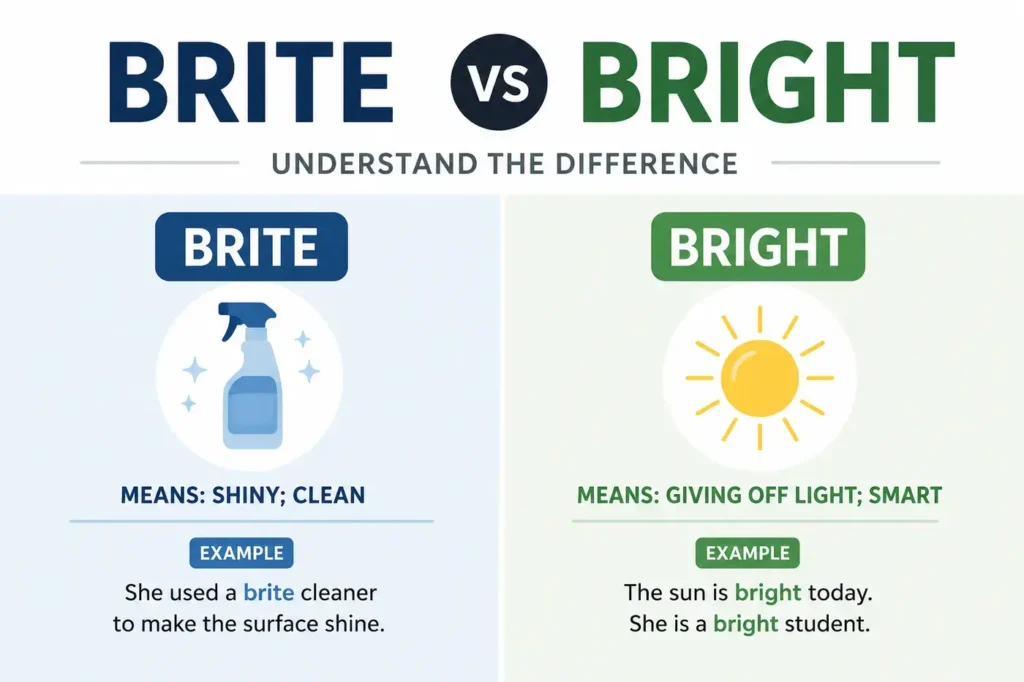
Bright is the correct English word for describing something full of light, intelligent, cheerful, or vivid. Brite isn’t the standard dictionary spelling in modern English. It usually appears in brand names, personal names, or as a deliberate alternative spelling rather than a regular vocabulary word.
Quick Answer
If you’re writing an email, school assignment, article, or business document, choose bright. Use brite only when you’re referring to a specific name, trademark, product, business, or another proper noun that intentionally uses that spelling.
Here’s an easy way to remember the rule.
- Bright is the standard English spelling.
- Brite is usually a name or stylized spelling.
- If you’re unsure, bright is almost always the correct choice.
Comparison Table
| Feature | Brite | Bright |
|---|---|---|
| Part of speech | Proper noun in many cases. Rare adjective. | Adjective. Adverb in some expressions. Noun in limited uses. |
| Meaning | Usually a brand name, surname, or intentional spelling variation. | Full of light. Intelligent. Cheerful. Vivid. Promising. |
| Origin | Alternative spelling developed mainly for names and branding. | Old English beorht. |
| Standard English | No in most contexts. | Yes. |
| Formality | Depends on the name or brand. | Suitable in both formal and informal writing. |
| Common contexts | Product names. Company names. Personal names. Marketing. | Everyday conversation. Literature. Education. Business. Journalism. |
| Usage frequency | Rare in ordinary writing. | Extremely common. |
| Example | Brite Laundry Detergent. | The room looked bright after sunrise. |
If you enjoy learning about common spelling mix-ups, you’ll also find plenty of everyday word pairs that can easily trip up even confident writers.
Meaning Of Each Word
Although these words sound identical, they don’t serve the same purpose. Understanding each one separately makes the difference much easier to remember.
What Does Bright Mean
Bright is a standard English adjective with several related meanings. Depending on the sentence, it can describe light, intelligence, colors, emotions, or even the future.
You’ll commonly see it used to describe:
- A place with plenty of light.
- Someone who learns quickly.
- Strong or vivid colors.
- A cheerful personality.
- A hopeful future.
Here are a few examples.
- The classroom was bright and welcoming.
- Maya is one of the brightest students in her class.
- She chose a bright yellow jacket.
- His bright smile made everyone feel comfortable.
- The company has a bright future ahead.
Even though these examples describe different situations, they all share the idea of something positive, noticeable, or full of energy.
What Does Brite Mean
Unlike bright, brite isn’t a standard vocabulary word in modern English. Most dictionaries either don’t include it as a standalone word or identify it as a variant spelling used in specific names.
You’ll most often encounter brite in situations like these.
- Brand names.
- Product labels.
- Company names.
- Personal names.
- Creative marketing.
For example:
- A cleaning product might use Brite as part of its brand name.
- A business may choose the spelling because it’s short, memorable, and distinctive.
- Some people have Brite as a family name.
Outside these situations, replacing bright with brite is generally considered a spelling mistake.
Key Differences
The easiest way to remember the difference is to think about purpose instead of appearance. Both words sound the same, but they belong in different contexts.
Here are the biggest differences.
| Brite | Bright |
|---|---|
| Usually a name or branding choice. | Standard English word. |
| Rare in everyday writing. | Used every day by native speakers. |
| Not the preferred dictionary spelling. | Accepted by all major dictionaries. |
| Common in trademarks and product names. | Common in speech and writing. |
| Limited grammatical use. | Used in many different sentence structures. |
A useful rule is this. If you’re describing a person, object, color, room, idea, or future, bright is almost certainly the word you need. If you’re referring to the official name of a company or product, keep the spelling exactly as that name appears.
Which One Is Correct
For ordinary English writing, bright is the correct spelling.
That’s the version you’ll see in dictionaries, classrooms, newspapers, novels, business communication, and academic writing. Native speakers use it naturally because it’s part of standard English vocabulary.
Brite isn’t wrong in every situation. It’s simply used for a different purpose. When a company chooses Brite as part of its name, the spelling is intentional and should never be changed. The same applies to personal names and registered trademarks.
Before choosing between the two, ask yourself this question.
Am I describing something, or am I referring to a specific name?
That simple question usually gives you the correct answer.
Pronunciation Guide
One reason people confuse these spellings is that they sound exactly alike.
Bright
IPA pronunciation:
/braɪt/
Syllable breakdown:
Bright
Brite
IPA pronunciation:
/braɪt/
Syllable breakdown:
Brite
Both words have the same pronunciation. The spelling changes, but the spoken sound stays exactly the same.
Here are a few pronunciation tips.
- The vowel sounds like the word eye.
- The final t should be clear but not overly emphasized.
- Native speakers pronounce both spellings in exactly the same way.
Is Brite A Real Word
This is one of the questions people ask most often.
The answer depends on what you mean by word.
Brite exists because you’ll find it in company names, product labels, and personal names. However, it isn’t the standard spelling used in modern English dictionaries when you’re describing light, intelligence, or vivid colors.
That’s why an English teacher would correct The room is brite to The room is bright, but they wouldn’t change the spelling if Brite were part of a company’s official name.
Understanding that distinction prevents many common spelling mistakes.
Expert Language Insight
Professional editors don’t choose between these spellings based on preference. They choose based on context.
When editing articles, books, or business documents, experienced editors automatically replace brite with bright unless the word is part of an official name. That’s because dictionaries, style guides, and publishing standards recognize bright as the correct spelling for everyday English.
This is also how native speakers think about the word. They don’t stop to decide between the two spellings because bright is the default choice. The only time brite appears naturally is when it’s tied to a specific brand, business, or person’s name.
Learning that habit will make your writing more accurate and more professional.
Examples In Sentences
The easiest way to remember the difference is to see each word in context. After reading a few examples, you’ll notice that bright fits naturally into everyday English, while brite usually appears only as part of a specific name.
Bright Examples
These sentences show how native speakers use bright in daily conversation and writing.
- The sun was so bright that I had to wear sunglasses.
- Emma is a bright student who enjoys solving difficult math problems.
- We painted the kitchen a bright shade of white to make it feel larger.
- The stars looked bright on the clear summer night.
- His bright smile made everyone feel welcome.
- The company has a bright future because it continues to innovate.
- She wore a bright red sweater that stood out in the crowd.
- The teacher praised the child for asking bright questions during class.
- A bright idea can solve a problem that seemed impossible.
- The room became much brighter after we opened the curtains.
These examples highlight the different meanings of bright. It can describe light, intelligence, colors, emotions, ideas, and future success.
Brite Examples
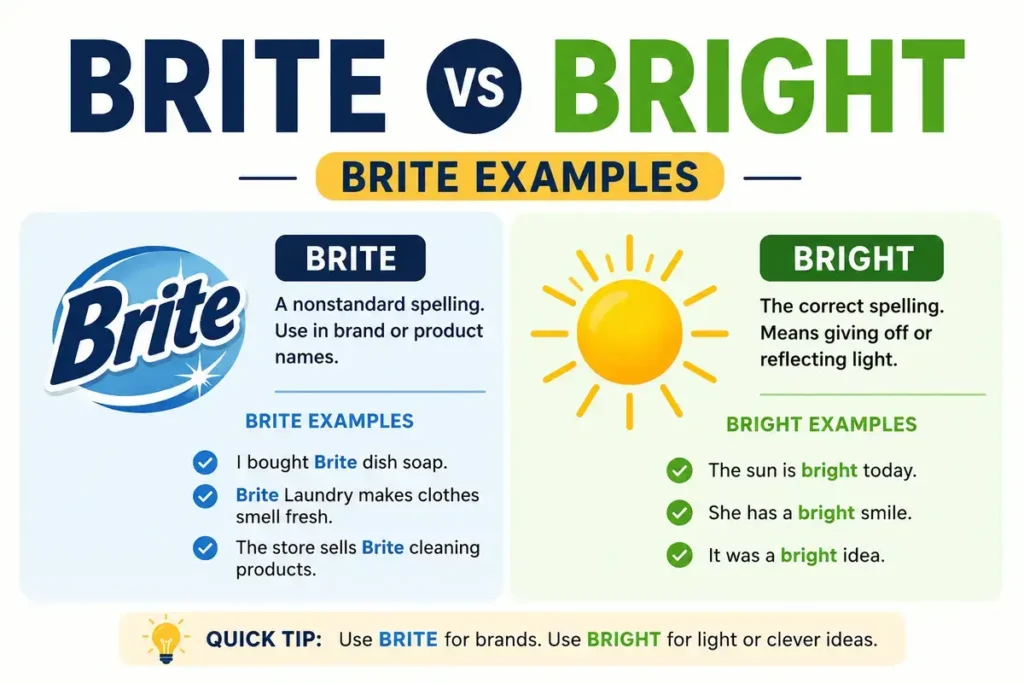
The word brite is much less common in ordinary English. You’ll mainly see it in names and branding.
- She bought a bottle of Brite floor cleaner at the store.
- The company introduced a new Brite cleaning solution.
- Mr. Brite spoke at the community meeting.
- The designer created a logo for Brite Technologies.
- Brite Dental opened a new office downtown.
- The package displayed the Brite brand on the front label.
- Our office switched to Brite Office Supplies.
- The advertisement promoted Brite Home Products.
- The conference was sponsored by Brite Solutions.
- Brite appeared as the company name throughout the presentation.
Notice that brite functions as part of a proper noun rather than a regular adjective.
Common Mistakes
Many spelling mistakes happen because people rely on pronunciation instead of context. Since both words sound exactly the same, it’s easy to type the wrong one without noticing.
Here are the mistakes editors see most often.
Using Brite Instead Of Bright
This is the most common error.
Incorrect:
The classroom is brite.
Correct:
The classroom is bright.
If you’re describing light, intelligence, color, or someone’s personality, bright is the correct spelling.
Assuming Both Spellings Are Interchangeable
Some people believe brite is simply another accepted spelling.
It isn’t.
Outside official names, standard English uses bright.
Changing Official Brand Names
Editors correct spelling mistakes, but they don’t change trademarks or proper nouns.
For example:
- Bright Laundry Detergent may be incorrect if the official product name is Brite Laundry Detergent.
- Company names should always keep their registered spelling.
Ignoring Context
Context usually answers the question before you even think about spelling.
Ask yourself:
- Am I describing something?
- Am I referring to a company or product?
If you’re describing something, bright is almost always the right choice.
Another frequently misspelled word follows a similar pattern, where one small spelling change can make the difference between a correct and incorrect form.
Etymology And Word Origin
The history of these spellings explains why one became standard while the other remained uncommon.
The Origin Of Bright
The word bright comes from the Old English word beorht, which meant shining, radiant, or clear. Similar words appeared in several early Germanic languages, showing that the concept has existed for well over a thousand years.
As English developed, the spelling gradually became bright, and its meaning expanded beyond light. Today, it can describe intelligence, cheerful personalities, vivid colors, promising futures, and creative ideas.
The Origin Of Brite
Unlike bright, brite didn’t develop as a standard English spelling.
Instead, it emerged much later as a simplified spelling adopted by businesses, advertisers, and product designers. Removing the letters gh made names shorter, easier to recognize, and more distinctive for branding.
That’s why you’ll find Brite in trademarks, business names, and product labels rather than in standard dictionaries.
Brite Meaning In German
Many people search for brite meaning in German, but this often comes from confusion with similar looking words.
Brite is not a standard German word with the same meaning as the English adjective bright. In German, words that describe brightness include terms such as hell for something full of light and klug for someone intelligent, depending on the context.
Regional Usage
Unlike many English spelling pairs, this isn’t a case of American versus British English.
American English
American English uses bright in everyday speech, education, journalism, business writing, and literature.
You’ll also find Brite in company names because businesses are free to create unique spellings for branding.
British English
British English follows exactly the same pattern.
The standard adjective is bright, while Brite appears mainly in proper nouns and trademarks.
Australian English
Australian English also recognizes bright as the correct spelling in ordinary writing. Alternative spellings such as Brite remain limited to names and branding.
Canadian English
Canadian English follows the same convention.
Regardless of the country, dictionaries, schools, publishers, and professional editors use bright as the standard spelling.
Grammar Rules
Understanding the grammar behind bright makes it much easier to use correctly.
Part Of Speech
Bright is most commonly an adjective.
Examples include:
- A bright room.
- A bright child.
- A bright future.
- A bright color.
In some contexts, it also appears in fixed expressions or older forms, but its primary role is as an adjective.
Comparative And Superlative Forms
Like many adjectives, bright changes form when making comparisons.
- Bright.
- Brighter.
- Brightest.
Examples:
- This room is brighter than the hallway.
- Today is the brightest day of the week.
Common Sentence Patterns
You’ll often see bright used with these nouns.
- Light.
- Color.
- Smile.
- Student.
- Future.
- Idea.
- Morning.
- Sky.
- Personality.
- Star.
These combinations sound natural because native speakers use them every day.
Bright Meaning And Sentence
The word bright has several related meanings, but each one suggests something positive, noticeable, or full of energy.
Here are a few natural examples.
- The bright sunshine warmed the entire park.
- Olivia is a bright engineer who solves problems quickly.
- They decorated the room with bright blue curtains.
- We all hope for a bright future.
- His bright attitude encouraged the rest of the team.
The meaning changes slightly with the context, but the overall idea remains consistent.
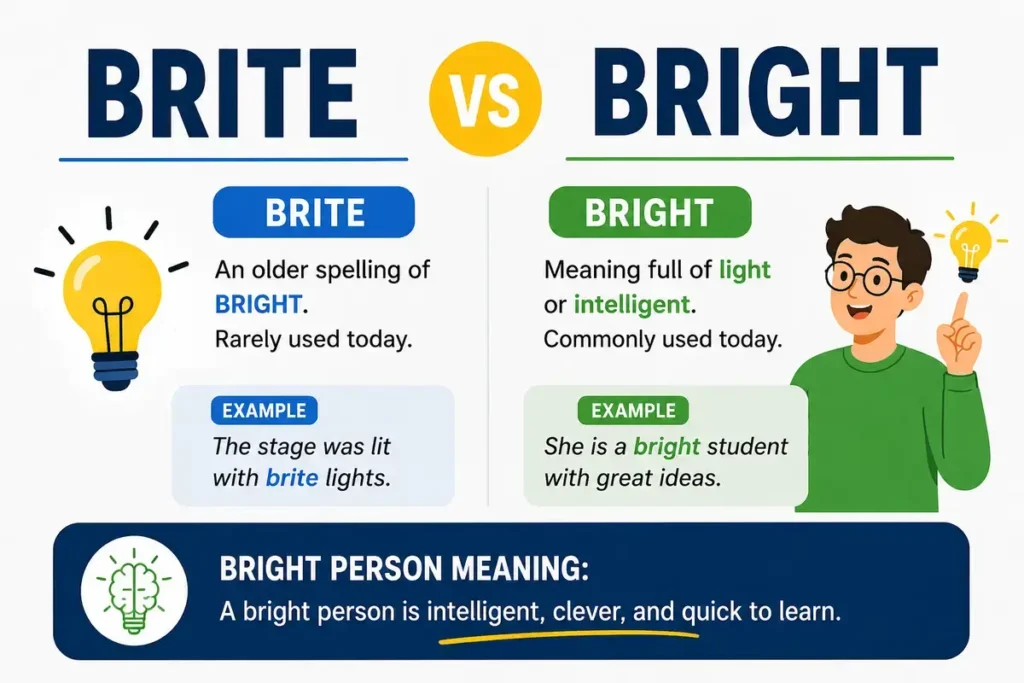
Bright Person Meaning
When someone describes a person as bright, they usually mean the individual is intelligent, quick to learn, or capable of understanding new ideas easily.
For example:
- She’s a bright student who enjoys science.
- He’s bright enough to solve complex problems without much help.
- The new employee is bright and learns quickly.
In everyday English, calling someone bright is a compliment because it recognizes their intelligence and ability to think clearly.
Related Words And Confused Terms
People who search for this topic often confuse bright with other words that look or sound similar. Learning the differences helps you avoid spelling mistakes and choose the right word with confidence.
Here are some commonly confused terms.
| Word | Meaning | Example |
|---|---|---|
| Bright | Full of light. Intelligent. Cheerful. | She has a bright future. |
| Brilliant | Extremely intelligent or impressive. | That was a brilliant solution. |
| Light | Natural or artificial illumination. | The room has plenty of light. |
| Radiant | Shining brightly or showing happiness. | She gave a radiant smile. |
| Vivid | Strong and clear in color or detail. | The painting uses vivid colors. |
| Luminous | Giving off or reflecting light. | The moon looked luminous tonight. |
| Smart | Intelligent or quick to learn. | He’s a smart student. |
| Clever | Good at solving problems. | She found a clever solution. |
Bright Synonyms
The best synonym depends on the sentence because bright has several meanings.
If you’re talking about light, these words often work well.
- Shining.
- Radiant.
- Luminous.
- Brilliant.
- Glowing.
You might choose if you’re describing intelligence:
- Smart.
- Clever.
- Intelligent.
- Sharp.
- Quick witted.
If you’re describing colors, consider:
- Vivid.
- Bold.
- Vibrant.
- Colorful.
- Brilliant.
Choosing the right synonym depends on the context rather than replacing every instance of bright with the same word.
Usage In Everyday Life
Although this spelling question seems simple, you’ll come across it in many situations.
Daily Conversation
People regularly use bright to describe light, colors, personalities, and intelligence.
Examples include:
- What a bright morning.
- She’s a bright student.
- That’s a bright idea.
- Your jacket is really bright.
Academic Writing
Teachers and professors expect the standard spelling in essays, reports, and research papers.
Using brite instead of bright in academic work is generally treated as a spelling error unless you’re referring to a proper name.
Professional Communication
Business emails, reports, proposals, and presentations also use bright in its standard form.
Examples include:
- We have a bright opportunity ahead.
- The office feels bright after the renovation.
- She shared several bright ideas during the meeting.
Literature
Authors use bright in both literal and figurative ways.
It may describe sunshine, stars, hope, intelligence, happiness, or colorful imagery. The flexibility of the word makes it one of the most commonly used descriptive adjectives in English.
Media And Advertising
Advertising introduces one exception.
Many companies intentionally spell their names as Brite because the shorter form is distinctive and memorable. In those cases, the spelling reflects branding rather than standard English.
English is full of words that look alike but mean different things, making it worthwhile to understand how context determines the correct choice.
Brite In The Bible
Some people search for brite vs bright bible or wonder if brite appears in the Bible.
Modern English Bible translations use bright when describing light, glory, stars, angels, or radiant appearances. The spelling brite does not appear as the standard English word in widely used Bible translations. If you encounter Brite in religious material, it’s most likely part of a person’s name, a publisher’s name, or another proper noun rather than a vocabulary word.
Expert Language Insight
Professional editors don’t make spelling decisions by habit alone. They look at context first.
When editing articles, books, academic papers, or business documents, the default choice is always bright because it’s the recognized dictionary spelling. The only time editors leave Brite unchanged is when it’s part of an official name, trademark, or another proper noun.
Native speakers follow the same pattern naturally. They don’t pause to decide between the two spellings because bright is deeply established in everyday English. Seeing brite in a normal sentence often feels unusual unless readers immediately recognize it as a brand or name.
A useful editing habit is to ask yourself one question before proofreading.
Is this word describing something, or is it naming something?
If it’s describing light, intelligence, color, or a positive quality, bright is almost certainly correct. If it’s the official name of a business, product, or person, keep the original spelling exactly as it appears.
Frequently Asked Questions
Is brite a real word?
Brite exists as a name, trademark, surname, and intentional alternative spelling. It isn’t the standard English word used to describe light, intelligence, or vivid colors. In everyday writing, bright is the correct choice.
Which spelling should I use?
Use bright in ordinary English writing, including emails, school assignments, articles, and professional documents. Use Brite only when you’re referring to an official company name, product, or another proper noun that uses that spelling.
Why do bright and brite sound the same?
They’re homophones, which means they share the same pronunciation even though they have different spellings and uses. English has many homophones, including pairs like right and write.
Is brite accepted in dictionaries?
Most dictionaries recognize bright as the standard English word. Some dictionaries may mention brite as a variant spelling or note its use in names and trademarks, but it isn’t treated as the normal spelling for everyday English.
Does the spelling change in American or British English?
No. Both American and British English use bright as the standard spelling. Unlike pairs such as color and colour, this isn’t a regional spelling difference.
Can I use brite in school or business writing?
It’s best not to unless you’re writing an official name. Teachers, editors, and employers expect the standard spelling in formal communication, so bright is the safer and more accurate choice.
What does bright mean when describing a person?
Describing someone as bright means they’re intelligent, quick to understand new ideas, or able to solve problems effectively. It’s a positive compliment that’s common in both casual conversation and professional settings.
How can I remember the correct spelling?
Think about the letters gh as part of the standard English word. If you’re describing light, intelligence, a cheerful personality, or a promising future, you’ll almost always need bright. Save Brite for names and branding.
Conclusion
The difference between these two spellings becomes clear once you understand their purpose. Bright is the standard English word used to describe light, intelligence, vivid colors, cheerful personalities, and hopeful futures. It’s the spelling you’ll find in dictionaries, classrooms, books, newspapers, and professional writing.
Brite has a much narrower role. It usually appears in company names, product labels, personal names, or creative branding. Outside those situations, it isn’t considered the standard spelling.
When you’re unsure, let the context guide your decision. If you’re describing a quality or characteristic, choose bright. If you’re referring to an official name that intentionally uses Brite, keep that spelling exactly as written. Following this simple rule will make your writing clearer, more accurate, and more professional.