Have you ever typed cheff or chef and paused because both words looked right for a moment? It is a common mistake. Many people add an extra f by accident, especially when writing quickly or relying on autocorrect. Since the word appears so often in recipes, cooking shows, restaurant menus, and social media, it is easy to second guess the spelling.
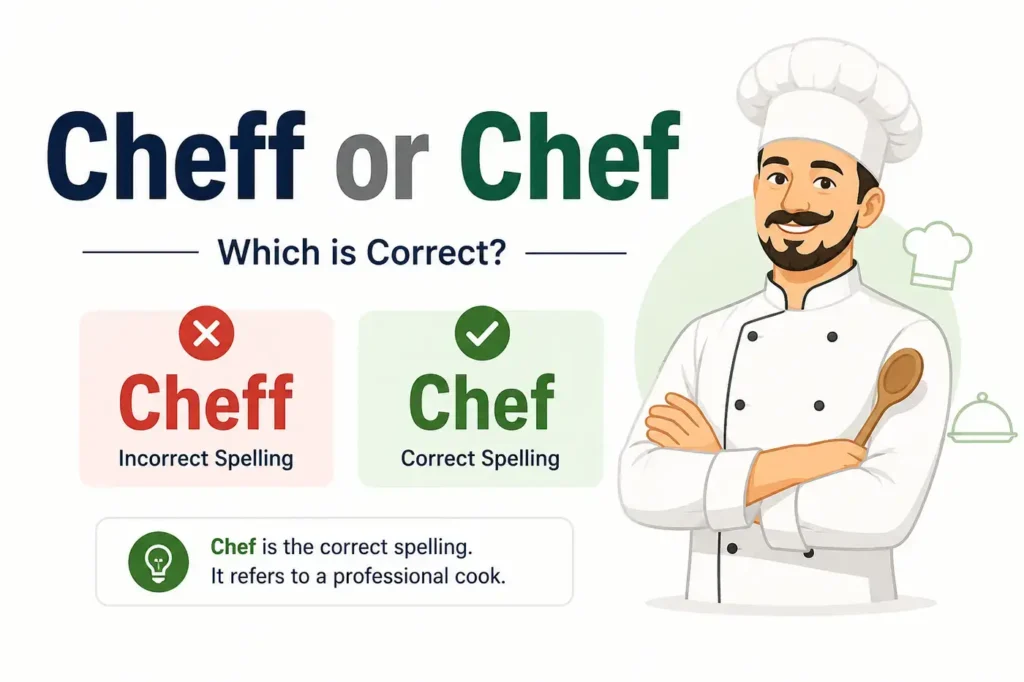
The correct spelling is chef. The word cheff is a misspelling and is not recognized as a standard English word. You should use chef in every form of professional, academic, and everyday writing. This applies to restaurant menus, job titles, resumes, business websites, and casual conversations.
The confusion usually comes from English spelling patterns. Many English words end with double consonants, so some writers naturally assume this word follows the same rule. It does not. The word entered English from French, where it has always been spelled chef with a single f.
This guide explains the correct spelling, pronunciation, meaning, history, grammar, and real world usage. You will also learn why the mistake happens, how professional editors handle it, and simple tricks that make the correct spelling easy to remember.
Quick Definition
A chef is a professional cook who is trained to prepare, cook, and often supervise food in a restaurant, hotel, bakery, catering business, or commercial kitchen. Cheff is simply a spelling mistake and should never replace chef in standard English writing.
Quick Answer
If you only need the short answer, here it is.
- Chef is the correct spelling.
- Cheff is incorrect.
- Use chef in American English, British English, Australian English, and Canadian English.
- The spelling does not change across English speaking countries.
- The pronunciation stays almost the same around the world, although accents vary slightly.
If you are writing about a professional cook, always choose chef.
Similar spelling mistakes also appear with ordinal number spelling, where people often wonder whether ninth or nineth is the correct form.
Comparison Table
| Feature | Chef | Cheff |
|---|---|---|
| Part of speech | Noun | Not a standard English word |
| Meaning | A professional cook who manages or prepares food | No accepted meaning |
| Origin | Borrowed from French | Misspelling of chef |
| Correct form | Yes | No |
| Formality | Standard in all writing | Incorrect |
| Common contexts | Restaurants hotels culinary schools recipes hospitality | None |
| Usage frequency | Extremely common | Appears only as a spelling error |
| Example | The chef prepared a five course dinner. | Incorrect spelling |
Meaning Of Each Word
Although these two spellings look similar, only one has a recognized meaning in English. Understanding the difference removes the confusion immediately.
What Does Chef Mean
A chef is a trained culinary professional responsible for preparing food and, in many kitchens, leading the cooking staff. Depending on the workplace, a chef may also create menus, develop recipes, order ingredients, manage food safety, and supervise other cooks.
The word is commonly associated with restaurants, but chefs also work in hotels, cruise ships, hospitals, catering companies, resorts, schools, and private homes.
Common responsibilities include:
- Planning menus.
- Preparing meals.
- Managing kitchen staff.
- Maintaining food quality.
- Following food safety standards.
- Creating new recipes.
- Controlling kitchen costs.
Not every cook is a chef. In professional kitchens, the title usually refers to someone with greater responsibility, experience, or leadership.
What Does Cheff Mean
The word cheff has no accepted meaning in English dictionaries.
It is simply a misspelling of chef. You may occasionally see it in social media posts, text messages, or online comments, but that does not make it correct. Spell checkers, dictionaries, publishers, and style guides recognize chef as the proper spelling.
If you accidentally write cheff in a resume, job application, restaurant website, or business document, it can make the writing appear less professional. Correct spelling builds credibility, especially in industries where attention to detail matters.
Key Differences
The biggest difference is simple. One is a real English word, and the other is not. Still, comparing them side by side helps reinforce the correct choice.
| Feature | Chef | Cheff |
|---|---|---|
| Dictionary entry | Yes | No |
| Correct spelling | Yes | No |
| Used by native speakers | Yes | Only as a mistake |
| Professional writing | Accepted | Avoid |
| Restaurant industry | Standard job title | Incorrect |
There are no differences in pronunciation, grammar, or meaning because cheff is not a legitimate alternative spelling. Every professional publication, dictionary, and language guide uses chef.
Which Spelling Is Correct
The answer is straightforward. Chef is always the correct spelling.
This rule applies across every major variety of English. Unlike words such as color and colour, there is no regional spelling difference. American English, British English, Australian English, and Canadian English all use exactly the same spelling.
If you are unsure, remember these simple rules.
- Write chef with one f.
- Never add an extra f.
- Use the same spelling in formal and informal writing.
- Follow the spelling used in dictionaries and professional publications.
Once you know that the word comes directly from French, the spelling becomes much easier to remember.
Pronunciation Guide
Many people spell the word incorrectly because they rely on how it sounds instead of learning its written form. Fortunately, the pronunciation is simple.
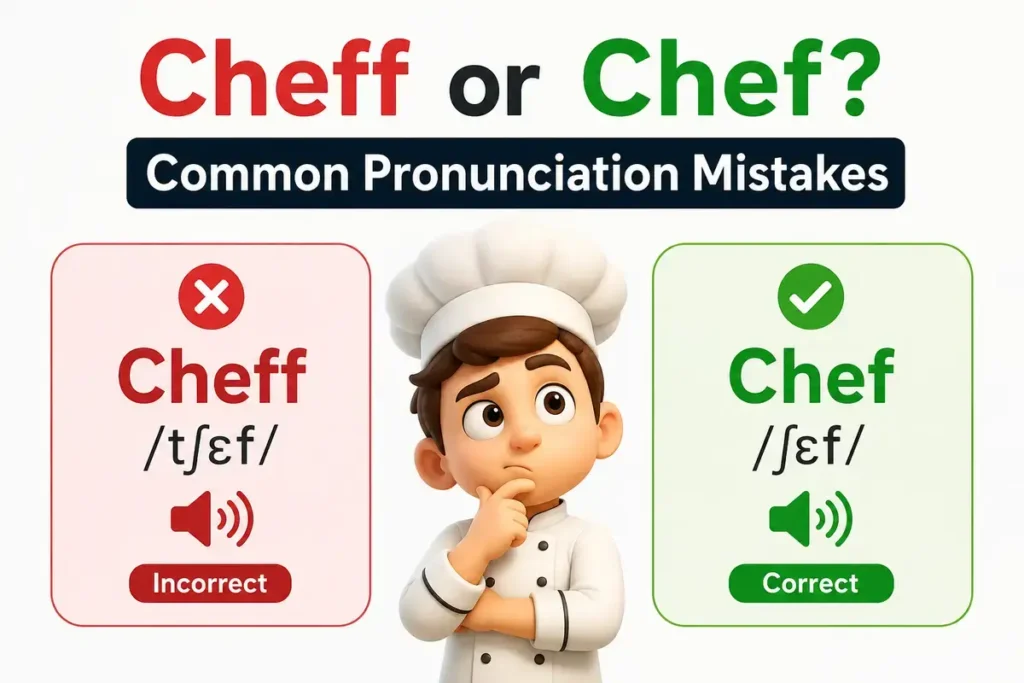
American Pronunciation
IPA:
/ʃɛf/
It sounds like shef.
British Pronunciation
IPA:
/ʃef/
The pronunciation is almost identical to American English, with only a slight difference in accent.
French Pronunciation
The word comes from French, where it is pronounced slightly differently.
IPA:
/ʃɛf/
Although the French pronunciation has a more authentic accent, English speakers generally pronounce the word in a way that fits their own accent. Both American and British pronunciations are accepted in everyday English.
Syllable Breakdown
The word has one syllable.
Chef
Common Pronunciation Mistakes
Some learners make small pronunciation errors because they are unfamiliar with French loanwords.
Common mistakes include:
- Saying the ch like the ch in chair.
- Adding an extra syllable.
- Pronouncing the final f too softly.
- Assuming the spelling should include two f letters because of the sound.
The easiest way to remember the pronunciation is to think of the word shef. That closely matches how most native English speakers say it.
Expert Language Insight
Professional editors rarely need to think twice about this word because the spelling has remained consistent for centuries. Unlike many English words with regional variations, chef never changes from one English speaking country to another.
The extra f usually appears because writers apply common English spelling patterns to a word that follows French spelling rules. That is an understandable mistake, but it is still a mistake. Once you recognize chef as a French loanword, the correct spelling becomes much easier to remember.
Professional writers, publishers, culinary schools, and restaurant organizations all use the same spelling. Following that standard keeps your writing accurate, credible, and professional.
If you enjoy clearing up common writing mistakes, you’ll also find it useful to learn why written is correct while writen is a frequent misspelling.
Examples In Sentences
Reading natural examples is one of the fastest ways to remember the correct spelling. Notice that every correct sentence uses chef with a single f. The incorrect examples show mistakes that should be avoided in everyday writing.
Correct Examples Using Chef
- The chef prepared a delicious three course dinner for the guests.
- Our favorite restaurant hired a new chef with years of international experience.
- She dreams of becoming a pastry chef after graduating from culinary school.
- The head chef created a seasonal menu using fresh local ingredients.
- Every chef in the kitchen followed strict food safety guidelines.
- The television chef shared an easy pasta recipe for beginners.
- His grandfather worked as a chef in a luxury hotel for more than thirty years.
- The executive chef trained the new kitchen staff before the restaurant opened.
- A skilled chef understands both cooking techniques and kitchen management.
- The chef received praise for preparing every dish with great attention to detail.
Incorrect Examples Using Cheff
The following examples contain a spelling mistake. They are included only to show what to avoid.
- The cheff prepared dinner for the wedding reception.
- She wants to become a cheff after college.
- The hotel hired a new cheff last month.
- My brother works as a cheff in a seafood restaurant.
- The cheff designed a creative dessert menu.
- We watched the cheff cook on live television.
- Every cheff must understand food safety.
- The cheff won a national cooking competition.
- The famous cheff published another cookbook.
- He introduced himself as the restaurant’s cheff.
In every sentence above, cheff should be replaced with chef.
Common Mistakes
The spelling mistake is easy to make, especially for people who are still learning English or typing quickly. Fortunately, it is also easy to avoid once you know why it happens.
Adding An Extra F
This is the most common mistake.
Incorrect:
Cheff
Correct:
Chef
Many English words double the final consonant, so writers sometimes assume this word follows the same pattern. It does not.
Confusing A Cook With A Chef
Some people use cook and chef as if they mean exactly the same thing.
Although they are related, they are not always interchangeable.
A cook prepares food. A chef is usually a trained culinary professional who often manages a kitchen, creates menus, supervises staff, and oversees food preparation.
In many restaurants, every chef is a cook, but not every cook is a chef.
Using The Wrong Job Title
Professional kitchens have several specialized chef titles.
Examples include:
- Executive chef.
- Head chef.
- Sous chef.
- Pastry chef.
- Private chef.
Using the correct title helps readers understand the person’s role more accurately.
Trusting Autocorrect Too Much
Autocorrect is helpful, but it is not perfect. Some applications may fail to catch uncommon spelling mistakes, especially in names or user generated content.
Always proofread important documents such as resumes, restaurant websites, business emails, and job applications before publishing or sending them.
Etymology And Word Origin
Understanding where a word comes from often makes it easier to remember its spelling.
The word chef entered English from French during the nineteenth century. It comes from the French phrase chef de cuisine, which means head of the kitchen or chief of the kitchen.
The French word chef originally meant chief, leader, or head. Over time, English speakers shortened the phrase and began using chef on its own to describe the person responsible for leading a professional kitchen.
Although the word became part of English vocabulary, its original spelling remained unchanged. That is why modern English still uses chef with one f instead of adapting it to common English spelling patterns.
This French origin also explains why the pronunciation differs slightly from what some learners expect.
Regional Usage
One reason this word is easy to learn is that its spelling remains consistent across major English speaking countries.
American English
American English always uses chef.
The word appears in restaurants, culinary schools, cooking competitions, television programs, newspapers, and hospitality businesses throughout the United States.
British English
British English also uses chef without any spelling changes.
Unlike words such as color and colour, there is no British variation.
Australian English
Australian English follows the same standard spelling.
Restaurant menus, hospitality organizations, and culinary institutions all use chef.
Canadian English
Canadian English also keeps the original French spelling.
This consistency makes the word easier to remember because you never need to change the spelling for different audiences.
Grammar Rules
Although chef is a simple noun, understanding how it functions in a sentence helps you use it more confidently.
Part Of Speech
The word chef is a countable noun.
Examples include:
- The chef prepared dinner.
- Every chef needs strong organizational skills.
Singular And Plural Forms
Singular:
Chef
Plural:
Chefs
Examples:
- Several chefs attended the culinary conference.
- The restaurant employs five experienced chefs.
Notice that the plural adds s without changing the spelling.
Common Sentence Patterns
You’ll often see the word used in structures like these.
- The chef prepared the meal.
- She works as a chef.
- He became a chef after culinary school.
- The chef created a new menu.
- Our chef specializes in Italian cuisine.
These sentence patterns appear frequently in newspapers, books, recipes, restaurant websites, and hospitality publications.
Real Life Usage
The word appears in many situations beyond restaurant kitchens.
Daily Conversation
People often use the word when talking about food, restaurants, or careers.
Examples include:
- My cousin is a chef in Chicago.
- That chef makes incredible desserts.
- She hopes to open her own restaurant one day.
Academic Writing
Hospitality programs and culinary schools regularly use the term in textbooks, training manuals, and research papers.
Students may study topics such as kitchen management, nutrition, menu planning, and leadership while preparing to become professional chefs.
Professional Communication
Restaurants, hotels, resorts, and catering businesses use the word in job descriptions, employee handbooks, business websites, and recruitment advertisements.
Examples include:
- Executive Chef.
- Sous Chef.
- Pastry Chef.
- Private Chef.
- Personal Chef.

Literature And Media
Books, documentaries, cooking competitions, and food magazines frequently feature chefs as experts, judges, teachers, or business owners.
Popular cooking programs have also helped the word become familiar to audiences around the world. Today, many people recognize the title even if they have never worked in a professional kitchen.
Related Words And Commonly Confused Terms
Learning related words helps you understand how chef fits into the world of cooking and hospitality. It also prevents confusion with similar job titles that have different meanings.
Chef And Cook
These words are closely related, but they are not identical.
A cook prepares food by following recipes or established methods. A chef usually has formal culinary training or significant professional experience and often manages a kitchen, creates menus, develops recipes, and supervises other cooks.
In many restaurants, the chef is responsible for the overall operation of the kitchen, while cooks focus on preparing specific dishes.
Chef And Baker
A baker specializes in bread, cakes, pastries, and other baked goods. A chef may understand baking, but the role usually involves a much wider range of cooking techniques and kitchen responsibilities.
Chef And Sous Chef
A sous chef is the second in command in a professional kitchen. This person supports the head chef by supervising daily operations, coordinating staff, and ensuring meals are prepared to the required standard.
Chef And Executive Chef
An executive chef oversees the entire kitchen. Responsibilities often include menu planning, budgeting, staff management, purchasing ingredients, and maintaining food quality across the restaurant.
Related Culinary Terms
You may also come across these words when reading about professional cooking.
- Culinary arts.
- Cuisine.
- Kitchen brigade.
- Menu planning.
- Food preparation.
- Restaurant management.
- Fine dining.
- Hospitality.
- Recipe development.
- Food presentation.
Understanding these terms gives you a broader picture of the culinary profession and helps you use the word chef more naturally.
Mastering spelling words ending in -ing can help you avoid errors like chosing and understand why choosing is the correct spelling.
Expert Language Insight
From an editor’s perspective, this spelling question is surprisingly common. Many people type cheff because English contains countless words with double consonants. The mistake feels logical, but the history of the word explains why the extra f does not belong.
Since chef entered English directly from French, it kept its original spelling. Unlike some borrowed words that changed over time, this one remained almost untouched. That consistency is one reason dictionaries, publishers, culinary schools, and restaurant organizations all use the same spelling.
Professional writers also pay attention to context. If someone prepares meals at home, calling that person a cook is often appropriate. If someone leads a professional kitchen, develops menus, or manages a culinary team, chef is usually the better choice. Choosing the right word makes your writing more accurate and shows that you understand the difference between everyday cooking and professional culinary work.
Frequently Asked Questions
Is chef or cheff the correct spelling?
Chef is the correct spelling. Cheff is a misspelling and is not recognized in standard English dictionaries. If you are referring to a professional cook, always write chef with a single f.
Why do people spell chef as cheff?
Many people add an extra f because English contains many words with double consonants. Others rely on pronunciation instead of learning the correct spelling. Since chef comes from French, it keeps its original spelling with one f.
How do you pronounce chef?
Most English speakers pronounce the word as shef.
American IPA:
/ʃɛf/
British IPA:
/ʃef/
Although accents differ slightly, the pronunciation is very similar in both varieties of English.
How is chef pronounced in French?
In French, the pronunciation is also close to /ʃɛf/, although native French speakers use a different accent and rhythm. English speakers do not need to imitate the French accent. Using the standard English pronunciation is completely acceptable.
What does chef mean?
A chef is a trained culinary professional who prepares food and often manages a commercial kitchen. Depending on the position, a chef may supervise staff, create menus, develop recipes, maintain food quality, and oversee daily kitchen operations.
Is every cook a chef?
No. A cook prepares food, but a chef usually has greater responsibility and leadership within a professional kitchen. Many chefs begin their careers as cooks before gaining experience and moving into management roles.
Is chef spelled the same in American and British English?
Yes. The spelling does not change across American English, British English, Australian English, or Canadian English. Every major English variety uses chef with one f.
How can I remember the correct spelling?
A simple trick is to remember that chef comes from French. Because it keeps its original spelling, it ends with one f, not two. Reading books, restaurant menus, and recipes also helps reinforce the correct spelling over time.
Conclusion
If you have ever wondered cheff or chef, the answer is simple. Chef is the only correct spelling in standard English. The word cheff is a spelling mistake and should not be used in professional or everyday writing.
The confusion often comes from familiar English spelling patterns, but this word follows its original French form. That is why it keeps a single f in every variety of English, including American, British, Australian, and Canadian English.
Understanding the difference also helps you choose the right term. A chef is more than someone who cooks meals. In many professional kitchens, chefs lead teams, design menus, develop recipes, and maintain high standards for food quality and safety.
The next time you write about restaurants, cooking, or culinary careers, remember one simple rule. If you are referring to a professional cook, always write chef with one f. Using the correct spelling makes your writing more accurate, more professional, and easier for readers to trust.