Choosing between distress vs duress can be surprisingly confusing because the words sound similar and both describe difficult situations. Many people assume they mean the same thing, but they do not. Using the wrong one can change the meaning of a sentence, especially in legal, academic, or professional writing.
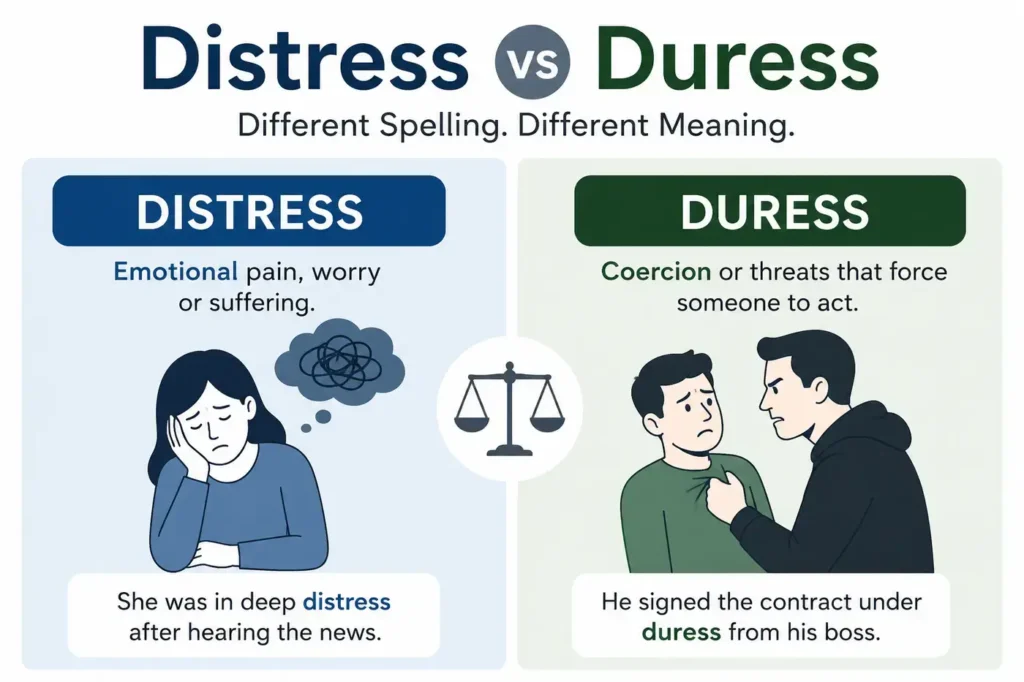
The simplest way to understand the difference is this. Distress refers to emotional, mental, or physical suffering. Duress refers to pressure, threats, or force used to make someone do something against their will. In other words, distress describes a state of suffering, while duress describes the cause or pressure that removes a person’s freedom to choose.
Knowing this distinction helps you write more clearly and avoid common language mistakes. It is especially important if you are reading legal documents, writing formal papers, or trying to understand phrases like under duress or mental duress.
This guide explains both words in plain English. You will learn their meanings, origins, pronunciation, grammar, real life usage, common mistakes, and practical examples. By the end, you will know exactly when to use each word with confidence.
Quick Definition
Distress means severe emotional, mental, or physical pain, suffering, or hardship. Duress means being forced to act because of threats, coercion, or unlawful pressure. Although both involve unpleasant situations, distress describes the condition a person experiences, while duress describes the force or pressure influencing someone’s actions.
Quick Answer
The easiest way to remember the difference is to focus on what each word describes.
- Distress is the suffering or emotional pain someone feels.
- Duress is the pressure or threat that forces someone to act.
- A person can experience distress without being under duress.
- Someone acting under duress may also feel distress, but the two words are not interchangeable.
For example, losing a job may cause emotional distress. Signing a document because someone threatened you is acting under duress.
Comparison Table
| Feature | Distress | Duress |
|---|---|---|
| Part of speech | Noun Verb | Noun |
| Core meaning | Emotional physical or financial suffering | Force threats or coercion |
| Origin | Latin through Old French | Latin through Old French |
| Common context | Health emotions finance emergencies | Law contracts criminal cases |
| Formality | General and formal writing | Mostly formal and legal writing |
| Usage frequency | Very common | Less common |
| Typical emotion | Pain anxiety hardship | Fear pressure intimidation |
| Example | She showed signs of emotional distress. | He signed the agreement under duress. |
Understanding The Meaning Of Each Word
Although these words are sometimes confused, they describe different ideas. Learning them separately makes the distinction much easier to remember.
What Does Distress Mean
Distress is a broad word that describes suffering, pain, or serious discomfort. The suffering may be emotional, mental, physical, or even financial depending on the situation.
For example, someone may feel distressed after losing a loved one, facing a financial crisis, or receiving bad medical news. The word focuses on the condition a person experiences rather than the event that caused it.
Common types of distress include:
- Emotional distress caused by grief, heartbreak, or trauma.
- Mental distress linked to anxiety, fear, or overwhelming stress.
- Physical distress caused by illness, injury, or exhaustion.
- Financial distress resulting from debt or economic hardship.
Because the word has a broad meaning, it appears in everyday conversations, psychology, medicine, news reports, and business writing.
What Does Duress Mean
Duress has a much narrower meaning. It refers to threats, coercion, or unlawful pressure used to force someone into doing something against their will.
The phrase under duress is especially common in legal English. It suggests that a person’s decision was not completely voluntary because they faced intimidation or serious pressure.
Here are a few situations where duress applies.
- Someone signs a contract after being threatened.
- A witness gives false information because of intimidation.
- A person transfers money after receiving threats.
- An employee feels forced to accept unfair terms because of coercion.
Unlike distress, duress almost always involves another person or outside force creating the pressure.
Distress vs Duress Key Differences
At first glance, these words seem closely related because both involve unpleasant experiences. Once you look at how they are used, the distinction becomes much clearer.
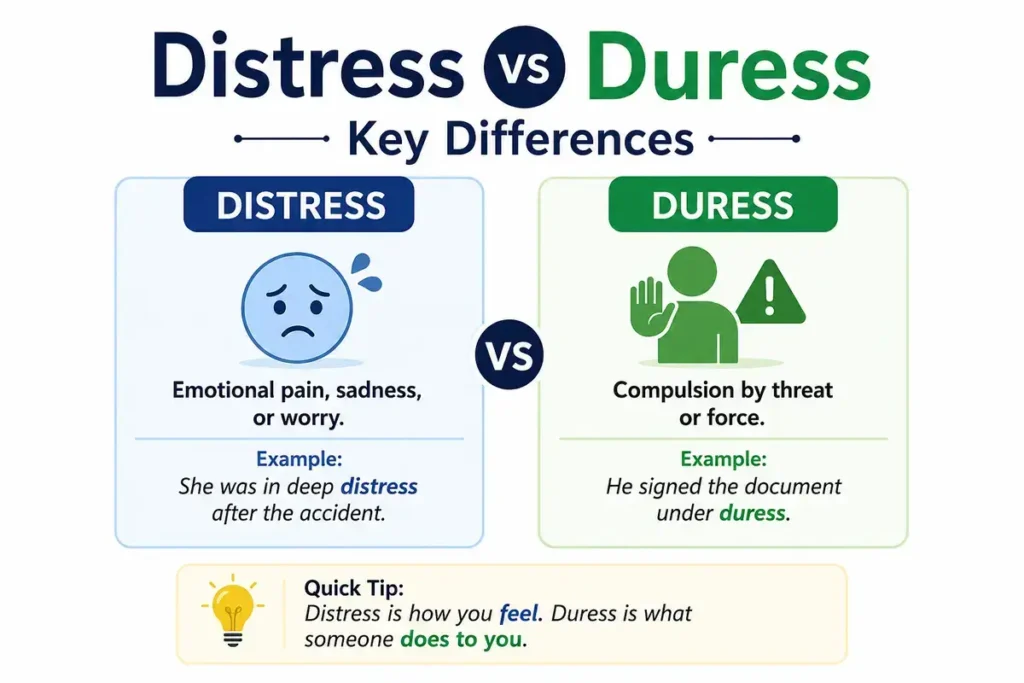
The biggest difference is that distress describes a person’s condition, while duress describes the pressure that influences a person’s actions. One focuses on suffering. The other focuses on coercion.
Here are the main differences.
| Distress | Duress |
|---|---|
| Describes suffering | Describes coercion |
| Emotional physical or financial hardship | Threats force or intimidation |
| Common in everyday English | Common in legal English |
| Can happen without another person’s involvement | Usually involves pressure from another person |
| May describe feelings | Usually describes circumstances |
Think of it this way.
A person who loses a home in a flood experiences distress because of the hardship. A person who signs legal paperwork after receiving threats acts under duress because someone removed the freedom to choose.
The same attention to context that helps distinguish duress from distress also makes it easier to understand the difference between indulgent and sober, where the intended meaning depends entirely on the situation.
Which Word Is Correct
Neither word is more correct than the other. The correct choice depends entirely on what you want to communicate.
Use distress when describing suffering, hardship, emotional pain, anxiety, or serious discomfort.
Use duress when describing threats, coercion, intimidation, or force that causes someone to act against their wishes.
Before choosing between the two, ask yourself a simple question.
Are you describing how someone feels or explaining why they were forced to do something?
If you are describing feelings, distress is usually the right word.
If you are describing pressure or threats, duress is the better choice.
This simple habit helps writers avoid one of the most common vocabulary mistakes in English.
Pronunciation Guide
Although the words look similar, they have different vowel sounds and are pronounced differently.
Distress
IPA pronunciation:
/dɪˈstrɛs/
Syllable breakdown:
Dis.
Stress.
The second syllable receives the strongest emphasis.
Duress
IPA pronunciation:
/djʊˈrɛs/ in British English.
/duˈrɛs/ in American English.
Syllable breakdown:
Du.
Ress.
Again, the second syllable carries the primary stress.
Common Pronunciation Mistakes
People often confuse these words because they share the same ending. Paying attention to the first syllable makes them much easier to distinguish.
To improve your pronunciation:
- Say each word slowly.
- Stress the second syllable.
- Practice reading them in complete sentences instead of saying the words by themselves.
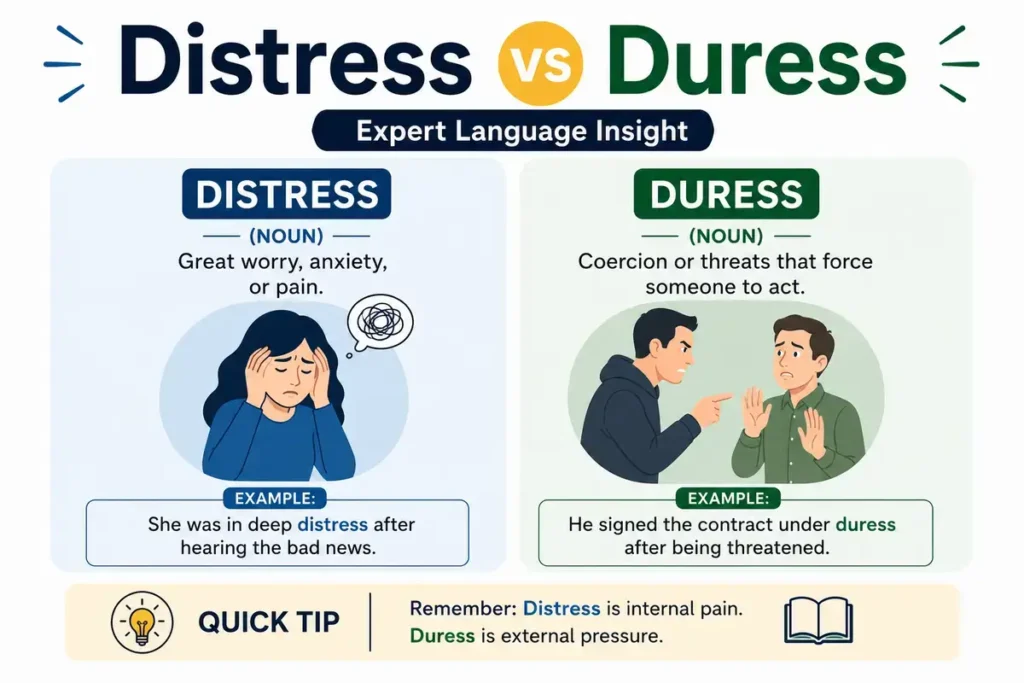
Distress vs Duress Expert Language Insight
Professional editors rarely confuse these words because they ask one simple question before making a correction.
What is the sentence trying to describe?
If the sentence focuses on emotional suffering, hardship, or discomfort, distress is almost always the right choice. If the sentence explains that someone acted because of threats or coercion, duress fits naturally.
Another clue comes from the surrounding vocabulary. Words like anxiety, trauma, pain, grief, and hardship often appear near distress. Words like contract, threat, coercion, force, and legal agreement frequently appear near duress.
Learning these patterns helps you recognize the correct word without memorizing definitions. After enough practice, choosing the right term becomes instinctive because the surrounding context points you in the right direction.
Examples In Sentences
Reading real examples is one of the fastest ways to understand the difference between these words. Notice how distress focuses on suffering or hardship, while duress describes pressure or threats that influence a person’s actions.
Distress Examples
The word distress fits naturally when someone experiences emotional, mental, physical, or financial hardship.
- She was in emotional distress after hearing the unexpected news.
- The family experienced financial distress when the business closed.
- The loud alarm caused distress among the young children.
- Doctors treated the patient for respiratory distress immediately.
- His voice revealed genuine distress during the interview.
- The rescue team responded to a distress call from the stranded boat.
- Many people felt deep distress after the natural disaster.
- The company entered financial distress during the economic downturn.
- The heartbreaking letter described the writer’s emotional distress.
- The counselor helped students cope with stress and emotional distress after the accident.
These examples show that distress can describe many kinds of suffering. The source of the hardship may change, but the word always focuses on the person’s condition.
Duress Examples
The word duress is most common when someone acts because of pressure, threats, or intimidation.
- He admitted that he signed the agreement under duress.
- The witness claimed the statement was made under duress.
- Police investigated claims that the confession resulted from duress.
- She transferred the money under duress after receiving repeated threats.
- The court examined evidence of economic duress during the contract dispute.
- The employee argued that the resignation was submitted under duress.
- They insisted the decision was made under duress instead of free choice.
- A contract signed under duress may not be legally enforceable.
- The suspect claimed he participated only because he was under duress.
- The judge asked both sides to provide evidence supporting the claim of duress.
You may notice that the phrase under duress appears repeatedly. That is the most common and natural way native English speakers use this word.
Distress vs Duress Common Mistakes
Although the meanings are different, these words are often confused because they sound similar and both involve unpleasant situations. Understanding the most common mistakes will help you use each word accurately.
Using One Word In Place Of The Other
This is the mistake people make most often.
Incorrect:
She signed the contract because of emotional distress.
If the person signed because someone threatened or forced her, duress is the correct word.
Correct:
She signed the contract under duress.
On the other hand, if the sentence describes her emotional state instead of the reason for signing, distress is appropriate.
Assuming Duress Means Stress
Many people think duress is simply another word for stress.
It is not.
Stress describes mental or emotional pressure that may come from work, family, school, or everyday responsibilities. Duress involves coercion, threats, or force. The legal element is much stronger.
Confusing Distress With Stress
Stress and distress are related, but they are not identical.
Stress is a normal response to challenges. It can even be positive in some situations, such as preparing for an important presentation or athletic competition.
Distress is harmful stress that overwhelms a person’s ability to cope. It usually has negative emotional, mental, or physical effects.
A simple way to remember the difference is this.
- Stress can motivate.
- Distress usually harms.
- Duress forces.
Thinking Duress Is Only Physical Force
Another common misunderstanding is believing that duress requires physical violence.
In reality, the pressure may be psychological, financial, or emotional as long as it removes a person’s ability to make a free decision.
For example, threatening someone’s family or livelihood may also qualify as duress in some legal situations.
Using Under Duress Incorrectly
The phrase under duress should only be used when someone acts because of coercion or serious pressure.
Incorrect:
I finished my homework under duress because it was difficult.
Correct:
I signed the document under duress because I was threatened.
Difficulty alone does not create duress.
Etymology And Word Origin
Looking at the history of these words helps explain why their meanings developed in different directions.
Origin Of Distress
The word distress comes from the Old French word destresse, which meant suffering, hardship, or affliction. It ultimately traces back to the Latin verb distringere, meaning to tighten or draw apart.
Over time, English speakers began using distress to describe emotional pain, physical suffering, financial hardship, and emergency situations. Although the contexts expanded, the central idea of hardship remained the same.
Origin Of Duress
The word duress also entered English through Old French. It developed from duresse, meaning severity, hardship, or compulsion. Like distress, it has roots in Latin, where related words expressed ideas of hardness and constraint.
As English legal language evolved, duress became associated with coercion and unlawful pressure. Today, it remains one of the most important terms in contract law and criminal law.
Although the two words share historical connections, centuries of usage have given each one a distinct meaning.
Regional Usage
One interesting fact about these words is that their meanings remain consistent across major varieties of English. The differences appear more in frequency than in definition.
American English
American speakers use distress regularly in everyday conversations, healthcare, psychology, business, and news reporting.
Duress appears less often in casual speech but is common in legal writing, courtroom discussions, law enforcement, and formal documents.
British English
British English follows nearly the same pattern.
Distress is widely used in both formal and informal settings, while duress is most often found in legal contexts and official communication.
Australian English
Australian English uses both words with the same meanings.
Writers commonly use distress in healthcare, emergency services, and mental health discussions. Duress appears mainly in legal and professional writing.
Canadian English
Canadian English also follows the same conventions.
Because Canada’s legal system relies heavily on established legal terminology, the phrase under duress appears frequently in contracts, legal cases, and judicial decisions.
Across all four regions, the meanings stay remarkably consistent. The only noticeable difference is that duress remains far more specialized than distress.
If you enjoy clearing up commonly confused English words, you’ll also find realist and realest explained useful for avoiding another frequent language mix-up.
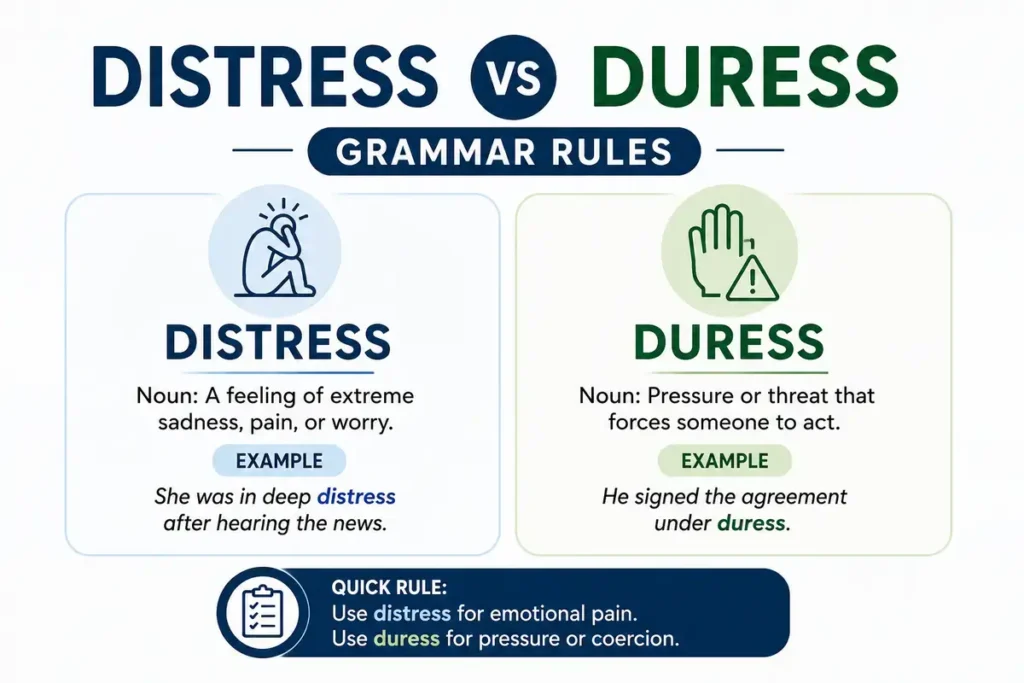
Grammar Rules
Although these words are closely related in sound, they function differently in English grammar.
Distress As A Noun
The noun form refers to suffering or hardship.
Examples include:
- The family experienced severe distress after the flood.
- Emotional distress can affect daily life.
- Financial distress forced the company to reduce expenses.
Distress As A Verb
Distress can also function as a verb meaning to cause suffering or anxiety.
Examples include:
- The news distressed everyone in the room.
- Loud noises often distress young children.
- The unexpected announcement distressed many employees.
Duress As A Noun
Unlike distress, duress functions almost exclusively as a noun.
Examples include:
- The confession was obtained under duress.
- The lawyer argued that the contract was signed under duress.
- Evidence of duress became central to the case.
Common Sentence Patterns
Native speakers often use these natural combinations.
For distress:
- Emotional distress.
- Mental distress.
- Financial distress.
- Respiratory distress.
- Distress signal.
- Distress call.
For duress:
- Under duress.
- Economic duress.
- Legal duress.
- Acted under duress.
- Signed under duress.
Learning these common combinations helps your writing sound more natural because they reflect how experienced writers use the language.
Real Life Usage Examples
These words appear in many different situations, but each one has its own typical setting.
Daily Conversation
People usually use distress when talking about emotional pain, illness, financial struggles, or difficult life events.
Examples include:
- She was clearly in emotional distress.
- The family faced financial distress after losing their home.
Academic Writing
Researchers often discuss psychological distress, financial distress, and emotional distress when studying health, education, economics, or social science.
The term duress appears more often in legal journals, ethics research, and criminal justice studies.
Professional Communication
Business professionals may refer to financial distress when discussing companies facing economic challenges.
Lawyers frequently discuss contracts signed under duress because coercion can affect their legal validity.
Literature And Media
Novelists often describe characters experiencing distress after traumatic events.
News organizations use the phrase under duress when reporting legal disputes, criminal investigations, or allegations of coercion.
These real world examples highlight an important pattern. Distress appears in a wide range of everyday situations, while duress remains closely connected to law, contracts, and situations involving pressure or threats.
Related Words And Commonly Confused Terms
Once you understand the difference between these two words, it helps to learn a few related terms. They appear in similar contexts and are often searched together, but each has its own meaning.
| Term | Meaning | How It Differs |
|---|---|---|
| Stress | Mental or physical pressure caused by everyday demands | Stress may be temporary and is not always harmful. |
| Distress | Severe emotional, mental, physical, or financial suffering | Focuses on the person’s condition or hardship. |
| Duress | Coercion or unlawful pressure that forces someone to act | Focuses on threats or force rather than feelings. |
| Coercion | Persuading or forcing someone through pressure or intimidation | Broader term commonly used in legal and social contexts. |
| Compulsion | A strong force or irresistible urge to act | May come from internal or external influences. |
| Intimidation | Creating fear to influence another person’s actions | Often becomes part of a claim involving duress. |
People also search for several related questions. Here are simple explanations.
Distress Vs Stress
Stress is a natural response to challenges or demands. It is not always harmful because a manageable amount of stress can improve focus and performance.
Distress develops when stress becomes overwhelming and begins affecting a person’s emotional, mental, or physical well being. In other words, every case of distress involves stress, but not every case of stress becomes distress.
Under Duress Meaning
The phrase under duress means someone acted because of threats, intimidation, or serious pressure instead of making a completely free choice.
For example:
- She signed the agreement under duress after being threatened.
- The witness claimed his statement was given under duress.
Under Duress Meaning In Law
In legal settings, under duress means a person entered into an agreement or performed an action because of unlawful pressure or coercion.
If a court determines that someone truly acted under duress, a contract or agreement may become unenforceable because genuine consent was missing.
Mental Duress Definition
Although legal systems often discuss physical or economic pressure, mental duress refers to psychological intimidation or emotional coercion that overcomes a person’s free will.
The exact legal definition varies by jurisdiction, so courts examine the facts of each case carefully.
Under Duress Signature
A signature given under duress is one made because of threats or coercion rather than voluntary consent.
If sufficient evidence proves that a signature was obtained under unlawful pressure, the document may be challenged in court depending on the applicable laws.
Mastering distinctions like distress vs duress becomes much easier when you also know how to spell “finally” correctly, helping you avoid another common writing mistake.
Expert Language Insight
Native speakers rarely confuse these words because they appear in different situations.
When people talk about anxiety, grief, financial hardship, illness, or emotional pain, distress is usually the natural choice. It fits comfortably in everyday conversations, medical reports, psychology, education, and journalism.
Duress, on the other hand, belongs mainly to legal English. Most native speakers encounter it in contracts, court decisions, police investigations, employment disputes, and legal news. Outside those situations, they often choose words like pressure, threat, or coercion instead.
As an editor, one question helps identify the correct word every time.
Is the sentence describing someone’s emotional condition, or is it explaining why someone acted against their own wishes?
If the focus is on suffering, use distress.
If the focus is on coercion, use duress.
That simple distinction removes almost all confusion.
Frequently Asked Questions
What is the main difference between distress and duress?
The main difference is that distress describes suffering or hardship, while duress describes pressure or threats that force someone to act. One refers to a person’s condition, and the other refers to the circumstances influencing that person’s decisions.
Can distress and duress be used interchangeably?
No. Although both words describe unpleasant situations, they have different meanings. Replacing one with the other changes the meaning of a sentence and may create confusion, especially in legal or professional writing.
What does under duress mean?
The phrase under duress means someone acted because of coercion, threats, or unlawful pressure instead of acting voluntarily. It commonly appears in legal documents, court cases, and contract disputes.
What is the difference between distress and stress?
Stress is the body’s normal response to challenges or demands. Distress is harmful stress that negatively affects emotional, mental, or physical well being. Stress can sometimes be helpful, but distress almost always has negative effects.
Is duress only used in legal situations?
Legal writing uses the word most frequently, but it is not limited to courtrooms. People also use duress when describing serious coercion in business, employment, or personal situations where someone is forced to act against their wishes.
Can emotional distress exist without duress?
Yes. Someone may experience emotional distress because of grief, illness, financial problems, or personal loss without anyone forcing or threatening them. The two ideas are related but independent.
Can a contract signed under duress become invalid?
In many legal systems, a contract signed because of unlawful coercion may be challenged in court. Judges examine the evidence carefully before deciding if genuine consent was missing. Laws vary between jurisdictions, so the outcome depends on the specific facts and applicable legal standards.
How can I remember the difference?
Think about the focus of the sentence. Distress describes how someone feels. Duress explains why someone acted. Remembering this simple distinction makes it much easier to choose the correct word.
Conclusion
Understanding the difference between these two words becomes much easier once you focus on their purpose instead of their similar sound. Distress refers to emotional, mental, physical, or financial suffering. Duress refers to threats, coercion, or unlawful pressure that forces someone to act against their will.
The easiest way to choose the right word is to consider what your sentence is describing. If the focus is on pain, hardship, or emotional struggle, distress is usually the correct choice. If the focus is on intimidation, pressure, or the absence of free choice, duress is the better fit.
You will encounter distress in everyday conversations, healthcare, psychology, business, and news reporting. Duress appears most often in legal writing, contracts, and discussions involving coercion. Recognizing these common contexts helps you use both words naturally and confidently.
Once you understand the difference in distress vs duress, choosing the right word becomes much easier. Remember that distress describes suffering, while duress describes threats or coercion that force someone to act against their will. Keep that simple distinction in mind, and you will use both words with confidence in everyday conversations, professional writing, and legal contexts.