Have you ever searched for chalant meaning after seeing someone use the word online and wondered if they were joking or using an unusual piece of slang? The confusion makes sense because chalant is not commonly used in standard English. You are far more likely to encounter nonchalant, which describes someone who appears calm and unconcerned.
The newer playful use of chalant turns that familiar word on its head. People use it online to describe someone who is openly interested, attentive, eager, or emotionally expressive instead of trying to act indifferent. It often appears in texting, social media posts, dating conversations, memes, and casual jokes.
The important point is that the meaning depends heavily on context. In standard English, nonchalant is the established adjective. Chalant is better understood as an informal and often humorous formation that people use to express the opposite idea or to describe visible interest.
This guide explains how the word works, where the idea comes from, how people use it in chat, and how it compares with nonchalant. You will also see natural examples that show the difference between dictionary English and playful internet language.
Quick Definition
Chalant is an informal and playful word used to describe someone who shows interest, attention, concern, or enthusiasm openly. It is often presented as the opposite of nonchalant. In casual online communication, calling someone chalant can suggest that they are clearly interested instead of pretending to be cool or unconcerned.
What Does Chalant Mean
The simplest way to understand the term is to think about someone who is not trying to hide their interest.
Imagine that someone likes another person. A nonchalant response might be acting relaxed and pretending that the situation does not matter. A playful chalant response would be checking the phone immediately, asking how the person is doing, remembering small details, and openly showing enthusiasm.
That is why the word often appears in jokes about dating and texting. Someone might proudly admit that they answered a message immediately instead of waiting for an hour to appear mysterious. Calling that behavior chalant adds a humorous label to the situation.
The word can also describe genuine attentiveness outside romantic situations. Someone who checks on a friend, gets excited about a project, or openly expresses appreciation could be described as chalant in casual language. The underlying idea is the same: the person is showing that they care.
It is important to understand the register. This is not the kind of word you would normally choose for a formal essay, business report, academic paper, or professional document. Its appeal comes partly from its playful quality.
Is Chalant A Real Word
This is where the answer needs a little nuance. Chalant appears in informal English and online slang, but it does not have the same established status as nonchalant. Many people use it deliberately as a humorous formation based on the familiar word.
English has a long history of people creating words by reshaping existing expressions. Internet culture has made this process even faster. A word can begin as a joke, spread through social media, become recognizable within a community, and eventually gain a stable informal meaning.
That does not automatically make the word standard English.
Think of it this way. A person can use a playful expression successfully without that expression becoming appropriate in every form of writing. Context matters. In a group chat, the word can be funny and immediately understandable. In a formal report, it may look like an error.
For everyday communication, the safest interpretation is that chalant is informal slang or a playful word formation rather than a standard adjective that belongs in every situation.
If you’ve come across workplace or education-related abbreviations while exploring word meanings, you may also want to understand what LMS stands for and how it is commonly used.
Chalant Meaning In English
In casual English, the term generally suggests showing interest or concern openly.
It can describe someone who:
- Clearly shows that they care.
- Responds enthusiastically instead of pretending not to care.
- Makes their romantic interest obvious.
- Pays attention to another person.
- Expresses emotions instead of hiding them.
- Takes an active interest in a situation.
The exact shade can change from one conversation to another. Sometimes the word is affectionate. Sometimes it is sarcastic. Sometimes it is simply a joke about someone who has stopped pretending to be indifferent.
For example, imagine a person who usually waits several hours before answering a crush. One day they respond instantly and say, I am being chalant today.
The humor comes from the contrast. The speaker is admitting that they are intentionally showing interest instead of playing it cool.
Chalant Vs Nonchalant
The easiest way to understand this slang is to compare it with nonchalant.
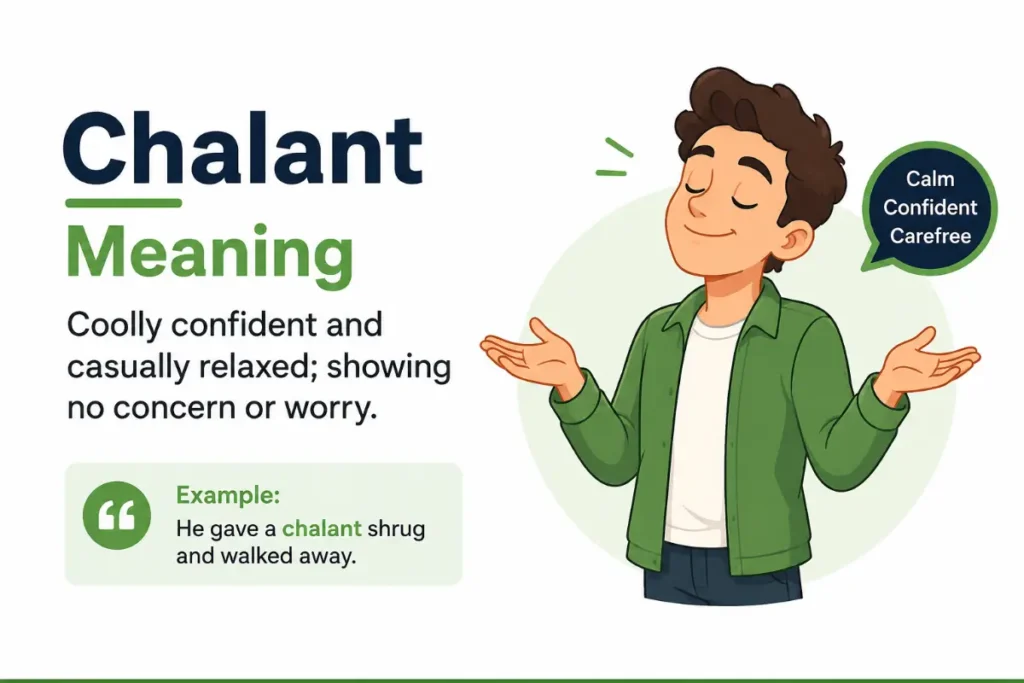
Nonchalant is an established English adjective. It describes someone who appears calm, unconcerned, relaxed, or unaffected by something that might normally create excitement or worry.
For example:
He looked completely nonchalant after winning the competition.
The sentence suggests that he did not appear especially excited or disturbed.
Now imagine someone saying:
He is being chalant and telling everyone how excited he is.
The second sentence uses the newer informal idea as a humorous contrast. Instead of hiding emotion, the person is showing it.
| Expression | General idea | Typical tone |
|---|---|---|
| Nonchalant | Calm and apparently unconcerned | Standard and neutral |
| Chalant | Openly interested or attentive | Informal and playful |
| Enthusiastic | Showing strong excitement | Standard |
| Attentive | Paying close attention | Standard |
| Interested | Showing curiosity or concern | Standard |
| Eager | Very willing or excited | Standard |
The contrast is useful because it explains why the slang feels intuitive even to someone seeing it for the first time.
Why People Say Chalant
Part of the appeal comes from the structure of nonchalant.
People recognize the word nonchalant as meaning relaxed or unconcerned. When they encounter chalant, they can infer a playful opposite from the missing negative element.
That makes the word easy to understand in context.
Internet slang often works this way. People enjoy taking a familiar word and twisting it into something humorous. The new form does not need a long dictionary definition because readers can work out the joke from the original word.
There is also a cultural reason for its popularity. Modern online conversations often joke about dating habits such as waiting to reply, pretending not to care, acting mysterious, or trying to look emotionally detached.
The idea of being openly interested gives people a funny way to reject those behaviors.
Instead of saying, I am going to stop pretending that I do not care, someone can simply joke:
I am choosing to be chalant.
The shorter expression carries the same idea with more personality.
Chalant Meaning In Chat
In chat, the term is usually playful rather than technical. Someone may use it to describe a person who is clearly interested in another person or situation.
Consider a conversation between two friends.
Friend 1: Did you answer them already?
Friend 2: Immediately.
Friend 1: That was fast.
Friend 2: I am being chalant.
The joke is easy to understand. The speaker is openly admitting interest instead of trying to appear detached.
Another example might involve someone checking on a friend:
I asked if she got home safely. I am being chalant today.
Here, the word is not necessarily romantic. It can simply emphasize attentiveness and care.
The surrounding conversation tells you how to interpret it. That is one reason slang can be difficult to define with a single rigid sentence.
Chalant Meaning In Slang
As slang, the word generally carries the idea of openly showing interest instead of acting indifferent.
It can be especially common in playful conversations about relationships. Someone might describe themselves as chalant because they are texting first, responding quickly, giving compliments, asking questions, or making their feelings obvious.
The word can also be used ironically.
Someone might post:
Me trying to be nonchalant after checking their profile for the fifth time.
A friend could respond:
Just be chalant.
The humor comes from acknowledging the obvious interest instead of pretending it is not there.
In this sense, the word belongs to the larger language of internet humor where emotional behavior becomes a joke about social expectations.
Chalant Meaning In Dating
Dating is one of the clearest contexts for this expression.
People often talk about acting cool when they like someone. They may intentionally delay replies, avoid showing too much enthusiasm, or pretend that they are less interested than they really are.
The playful opposite is to stop performing that indifference.
Someone who sends the first message, responds quickly, asks thoughtful questions, remembers details, and openly says they enjoyed a date could jokingly describe themselves as chalant.
For example:
I liked the date, so I texted her when I got home. I am done pretending to be mysterious.
That statement communicates the same general attitude even without using the slang.
The term can therefore function as a humorous badge of honesty. It says, in effect, I like this person and I am not going to pretend otherwise.
Chalant Meaning In Relationships
The idea can extend beyond early dating.
In an established relationship, someone might use the word to describe being attentive or openly affectionate. A person who remembers an anniversary, checks on their partner after a difficult day, or expresses appreciation could jokingly call themselves chalant.
For example:
I remembered your favorite snack and brought it home. Look at me being chalant.
The sentence sounds playful because the speaker is using an unusual word for an ordinary act of thoughtfulness.
This is a useful reminder that slang often gains meaning from attitude. The word itself is only part of the message. Tone, context, and the relationship between the speakers do a lot of the work.
Chalant Meaning In Social Media
Social media gives unusual expressions a place to spread quickly.
A short phrase can become recognizable because people repeat it in captions, comments, memes, videos, and reaction posts. The humor becomes easier to understand as more people encounter the same pattern.
The word fits social media particularly well because it can summarize a recognizable behavior in one playful label.
Someone who openly likes a post from their crush might joke about being chalant. Someone who sends the first text might use the term. Someone who enthusiastically supports a friend might also use it.
The tone is usually lighthearted.
That does not mean every social media user interprets it in exactly the same way. Slang changes quickly, and individual communities can give a word slightly different shades of meaning.
Chalant Meaning In Texting
Texting gives people plenty of opportunities to use this kind of playful language.
A person might say:
- I replied in thirty seconds. I am being chalant today.
- I asked how your day was because apparently I am chalant now.
- I sent the first message. Character development.
- Forget playing it cool. Be chalant.
These examples work because the word adds humor to a normal action.
The speaker could simply say I am interested or I care about them, but those phrases sound more direct. The slang version makes the statement feel lighter and more self aware.
Like many informal words and phrases, slang can sometimes have a surprisingly specific meaning, as with a surprisingly specific slang term such as “buckle bunny.”
Chalant Meaning In Spanish
If you encounter a search for this term followed by Spanish, the important point is that the English slang does not have a single universal Spanish translation.
The best translation depends on the intended meaning. If the speaker means showing interest, possible Spanish expressions can include ideas such as mostrar interés or estar interesado.
If the speaker means being attentive, a phrase such as estar atento may fit. If the speaker means being openly affectionate, another expression may be more natural depending on the situation.
The problem with translating slang word for word is that humor often disappears. A direct dictionary replacement may communicate the basic idea but miss the playful relationship between chalant and nonchalant.
For learners, understanding the situation is more useful than memorizing one fixed translation.
Chalant Meaning In French
The French connection can also cause confusion because nonchalant exists in French and is related to the broader history of the English word.
French nonchalant carries meanings connected with an unconcerned, relaxed, or indifferent manner. English adopted the word and developed its own usage.
The playful English formation chalant should not automatically be treated as a standard French word simply because it resembles a French expression.
This is a good example of why similar looking words across languages can be misleading. Shared roots do not mean that every modern variation has the same status or meaning.
Is Chalant The Opposite Of Nonchalant
In a playful sense, yes. That is the joke behind the expression.
However, it is better to say that chalant is used as a humorous opposite of nonchalant rather than claiming that the two are formal dictionary antonyms in standard English.
That distinction matters.
Nonchalant is an established word with a clear place in standard English. Chalant is much more informal and is often deliberately used for its humorous effect.
So if someone asks for the formal opposite of nonchalant, you should choose a standard expression based on the intended meaning.
Words such as concerned, interested, attentive, engaged, or enthusiastic may work better.
Chalant Meaning And Example Sentences
The following examples show how the expression can appear naturally in casual language.
- I texted first because I am feeling chalant today.
- He is being chalant and making his feelings obvious.
- She stopped pretending not to care and decided to be chalant.
- I replied immediately. Apparently, I have become chalant.
- Forget the mysterious act. Just be chalant.
- He brought her favorite coffee because he is apparently very chalant.
- I am being chalant and asking how your interview went.
- She liked his message right away and fully embraced the chalant lifestyle.
- He is usually quiet about his feelings, but today he is being surprisingly chalant.
- There is nothing wrong with being chalant when you genuinely care about someone.
Notice that these sentences are informal. They sound most natural in conversations, captions, comments, memes, or playful messages.
Common Mistakes With Chalant
Because the word is informal, people sometimes misunderstand its status.
Treating Chalant Like A Formal Dictionary Word
The biggest mistake is assuming that it has exactly the same status as nonchalant.
It does not.
If you are writing a college paper, formal article, business email, application, or professional report, choose a standard adjective that expresses the intended idea.
For example, instead of writing:
She was chalant about the issue.
you could write:
She was attentive to the issue.
Or:
She showed clear concern about the issue.
The formal alternative will usually communicate your meaning more precisely.
Assuming It Always Means Romantic Interest
Dating is a common context, but the slang can be broader.
Someone can use the term jokingly to describe attention, enthusiasm, concern, or visible emotional investment. The surrounding sentence determines the exact meaning.
Assuming Every Speaker Uses It The Same Way
Internet slang is not a fixed scientific system. Different communities can use the same expression with slightly different meanings.
If you see the word in a meme, comment, or text message, read the surrounding context before assigning a strict definition.
Standard English Alternatives
If you want to express the idea clearly without relying on slang, English gives you plenty of options.
Choose the word that matches the specific behavior.
- Interested means you care about or want to know more about something or someone.
- Attentive means you pay close attention.
- Concerned means you care about a possible problem or situation.
- Engaged means you are actively involved.
- Enthusiastic means you show strong excitement.
- Eager means you are very willing or excited to do something.
- Affectionate means you openly express fondness or love.
- Responsive means you react or reply readily.
These words are useful in formal and informal writing because readers do not need to understand internet slang to interpret them.
How To Use Chalant Naturally
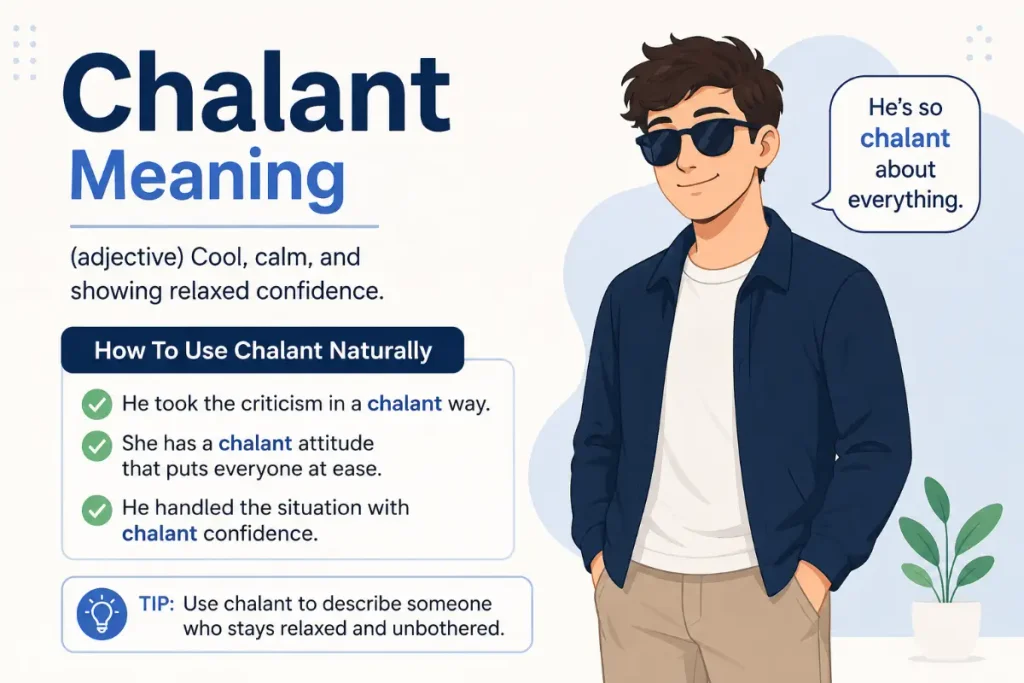
If you want to use the expression yourself, the safest approach is to keep it casual. It works best when you are intentionally playing with the contrast between appearing indifferent and showing interest.
For example:
I am done waiting three hours to reply. I am being chalant.
That sounds natural because the context creates the joke.
Another option is:
He is being unusually chalant about his new crush.
The reader can infer that he is openly showing interest.
You can also use the word self consciously:
Apparently I am chalant now.
That construction works because the speaker knows the expression is playful.
When You Should Not Use Chalant
There are situations where standard English is a better choice.
Avoid relying on this slang in:
- Academic assignments.
- Formal business communication.
- Professional reports.
- Legal documents.
- Official applications.
- Technical documentation.
- Serious news writing.
- Formal correspondence.
In these settings, clarity matters more than wordplay.
If you are writing for a general audience and the expression is important to your topic, you can mention it and explain that it is informal. That gives readers the context they need.
The Language Trick Behind Chalant
The interesting part of this word is not simply its meaning. It is the way speakers mentally construct it.
People already know nonchalant. They know that the word describes someone who appears unconcerned. Once they encounter chalant, they can interpret the new form as a playful reversal.
This is an example of how speakers creatively manipulate language.
English contains many expressions that have developed through similar processes. Speakers remove, add, reshape, or reinterpret parts of familiar words to create something that feels understandable even before it becomes widely established.
Internet culture accelerates that process.
A clever expression can spread because people understand the joke immediately. Once enough people repeat it, the expression becomes part of the shared vocabulary of a particular online community.
Why Context Matters So Much
Slang rarely behaves like a simple equation where one word always equals one definition.
Suppose someone says:
I am being chalant.
You still need context.
Are they talking about a crush?
Are they joking about answering a message quickly?
Are they talking about checking on a friend?
Are they making fun of their own enthusiasm?
The surrounding conversation answers those questions.
That is why a good slang definition should describe the central idea without pretending that every use has exactly the same shade.
The central idea here is visible interest or concern instead of deliberate indifference.
From there, the context supplies the details.
Chalant And Playing It Cool
The expression makes especially good sense when contrasted with playing it cool.
Playing it cool means deliberately avoiding an overly eager appearance. In dating, this might mean waiting before replying, avoiding excessive compliments, or pretending that you are less interested than you really are.
Being chalant reverses that behavior.
You reply because you want to reply. You ask because you care. You compliment someone because you mean it. You show enthusiasm without worrying about appearing too interested.
That contrast is what gives the word much of its humor.
It turns an ordinary emotional choice into a playful statement about social behavior.
Chalant And Confidence
There is also an interesting emotional difference between being openly interested and being desperate.
The slang does not automatically mean that someone is needy or overly emotional.
A person can show interest while remaining confident.
For example:
I liked the conversation, so I texted her afterward.
That is simply direct communication.
The playful label makes the behavior sound more dramatic than it really is. In reality, showing interest is often perfectly normal.
This is one reason the expression works well online. It can make ordinary emotional honesty feel funny without necessarily making it negative.
What Does Being Chalant Look Like
In practical terms, the behavior might include:
- Replying because you genuinely want to talk.
- Asking someone how their day went.
- Remembering something they told you.
- Giving a sincere compliment.
- Admitting that you enjoyed spending time together.
- Showing excitement instead of hiding it.
- Checking on someone when they seem upset.
- Starting a conversation instead of waiting for the other person.
None of these behaviors is inherently slangy. The humor comes from applying the label to them.
If you enjoy exploring unfamiliar abbreviations, another useful example is PTSO in everyday conversations, where the intended meaning depends heavily on context.
Expert Language Insight
From a language perspective, the most important distinction is between meaning and lexical status.
A word can have an understandable meaning without functioning as a standard vocabulary item in every context. English speakers constantly create informal expressions, especially in communities where humor and identity play a major role.
This term is a good example. Its meaning can be inferred from its relationship to nonchalant, but that does not give it the same formal status.
For editors, context is the key test. If a writer is deliberately using internet slang in a conversational article, keeping the expression can add personality. If the same writer is preparing a formal document, replacing it with interested, attentive, concerned, or another precise adjective will usually improve the writing.
That is how experienced writers handle informal language. They do not ask only, Is this word real? They also ask, Who is reading this, what tone do I want, and will the reader understand the expression?
Frequently Asked Questions
What does chalant mean in simple English?
It is an informal and playful expression for someone who openly shows interest, care, attention, or enthusiasm instead of acting indifferent. People often use it online when talking about dating or texting. The word is commonly presented as a humorous contrast to nonchalant, which describes someone who appears calm and unconcerned.
Is chalant the opposite of nonchalant?
In informal slang, it is commonly used as a playful opposite of nonchalant. However, the two words do not have equal status in standard English. Nonchalant is an established adjective, while chalant is mainly an informal and humorous formation. Standard alternatives include interested, attentive, concerned, engaged, and enthusiastic.
Is chalant a real English word?
It is used in informal English, particularly in online communication, but it is not as established in standard English as nonchalant. Speakers often create the term playfully by treating the familiar word as though it contains a negative prefix. Its meaning is usually understandable from context even when the speaker is using it humorously.
What does chalant mean in texting?
In texting, it usually means openly showing interest instead of trying to appear indifferent. Someone might call themselves chalant after replying quickly to a crush, sending the first message, asking thoughtful questions, or showing obvious enthusiasm. The expression is usually playful and self aware rather than formal.
What does chalant mean in slang?
As slang, it generally describes someone who is visibly interested, attentive, caring, or enthusiastic. Dating conversations are a common setting because people often joke about acting uninterested to appear cool. The slang gives speakers a humorous way to say that they have stopped hiding their feelings or enthusiasm.
Can I use chalant in formal writing?
It is better to avoid it in formal writing unless you are specifically discussing the slang itself. Academic papers, professional documents, business emails, and official communication usually benefit from established vocabulary. Depending on the meaning, use words such as interested, attentive, concerned, enthusiastic, engaged, or affectionate instead.
Why do people say chalant when nonchalant already exists?
The humor comes from treating nonchalant as though its first part works like a negative prefix. People then imagine that removing it creates the opposite quality. This kind of playful word formation is common in informal language, especially online, where people enjoy reshaping familiar expressions to create jokes and memorable phrases.
Does chalant always mean romantic interest?
No. Romantic interest is one common use, but the expression can describe other forms of visible attention or enthusiasm. Someone might use it jokingly after checking on a friend, showing excitement about a project, or responding quickly to a message. The surrounding context determines the precise shade of meaning.
Conclusion
Chalant is best understood as a playful piece of informal language that describes someone who openly shows interest, care, attention, or enthusiasm instead of pretending to be indifferent. Its meaning becomes especially clear when you place it beside nonchalant.
The expression is most at home in texting, social media, dating conversations, memes, and casual speech. It can make a simple idea feel funny and self aware, especially when someone admits that they have stopped playing it cool.
For formal English, stick with established words such as interested, attentive, concerned, engaged, or enthusiastic. For casual conversation, the slang can work perfectly well when the audience understands the playful tone.
The easiest way to remember chalant meaning is simple: nonchalant hides the interest, while chalant jokingly admits it.