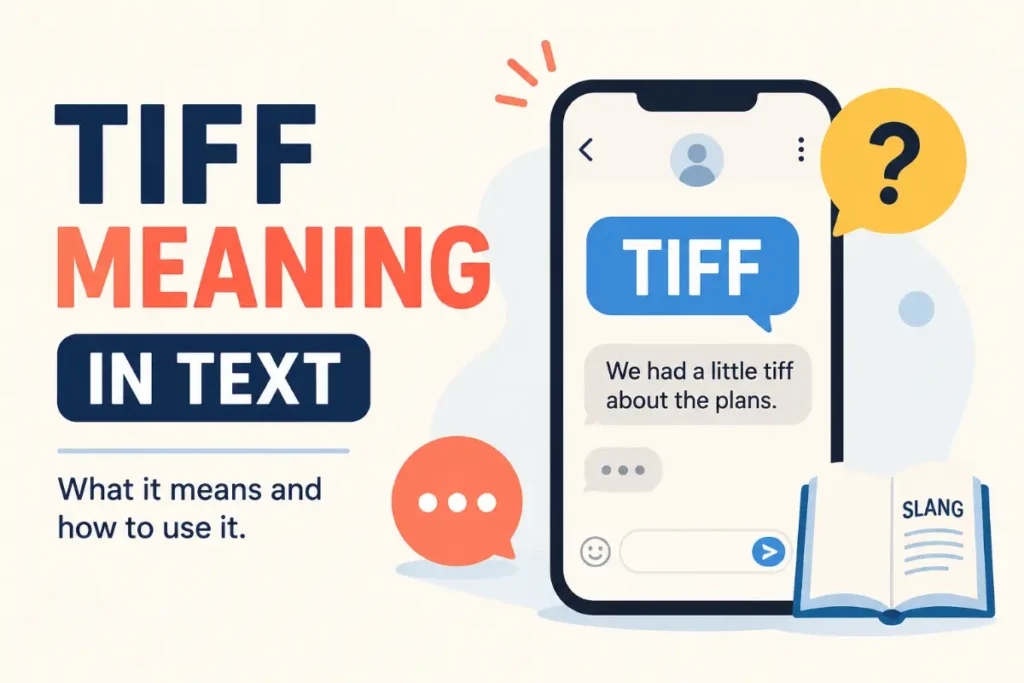
If you are searching for tiff meaning in text, the word tiff usually means a small argument, disagreement, or brief quarrel. It is a casual English word that often describes a minor conflict between people who may still care about each other. For example, someone might say, We had a little tiff last night, meaning they had a short argument that was not especially serious.
However, tiff has another completely different meaning in the world of computers and digital images. TIFF can refer to the Tagged Image File Format, a high quality image format commonly associated with scanning, photography, publishing, graphic design, and professional image editing.
That difference in capitalization matters. Lowercase tiff is normally the English noun for a minor quarrel. Uppercase TIFF usually refers to the image file format. The surrounding words tell you which meaning someone intends.
This guide explains both meanings clearly. You will learn how the word works in texting and everyday English, how it differs from words such as argument and fight, what TIFF means on a computer, how TIFF files work in Photoshop, and why the same spelling can refer to two unrelated ideas.
Quick Answer
In text messages and everyday English, tiff means a small or minor argument between people. It usually suggests a brief disagreement rather than a serious fight. For example, They had a tiff but made up later means they had a small argument and then resolved it. In computing, TIFF means Tagged Image File Format, a high quality image file format.
If you want to understand the phrase more clearly, explore what “well said” really means and how it is used in everyday conversations.
What Does Tiff Mean In Text
When someone uses tiff in a text, they are usually describing a minor disagreement.
The word has a softer tone than fight, conflict, or serious argument. It often suggests that the disagreement was temporary and not worth treating as a major problem.
For example:
We had a little tiff yesterday.
This tells the reader that two people argued. However, the word tiff makes the situation sound relatively small.
You might use it when talking about friends, couples, family members, or coworkers. The relationship between the people can influence the tone because a tiff often implies that the disagreement happened between people who normally get along.
Consider these examples:
- My sister and I had a tiff over the remote.
- They had a little tiff before dinner.
- We had a tiff but everything is fine now.
- The couple got into a brief tiff about their weekend plans.
In each sentence, the disagreement sounds limited rather than dramatic.
That is one reason the word can work well in casual conversation. It describes friction without making the situation sound like a major dispute.
Tiff Meaning In English
In general English, tiff is a noun meaning a small quarrel or petty argument.
The word is informal and often carries a slightly lighthearted tone. It can describe a disagreement that involves irritation, annoyance, or hurt feelings but does not rise to the level of a serious conflict.
The word is especially useful when the speaker wants to minimize the seriousness of an argument.
Compare these sentences:
They had a fight.
They had an argument.
They had a tiff.
The first sounds stronger. It can suggest a heated confrontation and in some contexts can even suggest physical violence.
The second is neutral. It simply tells us that the people disagreed.
The third sounds lighter. It suggests a relatively minor quarrel.
That difference in emotional weight is important. A dictionary definition alone does not tell you everything about how a native speaker hears the word.
Tiff As A Slang Or Casual Word
People sometimes search for tiff meaning slang because the word appears in informal conversations. Strictly speaking, tiff is better described as an informal English word than as modern internet slang.
It has been part of English for a long time. Unlike newer texting expressions, it was not created by social media or smartphones.
Still, it can sound casual because people do not normally use it in highly formal documents.
For example, you would probably not write:
The company experienced a tiff between two departments.
in a serious corporate report.
You could instead write:
The departments had a disagreement.
In a personal conversation, however, tiff can sound perfectly natural:
We had a little tiff this morning, but we are good now.
The word works because the situation is personal and informal.
Tiff Vs Argument
A tiff is a type of argument, but the two words do not carry exactly the same tone.
Argument is broad and neutral. It can describe anything from a minor disagreement to a heated dispute.
Tiff normally suggests something smaller.
Compare:
They had an argument about money.
This sentence tells us that they disagreed about money, but we do not know how serious the disagreement was.
Now consider:
They had a tiff about money.
The second sentence makes the disagreement sound less severe.
That does not mean every tiff is completely harmless. People can still become upset during a tiff. The word simply frames the disagreement as relatively minor.
Tiff Vs Fight
The difference becomes even clearer with fight.
A fight can mean a serious verbal argument or a physical confrontation. The word carries much more intensity than tiff.
For example:
The brothers had a fight.
This could suggest a heated argument or even physical violence.
The brothers had a tiff.
This sounds like they argued over something relatively small.
The choice of word changes the mental picture. Fight creates tension. Tiff softens it.
That softer quality is one of the most useful features of the word.
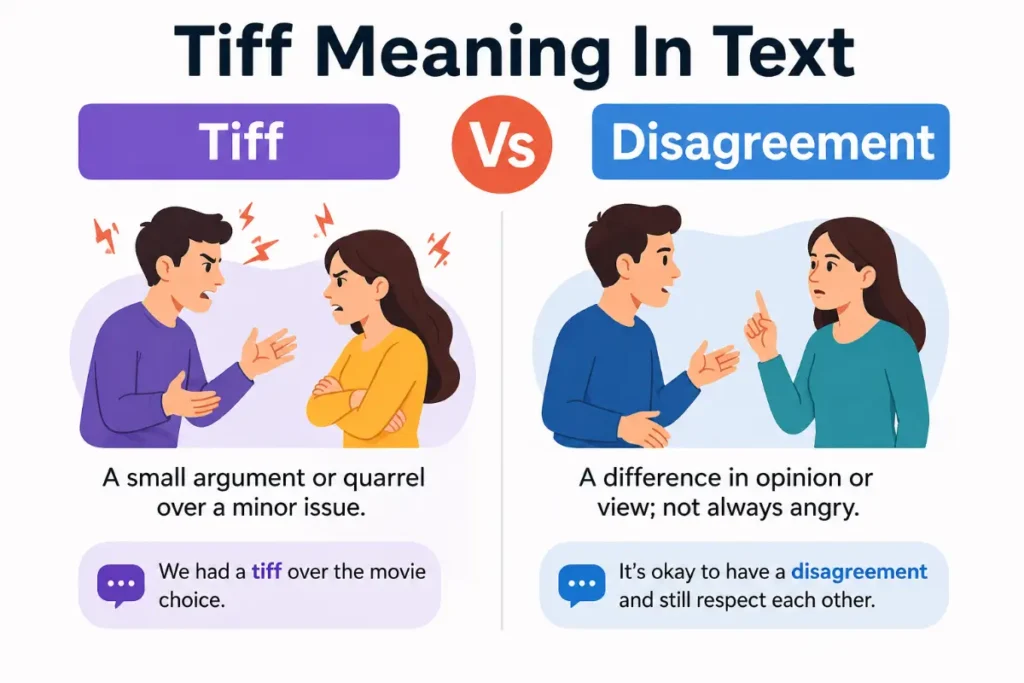
Tiff Vs Disagreement
Disagreement is more neutral and more formal than tiff.
A disagreement can be serious or minor. It does not necessarily involve anger.
For example:
The two researchers had a disagreement about the results.
This sounds appropriate in academic or professional writing.
The two researchers had a tiff about the results.
This sounds more personal and somewhat playful. It may even make the researchers sound irritated with each other rather than simply divided over evidence.
As a result, disagreement is usually the safer word in formal communication.
Tiff Vs Quarrel
Quarrel is probably the closest traditional synonym.
Both words describe an argument or disagreement. However, quarrel can sound more serious or old fashioned depending on the context.
They had a quarrel over the property.
This sounds more substantial.
They had a tiff over who should wash the dishes.
This sounds much lighter.
The difference is not always absolute. Tone depends on context, but tiff generally pushes the meaning toward a minor personal dispute.
Examples Of Tiff In A Sentence
Here are natural examples that show how native speakers might use the word.
- My friends had a little tiff during the road trip.
- We had a tiff about where to eat.
- They had a brief tiff and then laughed about it.
- I had a silly tiff with my brother yesterday.
- The couple had a tiff before the party.
- Their tiff was over something completely trivial.
- She mentioned that they had a small tiff earlier.
- We had a tiff about whose turn it was to cook.
- The two roommates had a tiff over the thermostat.
- It was only a tiff, so nobody stayed angry for long.
Notice the recurring pattern. The word often appears with modifiers such as little, small, brief, or silly. These combinations reinforce the idea that the disagreement was limited.
How Tiff Is Used In Text Messages
In texting, people generally use tiff in the same way they use it in spoken English.
A person might write:
Had a tiff with my boyfriend lol.
or:
We had a little tiff but we are fine now.
or:
Sorry I was quiet. Had a tiff with my sister.
The word can make a disagreement sound less dramatic. Sometimes the speaker uses it deliberately to signal that the situation is not a major crisis.
It can also carry a slightly humorous tone.
For example:
We had a tiff over pizza toppings 😂
This clearly suggests a small and probably temporary disagreement.
The exact tone still depends on the rest of the message. Context always matters more than the individual word.
Does Tiff Mean A Serious Fight
Usually, no.
Tiff normally refers to a minor argument or quarrel. It does not usually suggest a serious fight.
If someone says:
We had a tiff last night.
you would generally understand that they had some disagreement but probably not a major confrontation.
Still, words do not have mathematical boundaries. A speaker can use tiff humorously or sarcastically to describe a disagreement that was actually more serious.
For example:
We had a little tiff that lasted three hours.
The word little might be deliberately ironic.
This is common in natural language. People often choose softer words to make a situation sound less intense.
Is Tiff A Negative Word
Tiff is not strongly negative, but it describes a negative interaction.
It usually carries a mild tone. The word can even sound affectionate or humorous when used between people who normally have a close relationship.
For example:
My parents had a little tiff over the garden.
This does not automatically make the parents sound hostile. It presents the disagreement as a temporary irritation.
That is different from words such as hostility, feud, or conflict, which suggest a more serious or prolonged problem.
Where Did The Word Tiff Come From
The English word tiff has a long history and has been used to describe a fit of irritation or a small quarrel.
Its exact origin is not completely straightforward, which is common with older informal English words. Historical dictionaries connect early uses of tiff with ideas involving a slight fit of temper, irritation, or quarrelsome behavior.
Over time, the word developed the familiar sense of a petty quarrel or minor disagreement.
This history also helps explain why tiff sounds somewhat old fashioned to some speakers while still remaining understandable and usable today.
It is not a new texting abbreviation. Modern users simply continue to use an established English word in casual communication.
Is Tiff Common In American English
Yes, American English speakers understand tiff, and the word can be used naturally in the United States.
However, it is not among the most common words for an argument.
Americans are more likely to say:
- Argument.
- Fight.
- Disagreement.
- Little argument.
- Spat.
Tiff is more distinctive because it has a deliberately mild tone.
You may encounter it more often in writing, storytelling, entertainment, relationship discussions, and humorous descriptions than in ordinary serious conversation.
Tiff In British English
British English also uses tiff to mean a small argument or quarrel.
The word may feel especially natural in phrases such as:
They had a little tiff.
The couple had a tiff.
They had a tiff over the arrangements.
British English has several words for minor arguments, including spat, row, and quarrel. Their exact tone differs.
A row can be considerably more heated than a tiff.
That makes tiff useful when the speaker wants to emphasize the small scale of the disagreement.
Tiff Meaning In Chat
When you see tiff in chat, do not automatically assume it is an acronym.
Look at capitalization and context.
If someone says:
I had a tiff with my friend.
they mean a small argument.
If someone says:
Can you send me the TIFF file?
they are almost certainly talking about a digital image format.
The same spelling can therefore create confusion in search results because tiff and TIFF belong to completely different semantic fields.
One belongs to everyday English and relationships. The other belongs to computing, digital photography, scanning, graphic design, and publishing.
What Does TIFF Mean On A Computer
In computing, TIFF stands for Tagged Image File Format.
It is an image file format designed to store digital images with considerable flexibility and strong support for high quality image data.
TIFF files are commonly associated with:
- Professional photography.
- Scanning.
- Graphic design.
- Desktop publishing.
- Archiving.
- Printing.
- Image editing.
The file extension is usually .tif or .tiff.
Unlike the everyday English word tiff, this version is normally written in uppercase when discussing the technical format.
TIFF Meaning In Photoshop
In Adobe Photoshop and other image editing software, a TIFF file is a format that can preserve high quality image information and support professional editing workflows.
TIFF is especially useful when image quality matters more than keeping the file extremely small.
A photographer or designer might save a working image as TIFF when they want to retain detailed image data for later editing or printing.
TIFF can also support features such as layers and transparency in workflows where the software and settings allow them.
However, the exact capabilities depend on how the file was created and which application opens it. For everyday web images, TIFF is often less convenient than formats designed for efficient online delivery.
Just as “Tiff” can carry different shades of meaning depending on context, the meaning behind purple roses can also vary based on the situation and message intended.
TIFF Vs JPEG
TIFF and JPEG serve different purposes.
TIFF is commonly chosen when image quality, editing flexibility, scanning, archiving, or professional printing is important.
JPEG is widely used when smaller file sizes and convenient sharing matter.
A JPEG typically uses lossy compression, which means some image information may be discarded to reduce file size.
TIFF can be stored without lossy compression and can preserve substantial image information. It can also use several compression approaches depending on the file.
For example:
| Feature | TIFF | JPEG |
|---|---|---|
| Typical use | Professional images and archives | Web and everyday photos |
| File size | Often large | Usually smaller |
| Editing | Strong choice for workflows | Better for finished images |
| Compression | Supports multiple methods | Commonly lossy |
| Printing | Excellent | Widely supported |
| Web use | Less common | Extremely common |
The best format depends on the job rather than on a simple idea of one format being universally better.
TIFF Meaning As An Image Format
As an image format, TIFF is valued because it can store detailed raster image information.
A raster image is made from pixels. TIFF can store images with different color depths and configurations depending on the file and software involved.
This makes it useful in professional environments where preserving image information matters.
For example, a scanned historical document may be stored as TIFF for archival purposes. A publishing workflow may also use TIFF images because the format fits professional editing and print production needs.
TIFF is therefore not simply a large version of JPEG. It belongs to a different part of the digital imaging workflow.
TIFF And Film
The word TIFF can also appear in searches involving film because of the Toronto International Film Festival.
The Toronto International Film Festival is commonly abbreviated as TIFF and is one of the major film festivals associated with Toronto.
This is another completely different meaning.
Context makes the distinction easy:
The photographer exported the image as a TIFF.
This refers to the file format.
The film premiered at TIFF.
This refers to the Toronto International Film Festival.
The same capital letters can therefore represent different entities depending on the subject being discussed.
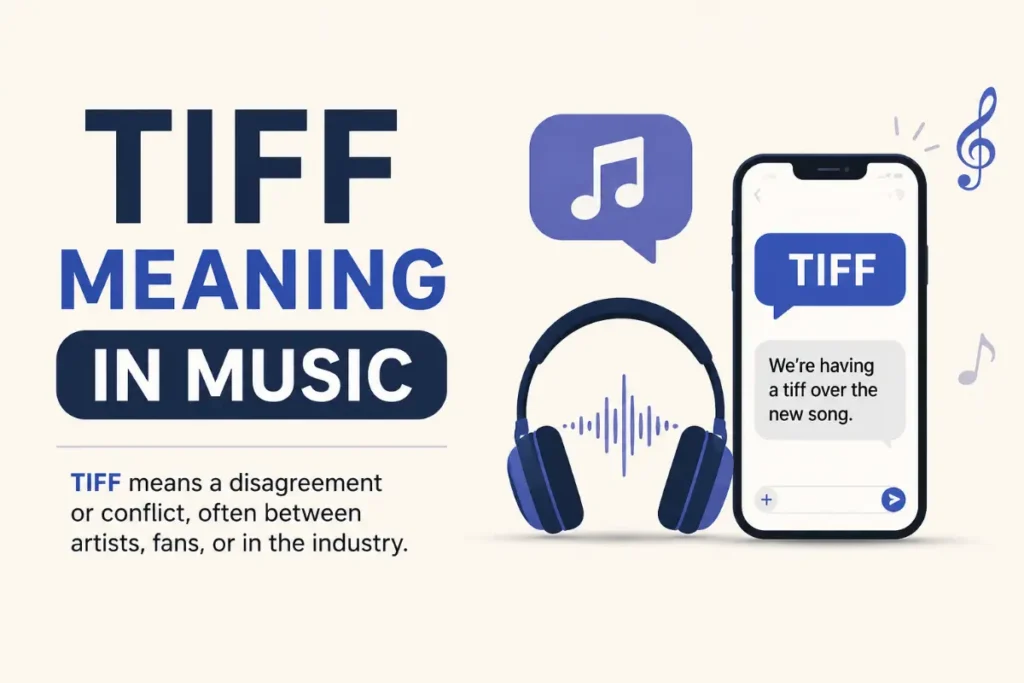
TIFF Meaning In Music
Searches for TIFF meaning music can also produce different results because TIFF may appear as an artist name, title, abbreviation, organization name, or other proper noun.
There is no single universal music meaning for TIFF comparable to the standard computing definition.
If you encounter the term in a song, artist profile, album title, or music discussion, the surrounding text is necessary to identify the intended reference.
This is a good example of why search intent matters. A short term can have several unrelated meanings across different industries.
Tiff As A Name
Tiff can also appear as a shortened personal name, commonly associated with names such as Tiffany.
For example:
Tiff is coming over later.
In this context, Tiff is a person’s nickname rather than a word describing an argument.
Capitalization usually provides a clue because personal names are normally capitalized.
This creates yet another possible meaning when you encounter the word in a message.
How Context Determines The Meaning
When a word has several meanings, the surrounding words usually solve the puzzle.
Consider these sentences:
I had a tiff with my roommate.
The word refers to a disagreement.
Open the TIFF in Photoshop.
The word refers to an image file.
Tiff is meeting us at seven.
The word is probably a person’s name.
The movie premiered at TIFF.
The word refers to the Toronto International Film Festival.
The spelling alone is not enough. Context supplies the missing information.
That is a useful lesson for texting and internet searches because short words often have several meanings across unrelated subjects.
Common Confusion Around Tiff
One common mistake is assuming that tiff always means the image format because people see TIFF frequently in computer settings.
Another mistake is assuming that TIFF always refers to an argument because someone encountered the lowercase word first.
Neither assumption works in every situation.
Instead, look at the surrounding vocabulary.
Words such as file, image, photo, Photoshop, scan, format, and export strongly point toward the digital image meaning.
Words such as argument, friend, couple, fight, relationship, angry, and disagreement point toward the everyday English meaning.
Words such as film, festival, Toronto, cinema, and premiere can point toward the film festival.
Synonyms For Tiff
If you mean a small argument, several related words may work.
- Spat means a brief argument or quarrel.
- Quarrel means an argument or disagreement and can sound somewhat traditional.
- Disagreement is neutral and works well in formal contexts.
- Argument is broad and common.
- Squabble suggests a petty or trivial argument.
- Row is common in British English and can suggest a heated argument.
- Conflict is broader and usually sounds more serious.
The best synonym depends on the emotional intensity you want to communicate.
- If you want the disagreement to sound small and temporary, tiff or spat may fit.
- If you want a neutral professional tone, disagreement is usually better.
- If the argument was intense, fight, dispute, or conflict may communicate the situation more accurately.
When Should You Use Tiff
Use tiff when you want to describe a minor disagreement in a casual or conversational way.
It works especially well when the people involved are close or when the disagreement is temporary.
For example:
- My wife and I had a little tiff about the vacation plans.
- The kids had a tiff over the game controller.
- My coworkers had a small tiff about the meeting schedule.
The word can make the situation sound less dramatic.
Avoid it when you need precise formal language about a serious dispute.
For a legal document, business report, academic paper, or official statement, words such as disagreement, dispute, or conflict will usually be more appropriate.
If the context involves someone suddenly changing their position or direction, understanding the meaning of an about-face can help clarify the expression.
Expert Language Insight
One of the easiest ways to understand tiff is to think about emotional scale.
Imagine a simple range:
Tiff → spat → argument → heated argument → fight → major conflict
These categories overlap, so they are not strict levels. Still, they show how speakers often perceive the words.
A tiff sits toward the mild end.
It tells the listener that something went wrong between people, but it does not automatically suggest lasting damage.
That makes the word especially useful in storytelling. A writer can say that two characters had a tiff without turning a small disagreement into a major plot event.
It also explains why little tiff sounds so natural. The adjective and noun reinforce the same idea.
As an editor, I would also pay attention to the audience. If the reader is expecting formal language, disagreement is clearer. If the writing is conversational, personal, or lightly humorous, tiff can add personality.
Frequently Asked Questions
What does tiff mean in a text message
In a text message, tiff usually means a small argument or minor disagreement. It often describes a temporary quarrel between friends, couples, relatives, or other people who normally get along. For example, We had a tiff last night means the people had a brief disagreement. The word usually sounds much milder than fight or serious conflict.
Is tiff a slang word
Tiff is an informal English word rather than modern internet slang. It has been used for a long time to describe a small quarrel or fit of irritation. People can use it casually in texts and conversation, but the word existed long before smartphones and social media. Its informal tone makes it more common in personal or conversational contexts than formal writing.
Does tiff mean fight
Tiff can mean a minor argument, but it usually does not suggest a serious fight. A fight can describe a heated verbal disagreement or physical confrontation, while a tiff normally sounds much smaller and less intense. Saying They had a tiff suggests a temporary quarrel rather than a major conflict.
What does TIFF mean in computers
In computing, TIFF means Tagged Image File Format. It is a digital image format commonly used for professional photography, scanning, graphic design, publishing, printing, and archiving. TIFF files commonly use the .tif or .tiff extension. The technical meaning has nothing to do with the English word tiff meaning a small argument.
What does TIFF mean in Photoshop
In Photoshop, TIFF refers to the Tagged Image File Format. It is commonly used for high quality image workflows, professional editing, printing, scanning, and archiving. TIFF can preserve substantial image information and can support different color and compression configurations. It is generally more useful for professional image workflows than for ordinary web images where small file sizes are important.
What is the difference between TIFF and JPEG
TIFF is commonly used when preserving image quality and editing information is important, while JPEG is widely used for smaller files and convenient sharing. JPEG commonly uses lossy compression, whereas TIFF supports several compression approaches and can be stored without lossy compression. Photographers, designers, publishers, and archivists may choose TIFF when preserving detailed image information matters.
Does TIFF mean Toronto International Film Festival
Yes. TIFF is also the widely used abbreviation for the Toronto International Film Festival. The meaning is clear from context. A sentence about movies, premieres, directors, or Toronto is likely referring to the festival. A sentence about Photoshop, image files, scanning, or photography is likely referring to the Tagged Image File Format.
Is tiff a word in English
Yes. Tiff is an established English word meaning a small quarrel or minor argument. It can be used as a noun, as in They had a tiff, and it is generally informal. The word is separate from the technical acronym TIFF, which refers to an image file format.
Final Takeaway
When you see tiff in a text message, the tiff meaning in text is usually a small argument or minor quarrel, especially when the conversation involves friends, couples, family, or relationships.
The technical form TIFF is completely different. In computing, it means Tagged Image File Format, a high quality image format used in photography, scanning, publishing, printing, archiving, and professional image editing. TIFF can also refer to the Toronto International Film Festival in film related contexts.
The easiest way to identify the intended meaning is to read the surrounding words. Argument, friend, and relationship point toward the everyday word. Photoshop, image, and file point toward the computer format. Film, Toronto, and festival point toward the entertainment meaning.
So when someone writes I had a tiff with my friend, think minor argument. When someone says Save the image as a TIFF, think image file format. Context does the heavy lifting