If you’ve searched for more than vs more then, you’re probably trying to figure out which phrase is correct. You’re not alone. This is one of the most common grammar mistakes in English because than and then look almost identical and can sound similar in everyday speech. Even experienced writers sometimes type the wrong word when they’re writing quickly.
The short answer is simple. More than is the correct phrase when you’re comparing people, things, numbers, amounts, or ideas. More then is almost always a mistake. The only time the two words might appear together is when then keeps its normal meaning of at that time or next, but that isn’t the comparison phrase most people are searching for.
This confusion happens because than and then have different jobs in English grammar. One compares, while the other talks about time or sequence. Once you understand that difference, choosing the correct word becomes much easier.
In this guide, you’ll learn what each phrase means, why people confuse them, how native speakers actually use them, and how to avoid the mistake in your own writing. You’ll also find practical examples, grammar tips, pronunciation guidance, and editor approved advice that you can apply in everyday conversations, emails, school assignments, and professional writing.
Quick Definition
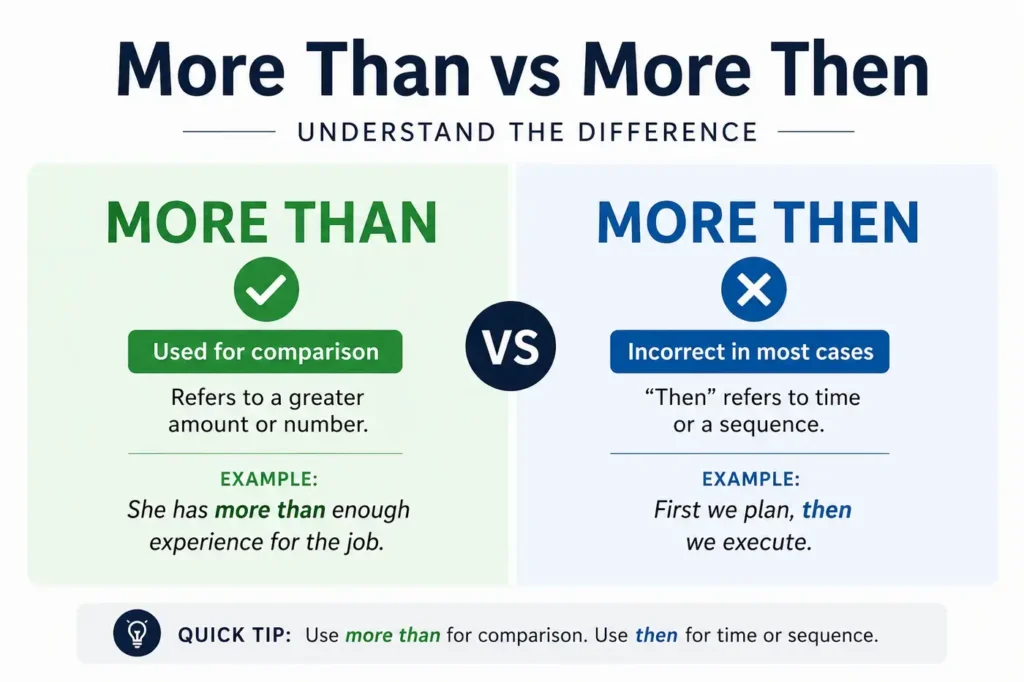
More than is the correct phrase for making comparisons. It means a larger amount, number, degree, or quantity. More then is usually a spelling mistake because then refers to time or what happens next, not comparison.
Quick Answer
If you’re comparing two things, always use more than.
Here are the rules to remember.
- Use than after words like more, less, better, worse, and rather.
- Use then when talking about time, order, or the next step.
- If you can replace the word with next or after that, then is correct.
- If you’re making a comparison, than is the right choice.
For example:
- She earns more than her brother.
- We waited, then we left.
- This movie is better than the first one.
- Finish your homework, then watch TV.
Comparison Table
| Feature | More Than | More Then |
|---|---|---|
| Part of speech | Comparison phrase | Usually an incorrect phrase |
| Main meaning | A larger amount or degree | Not correct in comparisons |
| Uses | Comparisons, quantities, measurements | Rarely correct unless then keeps its time meaning |
| Grammar | Uses the conjunction than | Uses the adverb then |
| Formality | Standard in all writing | Usually considered an error |
| Common contexts | Everyday English, academic writing, business writing | Typing mistakes and online confusion |
| Usage frequency | Extremely common | Very uncommon as a correct phrase |
| Example | More than 50 people attended. | More then 50 people attended. ❌ |
Meaning Of Each Phrase
At first glance, these expressions seem almost identical. The only visible difference is one letter, yet that single letter completely changes the grammar.
What Does More Than Mean
More than is a comparison phrase. It tells us that one person, thing, amount, or idea is greater than another.
You’ll see it used every day when people compare numbers, prices, distances, ages, or preferences. It also appears in business reports, academic papers, news articles, and casual conversations.
Here are some common examples.
- More than 100 students attended the event.
- I like coffee more than tea.
- This project took more than two weeks to finish.
- She has more than enough experience for the job.
- The package weighs more than five pounds.
In each sentence, than introduces the second part of the comparison.
What Does More Then Mean
In most situations, more then isn’t correct English. It’s usually a typing error caused by confusing than with then.
The word then has its own meaning. It refers to time, sequence, or what happens next.
For example:
- Eat dinner, then wash the dishes.
- We finished the meeting, then went home.
- Back then, life was much quieter.
- Finish this chapter, then start the next one.
Notice that none of these examples compare two things. They describe when something happens or what comes next.
In rare situations, the words more and then may appear next to each other as separate parts of a sentence, but they don’t form a comparison phrase.
For example:
We needed more. Then everyone volunteered to help.
Here, more ends one sentence and then begins the next idea. They are not working together as a fixed expression.
Key Differences Between More Than vs More Then
The easiest way to remember the difference is to think about the job each word performs.
Than compares.
Then tells time or sequence.
Once you understand that simple rule, most mistakes disappear.
Here are the biggest differences.
| More Than | More Then |
|---|---|
| Used for comparisons | Usually a mistake in comparisons |
| Uses than | Uses then |
| Shows a larger amount or degree | Refers to time or the next event |
| Grammatically correct | Usually grammatically incorrect |
| Common in speaking and writing | Mostly appears as a typo |
Another helpful way to think about it is this.
If your sentence answers the question Compared to what?, you almost certainly need than.
If your sentence answers the question What happened next?, you probably need then.
Which One Is Correct
For almost every comparison, more than is the correct phrase.
Professional editors automatically replace more then because it’s considered a spelling error, not an acceptable alternative. That’s true in American English, British English, Australian English, and Canadian English.
To make the choice easier, ask yourself these questions before you write.
- Am I comparing two people, things, or amounts?
- Can I replace the word with next or after that?
- Does the sentence describe order instead of comparison?
If you’re making a comparison, the answer is always than.
For example:
- I love you more than anyone else. ✔
- She studied more than her classmates. ✔
- The new model costs more than the old one. ✔
- I love you more then anyone else. ✘
- This laptop is more then expensive. ✘
Pronunciation Guide
One reason people confuse these words is that their pronunciation is similar in fast conversation. Native speakers often reduce unstressed sounds, making the difference harder to hear.
Than
IPA pronunciation:
/ðæn/
In casual American English, it may also sound closer to /ðən/ when unstressed.
Then
IPA pronunciation:
/ðen/
Although the vowel sound is slightly different, the distinction can be subtle during rapid speech. That’s why this mistake appears far more often in writing than in conversation.
The best way to avoid confusion isn’t by listening for the sound. Instead, focus on the meaning. Ask yourself if you’re making a comparison or describing time. The answer will point you to the correct word every time.
Expert Learning Tip
Many learners try to memorize the spelling, but experienced editors use a different approach. They look at the purpose of the sentence first.
If the sentence compares two ideas, than belongs there. If it explains what happens next, then is the correct choice. That simple habit works far better than trying to remember which word has the letter a or e.
Grammar Rules You Should Remember
Understanding the grammar behind than and then makes this mistake much easier to avoid. Once you know the role each word plays in a sentence, you’ll spend less time second guessing yourself and more time writing confidently.
How Than Works
Than is mainly used as a conjunction or preposition that introduces the second part of a comparison. Anytime you compare people, objects, amounts, actions, or ideas, than is usually the word you need.
You’ll commonly see it after comparative words such as:
- More.
- Less.
- Better.
- Worse.
- Faster.
- Slower.
- Bigger.
- Smaller.
- Higher.
- Lower.
Here are some natural examples.
- This phone is better than my old one.
- She runs faster than her brother.
- The meeting lasted longer than expected.
- We sold more tickets than last year.
- His explanation was clearer than mine.
Notice that every sentence compares two things. That’s the clue that tells you than belongs there.
How Then Works
Then is an adverb. It tells readers when something happens or what happens next.
You’ll often find it in instructions, stories, conversations, and timelines.
Examples include:
- Finish your breakfast, then brush your teeth.
- We visited the museum, then went out for dinner.
- I wasn’t living here back then.
- First save your work, then close the program.
- Call me then if your plans change.
The sentence isn’t making a comparison. Instead, it shows time, sequence, or the next event.
A Simple Test
If you’re unsure which word to use, try replacing it with next or after that.
If the sentence still makes sense, then is probably correct.
For example:
- We ate dinner, then watched a movie.
- We ate dinner, next watched a movie.
The wording sounds slightly different, but the meaning stays close enough to confirm that then is the right choice.
Now try the same trick with a comparison.
I have more then money.
Replacing then with next doesn’t make sense. That tells you the sentence needs than instead.
Common Mistakes People Make
Because these words differ by only one letter, it’s easy to hit the wrong key while typing. Still, some mistakes happen because writers misunderstand the grammar rather than simply making a typo.
Here are the errors editors see most often.
Using Then After Comparative Words
This is by far the most common mistake.
Incorrect:
- More then.
- Better then.
- Less then.
- Rather then.
Correct:
- More than.
- Better than.
- Less than.
- Rather than.
Every comparative word pairs with than, not then.
Writing Too Quickly
Many people know the correct word but type too fast. Since then is also a common English word, spell checkers don’t always catch the mistake.
That’s why proofreading is still important.
Depending Only On Spell Check
Grammar tools have improved, but they aren’t perfect. Some programs miss the error because both words are spelled correctly on their own.
Reading your sentence aloud often makes the mistake much easier to notice.
Forgetting The Purpose Of The Sentence
Instead of looking at the spelling, ask yourself one question.
Is this sentence comparing something?
If the answer is yes, than is almost certainly correct.
If the sentence explains time or order, then is the better choice.
Twenty Everyday Examples
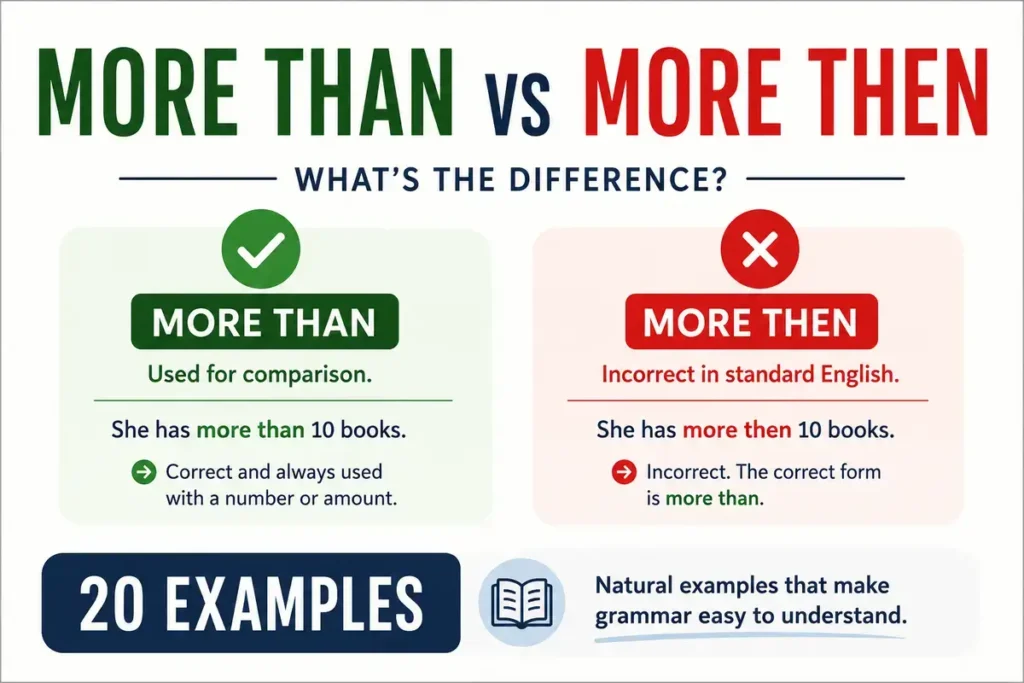
Learning grammar becomes much easier when you see natural examples instead of isolated rules. Here are 20 examples explaing more than vs more then
Examples Using More Than
- More than 300 people attended the concert.
- She loves reading more than watching television.
- This project required more than a month to finish.
- I spent more than I planned at the bookstore.
- The restaurant serves more than fifty different dishes.
- They traveled more than two thousand miles.
- My grandfather is more than eighty years old.
- The meeting lasted more than three hours.
- He cares more than he likes to admit.
- We received more than enough support from our friends.
Examples Using Then
- Finish your homework, then go outside.
- We stopped for coffee, then continued our trip.
- Back then, smartphones didn’t exist.
- Read the instructions first, then begin.
- The lights went out, then everything became quiet.
- She smiled, then walked away.
- I’ll call you then.
- We checked the map, then changed our route.
- First mix the ingredients, then bake the cake.
- They celebrated, then started planning the next event.
A Common Question
Many people search for the sentence I love you more then or than because they’re unsure which word belongs there.
The correct sentence is:
I love you more than anyone.
The sentence compares one person with everyone else. Since it’s making a comparison, than is the only correct choice.
The version using then is a grammar mistake.
The same rule applies to similar expressions.
- I miss you more than ever.
- She knows more than I expected.
- He laughed more than anyone else.
Every example compares one thing with another.
Real Life Usage
These words appear almost everywhere, even if you don’t notice them.
Daily Conversation
People make comparisons constantly during ordinary conversations.
Examples include:
- This coffee tastes better than yesterday’s.
- We spent more than we planned.
- That movie was funnier than the last one.
Words related to time also appear naturally.
- I’ll see you then.
- We finished dinner, then went home.
- Back then, everything seemed simpler.
School And Academic Writing
Students use than in essays, math problems, science reports, and research papers.
Examples include:
- The experiment produced more results than expected.
- Water expands more than most liquids when it freezes.
Teachers often mark then as an error because it changes the grammar of the sentence.
Professional Communication
Business writing also relies on comparisons.
You’ll commonly see sentences like these.
- Sales increased more than 15 percent this quarter.
- The new process saves more time than the previous method.
- Customer satisfaction improved more than expected.
Instructions and procedures, on the other hand, naturally use then.
- Complete the form, then submit it.
- Review the document, then send your approval.
- Save the file, then close the application.
Word Origin
Understanding the history behind these words explains why they’re so easy to confuse.
Than comes from Old English and developed as a word used for comparison. Its purpose has remained remarkably consistent for centuries.
Then also comes from Old English, but it evolved as a word connected with time and sequence. Even today, its meaning still centers on at that time, next, or afterward.
The spellings gradually became standardized, yet their similar appearance continues to confuse writers because both words remain extremely common in modern English.
Regional Usage
Unlike spelling differences such as color and colour, there isn’t a regional preference here.
American English, British English, Australian English, and Canadian English all follow the same grammar rule.
Professional editors across every major English speaking country treat more than as the correct comparison phrase. Using more then in the same context is considered a grammatical mistake, not a regional variation.
That consistency makes this one of the easier grammar rules to learn. Once you understand the purpose of each word, the rule stays the same no matter where you’re writing or who you’re writing for.
Related Words And Commonly Confused Terms
Once you understand the difference between more than vs more then, you’ll notice several other word pairs that cause similar confusion. They look alike, sound similar, or appear in related situations, which makes them easy to mix up.
Learning these pairs together can improve your grammar far beyond this single topic.
Here are some of the most commonly confused words.
| Word Pair | Correct Use | Example |
|---|---|---|
| Than and then | Comparison versus time | She is taller than me. Then we went home. |
| Less than and more than | Compare smaller and larger amounts | Less than 10 people arrived. More than 50 attended. |
| Rather than and then | Preference versus sequence | I’d rather stay home than drive. Then we watched a movie. |
| Compare to and compare with | Different comparison styles | The results compare with last year’s figures. |
| Fewer and less | Countable versus uncountable nouns | Fewer mistakes. Less stress. |
Understanding these related grammar patterns makes your writing clearer and helps you avoid repeating the same kinds of mistakes.
Then And Than Examples
Seeing both words in the same group makes the difference much easier to remember.
- She is older than her sister.
- Finish your lunch, then we’ll leave.
- This route is shorter than the highway.
- Read the directions first, then begin the test.
- I expected more than that.
- We packed our bags, then headed to the airport.
- The blue shirt costs less than the black one.
- Turn off the lights, then lock the door.
- He speaks faster than anyone I know.
- We visited the park, then went out for dinner.
Notice the pattern. Every sentence with than compares two things. Every sentence with then describes time or sequence.
More Then Meaning
A common online search is more then meaning. The answer is surprisingly simple.
On its own, more then doesn’t have a separate meaning in standard English. Most of the time, it’s simply a typing mistake where than was intended.
There are rare situations where the two words appear next to each other without forming a fixed phrase.
For example:
We wanted more. Then the rain started.
In this case, more ends one thought, and then begins the next sentence. They are separate words performing different jobs.
More Then Or Less Than
People also search for more then or less than, usually because they’re comparing mathematical expressions or quantities.
The correct comparison is:
- More than.
- Less than.
Both phrases use than because they compare amounts.
Examples include:
- More than 100 people attended.
- Less than half the tickets were sold.
- The package weighs less than two pounds.
- She earns more than her previous manager.
Replacing than with then in these sentences creates a grammar mistake.
Expert Language Insight
One habit separates experienced writers from everyone else. They don’t choose between than and then by looking at the spelling. They choose by understanding the purpose of the sentence.
Professional editors scan a sentence for comparison words before checking anything else. If they see words like more, less, better, worse, higher, or lower, they immediately expect than to follow.
If the sentence describes a timeline, instructions, or events happening one after another, they expect then instead.
This approach is much more reliable than relying on memory tricks. It also makes proofreading faster because you’re checking the sentence for meaning instead of individual words.
Another useful habit is reading your work aloud. Your ears often catch mistakes that your eyes skip over, especially when you’ve been looking at the same paragraph for several minutes.
Frequently Asked Questions
Is more than always correct?
Not always. More than is correct only when you’re comparing people, things, numbers, amounts, or ideas. If your sentence talks about time or the next event, you probably need then instead. Looking at the purpose of the sentence is the easiest way to choose the right word.
Is more then ever correct?
As a comparison phrase, no. It’s almost always a grammar mistake. The only time the two words appear together naturally is when more finishes one idea and then begins another, or when they happen to appear next to each other without forming a comparison.
Why do people confuse than and then?
The words differ by only one letter, and their pronunciation can sound similar in everyday conversation. Since both are common English words, spell check doesn’t always catch the mistake. Understanding their grammatical roles is much more helpful than memorizing their spelling.
Is I love you more then correct?
No. The correct sentence is I love you more than anyone or I love you more than you know. In both cases, the sentence compares one thing with another, so than is required.
Is this mistake common among native English speakers?
Yes. Native speakers make this mistake surprisingly often, especially while texting, writing quickly, or posting on social media. Most of these errors are simple typing mistakes rather than misunderstandings of the grammar.
What is the easiest way to remember the rule?
Think about the purpose of the sentence. If you’re comparing two things, use than. If you’re talking about time or what happens next, use then. This method works much better than trying to remember individual spellings.
Does the rule change in British English?
No. American English, British English, Australian English, and Canadian English all follow the same grammar rule. There is no regional variation for this comparison.
Why does this mistake appear so often online?
Online discussions, social media posts, and community forums are usually written quickly with little proofreading. That’s one reason searches like more than vs more then Reddit are common. People notice the mistake, question which version is correct, and look for a clear explanation. The answer remains the same regardless of where the sentence appears. Comparisons require than, while then refers to time or sequence.
Conclusion
Confusing more than vs more then is one of the most common grammar mistakes in English, but it’s also one of the easiest to fix once you understand the difference.
Use than when you’re comparing people, things, numbers, amounts, or ideas. Use then when you’re talking about time, order, or what happens next. That single rule covers almost every situation you’ll encounter in everyday writing.
Instead of relying on memory tricks, pay attention to the purpose of your sentence. Ask yourself if you’re making a comparison or describing a sequence of events. The answer will guide you to the correct word every time.
With a little practice, choosing between these two words becomes automatic. You’ll write with more confidence, avoid a common grammar mistake, and make your emails, essays, reports, and everyday conversations clearer for every reader.