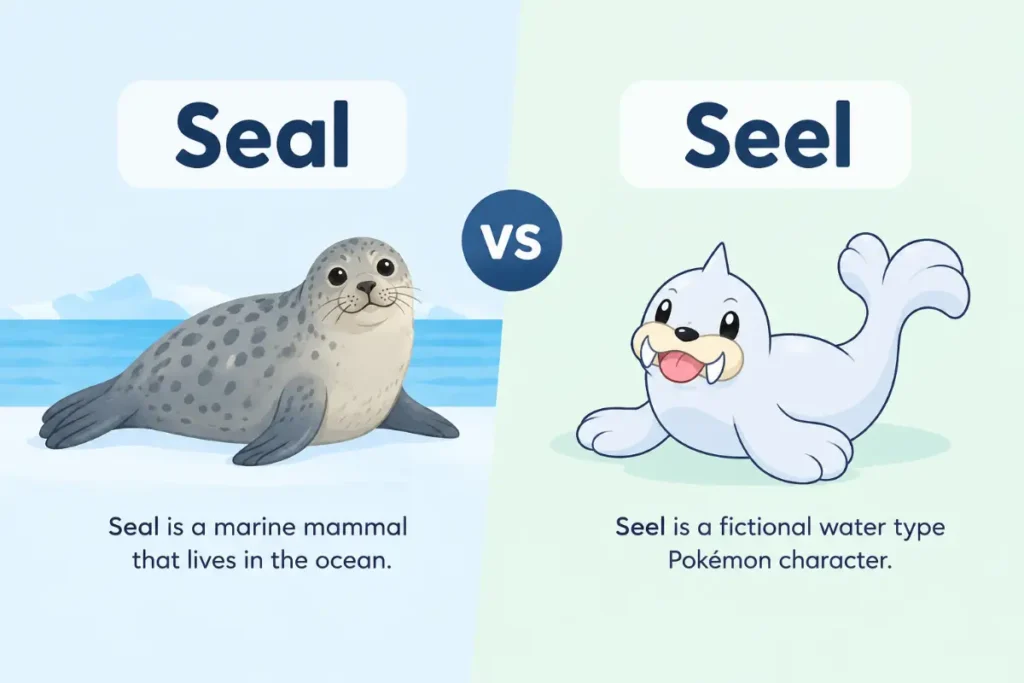
If you are unsure about seal vs seel, the answer depends on what you mean. Seal is the standard modern English word for closing an envelope, securing a container, confirming an agreement, referring to an official mark, or naming the marine animal. Seel is also a real English word, but it is rare and specialized. It is traditionally associated with falconry and means to close the eyes of a bird by stitching the eyelids.
The confusion is easy to understand because the two words have the same pronunciation in ordinary American English. When someone says the word aloud, you cannot tell from the sound alone which spelling they intend. The meaning and context provide the clue.
This distinction becomes especially useful in phrases such as seal an envelope, seal of approval, and seal the deal. You will also see seal when discussing seals and sea lions, although the two animals are not the same. This guide explains the meanings, grammar, pronunciation, word origins, common mistakes, examples, and practical usage so you can choose the right word confidently.
Quick Answer
Seal is the correct modern word for closing an envelope, securing something, making an agreement final, referring to an official mark, or naming the marine animal. Seel is a legitimate but rare word mainly associated with historical falconry, where it means to close a bird’s eyes. The two words sound alike but have different meanings.
If you’re unsure about the correct spelling of a word describing a raised shoe sole, comparing platform and flatform can help clear up the difference and prevent another common spelling mix-up.
What Does Seal Mean
Seal is a common English word that works as both a noun and a verb. Its meaning changes according to context, but its main ideas involve closing, securing, confirming, marking, or referring to a marine animal.
As a verb, seal can mean to close something securely so that it cannot easily be opened or so that air, water, or another substance cannot pass through. You can seal an envelope, seal a package, seal a container, or seal a crack.
For example:
Please seal the envelope before putting it in the mailbox.
It can also mean to make something final or certain. This explains familiar expressions such as seal the deal and seal a victory.
As a noun, seal can refer to an official mark or emblem. A government office, university, organization, or institution may have an official seal.
The word also refers to a marine mammal. Seals live in coastal and marine environments and include several different species. This meaning has a separate historical origin from the word referring to an official mark or closure.
What Does Seel Mean
Seel is a genuine English word, but it is not the normal spelling of the verb meaning to close something.
The specialized verb traditionally belongs to the language of falconry. It means to close the eyes of a hawk or another bird by stitching the eyelids. Historical dictionaries also record older meanings connected with closing or blinding the eyes.
Modern readers are unlikely to encounter this word in ordinary conversation. It mainly appears in historical writing, literature, dictionaries, or discussions of traditional falconry.
For example:
The historical account describes how a falconer would seel a hawk’s eyes.
That is a specialized use. It would be incorrect to replace seal with seel in an everyday sentence such as:
Please seel the envelope.
The correct sentence is:
Please seal the envelope.
So, seel is not simply an alternative spelling of seal. It has its own meaning and grammatical history.
Seal And Seel At A Glance
| Feature | Seal | Seel |
|---|---|---|
| Standard modern word | Yes | Yes but rare |
| Common in American English | Very common | Extremely uncommon |
| Part of speech | Noun and verb | Mainly verb |
| Main meaning | Close, secure, confirm, official mark, marine animal | Close the eyes of a bird |
| Common context | Envelopes, packages, agreements, documents, animals | Historical falconry |
| Pronunciation | /siːl/ | /siːl/ |
| Everyday usage | Very common | Rare |
| Can refer to an animal | Yes | No |
| Can mean close an envelope | Yes | No |
| Common phrase | Seal of approval | None in ordinary modern English |
Seal vs Seel Differences
The biggest difference is meaning, not pronunciation. The words sound alike, but their uses are quite different.
Meaning
Seal has several common meanings. It can describe closing something, making something secure, confirming an agreement, identifying an official mark, or referring to a marine mammal.
Seel has a much narrower meaning. Its best known historical use refers to closing a bird’s eyes as part of traditional falconry.
Grammar
Seal can function as both a noun and a verb.
As a noun:
The official seal appears on the document.
As a verb:
Please seal the package.
Seel is primarily used as a verb in its specialized sense.
The falconer would seel the bird’s eyes.
Frequency
Seal is part of ordinary modern vocabulary. You may encounter it in personal communication, business documents, government materials, packaging instructions, news reports, and everyday conversation.
Seel is much less common. A modern reader may know the word mainly because of dictionaries, historical texts, literature, or word games.
Context
Context usually makes the intended word obvious in writing.
If the sentence mentions an envelope, package, container, contract, official emblem, or marine animal, seal is the natural choice.
If the sentence describes historical falconry and the closing of a bird’s eyes, seel may be appropriate.
Which One Should You Use
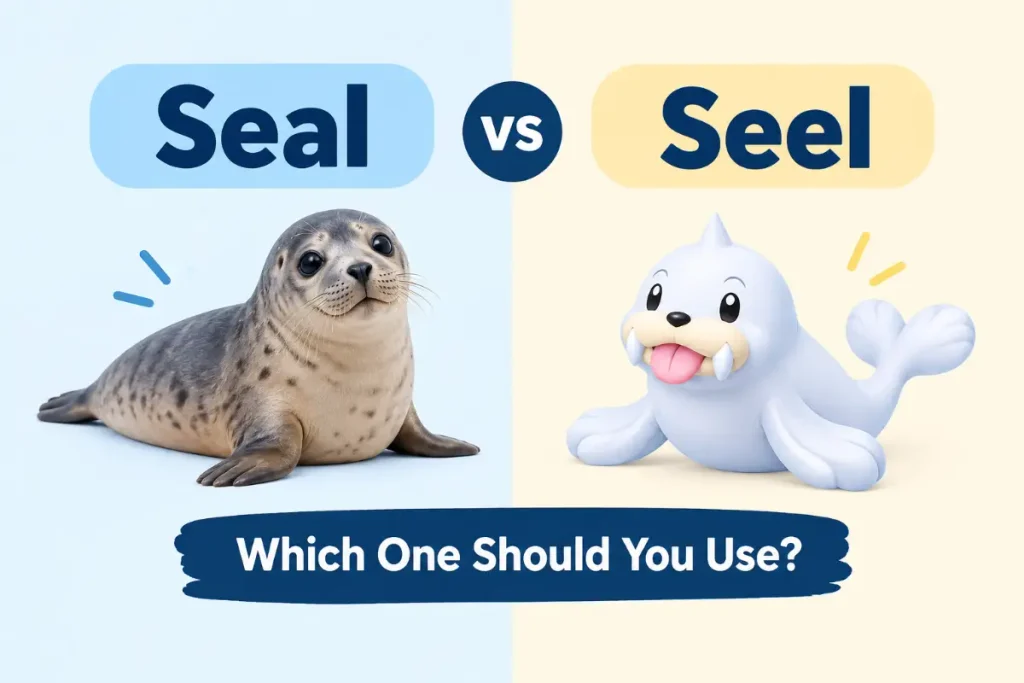
For almost all everyday writing, choose seal.
Use seal when you mean:
- Close an envelope.
- Close or secure a package.
- Prevent air or liquid from passing through.
- Make an agreement final.
- Confirm or strengthen an outcome.
- Refer to an official emblem or mark.
- Refer to the marine animal.
Use seel only when the specialized historical meaning is intended.
A useful test is to ask yourself what the word is doing in the sentence. If you mean close, secure, confirm, mark, or marine animal, choose seal. If you mean the traditional falconry practice involving a bird’s eyes, seel can be correct.
Seal Examples In Sentences
Here are natural examples showing the most common meanings.
- Please seal the envelope before you mail it.
- The technician sealed the opening to prevent water from entering.
- We used tape to seal the box securely.
- The agreement was signed to seal the deal.
- The final goal sealed the team’s victory.
- The university’s official seal appears on the certificate.
- The bottle has a plastic seal under the cap.
- We watched a seal swimming near the rocks.
- The company used a special material to seal the container.
- The president’s signature helped seal the agreement.
These examples show why the word is so common. It can describe a physical action, an abstract decision, an official symbol, or an animal.
Seel Examples In Sentences
Because the word has a highly specialized meaning, examples should reflect its historical use rather than make it look like an everyday synonym for seal.
- The historical text describes how falconers would seel a hawk.
- The manuscript uses the verb seel when discussing traditional falconry.
- The author used seel in its old falconry sense.
- Readers may encounter seel in older literature about hawking.
- The dictionary lists seel as a specialized verb involving a bird’s eyes.
- The passage describes a falconer preparing to seel the bird.
- The historical account explains why falconers once used the practice of seeling.
- The unusual word seel can confuse modern readers.
These sentences are intentionally specialized. In normal modern writing, you will almost never need this word.
Common Mistakes
The most common error is using seel when you mean seal.
Mistake One
Incorrect: Please seel the envelope.
Correct: Please seal the envelope.
An envelope is closed by sealing it. The historical falconry meaning has nothing to do with ordinary mail.
Mistake Two
Incorrect: She added a seel to the document.
Correct: She added a seal to the document.
An official mark or emblem is a seal.
Mistake Three
Incorrect: They seel the package with tape.
Correct: They seal the package with tape.
The verb for closing or securing a package is seal.
Mistake Four
Incorrect: The company gave the project its seel of approval.
Correct: The company gave the project its seal of approval.
The established expression is seal of approval.
Mistake Five
Incorrect: We saw a group of seels near the shore.
Correct: We saw a group of seals near the shore.
The marine animals are seals.
Mistake Six
Incorrect: The contract was finally seeled.
Correct: The contract was finally sealed.
The normal past tense of seal is sealed.
Similar confusion can occur in specialized vocabulary, where knowing the correct medical term matters because two nearly identical-looking words may differ in standard usage.
Why These Words Are Confused
The main reason is pronunciation. In standard American English, seal is pronounced /siːl/, and the specialized word seel has the same basic pronunciation. That makes them homophones in ordinary speech.
If someone says:
I need to seal the envelope.
You hear the sound /siːl/. You do not hear the spelling.
This is why spoken English can create spelling confusion. The listener has to use the surrounding meaning to understand which word is intended.
English has many other homophones that create the same problem. Words such as right and write, there and their, and flower and flour sound alike but have different meanings and spellings.
The solution is not to guess from pronunciation. Look at the meaning and grammatical role.
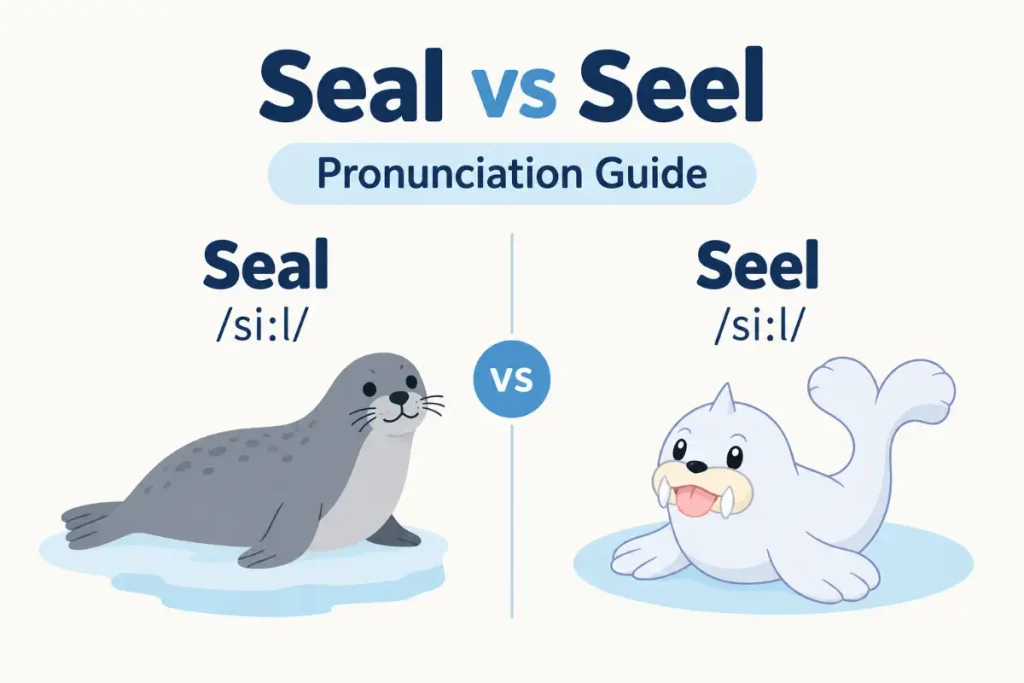
Pronunciation Guide
Both words are pronounced with the long ee sound.
Seal: /siːl/
Seel: /siːl/
A simple pronunciation guide is:
SEEL
The vowel sound is similar to the sound in see, followed by the final l sound.
There is no meaningful pronunciation difference that reliably tells you which spelling is being used. This is one reason the words are easy to confuse when heard rather than read.
For American English speakers, the safest approach is to learn each spelling together with its meaning.
Think:
Seal the envelope.
And:
Seel a hawk’s eyes.
The context provides the distinction that pronunciation cannot provide.
Word Origin And Etymology
The two words have different historical stories, even though they now sound alike.
The word seal in the sense of an official mark or a device used to authenticate something developed through Middle English from Old French seel and ultimately from Latin sigillum, meaning a small mark or image. The verb developed alongside this idea of marking, securing, or closing something.
The animal meaning has a different origin. The noun comes from Old English seolh, from a Germanic source. So the modern spelling brings together meanings that developed from separate historical roots.
The specialized verb seel has a different history. It is associated with the traditional falconry practice of closing a bird’s eyes. Historical dictionary records connect this sense with French and Latin terms related to the eyelids and the practice itself.
This history explains why treating seel as simply a misspelling is not completely accurate. It is a real word, but it is not the ordinary spelling of the modern verb seal.
American English Usage
In American English, seal is overwhelmingly the practical choice for modern communication.
You will commonly see it in:
- Business contracts.
- Mailing instructions.
- Product packaging.
- Government documents.
- Legal writing.
- Manufacturing.
- Construction.
- Environmental writing.
- News articles.
- Everyday conversation.
The word seel is not a normal alternative spelling in American English. Its specialized dictionary meaning survives, but most Americans will rarely encounter it outside historical or specialist material.
This means a writer should not treat the two spellings as regional alternatives. They are not like color and colour, where different national standards exist. The difference here is mainly one of meaning and historical usage.
Grammar Rules
Seal is flexible because it can function as both a noun and a verb.
Seal As A Verb
The base form is seal.
Please seal the package.
The third person singular form is seals.
The machine seals each container automatically.
The past tense and past participle are sealed.
They sealed the agreement yesterday.
The present participle is sealing.
She is sealing the envelopes now.
Seal As A Noun
The plural form is seals.
Several seals were resting on the rocks.
The possessive singular form is seal’s.
The seal’s habitat is protected.
The possessive plural form is seals’.
The seals’ habitat is protected.
The correct grammatical form depends on the meaning, but the spelling remains straightforward.
Seel As A Verb
The specialized verb follows regular English verb patterns.
Present:
seel
Third person singular:
seels
Past tense:
seeled
Present participle:
seeling
Because the word is so uncommon, many readers may find these forms unfamiliar. That does not make them automatically wrong. They simply belong to a specialized and largely historical vocabulary.
Seal And Sea Lion
A related search question is the difference between a seal and sea lion. Both are marine mammals, but they are not the same animal.
One of the easiest visual distinctions is the presence of external ear flaps. Sea lions have visible external ear flaps, while true seals do not have external ears that project from the head.
Their movement on land also differs. Sea lions can rotate their hind flippers underneath their bodies and move more effectively on land. True seals have a different body structure and generally move by wriggling or using their fore flippers and body.
The terms are sometimes mixed up in casual conversation, but they describe different groups of marine mammals.
So if you are writing about the animal, use seal for a seal and sea lion for a sea lion. The spelling seel does not refer to either animal.
Common Phrases With Seal
Several familiar expressions use seal, which can help reinforce the correct spelling.
Seal Of Approval
A seal of approval means official or strong approval.
The new product received the company’s seal of approval.
Seal The Deal
To seal the deal means to make an agreement final.
The final contract helped seal the deal.
Signed Sealed And Delivered
This expression describes something that has been formally completed.
The documents were signed, sealed, and delivered.
Seal Off
To seal off an area means to close it so people cannot enter or pass through.
Police sealed off the street after the accident.
Seal In
To seal in something means to keep it inside.
The container helps seal in moisture.
These phrases all use seal, not seel.
Just as with “seel” and “seal,” checking the commonly confused spelling can help you avoid using a word that looks plausible but is not standard English.
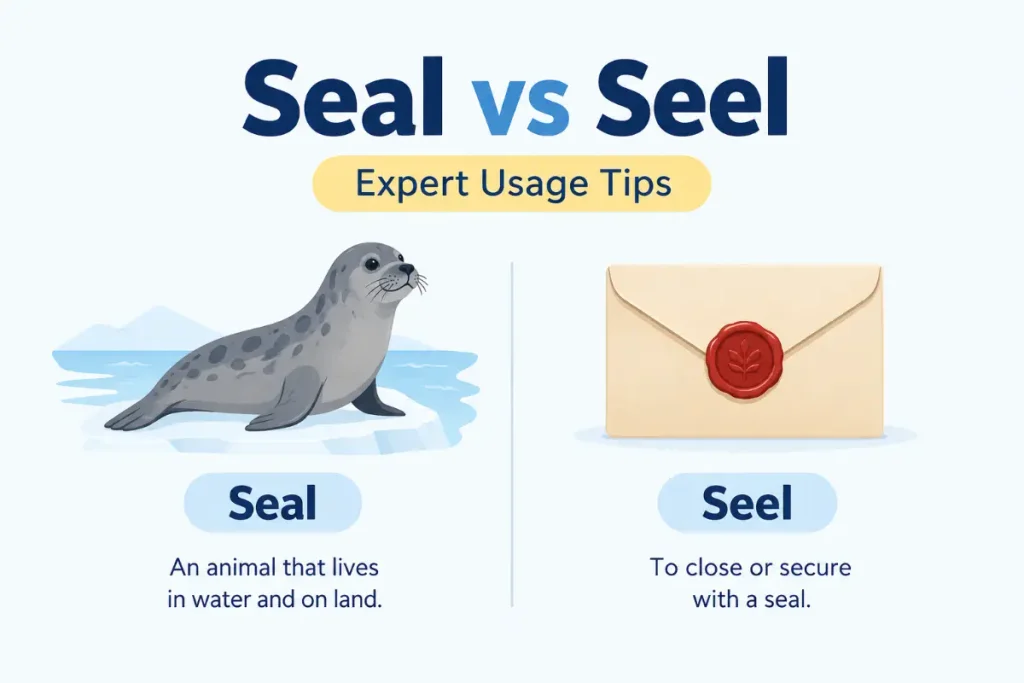
Expert Usage Tips
For modern American writing, there is a very simple editorial rule: do not use seel as a spelling variation of seal.
If you are talking about an envelope, package, contract, document, container, agreement, official mark, or marine animal, write seal.
If you are reading an old text and encounter seel, do not automatically assume it is a typographical error. The word has a legitimate historical meaning connected with falconry and the closing of a bird’s eyes.
Another useful point is that context matters more than sound. Since the two words are pronounced alike, memorizing the spelling together with a representative phrase is more effective than trying to distinguish them by pronunciation.
For everyday writing, remember:
- Seal an envelope.
- Seal the package.
- Seal the deal.
- Seal of approval.
- Watch a seal swim.
For historical falconry:
Seel a hawk’s eyes.
That small distinction is enough to eliminate nearly every modern usage error.
Frequently Asked Questions
Is Seal Or Seel Correct
Seal is correct for the normal modern meanings of closing, securing, confirming, referring to an official mark, or naming the marine animal. Seel is also a legitimate word, but it has a rare specialized meaning connected mainly with historical falconry. It is not an alternative spelling for everyday uses of seal.
How Do You Spell Seal An Envelope
The correct phrase is seal an envelope. The verb seal means to close the envelope by securing its flap. Seel an envelope is incorrect because seel does not have the modern general meaning of closing an envelope.
Is Seel A Real English Word
Yes. Seel is a real English word. It is traditionally a falconry verb meaning to close the eyes of a bird by stitching the eyelids. The word is uncommon in modern English, so most readers will encounter it mainly in historical, literary, or specialized contexts.
Are Seal And Seel Homophones
Yes. In standard American English, the two words have the same basic pronunciation, /siːl/. They sound alike but have different spellings and meanings. This makes them homophones. Context is therefore important when determining which word belongs in writing.
What Is The Difference Between A Seal And A Sea Lion
A seal and a sea lion are different marine mammals. Sea lions have visible external ear flaps and can rotate their hind flippers underneath their bodies for easier movement on land. True seals lack those external ear flaps and have a different body structure and movement pattern.
Is Seel A Common Word
No. Seel is a rare word in modern English. Its best known surviving use is the specialized falconry verb concerning the closing of a bird’s eyes. Most American readers will not need this word in everyday conversation, business writing, school assignments, or ordinary professional communication.
How Do You Remember The Difference
Think about the meaning first. If you can replace the word with close, secure, confirm, official mark, or marine animal, use seal. If the context specifically describes the historical practice of closing a bird’s eyes in falconry, seel may be the correct word.
Conclusion
The practical answer is simple. Seal is the standard word you should use in modern American English for closing an envelope or container, securing something, making an agreement final, referring to an official mark, or naming the marine animal.
Seel is not merely a misspelling. It is a legitimate but rare word associated mainly with historical falconry, where it means to close a bird’s eyes. The two words sound alike, which explains the confusion, but their meanings are very different.
When you are writing about an envelope, package, contract, approval, document, or marine mammal, choose seal. Save seel for the specialized historical context where its meaning is actually intended.