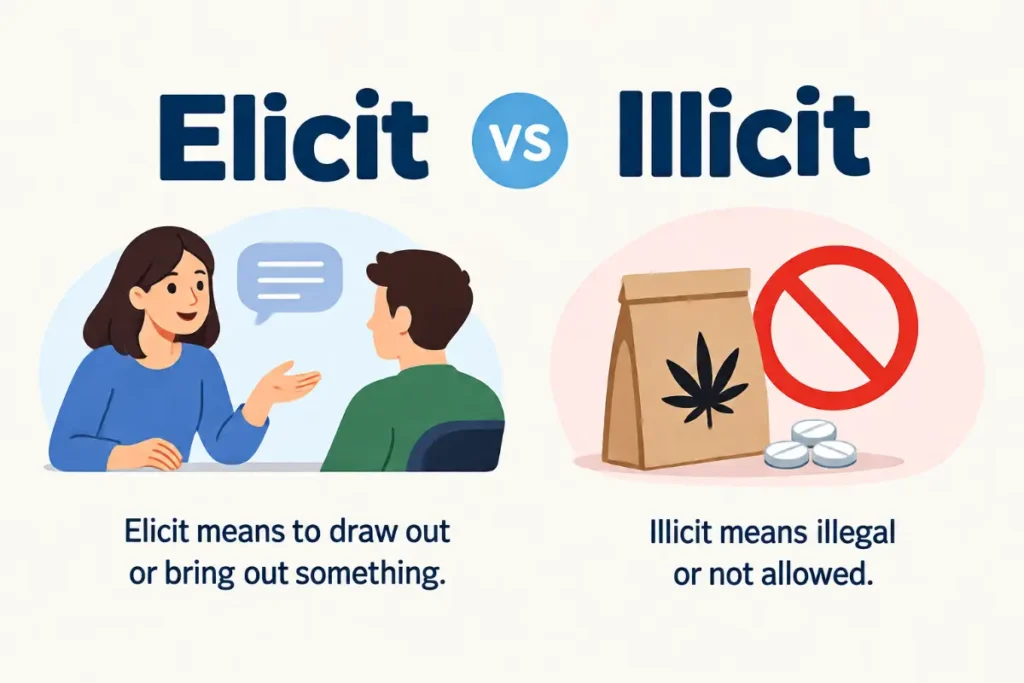
If you are unsure about elicit vs illicit, the difference comes down to meaning, grammar, and context. Elicit is a verb meaning to draw out or obtain a response, reaction, answer, or information. Illicit is an adjective describing something illegal or socially disapproved of. The two words look and sound very similar, which makes them easy to confuse in writing. They are not interchangeable, though. Understanding what each word does in a sentence makes the distinction much easier to remember.
This guide explains the meanings, grammar, pronunciation, origins, common mistakes, and real world uses of both words. You will also see examples from everyday conversation, school, professional communication, research, and formal writing. By the end, you should be able to choose the right word quickly without relying on guesswork.
Quick Answer
Elicit is a verb meaning to draw out or obtain something, especially information, a response, or a reaction. Illicit is an adjective meaning illegal or socially disapproved of. For example, a question can elicit an answer, while an illicit activity violates the law or accepted social standards.
Knowing the difference can make your writing more precise, especially when you’re understanding passed and past in everyday English.
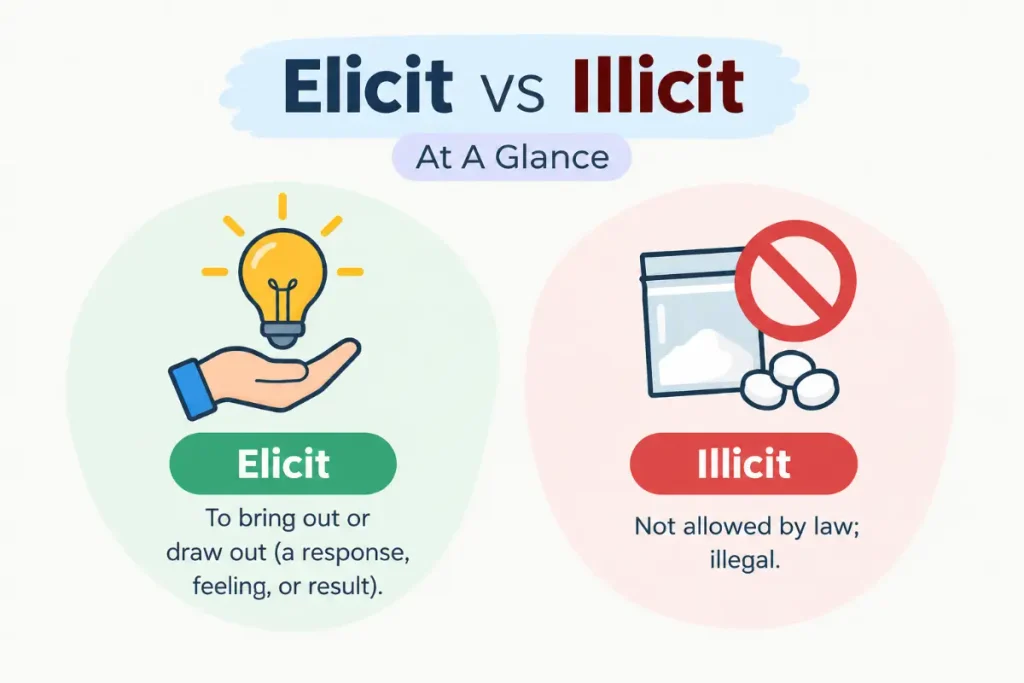
Elicit vs Illicit At A Glance
The easiest way to separate these words is to focus on their grammatical roles. Elicit describes an action. Someone elicits information, a reaction, a response, or an idea. Illicit describes a person, activity, product, relationship, trade, or other thing that is not legally permitted or is socially disapproved of.
| Feature | Elicit | Illicit |
|---|---|---|
| Part of speech | Verb | Adjective |
| Basic meaning | Draw out or obtain a response, reaction, or information | Illegal or socially disapproved of |
| Main function | Describes an action | Describes a noun |
| Common contexts | Questions, interviews, research, teaching, reactions | Law, crime, trade, drugs, relationships, prohibited activity |
| Common phrase | elicit a response | illicit activity |
| Pronunciation | /ɪˈlɪs.ɪt/ | /ɪˈlɪs.ɪt/ |
| US usage | Standard | Standard |
| Related form | elicited, eliciting, elicitation | illicitly, licit |
Both words have the same standard US pronunciation, /ɪˈlɪs.ɪt/, so hearing the difference is not always possible. Their meanings and grammatical functions provide the real distinction.
What Does Elicit Mean
Elicit is a verb that means to draw something out, obtain something, or cause a particular response. It is especially common when the thing being obtained is information, an answer, a reaction, an opinion, support, or an emotional response.
The important idea is that something is being brought out from a person or situation. A teacher may ask a question to elicit an answer. A reporter may ask questions to elicit information. A photograph may elicit an emotional reaction from viewers.
The word often appears in formal, professional, academic, and educational writing. It can sound more precise than simply saying get or cause.
For example:
- The interviewer asked several questions to elicit more information.
- The teacher used a simple question to elicit a response from the class.
- The speech elicited strong reactions from the audience.
- The survey was designed to elicit honest opinions.
- Her comment elicited laughter from the room.
In each example, something is being drawn out or brought forth. The word does not mean that the person necessarily forces the response. The focus is on obtaining or producing the response through a question, situation, action, or stimulus.
Elicit As A Verb
Elicit is a transitive verb, which means it normally takes a direct object. You generally elicit something.
Common structures include:
- elicit a response
- elicit an answer
- elicit information
- elicit an opinion
- elicit support
- elicit laughter
- elicit concern
- elicit a reaction
- elicit details
- elicit feedback
The object can be something verbal or something emotional. That flexibility is one reason the word appears in many different fields.
In education, for example, a teacher may elicit an answer rather than immediately giving students the answer. In research, an interviewer may use carefully designed questions to elicit information from participants. Cambridge specifically notes this educational use, where a teacher encourages a student to provide or remember information instead of simply supplying it.
What Does Illicit Mean
Illicit is an adjective. It describes something that is illegal or not accepted by society. The word is often used for activities, goods, trade, money, relationships, or other conduct that is prohibited or socially disapproved of.
For example:
- The police investigated an illicit trade operation.
- The report discussed illicit activities.
- Authorities seized illicit goods.
- The company was accused of participating in an illicit scheme.
- The investigation uncovered an illicit financial transaction.
The word can overlap with illegal, but it can carry a slightly broader sense. Cambridge defines it as illegal or disapproved of by society, while its Business English definition includes things that are not allowed by law or are socially disapproved of.
This means illicit does not always have to describe something that is specifically prohibited by a criminal statute. Depending on the context, it can also describe conduct that violates accepted social standards.
The Main Difference Between Elicit And Illicit
The clearest distinction is simple:
Elicit is an action. Illicit is a description.
When you elicit something, you bring it out or obtain it.
When something is illicit, it is illegal or socially unacceptable.
Compare these sentences:
- The interviewer elicited useful information from the witness.
- The investigators discovered an illicit business arrangement.
The first sentence describes an action performed by the interviewer. The second describes the nature of the business arrangement.
Another useful comparison is:
- The question elicited an angry response.
- The investigation uncovered an illicit payment.
The first word is a verb. The second is an adjective.
This grammatical difference is often more useful than trying to remember the spelling letter by letter.
How To Use Elicit In A Sentence
Elicit works best when something causes or draws out a response, answer, reaction, feeling, opinion, or information. It is especially natural in formal writing, although it is also used in everyday speech.
Here are several useful examples:
- The reporter asked a follow up question to elicit more details.
- The teacher’s question elicited several thoughtful answers.
- The comedian’s final joke elicited laughter from the audience.
- The survey was designed to elicit honest feedback.
- The photograph elicited an emotional response.
- The attorney’s question elicited important information.
- The announcement elicited concern among employees.
- The new policy elicited mixed reactions.
- The researcher used interviews to elicit personal experiences.
- The manager’s question elicited a useful suggestion.
Notice the pattern. In every case, something is brought out or produced in response to another action, question, event, or stimulus.
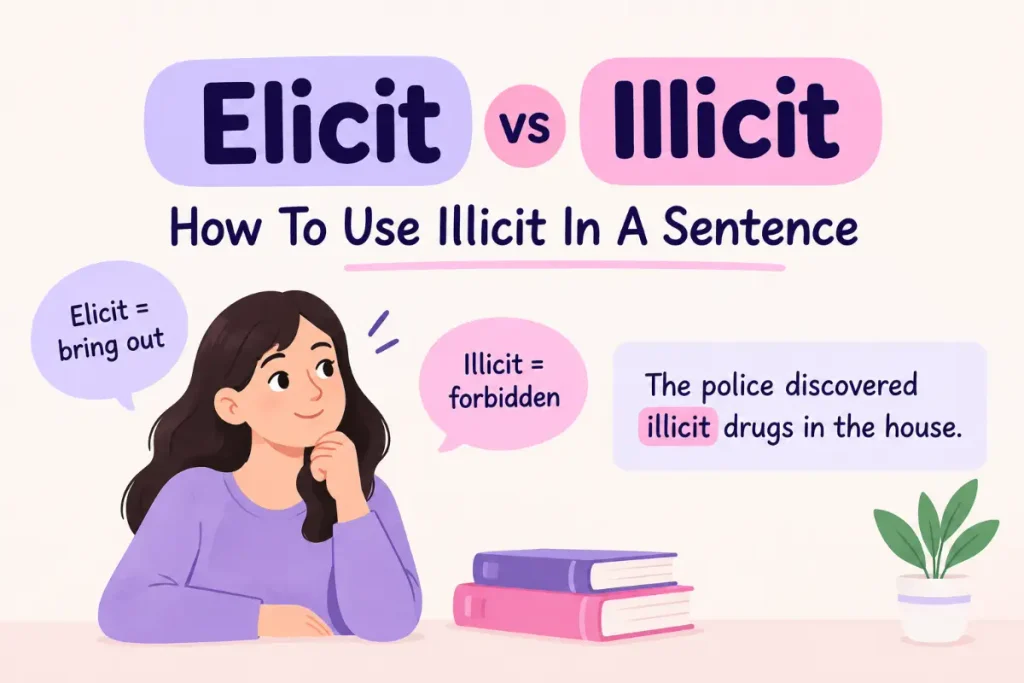
How To Use Illicit In A Sentence
Illicit normally appears before a noun because it is an adjective. The noun identifies the activity, object, relationship, or conduct that is considered illegal or socially unacceptable.
Examples include:
- The investigation uncovered an illicit trade network.
- Officials worked to prevent illicit sales.
- The report examined illicit financial activity.
- The company was accused of making an illicit payment.
- Authorities seized illicit goods.
- The organization created new procedures to prevent illicit transactions.
- The article described an illicit agreement between the parties.
- Investigators were looking for evidence of illicit conduct.
- The agency monitors the movement of illicit products.
- The investigation focused on an illicit business operation.
You can also use the related adverb illicitly when you need to describe how an action was performed. For example, The funds were obtained illicitly means they were obtained in an illegal or socially disapproved way.
Elicit And Illicit In Professional Writing
Both words appear frequently in professional writing, but they serve very different purposes.
Elicit is useful when discussing communication, research, interviews, surveys, education, customer feedback, or reactions. A business report might say that a survey was designed to elicit customer feedback. A researcher might describe a method used to elicit responses from participants.
Illicit is more common in legal, regulatory, financial, investigative, and compliance contexts. You may see phrases such as illicit trade, illicit payments, illicit activity, or illicit transactions.
Consider these examples:
- The customer survey was created to elicit useful feedback.
- The compliance team investigated illicit financial activity.
Using the wrong word can completely change the meaning. Saying that a survey was designed to illicit feedback is incorrect because illicit cannot function as the verb meaning obtain.
Similarly, confusing council and counsel explained can lead to mistakes when discussing legal advice, organizations, or formal decisions.
Elicit And Illicit In Academic Writing
Elicit is particularly useful in academic and research contexts. Researchers often need to obtain information, opinions, reactions, judgments, or responses from participants. The noun elicitation is also common in specialized academic fields. Cambridge defines elicitation as the process of getting or producing something, especially information or a reaction.
Examples include:
- The researchers used interviews to elicit participants’ opinions.
- The experiment was designed to elicit a specific response.
- The questionnaire helped elicit information about study habits.
- The teacher used open questions to elicit student responses.
- The researchers analyzed the data elicited during the interviews.
Illicit can also appear in academic writing, especially in research involving law, economics, public policy, sociology, criminology, or public health.
Examples include:
- The study examined illicit financial flows.
- Researchers analyzed patterns of illicit trade.
- The report discussed the effects of illicit drug markets.
Elicit vs Illicit Pronunciation
One reason these words cause so much confusion is that they are pronounced the same in standard American English.
Both are pronounced:
/ɪˈlɪs.ɪt/
A simple pronunciation guide is approximately:
ih LIS it
The stress falls on the second syllable. Cambridge lists the US pronunciation of both elicit and illicit as /ɪˈlɪs.ɪt/.
Because the pronunciation is identical, you cannot reliably determine the spelling simply by hearing the word. Context matters.
For example, if someone says:
The question will elicit a response.
You know the intended word from the grammatical structure and meaning.
If someone says:
The company was involved in illicit trade.
The adjective before trade makes the intended word clear.
Elicit And Illicit Word Forms
Understanding related forms can make the distinction easier.
The verb elicit has common forms such as:
- elicit
- elicits
- elicited
- eliciting
- elicitation
Examples:
- The question elicits useful information.
- The interview elicited several important details.
- The researchers are eliciting responses.
- The study describes the elicitation process.
The adjective illicit has related forms including:
- illicit
- illicitly
Examples:
- The activity was illicit.
- The funds were obtained illicitly.
The word licit is also worth knowing. It means allowed by law and is the opposite of illicit. It is a formal word and is less common in everyday conversation.
Common Mistakes With Elicit And Illicit
The most common mistake is using illicit as a verb when the intended meaning is elicit.
Incorrect: The survey was designed to illicit customer feedback.
Correct: The survey was designed to elicit customer feedback.
The reason is grammatical. Elicit is the verb meaning to obtain or draw out. Illicit is an adjective describing something illegal or socially disapproved of.
Another common mistake is using elicit when describing something illegal.
Incorrect: The company was involved in elicit trade.
Correct: The company was involved in illicit trade.
Here, the word must describe trade, so an adjective is required. Illicit fits that role.
A third mistake comes from the identical pronunciation. Writers sometimes choose the spelling based on how the word sounds. That does not work with these two words because both have the same standard US pronunciation.
Elicit vs Illicit vs Solicit
Solicit is another word that can cause confusion because it resembles elicit and shares some contexts with it.
Solicit generally means to ask for, seek, or try to obtain something. Elicit means to draw something out or cause a response to emerge.
Compare these examples:
- The company solicited customer feedback.
- The survey questions elicited detailed customer feedback.
In the first sentence, the company actively asked for feedback. In the second, the questions brought out the feedback.
The distinction can be subtle because the actions may occur together. A researcher might solicit participation and then use questions to elicit information from the participants.
The words therefore should not be treated as interchangeable synonyms. Solicit emphasizes actively asking or seeking. Elicit emphasizes drawing out or obtaining a response, reaction, or information.
Elicit Synonyms And Related Words
The best synonym for elicit depends on the context. Useful alternatives include:
- obtain
- draw out
- bring out
- evoke
- prompt
- produce
- generate
- induce
- extract
- provoke
These words are not identical in every situation.
For example, evoke often focuses on bringing a feeling, memory, image, or reaction to mind. Obtain is broader and simply means getting something. Prompt can emphasize causing someone to act or respond. Extract can suggest obtaining something through deliberate effort.
That is why replacing elicit with a synonym should be based on the sentence’s intended meaning rather than simply choosing the closest dictionary entry.
Illicit Synonyms And Related Words
Common words related to illicit include:
- illegal
- unlawful
- prohibited
- unauthorized
- forbidden
- unsanctioned
- improper
- illegitimate
Again, the meanings are not perfectly identical.
Illegal directly emphasizes violation of the law. Illicit can refer to something illegal, but it can also describe conduct that is socially disapproved of. Unauthorized focuses on a lack of permission rather than necessarily breaking a law.
For example:
The employee made an unauthorized purchase.
This does not automatically mean the purchase was illegal.
By contrast:
The company investigated an illicit payment.
This wording suggests conduct that may have violated the law or accepted standards, depending on context.
Word Origins And Etymology
The two words have different historical backgrounds despite their similar modern pronunciation and spelling.
Elicit comes from Latin elicere, meaning to draw out or draw forth. Its modern English meaning retains that basic idea of bringing something out, especially a response, information, or reaction.
Illicit comes from Latin illicitus, meaning not permitted or unlawful. It is related to licet, a Latin form associated with something being permitted. The modern word therefore retains the basic idea of something not allowed.
The different origins explain why the words have completely different meanings even though they look remarkably similar.
A useful memory connection is:
Elicit → draw something out.
Illicit → not permitted.
Is Elicit Or Illicit American Or British English
Both elicit and illicit are standard English words used in American and British English. There is no American versus British spelling difference between them.
The meanings are also broadly consistent across major varieties of English. Cambridge lists the same basic definitions and US pronunciations for the words.
So if you are writing for an American audience, you do not need to choose one form based on regional spelling.
The choice depends entirely on meaning and grammar.
- Use elicit when you mean draw out or obtain a response, reaction, or information.
- Use illicit when you mean illegal or socially disapproved of.
Another useful distinction is the difference between discreet and discrete, since these words have different meanings despite their similar spelling.
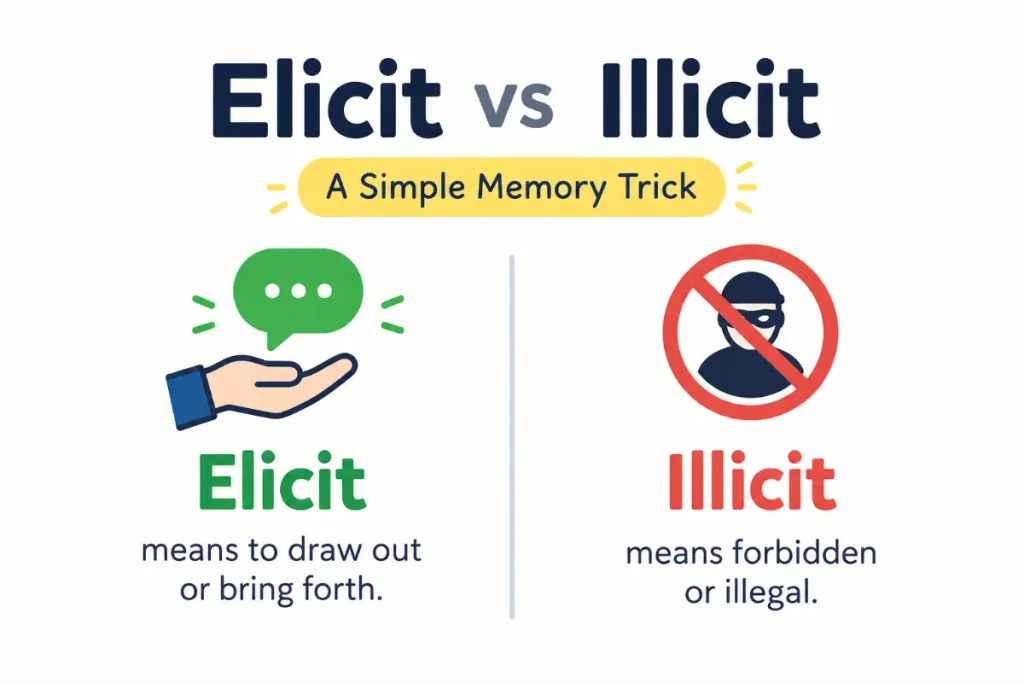
A Simple Memory Trick
If you regularly mix these words up, connect each spelling with its function.
Think:
Elicit = extract a response.
Both ideas involve drawing something out.
Then think:
Illicit = illegal or not allowed.
The beginning of illicit can remind you of illegal, even though the words are not formed from the same English root.
Another useful trick is to look at the word that follows it.
If you need an action such as:
___ a response
the answer is elicit.
If you need an adjective such as:
___ activity
the answer is illicit.
These simple sentence patterns can help you identify the correct word quickly.
Which Word Should You Use
Choose elicit when your sentence describes someone or something drawing out information, a response, a reaction, an opinion, an emotion, or another result.
Choose illicit when you are describing something as illegal, prohibited, unauthorized in a relevant context, or socially disapproved of.
A quick test is to ask what role the word plays:
- Is it describing an action that obtains or draws something out? Use elicit.
- Is it describing an activity, object, relationship, transaction, or conduct that is not permitted or socially accepted? Use illicit.
This works in most everyday and professional situations.
Frequently Asked Questions
Which is correct elicit or illicit
Both elicit and illicit are correct words, but they have different meanings. Elicit is a verb meaning to draw out or obtain a response, reaction, or information. Illicit is an adjective meaning illegal or socially disapproved of. The correct choice depends on what you are trying to say.
What does elicit mean
Elicit means to draw out, obtain, or produce something such as information, an answer, a reaction, or a response. For example, a thoughtful question can elicit a detailed answer. The word is especially common in formal, academic, educational, research, and professional contexts.
What does illicit mean
Illicit means illegal or disapproved of by society. It is an adjective used to describe things such as illicit trade, illicit activities, illicit payments, or illicit relationships. In some contexts, it refers specifically to conduct prohibited by law; in others, it emphasizes social disapproval.
Are elicit and illicit pronounced the same
Yes. In standard American English, both words are pronounced /ɪˈlɪs.ɪt/. This identical pronunciation is one reason they are frequently confused in writing. Their meanings, grammatical functions, and sentence contexts distinguish them.
Is illicit a synonym for illegal
Illicit can be used as a synonym for illegal, but the two words are not identical in every context. Illegal specifically emphasizes something prohibited by law. Illicit can also describe conduct that is socially disapproved of, even when the context is not limited to a specific legal prohibition.
Is elicit the same as solicit
No. Solicit generally means to ask for, seek, or try to obtain something. Elicit means to draw out or bring forth a response, reaction, information, or similar result. A person can solicit feedback, while a well designed question can elicit detailed feedback.
What is the opposite of illicit
The formal opposite of illicit is licit, meaning allowed by law. Legal, lawful, and permitted can also express the opposite idea in ordinary contexts. Licit is less common in everyday American English but appears in formal and specialized writing.
How can I remember the difference between elicit and illicit
Remember elicit as the action of drawing something out, such as eliciting an answer or reaction. Remember illicit as something not permitted, such as illicit activity or illicit trade. If the word is functioning as a verb for obtaining a response, choose elicit. If it is an adjective describing prohibited or socially disapproved conduct, choose illicit.
Conclusion
The difference between elicit vs illicit becomes straightforward once you focus on meaning and grammar. Elicit is a verb used when something is drawn out, obtained, or brought forth, especially information, an answer, or a reaction. Illicit is an adjective used for something illegal or socially disapproved of.
The pronunciation does not help because both words are pronounced /ɪˈlɪs.ɪt/ in standard American English. Context does the work. If you are talking about eliciting a response, gathering information, or producing a reaction, use elicit. If you are describing prohibited conduct, trade, payments, or activities, use illicit. Once you connect each word to its grammatical role, this commonly confused pair is much easier to use correctly.